All posts by Nivedita Menon

The terrorist and the madman: Nandagopal R. Menon

Guest post by Nandagopal R. Menon

Scepticism is warranted only when patterns are broken. Normally, prejudice alone will suffice. So if there is a bomb blast in a Western capital, it can only be an Islamist “terror plot”. The motivations could be chosen from a short list of grievances of a peculiarly “Islamic” nature –  anger against illegal occupation of “Muslim lands” being the most favourite among them.

In the immediate aftermath of the July 22 terrorist attacks in the government quarters of Oslo, there was no room for doubt. All that was left to be done was to identify the exact name of the “jihadi” group involved (Ansar al-Jihad al-Alami, The New York Times concluded after a swift investigation); and the specific motive that propelled the attack (first choice: presence of Norwegian troops in Afghanistan; second: publication of the infamous Danish cartoons in the Norwegian press; and a distant third: Colonel Gaddafi’s retaliatory attack for Norway’s participation in bombing Libya). Whatever the motive or the group, it was indisputable that it was a “terrorist” attack.

Continue reading The terrorist and the madman: Nandagopal R. Menon

Delhi Police solve Mumbai blasts case

The Times of India reported today that Delhi Police intercepted a call immediately after the Mumbai blasts on Wednesday, which has given them crucial clues to solving this case.

Read the full report here

Basically, immediately after the blasts,  the ever alert Delhi police intercepted a call from  Mumbai  to the NCR to ask the person in the NCR if  ‘the work had been done’ and whether ‘Sharif” had been informed. On getting the answer ‘yes’, the caller hung up, and not just hung up, but ‘immediately’ hung up. The call lasted for about a minute.

This brief call was not too brief for the Delhi Police’s keen forensic skills.

Continue reading Delhi Police solve Mumbai blasts case

Solidarity letter to anti-POSCO movement from Korean jail: Sung-Hee Choi

Madhumita Dutta has sent us this powerful letter in solidarity with the people of Jagatsinghpur opposing the POSCO project, written by a South Korean activist SUNG-HEE CHOI, in prison for opposing a naval base.

Dear residents in Jagatsinghpur,

I am a woman and activist living in South Korea, the country of the POSCO you oppose. I am currently being jailed in the Jeju prison, under the charge of ‘interruption of business’, because of my resistance against the enforcement of the naval base construction in the Jeju Island located in the south of South Korea. As of today, July 3, I met 46th day since my arrest and 44th day since my being restrained.

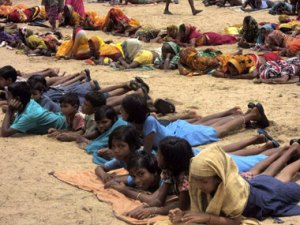
I accidently happened to see two of your struggle photos and a photo in the Korean Times, June 13, 2011 had a  caption underneath it:
‘Anti POSCO action in India: A village sprays water to relieve children lying with other villages along the entry point to prevent policemen and officials from entering their area at Jagatsinghpur district, about 140 kilometers(87 miles) east of eastern Bhubareshwary India, Saturday. The villagers have been protesting against turning their farmland into an industrial developed area for a $12 billion steal plant of South Korean conglomerate POSCO (AP-Yonhap).’

Continue reading Solidarity letter to anti-POSCO movement from Korean jail: Sung-Hee Choi

Don’t let Mumbai blasts investigations fall victim to prejudice and shortcuts: JTSA

Statement by Jamia Teachers’ Solidarity Association

JTSA offers its heartfelt sympathies to the bereaved and the injured in the Mumbai serial blasts. We sincerely hope that the perpetrators of this mindless violence will be brought to justice swiftly. There are early indicators though that this investigation will be marred by prejudiced investigating agencies. There are news items appearing in various media outlets which cite the interrogation report of Md. Salman, a supposed operative of the Indian Mujahideen (IM) to establish that Mumbai was on IM’s sights.

Already we see that, though the Home Ministry has restrained from holding any group culpable, the investigation is being gently pushed in one direction. But even if one leaves aside for a moment the criticism that investigators react in stereotypical ways, their compass needle invariably pointing towards Azamgarh, there are serious issues arising out of this reliance on Salman’s interrogation report for getting to the bottom of the Mumbai serial blasts conspiracy.

Continue reading Don’t let Mumbai blasts investigations fall victim to prejudice and shortcuts: JTSA

These rapes aren’t rapes? Amrita Nandy

Guest post by AMRITA NANDY

Like the French, Mona, a 30-year old sex worker in Delhi, is intrigued and amazed over the hullabaloo around the DSK sexual assault case.  From her one-room shed, she has been keenly following television channels for the latest on the scandal. She asked me if I had any updates, adding: “That man may be in jail for 25 years! Really? Unbelievable. For us, being assaulted at work is a regular part of it. I tolerate some of it and ignore the rest. But you see… I cannot complain if I am harassed. A sex worker is a doll in the hands of her customer. No one will play with the doll if she complains!”

While Mona’s fatalism may have helped her cope, the risks at work are especially dire for non-brothel sex workers.  Some have nearly been killed.

Continue reading These rapes aren’t rapes? Amrita Nandy

Women Against Sexual Violence and State Repression condemns crackdown on anti-corruption protesters

WSS strongly condemns the midnight crackdown on thousands of people staging a ‘Satyagraha’ and hunger strike at Ramlila Maidan with Baba Ramdev for demands related to corruption and black money.

We are astonished at Mr Manmohan Singh’s defense of police action saying that there was no alternative. The attack on the protesters was absolutely unwarranted as the ‘satyagraha’ was neither causing any law and order problems nor was it disrupting the peace of the city in any manner.

We are not supporters of Baba Ramdev but clearly see the role of dissent in upholding a democratic society. Continue reading Women Against Sexual Violence and State Repression condemns crackdown on anti-corruption protesters

Make Delhi Metro safe for women! Please Mend The Gap

PLEASE MEND THE GAP is a citizen- led initiative to promote gender equality and commuter safety in public spaces. 

Follow these two links for some background:

A few weeks ago, a friend was molested on the Yellow line of the Delhi Metro

A flash mob of citizens got together to protest against the Delhi Metro, claiming that it is promoting a gender divide.

Sign PMTG’s Petition to Chief Minister and DMRC

We believe that a majority of women do not feel safe while travelling in the Delhi Metro. We have spoken to a cross-section of Metro commuters who have shared with us their experiences most of which include instances of verbal and physical harassment mostly faced by women, specifically in the women’s-only compartment. In fact, a few days ago, some of the members of our group who were traveling at night observed that the women’s-only compartment was populated with men who had occupied almost all the seats forcing the women to stand, leaving them with no choice but to actively demand the seats they were entitled to. The men were unapologetic and dismissive. Most shrugged off the women’s protest by claiming falsely that the women’s-only compartment turns general post 9 p.m..

Women who choose to travel in the general compartment are also harassed. There have been many instances where men have told women that they are not welcome in this compartment and should use the compartment reserved for them. This attitude has become so deeply entrenched in commuters’ mindsets that most accidentally refer to the general compartment as the ‘men’s compartment’. There have been times when authorities have driven out men from the women’s-only compartments, but without having imposed any fine whatsoever…

The situation needs to change. It is the duty of the State and the DMRC to spearhead this change.

Read the full petition and sign.

Dominique Strauss-Kahn and the union maid: Dean Baker

A little-reported fact of the Dominique Strauss-Kahn case is that his accuser is a union member – with rights the IMF opposes, says Dean Baker in the Guardian.

But do listen to this song first!


“The reason that this is an important part of the story is that it is likely that Strauss-Kahn’s alleged victim might not have felt confident enough to pursue the issue with either her supervisors or law enforcement agencies, if she had not been protected by a union contract. The vast majority of hotel workers in the United States, like most workers in the private sector, do not enjoy this protection.

Received via Mini Mathew

‘End of the Left’ in India? Statement by Leftists after recent election results

Text of statement by Jairus Banaji, Sukumar Muralidharan, Dilip Simeon, Satya Sivaraman and Rohini Hensman endorsed by 224 others.

In a minor replay of 1989 and the fall of the Berlin Wall, the Indian media have been gloating at the defeat of the Left Front in West Bengal especially and have repeatedly suggested that this signals the ‘end of the Left in India’. Even at the best of times our news channels tend to avoid serious analyses of the underlying trends within the country, since they have transformed the news itself into a form of entertainment on models surpassed only by the U.S. news networks.

For its part the CPI(M) leadership has been at pains to minimise the significance of the defeat (in Bengal especially) and said that it would be wrong to write off the Left. For them ‘the Left’ means the Left Fronts in Bengal and Kerala and of course chiefly the CPI(M) itself.  They stress the fact that they still retain a considerable vote share, just over 40% in West Bengal for example, and there is indeed some truth in this claim.

Continue reading ‘End of the Left’ in India? Statement by Leftists after recent election results

Choice in the labour market – sex work as “work”

The summary of preliminary findings of the first pan-India survey of sex-workers is now available on-line.  3000 women from 14 states and 1 UT were surveyed, all of them from outside collectivised/organised and therefore politically active spaces, precisely  “in order to bring forth the voices of a hitherto silent section of sex workers.”

The significant finding is this: About 71 percent of them said they had entered the profession willingly.

(The data on male and transgender sex workers has not been processed yet).

The study was conducted by Rohini Sahni and  V Kalyan Shankar under the aegis of the Center for Advocacy on Stigma and Marginalisation (CASAM),  supported by Paulo Longo Research Initiative (“a collaboration of scholars, policy analysts and sex workers that aims to develop and consolidate ethical, interdisciplinary scholarship on sex work to improve the human rights, health and well being of women, men and transgenders who sell sex.”). The study was supported by a large number of groups, organizations and individuals in each state, who helped to conduct the surveys.

This background is important, because it appears to be a study that is well grounded, and drawing on large networks of local interconnections.

Continue reading Choice in the labour market – sex work as “work”

Music and politics – the power of minimalism: Prasanta Chakravarty

Guest post by Prasanta Chakravarty

I want to tell you about a song.  A song and a singer that few will call political. I want to talk about a song called Daya Karo (Have Mercy) sung by Mousumi Bhowmik, which appears originally in her album Ami Ghor Bahir Kori/ In and Out of My Room (2001).

Though she would routinely perform in certain public events and campus fests in Kolkata, Bhowmik has always been a peripheral figure in the popular imagination on Bangla singers who appear in the last couple of decades. She does not qualify as a mainstream modern popular singer. It is an equally barbed proposition to accommodate her within a new group of singers who would tilt the popular musical scenario in Kolkata and its suburbs by some straight talking, angst ridden compositions and solo performances throughout the nineties. Some of these singers have of late plunged into active politics and one of them has even become a Member of Parliament.

Continue reading Music and politics – the power of minimalism: Prasanta Chakravarty

Modest? Sexy? Or just an athlete?

By goddess, it’s that spot again – at once familiar and deeply uncomfortable. Us feminists in the same rage as the patriarchs and religious right, over the same damn thing. For very different reasons, we bellow (cutely), but is anybody listening?

The  Badminton World Federation has announced its new dress code that requires women players to wear skirts  “to ensure attractive presentation of badminton.” Almost every Indian woman player has objected, saying that dress should be one’s personal preference.

Of course most workplaces have dress codes.  So this is about more than simply an infringement of individual tastes. This is about the utter blatant sexism of this particular requirement. Basically, what’s the BWF saying quite shamelessly? That they expect more people to come to the sport if they can see suggestively flying skirts (on women). Even if there are shorts beneath, which they have grudgingly permitted. It’s not enough to show legs, skirts have to fly. Continue reading Modest? Sexy? Or just an athlete?

The gospel according to a divine identifier – An essay on the biblical origins of UID: Taha Mehmood

Guest post by TAHA MEHMOOD

1.

Simon Bar Jona was a fisherman based in small town called Bethaida. They say one day Simon’s brother, Andrew, led him to a man who called himself Jesus. They say Simon and Andrew became disciples of Jesus.

One day Jesus asked his disciples, “Who do you think I am?”

His disciples looked at each other. They did not know anything about him. They did not know who he was. Some disciples said Jesus was actually John the Baptist: some said he was Elijah; and others though he was Jeremias. Jesus could have been any of these or none of these. But Jesus was not satisfied with the answer, so he asked again, “Who do you think I am?”

At that point Simon Bar Jona, the fisherman answered, “Are you not Christ, the Son of the living God?’“

Jesus was pleased, he replied, “Bless you, Simon Bar Jona: for flesh and blood has not revealed it to you, but my Father who is in heaven.” Continue reading The gospel according to a divine identifier – An essay on the biblical origins of UID: Taha Mehmood

The UGC’s dictates: Pratiksha Baxi

Guest post by Pratiksha Baxi

The UGC’s new regime of qualifications, evaluation and supervision of teachers employed in universities makes fascinating reading for those who are entertained by the sublime ludicrousness of those with the power to shape our everyday lives in the academia.

The new regime betrays a lack of understanding of the basic enterprise of what academics do. The new regime is too voluminous to be read with lucidity at once. However it is not too difficult to understand immediately that the new regime, ushered in with the new pay hike, has imposed adverse conditions of employment. This is specially true for assistant professors who now are eligible for associate professorship only after 12 years of serving the University (instead of 5 years as earlier). The doctrine of reasonable and legitimate expectations  stands fully violated by the UGC, as assistant professors at the time of employment would not have expected the imposition of these adverse conditions.

The UGC has ignored the fact that the revision of pay scales cannot enforce a contract – signed or otherwise – on any faculty to adhere to the new rules since such a contract can only be constituted as un-free and therefore, not valid. In other words, better pay which was ostensibly ushered in to meet the rising cost of living cannot be conditional to the UGC’s homogenising and uncreative vision of how to enhance evaluation of teachers’ performance and determine promotions.

Continue reading The UGC’s dictates: Pratiksha Baxi

Anti-Nuclear Parliament March on 25th March, 2011

Organized by  Anti-Nuclear Struggles Solidarity Forum

Mandi House to Parliament. Assemble in front  of the Sahitya Academy Lawns at 12.00 noon.

This protest march is to state our stand that we oppose all  forms of nuclearisation of India, including nuclear (fission) power and weaponisation plans and programmes.

We further demand an immediate moratorium on all new projects, and a stringent review of existing plants by independent experts.

We demand investment in exploring sustainable alternative forms of energy.

Continue reading Anti-Nuclear Parliament March on 25th March, 2011

The evidence from Fukushima: nuclear power means nuclear catastrophe – Daniel Tanuro

Excerpts from an article by Daniel Tanuro, an eco-socialist environmentalist

What has happened is entirely predictable: yet another major nuclear “accident”. At the time of writing, it is not yet certain that it will take on the dimensions of a disaster similar to Chernobyl, but that is the direction in which things, alas, look set to evolve. But whether it develops into a major disaster or not, we are once again faced with evidence that the technology can never be 100% secure. The risks are so frightening that the conclusion is obvious: it is imperative to abandon nuclear energy, and to do so as quickly as possible. This is the first lesson of Fukushima, one which raises absolutely fundamental social and political questions, requiring a real debate throughout society about an alternative to the capitalist model of infinite growth…

Continue reading The evidence from Fukushima: nuclear power means nuclear catastrophe – Daniel Tanuro

Praful Bidwai on Lessons for India from Fukushima

Excerpts from a recent article by Praful Bidwai, journalist, social science researcher and activist on issues of human rights, the environment, global justice and peace.

The crisis holds a number of lessons for India as it embarks on a massive nuclear power expansion programme, which will double and then further triple India’s nuclear power capacity.

First, nuclear power generation is inherently hazardous. It is the only form of energy production that can lead to a catastrophic accident with long-time health damage and environmental contamination. Human error or a natural calamity can trigger a catastrophe—but only because reactors are themselves vulnerable.

Reactors are high-pressure high-temperature systems in which a high-energy fission chain-reaction is only just controlled. Nuclear reactors are both systemically complex, and internally, tightly coupled. A fault or malfunction in one sub-system gets quickly transmitted to others and gets magnified till the whole system goes into crisis mode.

Continue reading Praful Bidwai on Lessons for India from Fukushima

Compromise in Rape Cases: Whither Constitutional Morality?: Kalpana Kannabiran

Guest post by KALPANA KANNABIRAN

The Supreme Court judgement reported in some newspapers on 24 February 2011, legitimizing compromise in rape cases, is cause for serious concern.  For thirty years now human rights groups and women’s groups have fought difficult battles to have rape recognised as a serious offence both in communities and by courts.  Rights advocates have been concerned by the fact that all too often the view of the judiciary converges with the view of the community in seeing women’s sexuality as communally owned property, thus removing any articulation of violence from the crime of rape.

Some years ago, at a workshop of judicial officers, we had one senior officer arguing that if a man found guilty of raping a woman offered to marry her, this offer should be considered as a “mitigating circumstance,” and his sentence reduced to the bare minimum.  That done, since his continuing in jail will be detrimental to his new family life, he should be set at liberty under the provisions of the Probation of Offenders Act.  Fortunately in that gathering, the majority of officers, most of them junior to the officer concerned, felt strongly that this is a gross misapplication of the law.  But the existence of the possibility that a judge might actually rationalize the gross misinterpretation of a law as critical to women as this, has far reaching consequences.

Continue reading Compromise in Rape Cases: Whither Constitutional Morality?: Kalpana Kannabiran

Nukes, Wikileaks and Corruption: National Alliance of People’s Movements

Press Release by NAPM

PM Must Reveal Truth to Nation
Cancel all the Proposed Nuclear Power Plants and Related Facilities
Moratorium on Dams in High Seismic Zones

New Delhi Delhi, March 18 : Prime Minister Manmohan Singh’s statement after the nuclear disaster in Japan that there is no need to be panicky as India will take all safety measures is not only amateurish but also lacks wisdom.
His statement gives the impression that the Japanese have not taken adequate safety measures. What type of natural calamities or man made lapses are in store for us, no one can visualise or predict leave alone taking safety measures against them.

The Prime Minister who has no control over his own cabinet ministers and has unashamedly wailed in public that he was ineffective due to coalition government, and caused the nation unimaginable and unprecedented loss by allowing mind blowing scams, issuing such absurd statements like taking all safety measures- lacks any tangible weight. Continue reading Nukes, Wikileaks and Corruption: National Alliance of People’s Movements

The ‘new’ Indian filmi woman: Arpita Das

Guest post by ARPITA DAS

In these times of celebrating ‘small’ films, ‘new’ unheard-of young directors, little India, and non-filmi characterizations, it seems to have become mandatory for critics to praise every film claiming to build its  narrative around a so-called non-mainstream idea.  If this were not so, two ‘small’, ‘different’ films which created a lot of hype recently, would not have gathered as much post-release steam.  I am talking about No One Killed Jessica and Manu weds Tanu.  Both have been promoted and described in reviews as bold films, with star heroines showing a no-holds-barred temperament and verbal acumen, and this being the central focal point of their ‘different-ness’, both have made that oft-repeated Bollywood claim, ‘pikchar hatke hai’. If the films are to be believed, this new Indian woman can be instantly recognized by one or more of the following traits: smoking nicotine or other substances, mouthing expletives both in Hindi and English with ease, being sexually promiscuous or even vaguely ambivalent, manipulating people close to them without giving a thought to causing hurt, and a sound lack of any sense of ethics in the professional sphere or personal turf.

Continue reading The ‘new’ Indian filmi woman: Arpita Das

You fill up my Census…

…quipped my brother Dilip in response to the following mail from my sister Pramada:

So the bell rings this afternoon. desperate clanging. i open the door and there is a man with forms in his hand and a general irritated demeanor. figured that this was the census man. he comes in and settles down. starts by wanting to know who the head of the household is. i say there is no one. he insists. i continue to say no one.

Census of India 2011 mascot

He proceeds to explain that if the parents live in the house, then they are the head of the household, if married then the husband is. I proceed to ask for definition and say that all three of us who live in the house are head of the household since we all earn and take decisions. he promises to erase what he has written since he was sure my mother was head of household.

He seemed to find my gender a bit dubious so questioned my mother if i was a boy or a girl and then repeatedly said “ladki” to me. having established that i indeed was a woman, he wanted to know date of birth, which was not difficult, but place of birth he found extremely challenging. he could not get his spellings right, or did not know districts or states in the country so tattamangalam in palghat district in kerala was as baffling as mysore in karnataka. calcutta was easy to deal with and he said calcutta was in calcutta!!! mother tongue caused him more angst because he had to write malayalam and again the spelling eluded him.

Continue reading You fill up my Census…