
This story of the birth of a new language raises some significant questions for our understanding of how bodies of knowledge are transformed. After the Sandinista revolution in 1979, for the first time in the history of Nicaragua, a huge nation-wide effort was made to educate deaf children. Hundreds of deaf students were enrolled in two schools. They had never been introduced to any of the world’s existing sign language systems, and came to the schools with only the simplest kind of gestural signs they had developed within their families. Their teachers were new and inexperienced, and found it difficult to communicate with their students, but the students themselves had no problem at all in “talking” to one another. With great rapidity they began to build on the common pool of signs, and a complex new language began to emerge, which has come now to be called Nicaraguan Sign Language (NSL). Some years down the line, an even more interesting development is noticed. As younger children enter the school system, they not only pick up the language their seniors had developed, but they confidently break the existing language rules. They invent new signs and deform old ones, and these new signs that do not obey the old rules filter back into the language, making it more complex, richer and more varied.
All posts by Nivedita Menon
Ultra Violet:A feminist blog
I came across this blog a couple of months ago, and have been wanting to bring it to the attention of kafila-readers who may not have visited it yet. Always something interesting and provocative going on there.
Its self-definition:
Ultra Violet is a place for Indian feminists.
It’s a place for sharing stories and views and questions. It’s a place for exploration, opinion and information (not necessarily in the order). It’s a place where we can come together to understand what other feminists around the country–or around the world–are saying…
Ultra Violet does not represent any school, wave, organization, institution or categorization. We do not belong in a box. We do not huddle together in a tank. We do not fly in formation like a flock of geese. We are all free people, approaching feminism from different locations, backgrounds and personalities…
Jailing Journalists: Pradeep Jeganathan
This is a guest post by PRADEEP JEGANATHAN from Colombo.
The sentencing of J.S. Tissainayagam is deeply distressing.
While I’m neither a attorney, nor conversant with the details of the evidence presented by the prosecution, nor the text of the judgment delivered — and so can not comment on those areas, it seems clear that this judgment and sentence was only possible given the Prevention of Terrorism Act, of 1979. Two features stand out, given the PTA– the narrow bounds allowed for freedom of expression, on certain themes, and the admissibility of a ‘confession’ as ‘evidence,’ which is not allowable under the penal code. Taken together they make for a curtailing of freedom which is telling. There is an appeal pending, I understand, and there may be a possibility of a pardon, if that process is exhausted to no avail.
Anand Jon wants to be tried in India – I would too, if I were him
Fashion designer Anand Jon has been sentenced by a Los Angeles court to 59 years in prison for violent sexual assault on seven young women, some of them under-age. His defence tried to move for a mistrial on the grounds that one of the jurors had contacted Jon’s sister during the trial, but a new trial was not granted by the judge. The concerned juror delivered a “guilty” verdict along with the other 11 jurors in the case.
A month ago, his sister Sanjana had pleaded with the Indian government to extradite him as he would not get a fair trial in the US, being Indian. She claimed then, and did so again after the verdict on September 1, that Jon is a victim of racist discrimination.
Would Anand Jon have been acquitted of such charges in an Indian court? Almost certainly, yes. In a justice system in which alleged rapists are routinely acquitted for “lack of evidence” and proven rapists given a reduced sentence because of their youth and the promising life ahead of them, Sanjana is right to insist that he be tried in an Indian court. In an Indian court, the testimony of women who had willingly gone to his home on the promise of jobs in the fashion business, and then claimed they were raped, would be dismissed out of hand. Especially if the women are white. Gratuitous references to “western women” and their supposed attitudes to sex, pepper judgements and statements by officials on rape in India.
Continue reading Anand Jon wants to be tried in India – I would too, if I were him
Teachers and Academics Against 377
University teachers, researchers and academics from all over India issued a strong statement in support of the recent Delhi High Court judgement decriminalizing consensual sex among adults and challenged the legitimacy of “religious leaders” to speak for the whole of society.
180 signatories from institutions and universities in Allahabad, Calicut, Peechi, Punalur, Thiruvananthapuram, Kottayam, Sonipat, Goa, Jammu, Nanded, Mumbai, Pune, Pondicherry, Kolkata, Ahmedabad, Baroda, Chennai, Chandigarh, Delhi, Bangalore, Hyderabad, Guwahati and Shillong endorsed a statement that said:
My son Jane: Moira McDonald
Guest post by MOIRA MCDONALD (Written three years ago).
“I want to be Jane,” repeats my two year old, this time bringing his face very close to mine for special emphasis. “He has to be Michael. Michael is the boy” says his nearly four year old sister Naomi who is oh-so aware of her budding gender identity. “Honey, you know in our family, anyone can pretend to be anything. Someday you may want to pretend to be boy, or a cow for that matter,” I explain. She shrugs agreeing to his choice as long as she can be Mary Poppins. I wish the contradictions surrounding gender identity were as easily resolved for the other adults in our lives.
A Tale of Two Encounters – Dehradun and Batla House: Jamia Teachers Solidarity Group
We publish below a statement from Jamia Teachers Solidarity Group, formed after the “encounter” at Batla House in Jamia Nagar, Delhi. For background information on this issue, see Some questions about the Delhi encounter; A little less melodrama, a lot more forensics; Shame is a revolutionary sentiment.
Jamia Teachers’ Solidarity Group extends its heart-felt condolences to the family of Ranbir Singh, the youth who was killed in a police encounter in Dehradun last week. This encounter again brings to the fore the trigger happy ways of the Indian police who kill and torture for medals and promotions. We demand exemplary punishment for the guilty policemen. Continue reading A Tale of Two Encounters – Dehradun and Batla House: Jamia Teachers Solidarity Group
And that is why your neighbors don’t like you: Anurag Acharya
Guest post by ANURAG ACHARYA, student from Nepal at Jawaharlal Nehru University.
Peaceful coexistence among nations does not encompass coexistence between the exploiter and the exploited, the oppressor and the oppressed.
– Ernesto ‘Che’ Guevara
The 1800 km open border between India and Nepal has always been a matter of dispute between the two countries. While India has glorified the open border as its grace and gratitude towards a landlocked nation, Nepal has had to accept the miseries of sharing an open border with a bigger and powerful nation as a price for a trade transit. It goes without saying that whenever there has been a proposal or a debate within Nepal about the possibility of opening a trade route across the Himalayas to our north to tap the world’s largest market for Nepalese goods, it has attracted serious concerns from the South block. Bound by the unfair Indo-Nepal treaty of 1950 which prevents Nepal from independently conducting its international affairs and thwarts Nepal’s ambition to exploit the huge trade potential with China, an end to Nepal’s historical dependence on India has not materialized yet. While the treaty gives India a free hand to interfere in Nepal’s foreign affairs, citing its own domestic security, it has seriously impaired Nepal’s right to trade access, as a landlocked nation under the International Law. The treaty also stands in clear violation and entrenchment of a sovereign nation’s right to conduct its external and internal affairs independently. However, weak diplomacy on Nepal’s part and unsympathetic attitude on the Indian side has ensured that Nepal stays dependent on India for all its exports and imports.
Continue reading And that is why your neighbors don’t like you: Anurag Acharya
The Day After the Judgement
So now that we have one group of criminals less to deal with, I have a proposal: Criminalize English TV news channels.
-
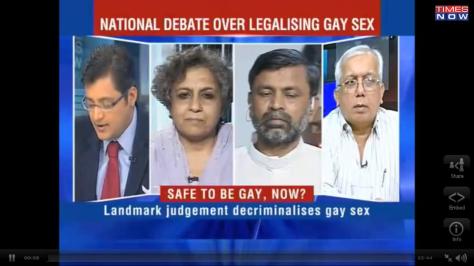
- ‘Debate,’ the Times Now way
Watching Times Now yesterday after the Delhi High Court ruling on Section 377, I was overcome by a growing sense of bewilderment. I could hear Dominic Emmanuel (Director of the Delhi Archdiocese of the Roman Catholic Church) and Kamal Farooqui (Chairman of the Delhi Minorities Commission), saying quite cearly and more than once, to my surprise, that they welcome the decriminalization of homosexuality, that homosexuals should not be treated as if they were criminals. Okay, correct that – I could barely hear these statements over the insistent, aggressive and disruptive interruptions of the anchor Arnab Goswami, who had obviously pre-set this “discussion” rigidly as a face-off between Reactionary Clerics/Minorities and Gay Rights Activists, while he himself was super hero, Anchorman. So each time they said “we welcome” etc., Anchorman would swoop in, bellowing, “So are you saying that they dont have rights, Sir, are you saying they should not have rights. Over to Anjali Gopalan (Naz) – Anjali, they say homosexuals should not have rights, what do you say?”
“The Magic of the Human Spirit and of a Nation’s Passion”: Three Queers for the Delhi High Court!

So – here we are folks, in a historic judgement this morning, Delhi High Court has read down Section 377 of the Indian Penal Code to exclude consensual sex among adults. Congratulations to the group of tireless activists who have helped to bring this about, and congratulations to all of us who count ourselves as part of the queer community. Continue reading “The Magic of the Human Spirit and of a Nation’s Passion”: Three Queers for the Delhi High Court!
Gaon chodab nahin
Nandi’s divine wrath strikes BJP leader: Rukun Advani
This is a news flash from rainy Ranikhet, from RUKUN ADVANI of Permanent Black.
Balbir Punj owns a hotel called ‘Windsor Lodge’ on Ranikhet’s outskirts. (When it comes to personal money-making, BJP ideologues seem to have no problems naming their properties after the Queen of England.) Last week Punj came to his Lodge and went to the Kalika temple opposite the property. He did not notice a large bull there, but the bull noticed him: it charged straight for him and before Punj knew what was happening he had been thrown up in the air and gouged in the front. His arm is now in a sling. It being specially embarrassing for a BJP Hindu to be thus cast aside by a cow, Punj has been desperately downplaying his injuries. However, he asked Khanduri to immediately pen the bull, and the bull has been removed from the Kalika temple.
Reservations for Women: ‘Am I That Name?’
[I am posting here the chapter from my book – Recovering Subversion. Feminist Politics Beyond the Law – that I referred to in response to demands for references on my previous post on the WRB. I do apologize to those (including fellow-kafilaites!) who may rightly feel I have said enough on the topic.
The title of this chapter is a tribute to Denise Riley’s question “Am I that name?” referring to the label “Woman.” Am I That Name? Feminism and the Category of ‘Women’ in History Minneapolis, University of Minnesota Press, 1988].
When the Women’s Reservation Bill (WRB) first appeared as the 81st Amendment Bill in 1996, proposing to reserve 33% of seats in Parliament for women, it burst into public discourse full-blown as a “women’s” (indeed, a feminist) issue, and continues to be debated largely in terms of women’s rights. It is becoming increasingly clear however, that the questions thrown up by the timing of the Bill and the responses to it cannot be understood solely within the framework of women’s rights. This chapter attempts to relocate these questions in a complex matrix of political identities in order to realize their full significance. I also argue that the debates around the Bill reveal a more fundamental set of questions about the issues of citizenship, representation, and the subject of feminist politics.
And aren’t OBC women “women”? Loud thinking on the Women’s Reservation Bill
The career of the Women’s Reservation Bill in Parliament since it first appeared in 1996 as the 81st Amendment Bill, has been striking for the high drama and rhetoric of women’s rights that has accompanied it, the passionate opposition to the proposed 33% reservation for women in Parliament, generally being characterised by its supporters as anti-women and patriarchal. However, if we try to organize the welter of arguments that have been flying around for 13 years, we would find that while the proponents of the measure certainly base their claims on the idea of gender justice, the opposition to the Bill does not come from an anti-women position. Rather, the latter arguments stem from either
1) a generally anti-reservation position (which I am not interested in here) or
2) a claim that reservations for women should take into account other disempowered identities within this group – that is, the “quotas within quotas” position, which says that there should be reservation within the 33% for OBC and Muslim women. (The 22.7% reservation for SC/ST women would come into operation automatically.)
In other words, the sharp opposition to the Bill cannot simply be dismissed as anti-women. Continue reading And aren’t OBC women “women”? Loud thinking on the Women’s Reservation Bill
A desk of her own. Farewell to Kamala Das

Kamala Das (Madhavikutty, Kamala Suraiya), died this morning, May 31, 2009, aged 75.
Virginia Woolf wrote in A Room of One’s Own (1929):
“A woman must have money and a room of her own if she is to write fiction; and that, as you will see, leaves the great problem of the true nature of woman and the true nature of fiction unsolved.”
In an interview in 1996, the interviewer Shobha Warrier reminds Das of something she had once said “about the pathetic condition of a woman writer who does not even have a writing table. The dining table has to serve as her writing table once it is cleared.”
Kamala Das replies:
Making Sense of the Ravi Dasis: Surinder S. Jodhka
The recent attack on the head of Dera Sachkhand Ballan in one of their gurudwaras in Vienna and the ensuing shoot-out between Dalit and non-Dalit Sikhs, spilling over in India into angry street demonstrations in Jalandhar by followers of Dera Sachkhand and other Dalit bodies, forces us to confront the question of caste in contemporary Punjab. We asked SURINDER S. JODHKA, sociologist and Director, Institute of Dalit Studies, who works in this area, to give us a background note.
The Dera Sachkhand Ballan is one of the most important Guru Ravi Das Deras in Punjab today. Ravi Das was a 15th century saint of the Chamar caste whose message is constructed by his contemporary followers in a modern language that foregrounds questions of caste oppression and the fight against the prevailing structures of authority and the Brahmanical moral order. In his piece here, Surinder gives us a historical background to the emergence of this movement, and brings us to the point of the 1990s, when the “diasporic energy” of Ravi Dasis who had emigrated to the UK and Europe, gave a boost to the movement both at home as well as in the diaspora, where Ravi Dasis had found things to be no different. In the alien context, with no systemic justification for caste ideology, the Punjabi Dalits did not expect to be reminded of their “low” status in the caste hierarchy, says Surinder, but facing systematic discrimination from wealthy Jat Sikhs, were forced to set up their own autonomous organizations and their own gurudwaras. Continue reading Making Sense of the Ravi Dasis: Surinder S. Jodhka
Barter – is that what they’re calling it now?
It’s a world on the downturn out there.
And new and creative ways of handling the situation emerge. Imagine a journalist accepting some old jeans (in very good condition), some rice, atta and vegetables (and also sugar) from the newspaper proprietor in exchange for her reporting. Meanwhile, an ad agency employee opts for day-old newspapers and fruits for every successful slogan he coins.
Impossible?
Continue reading Barter – is that what they’re calling it now?
Another sort of touch
The British queen placed a royal hand around the American First Lady’s waist, who graciously reciprocated, and a million words and images were launched in the world media on that historical moment.
How come we never got to see this other Touching Moment in London involving another Obama? Thanks to Dilip Simeon, who was sent this by a friend, I received this picture of what happened when Barack Hussein was entering 10, Downing Street on April 1, 2009.
There he is, a British police officer joyously breaching protocol while ushering a black American president into the British corridors of power. As the caption in the forwarded message said – “the two brothers couldn’t resist the historic moment!”
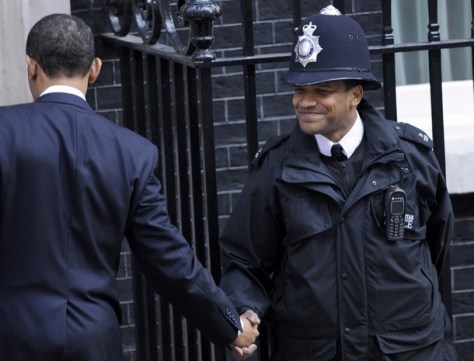
(Reuters/Toby Melville)
That’s it for now, folks.
The Art of Not Writing: Shubhranshu Choudhary
Shubhranshu Choudhary from Chhattisgarh:
How does the media in Chhattisgarh report the conflict between the Naxalites and the Salwa Judum, or the conflict between local communities and corporations? Quite simply, it doesn’t. The pressures on journalists in Chhattisgarh are unique. They are paid not to report stories that are critical of the powers-that-be, whether they are industrial lobbies or state authorities.
Posted on Free Binayak Sen Campaign
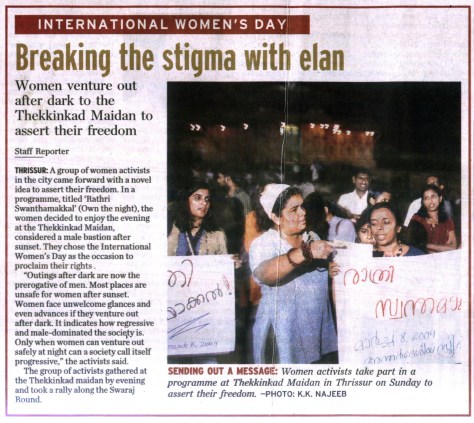
Women’s Day 2009, Thrissur
Civility, Harmuniya Bajaiyke: Prasanta Chakravarty
This guest post was sent to us by PRASANTA CHAKRAVARTY
A recent exchange in a congregation addressing the nature of contemporary civil society caught my attention. This was a formal gathering where there was supposed to be a pitch on an idea tentatively christened civility index: that is, whether it was possible to empirically measure civility and come up with some conceptual conclusions, as well as have more practical usages once such indicators will have been developed. A searching question came from someone who had spent a lifetime fighting liberal centrism and opportunism. “Why do you call the whole thing civility index,” she inquired, “civility connotes propriety and manner and etiquette, when you are interested to scale human capacities, right?”
This is a fundamental and worthy question, especially keeping in mind that certain variants of civil society discourse has caught the imagination of many invested in democracy right now, even as they wish to steer clear of old leftist certainties and eschew easy liberal pluralism at once. Are propriety and etiquette wholly irrelevant to our understanding of modern civil society? Is manner rudimentary to civil society, counterproductive to doing anything worthwhile? Does civility dilute the associational potential of civil society—human capacities being robbed off by issues of mere conduct and comportment? Are traditional societies uncivil by definition? And does civility, more than just civil, civic or public, betray fashionable elitism unabashedly?
Continue reading Civility, Harmuniya Bajaiyke: Prasanta Chakravarty
 KAFILA - COLLECTIVE EXPLORATIONS SINCE 2006