Category Archives: Capitalism

Of land and other demons

The Hindu/Aman Sethi

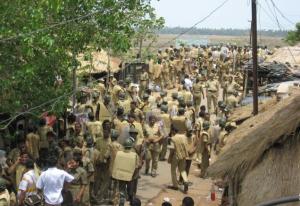
Since January this year, I have been traveling in North Chhattisgarh to try to understand the scale of land acquisition and dislocation in a state that markets itself as India’s “Power Hub”.

There is something pretty massive going on in North Chhattisgarh – as a recent Down to Earth Cover pointed out :

The state has 10,300 MW of coalbased power capacity, including the captive 2,063 MW that industry consumes. This is about 12 per cent of India’s current coal-based power capacity. To this, it will add 56,000 MW, which is 65 per cent of the country’s coal-based installed capacity, as per the Central Electricity Authority. Nearly two-thirds of this capacity are planned in Raigarh (37 per cent) and Janjgir- Champa (34 per cent).

For this to happen, the state has to acquire vast amounts of land – in some places because the land happens to be above a coal bed, and in other because the land happens to be adjacent to a coal-bed. Most developers prefer “pit head plants”, or plants just adjacent to coal mines to reduce transportation difficulties.

Over the last month, I worked on two interesting legal cases that point to how such acquisition is taking place.  I think the two cases offer an interesting insight into the sort of battles that villagers are fighting.
Continue reading Of land and other demons

A “Green Signal” for The Rape of Justice and the People: POSCO Pratirodh Sangram Samiti

The following is the statement issued by the POSCO PRATIRODH SANGRAM SAMITI on the latest decision of the Environment Ministry on POSCO. The image below from an earlier round of land acquisition attempt is a telling illustration of how the ‘free market’ functions. Received via Shankar Gopalakrishnan.

Courtesy The Hindu
Land being acquired for POSCO. Image courtesy The Hindu

Jairam Ramesh and the UPA government have shown their true colours with their decision today on the POSCO project. Ignoring the reports of its own advisory bodies and enquiry committees, violating its own orders and the laws of the land, this Ministry has shown that the naked face of corporate greed – it is not the “rule of law”, the “aam aadmi”, “inclusive growth” or any of these other lies – that rules this country. The decision today can be summarised in one sentence:”Repeat your lies, give us promises that we all know are false, and then loot at will.”

We repeat: we will not give up our lands, our forests and our homes to this company. It is not the meaningless orders of a mercenary government that will decide this project’s fate, but the tears and blood of our people. Through the road of peaceful demonstrations and people’s resistance we have fought this project, in the face of torture, jail, firings and killings. If this project comes it will come over our dead bodies.
Continue reading A “Green Signal” for The Rape of Justice and the People: POSCO Pratirodh Sangram Samiti

Niyamgiri, You Are Still Alive

This 17 minutes long film won the Vasudha, Environment Award at the International Film Festival of India in Goa, 2010.

The Republic of Exploitation

On this Republic Day, while armoured tanks muscle across Rajpath in New Delhi, little ossified museums of culture called tableaux charm the assembled pass-holding citizenry and the Prime Minister sits like a barely-sentient caricature of himself behind a bullet-proof screen, it may do well to think about the other republic that remains hidden within the bosom of Superpower India – the republic of unfree labour.

This is a world where the laws of the upside world are inverted – where the more you work, the less you are paid, the more your company profits, the poorer you end up and if you find yourself the victim of an injustice and god forbid complain about it, the police put your family in jail. It’s a great irony of our times that we believe the choice before us is between loving the Nation and loving the Corporation, not realising that most of the time its the same person wearing two grotesque masks.  All those who believe that the world begins with their newspapers and television sets and ends at their white picket fences (and all those who don’t), please take a minute to go through the excellent documentation of the war that is raging for workers in this country, put together by the Gurgaon Workers’ Solidarity Group, the Faridabad Mazdoor Sangathan and several other exemplary organisations.

GurgaonWorkersNews – Newsletter 35 (February 2011)

Continue reading The Republic of Exploitation

The New Cellu-lar Jail: Madhumita Dutta & Venkatachandrika Radhakrishnan

Guest post by MADHUMITA DUTTA and VENKATACHANDRIKA RADHAKRISHNAN
The writers are activists based in Chennai working on issues of land, labour, industry and SEZs.

Sriperumbudur grabbed media attention in 1991 when former Prime Minister Mr Rajiv Gandhi was assassinated during an election rally. Since then, this nondescript little village-town in west Chennai, dotted with paddy fields and large expanses of natural water-bodies, has transformed itself into a little ‘Shenzen’- world’s largest special economic zone in Southern China, which churns out one out of every eight mobile handsets sold anywhere in the world. Slated to attract investments worth $4 billion in electronics and automobile manufacturing, Sriperumbudur is now home to the largest mobile handset making factory of Nokia, a Finnish company that can churn out 7.5 lakhs handsets a day. This town and its neighbouring region is also known as the Detroit of India, churning around 12,80,000 cars every year. With a booming manufacturing industry and a promise of 2 lakhs jobs, Sriperumbudur is touted as the jewel in the industrial crown of Tamil Nadu. But of recent this seemingly success story has turned a little sour. Continue reading The New Cellu-lar Jail: Madhumita Dutta & Venkatachandrika Radhakrishnan

Ambika’s Death: Madhumita Dutta & Venkatachandrika Radhakrishnan

Guest post by MADHUMITA DUTTA and VENKATACHANDRIKA RADHAKRISHNAN
The writers are activists based in Chennai working on issues of land, labour, industry and SEZs.

A view of Nokia's Sriperumbudur plant. Photo credit: Economic Times

S Ambika, a 22 year old woman factory-worker, died in the middle of the night in a posh hospital in Chennai on 31st Oct. She was a permanent employee of Nokia Telecom Special Economic Zone (SEZ) in Sriperumbadur in Kancheepuram district of Tamil Nadu. Her agonising death was due to a fatal accident at a panel loading machine in the factory.

Continue reading Ambika’s Death: Madhumita Dutta & Venkatachandrika Radhakrishnan

Democracy and the Politics Around NREGA: Ruchi Gupta

Guest post by RUCHI GUPTA

Subverting Democracy [1]

It took 47 days of a protest sit-in in Jaipur to make the State budge[2]. It’s notable that the objective of this protracted protest wasn’t to coerce the government for an extra share of State resources but to hold the government accountable to the Constitution and its own laws. The protest, “mazdoor haq satyagraha” was staged by workers employed under the National Rural Employment Guarantee Act (NREGA) to demand enforcement of their constitutional right to earn minimum wage. Even now after some initial encouraging signs, the matter seems to have stalled. Continue reading Democracy and the Politics Around NREGA: Ruchi Gupta

Contract Workers in IIT Kanpur: Raj Sahai

Link to full fact-finding report by RAJ SAHAI.

Link and background note below sent to us by AMIT SINGH.

[This follows the report by Rashmi Singh on the condition of contract workers in JNU – another institution of higher learning.]

Background

The practice of employing contract workers by IIT Kanpur started increasing at the expense of direct regular employees during the past two decades and presently the figure of the contingent workforce is estimated to be around 2,500. For its normal functioning, the Institute relies upon these contract workers not only for temporary construction works but also for perennial
works such as messing (food preparation, serving and cleaning of kitchen and dishes), civil maintenance, electrical maintenance, horticulture, sanitation and sewer cleaning. The Ministry of Labor and Employment, Government of India, views that inferior labor status, casual nature of employment, lack of job security and poor economic conditions are the major characteristics of contract labor.[1] These most vulnerable workers have been provided unequivocal legal protection by different laws, mainly,
Contract Labor (Regulation and Abolition) Act, 1970 [CL(R & A) Act, 1970], Minimum Wages Act, 1948 [MW Act, 1948], The Payment of Wages Act, 1936 [PW Act, 1936], Workmen Compensation Act & Apprentices Act 1961, and Inter-state Migrant Workmen Act, 1979 [ISMW Act, 1979].

Continue reading Contract Workers in IIT Kanpur: Raj Sahai

800 new Radia tapes!

It keeps getting better. The promise of more emperors losing their clothing, the promise of more political gossip and media wars and conspiracy theories. More light will be thrown at crony capitalism, sorry I mean economic growth. Outlook is putting out another 800 Radia tapes in the next few hours. There are a total of 5,000 and they’ve already put out 140.

Of those 140, some 36 yet to be transcribed.

Conditions of contract labourers in JNU: Rashmi Singh

This is a guest post by RASHMI SINGH. This article is based on the research conducted by the author on informal labour, for AMAN Trust.

The recently concluded Commonwealth Games have exposed the government’s contempt towards the working class in Delhi.Even though some sections of the media did highlight the terrible working conditions of the labourers, much of it got lost in the noise about corruption scandals and nationalist jingoism. In the aftermath of the games, the so-called fourth estate continues to focus its energies on the question of corruption, while everyone seems to have forgotten about the lakhs of construction workers who built the very edifice of the Games. Indeed, the dusty secrets of labour code violations during the Games have been relegated to just that – the dust of the city.

Continue reading Conditions of contract labourers in JNU: Rashmi Singh

The Media Barons and the Radia Tapes: Monobina Gupta

Guest post by MONOBINA GUPTA

The first formal discussion on the Radia-Media nexus by a section of top media professionals this Friday revealed the media’s general reluctance to put themselves through the same wringer of criticality that they so love to put others through. Barring Manu Joseph, editor of  Open Magazine, which put out in the public domain the tapes which had been lying  for days in the ‘safe’ custody of most media organizations, majority of the speakers argued that the controversy was not about Vir Sanghvi and Barkha Dutt; that there was no proof whether Sanghvi had actually written his ‘most read’ column as he had assured Nira Radia; that we do not know if Barkha Dutt had kept her word to Radia and passed on the message of the DMK’s internal dissensions to the Congress; that pressured by the minute-by-minute  demands of 24/7 TV channels, journalists have to make random promises (which they do not intend to honour!); that they have to play along with their sources to extract news etc. The list of extenuating circumstances offered by the media, now getting a taste of its own treatment, was quite revolting.

Continue reading The Media Barons and the Radia Tapes: Monobina Gupta

‘Editors as Powerbrokers’?: Vinitha Mokkil

Guest post by VINITHA MOKKIL

The good news first. On the morning of November 26, the Foundation for Media Professionals (an independent, not-for-profit organization) decided it was time to break the polite silence and hold a panel discussion on the topic, ‘Editors as Powerbrokers’ at the India International Centre (IIC), Delhi. The Nira Radia tapes, whose transcripts were first published by Open magazine a week ago, was the trigger for the discussion. The panelists included editors from prominent print and electronic media houses.

The auditorium was packed. Clearly, the nexus between the media, politicians and PR honchos, as revealed by the transcripts, had shocked people enough to bring them out of the comfort of their homes to the venue.

Continue reading ‘Editors as Powerbrokers’?: Vinitha Mokkil

25,000 Maheshwar dam oustees march in Madleshwar: Narmada Bachao Andolan

Thousands demand revoking of clearance and scrapping of dam

Press note from NBA

The Mandleshwar town resounded with the voices of 20,000 to 25,000 people (over 50% of them women) affected by the Maheshwar dam who marched through the town today, in defence of their rights despite the heavy rain, asking for rehabilitation and land, or scrapping of the dam. After marching through the main roads of Mandleshwar town, the oustees reached the Narmada River and after affirming and renewing their resolve to struggle against all odds, the people congregated in a huge public meeting at the local “Krishi Upaj mandi” in Mandleshwar. Continue reading 25,000 Maheshwar dam oustees march in Madleshwar: Narmada Bachao Andolan

Volunteers needed to transcribe all 104 Radia tapes

See Reading Radia

As you know, Open and Outlook magazines have put out legally taped telephone conversations of several people with lobbyist Niira Radia. Open put out only a few audios, and transcribed them all, where as Outlook put out a somewhat different set. However, Outlook was kind enough to put out all the audios they had on their website. There’s a lot of muck in there, and it’s not just about Barkha Dutt and Vir Sanghvi, it’s not just about the 2G scam. It’s very crucial that we transcribe ALL these tapes so that the words are on Google, se we can access the content of all tapes more easily. The media should have done this by now but the media is silent to save the skin of their own. So we need to become the media, you and I. Just 15 minutes of your time needed. To volunteer, please leave a comment on any post which says a volunteer is required to transcribe this one.

Thanks!


The Fuhrer Reacts to the Radia Tapes

Hope you’ve listened to all the Radia tapes?

If you haven’t, you’ve missed out on a lot. These five links lead you to all the phone calls, and you can even download them. This is history. The tapes are revelatory about the corporate media, but more than that, about the corporates. They have come out due to corporate wars. Internecine corporate wars seem to be our only hope for transparency and accountability in this nation. Please listen to every pause in every audio to for a clear insight into what today’s India is. And lament this Manmohan yug, ghor Manmohan yug. Also see Sevanti Ninan’s excellent analysis of the media black-out of the story.

Four transcripts that were submitted to the SC along with a total of eight recordings in May 2009 covering the cabinet formation, DMK politics and who’d get telecom portfolio
The conversations with M.Karunanidhi’s daughter M. Kanimozhi about keeping Dayanidhi Maran out from negotiations with the Congress and to get the telecom portfolio for A. Raja
In these Radia wants Sanghvi to tell the Congress not to negotiate with Dayanidhi Maran. He tells her that while he has been meeting Rahul and can’t “get into Sonia in the short term” he would “try and get through to Ahmed”
Recordings of conversations with the likes of Ratan Tata, Ranjan Bhattacharya, Barkha Dutt, Shankar Aiyar, Sunil Arora etc
The other big ‘national resource’ story involves the virtual who’s who: Ambani V/s Ambani V/s Tata, gas and power sector war involving big name journos, politicians, babus, corporates – this has the largest number of tapes, and perhaps the most important ones.

Before We Tape Our Mouths Forever…

It’s always better to begin with a caveat. Sets the tone, and prepares readers for what not to expect. I am one of those self-obsessed people who seldom see beyond their existence. I google my name twice a week, and inevitably find other people getting enriched when conversing with me. It’s an achievement if I could rescue their names from these conversations for my memory. So, you can imagine now my level of awareness.

But once in a while something gets my goat and then I start reading about it. One of those things has been the Nira Radia tapes recently. I first saw a mail from a friend in my inbox with the transcripts and links to the audio versions. I read the scripts and followed the audio links. It led me to more links. And soon I found it was all over the virtual world. First it was Nira Radia and Barkha Dutt, then Nira Radia and Vir Sanghvi, then Nira Radia and Ratan Tata, then Nira Radia and A. Raja, then… I don’t know what else is there. I was like what the f*#@? They just kept stumbling out. I thought Amar Singh was the most tapped guy but then I stopped following politics long back. I am told now that these days he doesn’t even make it to the 7th page. Continue reading Before We Tape Our Mouths Forever…

“Inside the networks of lobbyists and power brokers that dictate how this country is run”

This is explosive – you’ve heard of Niira Radia’s role in the 2G spectrum scam for months, and also that of two high profile journalists. Now, Open magazine has put out the phone transcripts, and even the audio, for all of us to listen in and know, as they put it, “how this country is run”. Many must have had the tapes with them for some time now, and god knows how many hundreds of hard disks have the CBI papers that made these allegations to begin with. But it takes courage to put this out.

For context, also read this profile of lobbyist Niira Radia, also in Open. Also see this April 2010 post from a media blog.

Revisiting Obama’s Visit: Suvrat Raju

Guest post by SUVRAT RAJU

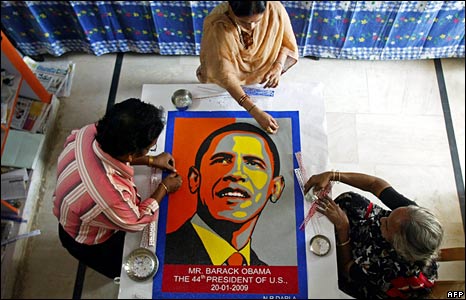
January 2009: Indian artist Darla Nageswara Rao (left) has used more than 33,000 coloured stickers on his portrait of Barack Obama. The work has taken 160 hours to complete.

Although the Indian media collectively swooned on President Obama, and breathlessly informed its audience about how many rooms he had booked at various five-star hotels, there was surprisingly little discussion on two key questions. What is Obama’s foreign policy record? Moreover, what impact will his visit have on most Indians?

Continue reading Revisiting Obama’s Visit: Suvrat Raju

Protesting FTII students write to Ambika Soni

Studnets at the Film and Television Institute of India, Pune, have been protesting against the commercialisation of India’s best known film school. In letters to the Union Information and Broadcasting Minister Ambika Soni, they write:

In the proposal, made by Hewitt at the behest of your ministry for the ‘up-gradation of FTII to international standards’, refers to FTII as a ‘brand’. What this company fails to understand that this ‘brand value’ it refers to has come into being because of the diploma films that the students of the ‘3 year subsidized course’ have made it in the last 50 years. The other ‘self sustained courses’ that exist today (with its self sustainence) exists and has any value, if at all, because of these 3 year diploma courses. Continue reading Protesting FTII students write to Ambika Soni

Greed-Kerala Express, Anyone?

The panchayat elections in Kerala are over and the dust has settled in the battle-field. In the past weeks, I have been repeatedly asked, why aren’t you writing something on the elections? Well, I told them, I have many failings but I do not suffer from Schadenfreude.

Continue reading Greed-Kerala Express, Anyone?