
- Share on X (Opens in new window) X
- Print (Opens in new window) Print
- Share on Facebook (Opens in new window) Facebook
- Email a link to a friend (Opens in new window) Email
- Share on Reddit (Opens in new window) Reddit
- Share on LinkedIn (Opens in new window) LinkedIn
- Share on Pinterest (Opens in new window) Pinterest
- Share on Tumblr (Opens in new window) Tumblr
Category Archives: Capitalism
An Eco-Anarchist Manifesto: Prasanta Chakravarty
Municipalizing Nature.
Guest post by PRASANTA CHAKRAVARTY
The introduction to Mutual Aid: A Factor of Evolution, Peter Kropotkin’s masterly rejoinder to competitive social Darwinists published in 1902, recounts the following anecdote: “When Eckermann told once to Goethe—it was in 1827—that two little wren-fledglings, which had run away from him, were found by him next day in the nest of robin redbreasts (Rothkehlchen), which fed the little ones, together with their own youngsters, Goethe grew quite excited about this fact. He saw in it a confirmation of his pantheistic views, and said: — ‘If it be true that this feeding of a stranger goes through all Nature as something having the character of a general law — then many an enigma would be solved.’ He returned to this matter on the next day, and most earnestly entreated Eckermann (who was, as is known, a zoologist) to make a special study of the subject, adding that he would surely come “to quite invaluable treasuries of results.”
This is the Goethe of The Theory of Colors and Metamorphosis of Plants, a unique dimension of the savant known and appreciated by artists and morphologists since. But why does a classical anarchist like Kropotkin needs to cite Goethe, whose inclinations for the storm and stress can only be matched by his surpassing urge to produce enduring literature and critiquing dilettantism at all levels? How the connection between ecology, evolution and philosophical anarchism gets stitched in the first place—before the advent of chaos and complexity theories, long before Earth First and Sierra Club became hip tags? Is it sound to dismiss such hitching as one more instance of misguided and modernist humanism as many radicals of our time—deep ecologists and votaries of biocentrism, not to speak of more mainstream anti-utopians—often tend to do?
Continue reading An Eco-Anarchist Manifesto: Prasanta Chakravarty
Unfair Wealth and Fair Elections
Poverty talk is common; wealth is taboo — even when crorepati candidates (millionaires, billionaires) are on the rise in elections today. There is no doubt whatsoever that our elections are conditioned by wealth, and the rich are thriving on the benefits drawn from their money power. Ironically however, in our people’s democracy, no calls for fair elections are considered credible unless they are accompanied by cries for reforms in the role of wealth and wealthy candidates in the elections. Chances are that the Indian elections of 2009 might get caught up in this credibility trap.
In the first phase of elections, data (affidavits) available of 1440 candidates out of a total of 1715, compiled and analysed by the National Election Watch, is revealing: There are 193 crorepatis contesting elections in this phase; they have increased from 9 percent in 2004 to 14 percent in 2009. Congress has 45, followed by BJP and BSP, with 30 and 22 respectively. All parties, including independents, share this burden. Andhra Pradesh, Uttar Pradesh, Maharashtra, Bihar, Jharkhand and Chhatisgarh have a majority of them. Their total assets go as high as 173, 125, 89, 72, 56, 45, 30 crores. Neither the earth, nor the sky is the limit. And the declared assets may just reveal a partial picture, considering the fact that most of them (979 candidates) do not even bother to have a permanent account number (PAN), which is necessary for filing annual income tax returns.
Tens of Thousands Protest G20 Summit
‘They hoped for ten thousand, but in the end more than three times that number turned out on London’s streets today for the biggest mass demonstration since the beginning of the economic crisis’, writes a report in the Guardian.

According to another report: Tens of thousands of people marched across central London Saturday to demand jobs, economic justice and environmental accountability, kicking off six days of protest and action planned in the run-up to the G20 summit next week.
More than 150 groups threw their backing behind the “Put People First” march. Police said around 35,000 attended the demonstration, but there were large gaps in the line of protesters snaking its way across the city toward Speaker’s Corner in Hyde Park.
Read the full report here.
What is significant about the protests this time round, is that ordinary people are not ready any more to be the sacrifiical lambs while the big corporations are bailed out. ‘Capitalists, you are the crisis’ and ‘We won’t pay for their crisis’ are in fact some of the important and key slogans of the current round of protests.
The Rise of the Underground – A New Discovery?
Believe it or not, experts at the World Bank and the IMF are disovering the virtues of something we at Kafila have been, off and on, debating: the so-called ‘underground economy’, the ‘informal sector’ or what has also been called the sphere of ‘noncorporate capital’.
“Economists have long thought the underground economy — the vast, unregulated market encompassing everything from street vendors to unlicensed cab drivers — was bad news for the world economy. Now it’s taking on a new role as one of the last safe havens in a darkening financial climate, forcing analysts to rethink their views”, states a recent Wall Street Journal report from Ahmedabad. Continue reading The Rise of the Underground – A New Discovery?
How to know if (when) your bank is insolvent
Analysing a bank’s financial statements is a bit like suing your family lawyer for malpractice; the jury may be on your side but the evidence is invariably circumstantial. However, in times such as these when even charities are screwed by their bankers – it is best not to trust anyone. Worry not, we at Kafila are not just concerned with playing theory-theory and pseudo-secular Hindu-bashing, we are also deeply concerned about the financial crisis – it has a direct impact on the bonuses taken home by our CEO and board-members. Accordingly, I offer you a simple step by step way to figure out when your bank will go under.Written in an easy conversational style, this post is an invaluable tool pedagogic for Kafila readers both young and old. Stay with me guys, this is going to be fun.
First a bit of background: In May 2008, Vikram Pandit finally stamped his authority on the behemoth company that he had been chosen to lead. Signalling a bold break from the past, he replaced Citigroup’s 2007 slogan “Let’s get it done” by reviving Citigroup’s 1970s slogan “The Citi Never Sleeps”. While the new/old ad campaign is sure to bring back memories of more profitable times, the firm’s precarious financial situation suggests that The Citi apart, Pandit won’t be getting much rest either. Mystery Question: What will it take to wipe Citi out?
Continue reading How to know if (when) your bank is insolvent
Evangelist Zizek and the End of Philosophy – II
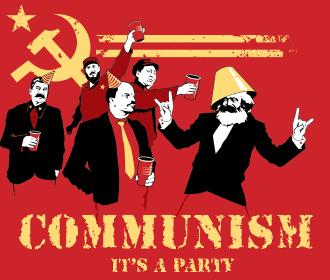
- Idea of communism? Courtesy Oscar’s global blog
Today was the third and final day of the ‘Idea of Communism’ conference and it was the truly most bizarre experience – bizarre philosophical experience, I should say – of my life. Let me start backwards today.
The preacher from Ljubliana was in full form and he closed his own hour-long (or was it 55 minutes) presentation ‘To Begin from the Beginning, Over and Over Again’ with the following: “If the rumour that Gilles Deleuze was writing a book on Marx before he died, is true then this should be seen as a sign that after having spent a life time away from the Church he wanted to come back to its fold…We welcome all those anti-communist Leftists who have spent their lifetimes attacking us to come and join us.” Continue reading Evangelist Zizek and the End of Philosophy – II
Re-booting Communism Or Slavoj Zizek and the End of Philosophy – I
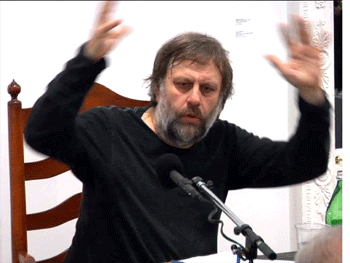
Today, 13 March, a whole galaxy of philosophers and theorists got together for a three-day conference “On The Idea of Communism” under the auspices of the Birkbeck Institute for the Humanities, London University. The Conference opened to a jam-packed hall where all tickets had sold out (no jokes, this was a ticketed show where the likes of Alain Badiou, Slavoj Zizek, Jean Luc-Nancy, Toni Negri, Jacques Ranciere, Terry Eagleton and many many others are to perform on the ‘idea of communism’). The huge Logan hall with a capacity of about 800-900 was so packed that the organizers had made arrangements for video streaming in another neighbouring hall – and that too was half full! Very encouraging in these bleak days.
The conference began in the afternoon with brief opening remarks by Alain Badiou and Slavoj Zizek. Badiou made his general point (see below) about the continuing relevance of the ‘communist hypothesis’. Staid and philosopherly. Continue reading Re-booting Communism Or Slavoj Zizek and the End of Philosophy – I
Silencing Social Activists
An escalating wave of attacks on social activists has been sweeping the country. Several recent incidents indicate an increase in the number of cases alleging grave human rights abuses against social activists, and a shift from low-level targeting, such as intimidation and harassment, to more serious violations, such as detention, prosecution, imprisonment and threats to their physical integrity. The authorities are also trying to silence them through unfair trial, denial of bail and long prison terms. There is excessive use of force, torture and other ill-treatment by the police. Women social activists are facing further violations, as women and as human rights defenders, including sexist verbal abuse and derogatory accusations. Continue reading Silencing Social Activists
The Arrest of Shamim Modi at Industrialists’ Behest
Activist Working for Rights of Tribal People Arrested
Ms Shamim (nee Meghani) Modi, a law graduate working among the tribals in Betul district, Madhya Pradesh, has had to pay a heavy price for taking up the cause of tribal people and other industrial workers. Shamim, who works with the Samajwadi Jan Parishad (an organization of socialist-Gandhian orientation) has been put behind bars in Hoshangabad jail for exposing the corrupt nexus between politicians and the mining mafia. She was arrested in gross violation of democratic rights on 10th February 2009 from her residence at Harda, M.P. The process of attempting to secure bail from M.P High Court is now on.
The arrest was made on false charges, one of instigating tribals to ‘attack forest officials’ and another of ‘kidnapping with the intention to kill’ these officials! These charges were brought against her (and her husband) two years ago in 2007. Subsequently no enquiries were conducted, and no follow-up was done but the fact that these charges hung over their heads was presumably meant to cow them down. These charges have suddenly been resurrected because the administration has been under pressure from industrialist lobbies. Earlier, the trial court had rejected her bail plea despite the fact that the person supposed to have been ‘kidnapped’ was said to be present in court and denied any such thing. Another evidence, if any was still required, of the deep nexuses of power that operate at these levels. Continue reading The Arrest of Shamim Modi at Industrialists’ Behest
Bailout or Bankruptcy?
With the economy in the doldrums, Barack Obama in the White House, and Elton John releasing a line of crystal encrusted Ipods for charity, it’s suddenly fashionable to talk about “Sacrifice” once more; a trend that senior management at General Motors seems to have picked up on. Their December 2, 2008 proposal to the Senate Banking Committee calls for sacrifices no less than nine times in twenty four pages from everyone including stake holders, share holders, bond holders, management, senior executives and in one instance, even the GM balance sheet (it has been asked to sacrifice leverage). That the Company wrangled out $13.4 billion from the TARP suggests an era in which nothing succeeds like sacrifice, but the accompanying term sheet suggests that the time for martyrdom has just begun.
Interview with Ragavan on Tamil Militancy (Early Years)
As the Tamil community in Lanka is at the crossroads with twenty five years of war nearing an end with the increasing marginalization of the LTTE, I would like to do a series of interviews on the social, economic and political conditions that led to the emergence of armed politics and militarization of the Tamil community. Returning to those years in the seventies and early eighties then is an attempt to also think about ways forward out of the militarized and armed politics of the last few decades. I intend to do a series of interviews to capture that important political period for Lankan Tamils. This important shift in Lankan politics and the decades of war that followed it did irreparable damage to the Lankan Tamil community and all the peoples of Lanka.
I begin with an interview of Ragavan, a founding member of the LTTE, who left the movement in 1984 and has since moved to London where he lives in exile. In this first interview, Ragavan speaks about his background and early years of militancy.
This is an interview by Ahilan Kadirgamar of Ragavan at his London home on 25 January 2009. Continue reading Interview with Ragavan on Tamil Militancy (Early Years)
The Caste of a Scam: A Thousand Satyams in the Making
Guest post by D.PARTHASARATHY
Industry leaders, CEOs, and Corporate big-wigs have been falling over each other to portray the Satyam scam as an isolated case, as a simple failure of corporate governance. On the other hand critics from the left once again have had a field day with their “I told you so” condemnation of capitalist free market economies. There is also a moralistic middle class which blames it on greed pure and simple. The fact that the Indian private sector is largely dominated by family owned and controlled businesses of sundry sizes, that caste, community, gender, and social networks play a significant role in who gets nominated to top positions within the companies, and how businesses are run, that these have significant implications for corporate governance as well as corporate loot – these are issues that are too dangerous and embarrassing at the same time, and so are conveniently ignored.
Continue reading The Caste of a Scam: A Thousand Satyams in the Making
Interview with Jacques Ranciere
Interview with Jacques Rancière
Conducted by Lawrence Liang
Lodi Gardens, Delhi, 5th February 2009
Jacques Rancière (born Algiers, 1940) is Emeritus Professor, Philosophy, at the University of Paris (St. Denis). He came to prominence when he co-authored Reading Capital (1968), with Louis Althusser, the Marxist philosopher. He subsequently broke away from Althusser and wrote The Nights of Labour, a work that examined the philosophical and poetical writings of workers in 19th century France. Through an examination of the lives of these worker autodidacts, Rancière introduced a new way of thinking about the idea of the worker, and of the injunction that divides between those entitled to a life in thought and those born to do manual labour.
He went on to write The Philosopher and His Poor which looks at the figure of the poor artisan from classical philosophy down to Marx and Sartre. In The Ignorant Schoolmaster, inspired by the experiences of a radical early 19th century teacher, Joseph Jacotot, Rancière sought to rethink the idea of pedagogy away from the idea of moving form the unknown to the known and from those who possess knowledge to those who don’t, to look at how all forms of ignorance are also conditions of knowledge.
He was in Delhi recently, on the occasion of the release of the Hindi language edition of The Nights of Labour.
Why Mulally can af-Ford to dilly dally
Vodpod videos no longer available.
more about “Una-ford-able Risk?“, posted with vodpod
You know it’s been a bad season for auto sales when the Chief Executive of Ford personally calls you up when you buy a car. Michael Snapper, a lawyer from Grand Rapids Michigan, received such a call from Ford Chief Exec Alan Mulally to thank him for choosing a 2010 Ford Fusion hybrid over rival Toyota Motor Corp.’s wildly popular Prius. Snapper was quoted as saying that Mulally’s actions “reflect a new attitude and a real commitment” to improving the company. Given that US auto sales plunged 38 % in January and Ford’s sales fell 39 %, Mulally is going to have to make a lot more calls if he hopes to save the company.
Generally Motored! Why GM has the Government by the Gonads
Either the well was very deep, or she fell very slowly, for she had plenty of time as she went down to look about her and to wonder what was going to happen next…” As General Motors representatives prepare for the February 17 discussion with the Treasury Department on viability plans, they shall be under some pressure to illustrate how they plan to pull the company of its $44 billion dollar rabbit-hole of debt and re-emerge into the sunny wonderland where selling cars actually generates profit. The company is expected to show progress on negotiations with its creditors and must have firm commitments by end-March, else it could be forced to pay back the $13.5 billion loaned by the Treasury thus far. Given GM’s current liquidity crisis, a misstep on February 17 could plunge it into bankruptcy.
Continue reading Generally Motored! Why GM has the Government by the Gonads
Beyond violence and non-violence – K Balagopal
Via Jamal Kidwai
[We are posting this piece by K Balagopal, hoping to continue our reflections on violence and non-violence in political movements. – AN]
The public arena is witness to dispirited discussion of the ineffectiveness of people’s movements, which are at the most able to slow down things, and nothing more. The discussion often turns around violence and non-violence, not as moral alternatives but as strategic options. Those who are sick of sitting on dharna after dharna to no effect are looking with some envy at violent options,
while many who have come out of armed groups find the Narmada Bachao Andolan (NBA) fascinating.
It is good that there is some openness in the matter now, for dogmatic attitudes have done considerable harm. To say that one should not be dogmatic about violence may be morally a little unsettling but it is a defensible position even without adopting a relativistic attitude towards the preciousness of life or a casual attitude towards one’s moral responsibility for injury caused in the course of a struggle. More of that in the right context. But the
discussion will unavoidably be based on assessments of the effectiveness of the alternatives, and a distant view is likely to colour the reality with hopes and assumptions, even illusions. A realistic assessment of what each strategy has been able to achieve would better inform the debate.
The plain and stark fact is that while all strategies have been effective in curbing some injustice, none has succeeded in forcing the government to take back a single major policy in any sphere. And none has been able to reverse the trends inherent in the structures of society and economy. Yet no serious political movement or social struggle we know of is only for softening oppression or improving relief. The general understanding is that governance of the country – and may be the systemic infrastructure of society – is fundamentally wrong and needs remedying, maybe overturning. Do we know of any
effective strategy for that? I am not talking of political strategies,
but strategies of struggle that will successfully put pressure upon the State and the polity to stop them in their tracks. The struggle may be built around class or caste or any other social combination. It may in the end seek reform or the upturning of the polity. It may operate mainly or in part within the polity or keep out of it altogether. Whichever it is, the common problem is this: the experience of this country is that governments do not stop doing some thing merely because it has been demonstrated to be bad. Or even contrary to constitutional directives and goals. They stop only if going along is made difficult to the point of near impossibility. No democratic dispensation should be thus, but Indian democracy is thus. Short of that, you demonstrate the truth of your critique till you are blue in the face or shout till you are hoarse in the throat, it is all the same.
Continue reading Beyond violence and non-violence – K Balagopal
Corporate Complicity and Gujarat
The 4th ‘Vibrant Gujarat Global Investors’ Summit, organized by the Gujarat government on 12-13 January 2009 in Ahmedabad, and the statements by some prominent Indian corporate leaders, have spawned protests, analysis, debates and questions about corporate accountability, complicity, responsibility and rights in Indian democracy. At this biennial event, ‘Jai Jai Garvi Gujarat’ has been showcased as an ‘ideal investment destination, both for Indian and foreign investors’, where prospective investors have ‘only Red Carpet and no Red Tape and it is where investors can sow a rupee and reap a dollar as returns’ (see Official portal of Gujarat Government).
Bringing together business leaders, investors, corporations and policy makers by a democratically-elected government, exploring business opportunities and signing memorandum of understandings are legitimate economic activities. However, the projection of the Chief Minister of the State, Narendra Modi, as the next Prime Minister of India by corporate cheerleaders is much more than mere economic activity. It is turning a blind eye to gross abuses of rule of law, and knowingly assisting a political leader and his government to continue committing them. It is becoming party to a specific political vision in a manner that incurs responsibility and blame. Such corporate leaders thus become complicit with a government and its leader in serious human rights abuses. It is negative and unacceptable.
A short note on National Interest
The list of things that can be done in national interest appears to grow longer every day. While in India it can be used for anything from destroying working class housing to build stadiums to destroying tribal communities to build dams, to torturing, illegally detaining, and killing innocents under false pretences; in the US, officials and executives are coming to terms with how to deal with an “economic emergency”.
As information on Bank of America’s purchase of Merrill Lynch begins to trickle through the American financial press; news of Merrill’s larger than expected losses seems to have taken some of the sheen of BoA Chief Executive Kenneth Lewis’s knight in shining armour costume.
As reported by Reuters on Jan 16th, shareholders at BofA believe that, at $19.4 billion, Lewis not only overpaid for Merill Lynch; but Merrill’s staggering $15.3 billion dollar loss suggests that he did not do his homework on the deal. As Dennis K. Berman notes in this morning’s Wall Street Journal, the murkiness surrounding the deal has meant that “in the past five trading days, Bank of America’s market capitalisation has dropped 45 %, wiping away a sum greater than the Merrill transaction itself.”
The press freedom bogey
…is raised every time there’s talk of a law “regulating” TV News channels in India. A rajya Sabha committee now says self-regulation is not enough, the media needs a set of rules from the government. I think that one shoudn’t necessarily view the idea of a law, or regulation, with suspicion. After the despicable 26/11 coverage and even before, many channels have lost the right to hide their TRP-driven sensationalism behind the free speech bogey.
That may sound self-contradictory, but see what the committee has concluded on the subject:
The Battle of Mumbai
Guest post by BALMURLI NATRAJAN, a member of the South Asia Solidarity Initiative (SASI)
The Battle of Mumbai did not begin on November 26, 2008. There was no clear beginning, regardless of what somnambulists who have just woken up, or saber-rattlers who have been sharpening their tools for a while, pronounce. Like all modern wars, it burst into public view over the internet, unannounced and in full-swing. Continue reading The Battle of Mumbai
 KAFILA - COLLECTIVE EXPLORATIONS SINCE 2006