Category Archives: Centre watch

Yes, the Biharis chose Mud over the Lotus. Get Over It.

It is not difficult to imagine some of the reactions to the sweeping victory for the Grand Alliance in Bihar. All those who have spent a lifetime thinking of Bihar as the worst kind of social, economic and political cesspool in the country, all those who shudder at the sight of Lalu Prasad Yadav and amuse themselves with jokes about his rustic origins and his apparently appalling antics, all those who are charmed by the hologram charm of our current PM – all those have found the best kind of alibi to explain the result of November 8th. As Prem Panicker has noted on Twitter, the sum total of their reactions is – “Illiterate Biharis deserve this”. A particularly pee-yellow variant of this jaundiced view of the lower castes and classes was given (and mysteriously withdrawn later) by one Sonam who goes by the handle #Asyounotwish on Twitter:

Thank you Bihar for choosing mud over lotus. You deserve to stay rickshaw walas.

It’s perfect – for the thousands of Sonams out there, Lalu and Bihar are made for each other in a kind of self-limiting loop, and we can return to our economically dynamic, socially vibrant and thankfully un-Bihari Indian lives. Another joke that is doing the rounds:

Wife: Ever been to Bihar?

Husband: No

Wife: Moving there?

Husband: No

Wife: Relatives fighting elections?

Husband: No

Wife: Then give me the damn remote…

Continue reading Yes, the Biharis chose Mud over the Lotus. Get Over It.

Statement by Academics Against Intolerance

In light of the recent spate of killings of noted writers and intellectuals M M Kalburgi, Govind Pansare, and Narendra Dabholkar, and the Dadri lynching incident followed by forced nation-wide attempts at cultural policing, we feel that the current political dispensation headed by the Prime Minister is mandating an atmosphere of violence and fear. Continue reading Statement by Academics Against Intolerance

The Move to Professionalise Research: Aswathy Senan

This is a guest post by ASWATHY SENAN

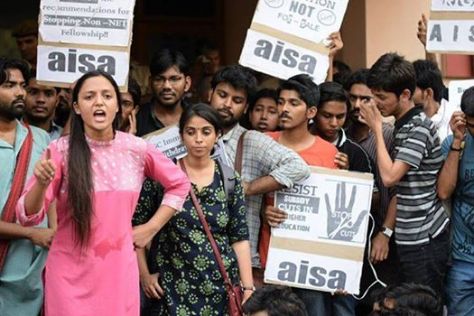
Researchers all over the country are protesting the move by the UGC to scrap the non-NET fellowship and students have gathered in hundreds to resume their agitation at the UGC office through OccupyUGC. it appears that one should be clear about what the student reaction means: it is much more than as a demand for monetary benefits. The student mobilization happened after the committee that met at the UGC office in Delhi to discuss and increase the non-NET fellowship, decided to scrap it. Following the protests that lasted through the nights from 21 October, the Minister of Human Resources Development tweeted that the fellowship shall be continued leaving out one crucial detail: its availability to new students. This decision to end all financial support of researchers doing their MPhil and PhD until they qualify NET or JRF is a huge threat for the research community in India as this is a clear move to professionalise research and make it a mere add on to teaching career. Continue reading The Move to Professionalise Research: Aswathy Senan

Students Occupy UGC to Defend the Right to Research in Universities Across India: Sucheta De

Guest Post by Sucheta De.

[ Videos by V. Arun, Om Prasad, Akhil Kumar, with Facebook Post Updates by Shehla Rashid and Akhil Kumar ]


#SaveNonNETfellowship: A movement for ensuring democratic, inclusive and pluralistic research in India

The ideas of the ruling class are in every epoch the ruling ideas, i.e. the class which is the ruling material force of society, is at the same time its ruling intellectual force.”

― Karl MarxThe German Ideology

JNUSU vice president Shehla Rashid addressing protestors at UGC
JNUSU vice president Shehla Rashid addressing protestors at UGC HQ, Delhi

On the afternoon of 21st October, students from several universities in Delhi began ‘Occupying’ the Delhi premises of the head-office of University Grants Commission (UGC) –  the government mandated body under the Ministry of Human Resources that is supposed to govern the functioning of universities across the country.  The occupation continued through the night of the 21st, the day of the 22nd, and is still currently in process. The students occupying the UGC premises have decided, as of now, not to let the UGC function. Goons from the BJP aligned students organization Akhil Bharatiya Vidyarthi Parishad (ABVP) have now reached the UGC and are continuously harassing and abusing the student activists who are in ‘occupation’ of UGC. There is heavy police presence. There is a state of near siege at the UGC head quarters near ITO Chowk in Delhi.

Continue reading Students Occupy UGC to Defend the Right to Research in Universities Across India: Sucheta De

House of Cards


Courtesy Indian Express
Courtesy: Indian Express.

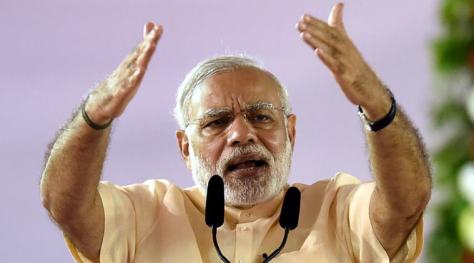
Anybody with a passing interest in consistency or coherence might be forgiven for being stumped at the political spectacle unfolding right now. Yesterday, Prime Minister Narendra Modi assured us that his government was committed to reservations. The statement was made at a ceremony to inaugurate the Ambedkar memorial at the Indu Mills compound in Mumbai. The fact that ordinary Dalits, in the habit of thronging any joyous celebration on Ambedkar in big numbers, were kept out of the ceremony, is possibly irrelevant. After all, officialese is officialese, and no political party – certainly not the BJP – has a monopoly on stiff-necked commemorations of people’s leaders that want nothing to do with the people. It is Modi’s commitment to reservations and the Indian constitution that is of interest. In some ways a statement of this nature made at the inauguration of an Ambedkar memorial, makes perfect sense. Apart from the occasion and locale, also not coincidental was the timing of Modi’s statement – one that he himself alluded to, when he referred to the bitterly fought Bihar elections now underway, “With a BJP government in power and polls getting under way, a malicious propaganda is being spread that the government is against reservation…”. The fact that the anti-BJP mahagathbandhan (grand alliance) in Bihar has made reservations one of their chief planks, with Lalu Prasad Yadav declaring in his inimitable style that he will kill himself if reservations are removed, is relevant.

Zooming back from the Ambedkar memorial event, the PM was clearly also responding to the threat to his Sabka Saath Sabka Vikas model begun a couple of months ago by the irrepressible Hardik Patel. Patel – erstwhile BJP supporter, self-styled Patidar-Patel revolutionary and a wild child in imminent danger of being silenced (or coopted) by the BJP – was temporarily subdued by the Gujarat administration following the wave of violence over his first call for reservation, but resurfaced a couple of days ago to be the nightmare Modi hadn’t dreamed yet – saying his aim was to expose the “Gujarat model of development”. This is for the current party nothing short of the youngest born of a rambling illustrious family running into the street from the family mansion saying our house is made of mud! our house is made of mud!

Continue reading House of Cards

Another One Bites the Dust: “Cultural Pollution” and the Nehru Memorial Museum & Library: Niyati Sharma and Snigdha Kumar

This is a guest post by NIYATI SHARMA AND SNIGDHA KUMAR

Courtesy thequint.com.

The latest in a line of institutions to fall victim to the BJP government’s campaign against “cultural pollution” is The Nehru Memorial Museum and Library (NMML). The agenda is loud and clear – anything which ‘pollutes’ the current government’s preferred way of life and thinking will be done away with. Bans such as the recent ones on porn and meat are the most obvious instruments at the disposal of the government to achieve this goal. The more effective interventions, however, are not those which instantly deny people their choices and freedoms. Presented instead as minor improvements and renovations, interventions in art, history and academic institutions allow the government to introduce subtle long term changes – changes with the capacity to access and alter our very being.

Given the enormity of these interventions in the long run then, it is particularly curious how the clear recent attempts to take over academic institutions such as the ICHR, FTII and now NMML have managed to raise only a few eyebrows while the bans on porn (and meat to an extent) have met with much protest and were subsequently lifted. Perhaps this is because such spaces appear to be remote islands inhabited only by those interested in history, film and/or academic research. Only such an impression can explain the rather meek public debate and outcry that these clearly targeted changes have generated.

Continue reading Another One Bites the Dust: “Cultural Pollution” and the Nehru Memorial Museum & Library: Niyati Sharma and Snigdha Kumar

Stop Interfering in Nepal : Statement in Protest Against India’s Interference

After seven tumultuous years following the overthrow of the more than two century old monarchy which led to elections to form a Constituent Assembly, and many governments failing to fulfill the task of finalizing a Constitution, at last on 20th September the President of Nepal has promulgated the new Constitution amidst support from overwhelming majority of the CA and people. The Constitution creates seven states in a secular, federal system. Continue reading Stop Interfering in Nepal : Statement in Protest Against India’s Interference

Bihar Needs a Corbyn Moment: Sushil Chandra

Guest post by SUSHIL CHANDRA

If the media discourse on Bihar elections has any semblance of truth, this election is a choice between Pepsi and Coke. Whatever you choose, you get a cola of casteism, corruption and gangsters. On one hand we have winning combination of intermediate castes, the assured Muslim vote, the great legacy of fodder scam and kidnapping rings with added glitter of so called good governance and on the other hand the return of feudal dominance, the guaranteed promise of a theocracy and another band of gangsters. It is difficult to fathom from the media coverage that there is a third alternative available in shape of left which is free from all these attractions and offering a principled platform. You can see on television Upendra Kushwahas and Pappu Yadavs holding forth on their great vision for Bihar, the daily tantrums of Majhi and Paswan for their tug-of-war on seats but talk of the left and even Ravish Kumar forgets to mention them on his daily shouting matches on Bihar election. Is it because of our corporate media is not willing to invest in those not willing to invest on caste and religion? Continue reading Bihar Needs a Corbyn Moment: Sushil Chandra

Workers right to unionize being trampled upon in yet another factory in Manesar: Report

Report on the protest by automobile workers in Manesar by BIGUL MAZDOOR DASTA AND AUTOMOBILE INDUSTRY CONTRACT WORKERS UNION


IMG-20150921-WA0005

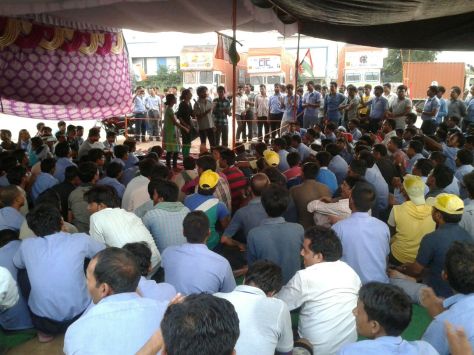
On the morning of 18 September 2015 when the workers employed in the Bridgestone company reached their factory gates they were met with Police officers and hired bouncers at the gate. When the workers tried to enter the factory premises they were resisted by the uniformed and the non-uniformed goons of the Factory Management. The Police beat up the workers and prevented them from entering the premises of the factory in spite of having a court order for tool down and without any prior notice the workers were sacked by the company. More than 400 workers employed in Bridgestone Factory in Manesar have been unlawfully sacked by the Company authorities after the workers demanded to get their Union registered. The workers are currently protesting outside the factory and have gathered there to raise their voice against the injustice and oppression that they are facing at the hands of the factory management.

Continue reading Workers right to unionize being trampled upon in yet another factory in Manesar: Report

A Contested line – Implementation of Inner Line Permit in Manipur: Deepak Naorem

This is a guest post by DEEPAK NAOREM

Violence and the accompanying disruption of everyday life in Manipur is not a recent phenomenon. This year too, the state was plunged into a spiral of violence following demands for the implementation of Inner Permit Line, a law originating in the colonial period. This demand is based on real or imagined fears that Manipur, like Sikkim and Tripura, would be overwhelmed by the ‘outsiders’ and that the ‘indigenous people’ of Manipur would become a minority in their homeland. Such demands are neither new nor surprising in this part of the world, where a nearly-unfathomable ethnic, demographic and political jigsaw puzzle was created by British colonialism; one that was deepened by even more myopic and inconsistent policy in the post-colonial years. However, this year, following the death of a young student by police firing during a student protest in Imphal, the movement demanding the Inner Line Permit (ILP) gained considerable momentum in Manipur. Subsequently, the legislature was forced to introduce three bills in the Manipur State Legislative Assembly on 28th August, 2015, ensuring the implementation of Inner Line Permit in the state. This in turn triggered another wave of violence with the ‘tribals’ and tribal organizations opposing the three bills, eventually bringing life to a standstill in the state.

Continue reading A Contested line – Implementation of Inner Line Permit in Manipur: Deepak Naorem

पेटलावद विस्फोट – मौतों पर बजती तालियाँ : जसबीर चावला

Guest Post by Jasveer Chawla

Madhya Pradesh CM Shivraj Singh Chouhan, who visited the blast site at Petlawad near Jhabua this morning, faced protests from angry residents               (Photo courtesy : http://www.odishanewsinsight.com)

मध्यप्रदेश के झाबुआ जिले के पेटलावद क़स्बे में बस स्टेंड के पास भीड भरे स्थान पर रहवासी और व्यवसायिक क्षेत्र के एक मकान में अवैध रूप से रखे विस्फोटक जिलेटिन के भंडार में शनिवार विस्फोट हो गया. विस्फोट से ९० लोगों की मौत हो गई और दर्जनों घायल हैं जिनमें से कई की हालत गंभीर है,जिन्हे इंदौर,दाहोद अादि जगह भेजा गया.

मुख्यमंत्री श्री शिवराज सिंह चौहान ने रविवार को घटनास्थल का दौरा किया और सार्वजनिक रूप से घोषणा की कि सरकार हायकोर्ट के किसी जज से इसकी न्यायिक जाँच करवायेगी.दोषियों को दंडित किया जायेगा. मृतकों के परिजनों को १० लाख रुपये और घायलों के इलाज का सारा खर्च सरकार करेगी और पीड़ित परिवारों के रोजगार पर भी सरकार ध्यान देगी.

✔️ ‘व्यापमं’ प्रदेश के मुख्यमंत्री जब ये घोषणायें कर रहे थे तो उनके पास खड़े उनके दल के लोग उनकी ‘भामाशाही’ घोषणाओं पर बार बार तालियाँ बजा कर स्वागत कर रहे थे.सामने दुखी और पीड़ितों का विरोध करता हुजूम था.

✔️ इस ‘विस्फोट’ से सीधे प्रश्न उठते है.मध्यप्रदेश कोई सीमावर्ती राज्य नहीं है जहाँ कोई आतंकवादी आ गया और मुठभेड़ हुई और मकान में रखे विस्फोटक सुलग उठे ना ऐसी आतंकवादी घटना है जिसमे आतंकवादी बाजार/घर / ट्रेन/बस में बम प्लांट कर देते हैं और रिमोट से या आत्मघाती तरीके से विस्फोट कर देते हैं.ऐसा कुछ नहीं था.

यहां के जैन समुदाय का एक व्यापारी (आतंकवादी की कोई जाति या धर्म नही होता,ऐसा ही लिखते हैं ना ?) जो भाजपा के स्थानीय व्यापारिक प्रकोष्ठ का पदाधिकारी था (अपराधी किसी भी राजनैतिक दल का हो सकता है ?) १० वर्षों से क़स्बे में एवं मध्य व्यवसायिक क्षेत्र में अवैध रूप से किराये के मकान में भारी मात्रा में रखे जिलेटिन डायनामाइट का भंडारण कर रहा था.

इतनें वर्षों तक पुलिस, प्रशासन सोया था जो वहाँ पर इतनी मात्रा में कुएँ /खदानों में वैध/अवैध विस्फोट के लिये जिलेटिन का भंडारण हो रहा था ? Continue reading पेटलावद विस्फोट – मौतों पर बजती तालियाँ : जसबीर चावला

Old Age Culture Homes and other Cultural Pollutants – Lessons in Toxicity from the Minister of Culture

The world’s largest ‘cultural’ organization, the Rashtriya Swayamsevak Sangh (National Volunteer Organization) recently met with the minister responsible for what is probably, in real terms, the world’s smallest ‘culture’ ministry, the Ministry of Culture, Government of India. Under Khaki shorts, size does matter. The big tell the small, what’s what.

Continue reading Old Age Culture Homes and other Cultural Pollutants – Lessons in Toxicity from the Minister of Culture

Muzaffarnagar Baaqi Hai – Critical Readings Online and Offline: Akash Bhattacharya and Arif Hayat Nairang

These are guest posts by Akash Bhattacharya and Arif Hayat Nairang

The film Muzaffarnagar Baaqi Hai has been in the news recently, and not always for the right reasons, having attracted disruptive and abusive protest at some screenings. Following a day of counter-protest in which the film was screened all over the country, a friend teaching in a Delhi University college suggested screening it in her college, only to be told by the student representative that it would “cause trouble” (“bawwal mach jayega ma’am!!”). She asked what that meant and if he had seen the film, and he simply said, “nahin, bhaiyya logon ne kaha hai ki woh film bahut buri hai” (No, but our elder brothers have said it’s a bad film). 

In an atmosphere where political self-censoring comes as easily to the current generation of students as scouring the net for “blocked content” we present below two readings of the reception of the film, the first ruminating on whether the film addresses the complexities of communal mobilisation adequately; and the second inquiring in the context of social media and particularly Facebook, what constitutes the ‘liking’ of an image or idea. The idea of posting these comments is as much to give space to these arguments as it is to make a larger point that the ‘sickular left’ voices that are presumably behind the film love discussion, critique and disagreement. That to my mind is the way forward, not pre-empting the always-already hurt sentiments of the bhaiyya log whosoever they may be.

Continue reading Muzaffarnagar Baaqi Hai – Critical Readings Online and Offline: Akash Bhattacharya and Arif Hayat Nairang

Hindutva: A Political Theory of Nationhood?: Aman Verma

Guest post by Aman Verma

It is disheartening to see amongst supporters of Hindutva these days a silent acquiescence and at times even active support for extra-constitutional techniques being adopted by organizations like the RSS and its offshoots towards attaining the goal of Ram Rajya. An assessment is necessary of what would ultimately entail on the social, political and economic fronts if such a policy that envisages a supposedly ‘Hindu’ cultural and linguistic hegemony over cultures and languages represented by minority communities becomes reality. However, being a student of law what disturbs me more is the absence of any socio-political entity or civil society movement rooted in values of democracy that can effectively counter the impact of Hindutva organizations on the Indian social fabric. While the BJP has its RSS, every other political party claiming to be the upholder of secularism lacks its equivalent, or at the very least an effective social protégé.

Further, my personal interactions with supporters of BJP reveals that there is some deep sense of hurt and helplessness, part valid for the sake of argument, but for the most part carefully manufactured by Hindutva propaganda, which manifests itself in questions a friend recently put to me, “What are the other ways in which the Hindus can also claim their rights and send out a message that they have been too tolerant for too long?” and another which sounded like “How else to keep our dignity and identity alive in our land?”. These questions, based upon presumptions like those of “Hindu tolerance” of acts perpetrated by other communities supposedly only against Hindus and, protection of a completely vague concept of “Hindu identity” are clearly an outcome of a campaign strategy that relies upon upping the antics on the romantic-nationalist front.

Continue reading Hindutva: A Political Theory of Nationhood?: Aman Verma

Open Letter to Odisha CM Re False Charges Against GASS Activist Debaranjan

 WITHDRAW FALSE CHARGES AGAINST DEBARANJAN OF GASS, ODISHA

To:

Mr Naveen Patnaik
Chief Minister,
Government of Odisha

22 August 2015

 We, the undersigned, unequivocally condemn the foisting of a false case on Debaranjan, member of the Ganatantrik Adhikar Surakhya Sangathan (GASS) in Odisha.

Debaranjan has for several years now been deeply involved with people’s struggles in Odisha, first as a full-time activist in Kashipur, Rayagada district, then as film-maker, and most recently also as a member of the democratic rights group GASS. His has been among the consistent voices in Odisha for over twenty years against state repression on people’s struggles, atrocities faced by adivasis, dalits and other underprivileged communities, and against communalization of the polity and in society. This is the political context in which he is being targeted.

Last week, Debaranjan was sought to be interrogated by the Special Branch of the Intelligence Department while he was engaged in work on a documentary film in Malkangari district. Subsequently, a number of false charges were filed against him by the Malkangiri Police, including charges pertaining to molestation under Section 354 (b) of the IPC, and under sections 354 and 323. We believe these charges to be patently false and absurd, and constitute nothing other than harassment and part of the continued persecution of democratic voices in this country. Continue reading Open Letter to Odisha CM Re False Charges Against GASS Activist Debaranjan

The Two-Finger Test at FTII: Prateek Vats

Guest Post by Prateek Vats

Picture of Demonstration before Parliament

In a two-finger test, a doctor at the government hospital inserts two fingers into the rape victim’s vagina to check for the presence or absence of the hymen and also to check the ‘laxity’ of the vagina, ostensibly to check if penile penetration has taken place. The test is deemed to establish whether the woman has had sexual intercourse and if she is habituated to it. Incidentally even that can’t be ascertained from this test since the presence or absence of hymen or width of the vagina has no correlation with virginity or sexual activity.”1

The correlation between Pune police’s impending raid at the FTII campus and the faulty appointments at the FTII society seem to be equally baffling. What logic justifies the police being used against the students when it is they who have faced vandalism and open threats during the course of their strike? It is they who need to be protected so that attention is not diverted from the grave questions they have raised. Unfortunately, the coercive steps taken by FTII administration and local law enforcing agencies betray the same indifference, insensitivity and irresponsibility epitomized by an archaic procedure like the two-finger test, which serves the twin functions of terrorizing and humiliating the already brutalized victim. Continue reading The Two-Finger Test at FTII: Prateek Vats

All That Remains for Us to Consider in the Wake of the Death of Yakub Memon

Yakub Menon was murdered yesterday morning. Apparently it was his birthday. When his brother Suleman and his cousin Usman met him on Wednesday afternoon his words to them, as reported in today’s Indian Express, were – “Agar woh mujhey mere bhai ke gunahon ke liye sazaa de rahe hain, toh mujhe kabool hai. Par agar unko lagta hai ki mein gunehgaar hoon aur sazaa de rahe hain, toh yeh galat hai. Main bekasoor hoon.” (If they are punishing me for the sins of my brother, then I accept this verdict. But if they are punishing me because they think I am guilty, then it is wrong. I am innocent.)

Continue reading All That Remains for Us to Consider in the Wake of the Death of Yakub Memon

याकूब मेमन को फांसी – न्याय के लबादे में अन्याय ?

Sify.com cartoon on Yakub Memon hanging by Satish Acharya

(courtesy : sify.com cartoon by satish acharya)

‘क्या आतंकवाद से जुड़े मामलों में अदालतें एवं अधिकारी भारतीय समाज की रक्तपिपासा की भावना से सामंजस्य दिखाने की कोशिश करते है ? आतंकवाद से जुड़े लोग, फिर भले ही वह उपरोक्त अपराध को अंजाम देने में हाशिये पर रहते आए हों, उन्हें दोषी करार देकर सूली पर चढ़ाया जाता है ?’

वरिष्ठ पत्रकार मनोज जोशी ने याकूब मेमन को फांसी देने के निर्णय को प्रश्नांकित करते हुए यह बात पिछले दिनों लिखी। /देखें http://www.thewire.in व्हाय याकूब मेमन शुड नाट बी हैंग्ड, 17.7.2015/ गौरतलब है कि 1993 में मंुबई में हुए बम धमाके के एक आरोपी याकूब मेमन की प्रस्तावित फांसी के प्रति असहमति प्रगट करने में महज जनतांत्रिक अधिकारों के लिए समर्पित लोग एवं संगठन ही आगे नहीं आए हैं बल्कि सिविल सोसायटी के अन्य लोग मसलन पत्रकार, लेखक, अभिनेता आदि भी आगे आए हैं। Continue reading याकूब मेमन को फांसी – न्याय के लबादे में अन्याय ?

Statement by PADS following CBI raid at Sabrang Communications and homes of editors and publishers

Statemeny by People’s Alliance for Democracy and Secularism (PADS)

PADS strongly condemns the CBI raids of 14 July 2015 at the premises of social activist Teesta Setalvad, her husband Javed Anand, Gulam Mohammed Peshimam and office of Sabrang Communications and Publishing in Mumbai. These raids are undertaken for purely vindictive reasons given the assurances of complete cooperation and submission of thousands of pages of documents to the CBI. It is by now an open secret that activists working for justice and truth with regard to the pogrom called ‘Gujarat Riots’ have earned the hatred and animosity of the Modi government; which does not hesitate to employ official state power to indulge in a witch-hunt.

Setalvad and Anand set up Sabrang Communications and began publishing Communalism Combat in 1993, and not after 2002. It was this company that published the Justice Srikrishna Commission Report on the Mumbai communal riots of 1992-1993 at a time when the state government would not make it available to the public. The state not only fails in its constitutional duty to protect all citizens from unlawful deprivation of life and liberty under Article 21, but hounds and intimidates all those who seek to uphold human rights and democratic values.

It may also be noted that a senior Public Prosecutor, Rohini Salian, has accused the NIA of showing a bias in favour of certain persons accused of terrorist crimes. None other than the respected Julio Rebeiro, retired Police Commissioner of Punjab, has asked the public to take serious note of what Ms Salian has alleged. Furthermore, a Gujarat special judge, Ms Jyotsna Yagnik, stated in May this year that she has received 22 threats since retirement, on account of her role in convicting those responsible for the Naroda Patiya massacre in 2002. Her security cover was not enhanced, but scaled down. It is also noteworthy that the final hearings in the Zakia Jafri Criminal Revision Application are due to begin on July 27. Mrs Jafri seeks to make top-level politicians, including the then Gujarat chief minister, and top-level policemen, including the present Commissioner of Police, Shivanand Jha, former joint CP, Crime Branch, AK Sharma (now in the CBI ) answerable for criminal and administrative culpability for their role in 2002.

Seen together, in their entirety, the above facts are a cause for grave concern to all Indian citizens. They portend nothing less than an undeclared Emergency. Lovers of democracy should resist the ruthless campaign of intimidation unleashed against Sabrang Communications. PADS demands that the Union Government abandon its hostile and vindictive stance towards human rights defenders and concentrate on upholding the rule of law and providing justice to innocent Indian citizens who have fallen victim to bloodthirsty communal politics.

Email: info-pads@lycos.com
Telephone contact: Srinivas Rao 09393875195

Slow and Steady : Abhipsit Mishra

This is a guest post by ABHIPSIT MISHRA
“The Government of India would like to bring out a National Education Policy to meet the changing dynamics of the population’s requirement with regards to quality education, innovation and research, aiming to make India a knowledge superpower by equipping its students with the necessary skills and knowledge and to eliminate the shortage of manpower in science, technology, academics and industry.
One can come to trust long sentences less; especially those which are promises made by the state to the citizens; in particular those that are interspersed with cleverly placed punctuation. Continue reading Slow and Steady : Abhipsit Mishra

June 1984 – 31 Years Later, Sikhs Are Mapping Their Stories: Ravleen Kaur

Guest post by RAVLEEN KAUR

When June 1984 comes up in conversation, the same talking points invariably arise – “it was the state’s burden to attack; they had no choice”, “Bhindranwale had to be taken down”, or “Punjab was already bleeding”.

What these oft-repeated phrases – a product of the tight PR messaging campaign on the part of the government – glide over is the scope of human suffering that occurred in June 1984 – and most glaringly, suffering that was perpetrated by those in power, by those who had been elected in a democracy to uphold the rights and dignity of the people who they killed in 1984.

Anthropologist Talal Asad has noted the “notorious tactic of political power to deny a distinct unity to populations it seeks to govern, to treat them as contingent and indeterminate.”

With the belief that every Sikhs who was alive in 1984 has a story to tell, the 1984 Living History Project is depicting the unity in trauma of a people, who, in 1984, felt attacked as a people. The 1984 Living History Project is working to give a platform to ordinary people who lived through the massacres of both June and November. The project was initiated in 2012 by Sikh millennials.  Realizing that the generation who experienced 1984 firsthand was getting older and that time was running out to capture their stories, they began a grassroots effort to capture as many stories and testimonies from Sikhs worldwide, one video narrative at a time. The first videos were their own parents and grandparents, recorded on smart phones and edited and shared rather seamlessly. The Project’s web platform allows easy Steps to make and share videos; something other Sikhs around the world have been doing through the 30th and 31st anniversary years of 1984.  Continue reading June 1984 – 31 Years Later, Sikhs Are Mapping Their Stories: Ravleen Kaur