Category Archives: Centre watch

We Are All Queer – Assemble at Jantar Mantar against Reactionary Judgement

Shocking! Shameful!!  Disgusting!!!

The Supreme Court has struck down the  Delhi High Court decision decriminalizing gay sex in what might go down as the most retrograde judgement in India’s history. While the details of the Court’s reasoning are still not available, we can perhaps easily imagine what they might be. This is time of civil disobedience. Time for protest.

Assemble at Jantar Mantar at 4.30 pm, today 11 December to announce to the world that ‘We Are All Queer’. To announce that this is not a struggle of just the ‘gay-lesbian community’ but a struggle for our most fundamental rights and cherished values.

Manmohan Singh says ‘No’ to CHOGM 2013, with a whimper: Anonymous

An Anonymous Guest Post

So, Prime Minister Manmohan Singh will not be attending CHOGM 2013 in Colombo after all. Many sections of Indian political and civil society, in Tamil Nadu in particular, will no doubt welcome this. But in reality, far from packing a punch this decision comes more as a whimper. If media reports are to be believed the PM’s letter to Rajapakse “does not talk about the reasons for Dr. Singh skipping the meet”. Muddled and last minute as it has been, far from demonstrating intent the decision actually betrays a singular lack of it, leaving India with little by way of leverage while doing its credibility no good. The PM’s absence will not be comfortable for Rajapakse but in the manner it has come it will in fact cost him little or at least much less than it would have if Delhi had made this decision count politically. But then the United Progressive Alliance is too busy dealing with its own rising electoral insecurities to care for India’s strategic interests let alone the human rights of Tamils in Sri Lanka. Continue reading Manmohan Singh says ‘No’ to CHOGM 2013, with a whimper: Anonymous

Securing Justice for Rape Survivors from Kashmir and Northeast is An International Human Rights Crisis: Ayesha Pervez

Guest Post by AYESHA PERVEZ

The events preceding the recent death sentence awarded to the rapists of December 16th  Delhi gang rape case from 2012 have certainly broadened  the canvas of discourse on sexualized violence in India. Not only was the institutional sexism that pervades India’s criminal justice system been challenged, but also patriarchal values and norms that sanction and reinforce gender biases were openly questioned.  It was remarkable to watch the unprecedented outpouring from the Indian citizenry from all across  which resulted in the decision of the government to constitute a committee which had the mandate for recommending amendments to the Criminal Law. Recommendations by the Justice Verma Committee in early 2013, undoubtedly paved a way for much needed reform of laws and criminal justice practices relating to crimes of sexual violence. However, this was not true for all the survivors of sexual violence, particularly from the “disturbed” peripheral states of India. For the victims and survivors of sexualized violence from the conflict zones of India – Jammu and Kashmir and Northeast, the discourse ended uneventfully with a reserved/muted  submission of the Committee’s report to the government. Continue reading Securing Justice for Rape Survivors from Kashmir and Northeast is An International Human Rights Crisis: Ayesha Pervez

Casting a backward glance after a court order – the UID project: Usha Ramanathan

Guest Post by USHA RAMANATHAN

On September 23, 2013, the Supreme Court ‘s directed that “no person should suffer for not getting the aadhaar card in spite of the fact that some authority had issued a circular making it mandatory”. Reacting to an argument of Mr Anil Divan, Justice Puttaswamy’s counsel, the judges added that “when any person applies to get the Adhaar Card voluntarily, it may be checked whether that person is entitled for it under the law and it should not be given to any illegal immigrant”. The order regarding making the UID mandatory  was made in the context of the questionable legality of the project, and the instructions being issued, as it has been in Maharashtra, that  teaching and non-teaching staff and judges of the High Court would not get their salaries unless they have a UID. The latter part of the order on `illegal immigrants’ echoes those who wanted, and got, an amendment to the Citizenship Act in 2003 authorising the creation of a National Register of Citizens. This was inherently illogical and opportunistic; for, the rhetoric of threat from the outsider drew upon the Kargil standoff in 1999, when it was Pakistan that was seen as sending in terrorists who needed to be identified and dealt with, but the politics of the day made the migrant from Bangladesh the `threat’. The Home Minister of the day saw them in every shadow. The UID project is a part of this enterprise.

The UID Project, with Mr Nandan Nilekani at its helm, has developed ambitions of its own in the four years since it was set by executive notification. In these four years, what observers and analysts have seen of the project has produced disturbing questions around what constitutes identity and how it will be established: [1]

Continue reading Casting a backward glance after a court order – the UID project: Usha Ramanathan

Aadhaar – What next after the SC ruling? Kalyani Menon-Sen

Guest Post by KALYANI MENON-SEN

Poor Mr Nilekani. Just when everything was going swimmingly for him – adulatory interviews in the foreign press, tantalising rumours of a Congress ticket for the 2014 polls, lots and lots of votes on a poll to select the Greatest Living Indian – comes another well-aimed spanner in his works from that bunch of litigacious Jokers who have been playing rasta roko with his Batmobile for some time now.

The Supreme Court ruling of 23rd September is curt and unequivocal – a) two other challenges to Aadhar in the High Courts of Chennai and Mumbai to be clubbed with this one and heard by a Constitution Bench; b) an immediate freeze on linking Aadhar to benefits under social schemes; and c) a direction to tighten up the registration process to make sure that only Indian citizens are enrolled.

Every line of this ruling is a painful blow for Aadhar. It’s bad enough that the Court has taken seriously the charge that Aadhar violates Constitutional rights. The implication that there are serious errors in the registration process is even worse, and pulls the plug on one of the main arguments in support of the UID  – that it will stop leakages in government schemes by weeding out bogus beneficiaries. Worst of all is the decoupling from the “Apna Paisa Apne Haath bandwagon. If the UPA decides not to  jettison the cash transfer scheme – its big-ticket strategy for the 2014 polls – it will find a way to keep it going without Aadhar. Whether or not this strategy pays off, Aadhar will be the loser. Continue reading Aadhaar – What next after the SC ruling? Kalyani Menon-Sen

PUCL statement on the police raid at Prof GN Saibaba’s residence

24th September, 2013
STOP THE WITCHHUNT!
PUCL STATEMENT CONDEMNING THE POLICE RAID OF PROF. GN SAIBABA’S RESIDENCE

The People’s Union for Civil Liberties (PUCL) condemns the illegal raid and search of the residence Professor GN Saibaba of Delhi University on 12th September, 2013. Professor Saibaba is a differently abled person and is wheel chair bound. Ironically, over 50 police persons and intelligence officers raided his house! Prof Saibaba and his entire family including his minor daughter and the driver were all locked in different rooms, during the three-and-half-hour search. It is believed that the raid is pre-cursor to the imminent arrest of Prof Saibaba.

SEARCH WARRANT ILLEGAL

Continue reading PUCL statement on the police raid at Prof GN Saibaba’s residence

Muzaffarnagar 2013 – Violence by Political Design: Centre for Policy Analysis

This fact-finding exercise was coordinated by the CENTRE FOR POLICY ANALYSIS. Team members were the human rights activist and former civil servant Harsh Mander; former Director-General of the Border Security Force, E N Rammohan; Professor Kamal Mitra Chenoy of Jawaharlal Nehru University; National Integration Council member John Dayal; senior journalist Sukumar Muralidharan and CPA Director and senior editor Seema Mustafa.

Introduction and Overview

The first impression of the Muzaffarnagar countryside, now green with the sugarcane ripening for harvest, is of utter desolation. Villages are tense with fear.  Kasbas and hamlets are purged of their Muslim presence and the Hindu quarters have also emptied out in a self-imposed curfew even at midday, as women and children peep out from behind closed doors and windows, their menfolk having fled to avoid arrest as criminal complaints are made out against them. Fear is in the air. The atmosphere reeks of embitterment and betrayed trust, with neighbour now unwilling to trust neighbour, and apprehensive of ever returning to their accustomed lives. All the evidence points towards people who were forced to flee their habitations in sheer terror and seek out the safety of gathering among others of their own faith, occupying any vacant space in areas where they could be sure of not being targets just because of who they were.

“We will never go back to our villages”, say Muslim women refugees in a makeshift camp in the tehsil town of Budhana, some twenty kilometres from Muzaffarnagar. Continue reading Muzaffarnagar 2013 – Violence by Political Design: Centre for Policy Analysis

Let taxpayers pay for ‘our’ treatment abroad, while they rot in government hospitals: Harsh Taneja

Guest post by HARSH TANEJA

The Government of India has recently gifted its bureaucrats a privilege. The state will reimburse the total cost of medical treatment abroad for the three highest civil services officers (the IAS, IPS and IFS).

And this entitlement is not limited to procedures that cannot be carried out in India.

According to this newspaper report, these officers and their families can decide to go abroad for even routine procedures such as bypass surgeries. A privilege that is unfair, undemocratic and borders on institutionalized corruption. Here’s why.

First, the most obvious argument pointed out in the newspaper article itself, is the huge expenditure to the exchequer. However that to me is the beginning of why this is problematic. The following two concerns are perhaps more grave. Continue reading Let taxpayers pay for ‘our’ treatment abroad, while they rot in government hospitals: Harsh Taneja

When the lid will burst: Fahad Shah

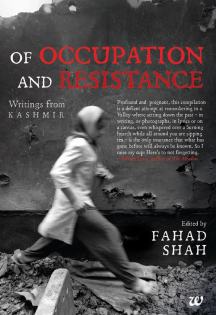
This is an excerpt from the introduction to the anthology Of Occupation and Resistance: Writings from Kashmir, edited by FAHAD SHAH
Once militancy took root in the Valley, it continued unabated, with a few exceptions in the years to come. The sentiment of the resistance movement prevailed across Jammu and Kashmir. At one point in time, blasts and encounters occurred almost every day. The first few years of the 1990s were the most brutal in the history of the conflicted Valley. After the 1996 assembly elections, when people were forced to vote at gunpoint, the National Conference Party and counter-insurgent groups ruled the state. People lived with trauma and threat – treating the injured, mourning for the dead and searching for those who had disappeared.

This was the story for more than a decade. A shift in the nature of resistance has been seen in the past few years; the generation that was born during the start of the war has been able to glean the nuances of the homeland’s political situation. Most of the youngsters from this generation, born between the late 80s and early 90s, choose stones over guns. Continue reading When the lid will burst: Fahad Shah

To the German ambassador in India, a letter from Kashmir

This letter was faxed from Srinagar on 26 August 2013 to the German embassy in New Delhi and the Bavarian State Opera. List of signatories given at the end.

To,
Ambassador Michael Steiner,
German Embassy,
New Delhi, India.

Subject:  URGENT Protest Letter to German Embassy on scheduled Zubin Mehta concert in Srinagar, Jammu and Kashmir on 7 September 2013

On 22 August 2013, a press release was issued by the German Embassy that Zubin Mehta would be conducting an orchestra on 7 September 2013 at Shalimar Bagh, Srinagar, Jammu and Kashmir.

The press release quoted you as stating that the concert was for the people of Jammu and Kashmir by way of a cultural tribute. The press release also reads that the concert was intended to give a message of hope and encouragement to the people of Jammu and Kashmir. The concert, said to be a part of a “broader engagement” is being organized by the German Embassy and supported by the “competent authorities both at Central as well as at Union State level”. The costs of the concert are covered by “benevolent sponsors mainly from the business world in India and Germany, as well as “Incredible India‟ and the German Foreign Office”. Continue reading To the German ambassador in India, a letter from Kashmir

Joint statement on atrocities on cultural activists and Dalits

Please send endorsements to  asit1917@gmail.com

download (1)We, the undersigned, are appalled and outraged by the arrest of Kanwal Bharti eminent Dalit writer for his comments on Face book. If one looks seriously at the banner headlines in the corporate media, the Indian ruling classes are  the new economic power house of the world and India, the world’s largest democracy. Various clauses of the Indian constitution guarantee the fundamental rights of its citizens to to freedom of expression and to choose ones cultural and political views. The pretensions of the Indian state about it being a liberal democracy have proved to be a total mockery of the very meaning of the words like liberalism, democracy and rule of law. Since the past six decades, under draconian laws like AFPSA, UAPA, National Security Act, tens of thousands of people have died in ‘encounters’, thousands of youth have vanished from Kashmir and Punjab. There are genocides happening on the struggling people of oppressed Nationalities, thousands are tortured, there are thousand of unknown mass graves in Kashmir. Thousands of woman are raped, tortured and killed in police custody. Continue reading Joint statement on atrocities on cultural activists and Dalits

Communalisation in the name of Security and Sovereignt: JKCCS

As Kishtwar continues to be under curfew, this public statement put out on 15 August 2013 by the Srinagar-based JAMMU AND KASHMIR COALITION OF CIVIL SOCIETY is pertinent.
On 29 July 2013, Village Defence Committee [VDC] members were alleged to have killed 16 year old Shamim Ahmed Lone, resident of Noutaas, Thatri, Doda. Further, a few days prior to the murder of Shamim Ahmed, a 16 year old girl, resident of Kuntwara, Kishtwar, was kidnapped and raped by persons backed and protected by the VDC. According to newspaper reports from last over a month at many places in Doda-Kistwar region masked men have terrorized people. Over the last week, several places in the Jammu region, particularly Kishtwar, have been subjected to violence at the hands of VDC members, supported by Hindu communal groups, which resulted into loss of three lives, numerous injuries and loss of public property. The unabated support and encouragement to VDCs by Government of India, has ensured deepening communal strife. Continue reading Communalisation in the name of Security and Sovereignt: JKCCS

The Batla House Judgement and the Impossibility of Closure

The word ‘closure’ has a reassuring, comforting resonance, particularly when it comes to matters of death. One achieves closure. It is granted.  Those who are fortunate receive it as recompense for the necessary tasks of grief and mourning. We move on.

On the 25th of July, last week, after Rajender Kumar Shastri, 2nd Addiitional Sessions Judge of the South East (Saket) Court in New Delhi announced in open court that a young man named Shahzad Ahmad of Khalispur village in Uttar Pradesh’s Azamgarh Disttrict was guilty of causing the death of Inspector Mohan Chand Sharma of the Special Cell of the Delhi Police in Flat No. 108, L-18, Batla House, in South Delhi’s Jamia Nagar on the 19th of September, 2008, the word ‘closure’ began to ring out on prime time television.  We were given to believe that the infamous ‘Batla House Encounter’ case had finally achieved closure. That the ‘martyrdom’ and sacrifice of Inspector Mohan Chand Sharma had now been vindicated. That all unseemly controversy could now be put to rest. We were told that it was time to move on.

Continue reading The Batla House Judgement and the Impossibility of Closure

The David Headley Lies Continue: There is Nothing ‘New’ About It

This release from the JUSTICE FOR ISHRAT JAHAN CAMPAIGN comes to us via Manisha Sethi.

“If you tell a lie big enough and keep repeating it, people will eventually come to believe it.” This is a quote often misattributed to the Nazi propagandist Joseph Goebbels. So widely is it believed to have been the key to Goebbelsian propaganda that it often employed by those whose politics is inspired by Goebbels’s Feuhrer.

This is exactly what we are seeing in this frenzied rush to pronounce Ishrat Jahan as a Lashkar operative by a section of media and commentators friendly to the ‘IB sources’.

Knowing full well that CBI’s mandate is only to enquire into the nature of the encounter – to probe whether Ishrat Jahan and three others were killed in cold blood – and realizing increasingly that the CBI investigation is leading to the unraveling of a plot so sordid that serious questions are going to be raised about the manner in which certain elements within the IB and agencies cynically used national security issues for vested interests, there is an attempt to pop up red herrings. False questions, planted stories, lies, fabrications – anything that will take the focus away from the guilt of those who conspired to abduct, drug and kill a teenaged college girl.

Continue reading The David Headley Lies Continue: There is Nothing ‘New’ About It

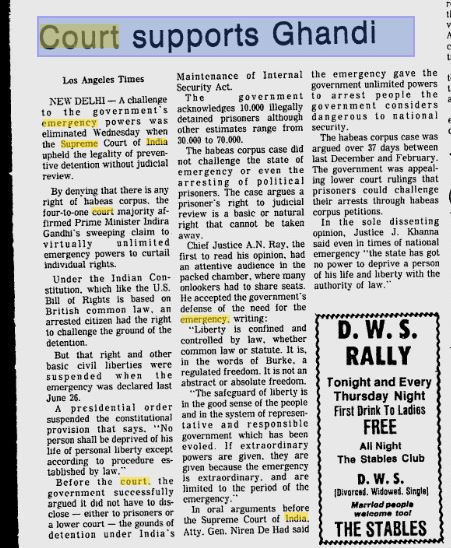
The shameful role of the Indian Supreme Court in the Emergency of 1975: Rajinder Sachar

This guest post by RAJINDAR SACHAR comes to us via the PEOPLE’S UNION FOR CIVIL LIBERTIES.

Lewiston Morning Tribune - Google News Archive Search - Mozilla Firefox_2013-07-14_19-25-11

Nations which do not remember their immediate past are in danger of repeating their tragic mistakes. This thought came to me on June 26th, 2013 (the Emergency day of 1975) when on random questioning of age group of 35 in the country (who are said to make up about half the population) I found that most of them did not know of any particular significance of the day – and more tragic, fairly large number of people above the age of 35 fared no better. Continue reading The shameful role of the Indian Supreme Court in the Emergency of 1975: Rajinder Sachar

IB says Headley says it’s too hot…

…CBI says it’s the humidity.

While the implausibility of David Headley having named Ishrat Jahan as an LeT operative has already been called out, there’s another problem here. How does anyone cross-check IB’s claim considering none of us has access to Headley?

In other words, the IB can make any insinuation and say Headley said it and we’ll have to believe at as truth.

This is apart from the fact that the judicial process in the news is not about whether or not Ishrat Jahan was an LeT terrorist. It’s about whether she was murdered in cold blood by Gujarat police. To that extent the IB does have a point in arguing that it cannot be blamed for how a state government interprets its inputs. Technically, the IB cannot be held responsible for murder by Gujarat police. But does that mean the IB cannot or should not be held accountable for what inputs it sends across?

Anyway, I posted a series of satirical tweets the other day making fun of the use of David Headley to justify the murder of Ishrat Jahan. Here are some of them.

Continue reading IB says Headley says it’s too hot…

The unbearable lightness of drowning in your own myth: Tamer Söyler

This guest post by TAMER SÖYLER is the third of a three-part series on Istanbul’s Taksim Square protests.

 995434-130611-turkey-protests

This is the final segment of a three-part account of the unrest in Turkey. The first part of the commentary discussed the unrest from the perspective of the political life course of Erdoğan. According to the protestors it was the Prime Minister as the key political figure who set the cat among the pigeons. Neither the opponents and nor the supporters of Erdoğan can make sense of Erdoğan’s turn to authoritarianism on the eve of critical election season. There are two possibilities: First, Erdoğan could have lost his emotional equilibrium and started to react to the events carelessly. Since the Prime Minister surrounded himself with advisors and party members who cannot dare to challenge him, he lost his bearings. Second, as an experienced politician Erdoğan must have a political strategy. Even if he is emotional his emotions are closely related to the concrete problems he faces. Continue reading The unbearable lightness of drowning in your own myth: Tamer Söyler

Killing it softly over two decades: Agrima Bhasin

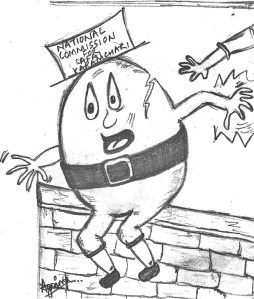
NCSK cartoon for Kafila

This is a guest post by AGRIMA BHASIN: No different from the caste hierarchy in India, the National Commission for Safai Karamcharis (NCSK) enjoys a marginal status, at the bottom, in the power hierarchy of commissions. “Why,” asked Former Prime Minister Narasimha Rao, “is it that the Commission for Safai Karamcharis is being subjected to the same discrimination as the safai karamcharis themselves? This is not something to be proud of.” He minced no words at the Conference of Welfare Ministers of States in 1996, to guilt the august gathering into recognising their culpability in deliberately weakening a competent commission. Continue reading Killing it softly over two decades: Agrima Bhasin

Will ACP Kisan Shengal of Mumbai ATS be prosecuted?: Yug Mohit Chaudhry

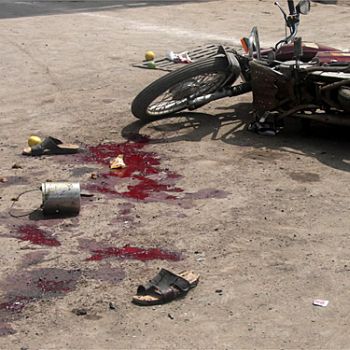
malegaon_blast_2

Guest post by YUG MOHIT CHAUDHRY: On Friday, 8th September 2006, four bomb blasts occurred in Malegaon killing thirty-one persons and injuring three hundred and twelve others. The case was originally investigated by the Maharashtra Anti-Terrorist Squad (ATS). After re-investigating the case, the National Investigation Agency (NIA) has concluded that the ATS fabricated evidence against nine persons. This unprecedented acknowledgement raises important questions about how terrorist cases are investigated, police misconduct and the rule of law in India. It remains to be seen whether the government will take action against the ATS investigating officer, Assistant Commissioner of Police (ACP) Kisan Shengal, for fabricating evidence on a capital charge. Continue reading Will ACP Kisan Shengal of Mumbai ATS be prosecuted?: Yug Mohit Chaudhry

For Erdoğan, you are with him or against him: Tamer Söyler

This guest post by TAMER SÖYLER is the second of a three-part series on Istanbul’s Taksim Square protests for Kafila.

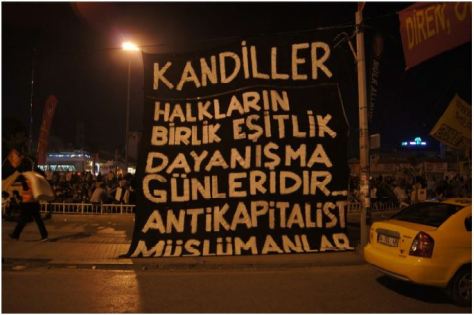
“Kandils (Islamic holy nights) are the times for equality, unity and solidarity.” Anticapitalist Muslims   Note: “Kandil” refers to the celebration of one of the five Islamic holy nights. While Erdoğan was accusing the protestors to be drinking beer and having some kind of a youth festival, anticapitalist muslims who were against the Taksim project from the very early on, wanted to give their support to the protestors. It was an interesting thing to witness. Socialists and communists were creating space for the members of the Anticapitalist Muslims to perform a public prayer in the square. This is already evidence enough that this is not secularists vs. pious.
“Kandils are the times for equality, unity and solidarity – Anti-capitalist Muslims,” this banner reads.
Kandil refers to the celebration of one of the five Islamic holy nights. While Erdoğan was accusing the protestors to be drinking beer and having some kind of a youth festival, anti-capitalist Muslims who were against the Taksim project from the very early on, wanted to give their support to the protestors. It was an interesting thing to witness. Socialists and communists were creating space for the members of the Anti-capitalist Muslims to perform a public prayer in the square. Clearly,the Taksim protests were not about secular vs. religious.

The first part of this commentary argued that as a part of his political strategy early Erdoğan had embraced a kaleidoscopic approach in governance by including various perspectives coming from citizens situated in different milieus. Erdoğan had given the impression to the citizens that his government was willing to hear the views of the citizens situated in all kinds of milieus. A simple strategy of inclusion proved to be extremely efficient for Erdoğan. Citizens who were not ideologically close to Erdoğan were quick to feel flattered by the symbolic gesture and did not hesitate to support Erdoğan. Continue reading For Erdoğan, you are with him or against him: Tamer Söyler

Can late Erdoğan learn from early Erdoğan?: Tamer Söyler

This guest post by TAMER SÖYLER is the first of a three-part series on Istanbul’s Taksim Square protests for Kafila.

taksim8
Photographs by Tamer Söyler

The 42nd President of the United States, Bill Clinton, is said to have remarked: being President is like running a cemetery; you have got a lot of people under you and nobody is listening. As is the case with any good politician, Clinton is known for his bamboo-like character. During his presidency whenever he looked the weakest, he proved to come stronger out of the chaos. Clinton’s remarkable flexibility provided him the ability to bend as much as he needed to achieve his goals without breaking. The Prime Minister of Turkey, Recep Tayyip Erdoğan, proved again that he does not have Clinton’s sense of humour, his presidency or his flexibility.

Turkey is a parliamentary representative democracy. Erdoğan has been expressing his intention to transform the country into a presidential system and become the first president of the country. The government plans to put the question of a constitutional referendum to a vote in the year 2014. The people of Turkey are suffering from a great anxiety related to a fear of finding themselves in an authoritarian, charismatic presidential system. Protestors worry that without adequate mechanisms to enforce the separation of powers in the constitution, Erdoğan can easily transform Turkey into an authoritarian regime.
Continue reading Can late Erdoğan learn from early Erdoğan?: Tamer Söyler