
For a summary with commentary, see this guest post by Arvind Narrain.
Category Archives: Centre watch
Implement Justice Verma Committee Recommendations Immediately: Freedom Without Fear Campaign
Guest Post from BEKHAUF AZAADI / Freedom Without Fear Campaign
UPA Government: Implement Justice Verma Committee Recommendations Without Delay!
The Report submitted by the Justice Verma committee marks an important measure of victory for the ongoing people’s movement against sexual violence, as well as for the decades of the women’s movement and democratic movement in India.
This Troll Has a Very Long Nose
 Ironically, the random arrest of people for tweets or Facebook postings made some of us happy—happy that, at last, citizens have started showing concern about internet censorship. But lock-up gates had to clang at night on the faces of a few people before we realised that, in our pompous democracy, the might of the state is Ctrl-Alt-Deleting opinion with such serious zeal. The arrests have been made under Section 66A of the Information Technology (Amendment) Act, 2008, notified in October 2009. This section makes punishable with up to three years’ imprisonment anything that is perceived as “grossly offensive” but does not set out the parameters of how to decide on that—even if we were to believe that could at all be done. Questions about these arrests are deflected: the government blames the police, the police says a vague law is the problem, and those who file the complaints that lead to such arrests say that they are free to seek enforcement of an existing law.
Anyone can see that the section is not designed to nudge a case towards a conviction verdict. It is designed only to harass. Arrests, courtwork, bail. You are ground down, but the government spokesman is able to say, “The law is taking its own course.” The implication: “Aren’t you grateful you have obtained bail?” But the recent arrests have caused outrage. Taking up a PIL against the section, the Supreme Court had said in December that had it not been filed, it would have taken up the matter anyway. Despite this, the government defended the section in the Rajya Sabha, refusing to repeal it and merely adding guidelines that such arrests should be made by an officer of a higher rank—as if that would make it better.
Read more, here.
A petition to end tensions at the Line of Control from citizens on both sides of the LoC
Signatures given at the end. Should you want to add your signature to this petition, write to Anuradha Bhasin at anusaba[at]gmail[dot[com]. The petition with the final list of signatories will be sent to the heads of state in both India and Pakistan.
To,
Indian Prime Minister Manmohan Singh and Pakistan President Asif Ali Zardari,
Dear Sirs,
We, the people of Jammu and Kashmir on both sides of the Line of Control, have been observing with great concern the escalation of tensions at the LoC that have been building up gradually since June 2012 and have suddenly taken an ugly turn since the first week of January, 2013.
We express grave concern at the loss of lives of the soldiers and any casualties to civilians on both the sides. At the same time, we are also concerned about the safety and security of the people of Jammu and Kashmir, particularly the people living at the borders, who are directly hit by sporadic incidents of shelling and firing. Continue reading A petition to end tensions at the Line of Control from citizens on both sides of the LoC
Now that Owaisi is in jail, how about Praveen Togadia?: Mahtab Alam
Guest post by MAHTAB ALAM
Akbaruddin Owaisi, an MLA of Andhra Pradesh Legislative Assembly, who belongs to a Hyderabad-based political party All India Majlis-e-Ittihad al-Muslimin, better known as MIM, and its floor leader in the Assembly made an inflammatory speech against Hindus on 24 December 2012 at a public meeting in Adilabad District. The speech attracted widespread condemnation by Muslim activists, rightly so, apart from left, liberal individuals and organizations. Dr. Zafarul Islam Khan, President, All India Muslim Majlis e Mushawarat (AIMMM), an umbrella body of prominent Indian Muslim organizations termed it ‘a hate and rash speech’ arguing, ‘words that should never have been uttered by a responsible person, let alone a political leader, were used’.
Shabnam Hashmi, a prominent social activist and who has been relentlessly working on the issue of minority rights registered an FIR in Delhi against Owaisi stating, ‘the whole speech is highly objectionable, inflammatory and against the values of our constitution, democracy and secular values’. Similarly, FIRs were also registered in the State invoking section 295 A (for deliberate and malicious acts intended to outrage religious feelings) and 153 A (promoting enmity between different groups) of Indian Penal Code (IPC). Owaisi was arrested finally arrested on Tuesday (8th January) and sent to 14-day judicial custody. Continue reading Now that Owaisi is in jail, how about Praveen Togadia?: Mahtab Alam
Posco – Building A Better Tomorrow with Steel: Madhumita Dutta
Guest post by MADHUMITA DUTTA
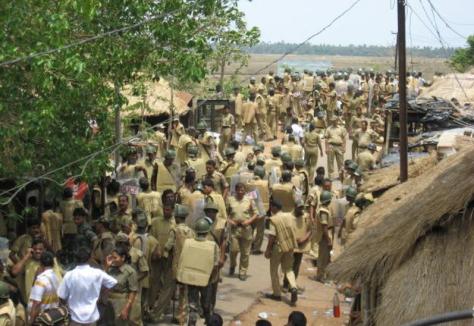
Policemen deployed at the proposed Posco site in Jagatsinghpur, June 2011
As I read the ‘sustainability-commitment’ page[1] on the website of Posco India Ltd, I was reminded of the images of a morning in a village square in the Ersama block of Jagatsingpur district in the Orissa. On April 1, 2008, Balithutha, a small village square, became the battle ground as hundreds of women, men, young and old tore down with their bare hands a 20 feet high bamboo barricade erected by the district police. An act of defiance by people who came in hundreds, mustering whatever they had—courage, fear, rage—to battle a giant – Posco Steel company of South Korea and the state of Odisha. They came to say ‘we disagree, we oppose’ the plans to take over the lands that we have farmed for generations. That day the sound of their voices and ululations reverberated from the small village square of Balithutha to the offices of the powerful. Continue reading Posco – Building A Better Tomorrow with Steel: Madhumita Dutta
The epiphanic moment of the lathi charge
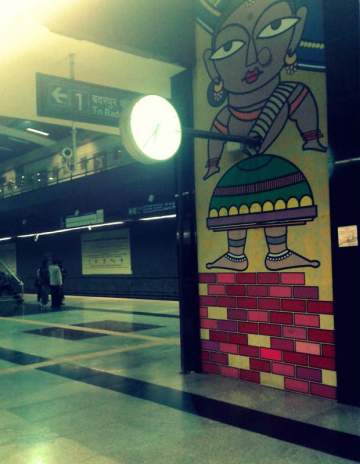
The girl wasn’t aware that the Udyog Bhavan Metro station in central Delhi had been shut down. In the Metro going to Gurgaon, she needed to get down at Udyog Bhavan. Her friend was waiting in a car outside the station. She waited at the door. The train stopped too, but the gates didn’t open. The PA system — the annoying PA system of the Delhi Metro that never stops saying something or the other — fell silent. The station was deserted. Not a soul in sight.
The girl asked fellow passengers — all of us men around her — which would be the nearest station that would be open. All the options were far off. Ramakrishna Ashram station on one end, for instance, was four kms. away. “Now what?” the girl asked her friend on the phone in a tone that blamed him, in a way only lovers can. “Now what?” she kept repeating. Continue reading The epiphanic moment of the lathi charge
How Delhi police assaulted my daughter on 25 December: Usha Saxena
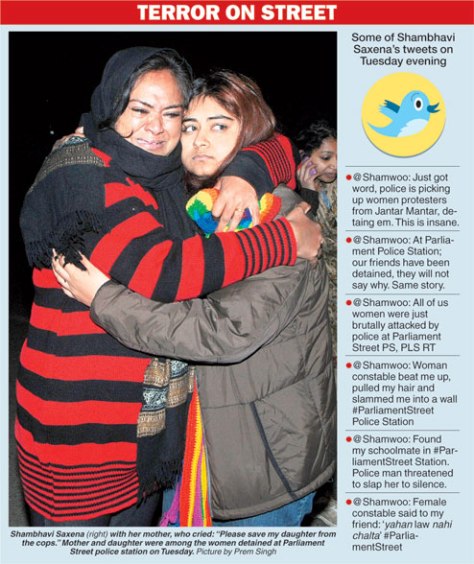
USHA SAXENA writes a letter to Delhi chief minister Sheila Dikshit:
Dear ma’am,
My daughter Shambhavi and I and a colleague of mine Reema Ganguly went to Jantar Mantar today 25th Dec to take part in a peaceful gathering there against the gang-rape.
At around 4pm two girls came running up to us in tears and said that the police had dragged away 2 of their female friends to Parliament Street Police Station and they asked us to help bring them back. The three of us joined 9 other women and we went to the police station. When we reached there we only saw male constables. We demanded to talk to a female senior officer and said that the 3 women must be released immediately. The policemen very rudely and aggressively tried to chase us out. We refused to leave without those 3 women and so one male cop ordered some female cops standing in the courtyard to come in and arrest all of us. Continue reading How Delhi police assaulted my daughter on 25 December: Usha Saxena
How not to think about violence against women: Noopur Tiwari
Guest post by NOOPUR TIWARI

I woke up in Paris last weekend to the news of the Delhi protests. I felt relieved. People are not just watching or suffering quietly anymore, I thought to myself. I wanted to be there too, out in the streets of Delhi. For all those times I had to suffer sexual harassment in Delhi, I want to be part of this churning for change now.
My Parisian friends asked me what was going on. And I told them about the new “national outrage” and the stories that had been stoking the anger. That’s when I realised I needed to make a list. What was informing my idea of what’s going on? These stories making it to the headlines, do they have something in common?
Yes, they do have one very obvious thing in common. They are all “sensational” news items. They are either:
Continue reading How not to think about violence against women: Noopur Tiwari
A Government in Hiding
Protestors from Raisina Hill began to be forcibly removed late last night. The police action continued in the foggy cold of this December morning. Aghast at the violence on a completely peaceful gathering of students – some of them just school children – many of us too felt compelled to join the demonstrations. A number of left-wing student groups who have been part of the protests had called for collecting at the Neel Gumbaz at Nizamuddin. At 11 am, we all started collecting there – many of us older folk going there in solidarity with what has been one of the most unprecedented student-youth mobilizations in the city. Yesterday, there had been repeated rounds of water cannons, tear-gas and brutal lathi-charge by the police of a government that has gone into hiding.
Finally, some 600-700 of us began moving in a procession from Nizamuddin to India Gate. When we reached there, we discovered that already large numbers of people had begun recongregating at ‘Rajpath’ – the Power Avenue where every January the Republic displays its military might to the world. The numbers were continuously swelling. A group of supporters of Arvind Kejriwal’s AAP – inclduing Kejriwal and other leaders – were squatting on one side, towards Hyderabad House. This was virtually on the margins of the area where the main crowds were. Apart from the group of people we had come with, there were hundreds who seemed to us to be completely unaffiliated ordinary students, contrary to some claims floating around in Facebook that these were ‘RSS crowds’. At one end a human chain had been erected and slogan shouting for justice continued. Around the Amar Jawan Jyoti, there were processsions of students still coming in. We were there till about 2 pm and there was no question of any violence at all – except for three unprovoked tear gas shells that had been lobbed by the police into the crowd. There had been some minor commotion as the police occassionally tried to push back students with a lathi charge of sorts.
By this time, however, it was apparent that the police was preparing for the offensive. Police briefings were taking place in different groups and gradually the crowd was being surrounded from all sides. And yet, till about 2.50 pm, despite twenty rounds of tear gas being fired by the police, as well as periodic lathi charges – they did not manage to provoke violence from the crowd to justify a crackdown. But the crackdown had to take place. And lo and behold, the justifications for it materialized, suspiciously, very soon. Continue reading A Government in Hiding
A Day at Raisina Hill: Nilanjana Roy
Guest post by NILANJANA ROY
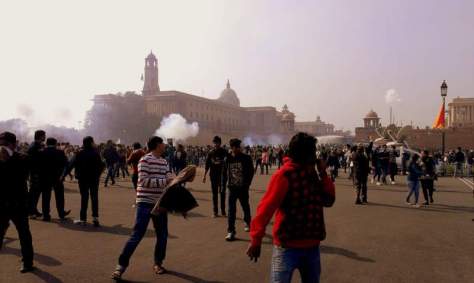
“We want justice! We want justice!”
I went to the protests at Raisina Hill expecting very little. Despite the anger over the recent, brutal gang-rape of a 23-year-old by a group of six men, who also beat up her male friend, protests over women’s violence in the Capital have been relatively small.
But the crowds walking up the Hill, towards the government offices of North and South Block, from India Gate are unusual. It’s a young crowd—students, young men and women in their twenties, a smattering of slightly older women there to show their solidarity, and it’s a large crowd, about a thousand strong at the Hill itself. There are two small knots representing student’s politicial organisations, but otherwise, many of the people here today are drawn together only by their anger. Continue reading A Day at Raisina Hill: Nilanjana Roy
Passage of Amendments to UAPA – Further erosion of Constitutional Rights: JTSA
This release was put out today by the JAMIA TEACHERS’ SOLIDARITY ASSOCIATION
The pushing through of the amendments to Unlawful Activities Prevention Act (UAPA) in the Rajya Sabha, despite protests and calls for further discussion and deferment, indicates the consensus between Congress and BJP on the issue of civil rights. The passage of the amendments, which now bring economic offences under terrorism, and broaden the definition of person to an extent that will criminalize all forms of associations, will provide sweeping powers to the police and security agencies, and create a regime of suspicion.
False Claims of the Government:
Responding to the debate in the RS, Minister of State for Home stated that, “The Act does not give sweeping powers to the police and there are checks and balances that will prevent misuse of the Act.” He further assured the House that the law was “religion neutral” and would not target any particular community.
This is patently false. Continue reading Passage of Amendments to UAPA – Further erosion of Constitutional Rights: JTSA
A song for snow: Arif Ayaz Parrey
Guest post by ARIF AYAZ PARREY
The beloved is like snow after a chilly wind. The beloved is a bright sun after snowfall. The lover is like the cinders in a kãger that refuse to die. The lover is the immortal heat of ashes.
In the 2008 Hindi movie Oye Lucky! Lucky Oye! the playing out of virtues of theft in a world of (corrupt) systems is not the only delicious element. As a matter of fact, even more lovable is the song Tu raja ki raj dulari which echoes Shiv’s plea to Parvati after she has hopelessly fallen in love with him, and chosen a path of austerity competing with his asceticism. Tu raja ki raj dulari mein sirf langoti aala sun, bhaang ragd ke piya karoun mein kunde sote aala sun. He tells her. “You are a king’s royal darling, I possess only a loincloth (Will tiger-cloth be a more helpful description here?), I drink ashes which I grind on a pistil and mortar.” Now there are several ways of looking at this parable. At the surface, and then again at its very core, it is a narration of one of the major themes of storytelling: An independent, beautiful and strong woman poignantly falling for a clumsy, reclusive and basically loser-type man, against better advice and to much heart-ache all around. But this characterisation holds only at the surface, the patriarchy of this theme works through the neat device of depth, the woman is strong, but only on the outside, quite literally when you know that Parvati once shed her outer mantle which became a powerful warrior-goddess in its own right, but in depth and beyond the obvious, she is a woman after all, while the man, clumsy, reclusive, scrawny on the surface, has an inner strength which can gulp Halahal (funnily enough called zahr-e-Hilal or ‘poison of the crescent-moon’ in Kashmiri) without much ado or do the Tandav when he feels like it. Continue reading A song for snow: Arif Ayaz Parrey
An open letter to the President of India: G. Ananthapadmanabhan
Sri Pranab Mukherjee
President of India
Rashtrapati Bhavan
New Delhi – 110 004.
India
12 December 2012
Subject: Open letter regarding the resumption of executions in India
Dear President,
I am writing on behalf of Amnesty International regarding the recent resumption of executions in India after eight years, to urge the Indian authorities to immediately establish a moratorium on executions with a view to abolishing the death penalty. Continue reading An open letter to the President of India: G. Ananthapadmanabhan
Aam Aadmi party learns from aam mahila
This release was put out yesterday by the RIGHT TO FOOD CAMPAIGN
On the second day of the “Right to Food dharna” convened by the Right to Food Campaign, hundreds of poor women from across the country braved the morning cold and rain to assemble at Jantar Mantar and voice their concerns, including the demand for a universal PDS, universalization with quality of ICDS, universal maternity entitlements, universal pensions for single women, and crèche facilities at the workplace.
Women living in urban slums, on the streets, working on construction sites, agricultural workers, single women, women with young children from different states shared their experiences of struggle for food security and access to the Public Distribution System and other food-related programmes. Continue reading Aam Aadmi party learns from aam mahila
*hit still happens
“Approximately 13000 trains run daily out of which 9000 are Passenger trains and 13 million passengers traveling every day. As per Nanda report the railways have cited several reasons for the delay, including prohibitive costs, with one estimate pegging the amount required for bio-toilets at Rs.1,600 crore. Continue reading *hit still happens
Full report: Alleged Perpetrators – Stories of Impunity in Jammu & Kashmir
Given below is a report put out this morning by the Srinagar-based INTERNATIONAL PEOPLES’ TRIBUNAL ON HUMAN RIGHTS AND JUSTICE IN INDIAN-ADMINISTERED KASHMIR [IPTK] and ASSOCIATION OF PARENTS OF DISAPPEARED PERSONS [APDP].
Given below is a press release and the executive summary of the report.
Continue reading Full report: Alleged Perpetrators – Stories of Impunity in Jammu & Kashmir
Can we solve Siachen without solving the Jammu and Kashmir dispute?
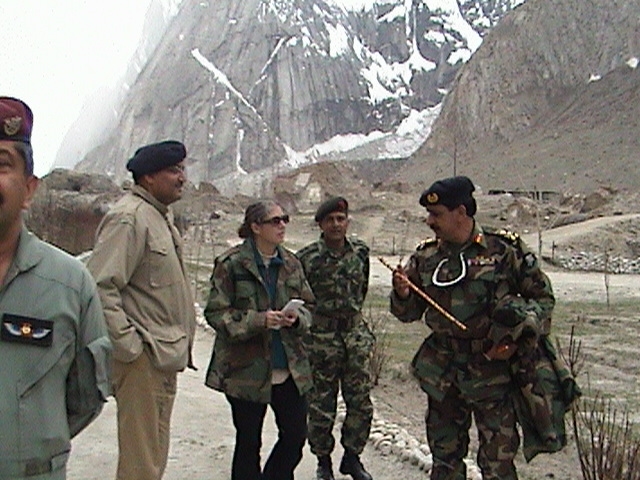
Myra MacDonald is a London-based journalist with Reuters and a long-time observer of South Asia. She tracks the turning points in Pakistan politics at the Pakistan: Now or Never. MacDonald is best known for her book on the Siachen conflict, Heights of Madness: One Woman’s Journey in Pursuit of a Secret War. Published in 2007, the research for the book took her to both sides of the conflict, on helicopter and on ground. She was bureau chief of Reuters in India in 2000-2003. She then took leave-of-absence to research the Siachen conflict, becoming one of the very few people to visit the war zone on both the Indian and Pakistani sides. She has given presentations on Siachen to the Royal Military Academy Sandhurst and to the International Institute for Strategic Studies in London. Amidst alarmist rumours that track-two parleys between India and Pakistan are urging India to ‘give up Siachen’, MacDonald tells Shivam Vij in an e-mail interview why resolving Siachen without resolving the Jammu and Kashmir dispute may not be easy.
Q1) The idea of demilitarising Siachen is being seen by some in India as a demand to hand Siachen over to Pakistan, or at the very least, to ‘lose’ the territory for which Indian soldiers have made great sacrifices. Do you agree with such an interpretation of demilitarising the glacier? Do you think India has real strategic advantage with its occupation of the glacier? Continue reading Can we solve Siachen without solving the Jammu and Kashmir dispute?
Reject amendments to UAPA – An appeal to members of the Rajya Sabha: JTSA
This release was put out by the JAMIA TEACHERS’ SOLIDARITY ASSOCIATION on 3 December 2012. Full list of signatories at the end.
It is saddening and surprising that at a time when more and more evidence is surfacing about the extensive abuse of anti-terror laws in targeting minorities, tribals, deprived sections as well as political activists, the government has chosen to move amendments in the present UAPA 2008. These amendments will make the law even more draconian and amenable to human rights violations.
You will remember that the amendments in the Unlawful Activities Prevention Act 1967 were passed in December 2008 without any thoroughgoing debate in the aftermath of the horrendous carnage in Mumbai. The Bill was not referred to any Parliamentary committee despite calls by several members for such a scrutiny and consultative process. Whilst the widespread sense of shock and reprehension at the Mumbai killings may have been weighing on the minds of the Hon’ble Members of Parliament then, four years later, surely, there is no reason to push through the amendments without a wider debate. Continue reading Reject amendments to UAPA – An appeal to members of the Rajya Sabha: JTSA
Save indie cinema in India

To:
Door Darshan India (Director General)
President of India (Shri Pranab Mukherjee)
Vice President of India (Shri Hamid Ansari)
Information and Broadcasting Minister (Manish Tiwari)
This petition is jointly filed by: Oscar Award and National Award winning sound engineer Resul Pookutty; National Award Winner and Oscar nominees Ashvin Kumar, Ashutosh Gowariker; National Award winning filmmakers Anant Mahadevan, Aparna Sen, Ashim Ahluwalia, Buddhadev Das Gupta, Girish Kasaravalli, Goutam Ghosh, Jahnu Barua, Janaki Viswanathan, Nila Madav Panda, Onir, Rituparno Ghosh, Sachin Kundalkar, Shivajee Chandrabhushan, Shyam Benegal, Sanjay Suri, Shonali Bose, Sooni Taraporevala, Sudhir Mishra, Suman Mukhopadhyay, Umesh Kulkarni, Vinay Shukla, Vishal Bharadwaj; Film makers Aamir Bashir, Amole Gupte, Anusha Rizvi, Bedabrata Pain, Homi Adajania, Kaushik Mukherjee (Q), Kiran Rao, Krishna D.K., Nandita Das, Rahul Bose, Samar Khan, Srijit Mukherji , Subhash Kapoor, Sudish Kamath, Vinta Nanda, Vipin Vijay, Zoya Akhtar; 5 time National Award winning actror, social activist and MP Shabana Azmi and actor/producer Juhi Chawla
As the country celebrates 100 years of cinema we want to bring to your notice how New Wave Indie Cinema of India is under threat. Among the various challenges that we face as Indie film makers, the biggest is that of exhibition. The multiplexes which were given tax benefits to promote small budget content film have in fact been instrumental in destroying small cinema by only playing the box office game. Continue reading Save indie cinema in India
Imagined Immunities: The Cure of Idinthakarai
The power of imagined communities was never so evident to us as on the other day, when a group of us — Malayalee people of different political affiliations — made our way to Idintakarai in southern Tamil Nadu. In many ways,we were representative of contemporary Malayalee society — we were from districts spanning the length and breadth of Kerala, had very vocally-expressed mutual differences of opinions and interests, and belonged to of different socioeconomic classes, faiths, and castes, were composed of local residents, NRIs, and Malayalees settled elsewhere in the country. Of course, we were also representative of the gender imbalances that characterize even the oppositional civil society here — there were just two women in a group of nearly thirty. We went there to express solidarity with the people of Idinthakarai who have been struggling valiantly against the monstrosity that the government of India is determined to foist on them — the Koodankulam nuclear power plant — and who have been described as traitors to the Nation by the very people who have ripped apart our sense of what a nation should mean to ordinary people. Continue reading Imagined Immunities: The Cure of Idinthakarai
 KAFILA - COLLECTIVE EXPLORATIONS SINCE 2006