Category Archives: Centre watch

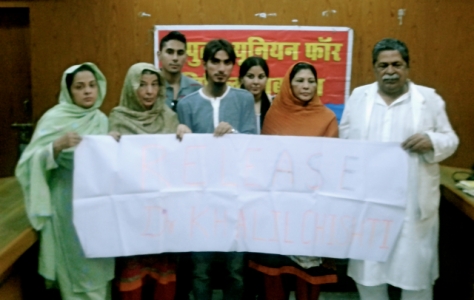
Shame on G.K. Pillai: Women demand an apology for his sexist comments

Released by JAMIA TEACHERS’ SOLIDARITY ASSOCIATION

24 November 2011

Stung by the SIT report which concluded that Ishrat Jahan was executed in cold blood, former Union Home Secretary G.K. Pillai—hard-pressed to defend his affidavit to the Supreme Court that Ishrat was a Lashkar operative—has stooped to now slandering the girl’s personal life suggesting that her checking into different hotels with “another man” was definitely suspicious. Perhaps, Mr. Pillai wishes us to believe that all those young women who travel and work independently are ‘suspicious’ and could have terrorist links. Continue reading Shame on G.K. Pillai: Women demand an apology for his sexist comments

Egypt, Revolution 2.0: Alia Allana reports from Tahrir Square

This guest post by ALIA ALLANA is a despatch from Cairo for Kafila, the ninth in a series of ground reports from the Arab Spring. Photographs by Alia Allana

This slideshow requires JavaScript.

The police lobbed another tear gas canister and soon the feeling of suffocation would take over. But he didn’t move, instead he stood in the center; he continued to wave the Egyptian flag. The sound of rubber bullets being fired drowned under the sound of the drum. The drum was the harbinger of doom: when it was sounded by protestors, when the cacophony cut through the air, the message was simple – run, run as fast as you can because the police would begin their attack, again.

Continue reading Egypt, Revolution 2.0: Alia Allana reports from Tahrir Square

Arrested Development – a comparative study of Delhi’s schools and prisons: Sajan Venniyoor

Guest post by SAJAN VENNIYOOR

“Schools are prisons,” sang the Sex Pistols. “Another brick in the wall,” raged Pink Floyd, “Teacher, leave them kids alone!” Schools and prisons have been so frequently equated in the popular imagination that it has become a cliché almost never held up to scrutiny. But even a cursory study of Delhi’s schools and prisons belies the comparison.

Sure, Delhi’s schools and prisons are both dreadfully overcrowded. Delhi’s jails, built for 6250 prisoners, house 10500 on an average.  We cannot say with any statistical certainly just how overcrowded our schools are, as the Dept. of Education has no idea how many schools it runs or the actual number of teachers and students therein.

But in almost every major indicator of human development, the penal system far outperforms the public school system in Delhi. Continue reading Arrested Development – a comparative study of Delhi’s schools and prisons: Sajan Venniyoor

JTSA welcomes the SIT report on Ishrat Jahan, demands free and fair probe into Batla House ‘Encounter’

This release comes from the JAMIA TEACHERS’ SOLIDARITY ASSOCIATION

21 November 2011 

JTSA welcomes the SIT report which has concluded that the teenaged college girl Ishrat Jahan and her three companions were killed in cold blood—and were not terrorists on way to kill Narendra Modi. This has reinforced the findings of the Tamang Enquiry Report which had drawn similar conclusions in 2009, and which the Gujarat government had tried to suppress and discredit.  The SIT report has given credence to the allegation of civil rights activists that the officers in Gujarat police had executed several people through the last decade in collusion with the highest political authority in the state. The police officers gained medals and promotions and Modi built his image as the Hindutva hero by highlighting the alleged assassination attempts on him. Continue reading JTSA welcomes the SIT report on Ishrat Jahan, demands free and fair probe into Batla House ‘Encounter’

Dilli

Dilli, the name most people of Delhi use for their city, is “a multiple-award winning documentary that has played in over 50 international film festivals across North America, South America, Africa, Europe and Asia”. Recently released online.

Continue reading Dilli

In The Indian Express, a statistical Nehru-Gandhi oddity

Over at the Indian media blog Sans Serif, Pritam Sengupta counts the number of advertisements by the Government of India on the holy occassion of the late Prime Minister Indira Gandhi’s birth anniversary, and discovers a statistical oddity:

While it is natural that ToI and HT should garner so many ads given their large circulations in the national capital, the second place for the Express group is revealing considering it sells less than five per cent of market-leaders ToI and HT in the Delhi market, which both sell in excess of 5 lakh copies.

The tabloid Mail Today, which has the third highest circulation among the Delhi newspapers, too gets fewer ads than the Indian Express. [Read the full post]

Dr Khaleel Chishty’s family in Ajmer to appeal for his release: Kavita Srivastava

This press release comes from KAVITA SRIVASTAVA of the People’s Union for Civil Liberties. It was released after a press conference in Ajmer on Friday, 18 November 2011

  • Family appeals to Governor Shivraj Patil to sign the mercy petition of Dr. Khalil Chishty pardoning him at the earliest
  • Government of Rajasthan grants perrmission to the family to meet Dr. Chishty in Jail

Clean Chit to Law-Breaker Lavasa, a Blot on India’s Democracy and Environmentalism: NAPM

This press release was put out by the NATIONAL ALLIANCE FOR PEOPLE’S MOVEMENTS on 14 November 2011

Post-facto Green signal to Phase-I of Lavasa by the Union Ministry of Environment and Forests (MoEF) given on the November 9th is a blot on the democratic process and a shockingly dangerous precedent in the history of environmental action in India. MoEF’s improper action has infact sent shock-waves to eco-activists within the country and also across the world. Although it is not the first time in the long history of Indian Environmental clearance regime that political highhandedness has been used to subvert rule of law and the ends of justice, this case is unique since the clearance has disregarded well established evidence based on facts collected by no other than the MoEF itself. It is surprising that the Ministry’s decision has come in the wake of the case filed by the Maharashtra government against 15 persons including promoters of Lavasa Corporation for alleged violations of the Environment Protection Act (EPA), while the Maharashtra Chief Minister on the other hand has recommended that Lavasa be considered for environmental clearance, exposes the double standards of the state government.  Continue reading Clean Chit to Law-Breaker Lavasa, a Blot on India’s Democracy and Environmentalism: NAPM

‘A Call for Rejecting 2011 Land Acquisition Bill’

This joint statement, signed and endorsed by various organisations and individuals from across India, named at the end, was put out on 12 November 2011. 

The 2011 Land Acquisition, Resettlement and Rehabilitation Bill is a dangerous exercise in doublespeak that will worsen the injustice and devastation caused by the present law. Below is a joint statement on this legislation from a number of organisations and individuals, calling for the rejection of the new Bill and raising the basic issues that need to be addressed by any legal framework.

The statement points out that:

Continue reading ‘A Call for Rejecting 2011 Land Acquisition Bill’

Govt must do more to protect minorities: Human Rights Commission of Pakistan

This press release was put out by the HUMAN RIGHTS COMMISSION OF PAKISTAN, Lahore, on 9 November 2011

The brazen murder of three brothers from the Hindu community in Shikarpur district on Eid day demonstrates that the perpetrators believe they can get away with murder simply because the victims are non-Muslim, the Human Rights Commission of Pakistan (HRCP) has said.

In a statement issued on Wednesday the Commission said: “HRCP is shocked at the brazen murder of the three Hindu citizens in Shikarpur and shares the sense of outrage of the Hindu community, not least because of the utter failure of the police to prevent the killings or arrest the killers even though threats of violence had been brought to their notice. Continue reading Govt must do more to protect minorities: Human Rights Commission of Pakistan

Rain, Eid and Geelani: Sameer Bhat

Guest post by SAMEER BHAT

A fine rain was falling as I disembarked the aircraft. Srinagar was shivering at 7 degrees centigrade. Rams and ewes, all set for slaughter on Eid, looked forlorn. Meat-market persons in untidy pherans haggled with locals for rates. Half the male population, I noticed, had not seen a shaving blade for weeks, a very Kashmiri trait most noticeable in winters. While it continued to drizzle, queues outside ATM machines got fretful. At least three people entered the cashpoint at one time to witness your transaction. The invasion of financial privacy has a very harmless ring to it, which is very indigenous. Continue reading Rain, Eid and Geelani: Sameer Bhat

Mistaken Identity: Arif Ayaz Parrey

Guest post by ARIF AYAZ PARREY

The Indian army in Kashmir must be reading a lot of Manto these days. Or Borges. Or Kundera. Or –and this is most likely, given the approaching winter season and their ‘hearts and minds’ programme– Kashmiri folklore.

Not three months have passed since they made a highly publicized acknowledgement of “mistaken identity” after they had killed a mentally “challenged” “Hindu” youth in Poonch and declared that he was a “fierce” “Pakistani terrorist Abu-Usman killed after a 12-hour long gunbattle” (such valour exhibited by the Indian security forces is the stuff of legends in Kashmir) that they have followed it with another announcement of a (dis)similar “mistaken indentity”.

This time, like always, the culprits are the Kashmiri people (whose synonym in the Indian army’s dictionary is “miscreants”) Apparently, people beat to pulp a “member of a covert team of the army and J&K police” who were “sent to Sopore Town on getting info of presence of terrorists in the public rally addressed  by SA Geelani”. The person was carrying a camcorder and his service pistol. The people thought he was the terrorist.

Democracy? History? Or “mishtake”? Choose your option.

Kundera writes, “When the institutions of a state no longer feel the need to make sense or to give plausible explanations, the state can only survive as long as people allow it to lie shamelessly.”

See also:

Previously in Kafila by Arif Ayaz Parrey:

My Days with Nationalism in Assam: Ankur Tamuli Phukan

Guest post by ANKUR TAMULI PHUKAN

Many of us who have been studying the political process in Assam were surprised when we received the news in December 2009 that Chairman Arabindo Rajkhowa and some of his colleagues of United Liberation Front of Asom (ULFA) had been arrested in Bangladesh. This moment had to come some day, but we were not prepared to face it. We were familiar with the brave and somewhat legendary image they had created for themselves and needed time to believe that they could be defeated. Continue reading My Days with Nationalism in Assam: Ankur Tamuli Phukan

Kashmir’s Horcrux: Sameer Bhat

Guest post by SAMEER BHAT

Hectic parleys are on at the moment to jettison the dreaded AFSPA in the valley. By conservative estimates the army must have beaten about one in every five Kashmiris at one point or the other since this piece of horrible legislation was slapped on us. An unjust law, is no law at all, Martin Luther, the symbol of protestant reformation, verbalized the sentiment of St Augustine in the 15th century. Rings true to this day.

For more than twenty years people have been punched, thrown in the back of military trucks, knocked down by gun-butts, given kicks, pushed around as they got off a bus or simply slapped around for no apparent reason. Just for being themselves, perhaps. No you could not question the moral turpitude of a military-walla from Madras if he clubbed your aging father.  Continue reading Kashmir’s Horcrux: Sameer Bhat

Giving democracy in Pakistan a chance: Raza Rumi

Guest post by RAZA RUMI

Endless predictions about the fall of the PPP-led coalition government in Pakistan have been made by pundits since the very day it came to power. The recent hullabaloo about this has been in the context of the forthcoming Senate Elections, due in March 2012, which ceteris paribus will ensure a simple majority to the PPP and its allies in the upper house. Given that the Senate is an equaliser in federalist politics, this would mean that legitimate representatives of smaller provinces would be permanent stakeholders in the system beyond this government. Continue reading Giving democracy in Pakistan a chance: Raza Rumi

AFSPA in Kashmir – “Armed Forces’ Say Prevails Anyway”: Gowhar Geelani

Guest post by GOWHAR GEELANI

There is a lot of noise in the media over AFSPA. Ask any senior Indian security official, a turn-coat politician or a retired Army General what AFSPA stands for. “Armed Forces Special Powers Act,” they will say. Now pose the same query to an ordinary Kashmiri living there in the hapless Vale for the past two decades. The answer perhaps would be: “Armed Forces’ Say Prevails Anyway”. Continue reading AFSPA in Kashmir – “Armed Forces’ Say Prevails Anyway”: Gowhar Geelani

End the culture of impunity, not just AFSPA: APDP

This is a press release from the ASSOCIATION OF PARENTS OF DISAPPEARED PERSONS

The Bund Amira Kadal, Srinagar – 190001, Jammu and Kashmir
28th October 2011

APDP feels that the recent announcement by the Chief Minister Omar Abdullah on the partial revocation of Armed Forces (Special Powers) Act (AFSPA) from some areas of Jammu and Kashmir would be insignificant for improving the human rights situation and also for providing justice to those affected by the mindless violence by armed forces.
Continue reading End the culture of impunity, not just AFSPA: APDP

Signs of improving times

Two incidents that took place recently provide hope, underlining that the India-Pakistan peace process must indeed be on track. One incident was related to the UN and the other to Kashmir, if you can believe it. Continue reading Signs of improving times

Which terrorism is a greater threat to India?

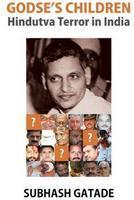
Rahul Gandhi’s answer to that question, given to American diplomats who seem to have his ear more than the people of India, was unequivocal: it’s the Hindu right whose violence he fears more. But fellow-Kafila-ite Subhash Gatade makes the point in an interview to Rediff.com that such violence is difficult to quantify and compare because it takes only a few from a community to perpetrate it:

…one sincerely feels that it is difficult to quantify the relative threats. Remember the period when India witnessed Khalistani terrorism, which involved a fraction of the misguided youth of the Sikh community and the danger it posed to peace and tranquility in the country then. [Link]

The interview discusses his new book, Godse’s Children: Hindutva Terror in India.

Assaulting Prashant Bhushan only proves the moral strength of his argument

Threatening people whose views you don’t like with violence is a sure-shot way of letting the world know who is right and whose argument is morally superior. To those who attacked Prashant Bhushan today for the comments he made in this video below, thank you for bringing more attention to them!

This is how “integral” a part of India Kashmir is – so integral that voices that doubt it must be silenced with vigilante force!

See also: a recent interview he gave to Kashmir Life in Srinagar

The unspeakable horrors of Delhi, 1947

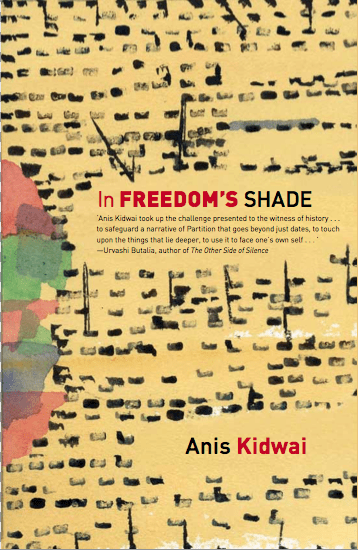
In Freedom’s Shade, by Anis Kidwai; translated from Urdu by Ayesha Kidwai; Penguin Books India 2011, Pp 382, price Rs. 450

Anis Kidwai belonged to the illustrious Kidwai family of Barabanki. The family has made more than a signal contribution to the making of India. Not only in politics and governance but also in diverse fields of creative endeavour. This short piece, though, is not about her or about her family but her most remarkable record of the unfolding tragedy in the Capital of India and in its surroundings in the aftermath of independence and partition.

Anis Kidwai, though extremely politically aware with sharp and clear views on what she saw happening, was not a political activist and would have probably continued to lead a well settled, almost sedentary life in Mussoorie, had the unthinkable not happened. Her husband, Shafi Ahmad Kidwai, the administrator of the Municipality, who had almost single handedly tried to keep peace in Mussoorie when everyone else had either given up or joined the rioters, was murdered.

Continue reading The unspeakable horrors of Delhi, 1947