“If the translation of poetry is impossible, then the translation of poetry is a genuine art.”
~Nasos Vayenas, Eight Positions on the Translation of Poetry
Translation is an act in the wake of literature. Both the languages – source and target – are variations on literary themes, with neither having priority. But translation depends on an essential paradox: a collision between restlessness and poise, detachment and recreation. In the best translations of poetry this paradox turns into a synthesis that must remain unfinished. Continue reading Slow Rendering of an Ache & Mahesh Verma’s Translation : Prasanta Chakravarty→
Since the death of a young and charismatic separatist named Burhan Wani, Kashmir has erupted into violence and chaos. Weeks of violent protests in the Valley have resulted in the deaths of at least 50 people and over 5,000 injuries. Kashmir is not new to violent protests and civilian deaths, but this time the intensity of the protest and the passion of the protesters is unprecedented. Continue reading Not Pakistan, but Modi has pushed Kashmir on the Brink : Ashok Swain→
As the cow-gangs of Hindutva go on a rampage and the the prime minister, Narendra Modi, adopts a posture of strategic silence, the country is rapidly being pushed to the brink of a civil war. This might sound a trifle far-fetched but classically, when large numbers of people begin to believe that there is no government for them, the time is not far when they will start making preparations for defending themselves. It started with the attacks on Muslims but soon enveloped the Dalits as it was bound to. The Una incident, which sparked off a veritable revolt, was followed up by subsequent attacks in Lucknow. The Progressive Dairy Farmers’ Association in Punjab, involving large number of Sikh farmers, has also been fighting continuing harassment and violence by cow-gangs of Hindutva in Punjab for some time now. The PDFA president has also stated that they might be forced to act in self-defense. The president Daljit Singh Gill, in fact, reportedly told mediapersons that “(I)f someone attacks the farmers, we will stop them now,” and “(I)f something goes wrong, it is the government’s responsibility.”
Even as the cow-gangs continue with their vigilantism unrestrained and unchecked, a large demonstration yesterday at Jantar Mantar by Samta Sainik Dal, actually sent out yet another signal. It spokespersons said in so many words that they were now prepared to take on the cow-gangs physically, if and where necessary.
Tracing SSD’s lineage back to Dr Ambedkar’s initiative in the 1924, the President of the organization openly blamed the ‘Manuvadi’ forces, in cahoots with the police and bureaucracy, backed by the government. He was candid that it is not the Sikhs or Muslims or Christians who are attacking the Dalits today but the Hindus who are doing it in the name of nationalism and that people were now in a mood to fight back unitedly together.
Not only is Modi’s deafening silence now coming to be seen as a sign of encouragement and complicity, with BJP leaders like Hyderabad MLA Raja Singh openly justifying the Una attack, and no action being taken against him by the party yet, it is clear that this vigilantism is endorsed by the highest quarters in the party. For those who may have missed seeing Raja Singh’s video, this is what he said:
“Jo Dalit gaye ke maas ko le ja raha tha, jo uski pitai hui hai, woh bohut hi achhi hui hai (Those Dalits who were taking the cow, the cow meat, those who were beaten, it was a very good thing to happen).
Sonam Mittal’s recent piece in Kafila, “Kashmir is Feminist Issue” draws upon an oft-cited gendered analogy to describe the Kashmir’s relationship with India and Pakistan. Though it makes a few pertinent points about the nexus of power and patriarchy and the urgent need for Indian feminist solidarity with the Kashmiri resistance, I found the analogy deeply problematic and strongly feel that it needs further unpacking to underline its worrying implications.
RELAA is a collective of cultural activists and independent artists across the country, on an ongoing journey to keep the space for dissent alive, for diverse understandings, imaginations and embodiments of resistance. Relaa does not wish to use the arts as an instrument for politics, but to create forms with rigour, passion, boldness and conviction – forms that can haunt, move, disturb and provoke people to think beyond facts.
An investigative report by NEHA DIXIT in Outlook on how the Sangh Parivar has flouted every law, to traffic 31 young tribal girls from Assam to Punjab and Gujarat to ‘Hinduise’ them, leaving their parents forlorn. In a three-month-long investigation, Outlook accessed government documents to expose how different Sangh outfits trafficked 31 tribal girls as young as three years from tribal areas of Assam to Punjab and Gujarat. Orders to return the children to Assam—including those from the Assam State Commission for the Protection of Child Rights, the Child Welfare Committee, Kokrajhar, the State Child Protection Society, and Childline, Delhi and Patiala—were violated by Sangh-run institutions with the help of the Gujarat and Punjab governments.
Excerpts from Neha Dixit’s five part story:
“I never wanted to send my daughter so far. What if she fell sick? What if she needed me? Where will I go looking for her? But this guy forced me,” says Adha Hasda, his eyes bloodshot with anger.
Mangal Mardi, his neighbour and a Rashtriya Swayamsevak Sangh (RSS) worker, stood by the barbed-wire fence marking out the small cowdung-plastered patch on which Adha Hasda’s house stood. He got me to meet Adha to hear for myself about the excellent welfare work that the RSS was doing in Bashbari village of Gossaigaon area in Kokrajhar district. Adha’s unexpected outburst has stunned him. He uttered something in Assamese but Adha was undeterred.
“Then where is Srimukti? Tell me? You sent her!” says Adha, breaking down. His wife Phoolmani consoles him.
“Do you plan to send the other three children too, like Srimukti?” I ask.
“No,” he says, looking up in anger. “Not even if they pay me money.”
Mangal smirks at this exchange, kneeling by the pillar of house as he twirls a smartphone in his hand.
I do not think ordinary Indians support the brutality of army occupation in Kashmir. Despite what the Indian state says, and despite what the Indian army and CRPF are doing, I honestly do not believe that any ordinary Indian supports the torture of young men, the blinding of people attending a funeral, the rape of women, the killings and maiming and abuse and humiliation that are now a routinized fact of daily life in the Kashmir valley. To believe that ordinary Indians enjoy watching this spectacle of violence, that ordinary Indians take pleasure in the torture of children, would be to think India is now a country comprised of sadistic psychopaths. I honestly do not think ordinary Indians are psychopaths. I do think, however, that ordinary Indians, and I count myself amongst them, have somehow managed, till now, to keep some distance between what is happening in Kashmir and the idea of India as a whole. After all, India is a large and complex country, a huge and diverse society. Everything that happens in Kashmir, the brutality of the army and the security forces, cannot signify the whole truth of India we tell ourselves. It seems somehow unfair to us ordinary Indians that what happens in Kashmir reflects on us all.
[Based on Gujarat Dalit flogging. It chronicles the fictionalised life of one of the victims.]
What comes to your mind when you think of India? If you’ve been seduced by films, books, pictures and anglophile Indians over the last century then you will no doubt paint a happy picture. You might romanticise the poor yet happy people, the colours, the cuisine, the attire, the mystics, the music, the dance, the cacophony, the heat and the sensory overload of this one country. The only colour missing in your picture will be any shade of black because black is a colour that India hides.Black is a colour that India detests whether it be the colour of your skin or the colour of the sewer that you’re lowered in. A bottomless pit is where you will find the true colour of India. Continue reading Black and Blue: A Short Story by Saunvedan Aparanti→
The following is a Memorandum to the Governor of Gujarat, initiated by statement issued by the Movement for Secular Democracy and signed by many eminent personalities in the state, demanding a judicial inquiry into the attacks on Dalits in Una by cow-vigilantes. The memorandum was sent on 16 July 2016.
..उना, गुजरात की इस घटना ने पूरे देश को स्तब्ध कर दिया है. पिछले दिनों इस मसले पर बात करते हुए गुजरात सरकार के चीफ सेक्रेटरी जीआर ग्लोरिया ने गोरक्षा के नाम पर चल रही गुंडागर्दी को रेखांकित किया. उन्होंने बताया कि समूचे गुजरात में दो सौ से ज्यादा ऐसे गोरक्षा समूह उभरे हैं जो ‘अपने हिंसक व्यवहार के चलते और जिस तरह वो कानून को अपने हाथ में लेते हैं, उसके चलते कानून और व्यवस्था का मसला बन गए हैं.’
ग्लोरिया ने अपने बयान में यह भी जोड़ा कि ऐसे समूहों के खिलाफ हम सख्त कार्रवाई करनेवाले हैं क्योंकि भले ही यह ‘स्वयंभू गोभक्त हों मगर वास्तव में गुंडे हैं.’ शहर से गांव तक फैले उनके नेटवर्क तथा स्थानीय पुलिस के साथ उनकी संलिप्तता आदि बातों को भी उन्होंने रेखांकित किया.
ध्यान रहे कि यह पहली दफा नहीं है जब गोरक्षा के नाम पर बढ़ रही असामाजिक गतिविधियों की तरफ संवैधानिक संस्थाओं या उनके प्रतिनिधियों की तरफ से ध्यान खींचा गया हो. अभी ज्यादा दिन नहीं हुआ जब पंजाब-हरियाणा हाईकोर्ट ने भी इसी बात को रेखांकित किया था.
अदालत का कहना था कि ‘‘गोरक्षा की दुहाई देकर बने कथित प्रहरी समूह जिनका गठन राजनीतिक आंकाओं एवं राज्य के वरिष्ठ प्रतिनिधियों की शह पर हो रहा है, जिनमें पुलिस भी शामिल है, वह कानून को अपने हाथ में लेते दिख रहे हैं.’..
( Click here for complete article : http://hindi.catchnews.com/india/protection-of-cow-violation-of-law-1469285844.html/fullview)
That subjective morality influences judicial interpretation of law is a given. But, this influence has to remain within the paradigm set by the law and cannot operate outside it or breaking it. So there are two moralities that effect the outcome of any case, one the morality of the law itself and second how the morality of the judge works in the interpretation of the law. It is in this context that judicial attitude towards sexuality has to be analyzed. And for this first the entrenched patriarchy of the legal profession has to be acknowledged. The best evidence for this is the representation of women at every level of the profession from the bench to senor advocates to advocates on record to the lowest echelons of the bar and judicial bureaucracy.
Indian law with respect to sexuality is in a Victorian time warp. It continues to criminalize any sexual activity that is not penile-vaginal penetration, so much so that till recently when the definition of rape was amended and the Protection of Children from Sexual Offences Act was enacted this was the paradigm of penalizing non-consensual sexual predation. Add to it the ingredients of individual judges’ patriarchy and accumulated religious and social conditioning.
It was the year 2013; I took an auto-rickshaw from Dal Gate to Shankaracharya temple. As the auto-rickshaw took a right from the Boulevard towards the road that goes to the temple it was halted by a long queue of vehicles, mostly cars. I could see a security-check post from the distance, men in uniform grilling the drivers and their automobiles with the same thirst. You have to clear it before you pay visit to the deity. In Kashmir, these security-checks posts are just like traffic signals we habitually obey and cross in Delhi or in any other city, every day, every few kilometres. As I got off from the auto to take some fresh air a faujee approached me. He inquired from where I was coming, a very friendly tone in his voice. I was not new to these security-checks. I am half-Kashmiri, half-Punjabi, half-Sikh, half-Indian, half-Pakistani, half- refugee, and many others halves I could never put together to give a name to. He was visibly happy to see an ‘Indian’ in the land of ‘terrorists’, probably mistaken by my Punjabi/Sikh appearance. I’m more Kashmiri than a Punjabi though. If it were 1980’s or 1990’s the approach would have been different. Punjabis, mostly Sikhs, were terrorists those days. There are few other adjectives he used for Kashmiris I would like to skip. I instantly gathered all my Indian-ness and replied in an equally friendly-Indian tone to his friendly-Indian questions. It was a casual chat. Then, he went to the auto-driver in his role as a uniformed Indian in a ‘conflict-zone’; spoke to him in a dialect ‘only Kashmiris understand’, gave a green signal and in few minutes our middle-class auto-rickshaw bypassed all the expensive cars with JK number at the rear. Continue reading The Outsiders: Jagjit Pal Singh→
Around two lakh people participated in the funeral procession of Burhan Wani: the slain Hizb militant from Shareifabad, Tral. Without a break Kashmiris are offering prayers in absentia and paying tributes to the `martyr.` Community kitchens in his locality have been set up to feed people who come to pay tributes. Defying curfew, people are crossing hills and hamlets on foot to reach his native place. Graffities in the Lalchowk area of Srinagar hail him as a hero who lives in “our hearts.” Never before has anyone witnessed such a tremendous support or tribute base for a slain militant. Militants have died before as well, but his death has given life to something unprecedented. Banners in his honour have been installed across the valley to convey the message that he will be remembered. The valley is on boil, and people are risking lives to attack armed police officers and CRPF personals. The death toll according to reports in Rising Kashmir has reached 43 and thousands of people are injured, many of them critically. While the state and the propagandistic TRP driven media emphasize Burhan being a ‘terrorist’, Kashmiris hail him as their ‘hero’ and ‘saviour.’ The question is what turned Burhan into a hero and why are Kashmiris across age groups eulogizing him? What is inspiring people to raise a slogan like, “mubarak tas maajeh yes ye zaav: shaheed hai aav, shaheed hai aaav” (congratulations to the mother who gave birth to Burhan—the Martyr). Continue reading What Made Burhan a Hero?: Muzaffar Ali→
Earlier this month I caught up with Delhi Sultanate, a member of the SkaVengers – a Delhi based reggae ensemble – around the launch of their new album XX or Double Cross to talk about their music, the unlikely journey of Udham Singh, a Indian revolutionary best known for assassinating General Dyer, and “Why Reggae?”.
Apart from the interview below, we’ve also got links to some of their music – listen, learn and enzoy.
“To be mortal is the most basic human experience, and yet man has never been able to accept it, grasp it, and behave accordingly. Man doesn’t know how to be mortal. And when he dies, he doesn’t even know how to be dead.” – Milan Kundera, Immortality
Insaan was a person who deliberately and desperately sought to mortalise himself in a world obsessed with immortality. He was very clear that he did not want to leave any footprints of his life when he died, no children, no money, no property, no awards, no monuments, no records, no pictures – except for those inevitable because of State restrictions that could trouble people who handled his death – like death certificate. He was working hard since his retirement towards his death fighting his way through the bureaucracy for anonymity in death! Then why am I writing about him disregarding his long cherished wish? Firstly his life was too important not to be chronicled; secondly whenever we joked that we would make a saint of him after he died he responded that he did not believe in an afterlife and what people did after he died was not his concern and finally, this is my way of grieving the loss of someone who was dear to me and whose relationship with me is not at all definable!
Insaan was not new to obituaries. In fact it was an obituary that brought him into my life. The story dates back to 1982, when Advocate P. M. Padhmanaban was visiting his relatives in Bombay. My grandfather, M. Rasheed had asked him to look up Insaan, his political co-traveler and fellow trade unionist from whom he had not heard in a while. On enquiries Padhmanabhan was informed that Insaan had succumbed to a long bout of jaundice and was no more. Dutifully he passed on the information to my grandfather, who wrote a long obituary in the Sunday edition of the Malayalam newspaper Mathrubhumi. The following Sunday as my grandfather was sitting with his cup of tea and perusing his morning newspapers at the Verandah of his Calicut house, Insaan walked in with a copy of the newspaper that carried his obituary!
Recent expulsion/resignation of Jagmati Sangwan from CPI(M) is reflective of organizational structure and functioning of the left. It has implications beyond the immediate specific issue of whether alignment of Party with the Congress in recently held Vidhan Sabha elections in Bengal was right or not, or for CPI(M) itself. At stake is principle of ‘democratic centralism’. Jagmati Sangwan episode has reminded me of an episode of my student days in Panjab University in early 80’s. I was convener of ‘Democratic Students’ Forum’ an independent left leaning student group on the campus (with no link with any political party as such). I was convener but found that my opinion was most often than not a minority opinion. So, effectively I was doing things, implementing decisions that I did not agree with. After many months of very intense work, I expressed my desire to be relieved of the responsibility. This was not accepted. Friends tried to persuade me to change my mind and continue with the responsibility as I ‘was making very valuable contribution’. Organisational colleagues were also personal friends, rather the only personal friends. One had no life beyond the organization. So, there was both organizational as well personal/emotional appeal to continue with the post but I found it was too much to carry out decisions with which one personally differed on grounds of principle. I requested at least a break, a breather from hectic schedule for some time. But rather than accepting my request/resignation from the post of convener, I was “expelled” from the organisation. And this was just a small, independent left leaning student group that called itself ‘democratic students’ forum’ rather than a unit of a communist party, which goes on to indicate that the problem is rather deep rooted and wide ranging. (I have cross checked my memory of this episode with some other key participants of this incident.) Continue reading Democratic Centralism – Public Issue, Private Debate: Rajinder Chaudhary→
Last year I carried out a study to record background and performance data of all students at NLS. Managing to get 97.9% compliance, the data helped in preparing the report “The Elusive Island of Excellence”, which provides a microanalysis of the institution touted as the country’s best law school, and answers two broad questions: who is likely to get admitted to NLS, and how much does background influence one’s performance within NLS? This article details why this year-long study was conducted, reflections on certain key findings and insights received from academics and scholars hypothesizing probable reasons for the outcomes of the report.
When the final figures of the Census were tabulated, the dearth of Muslims or the financial affluence of the under-graduate students at NLS came as no surprise. But what was shocking was the magnitude. Muslims form not even 1% of the student body and with average family incomes being higher than Rs. 20 lakhs per annum- majority of the NLS students come from top one percentile of the country! Not a single student who declared their caste as scheduled caste/tribe was admitted through general category, and Brahmins continue to be disproportionately dominate the numbers by forming more than a quarter of the student body. Likewise, 77.8% of the students came from families where even their grandparents had gone to college, while 26% are those with even longer history of graduates in their families.
The Kerala police has once more revealed how utterly unreconstructed it is since colonial times, in their brutal attack on transgender people in the city of Kochi. Stuck in 19th century Victorian morality on the one hand, and in the unabashed sense of power that only colonial authority can bequeath, these policemen thought it perfectly alright to use violence to correct what they perceive as a ‘moral problem’, sex work and that too, by transgendered persons. Continue reading Moral Police-Police!→
The recent “Toppers” scam in Bihar has served as a breeding ground to denigrate Biharis for their alleged corruption and backwardness. This is not the first time that Bihari bashing has surfaced as a favourite pastime of the self-indulgent elites of India. In fact, it is a continuous process with its periodic shifts. Ironically, the people who abuse people for the belief that India has gone intolerant and the people who denigrate Bihar constitute largely the same set of people reflecting the illusory, self-satisfying belief of Indian superiority and the unsuitability, other-worldliness of Bihar to suit that image of India.
Most of the trending stereotypes about Bihar, thanks to social media, seek to gain its legitimacy under the cloak of backwardness in Bihar. What is missing in the entire brouhaha and the mockery of Biharis is an attempt to delve into the processes that operate beneath the backward nature of Bihar.
One of the stark reasons, which the article would focus upon, for the alleged backwardness is that Biharis have failed to forge a concrete sub-national identity which can infuse a sense of provincial ownership over the region. It is no surprise then that elites of Bihar often hate to be termed as Biharis and, in fact, actively take part in Bihar bashing. They even go to the extent of denying their roots and to vindicate that they come up with different kind of explanations and excuses to distance themselves from the ignominy of being a Bihari. They cower down to the societal pressures of conformity so that they can live a relatively comfortable though pride-less personal life. They use English or for that matter, Hindi – both hegemonic languages – to show their progressive nature. It is an index of the lack of sub-national identity that neither of the official languages of the state, Hindi or Urdu, is the mother-tongue of a single major population group. This is despite the fact that there were languages like Maithili, which had their own literary heritage – and this leads to isolation and disillusionment to the people who do not share the language of Hindi. Continue reading Bihari Bashing and ‘Backwardness’ – A Case for Bihari Sub-Nationalism: Mayank Labh→
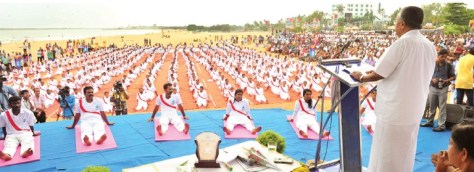
There are many ways in which ‘saffronization’ is being carried out at various levels. It takes the form of virulent battles at one extreme and persistent soft-campaigns at the other. It really does not require deep skills in socio-political analysis to see this entire spectrum of insidious divisive politics – all of that are in the clearly visible band. Surprisingly, the CPI(M) seems to have taken the attitude of a friendly match when it comes to certain variants of soft-saffronization, pretending not to see what is going on behind often innocuous-sounding things like Yoga – the latest weapon being deployed in the saffronization campaign. Instead of questioning the premises of this misplaced ‘national celebration’ and its belligerent imposition that defines the Modi government move, the party has chosen to play a friendly match by wholeheartedly joining the soft-saffronization race.
Pinarayi Vijayan at CPI-MK’s Yoga event
The CPI(M, Kerala syndicate) has, in many ways, outperformed the RSS in Kerala so much so that the hyper-active media in Kerala had very little to report on how BJP and RSS celebrated yoga day in God’s Own Country. It seemed the Sanghis were pleasantly surprised at the saffronization of the CPI(M) itself! May be, the CPI(M) is gloating over how it out-smarted the Sanghis at their own game but that is not how it works in the world of everyday politics. For their part, the Sanghis could find nothing to object to in the way the new government in Kerala celebrated yoga. It seemed the Gods came to the CPI(M) party headquarters to pay obeisance to the newly enthroned in their glorious new clothes, new language, new style, new gait, new approach, and, of course, some inklings of a new, disquieting politics.
31 May passed like any day in present-day Kerala – filled with the cacophony of mediocrities and expressions of greed, envy, and hate which have become the new normal. No wonder, then, that most people did not remember that this was the poet Kamala Das/Madhavikkutty/ Kamala Surayya’s death anniversary. I cannot help recollecting that I had predicted that this would happen: that people here would celebrate her death, display sickening sentimentality, and then quickly forget. In life and in death, Surayya never received the critical attention that she deserved as a thinker, nor did those interested in progressive left politics take her forays into politics seriously. In these times of despair, one must, however, turn to her …


 KAFILA - COLLECTIVE EXPLORATIONS SINCE 2006