The British queen placed a royal hand around the American First Lady’s waist, who graciously reciprocated, and a million words and images were launched in the world media on that historical moment.
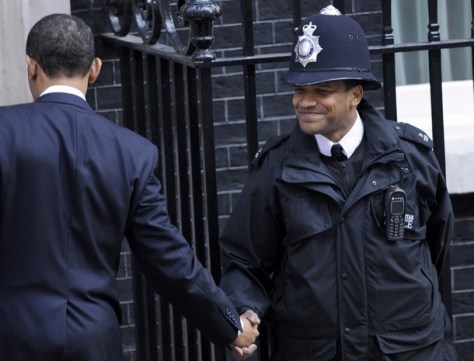
How come we never got to see this other Touching Moment in London involving another Obama? Thanks to Dilip Simeon, who was sent this by a friend, I received this picture of what happened when Barack Hussein was entering 10, Downing Street on April 1, 2009.
There he is, a British police officer joyously breaching protocol while ushering a black American president into the British corridors of power. As the caption in the forwarded message said – “the two brothers couldn’t resist the historic moment!”
[The following is the text of a press release issued by Asma Jahangir, Chairperson of the Human Rights Commission of Pakistan on April 14, 2009. The formal adoption of the Nizam-e-Adl is widely perceived in Pakistan as a surrender to the Taliban and a way of imposing the Shariat Laws in the region. And for good reason. As it went up for approval to the National Assembly, the Taliban and the Tanzim Nifaz Shariat-e-Muhammadi (TNSM) warned parliamentarians against opposing the Nizam-e-Adl Regulation. Meanwhile, Jamaat-e-Islami Naib Amir Senator Prof. Khurshid Ahmad has criticized the liberal secular lobby for debunking the introduction of Nizam-e-Adl in Malakand Area.]
Lahore: The way the National Assembly resolved to back the Nizam-e-Adl Regulation for Malakand Division on Monday does no credit to the House, and the day will be remembered for the state’s humiliating submission to blind force, a statement by HRCP said on Tuesday.
[This article was first published in Dawn 12 April 2009. It is reproduced here courtesy South Asia Citizens Web. The recent reports of the most spine-chilling instance of flogging of a young woman by Taliban goons unleashed a wave of indignation across Pakistan. This comment by Pakistani journalist Beena Sarwar is self-explanatory. For all the political illiterates and those given to anti-Muslim hate-speech in this country, this report and the innumerable discussions and posts on sites like Chowk, should indicate how much the Taliban and terrorism are hated and resisted by ordinary ‘secular’ people and women’s and human rights groups in Pakistan. They should indicate that ‘Islam’ and ‘being Muslim’ are themselves intensely contested ideas. But of course, we know that nothing can teach these hate-mongers anything, for they are the mirror-image of the Taliban. And as for us, as the old song goes: hum korea mein hum hain hindustan mein/ hum roos mein hain, cheen mein japan mein…And one might add: Pakistan mein bhi hain aur sare jahaan mein…
(There we are in korea and in hindustan/in russia we are, in china and in japan/and in pakistan too we are, we’re in the whole wide world…)
It is people like us there who must fight the Taliban, and people like them here who must fight the Hindutva fascists – always, relentlessly…Even when in the minority and especially when the political parties and leaders desert en masse. – AN]
Demo against woman's flogging, courtesy LA Times
In the “flogging video’s” undated footage shot with a cellphone in Swat (judging by the language and clothes) a man whips a woman in red, her pinned face down on the ground and encircled by men. The leather strap strikes her back as she cries out in pain.
The video, circulated on the Internet before local television channels broadcast it, caused a furore both in Pakistan and internationally. What caused the outrage? The public punishment meted out to a woman — or the fact that it was broadcast?
When newspaper columnists become self-righteous, it is usually because they see a good way of capturing reader interest by moralizing about an issue. After all, tabloids around the world regularly make fortunes by generating a false sense of moral outrage and indignation through stories of the indiscretions and ineptitudes, sufferings and misfortunes of celebrities and of not so famous people. It is a sign of irony as well as an indication of the way in which neo-liberal capitalist media works, that the consequences of alienation engendered by an individualist ideology is fodder for sensationalist reporting, but also a tool for mobilizing collective conscience against alienated individuals, and for preventing communities from understanding the real reasons for alienation.
This has never happened to me before. But then, there is always a first time for everything in life.
My name is Zainab Bawa.
“Are you Punjabi?”
“Are you Parsi?”
“What are you?” Arjun bhai, the hawker outside VT station had once asked me. “Muslim,” I had replied. And then, very bashfully, he said to me, “Just asking. Could not make out. You speak such good Marathi. And then, after all, we are all of the humanity kind – you cut my finger, the blood that oozes out will be the same as yours.” Continue reading The Shame of A Name→
This guest post was sent to us by PRASANTA CHAKRAVARTY
A recent exchange in a congregation addressing the nature of contemporary civil society caught my attention. This was a formal gathering where there was supposed to be a pitch on an idea tentatively christened civility index: that is, whether it was possible to empirically measure civility and come up with some conceptual conclusions, as well as have more practical usages once such indicators will have been developed. A searching question came from someone who had spent a lifetime fighting liberal centrism and opportunism. “Why do you call the whole thing civility index,” she inquired, “civility connotes propriety and manner and etiquette, when you are interested to scale human capacities, right?”
This is a fundamental and worthy question, especially keeping in mind that certain variants of civil society discourse has caught the imagination of many invested in democracy right now, even as they wish to steer clear of old leftist certainties and eschew easy liberal pluralism at once. Are propriety and etiquette wholly irrelevant to our understanding of modern civil society? Is manner rudimentary to civil society, counterproductive to doing anything worthwhile? Does civility dilute the associational potential of civil society—human capacities being robbed off by issues of mere conduct and comportment? Are traditional societies uncivil by definition? And does civility, more than just civil, civic or public, betray fashionable elitism unabashedly?
(Apologies for posting a mere press release, but it’s something important and yet I don’t think it will be ‘interesting’ enough for the ‘national’ media to pick up. This is not to take sides at all, because there are no sides to take.)
RASHTRIYA SAMAJ PAKSH
PRESS RELEASE
Rashtriya Samaj Paksh, Shiv Jayanti meeting attacked by Shiv Sainiks in Mumbai
The Shiv Sena once again proves that it is a Brahmanical party by attacking OBC’s
Mumbai – February 23, 2009
A meeting that was organized by the activists of the Kurla unit of the Rashtriya Samaj Paksh (RSP) was attacked by Shiv Sainiks. The SS storm troopers, numbering 50, unleashed their fury on the meeting, shouting slogans, attacking the people and throwing chairs. The very fact that the Shiv Sainiks attacked Shiv Jayanti celebrations organized by the OBC (Other Backward Caste) activists, namely the Dhangar community (Shepherds) has once again exposed the Manuwadi – Brahmanical character of the Shiv Sena. Continue reading SS Stormtroopers attack OBCs celebrating Shiv Jayanti→
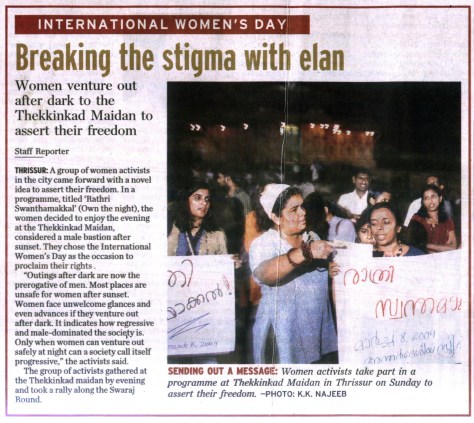
The Manglore-style of violence against women is clearly not the style of the politically powerful guardians of sexual morality in Kerala. But maybe the style is more or less redundant over here: there are very few pub-going local (or local-looking) women over here. How convenient for us women of Kerala that we Malayalees live in social arrangements that insist on sexual segregation in public spaces and institutions.
This is of course related to the particular history of gender and spatiality that unfolded between the mid-19th and 20th centuries in Kerala.Spatial categories have always underwritten caste and gender exclusion in Malayalee society. Take for instance, the derogatory term chanthapennungal (‘market women’) that refers to women who get their way through loud and vociferous argument – who work for their livelihood in market-space and reject feminine modesty. The chanthapennu is the very antithesis of taravattil pirannaval (‘she who was born in an aristocratic homestead’). Thus the woman whose daily life and labours involves traversing spaces outside the domestic and the familial is forever poised at the brink — she is who may, at any instant, collapse into being chantappennu.In traditional Malayalee society, family spaces were named by caste and constructed through caste practices and gender norms. For instance, the Brahmin home was referred to as Illam or Mana; the Nair homestead as Taravadu or Idam.In other words, a generalized notion of domestic space housing the family was absent. Indeed, the observance of spatial regulations was often taken to be crucial in shaping feminine moral qualities found characteristic of the aristocracy — and hardly vice-versa.
Sundays are days for doing nothing much. Often I sit in front of the television and surf and watch many, many movies until all the story lines start merging into one. It’s fun because it does not require you to think. If one switches on a news channel, the chances are that you will start to splutter like mustard seeds in oil, since there is so much to splutter about – Nirmala Venkatesh, a member of the central government’s National Commission for Women, was put in charge of a three-member panel to investigate the attack on the women at a pub in Mangalore at 4pm in the evening. The way she sees it, Venkatesh is supposed to have said, women have the right to enjoy themselves but should also recognize societal limits. As part of her inquiry, she said, she plans to meet with the attackers, the bar owner and the families of the young women to see whether their parents
allowed them to go out to pubs every night at midnight. “My personal advice: Women should be very careful,” she said. “I can’t just roam after midnight.”
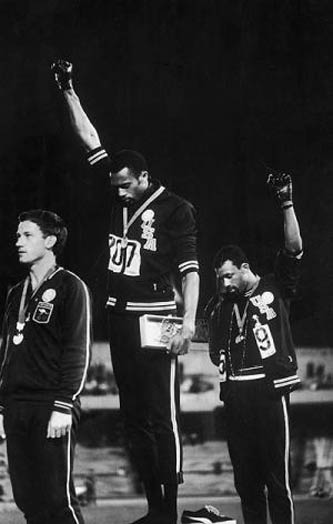
At the Mexico Olympics in 1968, this photograph of American athletes Tommie Smith and John Carlos standing on the victory podium with heads bowed and black-gloved fists raised in a Black Power salute in protest at racism in the USA, became the iconic image of the age.
In the fraught years since 1968, the weight of living through the aftermath put a heavy burden on the friendship of Carlos and Smith. In separate interviews with the Los Angeles Times it was revealed that they have barely spoken to each other since the early 1990s, despite living just a short drive apart in southern California. Smith described their relationship as “strained”. Carlos would call his former team-mate only “Mister Smith”.
When I read Vikas Swarup’s Q & A a year or so ago, I was intrigued and disappointed equally. I felt the author had focused all his energies on the tight and intricate plot, moving rapidly through it with no slip-ups, but this resulted in a grand plot outline rather than a novel. The prose is functional, characters inked in strongly but with little nuance, and when it all comes together with a click at the end, it is sort of morbidly satisfying, but one feels cheated nevertheless. All the more so because the story lingers stubbornly in memory.
I was interested enough keep track of Swarup, and found an interview in which he said that after writing four chapters he had to wind it up in a month since he was getting posted back to India and knew he would not have time for it back home.
“It was August 2003, and I had one more month in London. The plot was in my mind, so I took up the challenge and wrote down the remaining chapters in one month. Over one weekend I wrote 20,000 words.”
Well, that certainly explained the strange slightness and lack of density – the author’s hurry to reach the finish line shows drastically.
After seeing Slumdog Millionaire though, Q & A in retrospect appears serpentine in its complexity, so completely has Danny Boyle extracted the simplest and most predictable story line out of it. Continue reading Reading Swarup, Watching Boyle→
Oxford Book Store in Mumbai was visited by a cop about ten days ago, and offered a friendly caution to be “careful” about stocking books and CDs related to Pakistan, as the shop might be “targeted” after the recent terror strikes in Mumbai.
Trick question: The reason the cop dropped in was
a) to reassure the store that they would receive police protection in case such threats materialize
b) to pass on a message from Raj Thackeray
(Hint. Looks like there are two options, but there is only one)
This guest post has been sent by IMRANA QADEER and MARY E. JOHN
Surrogacy is suddenly front-page news. First there was the uncertain future of baby Manji, following the divorce of her Japanese commissioning parents; then the happy pictures of an Israeli gay couple with their son born to a Bombay-based surrogate mother. India is becoming a cheap location for foreigners wanting to use ‘assisted reproductive technologies’ (ART) and local clinics are promoting surrogacy arrangements because they are seen as lucrative ventures. While there is hardly any public debate on the ethical, social, epidemiological and medical questions around infertility and surrogacy, the extremely problematic ART Regulatory Bill (2008) is being hurried through. It barely addresses important concerns and ignores national health and population norms. It permits, for instance, three surrogate pregnancies to a woman.
[Dissidence comes along with responsibility. If that sounds an utter sell out, one has to look back no further than the career and oeuvre of John Milton, whose 400th Anniversary is being celebrated around the world.]
Students of English literature usually do not prefer meddling too much with politics, especially if that comes in the way of appreciating the hermeneutics of the text, the lyricism set aside for the work of art. Sophisticated scholars have learnt to deftly negotiate and work with Marxism, new historicism and cultural criticism, without compromising on the finer points of close reading. They have also welcomed areas like textual studies and performance and newer genres like memoirs, broadsheets, travelogues, petitions, graphic fiction and so forth within the critical ambit with a careful eye that such forays do not destabilize the Great Book tradition. Students of politics and the political, on the other hand, have a certain distrust for soft aesthetic options. In one interesting recent interview, James Scott, who routinely uses Zola and Tolstoy in his classes and works, lamented in jest on his status at the Yale Political Science Department as an outlier, blaming it onto the ascendancy and monopoly of formal and rational choice models in the discipline.
Guest post byBALMURLI NATRAJAN, a member of the South Asia Solidarity Initiative (SASI)
The Battle of Mumbai did not begin on November 26, 2008. There was no clear beginning, regardless of what somnambulists who have just woken up, or saber-rattlers who have been sharpening their tools for a while, pronounce. Like all modern wars, it burst into public view over the internet, unannounced and in full-swing. Continue reading The Battle of Mumbai→
Fifteen minutes into Dibakar Banerjee’s new film, a bunch of lower middle class Delhi boys are beating up a private school kid whose one refrain is a pleading “Jaan de bhai, extra class hai“. They don’t stop. But at one point, the gangly teenaged sardar pauses in his pummelling to make the padhaaku kid answer a crucial question, “Yeh greeting card mein likha kya hota hai?” Continue reading India’s fault lines, explored in a film about a Delhi thief – Trisha Gupta→
“The TV business is uglier than most things. It is normally perceived as some kind of a cruel and shallow money trench through the heart of the journalistic industry, along plastic hallway where thieves and pimps run free and good die like dogs, for no good reason.”
– Hunter Thompson in Generation of Swine
We, in the business of media, are running a trade in ‘faces;’ swapping ordinary ones for the attractive, distorting news coverage and not really giving a damn about it. But the craft of journalism was not always so warped. We made it so.
You have said everything there is to say, and felt everything there is to feel. You have shouted angrily or reflected seriously or stated in the calm tone of conviction that terrorists are as authoritarian as the states they target, that terrorists have no religion, that terrorists are cowards who target soft civilian populations. You have despaired at the carnage wreaked on a city sick and tired of having to be “resilient”; of having faced one disaster after the other – from floods to targeted attacks on specific communities to bomb blasts – and “emerged with its spirit intact”. Your heart has clenched painfully at the inconsolable tears of baby Moshe; at the blood-spattered, newly motherless one-year old Viraj in an exhausted Head Constable Salunkhe’s arms, entrusted to him by his father, a utensil seller wounded by bullets at CST. You have gazed numbly at the image of Maharashtra ATS Chief Hemant Karkare’s young son with drawn countenance bearing the ritual paraphernalia of his father’s cremation ceremonies. Despite yourself you felt a sudden glimmer of hope steal into you at the stony dignity in Kavita Karkare’s dry-eyed grief at her husband’s funeral, at her steadfast bindi and her coloured sari. You have hated yourself for being relieved that those you know in that poor torn city are safe, when hundreds you did not know were not.
In fear and foreboding the feeling has overcome you – “What lies ahead of us now?”