Category Archives: Debates

Black and Blue: A Short Story by Saunvedan Aparanti

This is a guest post by SAUNVEDAN APARANTI

[Based on Gujarat Dalit flogging. It chronicles the fictionalised life of one of the victims.]

What comes to your mind when you think of India? If you’ve been seduced by films, books, pictures and anglophile Indians over the last century then you will no doubt paint a happy picture. You might romanticise the poor yet happy people, the colours, the cuisine, the attire, the mystics, the music, the dance, the cacophony, the heat and the sensory overload of this one country. The only colour missing in your picture will be any shade of black because black is a colour that India hides.Black is a colour that India detests whether it be the colour of your skin or the colour of the sewer that you’re lowered in. A bottomless pit is where you will find the true colour of India. Continue reading Black and Blue: A Short Story by Saunvedan Aparanti

Kashmir, Summer 2016: Angana Chatterji

Guest Post by Angana Chatterji 

In 2011, I had written an essay on Kashmir entitled: “The Militarized Zone,”which was published in an anthology on Kashmir (Verso Books).

What was apparent then is all too real now. I reproduce an edited fragment here today, in solidarity with Kashmiris who are being asphyxiated in their land and subjected to life under conditions akin to collective internment, and their allies across India who are being intimidated to conserve the silence. Speaking up on Kashmir is inevitably accompanied by fear for many even as silence is a betrayal of humanity. Continue reading Kashmir, Summer 2016: Angana Chatterji

Statement Against State Violence in Kashmir: Ashoka University Students and Alumni

Guest Post by Ashoka University Students and Alumni

Letter condemning the State Violence in Kashmir

To

The Govt of India. and the Govt. of Jammu and Kashmir.

We, the undersigned—current students, alumni of the Young India Fellowship, and faculty of Ashoka University—write to voice our deepest anguish and grave concern at the violent turn of events in Kashmir in the past few days. The violence perpetrated by the Indian State after the extra-judicial execution(1) of 22-year old Hizbul Mujahideen Commander Burhan Wani (2) is highly condemnable. The Indian Army, Kashmir Police and other task forces have reacted violently with bullets, pellets and lathis in the clashes that erupted after Burhan’s funeral. This was immediately followed by many more protests and demonstrations as part of Kashmiri resistance to the military occupation of Kashmir by the Indian State. In the violent repression of the protests which had a huge ground support (evident from the large attendance to Burhan’s funeral) , 55 civilians (3) have been killed and around 3100 people (4) were severely injured by the pellets(5), lathis and bullets, some of whom have lost their eyesight. We, unequivocally, condemn this brutal use of force by the Indian State in dealing with the protests after the killing of Burhan Wani. Continue reading Statement Against State Violence in Kashmir: Ashoka University Students and Alumni

Students Protest in JNU Over Rising Civilian Casualties in Kashmir

The number of unarmed civilians killed in instances of firing by the armed forces, police and paramilitaries enforcing the occupation of Kashmir by the Indian state in the latest wave of violence has crossed fifty. Many more have been blinded by pellet guns. Hundreds have been injured and hospitalized. Reports of protests are coming not only from the Kashmir valley, Kargil, Drass and Jammu, but also from many cities in India. From Delhi (where there has been a public protest at Jantar Mantar, a press conference at Gandhi Peace Foundation and a student protest at Jawaharlal Nehru University), from Kolkata, which saw a massive turn out in a public march, from Chennai, from Patna, and from Kochi and Tricky in Kerala.

On Friday 22nd July, I went to a night protest march and public gathering by students at Jawaharlal Nehru University, Delhi. The march was called by Shehla Rashid, Vice President, JNUSU and Rama Naga, General Secretary, JNUSU (Both AISA activists) There were perhaps two hundred students gathered peacefully. The march began around 10:00 pm, made its way around the university campus and the protest continued well past midnight. Several student organizations, AISA, BASO, Hundred Flowers, Collective, DSU and individual students participated in the march. Shehla Rashid, Vice President, JNUSU and an AISA student activist, addressed the gathering before the march began, stating clearly, that this was going to be a peaceful expression of the democratic right to protest against the atrocities being enacted by the Indian state on the people of the part of Kashmir that is under Indian occupation. She asked the students to be vigilant in case any disruptive slogans were raised by planted agent-provocateurs. The entire march, and the protest meeting was documented by the students, so as to ensure that no ‘doctored videos’ would raise their ugly digital heads in the days to come. The students raised the demand for freedom for the people of Kashmir, and for people in all parts of South Asia. The slogans connected the realties of the people of Kashmir, the North East, Bastar, Jharkhand, with the experiences of Dalits, Workers, Peasants, Women, Students and Minorities. Slogans were raised against the killings and blindings by pellet guns in Kashmir. against torture, again rape, against draconian acts like AFSPA and PSA. The march made its way through the entire campus and culminated outside Chandrabhaga Hostel, where a meeting was held on the steps. The meeting lasted over two hours, was completely peaceful,and more than two hundred students listened to the speakers with close attention.

Police officers and campus security guards were present, and recorded everything. The students also recorded everything. And the indefatigable Shamim Asghor Ali made video recordings of several speeches, and uploaded them on to youtube, which we are lucky to be able to share here. We are also grateful for the still images uploaded by V. Arun, several others also took pictures and videos, which are now being shared on Facebook. Continue reading Students Protest in JNU Over Rising Civilian Casualties in Kashmir

The Outsiders: Jagjit Pal Singh

This is a guest post by JAGJIT PAL SINGH

It was the year 2013; I took an auto-rickshaw from Dal Gate to Shankaracharya temple. As the auto-rickshaw took a right from the Boulevard towards the road that goes to the temple it was halted by a long queue of vehicles, mostly cars. I could see a security-check post from the distance, men in uniform grilling the drivers and their automobiles with the same thirst. You have to clear it before you pay visit to the deity. In Kashmir, these security-checks posts are just like traffic signals we habitually obey and cross in Delhi or in any other city, every day, every few kilometres. As I got off from the auto to take some fresh air a faujee approached me. He inquired from where I was coming, a very friendly tone in his voice. I was not new to these security-checks. I am half-Kashmiri, half-Punjabi, half-Sikh, half-Indian, half-Pakistani, half- refugee, and many others halves I could never put together to give a name to. He was visibly happy to see an ‘Indian’ in the land of ‘terrorists’, probably mistaken by my Punjabi/Sikh appearance. I’m more Kashmiri than a Punjabi though. If it were 1980’s or 1990’s the approach would have been different. Punjabis, mostly Sikhs, were terrorists those days. There are few other adjectives he used for Kashmiris I would like to skip. I instantly gathered all my Indian-ness and replied in an equally friendly-Indian tone to his friendly-Indian questions. It was a casual chat. Then, he went to the auto-driver in his role as a uniformed Indian in a ‘conflict-zone’; spoke to him in a dialect ‘only Kashmiris understand’, gave a green signal and in few minutes our middle-class auto-rickshaw bypassed all the expensive cars with JK number at the rear. Continue reading The Outsiders: Jagjit Pal Singh

What Made Burhan a Hero?: Muzaffar Ali

This is a guest post by MUZAFFAR ALI

Around two lakh people participated in the funeral procession of Burhan Wani: the slain Hizb militant from Shareifabad, Tral. Without a break Kashmiris are offering prayers in absentia and paying tributes to the `martyr.` Community kitchens in his locality have been set up to feed people who come to pay tributes. Defying curfew, people are crossing hills and hamlets on foot to reach his native place. Graffities in the Lalchowk area of Srinagar hail him as a hero who lives in “our hearts.” Never before has anyone witnessed such a tremendous support or tribute base for a slain militant. Militants have died before as well, but his death has given life to something unprecedented. Banners in his honour have been installed across the valley to convey the message that he will be remembered. The valley is on boil, and people are risking lives to attack armed police officers and CRPF personals. The death toll according to reports in Rising Kashmir has reached 43 and thousands of people are injured, many of them critically. While the state and the propagandistic TRP driven media emphasize Burhan being a ‘terrorist’, Kashmiris hail him as their ‘hero’ and ‘saviour.’ The question is what turned Burhan into a hero and why are Kashmiris across age groups eulogizing him? What is inspiring people to raise a slogan like, “mubarak tas maajeh yes ye zaav: shaheed hai aav, shaheed hai aaav” (congratulations to the mother who gave birth to Burhan—the Martyr). Continue reading What Made Burhan a Hero?: Muzaffar Ali

Kashmir is a Feminist Issue: Sonam Mittal

Guest Post by SONAM MITTAL

To understand why Kashmir is a feminist issue, let’s take up a hypothetical, or not-really-so-hypothetical-after-all, situation of an abusive relationship.
A woman, gorgeous, graceful and delicate is in need of rescue. A man, mighty, strong and resourceful, offers to help. His only condition is that she should be his and only his for now and forever. She agrees.
It could have been the beginning of a beautiful love story if not for the underlying patriarchy and misogyny threatening to burst out. All it needed was an excuse. See, this woman had an acquaintance, a friend, with whom she had shared a part of her life. Her culture, her values and various elements that added to her charm were influenced by this friend. One fine day, this friend returned to lay claim on her. The man got angry, quite obviously. Fists and punches were thrown around and all three parties were badly hurt. Several grudges were adopted and nursed. Days went by but the memory of this brutality never faded away.
The man started placing restrictions on the woman. For her safety, obviously. Silly girl, he said, what if ‘your friend’ comes back again?
Then came in the taunts and verbal attacks. Are you really mine? Is this how you repay the help I gave you? Is this how you behave for sharing my life? Am sure you must have done something to provoke him and make him feel like he owns you.
The neighbors started talking and debating on who had a rightful claim on her. Nobody asked her what she wanted.
Day by day, the atrocities committed by the man, under the garb of protecting her, became unbearable. It was cruel enough that she had suffered many wounds on her body, some which were still hurting. The man would keep poking her, pinching and questioning her. Every action taken only for her ‘protection.’ It was almost as if he gained some perverse pleasure from her torture, knowing that no one can question him.

Continue reading Kashmir is a Feminist Issue: Sonam Mittal

Democratic Centralism – Public Issue, Private Debate: Rajinder Chaudhary

Guest post by RAJINDER CHAUDHARY

Recent expulsion/resignation of Jagmati Sangwan from CPI(M) is reflective of organizational structure and functioning of the left. It has implications beyond the immediate specific issue of whether alignment of Party with the Congress in recently held Vidhan Sabha elections in Bengal was right or not, or for CPI(M) itself. At stake is principle of ‘democratic centralism’.  Jagmati Sangwan episode has reminded me of an episode of my student days in Panjab University in early 80’s. I was convener of ‘Democratic Students’ Forum’ an independent left leaning student group on the campus (with no link with any political party as such). I was convener but found that my opinion was most often than not a minority opinion. So, effectively I was doing things, implementing decisions that I did not agree with. After many months of very intense work, I expressed my desire to be relieved of the responsibility. This was not accepted. Friends tried to persuade me to change my mind and continue with the responsibility as I ‘was making very valuable contribution’. Organisational colleagues were also personal friends, rather the only personal friends. One had no life beyond the organization. So, there was both organizational as well personal/emotional appeal to continue with the post but I found it was too much to carry out decisions with which one personally differed on grounds of principle. I requested at least a break, a breather from hectic schedule for some time. But rather than accepting my request/resignation from the post of convener, I was “expelled” from the organisation.  And this was just a small, independent left leaning student group that called itself ‘democratic students’ forum’ rather than a unit of a communist party, which goes on to indicate that the problem is rather deep rooted and wide ranging. (I have cross checked my memory of this episode with some other key participants of this incident.) Continue reading Democratic Centralism – Public Issue, Private Debate: Rajinder Chaudhary

Bangalore Police Revoke Permission for Protest on Kashmir: Greeshma Aruna Rai

Guest Post by Greeshma Aruna Rai, with Women against Sexual Violence and State Repression (WSS), Peoples’ Union for Civil Liberties (PUCL) & Karnataka for Kashmir Forum.
Police has revoked the permission which they had given yesterday to hold a democratic protest in solidarity with Kashmiris in Bangalore by concerned citizens and activists. This is another way in which the State shows its true colours to all Indian citizens who are against State repression and State colonialism in Kashmir.
Permission for today’s protest condemning atrocities on the people of Kashmir has been revoked by the Karnataka State Police. They have threatened us with legal action if we proceed.

As organisers we have been bombarded by the police, demanding that we withdraw this demonstration.

As we publish this message, the 11th day of curfew continues and valley remains awash with the blood of Kashmiris.
Today’s protest is postponed. We, however, refuse to be stifled by the very same state that is ravaging Kashmir. We have resolved to move against the actions of the Police. We’ll be releasing a Press Note shortly while discussing other options to challenge this.

[ Shortly after this post was uploaded, the organizers of the protest held a press conference where they released the following statement.]

Continue reading Bangalore Police Revoke Permission for Protest on Kashmir: Greeshma Aruna Rai

Statement On the Unfolding Situation in Kashmir : NSI Delhi Chapter

Guest Post by New Socialist Initiative, Delhi Chapter

The valley of Kashmir is on the boil again. Forsaking the so-called normal routines of their lives, people are on the streets. Not just young men, but even children and women are out, challenging the military might of the Indian state. Any fear of the police and army appears to have been discarded. Police stations and even CRPF camps have been attacked. A popular upsurge, it is energised by mass fury. Forty people have lost their lives in one week at the hands of the Indian security establishment. Hundreds of others have suffered serious eye and other injuries from presumedly ‘non-lethal’ pellets used by the police. While people are out confronting the police, para-military and army, the other organs of the Indian state in Kashmir, the elected government and its bureaucracy, elected members of the legislature, panchayats, etc. are in a rathole, fearing public appearance. It is just the people of Kashmir valley versus the institutions of organised violence of the Indian state.

While the immediate cause of popular anger is the killing of Hizbul Mujahideen militant Burhan Wani, reasons for this anger go much deeper and have a longer history. The stifling and repression of the Kashmiri people’s right to self-determination stands at the root of this conflict. This repression has taken on extreme violent forms. For twenty five years now, the Kashmir valley has been among the most militarised places in the world. More than half a million troops of Indian army and para-military forces have been stationed in the state and its border with Pakistan. Rashtriya Rifles and CRPF camps dot the land scape. Highway checkpoints and random searches are part of everyday life. Thousands of men have disappeared, been picked up by security forces, thrown in the black hole of interrogation camps, often ending up in unmarked graves. The hated AFSPA gives Indian security forces legal cover to assault basic rights of Kashmiris to live a life of elementary dignity. If an average valley resident is alienated from the normal practices of the Indian state such as elections and its administrative initiatives, s/he harbours deep resentment against the presence of Indian security forces in their homeland. This resentment has erupted in mass protests again and again.

Continue reading Statement On the Unfolding Situation in Kashmir : NSI Delhi Chapter

Kolkata Rally against Killings & Mayhem in Kashmir: Dwaipayan Banerjee

Guest Post by Dwaipayan Banerjee

Close to five hundred people came out in a rally yesterday, 15th July, to protest the ongoing killings and mayhem in Kashmir by the Indian State. The overwhelming majority of participants were students, but they were joined in good numbers by feminists, queer-activists, trade union activists, writers, journalists, academics, human rights activists, dalit rights activists, cultural activists, with many among them not affiliated with any organisation. Student and youth activists carrying flags and placards of PDSF (Progressive Democratic Student Federation), USDF ( United Students Democratic Front), AISA (All India Students’ Association), Progressive Youth League (PYL) and many from other student-youth organisations were present in good numbers, so were human rights activists from APDR (Association for Protection of Democratic Rights) and those from Bastar Solidarity Network (BSN). Many carried with them their own banners and posters. Like the rally in Delhi, protesters carried with them hand-written, hand-painted and printed placards with the names of civilians recently killed in Kashmir inscribed on it, and through those posters a connection of shared pain and solidarity flowed from the streets of Kolkata to the turbulent and stormy blood-stained streets in Kashmir. Those posters were reaching out to the people of Kashmir with messages that they were not alone in their hour of sorrow, anguish and mourning. Some of the protesters had written verses by the Kashmiri poet Agha Shahid Ali on their posters. One of those many posters summed up the mood of the rally, ‘Kashmir belongs to Kashmiris’.


[ Video by Peoples’ Camera]

Continue reading Kolkata Rally against Killings & Mayhem in Kashmir: Dwaipayan Banerjee

The ‘Congress Question’ in the CPI(M) and the Problem of Historical Relevance

The CPI(M) is currently being rocked by an internal ‘debate’ over what has emerged, to put it in somewhat old-style communist speak, the ‘Congress Question’. I put the word ‘debate’ in quotation marks because, there is a touch of innocence to the way positions in support of a possible alliance with the Congress are being expounded by respected, senior intellectuals like Irfan and Sayera Habib in their letter to the party politbureau or Badri Raina in his article in a leading newspaper. These statements follow the dramatic exit of another widely respected Central Committee (CC) member, Jagmati Sangwan, from the party for precisely the opposite reason – of the CC going soft on the Bengal CPM for having gone against the commonly arrived at understanding in allying with the Congress. There is undoubtedly a potential debate here but since the common reference point in both – the Habibs’ letter as well as in Raina’s article – happens to be the recent election in West Bengal, one cannot help feeling that it is either a  ‘debate’ over a non-problem or is, at best, a question badly posed.

I say this for two reasons. First, the West Bengal CPI(M) [henceforth CPM-WB] is not really fighting any principled battle – all its exertions in West Bengal, contra Irfan and Sayera Habib, are directed, not against the proto-fascist Modi regime but against the Trinamool Congress whose local party apparatus is substantially what it has inherited from the CPM-WB itself. In the present context of West Bengal, what is urgently required is a different Left platform (with different faces that speak a different language) that can take the place vacated by the CPM-WB. In the absence of any such alternative, nothing can prevent the BJP from emerging as the main opposition party – and if that happens, that will be the end of any kind of Left politics for a very long time to come. A ramshackle CPM-Congress alliance as the opposition to the TMC is the surest way of making the Left (even in name) irrelevant in the state’s politics. The CPM-WB’s desire for an alliance with the Congress is motivated not by the need to defeat the Modi regime’s incursions but rather to return to power any which way. This seemed such a distant dream before the elections that the latter was prepared to go into an alliance with the Congress and entertain the possibility of a joint Congress-CPM-WB ministry, even as junior partner, were electoral fortunes to be reversed by the coming into being of the alliance. Thankfully, this possibility seems ever so remote now, following the election results, despite the alliance that we need not worry about it anymore. Continue reading The ‘Congress Question’ in the CPI(M) and the Problem of Historical Relevance

Hindu Nationalists and California’s History Curriculum: Pepper Chongh

Guest Post by PEPPER CHONGH

Gayatri Chakravorty Spivak once asked us to consider that the histories of people at the margins are constantly in competition with dominant histories– that when a marginal woman speaks in dissent, the narratives of more powerful social groups can silence or supplant others.[1] This concept is at the heart of controversies around the revision of history textbooks throughout the world. It’s at the heart of the current debates on South Asian history in the California public school curriculum, up for revision this year.

In 2005-6, U.S. wings of Hindu nationalist groups named together as the Sangh Parivar[2] (the Sangh) attempted to insert changes into California’s 6th grade history textbooks. Rewriting history is one of the Sangh’s political projects toward the realization of a Hindu nation, where upper-caste Hindus dominate and benefit from all aspects of society to the exclusion and subordination of all other groups. The 2005-6 effort follows another in India in 2002-2003, when the successful insertion of Hindu nationalist histories into Indian textbooks resulted in a protest walkout by education ministers from 16 states and a scholar-led suit filed before India’s Supreme Court to block the new textbooks. In 2006, South Asian scholars and minority and other progressive activists defeated the U.S. Sangh in a public clash.[3] The California State Board of Education (SBE) rejected most of the Sangh’s edits, leading the Sangh to file two lawsuits against the SBE, both of which lost on claims of discrimination against Hindus. Continue reading Hindu Nationalists and California’s History Curriculum: Pepper Chongh

The Killings in Kashmir: Kavita Krishnan

Guest Post by KAVITA KRISHNAN

An appeal to the conscience of every Indian citizen – to tune down the shrill media noise for a bit, take a step back from the easy, packaged ‘discourse’ being dished out, and ask try and ask ourselves some uncomfortable but necessary questions. 

I am being asked by various persons in the media to comment on my apparently ‘controversial’ and ‘shocking’ claim that Burhan Wani’s killing was extra-judicial’ and must be probed. Let me begin with a few remarks about this issue.

For most Kashmiris, it may not matter all that much whether or not Burhan Wani was killed in a ‘fake’ encounter or a ‘genuine’ one. What matters is that the Indian State killed him – just as it has killed and is killing so many other Kashmiri youngsters. Their grief, their rage, does not depend on the authenticity or otherwise of the encounter. They have no expectations of due process or of justice from the Indian State. It it civil liberties activists who – in what sometimes feels like an exhausting, futile exercise – demand that due process be followed, that the mandates of the Indian Constitution be respected, that the armed forces in conflict areas be held accountable.

Continue reading The Killings in Kashmir: Kavita Krishnan

Kashmir Burns, Again

A hundred and twelve lives, most of them young, some very young, were lost in Kashmir when the army, paramilitaries and police forces opened fire on several occasions from June to September in 2010. That was only six years ago. The latest reports indicate that around twenty three lives have already been lost in the last two days alone, in the aftermath of state troopers, soldiers and paramilitaries firing at funeral protests, after Burhan Wani, a twenty two year old insurgent, who had acquired the aura of a folk hero in Kashmir, was killed in an ‘encounter’, along with two of his associates, on Friday morning in a village in Kokernag.

Several more people have sustained serious injuries. The body count is likely to rise. Curfews have returned, phone and internet links are suspended, but nothing seems to keep people from spilling out onto the streets, and unlike previous instances, the communications ban seems to be unworkable. No one can pretend that Kashmir is not in crisis, again, today.

The people in power, at the state and the centre, were different in 2010. Omar Abdullah, then chief minister of Jammu and Kashmir, was offering mealy mouthed rationalizations for killing kids then, while Mehbooba Mufti, was weeping crocodile tears. It is the other way round right now. Omar is being ‘sensitive’, Mehbooba, who the roll of the dice has placed in the position of chief minister now, is ’sullenly’ presiding over a badly timed by-election victory. Prime Minister Manmohan Singh was silent then, Prime Minister Narendra Modi is playing percussion instruments in Africa now. If Nero played the harp while Rome burnt, Modi beats drums while Kashmir goes up in flames.

Continue reading Kashmir Burns, Again

पवित्र किताब की छाया में आकार लेता जनतंत्र

भारतीय लोकतंत्र: दशा और दिशा को लेकर चन्द बातें

Never Be Deceived That the Rich Will Permit You To Vote Away Their Wealth
– Lucy Parsons


..लोग सोच रहे हैं कि आखिर जनतंत्र हर ओर दक्षिणपंथी हवाओें के लिए रास्ता सुगम कैसे कर रहा है, अगर वह ‘युनाईटेड किंगडम इंडिपेण्डस पार्टी’ के नाम से ब्रिटन में मौजूद है तो मरीन ला पेन के तौर पर फ्रांस में अस्तित्व में है तो नोर्बर्ट होफेर और फ्रीडम पार्टी के नाम से आस्टिया में सक्रिय है तो अमेरिका में उसे डोनाल्ड ट्रम्प के नाम से पहचाना जा रहा है। वैसे इन दिनों सबसे अधिक सूर्खियों में ब्रिटेन है, जिसने पश्चिमी जनतंत्र के संकट को उजागर किया है।

ब्रिटेन को यूरोपीयन यूनियन का हिस्सा बने रहना चाहिए या नहीं इसे लेकर जो जनमतसंग्रह हुआ, जिसमें सभी यही कयास लगा रहे थे कि ब्रिटेन को ‘अलग हो जाना चाहिए’ ऐसा माननेवालों को शिकस्त मिलेगी, मगर उसमें उलटफेर दिखाई दिया है; वही लोग जीत गए हैं। और इस बात को नहीं भुला जा सकता कि जो कुछ हो हुआ है उसमें प्रक्रिया के तौर पर गैरजनतांत्रिक कुछ भी नहीं है। दक्षिणपंथ के झण्डाबरदारों ने ऐसे चुनावों में लोगों को अपने पक्ष में वोट डालने के लिए प्रेरित किया है, जो पारदर्शी थे, जिनके संचालन पर कोई सवाल नहीं उठे हैं।

( For full text of the article click here : https://sabrangindia.in/article/pvitra-kitab-ki-chaaya-mein-aakar-leta-hai-jantanta)


Bihari Bashing and ‘Backwardness’ – A Case for Bihari Sub-Nationalism: Mayank Labh

Guest post by MAYANK LABH

The recent “Toppers” scam in Bihar has served as a breeding ground to denigrate Biharis for their alleged corruption and backwardness. This is not the first time that Bihari bashing has surfaced as a favourite pastime of the self-indulgent elites of India. In fact, it is a continuous process with its periodic shifts. Ironically, the people who abuse people for the belief that India has gone intolerant and the people who denigrate Bihar constitute largely the same set of people reflecting the illusory, self-satisfying belief of Indian superiority and the unsuitability, other-worldliness of Bihar to suit that image of India.

Most of the trending stereotypes about Bihar, thanks to social media, seek to gain its legitimacy under the cloak of backwardness in Bihar. What is missing in the entire brouhaha and the mockery of Biharis is an attempt to delve into the processes that operate beneath the backward nature of Bihar.

One of the stark reasons, which the article would focus upon, for the alleged backwardness is that Biharis have failed to forge a concrete sub-national identity which can infuse a sense of provincial ownership over the region. It is no surprise then that elites of Bihar often hate to be termed as Biharis and, in fact, actively take part in Bihar bashing.  They even go to the extent of denying their roots and to vindicate that they come up with different kind of explanations and excuses to distance themselves from the ignominy of being a Bihari. They cower down to the societal pressures of conformity so that they can live a relatively comfortable though pride-less personal life. They use English or for that matter, Hindi – both hegemonic languages – to show their progressive nature. It is an index of the lack of sub-national identity that neither of the official languages of the state, Hindi or Urdu, is the mother-tongue of a single major population group. This is despite the fact that there were languages like Maithili, which had their own literary heritage – and this leads to isolation and disillusionment to the people who do not share the language of Hindi. Continue reading Bihari Bashing and ‘Backwardness’ – A Case for Bihari Sub-Nationalism: Mayank Labh

Saffronization, Yoga and the Kerala Left: CP Geevan

Guest post by CP GEEVAN

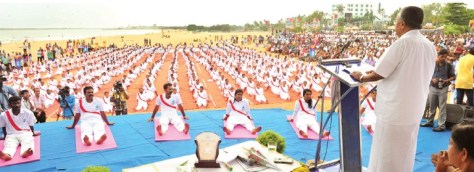
There are many ways in which ‘saffronization’ is being carried out at various levels. It takes the form of virulent battles at one extreme and persistent soft-campaigns at the other. It really does not require deep skills in socio-political analysis to see this entire spectrum of insidious divisive politics – all of that are in the clearly visible band. Surprisingly, the CPI(M) seems to have taken the attitude of a friendly match when it comes to certain variants of soft-saffronization, pretending not to see what is going on behind often innocuous-sounding things like Yoga – the latest weapon being deployed in the saffronization campaign. Instead of questioning the premises of this misplaced ‘national celebration’ and its belligerent imposition that defines the Modi government move, the party has chosen to play a friendly match by wholeheartedly joining the soft-saffronization race.

Pinarayi Vijayan at CPI-MK's Yoga event
Pinarayi Vijayan at CPI-MK’s Yoga event

The CPI(M, Kerala syndicate) has, in many ways, outperformed the RSS in Kerala so much so that the hyper-active media in Kerala had very little to report on how BJP and RSS celebrated yoga day in God’s Own Country. It seemed the Sanghis were pleasantly surprised at the saffronization of the CPI(M) itself! May be, the CPI(M) is gloating over how it out-smarted the Sanghis at their own game but that is not how it works in the world of everyday politics. For their part, the Sanghis could find nothing to object to in the way the new government in Kerala celebrated yoga. It seemed the Gods came to the CPI(M) party headquarters to pay obeisance to the newly enthroned in their glorious new clothes, new language, new style, new gait, new approach, and, of course, some inklings of a new, disquieting politics.

Continue reading Saffronization, Yoga and the Kerala Left: CP Geevan

Gandhi – A Religion of the Question: Ajay Skaria

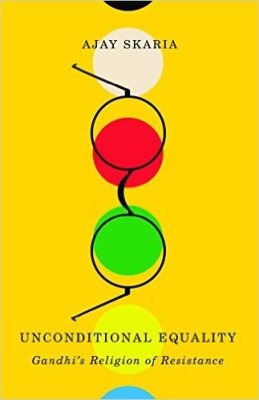
[The following is the ‘Preface’ to AJAY SKARIA’s recent book, Unconditional Equality: Gandhi’s Religion of Resistance by Ajay Skaria. The preface raises interesting questions not only about Gandhi’s politics but also about the idea/s of secularism and religion in what we might call a postsecular world – a world that is, where the naive and uninterrogated binary between the two terms is constantly put into question. Also of interest to readers might be the attempt made by the author to read Gandhi’s writings as a long and ongoing struggle to articulate or ‘understand’ his own politics – a politics that Skaria claims is as much premised on equality among humans as it is on the equality of all being/s.]

Unconditional Equality by Ajay Skaria

Somewhere in the early 2000s, while preparing to teach Mohandas Karamchand Gandhi’s English translation of Hind Swaraj to my undergraduate class, a passage about history in the text intrigued me. Since I happened to have the Gujarati version of that text at hand, I consulted it. The divergence is striking. The Gujarati text criticizes “history” (the English word occurs in the Gujarati text) and contrasts  it to itihaas [usually translated as “history”]. The English text criticizes “history,” but in it there is no equivalent for itihaas; the contrast between history and itihaas is thus obscured. The gap between the Gujarati and English texts, I have since come to realize, is symptomatic of Gandhi’s struggles to think his politics. What this politics involves is by no means clear to him; perhaps he writes so prolifically and indefatigably (his collected works run to ninety-eight volumes in English) precisely in order to try and understand his own politics. This politics becomes even more intriguing when we attend not only to Gandhi as an author or “intending subject,” but to his writing.[1] By dwelling in and on the gaps (between Gujarati and English and also within each of these languages) in his writing, this book tries to draw out his politics.

For me, writing this book has been difficult also because of another gap—that between Gandhi’s insistence that there can be “no politics without religion” and the secular inheritance that I have, as far as I know, no desire to abandon. Gandhi repeatedly describes satyagraha (his most famous neologism, which he coins initially as a translation of “passive resistance”) as his “dharma” or “religion,” even as the religion that stays in all religions.[2] Symptomatic of my difficulty with this religious politics was my inability for long to even recognize it. When Vinay Lal first asked me in 2007 to write an essay on Gandhi’s religion for a volume he was planning on political Hinduism, I protested that I was not interested in this aspect of Gandhi. But with his characteristic persistence, Vinay did not accept my protests, and I ended up writing that essay, which became a precursor of this book.

In the process, my own understanding of dharma and religion as “concepts” has been transformed.[3]

Continue reading Gandhi – A Religion of the Question: Ajay Skaria

Stop Trying to Portray Us as Extremists: Dalit Human Rights Movement

The police investigation about the bomb blast at the Kollam Collectorate on 15 June 2016 has now turned against us. Neither the organization nor its activists have any involvement in this incident. The accusation against us is just a ploy to use draconian laws such as the UAPA to destroy dalit-adivasi resistance.

The demeaning and enslaving social norms in Kerala have, since centuries, denied dalit people the most basic human rights such as the right to education, the right to decently clothe one’s body, the right to travel on public roads, and express one’s views. But India became a democracy that aimed for social democratisation, and Dr B R Ambedkar raised the possibility of social equality and reservations for the underprivileged groups through the Indian Constitution. Yet, sixty-five years later, the classes fundamental to this society have made no social, economic, or cultural progress and they continue to endure caste slavery and and exploitation in all areas of public life. The mainstream political parties who surfaced as the protectors of these classes have never offered them complete protection at any time. Though they have been faithful followers and workers of these parties, members of the disadvantaged groups have had little economic security; they have lacked social education; they have had to cry out for tiny parcels of land. Continue reading Stop Trying to Portray Us as Extremists: Dalit Human Rights Movement

Crushing Dignity, Force-feeding Honour: The CPM is Back in Form Again!

The hunt, it seems, is on again. The CPM in power has begun to show its fangs again, and shamefully, they seem to threaten only dalit people who refuse and criticise their disciplinary/welfarist embrace.  In north Kerala, two dalit women were arrested for having allegedly attacked a DYFI leader who abused them in casteist terms. In the south, the persecution of the Buddhist Dalit Human Rights Movement (DHRM)seems to have begun afresh, with the police and the press foisting on them responsibility for the recent bomb blast at the premises of the Kollam Collectorate. The two women mentioned belong to the Congress party; as for the DHRM, the CPM has had a long-standing grouse against them, carried forward now from their last term in power. I am not sure, but the recent ouster of Laha Gopalan, the leader of the Chengara land struggle in the wake of the CPM’s return to power, could be part of this story too. I have no love lost for that man, who evoked the name of Ambedkar but ran the village set up by the landless in Chengara like a crude caste headman. But the timing of his expulsion and the way the village seems to be under the thumb of the police arouses discomfort. Continue reading Crushing Dignity, Force-feeding Honour: The CPM is Back in Form Again!