Category Archives: Debates

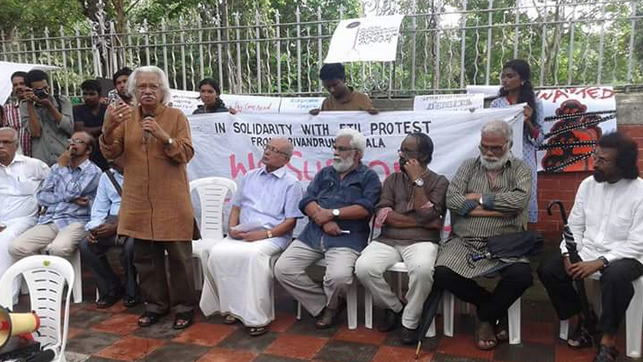
No To Ambedkar-Periyar in ‘Modern Day Agraharam’?

Whether discussing issues of contemporary concern among students, raising debates around them on the campus – taking inspiration from the ideas of leading social revolutionaries of 20th century – should be construed as an act of creating ‘social disharmony’ or ‘spreading hatred’ ?

Any sane person would rather reject this weird proposal but it appears that the bureaucrats in the Ministry of Human Resources Development (MHRD) think otherwise. It was evident in the way they acted on an anonymous complaint regarding the activities of a group of students in IIT Madras which calls itself ‘Ambedkar-Periyar Study Circle’ (APSC) – which comprises mainly of dalit, bahujan and adivasi students. Perhaps they were worried that the particular students group, has been critical about PM Modi’s policies and has been raising issues of caste, communalism as well as corporate loot of resources and challenging the ‘development’ narrative which is popular these days among a section of people. The impetuosity with which they acted when they wrote to the management of the Institute can also be gauged from the fact that in this process they violated the recommendations of the CVC (Central Vigilance Commission) itself which has ‘barred’ organisations from taking action on such (anonymous) complaints.

As of now the issue of ‘derecognition’ of APSC by the IITM management, has snowballed into a major controversy, with issues of curtailment of freedom of expression, infringement of autonomy of educational institutions and dominance of caste in higher education all coming to the fore. Continue reading No To Ambedkar-Periyar in ‘Modern Day Agraharam’?

Bread and Circuses? No sir, circuses alone will do.

Edited and updated version of the post.

I had the great fortune to be invited as an audience member to a live interaction with Union HRD Minister Smriti Irani last evening, televised live on Aaj Tak. I say “great fortune” because despite the fact that I walked out of this “interaction” in speechless disgust around an hour into the programme, I probably learned more about the state of politics and media in this country in one evening than I could have from years of academic study. And the irrelevance of academics was exactly what was on display last evening, never mind that the topic of the interaction was the state of higher education in the country.

I reached the venue – the auditorium of Khalsa College, Delhi University – at about 5.15 pm for a 5.30 pm programme. The mood was surprisingly charged, even electric for what I imagined would be a sober discussion on somewhat boring topics like syllabus formation, university infrastructure, promotions and pensions, the points system, and most importantly, the changes proposed under the Choice Based Credit System (CBCS). The auditorium was already packed – not so much with teachers and students – but with a large number of ABVP activists, BJP volunteers, and committed party supporters from within and outside the University. Nothing wrong with having a politically committed section dominating the audience of course. But if the resultant mix is innocently termed “the public” – the term the anchor used was “janta” – then that constitutes the first point of deception. I took a seat in the second row as instructed, surrounded by triumphant, pumped-up BJP supporters shaking hands with each other, suddenly feeling small and irrelevant, having come prepared with questions on Delhi University. At one point, turning to speak to the person next to me, I encountered a gentleman who introduced himself only as a “social worker” and asked me to elaborate on the problems with the university. As I began to list them however, he cut me short with a wave of a hand to say the government will prevail over all of them, and turned back to gaze admiringly at the life-sized posters of Modi all around us. I realised the person knew absolutely nothing about the University or teaching as a profession, and couldn’t care less.

Two anchors from Aaj Tak – Anjana Om Kashyap and Ashok Singhal – were on stage, interacting intermittently with the audience. At one point, Kashyap turned to the audience and said she was aware that there were many eminent professors in the first two rows who had been invited by Aaj Tak, but that she would begin the interaction with the Minister first with general questions on politics, and then move on to the topic of the evening – higher education. Nobody seemed happy with this, but having little choice, we vaguely nodded our assent. In walked Irani, striding up confidently on to the stage. Without so much as acknowledging the audience or making eye contact, she began to banter with the anchors, saying she only had half an hour and had not agreed to two hours, etc. While this time bargaining was going on, the crowd began to settle down somewhat, and the cameras began to roll. As planned and announced, Kashyap began with politics, asking Irani about her Twitter war with Rahul Gandhi and with her frequent visits to Amethi. As far as I or anybody who cares deeply about what is happening to Delhi University and other universities in the country was concerned, THAT WAS THE END OF THE EVENING.

Continue reading Bread and Circuses? No sir, circuses alone will do.

A Short Guide to Appropriate Behaviour in the Wake of A Judgement on Historically Respectable Personalities

[ This short guide is being released to the general public which is liable to fall into error and confusion in the wake of the recent Supreme Court judgement in Devidas Ramachandra Tuljapurkar vs. State of Maharashtra restricting freedom of speech and expression pertaining to what the Honourable Justices who have looked at this case call ‘historically respectable personalities’.]

1. Petition all history departments to start courses in historical respectability so that you know who is who and what is what.

2. Having carefully studied the history of respectability, separate out all historically respectable personalities. Genuflect.

3. Then, from those that remain, make a list of historically disrespectable personalities, starting with yourself.

4. Refer to a historically respectable dictionary of slang – for instance, ‘Cassell’s Dictionary of Slang’ by Jonathan Green, the works of William Shakespeare, or a set of curses of the historically respectable Muni Durvasa

5. Choose at least ten colorful insults, curses and terms of abuse, from the above. and construct a poem, written in the ‘voice’ of a historically disrespectable person.

6. Print in large characters, along with an image of a historically disrespectable personality.

7. Stand singly, or in groups, with the large character posters with the poems in the ‘voice’ of  historically disreputable personalities in meditative silence in front of the honorable Supreme Court of India, and in other public spaces, while considering the sagacious wisdom of our historically respectable judiciary.

8. Be ever grateful that you know now that you can always protect your constitutionally guaranteed and judicially protected freedom of speech by ventriloquizing to your hearts content in the abusive voice of a historically disrespectable personality.

9. And learn this formula by heart – “The dignity of historically respectable personalities cannot be protected without the self-flagellation and abuse of historically disrespectable personalities, which includes the majority of all populations, in all societies, in all times.”
10.  Never disobey a law, or a judgement. Only take obedience to its logical conclusion.

बाल श्रम कानून में बदलाव का औचित्य :किशोर

Guest Post by Kishore

Photo courtesy : newznew.com

संसदीय कैबिनेट ने १३ मई को बाल श्रम प्रतिबंधन एवं नियमन कानून (CLPRA act) में संशोधन को मंजूरी दे दी. मुख्य सकारात्मक बदलावों में १४ वर्ष की आयु तक किसी भी व्यवसाय अथवा प्रक्रिया में बाल श्रम पर पूर्ण प्रतिबन्ध का प्रावधान किया गया है जो स्वागत योग्य है. साथ ही ज्यादा कठोर सजा एवं जुर्माने का प्रावधान भी किया गया है जो कि सकारात्मक है. हालाँकि अभी भी यह बाल अधिकार समझौते की कसौटी पर खरा नहीं उतरता क्योंकि इसमें १४ से १८ साल के बच्चों को गैर खतरनाक उद्योगों में काम करने की अनुमति दी है पर फिर भी चौदह वर्ष तक पूर्ण प्रतिबन्ध एक प्रगतिशील कदम है.

चौदह वर्ष तक पूर्ण प्रतिबन्ध के बावजूद पारिवारिक व्यवसायों में बच्चों के काम करने को छूट दी गयी है .बच्चे पारिवारिक व्यवसायों में काम कर सकते हैं बशर्ते यह काम बच्चे स्कूल जाने के बाद करते हों. सरकार इस छूट का मुख्य कारण यह बता रही है कि इससे बच्चों को अपने पारंपरिक काम सीखने का मौके मिलेगा.

आइये इस बात की समीक्षा की जाये कि यह कारण कहाँ तक तार्किक है. सरकार पारंपरिक कौशल को लेकर कितनी चिंतित है यह तो पिछले बीस साल में हथकरघा और अन्य पारम्परिक पेशों के लिए बनाई गई नीतियों से स्पष्ट है. कोई उनसे पूछे की पिछले बीस सालो में घरेलू उत्पाद में पारंपरिक व्यवसायों का योगदान किस दर से बड़ा है? अगर सरकार को पारंपरिक कौशल के लुप्त होने का इतना ही डर है तो क्यों नहीं इसे स्कूली पाठ्यक्रम में शामिल करती ? अगर इसे पाठ्यक्रम में शामिल किया जाये तो बच्चे पढाई के साथ साथ व्यावसायिक कौशल भी सीखेंगे जो उनके जीवन में काम आयेगा. साथ ही पढाई के साथ काम सीखने से पढ़े लिखे लोगों में श्रम को नीची नज़र से देखने के नज़रिए पर भी लगाम लगेगी और शिक्षा और शारीरिक श्रम के बीच का फासला घटेगा. Continue reading बाल श्रम कानून में बदलाव का औचित्य :किशोर

Bombay Pavement Dwellers and Olga Tellis – A Quiet Verdict in Ahmedabad: N. Jayaram

Guest Post by N. Jayaram

After the order in the case of film star Salman Khan over a 2002 hit-and-run case was delivered by Sessions Court Judge D.W. Deshpande on Wednesday, 6 May 2015, there understandably were divided opinions on whether he deserved to be handed five years in jail.

But the rather more shockingly breath-taking comments from some of his friends in the industry and his fans were to do with pavement dwellers, such as the victim Nurullah Mahboob Sharif.

“Kutta rd pe soyega kutte ki maut marega, roads garib ke baap ki nahi hai (If a dog sleeps on the road, he’ll die a dog’s death. Roads are not poor people’s property)…,” singer Abhijeet Bhattacharya tweeted. “Roads are meant for cars and dogs not for people sleeping on them…,” he said, appealing to the film industry to back the star, whose sentence has now been suspended by the High Court.

Designer Farah Khan Ali chipped in with this:  “No one should be sleeping on the road or footpath. It is dangerous to do that just like it is dangerous to cross tracks.” She quite rightly laid the blame on the state: “The govt should be responsible for housing ppl. If no1 was sleeping on d road in any other country Salman wuld not have driven over anybody.”

Perhaps she had read the International Covenant on Economic Social and Cultural Rights, to which India is a state party. Article 11.1 of the Covenant says: “The States Parties to the present Covenant recognize the right of everyone to an adequate standard of living for himself and his family, including adequate food, clothing and housing, and to the continuous improvement of living conditions. The States Parties will take appropriate steps to ensure the realization of this right…” Continue reading Bombay Pavement Dwellers and Olga Tellis – A Quiet Verdict in Ahmedabad: N. Jayaram

Seminar on Balochistan Missing Persons at Karachi University despite administration refusing permission

mama3

Sabin Mahmud was killed after organizing an event on Balochistan in T2F in Karachi, and more recently, Syed Wahidur Rehman, a Karachi professor was also shot dead. But far from being silenced, the resistance of democratic forces in Pakistan is growing. Today, Karachi University faculty organized a seminar on Balochistan missing persons to massive response, despite the administration refusing permission and locking the doors of the venue. The event was held in the Arts lobby, from where it seems to have spilt outside too.

11214139_10152694077270870_338189832357349941_n

A determined audience sits on the floor outside the locked room where it was to have taken place.

11019548_10152694076845870_5299594296544608541_n

Audience outside KU Administration Block

Read the report in The Tribune

Images sent by Nida Kirmani, Asst Prof at LUMS, Lahore, Pakistan, via Shipra Nigam

The Priya Vedi Suicide: Diwas Raja Kc and Alston D’Silva

This is a guest post by Diwas Raja Kc and Alston D’Silva

Image Courtesy: www.pardaphash.com
Image Courtesy: http://www.pardaphash.com

On the 18th of April this year, Dr. Priya Vedi of AIIMS tragically ended her life and left a Facebook note incriminating her husband—fellow doctor at AIIMS Dr. Kamal Vedi—for “torturing” her mentally, clearly implying that his homosexuality was the reason for her suicide. Her distress is apparent in the note as she recounts the lack of intimacy in her marriage and her discovery of the husband’s sexual activities as a gay man before and during the marriage. At the end she includes a plea to all gay men to not “marry to a girl to save yourself,” to not play with the emotions of a girl and her family. It should not be surprising that some condolent commentators have placed the blame specifically on Kamal Vedi’s alleged sexual orientation, even calling for legal action. Even within the LGBT community, the tendency has been to first put culpability on the man’s opportunistic participation in the institution of marriage. There is a sense that this incident ought to serve as a teaching moment for gay men, who are argued to require an ethical code, who need to fixate on the deliverance of their conscience, and whose rights—as Sandip Roy pointed out—”mean nothing without responsibility.” But despite Priya Vedi’s strongly felt sentiments, must we proceed as if the case of her fatal end is a logical and natural consequence of gay men’s irresponsible intrusions into the sanctum of marriage? After all, such intrusions are routine, and the ensuing heartbreaks are sometimes even known to be productive of powerful empathy between straight women and gay men.

Continue reading The Priya Vedi Suicide: Diwas Raja Kc and Alston D’Silva

Piketty and the Economic Crisis in the Euro Zone: Cenan Pirani

PikettyGuest post by CENAN PIRANI

Though the US has seemingly bounced back from the 2008 financial crisis, southern European countries like Portugal and Greece are currently dealing with debt situations that were once only characteristic of the “developing world”. In order to stabilize their economies after the 2008 crisis these European countries took on a series of IMF and European Central Bank loans in which rates of interest were higher than the countries’ rates of GDP growth, thus stagnating their economies for the foreseeable future.

This situation that currently befalls these countries’ economies was explained by Thomas Piketty in a recent interview he gave for the major Portuguese newspaper, PÚBLICO. Piketty, who has become a prominent public intellectual due to the popularity of his recent work, “Capital in the 21st Century”, was in Portugal this week in order to discuss the economic future of the country with some of its political figures. Besides outlining the problem, he discusses possible courses of action for the countries to release themselves from perpetual debt and austerity. These ideas ironically enough come out of the paths once carved by those now economically dominant countries in the Euro Zone, specifically France and Germany. Continue reading Piketty and the Economic Crisis in the Euro Zone: Cenan Pirani

CPI(M)’s 21st Congress – A Schizophrenic Outcome: Prasenjit Bose

Guest post by PRASENJIT BOSE

Lost on the high seas?,
Lost on the high seas? Image courtesy CPI(M) 21st Congress site

Far from transparently and decisively resolving the issues which plague the Party and the Left movement in India, the twenty first Congress of the CPI(M) has yielded a schizophrenic outcome. The purported ‘political line’ adopted by the Party Congress and the ‘unanimous’ choice of the new general secretary are quite contradictory, which will only perpetuate the ideological-political incoherence that has gripped the CPI(M) and may further contribute to its organizational disarray.

When the central committee of the CPI(M) met in October 2014 to discuss a medium term ‘review of the political tactical line’ (PTL) in the light of the electoral reverses suffered by the Party, a politbureau (PB) member had moved a dissent note on the document presented by the PB. That note had argued against the very need to review the PTL and had instead held faulty implementation of the political line driven by ‘subjectivism’ of the leadership mainly responsible for the setbacks suffered by the CPI(M), alongside persistent organizational deficiencies. The elevation of the dissident voice within the outgoing politbureau as the new general secretary of the party raises the question whether the ‘review of the political tactical line’ and ‘political resolution’ adopted in the Congress have the support of the majority within the party? Or will the ‘political line’ adopted in the Party Congress give way over time to political opportunism in the name of ‘flexible tactics’, with the CPI(M) joining hands with the discredited, anti-people Congress in the name of fighting the communal, big corporate-backed, reactionary Modi regime? Continue reading CPI(M)’s 21st Congress – A Schizophrenic Outcome: Prasenjit Bose

Rattling the bag – Language Knowledge and the transformation of the university in South Africa and India: Dilip Menon

[Note: Recent events in South Africa – from raging student movements across university campuses to xenophobic violence in the streets of Durban – seem to echo so many struggles both inside and outside the university “here.” This is the second post from South Africa that seeks to listen and travel across. The first, by Richard Pithouse, is here.]

Guest post by DILIP MENON 

Susa lo-mtunzi gawena. Hayikona shukumisa lo saka
Move your shadow. Don’t rattle the bag

JD Bold, Fanagalo Phrase Book, Grammar and Dictionary, the Lingua Franca of Southern Africa, 10th Edition, 1977

In the bad old days in South Africa, whites spoke English or Afrikaans, the languages of command. When they did engage with those that did not speak English, there was Fanagalo, a pidgin based on Zulu peppered with English and some Afrikaans. Fanagalo was developed in the mines and allowed directives, if not conversation. The struggle against apartheid produced its freedoms, its heroes and heroines and new dreams of equality. As Richard Pithouse in his article shows, twenty years down the line the sheen has worn. Unemployment, xenophobia, violence, crime and a seemingly entrenched inequality dog our dreams. We live with the constant premonition of becoming an ordinary country, a nation like any other. Continue reading Rattling the bag – Language Knowledge and the transformation of the university in South Africa and India: Dilip Menon

Media Studies Group’s Statement on Internet Neutrality

Media Studies Group demands that TRAI place Consultation document in Indian languages and extend deadline for feedback on Net Neutrality. 

New Delhi: April 20, 2015: Media Studies Group, a Delhi based think tank on communication studies, held a marathon meeting on Sunday on internet neutrality in the light of TRAI’s consultation paper on over-the-top (OTT) services. The meeting discussed various technical, legal and social aspects emerging out of Airtel’s Plan Zero and the internet.org venture of Facebook.

There was complete unanimity that the issue of net neutrality is complex in nature and that the masses need to be educated in simple and non-technical language so that a fair opinion can be generated on the functioning of the internet as the present move, if successful, will pose a serious challenge to the principle of equality and democratic character of the internet.

The meeting took a critical view of Telecom Regulatory Authority of India (TRAI) for its failure to present the consultation document in Indian languages. To have chosen to make the document available only in English is a move which has the potential of altering the fair access to internet by large numbers of users of Hindi and other regional languages. Media Studies Group also felt that the deadline of April 24 is unreasonable and should be extended.

It has been decided that a representation will be given to TRAI to demand presentation of the consultation document in Indian languages in easy to understand language and to set a new reasonable deadline for feedback . Media Studies Group has also decided to give a detailed representation to TRAI on the issue of Net Neutrality with a holistic view seeking protection of fundamental principles and rights enshrined in the Constitution of India.

On behalf of MSG,

Anil Chamadia, Chairman, Media Studies Group.

Email – msgroup.india@gmail.com

Frontline’s Calculus of Caste: C. K. Raju

Guest post by C. K. RAJU

[Frontline carried a historically ill-informed article on Indian calculus which also had mathematical and casteist errors. When the errors were pointed out, the magazine ignored it, contrary to journalistic ethics. Here is Prof Raju’s response to that article.]

Frontline (23 Jan 2015) published an excessively ill-informed article by Biman Nath on “Calculus & India”. The article suppressed the existence of my 500 page tome on Cultural Foundations of Mathematics: the Nature of Mathematical Proof and the Transmission of Calculus from India to Europe in the 16th c. (Pearson Longman, 2007). This suppression was deliberate, for Nath and Frontline ignored it even after it was pointed out to them. They also refused to correct serious mathematical and casteist errors in the article. That is contrary to journalistic ethics. To understand my response, some background is needed.

According to my above book and various related articles, the calculus developed in India and was transmitted to Europe. The second part of the story is lesser known. As often happens with imported knowledge, calculus was misunderstood in Europe. Later that inferior misunderstanding was given back to India through colonial education, and continues to be taught to this day just by declaring it as “superior”. That claim of superiority was never cross-checked to see if it is any different from the other flimsy claims of superiority earlier made by the West, for centuries, for example the racist claim that white-skinned people are “superior”. Continue reading Frontline’s Calculus of Caste: C. K. Raju

An Interview on the Continuing Relevance of Marx

The following is an interview with PRADIP BAKSI, an independent Marx scholar based in Kolkata. He has translated and edited some of the notes and manuscripts of Karl Marx on mathematics and on the history of land relations in India. He has also written on Marx’s study of some of the natural sciences and technologies of his time. The interview was conducted by SANKAR RAY, a senior journalist based in Kolkata.

Sankar Ray [SR]: What are your views on the relevance of Marx for India today, in the context of the financial crisis continuing since 2008, a certain renewal of interest in Marx’s Capital and, of late in Piketty’s Capital for the 21st Century?

Pradip Baksi [PB]: Despite the echo of the title of Marx’s famous book in the title of Piketty’s bestseller, the latter is an exercise within one of the currently fashionable strands of Marx-innocent political economy. In contrast Marx’s Capital is a part of an unfinished and incomplete program of critique of political economy, proposing a continuous reconstruction of it as a science.

While marshalling a very large and interesting dataset on growing inequality within contemporary capitalism, Piketty proposes to make that inequality bearable through taxation within future capitalism, and thereby holds a brief for that very capitalism. Marx, it is true, left his critique of political economy incomplete and unfinished, but he never held any brief for capitalism.

The ongoing financial crisis has triggered some interest in these two books in some quarters. This financial crisis and this interest may or may not last long. I do not wish to speculate about that. The questions of relevance or otherwise of Marx for India, and for the rest of the world, however, are questions of a different order. Continue reading An Interview on the Continuing Relevance of Marx

Being Empowered the Vogue Way – Is There Anything Left to be Said?

Really, nothing. It’s been more than a week since the Vogue Empower video directed by Homi Adajania and featuring Deepika Padukone amongst others, has appeared, been watched, digested, commented upon, counter-videoed, spoofed and counter-spoofed. And a week on the internet constitutes nothing less than a geological age of course, so there’s been a veritable melting Ice Age of responses. To list just some of the reactions to the video – the female fan responses, that say kudos to Deepika for “saying it like it is”. Uncritically starry-eyed as they are, they point to the real chord struck by the video with thousands of young women fighting, thinking, arguing and surviving their way through a breathtakingly conflicted urban India. This is an India that by all appearances works hard and parties hard, in the process occupying a fraught and frequently violent terrain of interaction between the sexes.

Continue reading Being Empowered the Vogue Way – Is There Anything Left to be Said?

An Open Letter to the Protestors at the National Law University: Space Theatre Ensemble

Guest post by SPACE THEATRE ENSEMBLE

Thank you for renewing this much needed dialogue on freedom of expression.

We happen to be, by sheer coincidence, a four-piece all-women theatre group that performs poetry, and have been following the correspondence over the sexist performance of stand-up comedian Avish Matthew with some interest – all the more so since we are now touring in Delhi and its environs.

The protestors are absolutely right when they point out that domestic violence is not a laughing matter and we completely endorse their views on why Avish’s jokes just weren’t funny.

We do not believe in laughter as just therapy to laugh off the stress of living the good life.

However, as a professional theatre ensemble we also strongly disagree with the predictable, and frankly irrelevant form of agitprop used by the protestors against Avish.  Protest need not be chaotic, so far more vehemently we condemn the supposedly liberal students and others who heckled, booed, poked and shoved but stopped just short of physically molesting the protestors. Continue reading An Open Letter to the Protestors at the National Law University: Space Theatre Ensemble

Ban-man on the prowl again: Malvika Sharad

Guest Post by MALVIKA SHARAD on the recent call by Delhi University Students’ Union for a ban on the street play by Khalsa College theatre group, Ankur.

24lead6

Image courtesy rediff.com

One evening in 2013, a group of ‘street play seniors’ as we call them, visited us in the front lawns of my college, Lady Shri Ram College for Women. They were from various colleges across DU who had been actively involved in street theatre, and had been invited to give the newly formed street play team of that year, an introduction to the art form. Among those seniors was a dynamic young chap from Khalsa College, who reiterated several times that street theatre fills you with such immense courage that you end up doing things you never thought you would, for that courage comes from the sheer truth and brutal honesty that street theatre is based upon. He said that freedom of expression is taken to a whole new level when you perform amidst crowds, and state the truth looking directly into their eyes. A fire is born within you that cannot be extinguished, it burns brighter with every performance of the play. You become fearless in voicing your opinions and thoughts, so fearless that you don’t even realize how far you have pushed your own limits and emerged triumphant.

After a whole year dedicated to doing street plays in Delhi, I have learnt how right he was, that young student not much older than us. I find I have come out of my shell, shedding my inhibitions at a pace and scale I had never imagined. Torn chappals don’t bother me anymore, my sun-burned skin makes me look beautiful, I don’t flinch with embarrassment while sitting, sometimes lying, on the floor of the metro station out of sheer weariness, though co passengers stare at me with judgemental eyes, I can’t bring myself to stop romanticizing the mud and the dirt that hug me every time I wear my soiled street play kurta… But above all, I can articulate my thoughts properly now, I am not scared of speaking in public unlike the times when I was a meek docile person, cocooned in the comforts of home and parental pampering. I owe this change in my attitude and personality to street theatre, which taught me what it is to live confidently and fearlessly.

Continue reading Ban-man on the prowl again: Malvika Sharad

And then they came for Oyasiqur Rahman Babu !

Courtesy : m.bangladeshtime.com

….It is not the young who are writing obituaries for the old,…I have seen the blood shed by so many young people steadily mounting up until now I am submerged and cannot breathe. All I can do is take up my pen and write a few articles, as if to make a small hole in the mud through which I can draw a few more wretched breaths. What sort of world is this ? The night is so long, the way so long….

( Lu Xun, Written for the Sake of Forgetting, P 234, Selected Works of Lu Xun, Vol III, Beijing)

Md Oyasiqur Rahman Babu , aged 27 years is dead. A travel agency executive by profession and a secular blogger by passion he was killed by radical Islamists in Tejgaon, Dhaka when he was going to office in Motijheel. The three assailants – who did not personally know each other – met just for planning the murder and then executed it with military precision.

Thanks to the courage exhibited by trans genders living nearby who caught hold of these murderers while the locals who watched the act before their eyes just dithered to move. Zikrullah, a student of Hefazat-e-Islam’s Hathazari Madrasa in Chittagong, and Ariful, student of Mirpur Darul Uloom Madrasa – were caught while the third member of the team, Abu Taher of Mirpur Darul Uloom, managed to flee the spot. The arrestees said they had killed Oyasiqur for writing on religious issues. It is a different matter that none of them had read his blog, they even did not know what blogging is, they  just executed the order issued by some mastermind. Continue reading And then they came for Oyasiqur Rahman Babu !

People’s Union for Democratic Rights Condemns Bans on Cow Slaughter

Statement by People’s Union for Democratic Rights 
On March 16th 2015, the Haryana Government unanimously passed Haryana Gauvansh Sanrakshan and Gausamvardhan Bill with main opposition parties INLD and Congress supporting the Bill. The new bill passed by the Haryana Government bans cow slaughter and sale of beef and imposes a punishment of rigorous imprisonment of not less than three years extending up to 10 years and fines ranging from Rs. 30,000 to Rs. one lakh. The Haryana Government’s move comes just days after the President’s assent to Maharashtra Animal Preservation (Amendment) Bill 1995 early this month. Maharashtra Animal Preservation (Amendment) Bill 1995 not only banned beef but also extended the prohibition to slaughter of bulls and oxen. There was already a ban on slaughter of cows in Maharashtra since 1976.  The new amended act imposes a fine of Rs. 10,000 and a maximum prison term of five years for selling or even possessing beef.
What needs to be underlined here is that these bans on cow slaughter are not new; they were in existence in many of the states for many-many years. For example in Delhi, Bihar, Andhra Pradesh, slaughter of cows and calves is totally prohibited. In Goa and Andhra Pradesh, ‘cow’ is defined to include heifer, or a male or female calf of a cow under the Goa, Daman and Diu Prevention of Cow Slaughter Act 1978 and Andhra Pradesh Prohibition of Cow Slaughter and Animal Preservation Act 1977, respectively. In some states like Karnataka, Andhra Pradesh, Goa and Madhya Pradesh slaughter of bulls, bullocks and adult buffalos is permitted on ‘fit for slaughter’ certificate if the cattle is over 12 or 15 years of age, is not likely to become economical for draught, breeding or milk. Assam and West Bengal provides for slaughter of all cattle which includes bull, bullocks, calves, cows and buffalo on ‘fit for slaughter’ certificate. Meghalaya and Nagaland have no legislation to this effect.

Continue reading People’s Union for Democratic Rights Condemns Bans on Cow Slaughter

An Open Letter by the Protestors at National Law University, Delhi

An open letter from students at National Law University

Abish Mathew, comedian of the AIB Roast fame, performed at NLU Delhi on the 22nd of March for our annual fest, Kairos. Early in the show, Matthew cracked a joke on domestic violence, at which point, two women students who found the jokes to be extremely misogynistic, walked out, showing him the middle finger. The audience reacted with some tittering, and Abish Mathew fumbled momentarily, before resuming. The audience asked him to carry on and to ignore the protesters. In the mean time, a group of female students marched into the auditorium holding placards reading “Get Out, Sexist Pig”, and also used expletives such as ‘fuck off’.

The auditorium erupted in shouts of “fuck you guys” and the protesters were booed and heckled by the audience members who demanded that the protestors either leave or move to the side. They eventually did move to the side of the auditorium, where they continued to hold their placards up and attempted to interrupt him. Abish was greeted by a standing ovation when he stated that he was an artist and recognized the right of the protesters, and subsequently when he ended his show by stating he had overstayed his welcome.

Continue reading An Open Letter by the Protestors at National Law University, Delhi

Dealing with ‘sexist pigs’? Reflections on the feminist protest against AIB’s Avish Mathew at National Law University, Delhi: A Statement

A statement from concerned students and teachers

What does one do sitting in the middle of an audience roaring with laughter at jokes that one might find downright humiliating? Laugh along, retire hurt, or ask people to stop? It’s a dilemma that many of us on the ‘wrong’ side of various lines of privilege (caste, class, gender, race) and those sensitive to these divisions often find ourselves in. Some students at the National Law University, Delhi seem to have been put in a similar situation when during their annual college fest, comedian Avish Mathew of AIB Roast fame would not stop amusing his audience with one offensive joke after another. They first decided to walk out and then came back with a placard saying, “Get out you sexist pig!”

Continue reading Dealing with ‘sexist pigs’? Reflections on the feminist protest against AIB’s Avish Mathew at National Law University, Delhi: A Statement

While “Exposing 300 days of Modi’s Rule”, Let us not fall into the Trappings of Old Congress Style Politics: Nayan Jyoti

Guest Post by Nayan Jyoti

SOME QUESTIONS IN THE CONTEXT OF MASS ORGANISATIONS OF CPI(ML)LIBERATION, CPI, CPI(M) & OTHERS INVITING CONGRESS, RJD, JD(U) TO DEFEND ‘SECULARISM, INDIAN CONSTITUTION, INDIAN NATIONALISM’

Janta Dal (United) leader Ali Anwar, in an ‘united’ program in Jantar Mantar on 19th March had a frank admission to make in the first 15 minutes of his speech: “Elections ki hi baat se shuru kare, to haan, hum sab milkar Modi ko harayenge” (“If we begin with the question of elections, yes, we will unite to defeat Modi together”). He was indicating a plain and simple ‘unity’ of convenience for elections, of a converging pole in Indian politics. He indicated: “Bihar assembly elections are waiting to happen.” He of course, remembered the theme of ‘secularism’ for the event and said, “now I will say a few ideological things” and did utter a few lines against the BJP-RSS.

Delhi’s Jantar Mantar on 19th March thus saw a (not very?) strange unity. Various “civil society and secular political parties, victims, artists, intellectuals” came together to organize an Exposing 300 days of Modi’s Rule program. Many of the organizers included mass organisations of the Left like AISA, AICCTU, AIPWA connected with CPI(ML)Liberation, and SFI, AIDWA, CITU, DYFI, AILU connected with CPI(M), and AITUC, NFIW, PWA related to CPI, among others. In these dark times of achhe din, where unity and collaboration of various left, democratic and progressive forces has come up with renewed necessity to fight the present regime, it becomes important for us to interrogate such attempts without any sectarianism. An important question that requires asking here is the basis of these ‘Unities’ and Forums being variously attempted. ‘Unity’ is definitely required in these times of combined attack of brutal neoliberal and communal attack, but standing on what ground, and in what direction? Continue reading While “Exposing 300 days of Modi’s Rule”, Let us not fall into the Trappings of Old Congress Style Politics: Nayan Jyoti