Category Archives: Debates

On Hasan Suroor’s “Islam and Its Interpretations”: Zeeshan Reshamwala

Guest post by ZEESHAN RESHAMWALA

Many Interpretations are Still Better Than One

[Hasan Suroor suggests in an op-ed that one of the causes of Islamist violence is the ambiguity of the Quran and the hadith, adding that perhaps it is time to develop an “authorised” version of the Islamic tradition. This article critiques Suroor’s assumption that it is possible to achieve a “pure” interpretation of a text, whether it be from a religious tradition or otherwise. In addition, it argues against Suroor’s tendency to imagine violence as a “medieval” phenomenon, and world-history as a deterministic forward-moving arrow.]

Hasan Suroor suggests that the problem of Islamist fundamentalism and the violence that follows in its wake can be solved by untangling the multiple interpretations of ambiguous Islamic texts. In his op-ed in The Hindu (29 September), “Islam and its Interpretations,”  Suroor points out this apparent paradox: that although on the one hand Muslims cite verses and hadith that provide injunctions against violence, on the other hand a more violent strain of believers (such as the Taliban) are also able to cite Quranic verses and hadith that justify their violence. The problem, he claims, does not lie completely with the manner in which Islamic texts are interpreted, but instead with the fact that the Quran is an extremely ambiguous text, arranged athematically, and whose meaning is often dependent on the context of each individual revelation. More so the hadiths, written down from the sayings of Mohammed, are of variable authenticity. The lack of a single authoritative version of Islamic texts, says Suroor, leaves the tradition “open for fanatics to distort at will.” Continue reading On Hasan Suroor’s “Islam and Its Interpretations”: Zeeshan Reshamwala

Unwrapping the Soldier from the Flag – Kashmir after the Flood: Chirag Thakkar

Guest Post by Chirag Thakkar

Witnessing a culture of wounds trying to put itself together in times of a grave catastrophe is a difficult pursuit. For the archivist of State violence, the horror with which TRP-hungry television studios build a spectacle that is acutely wedded to a deep-rooted, pungent nationalism around catastrophe and relief in Kashmir, is frustrating. The insensitivity with which the Indian media has rubbed salt in the wounds of a people is appalling. One wonders if ours is a culture of calculated amnesia or of sightless apathy.
There is something very unique about the way in which we relate with the pain of the other. What is unique is the precision with which we reproduce perceptions about the masculine, hardened sons of soil – the security forces – and yet, at the same time, remain unmoved in failing to recognise the state of exception Kashmir has been in. What is also unique is how measured and stingy we are with our sympathy. Continue reading Unwrapping the Soldier from the Flag – Kashmir after the Flood: Chirag Thakkar

Uniform Civil Code – the women’s movement perspective

The BJP has once again raised the issue of a Uniform Civil Code (UCC) for all Indian citizens,  posed in a way that presents the BJP as ‘secular’ and pro-women, and opponents as communal or ‘pseudo-secular’ and anti-women. Since Independence, there has been very little change in the contours of the debate in the public domain, both within the BJP as well as among public intellectuals not necessarily aligned with the Hindu Right. The only change that has come about since the 1990s is that the UCC is now also posed as a ‘women’s rights’ issue and not only as a matter of national integrity, which requires the eradication of multiple legal systems. This new equation of ‘women’s rights’ with the UCC is at least partly a result of the interventions by the women’s movement in the debate in the 1990s. However, within BJP (and mainstream) discourse, it is assumed that only minority women need saving, for ‘we Hindus’ have already given ‘our’ women equal rights.

The women’s movement has developed this debate in complex and multiple directions over the decades, which this essay will briefly outline.

The debate over the UCC in contemporary India is produced by the tension between two notions of rights in the Fundamental Rights (Part III) of the constitution. The bearer of rights is both the individual citizen and the collectivity – the former is the subject of Articles 14 to 24 which ensure the individual’s rights to equality and freedom and the latter of Articles 25 to 30 which protect religious freedom and the educational and cultural rights of minorities [1]. It is from the latter that religious communities derive the right to be governed by their own ‘Personal Laws’. Since these Personal Laws cover matters of marriage, property inheritance and guardianship of children, and since all Personal Laws discriminate against women, the tension in Part III of the constitution can be read as a contradiction between the rights of women as individual citizens and those of religious communities as collective units of a democracy. Continue reading Uniform Civil Code – the women’s movement perspective

A God by Any Other Name: Sumbul Farah

Guest Post by SUMBUL FARAH

The move from ‘Khuda Hafiz’ to ‘Allah Hafiz’, which Shireen Azam sees as a move towards Arabisation of subcontinental Islam is problematized by Nandagopal Menon when he questions if ‘Arabised’ Islam is an Islam ‘we do not like’. Menon’s argument provides some important ways of thinking about cultural assimilation, territorially bounded nationalisms and notions of piety central to Islam. However, it misses out on the important point that the project of ‘correcting’ belief is often premised on an exclusivist understanding of religious interpretation.

To emphasize the ‘correct’ usage might well in be accordance with Islamic notions of ‘islah’ and piety but unless we stop and question as to who is it that determines ‘correctness’ we risk aligning ourselves with the hegemonic narratives within Islam. The issue underlying the usage of ‘Khuda’ versus ‘Allah’ is not that the Indian version of Islam is somehow more desirable than an Arabised one owing to some notion of cultural nationalism, which is premised on modern nation-states; it is a questioning of the processes through which traditionally acceptable usages and idioms become marked out as ‘incorrect’ in the light of a hegemonic narrative. Particularly in the context of Islam, there is a tendency to seek a return to a supposedly ‘pure’ version of Islam, which in turn, means privileging the Arabian interpretation of Islamic beliefs and practices. Continue reading A God by Any Other Name: Sumbul Farah

#Hokkolorob – The Politics of Making Noise: Rajarshi Dasgupta

Guest Post by RAJARSHI DASGUPTA

We must not celebrate every time we see a movement. Movements can be very popular without being very meaningful, disturbing only the surface of society. Some can be pretty and harmless like candle light vigils; others dangerous and ugly like ‘love jihad’. Some want efficient governance like Hazaare; others regime change like Nandigram. For those tired with political apathy, it is of course good news that a spate of new movements is emerging thanks to new technologies and media coverage. But it is equally true that they seem to be going indifferent directions, without any common end. The picture is not clear. Who knows better than us how ‘change’ can be purely rhetorical? It is not difficult to imagine why people are weary of dramatic social unrest. They hardly fail to bring yet more conservative and unscrupulous sections to power. If we don’t want to get carried away, it is because of repeated disillusionments with the promise of change that everybody makes but nobody keeps. Politics is not, we better understand, about promise but manipulation, bargaining for daily needs, livelihood and resources, and so it should be. Movements may come and go like fashion, they are incidental to reality, which changes very slowly if at all. There is an institutional process of elections we have put in place, and it has proven to be resilient and reliable.

Bandh Bhengey Dao – Break All Bonds –
Lyrics and Music – Rabindranath Tagore & Asian Dub Foundation
From the Original Sound Track of ‘Tasher Desh’ a film adaptation by Q
of Rabindranath Tagore’s Joyous Anarchist Opera

Continue reading #Hokkolorob – The Politics of Making Noise: Rajarshi Dasgupta

Freedom and the University – Reflections from a Teacher: Rimi.B.Chatterjee

Guest Post by RIMI B.CHATTERJEE. Photographs by RONNY SEN.

Graffiti on Jadavpur University Walls. Photograph by Ronny Sen

There has been a lot of noise about the recent agitation at Jadavpur University, and a lot of slanted media coverage. Allow me to set the record straight on a number of points.

Continue reading Freedom and the University – Reflections from a Teacher: Rimi.B.Chatterjee

Prose of Power and the Poetry of Protest – An Outsider’s Attempt to Make Sense of the ‘Kolorob’ in Kolkata: Uditi Sen

Guest Post by UDITI SEN

51288650-29337-hokkolorob
#Hokkolorob – Embodied

It’s been more than a week since tens of thousands of students marched in a rain drenched Saturday in Kolkata, in solidarity with Jadavpur University students and their fight for justice. Much has happened since to delegitimise this mammoth, genuinely popular and student-led march. A counter-march, the co-optation of the victim’s father by the ruling party, adverse propaganda in the press and fatigue and confusion amongst the protestors have been some of the dampening developments that followed the unexpected show of student power. True to their clarion call, hok kolorob (let there be clamour), the marchers made a lot of noise. A week later, as the numbers of protestors on the streets have dissipated as fast as they had congregated, it is perhaps time to step back from the euphoria of the gathering and the intimidation and murky co-optation of protest that followed, to reflect on the political meanings and potential of this uprising.

The march was not organised by any single political party, though many with experience or background in student politics of one ilk or the other, marched. The vast majority, however, were students who had never marched before and had no experience of politics. The question therefore arises, what, if anything is the unifying ideology of this body of protestors? What goals motivate them? Above all, the question that is doing the rounds the most, on social media, on mainstream news and on the streets is what are the politics of the protestors? The question of politics is seldom posed directly. Its ubiquitous presence, however, can be clearly read in the answers provided regarding the nature of the march, the motivations of the protestors and the identity of the marchers. Unsurprisingly, diametrically opposite sets of answers emerge from members of the ruling party, inside and outside Jadavpur University; and the people who took to the streets on Saturday. From the Vice Chancellor, the Education Minister and officially ordained leaders of the ‘youth’, such as Abhishek Banerjee and Shankudeb Panda, characterisations emerge that focus on indiscipline on campus, presence of Maoist and other outsiders and deep conspiracies. From students of Jadavpur University and their sympathisers, assertions emerge that this protest is about justice and not about politics. Both characterisations fail to capture what is at stake.

Continue reading Prose of Power and the Poetry of Protest – An Outsider’s Attempt to Make Sense of the ‘Kolorob’ in Kolkata: Uditi Sen

Terror, Performance and Anxieties of Our Times – Reading Rustom Bharucha and Reliving Terror: Sasanka Perera

Guest Post by SASANKA PERERA

[ This post by Sasanka Perera is a review of  Terror and Performance by Rustom Bharucha (2014). Tulika Books, New Delhi. Kafila does not ordinarily post book reviews. An exception is being made for this post because we feel that the subject of terrorism, which has interested Kafila readers in the past, is an important one, and needs to be thought through with seriousness. We hope that this post initiates a debate on Kafila regarding terror, the state, performance, and the performances – serious, or otherwise – that typically attend to the discussions of terror, whether undertaken by the agents of the state or by non-state actors, commentators in the media, or by intellectual interlocutors. ]

When I started reading Rustom Bharucha’s latest book, Terror and Performance, it immediately became an intensely personal and gripping engagement. It was difficult to read in a single attempt as the mind kept wandering from one unpleasant moment in our recent annals of terror to another in some of which I had also become an unwitting part – mostly as a spectator. From the beginning, my reading was a conversation with Bharucha’s text through detours of my own experiences and an interrogation to a lesser extent. In 1986, as a young man when I went to the Colombo International Airport to pick up my father who was returning from the Middle East, I was shaken by a tremendously loud sound for which I had no immediate references. I had not heard such a sound before. People started running towards the sound. It was a bomb that had blown up an Air Lanka flight which had come from Gatwick. The Central Telegraph Office in Colombo was bombed in the same year. We learnt that everyone was running towards the sound and not away from it. Dry local political humor very soon informed us that people were trying to get inside the bombed out telegraph office hoping that they could get free phone calls to their relatives in the Middle East as they had heard phones were dangling from the walls with no operators in sight. That was long before mobile phones and call boxes. We were still young in terms of our experiences with terror. However, we soon had very viable references to what all this meant as the political narrative of Lanka unfolded with devastating consequences. But in 1986, when the kind of terror that was to follow in all its fury was still relatively new and quite unknown, we were acutely unaware of the dynamics of the actual act of terror and the structure of feeling it could unleash. This is why many of us in these initial years were naively attracted towards the epicenter of the act rather than being mindful to run away from it. But as the society grew in experience, people soon learned their lessons. Though an academic text in every conceivable way, I was reminded one could always find a few rare books of this kind which might personally and emotionally touch a reader in addition to whatever intellectual stimulation it might also usher in. Terror and Performance is clearly one such book. From the perspective of the writer, Bharucha himself recognizes this personal emotional engagement and investment early in the book. For him, “this writing demands stamina as it faces an onslaught of uncertainties and cruelties at the global level that challenges the basic assumptions of what it means to be human” (xi). It is the same kind of stamina that one also needs to read it as most of us in South Asia would be reading it squarely sitting in the midst of our own worlds of unfolding terror. This is why all those thoughts came gushing into my mind throughout the reading. I was not only reading Bharucha; I was also reading my own past.

Continue reading Terror, Performance and Anxieties of Our Times – Reading Rustom Bharucha and Reliving Terror: Sasanka Perera

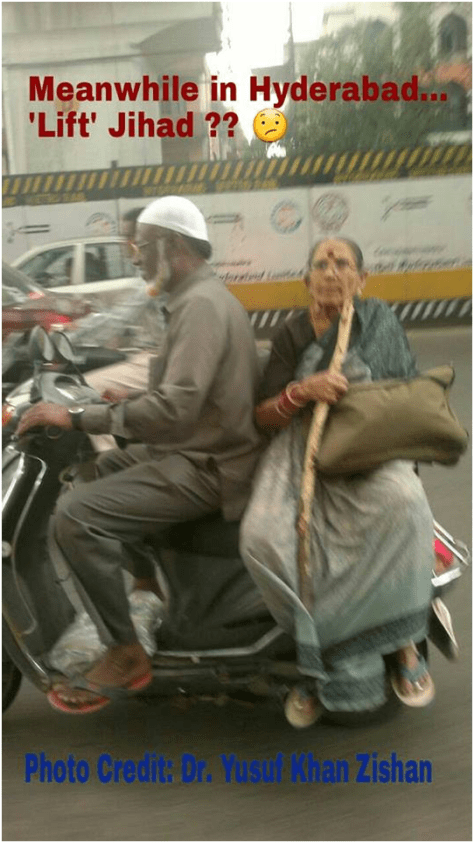
Lift Jihad: Yusuf Khan Zishan

This picture by YUSUF KHAN ZISHAN is circulating widely on Facebook. Received @ Kafila from Janaki Rajan who writes:

I was in Hyderabad on that day – August 19th, the day of the Telengana Intensive Household Survey, when people with two wheelers volunteered to help those arriving by trains to reach their homes as autos and taxis were not permitted to to ply that day… a spontaneous idea..

securedownload


A Letter to the Vice Chancellor of Jadavpur University, Kolkata: Ahona Panda

Guest Post by AHONA PANDA

[Ek Je Cchilo VC / Once There Was a VC – Thanks to Utsavdan, and to Manik-da of Bishop Lefroy Road]

To

The Vice Chancellor,
Jadavpur University,

and the Education System of West Bengal.

Respected Sir,

I would like to return to this university a gold medal that it awarded me, then a girl of 21, in the year 2009. I’ve never worn that medal since my convocation, and it lies in the box it was awarded in. I was a student of the English department in this university, and went on to study at Oxford and University of Chicago. Continue reading A Letter to the Vice Chancellor of Jadavpur University, Kolkata: Ahona Panda

Partha Chatterjee on Partha Chatterjee – An Interview with an Impostor: Partha Chatterjee

Guest Post by PARTHA CHATTERJEE

Continue reading Partha Chatterjee on Partha Chatterjee – An Interview with an Impostor: Partha Chatterjee

Lessons from Scotland for South Asia: Satya Sagar

Guest Post by Satya Sagar

Though ‘No’ finally trumped ‘Yes’ and the United Kingdom stayed ‘united’ the recent referendum for Scottish independence holds several important lessons for both votaries of separatism as well as national unity everywhere.

It also raises many questions, chief among them being, on a planet run by corporations and shaped by tsunami-like capital flows, do terms like national ‘independence’, ‘unity’ or ‘sovereignty’ have real meaning anymore? An even more fundamental question would be whether the nation-state, in its current form, has any future at all or not?

Coming to the lessons first, among the most obvious is the fact that it is possible to hold a referendum on independence peacefully, without a single shot being fired or spilling a single drop of blood.This has been hailed as a triumph of democracy and rightly so too.  How many countries around the world, which call themselves democracies, can muster the guts to allow a section of their citizens to exercise their right to self-determination through a simple vote? Continue reading Lessons from Scotland for South Asia: Satya Sagar

From Jadavpur to Everywhere #Hokkolorob – Let There be Clamour

#HOKKOLOROB
#HOKKOLOROB

More then one hundred thousand students and their friends (according to Kolkata Police estimates) defied the rain to walk in protest yesterday against the assault on Jadavpur University by Kolkata Police, backed by an insensitive University Vice Chancellor and a cynical State Government. There were students, ex students, professors, students from Presidency University, and many other colleges in Kolkata and the neighborhood, there were many ordinary citizens, some who had never been university students, and many who had stopped being university students a long time ago.

Continue reading From Jadavpur to Everywhere #Hokkolorob – Let There be Clamour

The Islam we do not like: Nandagopal R Menon

Guest post by NANDAGOPAL R MENON

Some recent posts on Kafila have identified a “movement of sorts” in South Asian Islam – A Short Memoir On the Arabisation of Islam in India and The Sheepification of Bakistan

Named ‘Arabisation’, this is a “remarkably dispersed” and “subtle” movement most readily evident in certain changes in quotidian linguistic choices, for example, Khuda Hafiz and Ramazan has or is being replaced by Allah Hafiz and Ramadan. This linguistic shift from Farsi/Urdu to Arabic is taken to index a “great cultural battle” under way in South Asian Islam – one that attempts “to ‘correct’ Islam as Muslims in the subcontinent have understood, practiced and lived it, and instead replace it with an Islam which is uniform, seemingly universal and which need not have any affiliation with our cultural and local identities and beliefs”. That ‘Arabisation’ is not something innocuous or laudable is clear, for it “conveniently ignores” – or undermines? – Islam’s “age-old assimilation in the Indian sub-continent”. The following are some thoughts provoked on reading these posts. This is not meant as a coherent response to any of the posts, but just an unsystematic attempt to think through some of the assumptions that condition the creation of concepts like ‘Arabisation’ in public discourse.  Continue reading The Islam we do not like: Nandagopal R Menon

‘My Heart says Yes, but the Head says No’: Economizing Politics in the Scottish Referendum: Akshaya Kumar

Guest post by AKSHAYA KUMAR

I

About two months ago, while walking by the roadside in Glasgow, a middle-aged man handed me out a pamphlet. In an endorsement of UKIP, the pamphlet declared ‘Our government pays GBP 55 million a day in fees to the EU’ (emphasis added). It went on to inform that in return, the EU gives ‘us’ accounts riddled with fraud, no control over ‘our’ own borders – putting pressure on our health, education and welfare services – and a super-government that makes more than 70% of ‘our’ laws. The pamphlet intrigued me a fair bit, not in the least because as an international student in the UK, I wondered if my case was a bigger or smaller burden on the UK defined thus – their UK. But who are they? One might rubbish them as a deviant community, or one might consider them a threat to yet another definition of us – the liberals or suchlike. But what intrigued me was not the neatness of these boundaries, or the speculations about how many of ‘us’ and ‘them’ there are. I was intrigued by the language of the starkly political proposition. Let us tentatively assume that in the pamphlet, ‘us’ meant the citizens of UK and it constructs an antagonistic position vis-à-vis other national citizens who are entitled to living and working within the UK. Surely the two are politically distinguishable? Or are there too many of them living next to us, so they cannot exactly be identified as such? Continue reading ‘My Heart says Yes, but the Head says No’: Economizing Politics in the Scottish Referendum: Akshaya Kumar

Temperance in the time of Rahu

So Onam is here again — despite the fact that several contradictory stars above  now form a malefic conjunction in the fate of poor Malayalis in Kerala. Indeed, rarely has a stranger gang dominated the starry heavens of our destiny: V M Sudheeran’s targeted gullet moralism that promises to close down a very large number of bars in Kerala and pave the way for total prohibition in the future, gangs of Hindu right wing youth and women forcing the government’s liquor outlets to close, policemen puffed up with jingoistic nationalism who hallucinate about Maoists in wake and sleep and declare social activists like Ajitha “dead”, CPM offspring who think that making foul, putrid public statements justifying murder is politics. All these are, well, rather drunk on self-righteousness and to be true, present a slightly ridiculous sight. Even the weather looks ridiculously inebriated – the sky alternates between bright sunny spells and horrid, harsh showers, crazily swinging between sunny smiles and bursts of tears. Continue reading Temperance in the time of Rahu

‘लव जेहाद’ की असलियत – इतिहास के आईने में: चारू गुप्ता

Guest post by CHARU GUPTA

लव जेहाद आंदोलन स्त्रियों के नाम पर सांप्रदायिक लामबंदी की एक समकालीन कोशिश है. बतौर एक इतिहासकार मैं इसकी जड़ें औपनिवेशिक अतीत में भी देखती हूँ. जब भी सांप्रदायिक तनाव और दंगों का माहौल मज़बूत हुआ है, तब-तब इस तरह के मिथक गढ़े गए हैं और उनके इर्द गिर्द प्रचार हमारे सामने आये हैं. इन प्रचारों में मुस्लिम पुरुष को विशेष रूप से एक अपहरणकर्ता के रूप में पेश किया गया है और एक ‘कामुक’ मुस्लिम की तस्वीर गढ़ी गयी है.

मैंने 1920-30 के दशकों में उत्तर प्रदेश में साम्प्रदायिकता और यौनिकता के बीच उभर रहे रिश्ते पर काम किया है. उस दौर में लव जेहाद शब्द का इस्तेमाल नहीं हुआ था लेकिन उस समय में भी कई हिंदू संगठनों — आर्य समाज, हिंदू महासभा आदि –- के एक बड़े हिस्से ने ‘मुस्लिम गुंडों’ द्वारा हिंदू महिलाओं के अपहरण और धर्म परिवर्तन की अनेकोँ कहानियां प्रचारित कीं. उन्होंने कई प्रकार के भड़काऊ और लफ्फाज़ी भरे वक्तव्य दिए जिनमें मुसलमानों द्वारा हिंदू महिलाओं पर अत्याचार और व्यभिचार की अनगिनत कहानियां गढ़ी गईं. इन वक्तव्यों का ऐसा सैलाब आया कि मुसलमानों द्वारा हिंदू महिलाओं के साथ बलात्कार, आक्रामक व्यवहार, अपहरण, बहलाना-फुसलाना, धर्मान्तरण और जबरन मुसलमान पुरुषों से हिंदू महिलाओं की शादियों की कहानियों की एक लंबी सूची बनती गई. अंतरधार्मिक विवाह, प्रेम, एक स्त्री का अपनी मर्जी से सहवास और धर्मान्तरण को भी सामूहिक रूप से अपहरण और जबरन धर्मान्तरण की श्रेणी में डाल दिया गया. Continue reading ‘लव जेहाद’ की असलियत – इतिहास के आईने में: चारू गुप्ता

A civil-war is on the doorstep of India: Interview with Kancha Ilaiah by Mahmood Kooria

This is a guest post by Mahmood Kooria

We are publishing an English translation of an important interview of the intellectual and academic Kancha Ilaiah, conducted by Mahmood Kooria for the Malayalam weekly Mathrubhumi. While what I see as Professor Ilaiah’s underestimation and perhaps misreading of the historic role of the Communists in Indian politics leaves me severely uncomfortable, especially when he exonerates the right from commensurate charges of elitism, his framing of Hindustva and Modi’s appeal within the great stream of caste in the subcontinent is brilliant and thought-provoking, as always. 

Kooria conducted the interview as well as translated it in to English. His introduction is as follows, “At a time when there was no any such discussion, in 2002 Professor Kancha Ilaiah predicted that Narendra Modi will be the prime-ministerial candidate of Baratiya Janata Party. It has come true and now Modi is in the office. At this point, I talked with him at Moulana Azad Urdu University Hyderabad where he chairs the Centre for the Study of Social Exclusion and Inclusive Policy. In the conversation, he talked about the future of Modi government and he predicted that a civil war is going to break out in India if Modi does not cater the needs of backward classes. A Malayalam-version of this interview was published in the Mathrubhumi Illustrated Weekly (August 24, 2014).”

Mahmood Kooria: Ten years ago you wrote that Modi will be the prime ministerial candidate of BJP. What would be your response as your prediction has come true?

Kancha Ilaiah: Well, at that time I was predicting that based on the Left parties’ indifference to understand the caste question. The caste question is not been seriously taken by the Left parties. And, after Mandal, the BJP and the RSS wings started looking at caste-question seriously because when Babari Masjid was demolished they mobilized a lot of backward classes. Though they oppose Mandal reservation, they wanted the backward classes to be part of the Hindu religion. Around 1994, a non-Brahmin called Rajju Bhaiya became the Sarsanghchalak of the RSS. Then he recruited a large number of backward classes, large number of youth, and he promoted the people like Narendra Modi, Uma Bharati at that time. Earlier, the first backward-class chief minister of Uttar Pradesh was a BJP man: Kalyan Sing. He was the chief minister in 1992 when the Babri Masjid was demolished.

The Sangh Pariwar was responding to the backward class demands more. But the Left or the Congress was not responding to the OBCs. The Congress was responding to the Dalits and Muslims. There was upper caste all the time on the top. So, when Narendra Modi became the chief minister and this whole atmosphere was created, I was writing a column in The Hindu. I thought that this seems to be cause/course of India, since the Hindu religion is surviving because of the backward classes. It is inevitable for the Hindutva organizations that they will have to project an OBC for the prime-ministership. But there was resistance from within itself. It is not that the Brahmins have given up the principle of varna-dharma. After that article came and of course after my writing Why I am not a Hindu itself, the backward classes even within RSS seemed to use that material for their advantage. The communists did not use or recognize it. The question of labour and caste which I have been consistently raising, which was also part of their theory, they did not care about. So the Communist Party remained tightly under the control of upper castes.

Continue reading A civil-war is on the doorstep of India: Interview with Kancha Ilaiah by Mahmood Kooria

The Wrongs In The Right To Education: Noyonika Bose

Guest Post by  NOYONIKA BOSE

In the winter of 2013 I had carried out a survey as part of an NGO CRY, Child Rights and You in 10 schools in the heavily populated slums of Rajabazar, an area in north Kolkata. The objective of the survey was to see whether the Right To Education (RTE) Act was being properly implemented in these schools.  The findings of the survey though not absolutely abysmal, were not positive either. However what I learnt is that it is not entirely the fault of these government and government aided schools that they were unable to provide their students with quality education. It has also to do with the basic structure of the RTE act which is peppered with several flaws. This article is a critique of the RTE and some possible solutions. Continue reading The Wrongs In The Right To Education: Noyonika Bose

Reading the Debate on the Planning Commission

I find it hard to think through the current debate on the Planning Commission (PC) outside a few things. The first is a clear centralisation of power at and within the PMO which I cannot help but be alarmed by. It’s all well and good when the decisions are those you agree with and all to easy to forget what centralisation does in the hands of, let’s please not forget so easily, a man whose IMHO has no H.

Its faults are easy to list but the PC (when it worked) did remain a space for thinking through a centre-state relationship and a development vision outside the government. It was a moment of articulation of intent with an (albeit diminishing) ability to put some weight behind it. I can’t quite bring myself to defend it because of what it refused to become in the more recent years, and the fights it refused to fight, but the need for such an autonomous voice remains. I don’t believe this new body will be anything other than a rubber stamp for a deeply authoritative PMO. In that, I am cautious of what will come. And by cautious, I mostly mean afraid.

Continue reading Reading the Debate on the Planning Commission

If Gail Omvedt is Katherine Mayo, then Sugatha Kumari is …? Thoughts on Salman’s Predicaments

Salman Zalman is a young man from Kerala who has recently been arrested for an alleged act of disrespect towards the Indian National Anthem. As an observer in Kerala, I think young people like him who choose to get involved in public struggles for justice face a number of predicaments that were perhaps not so severe for my generation when we were young. For this reason, I do feel that members of my generation, those of us alive to public issues, need to be more open to the challenges that public-minded younger people face today. Continue reading If Gail Omvedt is Katherine Mayo, then Sugatha Kumari is …? Thoughts on Salman’s Predicaments