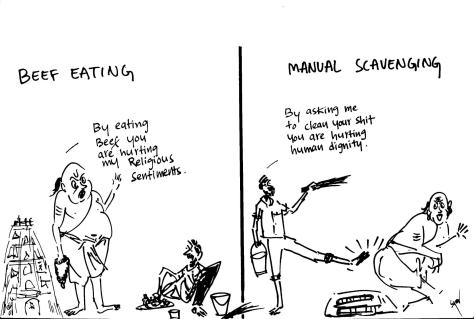
This guest post by UNNAMATI SYAMA SUNDAR is a cartoon
From Kafila archives:

This guest post by UNNAMATI SYAMA SUNDAR is a cartoon
From Kafila archives:
“क्या आपको इस बात का अहसास है कि ताकाहाशी को ‘तुम्हारी पूँछ तो नहीं है?’ पूछने पर कैसा लगा होगा” बच्चे शिक्षिका का जवाब नहीं सुन पाए. उस समय तोत्तो चान यह नहीं समझ पायी कि पूंछ वाली बात से हेडमास्टर साहब इतना नाराज़ क्यों हुए होंगे क्योंकि अगर कोई उससे यह पूछता कि तोत्तो चान तुम्हारे क्या पूंछ है? तो उसे तो इस बात में मजा ही आता.
-‘तोत्तो चान’ (तेत्सुको कुरोयांगी, अनुवाद – पूर्वा याग्निक कुशवाहा)
दलित चेतना और कार्टूनों का पुनर्पाठ
इस कार्टून पर चली ऐतिहासिक बहस के बाद अब यह पक्के तौर पर कहा जा सकता है कि साहित्य से आगे अभिव्यक्ति के अन्य क्षेत्रों में भी दलित चेतना ने दस्तक दे दी है। शायद हम कल चित्रकला और बहुत आगे संगीत में भी दलित चेतना युक्त दृष्टि से इतिहास का पुनर्पाठ देखेंगे। Continue reading ’बिगड़ैल बच्चे की खोज में’: हिमांशु पंड्या
Guest post by GOWHAR GEELANI
By any stretch of imagination, the All Parties Hurriyat Conference [APHC] has ceased to be an amalgam of ‘all parties’. It seems that this conglomerate of several pro-freedom political, social and religious parties is actually being run by a chosen few in a dictatorial manner. It is no secret now that the fissures in the Hurriyat ‘M’, the one led by the popular head-priest based in Srinagar, Mirwaiz Umar Farooq, run neck deep.
The APHC was formed on 10 March 1993 to find a political solution to Kashmir dispute after a large-scale armed rebellion since 1989 had successfully highlighted the need for a resolution to the long-standing dispute. Essentially, this conglomerate was formed with the clear aim of achieving the “right to self-determination” for Kashmiris in accordance with the United Nations’ Security Council Resolutions vis-à-vis Kashmir.
But all is not well with the Hurriyat (M). One of its prominent leaders, Professor Abdul Gani Bhat has openly challenged group’s constitution by declaring that the UN resolutions on Kashmir have become “irrelevant”.
Continue reading Is the Hurriyat divorcing democracy and freedom?: Gowhar Geelani
Guest post by AJAY SKARIA
Earlier this month, I signed, with some disquiet, onto this petition. Initiated by some members of the CHS at JNU, the petition protests against the withdrawal, in the wake of the cartoon controversy, of all NCERT Political Science textbooks, and seeks to defend the ‘gains of the new National Curriculum Framework 2005’. One reason I signed the petition was because it seems to me urgent that we try to save the NCF 2005 textbooks. They are, quite simply, amongst the most superb provocations available anywhere to critical thinking for young minds. I have over the years read them with my two children, and I would be very disappointed if other children were deprived of the same experience. There were other reasons too: I share the petition’s criticisms of the government’s arbitrary way of making its decisions about the textbooks, and its demand that textbooks be produced by an ‘academic, collective, democratic and inclusive process’ that excludes any ‘direct government intervention’. Continue reading Violence and Laughter: Ajay Skaria on the Ambedkar cartoon controversy
Guest post by PRABHAT KUMAR
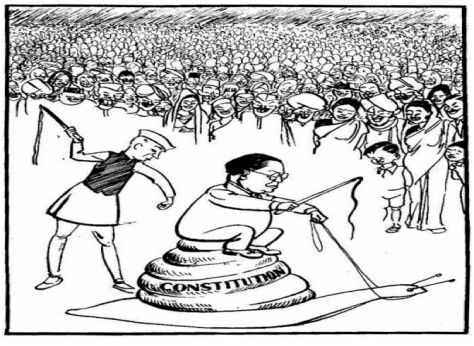
I wish to intervene in the ruckus over usage of Shankar’s cartoon in the NCERT’s political science text book. At the outset I want to clarify my personal impression (although inconsequential!) of the book and the cartoon therein. I feel the textbook in general is pedagogically superior to the previous ones for it does not infantilise young students as lacking critical ability. I also believe, as Aditya Nigam has rightly pointed out, it has accorded Ambedkar the status of a leading political and intellectual figure so far ignored. The cartoon in particular, both in the context of the narrative of the textbook as well as of its production in 1949, is not attacking Ambedkar the crusader of Dalits’ rights.
Continue reading This, that and other cartoons: Prabhat Kumar
With the recent article by Prabhat Patnaik, the controversy over the ‘Ambedkar cartoon’ issue has now moved into a different terrain. In this important statement, Prabhat undertakes the task of pointing out the numerous red herrings that have entered into the debate. These include ‘freedom of expression’ and ‘sense of humour’ and the question of whether Ambedkar had actually seen and let pass this cartoon. Prabhat’s point about the changed sensitivities and increased audibility of the dalit movement today is also well taken.
We must also be thankful to Prabhat for stating his views so candidly over the past few years, on a number of critical issues ranging from Nandigram and the electoral defeat of the Left to the ongoing cartoon controversy. We must thank him because because in my opinion, all his positions on these disparate sets of issues are of a piece and take us to the very heart of the impasse, not merely in the Left but in our politics itself. But before I respond to some of the issues raised by Prabhat, let me restate my positions on some aspects of the ongoing controversy. This is also necessary in order to identify what exactly it is in Prabhat’s piece that is so disturbing.
Dalit Response and Hurt Sentiments
In its initial phases, the cartoon issue was certainly a ‘dalit issue’ – even if it was raised only by a section of the dalit political leadership and intelligentsia. Very soon, however, it became clear that there was a more cynical game being played where the most corrupt and compromised sections of our politicians – especially those in parliament – were using Ambedkar as a shield, in order to deflect the blows that were actually aimed at them. The amazing unity of purpose and determination displayed by the parliament has rarely been seen in recent times; nor has the love for Ambedkar ever been expressed with such vigour.
These circumstances give enough reasons to suspect that the game had already changed by the time it reached the parliament. Not many people may have noticed but it was a Congress MP (an official spokesperson in Madhya Pradesh) who raked up a long dead issue of the book by Arun Shourie (Worshipping False Gods), demanding that it be banned. Continue reading Red Herrings, Red Rags and Red Flags – Once More on the Cartoon Controversy
The following is a petition initiated by a group of scholars who have been centrally involved in the debate on pedagogy and the writing of textbooks that followed National Currriculum Framework 2005
We have been watching with deep dismay the events as they have unfolded on the floor of the Indian Parliament and outside. Uproar against an individual cartoon has now snowballed into a wide-ranging attack against the new NCERT textbooks. The office of one of the Advisors of the Political Science textbooks has been ransacked, the Political Science textbooks have been withdrawn from circulation, and the Government has resolved to conduct an inquiry into the role of those who sanctioned the inclusion of the offending material in the textbooks. Clearly what is at stake here is not just the life of cartoons on the pages of school textbooks.
But the fear of cartoons is not unimportant. It tells us a lot about the democracies we now inhabit. Jawaharlal Nehru told Shankar Pillai ‘Don’t spare me Shankar’. B.R. Ambedkar saw the cartoon that is now being seen as ‘offensive’. He had no problem with it. Nehru and Ambedkar, and great democrats like them, were aware of what cartoons mean. They were aware that creative cartoonists like Shankar or Laxman can encourage us to question what is taken for granted, reveal the ambiguities and contradictions of individuals, persuade us to see things in a new light. India has a long creative tradition of satire and irony. The productive power of laughter has been used not only in movements for social justice, but in children’s literature as well. If we celebrate this tradition, we celebrate democracy. Only in non-democratic countries is there a fear of cartoons. Continue reading In Defense of Critical Pedagogy: A Petition
Guest post by RUCHI GUPTA
[This post was initially published in the Times of India and removed from their site soon thereafter.]
With a comfortable gap of time after the revelations of paid news, private treaties and the Radia tapes, the media is once again on the offensive to guard its independence. The trigger this time is a private member’s bill, the Print and Electronic Media Standards and Regulation Bill, 2012. The proposed legislation has been widely and energetically panned by the industry, with the Congress subsequently distancing itself from the Bill. The Bill is not available in the public domain; however based on news reports, some provisions could perhaps lend themselves to state censorship. While the merits of the Bill are debatable, what is striking is the complete lack of self-consciousness with which the media termed the attempt as an attack on democracy, without addressing its own corruption and its deleterious impact on democracy. Continue reading The Great Indian Media Hoax Of Self-Regulation: Ruchi Gupta
 At last, the real anxieties lurking behind what has come to be called the “Ambedkar cartoon” controversy are out in the open. It is hideously clear by now that MPs “uniting across parties” are acting as one only to protect themselves from public scrutiny, debate and criticism. It turns out, as some of us suspected all along, that the “sentiments” that have been “hurt” this time are the easily bruised egos of our elected representatives.
(By the way, you may have noticed that “MPs unite across party lines” is not a headline you will ever see after a massacre, a natural calamity, brazen public acts of sexual violence against women and so on. Oh no. Such unity is reserved only for utterly self-serving and anti-democratic interpretations of “Parliamentary privilege”).*
Artist: Abu Abraham
Declared HRD minister Kapil Sibal – “Much before the issue came to parliament, I had already taken action. I called for the NCERT text books and I looked at other cartoons. I realised that there were many other cartoons that were not in good taste and disparaging in nature. They were not sending the right message to our children in classrooms”.
Continue reading Please Sir, may I take a newspaper into my class?
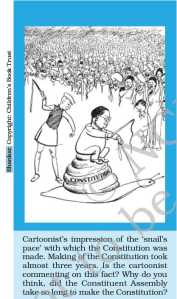 The uproar over what is being referred to as the ‘Ambedkar cartoon’ in the class XI textbook prepared by NCERT first began over a month ago, that is to say, almost six years after the books have been in circulation, been taught and received high praise for their lively style and a critical pedagogical approach (more on this below). It was a political party – one of the factions of the Republican Party of India – that decided to kick up a ruckus over ‘the issue’ – that is, the ‘affront’ to Dr Ambedkar that the cartoon in question supposedly constitutes, and the resultant ‘hurt sentiments’ that it has caused. Very soon everyone began to fall in line, and practically every member of our august Parliament was vying with one other to prove that they were indeed more hurt than their colleagues. One of them, Shri Ram Vilas Paswan has even demanded that the NCERT itself should be dissolved!
Good old Jurgen Habermas – and good old Habermasians – have always invested a lot in forums like the parliament, that are to them the hallowed institutions of ‘rational-critical discourse’ where through reasoned argument people convince each other. That is how the voice of Reason ultimately prevails in democracies. I have always been suspicious of this claim and have thought that Habermas’ empirical work on the decline (‘structural transformation’) of the public sphere was more insightful than his normative fantasies. Long long ago, his empirical work on the transformation of the public sphere showed that it was the rise of political parties that had actually destroyed all possibilities of ‘rational-critical discourse’, where organized passion in the service of immediate political interests carried the day.
The recent post by Shohini Ghosh on the first episode of Satyameva Jayate has raised key questions around the complicated relationship between abortion as such and the selective abortion of female foetuses. This dilemma is one with which the women’s movement in India has been grappling since the late 1980’s. In this post, I would like to move away completely from the television programme, especially because there the focus was on women who were forced to have abortions after sex determination, on which there is little to debate. I am concerned here with the more troubling question that Shohini also raises, of how to understand a situation in which women themselves decide to have sex selective abortions. I outline here the main contours of feminist debate and activism over close to three decades, that have circled around complex understandings of ethics and agency in the context of women’s control over their bodies. I conclude by stating my own position on the issue, which is not necessarily the position taken by the movement as such.
Continue reading Abortion as a feminist issue – who decides, and what?
मई दिवस और गणपति में सम्बन्ध ही क्या हो सकता है? दोनों की न तुक मिलती है और न ही अनुप्रास की छटा दोनों के पास–पास होने से बिखरती है. फिर गणपति शुद्ध हिन्दू देवता हैं, गणेश चतुर्थी के अवसर पर तो उनका नामजाप समझ में आता है, लकिन मई दिवस पर उनका आह्वान? इससे बड़ा दूषण हो ही नहीं सकता और इसका दंड उन्हें तो किसी न किसी रूप में भुगतना ही पड़ेगा. सो हुआ.
सती अनामंत्रित अपने पिता दक्ष के घर गई थीं और अपमान न सह पाने के कारण उन्हें यज्ञ वेदी में ही कूद कर जल मरना पड़ा . किसी भी जगह बिन बुलाए नहीं जाना चाहिए, इसकी सीख देने के लिए यह कथा वे सुनाते हैं जिन्हें इस समय भी कुछ कथाएँ याद रह गयी हैं. निश्चय ही त्रिथा को यह प्रसंग या तो पता न होगा या वे इसे भूल गईं जब मई दिवस पर जवाहरलाल नेहरु विश्वविद्यालय में एक वामपंथी छात्र संगठन द्वारा आयोजित एक संगीत संध्या में मंच पर वे अनामंत्रित गाने चली गईं. एक तो वे स्वयं अनपेक्षित , अतः किंचित अस्वस्तिकर उपस्थिति थीं , दूसरे आयोजकों और श्रोताओं को , जो मई दिवस पर संघर्ष और क्रान्ति के जुझारू गीत सुन कर अपने शरीर के भीतर जोश भरने आये थे इसकी आशंका थी कि वे इस पवित्र अवसर पर जाने क्या गा देंगी. और आखिरकार उन्होंने इस आशंका को सही साबित कर दिया, जब वे शास्त्रीय संगीत के नाम पर वक्रतुंड, महाकाय …. गाने लगीं. थोड़ी देर पहले जो सैकड़ों शरीर ‘हिल्लेले हिलोर दुनिया ‘ पर झूम रहे थे, उनसे नहीं–नहीं का शोर उठा. इस छात्र जनता के नेता जन–भावना का आदर करते हुए मंच पर पहुंचे और त्रिथा को अपना गाना बीच में रोक कर मंच से जाना पड़ा. Continue reading मई दिवस और गणपति
Guest post by NABANIPA BHATTACHARJEE
At the end of last month (March 2012) students of Jawaharlal Nehru University (JNU), New Delhi under the banner of a recently formed group called the New Materialists (NM) organized a public meeting to debate the issue of (dis)allowing certain kinds of food – beef and pork in particular – on the campus. The group, as one of its members Suraj Beri said, intended to petition the university administration to allow the sale of beef and pork in the canteen(s), and fight for inclusion of the same in the hostels’ menus; it was a struggle, as the NM declared, against the Brahmanical dietary impositions on Dalits and other minority community students of JNU. In fact, Francis (JNU students of the 1990’s would remember the man from Kerala) who ran a canteen at the basement of the School of Social Sciences II did serve beef curry on Saturdays, and it would not be an exaggeration to say that there would be more than a mad rush for that. However, he was pressurised – by Hindu right wing groups and other similar forces – to stop the sale of the “forbidden” food, and the canteen was eventually closed down.
Continue reading Resisting Culinary Fascism: Nabanipa Bhattacharjee
Guest post by RUTH VANITA, Professor at the University of Montana. This statement was written in the context of the teachers’ intervention in the Supreme Court in the appeal by religious groups against the Delhi High Court judgement on Section 377 . This statement does not form part of court documents. You can read Shivaji Panikkar’s statement here
I belong to a middle-class family of educationists, various members of which migrated to Delhi from Rangoon and Lahore at Partition. I was educated entirely in Delhi, first at Springdales School, and then at Miranda House. I got my Ph.D. from Delhi University. I started teaching at the age of 20 at Miranda House; I taught there for 18 years and then for two years as a Reader in the English Department, Delhi University, before taking early voluntary retirement in 1997.
Continue reading A Statement Supporting the Delhi HC Judgment on Section 377: Ruth Vanita
Guest post by SHIVAJI K PANIKKAR, art historian and Dean, School of Culture & Creative Expressions, Ambedkar University, Delhi. This statement was written in the context of the teachers’ intervention in the Supreme Court in the appeal by religious groups against the Delhi High Court judgement on Section 377 . This statement does not form part of court documents.
You can read Ruth Vanita’s statement here.
I was born in a traditional, upper caste Hindu family and lived in Kerala till I was 22 years old, and since then shifted to study, work and live inBaroda,Gujarat. In 1975c I completed a B.A in Kerala with Economics and History as my subjects. InBarodathrough 1980s, at MS University I did another B.A. in Dance (Bharatanatyam), an M.A. and Ph. D in Art History as specialization. I was appointed as Professor in 1998. Till recently I was Head of Department of Art History & Aesthetics, Faculty of Fine Arts, M.S. University of Baroda. I have an experience of teaching at the University of about 25 years.
Since childhood I knew I had homosexual inclinations, and lived it secretively till the age of about 43/45 years. Since then I lived an openly gay life; a fact that I couldn’t any more hide in my personal life as well as in my professional life. It was a matter of emotional and intellectual honesty and integrity that I accepted in public my sexual orientation, and no more live a life of fear and oppression.
Continue reading A Statement Supporting the Delhi HC Judgment on Section 377: Shivaji Panikkar
The Delhi High Court judgement reading down Section 377 to decriminalize consensual sex between adults was appealed against in the Supreme Court by several religious groups. However during the appeal, the Government of India withdrew its objections to the High Court judgement. In addition, there were some parties that intervened to support the judgement – parents, medical practitioners and teachers, among others. The Supreme Court judgement is awaited, but meanwhile, I am posting below the position of the 16 teachers who intervened in this matter. This statement does not form part of court documents.
As teachers we essentially wanted to make the argument that Section 377 vitiates for everybody (and not just for gay people) the general atmosphere of free expression, learning, enquiry, and dignity that an academic environment should ensure. That we oppose Sec 377 because its existence on the statute books legitimizes an atmosphere that runs counter to the spirit of openness and acceptance of difference that should mark modern academic spaces. Its existence is not only an affront to those who are non-heterosexual, but it is an affront to each and every person in the academy who believes that every teacher and student has dignity that should be respected, and that learning is a continuous and life-long process, in which fixed ways of thinking are continuously challenged and reshaped by winds of change.
Continue reading Teachers’ Intervention in the Supreme Court on Section 377
Recent debates on Internet censorship in India have focused to the allegedly free-for-all nature of the internet. Those of us who have argued against internet censorship have been somewhat misrepresented as arguing for absolute freedom whereby the reasonable restrictions laid down in Article 19 (A) of the Constitution of India don’t apply. Nothing could be farther than the truth.
It has been said that the internet can be used to incite violence, particularly inter-communal violence, and there needs to be a mechanism to prevent that. Communications minister Kapil Sibal wants internet giants to “self-regulate” for this reason, denying that he wants to censor political dissent on the internet. Following on the heels of his expression of such concern in December 2011, Mufti Aijaz Arshad Qasmi and journalist Vinay Rai filed cases against various internet companies for similar material that is religiously offensive.It needs to be pointed out, however, that the cases filed by Qasmi and Rai are under the Indian Penal Code and do not even invoke the Information Technology Act. So if the Indian Penal Code can be used against religiously offensive material why do we need any new mechanism to “regulate” or even “self-regulate” the internet? Continue reading Unpacking India’s Internet Censorship Debate
Guest post by ABHIJIT DUTTA
It is not every day that you wake up to find your Twitter timeline flooding with the assertion that Kashmir – of all places – is happy. Dangerous? Of course. Beautiful? well, yes, the postcards are pretty enough. Angry? Sure, they look it. Radical? Oh god, yes. Happy?
If you ask Manu Joseph, author of Serious Men and editor of Open, the answer is yes. In this article, he talks about his interactions with “regular” people in the valley – the non elite, the non journalist, the non artist, the non writer – and is convinced that Kashmir is ready to move on. That it has already moved on. That Kashmir is happy. As proof, he offers these exhibits: (a) record high tourism numbers, (b) 2010 IAS topper Shah Faesal (who tells him “commonsense is finally winning”), (c) a meeting of a District Magistrate with elected leaders of a village (“not a word about politics”, says the DM to Mr. Joseph, “They want to talk about things that matter to them and their families”) and (d) the desire for city life (“we want KFC”).
Guest post by RAM KRISHNASWAMY
HRD Minister Kapil Sibal seems to be getting a lot of flak from so many quarters on Jan Lok Pal Bill, HRD Computer Tablet Aakash and now his backing of ISEET, one common national entrance exam for science and engineering. Now as HRD Minister he has inadvertently attracted the wrath of over 1,75,000 IIT alumni globally; as also faculty and students of all IITs who are opposed to his idea of killing IIT-JEE and replacing it with a common national exam called ISEET.
Yes, Kapil Sibal is the HRD Minister but he is a lawyer and a politician and is not a technologis. It appears that he is being advised by technologists who are misleading him and telling him what he wants to hear, as opposed to giving him solid advice in the interest of the nation.
Let us just look at IITs and JEE alone.
Let us see what truly is wrong with IITs & JEE and what recommendations the HRD Minister has received and from whom.
If we were to simplify the problem with JEE as it is administered in 2012 they can be listed as follows (not a comprehensive list):
Continue reading Is India’s HRD Ministry Barking Up The Wrong Tree?
 Well, the truth is that I care two hoots for Indulekha Hair Oil, their stupid ads, and the wide-eyed chubby-cheeked teenage girls who they usually cast as epitomes of Malayalee feminine grace. All of Mallu FB world is agog with discussion about a brainless ad for the Indulekha Hair Oil, in which a fiery-looking woman whose dress-style follows the dress conventions of our Malayalee AIDWA Stars, bursts with indignation over the terrible harassment that women with long hair face on buses, how we are all forced to cut off “the hair that we have” (‘Ulla mudi’) and go about with short hair “like men” because of this horrible injustice, and finally, how we all ought to grow our hair long (and let it down, possibly) and hit back at such harassers. This stupid ad is actually only one among other stupid ads for this hair-oil which uses currently-common ideas like ‘women’s collectives’ (stree koottaimakal). All of them are jarring since the concepts they use, and what they aim at, simply don’t mix.Part of the outrage has been fueled by the fact that the ad uses as a model Sajitha Madathil, who is well-known as a feminist theatre activist in Kerala. Continue reading Forget Hair-Oil-Powered Indulekha, Remember the Muditheyyam
Via NITYANAND JAYARAMAN
Koodankulam: Curb on Free Speech
Video Interviews with eminent legal scholar Dr. Usha Ramanathan and Adv. R. Vaigai, a senior lawyer from the Madras High Court.
Since March 19, 2012, when Tamil Nadu Chief Minister Jayalalithaa announced that work on the controversial Koodankulam nuclear plant could be resumed, and even before that actually, the protesting villagers have been at the receiving end of a vicious state led campaign to paint their non-violent struggle as a violent one, and to crush their campaign into silence by using harsh sections of the Indian Penal Code. More than 7000 cases of “sedition” and “waging war against the Government of India” have been filed just in the Koodankulam police station just between September and December 2011. These are part of 107 cases filed against 55,795 people during the same period. That is probably more than in any other police station in India. Certain sections of the media too have played the role of a willing partner in propagating the State’s propaganda. In pursuing this counter-campaign against its own people, the State Government has placed itself above the law of the land and pursued an openly anti-democratic agenda.
See interviews in two parts at at
PRESS RELEASE
Cases against K-protestors a parody of law: Fact Finding Team
18 April, 2012. CHENNAI – A fact-finding team headed by senior journalist Sam Rajappa confirmed that the Government had indeed restricted movement of essential goods and people in the days following the Chief Minister’s March 19th declaration announcing her support to the nuclear plant. The report, which was released at a press conference in Chennai, noted that the spirit of opposition to the nuclear power plant was very high, and warned that arresting the leaders could lead to a serious law and order problem in the region.
 KAFILA - COLLECTIVE EXPLORATIONS SINCE 2006