Category Archives: Democracy

An Open Letter to Bhavana and Some Reflections on the Hostile Responses to it: Althea Women’s Friendship

[This letter was written by Gayatri Devi, as the opening segment of the series of analyses that Althea hopes to collectively publish in the wake of the atrocious judgement passed by the Ernakulam Principal Sessions Court, written by the controversial judge Honey M Varghese, exonerating Dileep aka Gopalakrishnan in the actor assault case of 2017. The reflections on Dileep-supporters’ responses to it were written by J Devika.

In 2017, a leading female actor was kidnapped on her way back from work and raped by six men in a moving vehicle on the roads of the city of Kochi. The lead-rapist claimed to her that he was hired to do it. The alleged role of the actor Dileep in commissioning the horrifying act of violence, which was also filmed, has been at the centre of public outrage from 2017 to this day. Dileep’s role seemed to be strongly indicated by circumstantial evidence, however in the course of the trial, the advantages that he enjoyed seemed to surface repeatedly. The whole trial appeared to be an extended punishment of the survivor, and the culmination of it therefore was hardly unexpected. Nevertheless, the public, overwhelmingly with the survivor, has not taken the judgment lightly.

We believe that it is our feminist political responsibility to develop a critical discourse on on the normalization in Kerala of the insecure masculine that Dileep and his supporters represent, over the past three decades. The material we hope to examine includes the judgement itself as well as the many films that Dileep starred in, from the so-called ‘serious’ film he acted in directed by Adoor Gopalakrishnan, to his many slapstick comedies which became popular. The series is anchored by Gayatri Devi, and others will also contribute. This is the first in the series.]

Dearest Bhavana:

When I first heard the verdict in your 2017 case, in my mind, I silently thanked the fortuitousness of your name, “Bhavana.” Your name “Bhavana” means “imagination.” I thanked your name, because I believed that the strength to process the disillusionment and dissatisfaction that beset you upon hearing the wrong verdict was contained in your name. You must remember this fact. You must not forget this fact. You own a precious name. Your name embodies a precious truth.

Continue reading An Open Letter to Bhavana and Some Reflections on the Hostile Responses to it: Althea Women’s Friendship

“SIR” Is a Process of Mass Disenfranchisement

The Solution

After the uprising of the 17th June Election of 2024

The Secretary of the Writers Union Prime Minister’s Office

Had leaflets distributed in the Stalinallee the message sent out via Nagpur

Stating that the people

Had forfeited the confidence of the government

And could win it back only

By redoubled efforts. Would it not be easier

In that case for the government

To dissolve the people

And elect another? – [Courtesy Bertolt Brecht]

The way things are going with the SIR, we are heading for the regime “electing its people” – with the full participation of the Opposition parties, who despite the knowledge of the process, have become unwilling participants. Not knowing how to respond, they seem to be running around like headless chickens. “Vote Chori” and the so-called “Special Intensive Revision” (SIR) are closely tied together and though Rahul Gandhi seems to have got the import of what this means, reports suggest that RSS “sleeper cells” within and outside the Congress Party are hyperactive now, trying to undermine the campaign against vote chori. Some INDIA bloc parties have even openly distanced themselves from it. Continue reading “SIR” Is a Process of Mass Disenfranchisement

The Day the Colloquium Fell Silent – Bureaucratic Diktat and the Fate of Thought: S. M. Faizan Ahmed

Guest post by S. M.  FAIZAN AHMED

Image courtesy The India Forum

The resignation of Professor Nandini Sundar from the convenorship of the seminar colloquium at the Department of Sociology, Delhi School of Economics, has left an emptiness that language struggles to fill and words can barely cover. The seminar she was to host, titled Land, Property and Democratic Rights, was to be delivered by Dr. Namita Wahi, a senior fellow at the Centre for Policy Research and one of India’s most thoughtful legal scholars on land rights.

The event formed part of the department’s long-standing Friday Colloquium series—among the oldest and most cherished intellectual traditions in Indian academia. Over the decades, nearly every major figure in the social sciences has presented a paper here at least once. More than a seminar, it has been a ritual of conversation—one that has weathered political shifts, personal rifts, intellectual disagreements, and institutional flux, sustaining across generations a living legacy of thought, dialogue, and learning. Continue reading The Day the Colloquium Fell Silent – Bureaucratic Diktat and the Fate of Thought: S. M. Faizan Ahmed

We Will Fight, We Will Win: ASHA Workers Vow to Continue the Protest

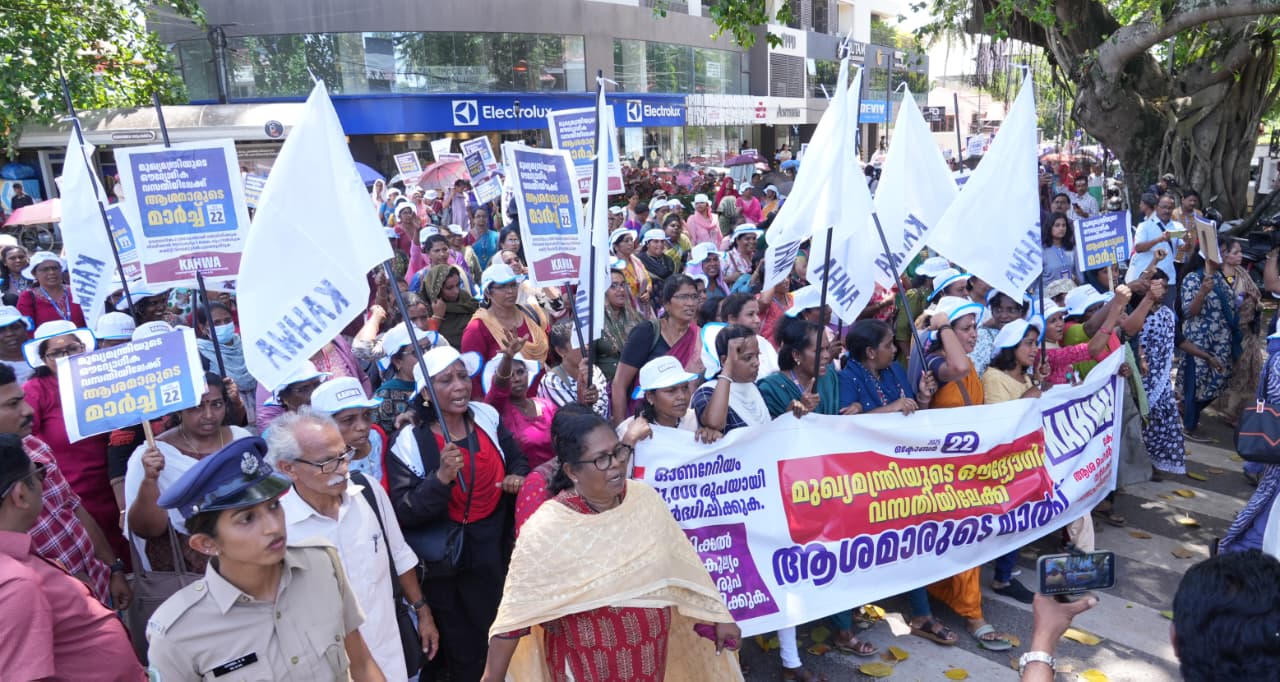
Today, exactly 266 days after it began, the ASHA workers’ protest led by the Kerala ASHA Health Workers’ Association vowed to continue the protest in a new form. Since the evening before, news channels and in the morning, newspapers, were claiming that the protest had ‘ended’ or was going to be ‘wound up.’ The meeting the KAHWA organised in front of the State Secretariat in Thiruvananthapuram was both a celebration of the victory the workers had secured over the hubris of the CPM and its lord and master, the Chief Minister of Kerala. But more importantly, it was a declaration of the workers’ determination to continue the struggle. The local body elections are imminent, and the protesting workers intend to turn their grievance into a campaign issue.

Continue reading We Will Fight, We Will Win: ASHA Workers Vow to Continue the Protest

Countering Propaganda against the ASHA Workers’ Struggle in Kerala: A Response by Anamika A. and others

Rejoinder written collectively by Anamika A, Archana Ravi, Ayana Krishna D, J Devika, Divya G S, Gayatri Devi, Shraddha Jain, Shradha S and Srimanjori Guha

[This piece was written in response to a flagrant misrepresentation of the ASHA workers’ ongoing struggle in Kerala, by Binitha Thampi and Varsha Prasad, which appeared in the Economic and Political Weekly early this month, titled “Labouring on the Margins: ASHA Workers’ Protests in Kerala and Working-class Solidarities” (Oct.4, 2025, LX, 40, 13-17). A group of us — scholars, activists, artists and others who have been closely following the struggle since its beginning — wrote a rejoinder to it. The EPW editor verbally agreed to consider it, but the edit desk insisted that it be subjected to the same peer-review process (as their special articles, it seemed). Commentary pieces, as those who have published in the EPW earlier know, were dealt with at the editorial desk, and the editor was back then obviously competent to judge whether a rejoinder to a commentary piece was a fair one or not. Now that seemingly requires a review process! That does not suit us simply because this atrocious piece of slander is aimed at an ongoing struggle, at the lives of struggling women workers, by other women steeped in academic, social, and political privilege. There is, then, the need to respond quickly, to defend the struggle from the verbal equivalent of a shower of stones thrown at it. At the same time, the very fact that B Thampi’s and V Prasad’s piece, which parrots the CPM troll position in each line and trips over themselves several times empirically and theoretically, has clearly not been subjected to peer-review by the same EPW editorial, for it would definitely would not have got published like it is now — biased in the extreme.

Continue reading Countering Propaganda against the ASHA Workers’ Struggle in Kerala: A Response by Anamika A. and others

Do not Steal Our Voices, Mr Vijayan! The ASHA Workers’ March to the Chief Minister’s Residence

Dear Mr Vijayan

Yesterday, the protesting ASHA workers marched to your residence in the pouring rain, seeking to rouse you from your utterly inexcusable stupor. Yes, over the past eight months, you tried to first crush the strike, and then to kill it by ignoring it. Who does not know that the worst form of violence is indifference?

Photo credits : Shradha S, Harsh, Ashna Thambi, Santhosh Nilakkal.

Continue reading Do not Steal Our Voices, Mr Vijayan! The ASHA Workers’ March to the Chief Minister’s Residence

JNU – The State of the University: JNU Teachers’ Association

Report prepared by Jawaharlal Nehru University Teachers’ Association

 (October 7, 2025 – updated version of report first released in September 2023)

Jawaharlal Nehru University (JNU) has suffered terribly under the effects of the concerted attack it has faced since February 2016. The vicious campaign slandering the image of the institution, its faculty, and its students, that was unleashed at that point of time was only the beginning of a long drawn process of sapping the institution of the vital energies that underlay its remarkable achievements and earned the institution such great prestige across the country and the world. What followed that attack has been a systematic process of undermining the institution from ‘within’, with the office of the Vice Chancellor serving as its hotbed. The current and the previous occupant of that office have shared the responsibility for this. Even as old wounds continue to fester, new injuries continue to be inflicted on the institution’s body politic – whereby JNU is being subjected to a process of death by a thousand cuts. This is happening despite the current Vice Chancellor being an alumna of the University.

In the last one decade, the terms ‘governance’ and ‘leadership’ have been turned on their heads to acquire rather ominous meanings, whereby they have in effect become synonyms for their antonyms. From being a ‘public’ institution in which the quest for knowledge and learning in all its dimensions thrives through the lives of its students and faculty, the University has been steadily pushed in the direction of being reduced to being an expression of the Vice Chancellor’s persona, into a fiefdom in which the writ of the occupant of that office reigns supreme. Displaying utter contempt for institutional norms and statutory provisions that made for democratic self-governance and orderly functioning, a centralised, arbitrary and dictatorial mode of (mis)governance was put in place, which tolerated no questioning of decisions. Currently, the JNU Administration under the leadership of the Vice Chancellor is waging a war against the University faculty. Continue reading JNU – The State of the University: JNU Teachers’ Association

Books as Crime ? – Whether J and K High-court Will End the ’Unprecedented Situation’ ?  

‘So you are the little woman who wrote the book that made this great (American) civil war’
— Abraham Lincoln to Harriet Beecher Stowe, author of Uncle Tom’s Cabin

The Writers’ Police !

Bruno Fulgini, a nondescript employee at the French Parliament, would not have imagined in his wildest dreams that his tedious and boring job at the Parliament library would lead him to a treasure hunt of another kind.

Nearly two decades back one witnessed him metamorphose into an author and editor, thanks to the sudden discovery of old files of the Paris police, which provided details of its surveillance work done way back in 18 th century. A report filed by AFP then, quotes Fulgini tell us that ’Beyond criminals and political figures, there are files on writers and artists. In some cases, they go far in their indiscretions.’….

It was clear to these protectors of internal security of a tottering regime that the renowned literati then viz. Victor Hugo, Balzac or Charles Dickens, might be writing fiction, but their sharp focus on the hypocrisy of the aristocrats or the livelihood issues of ordinary people is adding to the growing turmoil in the country. They knew very well that they might be writing fiction for the masses but it is turning out to be a sharp political edge that hit the right target and is becoming a catalyst for change.

The Parisian police was engaged in tracking down the daily movements of the writers, was more subtle in its actions; its present-day counterparts in the West do not seem to have such patience.

The strongest democracy in the world namely the US has of late become a site of an ’unprecedented’ ’Multi-level barrage of US book bans’ as per PEN America [1]….

And now there are indications that the biggest democracy in the World namely India is keen to follow the footsteps of the strongest democracy ?
Or it is too early to say that .[ Read the full article here : http://mainstreamweekly.net/article16227.html

Protest Assault on Adivasi Youth Leader Rama Kankonkar, Lawless Casino-based Development in Goa: NAPM

Statement by NATIONAL ALLIANCE OF PEOPLE’S MOVEMENTS demands principled investigation to establish command responsibility. It also demands that Govt review the unsustainable and unjust ‘development’ model fuelled by land mafias and casino interests in Goa .

National Alliance of People’s Movements (NAPM) unequivocally condemns the heinous assault on adivasi youth leader, Rama Kankonkar on 18th September, the subsequent intimidation against another activist Swapnesh Sherlekar, and the alarming descent into lawlessness that these incidents in Goa exemplify. We extend unwavering solidarity to Rama Kankonkar, Swapnesh Sherlekar and the people of Goa who continue to fight for justice, environmental protection, and the preservation of their collective identity. We also demand adequate protection to these activists, principled investigation to establish command responsibility and a review of the current unsustainable, unjust and unsafe ‘development’ model; fuelled by land mafias and casino interests. Continue reading Protest Assault on Adivasi Youth Leader Rama Kankonkar, Lawless Casino-based Development in Goa: NAPM

Whose Forest is it Anyway? The Forest Rights Act (FRA) and its unintended consequences: Sandeep Menon

Guest post by SANDEEP MENON

Image courtesy Himachal Watcher

The road to hell is paved with good intentions. That’s the first, visceral reaction that many passionate wildlife conservationists have, when you utter the 3 letters: FRA. The Forest Rights Act (2006) aims to give native tribal and forest dwelling populations ownership of, and decision-making rights over what happens in the wildlife areas that they are residents of. But many conservationists see it as a gateway for rampant encroachment into protected areas.

I was initially a bit more circumspect, having been a longtime advocate for community-based conservation. Having always believed that ivory tower conservation can never work, without putting the people involved at the center of it. But I have also had to temper my position over time, as I witnessed the complexities of how it was playing out on the ground. (ref- https://india.mongabay.com/2020/07/commentary-making-communities-central-to-conservation/ )

Continue reading Whose Forest is it Anyway? The Forest Rights Act (FRA) and its unintended consequences: Sandeep Menon

Lady Shri Ram College Students’ Union statement on former diplomat’s remarks

LSR graduates express outrage at former diplomat’s comments at the college

Over 500 graduates of Lady Shri Ram College (University of Delhi),  released a statement of outrage at the communal and misogynist statements of former IFS officer Deepak Vohra at an event held at the college on September 11, 2025

The statement and full list of signatories is below.

As proud alumnae of Lady Shri Ram College across the globe, we condemn the recent episode concerning Deepak Vohra in the strongest possible terms and call upon the college, and its senior management to explain how this came to happen.

This week, Lady Shri Ram College invited a retired diplomat Deepak Vohra, who freely articulated misogynist and communal views without being challenged at a lecture on college premises. He made openly anti-Muslim comments, told the young women in the audience that their roles were primarily that of mothers of future citizens, directed wholly inappropriate remarks to the principal of the college from the stage thereby insulting also the institution she heads.  And yet, there was no censure or objection expressed at the event itself and students were not even allowed to walk out in protest.

Lady Shri Ram College (LSR) is not simply an undergraduate women’s college, it stands for a vision of a world in which women have space to explore their interests and capabilities and rests on the legacy of a newly democratic India that chose to make world class higher education accessible to women from a diversity of backgrounds. LSR as an institution exists to actively enable such a vision. Despite the deeply patriarchal contexts many students come from, LSR gives them the space to experiment with ideas, explore freedoms, be inspired by other women, all outside the constant censorious gaze of men.  The teaching in the classroom has always been of an excellent standard, and outside it, there are a host of enrichment activities that makes an LSR education the well-rounded experience it should be. Continue reading LSR graduates express outrage at former diplomat’s comments at the college

Rightwing-Rightwing ‘Bhai Bhai : Who Fears Javed Akhtar?

A ‘unity of purpose’ has been witnessed between Hindu and Muslim supremacists, who consider themselves the sole spokespersons of ‘their community’.

There are rare occasions when literary academies associated with governments wilt under mob pressure.

Rarer are occasions when they even cancel the very programme they had organised with much fanfare.

It has been more than 10 days that West Bengal witnessed such a spectacle, when the West Bengal Urdu Academy suddenly postponed a programme where it intended to discuss ‘Urdu in Indian Cinema’ for four consecutive. Javed Akhtar — one of the foremost living Urdu poets — was also invited as a key speaker in the programme.

Two prominent Islamist organisations in Kolkata, Jamiat Ulema-e-Hind and the Wahyahin Foundation, had protested the invitation, as they considered Akhtar’s views on religion problematic, labelling him as someone who “speaks against religion and God”.

Akhtar is a declared atheist and openly talks about it on public fora, and that had irked these people.

The organisations even threatened to launch a state wide agitation — much on the lines of their agitation against Bangladeshi author Taslima Nasreen which as everyone knows had forced her to leave the state (2007) — if the government did not heed their demand.

Mamata Banerjee, the West Bengal Chief Minister, did not want to take any risk as elections to the state Assembly are not too far.

( Read the full article here : https://www.newsclick.in/rightwing-rightwing-bhai-bhai-who-fears-javed-akhtar)

RSS Centenary: In Search of an Icon!

[Centenary celebrations of RSS – the biggest ‘self-proclaimed’ cultural organisation in the world — comprising of Hindus are on.

Much is being said about its longevity etc., and much will be said about it in coming days, it remains to be seen if it is ready to take a fresh look at some discomforting aspects of its own history when it is embarking on a journey towards what it calls as ‘new horizons]

Ram Lila, the dramatic folk re-enactment of the life of Rama is still popular in Northern India.

Anyone who has watched this programme — especially in villages or towns — might have noticed a particular scene where god curses a sage for his misdemeanour that he will get a donkey’s face for his actions and will not even realise that he has got this new face.

One is reminded of this story — which tells us the great hiatus between claims and reality — whenever an individual or a formation starts bragging about its achievements that have no basis in reality.

Leaders of the Hindutva Supremacist movement in this part of South Asia look no different when they declare from the rooftops the “great role their political ancestors have played during the freedom movement”. It is a different matter that any objective student of India’s history — especially of the Independence struggle — is conversant with hundreds or thousands of pages, books, monographs written or documented to underline the contrary, their meek behaviour and compromising role during the very struggle. [https://www.newsclick.in/rss-centenary-search-icon]

When Police Comes Visiting Bookshops!

How saffron forces weaponise ignorance and stigmatise intellectauls

Silence gives consent

[Qui tacet consentire videturIn Latin]

“Intellectual terrorists” are “more dangerous than cross-border terrorists”

These were the pearls of wisdom of the then Human Resource Development minister, who was addressing a conference of the Bharatiya Janata Yuva Morcha (December 19, 2001).  Murli Manohar Joshi had even asked the ‘nationalist youths’ to counter ‘both types of terrorism effectively.’

…It would be 25 years soon since these objectionable remarks were targeted at India’s topmost historians, scholars, public intellectuals, even provoking followers to deal with them effectively’ like the way they deal with ‘cross border terrorists.’

Later commenting on these controversial remarks, the legendary historian Romila Thapar had famously said: ‘And then the government fell. But the books continued!”

Time for Thought Police?

As everybody can see, there is a sea change in the situation since the past more than a decade in this part of South Asia…

…..The target of attacks has now become broader, more expansive and more unpredictable. It is no longer restricted to ‘leftist’ ‘progressive’ writers, historians.

The recent move to ban 25 books on Kashmir history at a single go ‘for propagating false narrative and secessionism‘ — written by a spectrum of national and international scholars — which even do not share a similar world view, books which had been in circulation for years, even decades together is a case in point.

This list of authors includes, A G Noorani, Arundhati Roy, Anuradha Bhasin, Sumanta Bose, Victoria Schofield and several others… [Read the full article here : https://www.newsclick.in/when-police-comes-visiting-bookshops]

A Strategy for India’s Tryst with Its Destiny : Arun Maira

Democracy Dialogues Lecture 41

Organised by New Socialist Initiative

Title: A Strategy for India’s Tryst with Its Destiny

Speaker: Arun Maira, Author, Thinker, Former Member of the Planning Commission of India

Date and Time: August 31, 2025, 6 PM IST 

The lectures are also live streamed at facebook.com/newsocialistinitiative.nsi

Abstract:

I will share what I have learned about the process of transforming complex systems, the changes necessary in ideologies, and in the way in which public policies are being made, for India to progress towards its vision of poorna swaraj. The following points indicate an outline of the argument I plan to make in the talk:

• Global governance has broken down. The world is in disorder.

• India is strategically vulnerable. It is a long way off from its ‘tryst with destiny’ of poorna swaraj.

• India must become much more self-reliant, and less dependent on the US and China to protect its strategic autonomy. It must find its own democratic path to strengthen its society and economy. The US (and the West) cannot provide a blueprint. 

• Development and progress are processes of learning.

• Nations are complex ‘self-adaptive’ systems.

• Power and wealth in a system accumulate by a process of cumulative causation.

• The process of change must be democratic for new ideas to emerge.

I have explained such ideas in my book, Reimagining India’s Economy: The Road to a More Equitable Society, published this year, and in some previous books.

About the Speaker:

Arun Maira is an eminent author, a strategic thinker and a former member of the Planning Commission of India. He had joined the Commission at the invitation of then Prime Minister Dr Manmohan Singh himself. Mr. Maira has had a distinguished career as an enlightened business leader and management consultant. He worked as Executive Director on the Board of Tata Motors and later as the Chairman of Boston Consulting Group. He has authored many books including Transforming Systems: Why the World Needs an Ethical ToolkitTransforming Capitalism: Improving the World for EveryoneRedesigning the Aeroplane While Flying: Reforming InstitutionsShaping the Future: A Guide for Systems leaders; and most recently, Reimagining India’s Economy: The Road to a More Equitable Society, published in June 2025.

Citizens as Infants? – Judiciary ‘Schools’ People in Patriotism

Could it be argued that Bombay HC’s highly debatable decision on a peaceful rally against Gaza genocide is an attempt not to inconvenience the ruling dispensation?

It was the year 1763, when Genevaís ecclesiastical assembly ordered one Robert Covelle to genuflect and listen to a reprimand for having fathered an illegitimate child. Covelle refused to kneel and turned to Voltaire for help.

Voltaire, a leading light of enlightenment, outraged at the very idea that religious authorities daring to make a citizen kneel, wrote a pamphlet against genuflection comparing the act with a tyrant punishing slaves or pedant correcting children. The rest of the philosophes rallied behind Voltaire and after six years of agitation, the Genevaís ecclesiastical assembly was forced to abolish genuflection from its code 

Meera Nanda, writer and historian of science discusses, this episode in one of her monographs

Rereading this episode and seeing if around two-and-half centuries ago, the Church could be compelled to see incongruence, injustice and unreason in its own ruling, can a a similar thing be possible vis-à-vis the judiciary in the 21st century in the ‘biggest democracy in the world’?

This poser is related to a recent debatable decision of the Bombay High Court, which has rightly received enough opprobrium.

( Read the complete article here : https://www.newsclick.in/citizens-infants-judiciary-schools-people-patriotism_

Restore independence of Election Commission of India: Citizens for Democracy

The following is an appeal made by the Citizens for Democracy to the President of India to restore the independence of the Election Commission of India.

A public appeal to the Hon’ble President of India

The apex court is seized of the matter of Special Intensive Revision of voter rolls in Bihar, which the Election Commission of India (ECI) has ordered. The matter being sub judice, the Citizens for Democracy, as a responsible organisation, a defender of people’s democratic rights, would abide by the rules and traditions and refrain from commenting on the matter. In any case, several organisations, political parties and individuals have, as petitioners, already presented their point of view before the highest court of the land.   Needless to say, we are with the petitioners.

We, however, do not hesitate to do our duty to expose the sins of omission and commission of the ECI ever since the BJP government came to power in 2014. ECI, an independent constitutional body, has surrendered its autonomy to the ruling party and has become a willing tool in the party’s efforts to crush democracy in India. Things have taken many turns for the worse with every succeeding incumbent to the exalted position of Chief Election Commissioner.

EC – now a Government Department

In 2023 the Supreme Court suggested the appointment of the Chief Election Commissioner and other commissioners by a committee comprising the Prime Minister, the Leader of the Opposition and the Chief Justice of India and asked the government to amend the Act of 1991 suitably.  The government promptly amended the Act and, as if to mock the Supreme Court, did not include the CJI in the committee. Instead, it made a minister appointed by the Prime Minister as one of its three members. With the Prime Minister leading the Committee, and one of his appointees at his beck and call, the government effectively reduced the existence of the Leader of the Opposition (LoP) in Parliament, the third member of the Committee, to a permanent minority. This has brought down the ECI’s status to that of a government department. One cannot expect fairness from such a body.

Continue reading Restore independence of Election Commission of India: Citizens for Democracy

Why No ‘Gita’ Recitation in Schools ?

Is a resistance of some kind slowly emerging from the teaching community to save the secular character of education and foil Supremacist designs?

Representational Image. Image Courtesy: Pexels

“To learn to read is to light a fire.

Every syllable that is spelled out is a spark.” –

 – Victor Hugo

 Victor Hugo, (1802- 1885), the great French poet, novelist, and dramatist, once considered a national hero and a living symbol of republicanism in France, would not have imagined in his wildest dreams that a day would arrive where one of his famous quotes ‘“There is in every village a torch – the teacher; and an extinguisher – the priest”, would suddenly start reverberating across a section of learned people engaged in educating future generations in far away India, rather discreetly.

Close on the heels of an intervention by concerned citizens/activists on education in Uttar Pradesh, to stop Ramayana and Vedic workshops in Schools, as it violates Article 28 of the Constitution that specifically enjoins the State not to use public funds for religious instruction, one has come across two important and bold interventions from honourable members of the teaching community themselves, especially in the Hindi belt.

FIR For Asking ‘Light the Lamp of Knowledge’?

The police case against a school teacher from Bareilly for a Kanwad song is a case in point. The ‘offence’ of the teacher, Rajneesh Gangwar, is that he was singing a song in front of students asking them “not to bring kanwars“, instead “go light the lamp of knowledge’. A purported video of the incident, has gone viral. [ Read the complete article here : https://www.newsclick.in/why-no-gita-recitation-schools]

South Asian Futures in a Tri-Polar World : Professor Pervez Hoodbhoy

Democracy Dialogues Series – Lecture 40
Organised by New Socialist Initiative

Theme :
South Asian Futures in a Tri-Polar World

Speaker :
Professor Pervez Hoodbhoy
Eminent Physicist, author, public intellectual

Time and Date :
6 PM (IST)
Sunday , 27 th July 2025

The lecture is also live streamed at facebook.com/newsocialistinitiative.nsi

Abstract:

The Cold War and the collapse of the Soviet Union are long behind us, and we’re now hurtling toward a tri-polar world dominated by America, Russia, and China. These three powers vy to shape global influence, often competing but sometimes colluding. As the saying goes, “When elephants fight, the grass gets trampled.” So, the central question for this lecture is: What path are the nations of South Asia—including Afghanistan and Iran—likely to take? What alternatives and tools do they possess to navigate this landscape? Most importantly, what vision of society and power should guide them toward a viable future?

Speaker :

Professor Pervez Hoodbhoy is a nuclear physicist, author, and a prominent activist who is particularly concerned with promotion of freedom of speech, secularism, scientific temper and education. He is the founder-director of The Black Hole in Islamabad and as the head of Mashal Books in Lahore, he leads a major translation effort to produce books in Urdu that promote modern thought, human rights, and emancipation of women.

Prof Hoodbhoy received his undergraduate and doctoral degrees from MIT and has taught  physics and mathematics at Forman Christian College-University in Lahore, at the Quaid-e-Azam University (QAU) in Islamabad and later at Lahore University of Management Sciences (LUMS).

He is a recipient of the Baker Award for Electronics and the Abdus Salam Prize for Mathematics. He was visiting professor at MIT, Carnegie Mellon University, and the University of Maryland. In 2003 he was awarded UNESCO’s Kalinga Prize for the popularization of science.

Here is a list of a few of his publications :

– Pakistan: Origins, Identity and Future, published by Routledge (London, New York), 2023.
– Confronting the Bomb – Pakistani and Indian Scientists Speak Out, (edited) Oxford University Press, 2013.
– Education and the State – Fifty Years of Pakistan, (edited) Oxford University Press, 1998.
– Islam & Science: Religious Orthodoxy and the Battle for Rationality, published by ZED Books, London, in 1991 with translations in Turkish, Malaysian, Indonesian, Arabic, Spanish, Sindhi, and Urdu.
– Proceedings of School on Fundamental Physics and Cosmology, co-edited with A. Ali, World Scientific, Singapore, 1991.

Oppose The Inhuman Eviction in Dhubri: Hiren Gohain et al

Following is a statement on the violent displacement and dispossession in Dhubri, Assam by some leading civil society members of the state who were also the conveners of the Assam United Citizens Convention.

We strongly condemn the  inhuman, brutal and cruel eviction of more than thousands of farmers and labourers from  Chap Revenue Circle of Dhubri district by the government of Assam. Such atrocities against innocent people are unusual and indicative of a perverted mind. We don’t know who could be the next victims of such atrocities.  The government says the people are ‘encroachers’. However, the attitude of the ruling classes  towards land has been exploitative since the colonial times. Although the direct use of land is for settlement, agriculture, and other productive livelihoods of citizens, but for the government it is primarily a means of generating revenue. Since the colonial era, the government has not focused on the leasing and resettlement of landless indigenous people and other legal residents. However, the preceding governments at least allowed the people residing on government land to live in peace with some degree of humanitarian sympathy. But the BJP government has evicted these citizens like heartless zamindars. They are planning to hand over the land of the indigenous  residents of Assam to the big capitalists at home and abroad. Thus, the poor tribals, backward castes and char people have been turned into s beggars on the streets within a day. It is supposed to be a step forward for  ‘development’ and ‘industrialisation’. The ‘development’ of the state by killing people has assumed a demonic form now. We have also seen an anti-Muslim propaganda campaign openly and sometimes subtly launched  day and night by the government-owned media to cover up this evil character. Therefore, we demand the government to stop such evictions and warn the people to be vigilant against this evil government conspiracy.

Hiren Gohain, Harekrishna Deka, Ajit Kumar Bhuyan, Paresh Malakar, Abdul Mannan, Santanu Borthakur
Conveners, Assam United Citizens Convention