Category Archives: Ecology/Environment

Corona Biopolitics and Life After Capitalism – A Manifesto of Hope I

[This essay eventually became the first of a four-part series. The subsequent parts can be accessed Part II here, Part III here and Part IV here]

‘It seems we are massively entering a quarantine of consumption where we will learn how to be happy just with a simple dress, rediscovering old favourites we own, reading a forgotten book and cooking up a storm to make life beautiful. The impact of the virus will be cultural and crucial to building an alternative and profoundly different world.’ – Li Edelkoort, trend forecaster and fashion advisor

As large parts of the world reel under the impact of a lockdown that has prompted several people to recall the great lockdowns during the early twentieth century Spanisht flu and even the 14th centry plague, my thoughts in fact strayed in another direction. With international and national air traffic down to the barest minimum, with arenas of conspicuous consumption shut down, zillions of cars of the roads and construction activity to a halt, I was suddenly struck by a not-so-crazy thought: with all the suffering that a lockdown necessarily entails for the poorer sections of the population in particular, there might still be a silver lining here. Perhaps the temperature of the earth will have come down a few notches by the time we are done with this crisis and what is more, it might initiate a different mode of being in the world. It might give the world an opportunity to see what is continuously being denied by climate-deniers (as Naomi Klein recorded, backed by huge funds from right-wing US based foundations and  corporations). It might – it just might – reconnect us with what we have long left behind and have been longing for – a different pace of life where slow is beautiful, as it were.

Continue reading Corona Biopolitics and Life After Capitalism – A Manifesto of Hope I

Shaheen Bagh – A New Kind of Satyagraha, A Culture of Dialogic Protest: Pradip Kumar Datta

Guest post by PRADIP KUMAR DATTA

Pictures by author

Street art in Shaheen Bagh

Amidst the bustle of talk and announcements on stage, there is a surprise at Shaheen Bagh. A young, slim girl student in ankle length boots, dark pants and shirt is invited to take the podium. She begins her speech by saying that the Citizenship Amendment Act (CAA) has put her in a dilemma. She studies in Jharkhand where many of her close friends are Rashtriya Swayamsevak Sangh (RSS) and Bharatiya Janata Party (BJP) members. Their opinions matter to her personally. At the same time, when she comes to Shaheen Bagh she is gripped by the dangers and stakes involved in the CAA.

Continue reading Shaheen Bagh – A New Kind of Satyagraha, A Culture of Dialogic Protest: Pradip Kumar Datta

Everyday Tips for Surviving Tyranny: Anonymous

Guest Post by ANONYMOUS

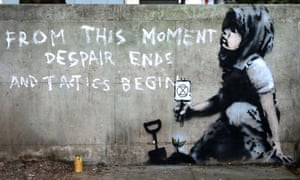
Suspected Banksy mural in London in support of environmentalist protest. 

As authoritarian right-wing populist leaders across the world unleash a reign of tyranny and hate, there is a need to think together about everyday strategies of survival. As an individual, it can get a bit overwhelming. Everything could look pointless. Many friends talk about how they find it impossible to write or work in an atmosphere of hate and violence. However, it is important to remember that what might look invincible today may not last for even half a decade. But while it lasts, how does one live under tyranny and what are the ways of building non-violent resistance? Continue reading Everyday Tips for Surviving Tyranny: Anonymous

Two Reports and Many Strategic Agents: Post-Disaster Thinking in Kerala

Two massive calamities, tremendous losses, continuing signs of serious ecological destruction impending — yet all we Malayalis seem to have produced in response: two reports, and even more frenzied strategic calculation. There is little doubt that the disasters happened in the first place at least partially because of the latter, but there seems to be no rethinking. Instead, we have strategic agents refurbishing their strategies to the new circumstances.

What else explains the Kerala government’s  Rebuilding Kerala Development Programme Report (RKDPR)? It popped up all of a sudden around the end of last year, after the UN-led Post-Disaster Needs Assessment Report (PDNAR), and even members of the Chief Minister’s Advisory Council were caught unawares.  The economist K P Kannan, whose life’s work has been focused on Kerala’s economy, a member of the Council, remarked in a recent interview in the Sastragathy that they did not know of it until the third meeting of the council. None knew who put it together, and there is no mention of this in the report itself. It draws heavily but selectively on the PDNAR, but also perhaps on the projects that were prepared for World Bank funding – and Kannan reaffirms this impression. The draft report was made available online for comments but there is no clear idea about these experts or the public consultations. Continue reading Two Reports and Many Strategic Agents: Post-Disaster Thinking in Kerala

After Kavalappara: Is the Future that of Ecological Patriotism?

I guess bad habits in development take a very long time to unlearn. Even in the face of the direst of warnings.

I know that last year, when taken completely by surprise, Kerala rose to the occasion. It appeared that a new civil society had come to being around the flood rescue and relief work, and that promised a new lease of life for our flagging-if-still-working project of people’s planning and political decentralization. It appeared that there was a real chance to stop the bureaucratic-technocratic coterie from shoving this ecologically-fragile area down the path of utterly destructive infrastructure-obsessed growth. It seemed that we could now seriously expose the depredations of the predatory capitalists, especially in the construction sector. Continue reading After Kavalappara: Is the Future that of Ecological Patriotism?

Alternative Futures – India Unshackled

Alternative Futures
Alternative Futures – India Unshackled

After the Berlin wall fell in 1989 and the Soviet Union collapsed in 1991, many consigned ideologies and alternatives to the rubble of history. The end of the cold war was explained as the victory, not just of liberal ethos and individual freedom, but of dynamic, market-driven capitalism championed by likes of Ronald Reagan, Margaret Thatcher and Manmohan Singh. India’s left also embraced this belief in practice, promoting foreign and national capitals and capitalist-led industrialization. They hoped market miracles would generate employment and wealth. Women such as MedhaPatkar, a social activist and a fierce opponent of the globalized developmental model and Sudha Bhardwaj, a trade union activist in Chhattisgarh seemed as thoroughly on the wrong side of the history as it was possible to be. Continue reading Alternative Futures – India Unshackled

Effects of Climate Change are not Contained within Nations – The Impact on India: Nagraj Adve

Guest post by NAGRAJ ADVE

This post is the second part, excerpted and slightly adapted, from the booklet by Nagraj Adve, Global Warming in the Indian Context: An Introductory Overview (Ecologise Hyderabad 2019). The first part appeared in Kafila on 1 July 2019

While the earlier post covered the basic science of global warming, the roots of the problem, and how inequality relates to climate change, this part focuses on key impacts of climate change in India, on humans and other species, and the reasons for urgency in tackling the problem. 

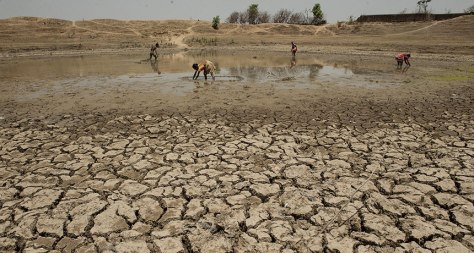
Villagers try to catch fish in drying pond in West Bengal, image courtesy Science News

Before we consider impacts in India and elsewhere, a few things are useful to keep in mind:

– Unlike most other forms of pollution, the source of carbon dioxide and where its effects are felt can be very far apart. Carbon dioxide generated in the United States affects people on the Orissa coast.

– A significant portion of carbon dioxide emitted today will remain in the atmosphere for centuries, influencing future climates.

– Even after the world ceases to emit carbon, higher average temperatures are “largely irreversible for a thousand years” because the gains of lesser radiation being trapped gets offset by the reduced loss of heat to the oceans. Hence, climate change is the new ‘normal’.

– Impacts will worsen because of the time lag between emissions and warming. Some of it is unavoidable. Our urgent intervention is needed to make sure they do not get much worse, and that the situation does not spiral out of our control. Continue reading Effects of Climate Change are not Contained within Nations – The Impact on India: Nagraj Adve

The Kisan Charter – ‘Farmers are not just a residue from our past but integral to the future of India and the world’

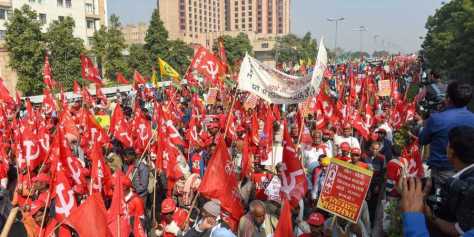
Kisan Mukti March in Delhi, image courtesy New Indian Express
Till just the other day, they were committing suicide, while some of them were demonstrating in Jantar Mantar, Delhi, humiliating themselves by disrobing and eating rats, trying in vain to draw the attention of the political establishment to their plight.  And to pour salt on their wounds, BJP leaders were saying that committing suicide had become a fashion among farmers! Today they are out on the streets, demanding, among other things, that their own debts be written off, not of the powerful and predatory capitalists. (See the Charter of the All India Kisan Sangharsh Coordination Committee below). This is, in all probability, the sign of a decisive shift, for today the charter relseased by the Coordination Committee declares loud and clear that
Farmers are not just a residue from our past; farmers, agriculture and village India are integral to the future of India and the world.

Continue reading The Kisan Charter – ‘Farmers are not just a residue from our past but integral to the future of India and the world’

Remote Islands, Savage Tribes: Sajan Venniyoor

Guest post by SAJAN VENNIYOOR

If you key in “remote island” on Google, most of the news stories it throws up are about an unfortunate and very dead young man named John Allen Chau. If you type in “remote Indian island”, Google will take you immediately to North Sentinel Island.

We are all, by now, familiar with sad tale of John Allen Chau and his ill-fated voyage to Sentinel Island. A young evangelical from the United States, Chau was – apparently from a very tender age – fired with zeal to convert to Christianity the natives of a very specific island in the Bay of Bengal: viz., North Sentinel Island in the Andaman & Nicobar archipelago.

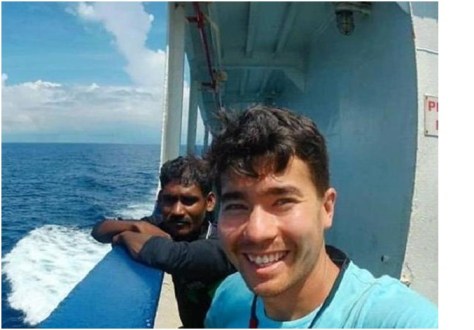
John Allen Chau

Continue reading Remote Islands, Savage Tribes: Sajan Venniyoor

Beneath the glitter – Looking at The Asian Games : Praveen Verma

Guest post by PRAVEEN VERMA

Hima Das

Does it amaze you when you hear the stories of poverty and success in same sentence? Does it amaze us when we hear the stories of some of the best sports-persons and the hardship they have dealt with before and throughout their careers? Does it amaze us when we hear about the sorry state of affairs of sports facilities and some athletes still coming up with great performances? Does it amaze that most of these athletes come from rural India and mostly where they have much economic and social constraints, where work and employment is still precarious? Does it alarm when one get to know that some of these phenomenal sports-persons come from the areas which are still dealing with the issues of hunger, high rate of unemployment, major gender gap? Areas where women coming out and trying to make cut into sports are still taboo? How often does one hear about women from marginal sections (Dalit/Backward caste/tribal) becoming a sportsperson?

Some stories of these kinds make usual snippets in many Hindi newspapers around big sports events. Though, these stories, which are posed as individual heroic one and less of a critical approach to see the working of sports administration, are meant to be sensational and don’t do justice to the entire sports affairs in India. Continue reading Beneath the glitter – Looking at The Asian Games : Praveen Verma

Restore Our Vision of the Future: A Letter to the Kerala Chief Minister

Dear Comrade

I write to you as a citizen, so unlike the many eulogies and appeals you have received recently, this will not be sugar-coated. You have received much praise, which is indeed well-deserved. But most of us have done, and are still doing, our duty well, but there is no need to indulge in any more self-praise.

Continue reading Restore Our Vision of the Future: A Letter to the Kerala Chief Minister

Brackish Reflections on the Great Deluge of 2018: Roby Rajan

This is a guest post by ROBY RAJAN

Epic. Biblical. Apocalyptic. These are some of the words that have been used to describe the floods and landslides that have wreaked havoc in Kerala over the last few weeks. Entire towns and cities were submerged, and entire rivers altered their courses overnight. Continue reading Brackish Reflections on the Great Deluge of 2018: Roby Rajan

A National Pledge for Kerala after the Great Deluge of 2018

  • Kerala is the land of my birth, and my life is intertwined closely and inseparably with the lives of all fellow-Malayalis. I will respect and remember this truth and will never think of my life as totally unrelated to nature, my neighbours, and the government that we elect to rule us.

Continue reading A National Pledge for Kerala after the Great Deluge of 2018

A List of Little-Knowledge Theories about Kerala in the Wake of this Disaster

By now everyone knows what the Sanghis, probably not just outside Kerala, but also inside, have been up to when others were battling the deluge, saving lives, working round the clock to organize relief: making Lord Ayappan look like a stupid brat (or, actually, painting him in their likeness), spreading idiotic claims that only the rich were affected, or that the Christians/Muslims/commies/everyone who isn’t a Hindutva bigot, are responsible for this catastrophe, and circulating fake photos, from relief work in Gujarat or somewhere else as RSS relief work for Kerala. Really, how we wish we could persuade them all to migrate to the Hindi heartland where ecological disasters are unheard of and will never ever be! Continue reading A List of Little-Knowledge Theories about Kerala in the Wake of this Disaster

A letter to Sanghiannan in the wake of our common woe

[Before you read this post, you might want to read KR Meera’s brilliant portrait of the average Malayali middle-class Sangh supporter, in her story Sanghiannan, which I translated as ‘My Brother Sanghi’, published by Juggernaut at : https://www.juggernaut.in/books/088d472b19d745d29492560654250e15 . I recommend this also because she sketches beautifully the spirit of deep compassion that inheres in the thought of Sreenarayana Guru, who tried to imagine the faith outside the brahmanical framework of caste. This will help you to get a sense of that section of Malayali middle class I address here.]


Kerala declares

Continue reading A letter to Sanghiannan in the wake of our common woe

Beware of Poisoning-Eating Maggots in Flood-Hit Kerala

In Malayalam, the usual way of referring to virulence that feeds on negative experience is paashaanathil krmi — or the maggot that is fattened by poison, instead of getting killed by it. Over the past few days, many of us have lived completely on the edge, bereft of sleep or ease, tossing about in a seemingly-unending nightmare, as the rain, floods, and landslides uproot not just our physical world, but the very culture of smugness and complacency that took over our deepest selves over the past twenty years or so. Continue reading Beware of Poisoning-Eating Maggots in Flood-Hit Kerala

Great Dance of Return in Gaza – Performing Palestinian Dabke in the Midst of Zionazi Attacks

This dance – the Palestinian Dabka – was performed amidst firing by Israeli Zionazis  on the 30th of June 2018. Remember the cowards stepped up their attack on Gaza as the holy month of Ramzan began. This video has all the ambient noises – of the firing of bullets and other war sounds and is therefore worth listening to. It has also gives you a sense of the extremely tense situation at the border.

To listen to the cleaner version, where you can hear the sound of the music more clearly, click here and listen to the second video.


A citizen’s protest at tree felling in Delhi: Poojan Sahil

Video prepared by POOJAN SAHIL

Disinheriting Adivasis – The Gadchiroli Game Plan: Vidhya A

Guest post by VIDHYA A

Image courtesy Subcontinental wind

In a statement issued on April 16th 2018, the Ministry of Home Affairs (MHA) claimed that the ‘National Policy and Action Plan’ to combat Left Wing Extremism (LWE) is ‘a multi-pronged strategy involving security and development related measures’[1]. This new policy, apparently in place since the NDA government came to power at the centre, claims to have ‘zero tolerance towards violence coupled with a big push to developmental activities so that benefits of development reached the poor and vulnerable in the affected areas’[2]. The statement talks of substantial improvement in the LWE scenario by indicating reduced incidents of violence over the last four years. Within a week of this statement to the press, several Maoists are killed in an alleged encounter in Gadchiroli district of Maharastra and, then, in Bijapur district of Chhattisgarh[3]. The Maharashtra state police immediately issued press notes and organised a press conference on April 24th declaring the operation an unmitigated success. A week later, Chhattisgarh police did the same. Even as the death count of Maoists kept rising, the police claimed that none of their personnel, primarily the elite C-60 force in Maharashtra and the Central Reserve Police Force (CRPF), were seriously injured let alone killed in action.

Continue reading Disinheriting Adivasis – The Gadchiroli Game Plan: Vidhya A

Thoothukudi Massacre – When State becomes Predator: Bobby Kunhu

Guest post by BOBBY KUNHU

Thoothukudi protests – Image courtesy LiveMint

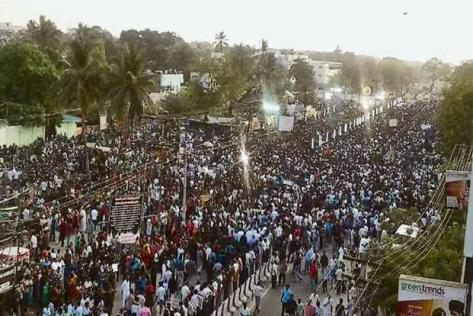
On 22nd May 2018, in what cannot be imagined even in a dictatorial regime, the police in Thoothukudi, Tamil Nadu – a South Indian state opened fire to kill, on a group of peaceful protesters marching towards the district administration office demanding denial of permission for expansion and closure of the existing copper smelting plant of Sterlite. Sterlite is a subsidiary of the London based corporation Vedanta, which has been dumping toxic waste all over this town since 1998 resulting in widespread health hazards including increase in reports of cancer. This massacre is unimaginable even in the worst dictatorial regimes, because not only were known national and international legal norms and protocols in crowd/riot control violated, but also because the video clippings that have surfaced after the massacre seem to indicate sufficient premeditation – with a plainclothes sniper on the top of a van being ordered to kill at least one person. Continue reading Thoothukudi Massacre – When State becomes Predator: Bobby Kunhu

A Theatre Olympics that Isn’t: Arundhati Ghosh

Guest post by ARUNDHATI GHOSH

Image courtesy Deccan Herald

I have been working for the past 16 years with a small organisation called India Foundation for the Arts (IFA) that attempts to support arts and culture projects across the country. In these years I have been fortunate enough to travel across the country to big cities and small ones, towns and villages where arts practitioners and scholars work intensely, passionately, with almost no economic resources or social acknowledgements. The percentage of our total national budget outlay to the arts and culture is negligible as is the amount that finally gets spent on it. The state of our national arts and culture institutions is abysmal and much has been written by eminent experts critiquing the vision, mandates, policies and mechanisms of funding or the lack of any of these prerequisites to support the sector with an imagination that attempts to build a robust, vibrant ecology for the arts.

Continue reading A Theatre Olympics that Isn’t: Arundhati Ghosh