Category Archives: Ecology/Environment

People’s Participation in Planning Mumbai?: Hussain Indorewala and Shweta Wagh

This is a guest post by Hussain Indorewala and Shweta Wagh

Since the past six months in Mumbai, there has been an unusual convergence between urban activists, community groups, rights groups, unions, Non-Governmental Organizations and academics, who have come together to provide a theoretical critique of the city’s neoliberal development model, to formulate a more diverse and hopeful vision for the city than the one proclaimed by its power elite, and to present practical alternatives to plans and projects promulgated by faceless state bureaucracies and unaccountable private consultants.

On 22nd October 2013, more than 1500 people gathered at Azad Maidan to formally present “The People’s Vision Document for Mumbai’s Development Plan (2014-2034)” to the Municipal Corporation of Greater Mumbai (MCGM).[1] The People’s Vision Document (PVD)[2] is a remarkable collective vision statement, an outcome of discussions focused around specific issues in the city with more than a hundred grassroots and community groups, along with activists, experts and academics who participated in them. With this movement, the less advantaged residents of the city have announced and forced themselves into an exclusionary and secretive Development Plan process; refusing to be silent spectators, in a striking example of initiative, organizational ability and creative agency, they have asserted their right to the city’s future, whose owners and managers have done much to keep them out. To use the language of other social urban movements around the world, some of the most marginalized groups of the city are fighting for spatial justice, urban democracy, and have claimed their ‘right to be equal in diversity.’[3] Continue reading People’s Participation in Planning Mumbai?: Hussain Indorewala and Shweta Wagh
A Night at the Pow Wow: Jay Desai

This is a guest post by JAY DESAI


As I approached the brown fields at the foothills of the rugged San Bernardino Mountains, the rhythm of the foot- stomping grew into a crescendo. I was visiting the annual pow wow of the San Manuel Band of Serrano Mission Indians.  Thousands of Natives from many of the 500 or so Indian nations of North America had gathered for three days of dance, song and celebration of their rich heritage. Above us, the autumn California sun had turned the barren high peaks into a shade of angry red at dusk. As the night fell, the enthusiasm of the dancers grew to match the vibrant colors of their traditional outfits and headdresses. My young niece, visiting from India, asked me if the dancers wore these dresses in their everyday lives and if yes, why she never saw them during her long travels through this vast country. She asked me if they were Americans. Continue reading A Night at the Pow Wow: Jay Desai

Laxmanpur Bathe, Then and Now: Monobina Gupta

Guest post by MONOBINA GUPTA

I remember a chill running down my spine that early afternoon in 1998. I was standing at Laxmanpur Bathe – the site of a cold-blooded massacre a year ago. Then a reporter with The Telegraph, I was touring Bihar, reporting on the 1998 general elections, less than two years after the United Front government came to power. Bihar was then firmly under the thumb of the redoubtable Lalu Prasad. Tensions between the Maoist Coordination Committee (MCC) and the Ranvir Sena, a private army of upper caste landlords, were running high. Every reporter visiting the area had been advised by the district magistrates concerned not to travel after sundown. Newspapers in Delhi were full of stories about Bihar’s lawlessness, extortions and abductions even in broad daylight.

I had read details of that deadly night in the newspapers; and then of the sudden trips made by VIP cavalcades to the village in the aftermath of the bloodbath. The massacre had pitched the forgotten hamlet of Dalits into the glaring spotlight. Crowds of politicians and media descended on the spot, even as the grief stricken survivors were struggling with the shock of the attack and the terrible loss of their loved ones. Continue reading Laxmanpur Bathe, Then and Now: Monobina Gupta

Indian Government needs to differentiate the real vs false solutions in agriculture this World Food Day : Neha Saigal

This is a guest post by NEHA SAIGAL


It is well-recognized globally that hunger and malnutrition are serious issues, but even after years of failed attempts by world leaders to try and solve this complex problem there has been little change. In 2009 for the first time in history the population considered to be malnourished exceeded one billion people signalling the serious issue of food insecurity we are faced with. In an effort to bring this serious issue to the forefront, the Food and Agriculture Organization (FAO) of the United Nations marks 16 October every year as ‘World Food Day’. Continue reading Indian Government needs to differentiate the real vs false solutions in agriculture this World Food Day : Neha Saigal

Dilemma of Indian Muslims After Partition: Yasmin Qureshi

Guest post by YASMIN QURESHI. Excerpts from this essay were read at an event organized by the Partition Archives project in Berkeley earlier this year.

Abbu’s family, like many other Muslims in India was torn between staying in their ancestral land and going to the new country founded for Muslims. The call for Pakistan and the Muslim League movement was more prominent in the elite or educated classes. For Abbu’s family it was a distant idea and life outside Dilli was inconceivable. But the partition wave didn’t leave them untouched and a few family members including Abbu migrated to Lahore. Lahore was chosen because they had heard it was similar to Dilli. A year in Lahore was enough for them to realize their heart was still in DilliGhalib ki galiyan, echoes of azaans from Jama Masjid, pigeons flying above their roofs and the aroma of korma brought them back to the home their father had built.

The conflict of choosing between the newly founded nation states of India and Pakistan divided many families. Some of Abbu’s relatives shuffled between the two for many years till they were forced to make a choice by the governments in the 1960s. His elder sister’s family and a few other nieces and nephews decided to become Pakistani citizens.

For Muslims that stayed in India, the next few decades were years of fear and subjugation. Communal violence, often organized and manufactured by political parties or the right wing Hindu organization, RSS throughout the 1960s in cities where Muslims were in large numbers was a threatening message to the Muslims that if they choose to stay here they would have to live as a silenced minority with a constant reminder they were guilty of dividing India. Continue reading Dilemma of Indian Muslims After Partition: Yasmin Qureshi

Jazeera in Delhi: Who Can Speak Against the Sand Mafia? : Bindu Menon M

This is a guest post by BINDU MENON M

Jazeera V, who began her fight against sand mining mafia in Kerala one and a half years ago in the North Kerala coastal hamlet Neerozhukkumchal, is now on a sit-in, in front of the Kerala House near Jantar Mantar New Delhi.  She had first approached the village office, the local panchayat, police station, the district authorities and Kerala State government with the appeal to stop sand mining in the beach which grossly violated the Coastal Zone regulations. Ridiculed by the local media and intimidated and physically assaulted by the supporters of the sand mining mafia, she sat in front of Kerala State Secretariat for several weeks before moving to Delhi.  She demands that the central government should immediately take action against the gross violation of laws for protecting the coastal zones. Her struggle in front of the Kerala secretariat at Thiruvananthapuram for 68 days against the inaction of Kerala Government forced Chief Minister Oommen Chandy to invite her to his chamber for discussion. Although he assured her that he would take necessary actions against sand mining on the coast, he was reluctant to give her any written reply. She finally decided to shift her sit in from Kerala to Delhi in protest of Chief Minister’s callous attitude.

Continue reading Jazeera in Delhi: Who Can Speak Against the Sand Mafia? : Bindu Menon M

A Fight till Death, A Fight for the Commons – The Story of Kathikudam, Kerala: Parvathy Binoy

This is a guest post by PARVATHY BINOY

“There is a lot of polluted rivers and lands in India…but this is not a big issue in Kerala”, Kerala Pollution Control Board Chairman (KPCB), 2011

We have no one with us now, neither the party in power nor its opposition, we only have the people with us” – Daisy Francis, Kadukutty Panchayat President, June 2013 Continue reading A Fight till Death, A Fight for the Commons – The Story of Kathikudam, Kerala: Parvathy Binoy

Interim report of the Kathikudam Fact Finding Commission THRISSUR, 30 and 31 July 2013

The news of police action against those agitating against the Nitta Gelatine India Ltd.,(NGIL) formally known as Kerala Chemicals and Proteins Ltd.)plant on 21 July 2013 in Kathikudam,Kerala, shocked the members of the civil society of the country. Various organizations across the country have come together in the form of this Commission to look into the matter. The team visited the site of the agitation of the NGIL Action Committee and some of the spots which are affected by the pollution of NGIL. The team also interacted with the affected residents and the members of Kadukutty Gram Panchayat to get a better insight into the pollution that the villagers have been alleging and the event that transpired on 21 July 2013. Continue reading Interim report of the Kathikudam Fact Finding Commission THRISSUR, 30 and 31 July 2013

People’s Victory Against Chutka (Madhya Pradesh) Nuclear Power Plant: Lokesh Malti Prakash

Guest Post by Lokesh Malti Prakash

The People of Chutka and adjoining villages in Mandla district of Madhya Pradesh won another victory against the Chutka (Madhya Pradesh) Nuclear Power Plant (being imposed on them by Congress-led Central government in active collusion with BJP-led state government) as the government was forced for the second time to postpone its farcical public-hearing on the project that was scheduled on 31st July. After a sustained protest by people of the region that was actively supported by almost every section of left-democratic forces in the state and beyond, the district administration called off the public-hearing on 29th July.

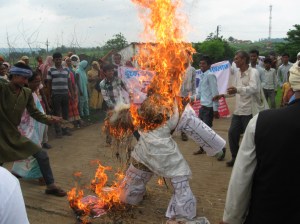
Burning the Effigy of Nuclear Power at Chutka

Continue reading People’s Victory Against Chutka (Madhya Pradesh) Nuclear Power Plant: Lokesh Malti Prakash

Lok Sabha elections, software imperialism and the Urdu language: Anant Maringanti

Guest post by ANANT MARINGANTI. Kapil Sibal may have unwittingly erased a whole historical geography of pre-windows software development in India. If the Times of India report on the release of Urdu fonts developed by National Council for Promotion of Urdu Language ( NCPUL) last week is accurate,  Sibal said that India developed Urdu Software and fonts and thereby ended a longstanding dependency on Pakistan. This, according to him is beneficial to the 15 crore Urdu language users. There is a  ‘pre-election Muslim wooing’ feel to the story which nicely blends with the  ‘massaging of Indian (read Hindu) nationalist pride’ feel.  The sense of triumph and pride at this historic achievement by Indian programmers would have been justified even if it could be read as symptomatic of the postcolonial condition that Amitav Ghosh captures in his recounting of the breakdown of conversation between himself and the Imam of Lataifa and Nashawy.  Unfortunately however, Urdu language users in India were never dependent on Pakistan for software and fonts.  This can be said in two different senses: first that Indian Urdu language computing originated in Hyderabad almost 25 years ago and has contributed significantly to local cultural economy. Second, to the extent that there has been exchange between India and Pakistan in Urdu language computing, the participants in that exchange have seen it primarily in terms of exchange. Afterall, people cannot help making language tools even if nation states do not pay them much attention.    Continue reading Lok Sabha elections, software imperialism and the Urdu language: Anant Maringanti

We do not want to see a repeat-performance of Muthanga: Appeal against Police Violence at Kathikudam

[When he finished recounting a glorious story of struggle by fisher folk against an obnoxious, oppressive feudal lord in a coastal village in Kerala, a senior activist told me: “But we can’t rest … the places where the poor live in Kerala are being taken over again … this time to be waste-dumps of the rich. This village can’t be an exception.” He was referring to the heavy pollution caused by the high-end pleasure resorts mushrooming around the village. Indeed, in all districts of Kerala, local struggles are becoming all the more frequent against the pillage of the earth to satisfy consumerist greed of the predatory rich and the shameless dumping of waste in areas where the poor live. The people of Kathikudam have been fighting a long battle — not just against the Nitta Gelatine factory’s heavily polluting practices which have nearly destroyed the Chalakudi river, wetlands in the area, extracting a huge toll on animal, and plant life in the region  and causing immense difficulties to local people there.  They are also condemning the company’s stealthy attempts to dump waste in distant border adivasi areas. Yesterday the police unleashed bestial violence against protestors, which has been widely condemned in the state.

Below is an appeal in protest signed by concerned intellectuals and activists. If the present UDF government considers itself to be above being a bunch of wheeler-dealers whose sole interest is grabbing the crumbs that fall from the table of predatory capital, they must act decisively and justly against this wanton disrespect to democracy on the part of the police they control. Those who wish to endorse the appeal may please indicate so in the comments]

We, the undersigned, are shocked to hear and read about the unfortunate and avoidable response of the police in the handling of the peaceful protest against thee pollution by Nitta Gelatin Company Limited has been creating in the village of Kathikudam in Thrissur District of Kerala.
The police attack on the protest has been brutal and the violence is against the people of the village who have been denied justice in the wake of insufferable pollution, which has been causing severe damage to the air, water, soil and agriculture of this region for three decades. This is what prompted the protestors to take action in the form of removing the pipe that carries effluents to the river. Continue reading We do not want to see a repeat-performance of Muthanga: Appeal against Police Violence at Kathikudam

The unbearable lightness of drowning in your own myth: Tamer Söyler

This guest post by TAMER SÖYLER is the third of a three-part series on Istanbul’s Taksim Square protests.

 995434-130611-turkey-protests

This is the final segment of a three-part account of the unrest in Turkey. The first part of the commentary discussed the unrest from the perspective of the political life course of Erdoğan. According to the protestors it was the Prime Minister as the key political figure who set the cat among the pigeons. Neither the opponents and nor the supporters of Erdoğan can make sense of Erdoğan’s turn to authoritarianism on the eve of critical election season. There are two possibilities: First, Erdoğan could have lost his emotional equilibrium and started to react to the events carelessly. Since the Prime Minister surrounded himself with advisors and party members who cannot dare to challenge him, he lost his bearings. Second, as an experienced politician Erdoğan must have a political strategy. Even if he is emotional his emotions are closely related to the concrete problems he faces. Continue reading The unbearable lightness of drowning in your own myth: Tamer Söyler

Huge Rally of Narmada Dam Oustees in Bhopal: Jeevan Adhikar Satyagraha and Upwaas begins with Demand for Rehabilitation and Resettlement

This is a press release by the NARMADA BACHAO ANDOLAN

28th June 2013

Rally 2

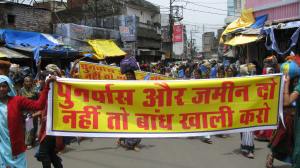
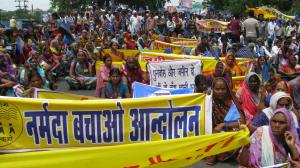
Thousands of oustees affected by the Indira Sagar, Omkareshwar, Maheshwar, Upper Beda and Man dam demonstrated in capital city Bhopal today and began their Satyagrah. Despite continuous rain in the entire Narmada valley, over 8000 men and women displaced persons have reached Bhopal to camp here for the next 5 days. The affected people demand that all the oustees of these dams should be rehabilitated and resettled with land and all other entitlements, and the injustice being wreaked on them for decades be stopped. Shri Alok Agarwal, senior activist of the Narmada Bacahao Andolan along with 4 men and women oustees have started their fast for 5 days in this “Narmada Jeevan Adhikar Satyagraha and Upwaas”.

Gyapan

Continue reading Huge Rally of Narmada Dam Oustees in Bhopal: Jeevan Adhikar Satyagraha and Upwaas begins with Demand for Rehabilitation and Resettlement

Hydro Power Projects and Northeast India: Ecology and Equity at Stake

This is a guest post by RICHARD KAMEI

Recently a two-day North East People’s Convention on water and dams was held at Bethesda Youth Welfare Centre, Dimapur (on 17th May-18th May 2013) which brought together a group of 26 organisations from North East India under the banner of the North East Dialogue Forum. This forum called for a focus into the objectives raised in this two day convention, by writing to leaders of India, China and Bangladesh over the imminent adverse impact of the issue of water, impacts of constructing big dams and mining in various regions of North-East India. The outcome of this two-day North East People’s Convention on water and dams, is the joint appeal known as ‘Dimapur Declaration’.  At the time of this declaration, prime address was made to the Prime Minister of Bangladesh, Sheikh Hasina; the Premier of China, Li Keqiang and Prime Minister of India, Dr Manmohan Singh. The main objectives of Dimapur Declaration are:  to protect the inherent rights of local people over their water, land, forest and other resources based on customary and international laws as guaranteed by the Universal Declaration of Human Rights and UN Declaration on the Rights of the Indigenous People 2007 etc., and their self-determined development of their water bodies in the region. The recommendations of the World Commission on Dams, 2000 have also been given a special mention in terms of its implementation in all decision making processes on dam constructions over Brahmaputra (Tsangpo) River. “The Thatte-Reddy Expert Committee said the present hydropower work on Subansiri contravenes the basic premise of the Brahmaputra Board Act with regard to flood control, irrigation and other benefits. The report agreed that the present planning of the project ignored the flood control aspect. Therefore, the committee agreed that the very purpose of the project and purpose of the Brahmaputra Board Act is defeated and the mandate of the board diluted by this action,” opined Akhil Gogoi, Krishak Mukti Sangram Samiti ( KMSS). Continue reading Hydro Power Projects and Northeast India: Ecology and Equity at Stake

The Greater Common Omelette

This is a guest post by NITYANAND JAYARAMAN

Governments like victims. Distressed people make for thankful recipients of public largesse. Within a week of Uttarakhand’s watery disaster of June 16 and 17, the Tamil Nadu Chief Minister announced a Rs. 5 crore relief in solidarity with the “Government and people of Uttarakhand.”

This generous gesture stands in stark contrast with the way the Chief Minister is dealing with people in her own state who are concerned about their increased vulnerability to natural disasters. Around the time that she handed out her cheque to Uttarakhand, 19 fishermen from Sulerikattukuppam, a hamlet about 40 km south of Chennai, begged their way to bail after spending a month in prison. They were arrested for demanding relocation and rehabilitation; the celebrated 100 million litres per day Nemmeli seawater desalination plant constructed by Chennai Metrowater had triggered severe sea erosion and brought the sea dangerously close to their homes. The highly toxic brine rejects were polluting their seas. Continue reading The Greater Common Omelette

From Koodankulam, an open letter to the Indian media

koodankulam

Press release issued by the PEOPLE’S MOVEMENT AGAINST NUCLEAR ENERGY (PMANE), based in Idinthakarai in Tirunelveli district of Tamil Nadu.

Dear friends,

Greetings!

Please allow us to bring the following to your kind attention in the larger interests of our country, people and most importantly, our democracy and freedom.

As the Fourth Pillar of our democracy, the media in India plays an important role in the smooth running of our country and the perpetuation of our democratic heritage.

We are sure that you have noticed the postponement of the commissioning of the Koodankulam nuclear power project (KKNPP) to July 2013 without giving any reasons or explanations. Continue reading From Koodankulam, an open letter to the Indian media

Iqbal Chacha and a Voice from the Past: Sameer Khan

Guest post by SAMEER KHAN: Mr. Chaddha lived in my neighbourhood, a tall lanky elderly gentleman who looked young for his age. I would often see Mr. Chaddha come for a morning walk in our local park, but I stayed aloof, not having an interest in the elderly gentlemen in the park who were either part of laughter clubs or the local residents union.  Whenever I managed to struggle out of my bed for my morning exercise I would notice Mr. Chaddha walking ramrod straight like a soldier. He was never generous with his smiles and would simply nod his head whenever I greeted him.

One pleasant winter morning as I passed Mr. Chaddha in the park I was surprised to hear him call my name. I went towards him, and looking at me from his towering height he asked me, “Can you read and write Urdu?” Startled by the question I answered, “Uncle I can read Urdu but I am not too confident of my writing abilities.“

He said, “Well actually I want someone to write a letter for me in Urdu” Continue reading Iqbal Chacha and a Voice from the Past: Sameer Khan

Ground Report on the Real Estate Mafia’s Reign of Terror in Noida: Bigul Mazdoor Dasta

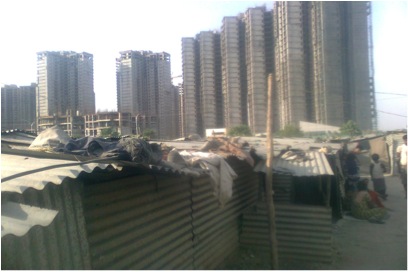
This is a guest post by Bigul Mazdoor Dasta  Noida is one among those places which are highlighted as the hub of the ’emerging’ and ‘shining’ India. The glittery shopping malls, world class expressway, flyovers, F1 International circuit, luxury apartments, villas etc. are cited as the symbols of India’s ‘growth story’ and Noida has all of these. For the last couple of decades, the mainstream corporate media has been busy selling this growth story to the emerging urban upper middle class; in the process making them a customer of artificially inflated dreams such as having one’s own luxurious house. But, curiously, the harrowing stories of those whose labour power is responsible for this so called development are conspicuous by their absence in the mainstream media’s narrative. The labourers come into the news only when some untoward incident happens and they are immediately held responsible for any such incidents without carrying out any investigation. One such horrendous incident took place on April, 28 at one of the hundreds of construction sites in Noida in which the security guards of the site opened fire on the labourers and in the process injuring some of them. On the morning of the April 28, the workers of the 3C Lotus Panache company’s constructions site at Noida’s Sector 110 witnessed the naked reign of terror by the company’s management. At the beginning of the morning shift at around 8 a.m., the workers had reached the construction site to join the construction work of the multi-story apartment complex, but they had to stand in a big queue because the security guards at the gate were taking a long time to intensively check each worker and make an entry. When some workers protested against this lax attitude of the guards, saying that they had to listen to the supervisor’s abuses if they were late even by one minute, a heated exchange took place between the security guards and workers and suddenly the guards started firing indiscriminately over the workers. As per the media reports, two workers were injured, but when a team of Bigul Mazdoor Dasta visited the workers settlement adjacent to the construction site, some workers said that the number of the injured workers could be four which includes a child as well and one of the workers is seriously injured and his life is in danger. As per the records of the district hospital in Noida, only one worker was admitted on April 28. Other workers were admitted to some private hospital.

Bigul1

The workers settlement adjacent to the construction site where the incident took place

Continue reading Ground Report on the Real Estate Mafia’s Reign of Terror in Noida: Bigul Mazdoor Dasta

Nuclear Energy – Reassurances Don’t Guarantee Safety: M V Ramana

This is a guest post by M V RAMANA 

On 23 March 2013, NDTV featured one of its Walk the Talk features with Shekhar Gupta interviewing Yukiya Amano, the Director General of the International Atomic Energy Agency (IAEA). This was reproduced a few days later in the Indian Express. Coming shortly after the second anniversary of the multiple accidents at Fukushima, the purpose of the interview is made clear by Gupta late in the interview when he says:

…some of us who support the idea of [expanding] nuclear power [in India] need more reassurance from people like you.

And Amano does oblige by asserting,

with more caution, with further measures, I am very confident that nuclear power is much safer than before.

To those already supportive of more nuclear reactors, the interview is likely to have been successful in offering them the assurance that they need, not so much for themselves, but to silence those skeptical of the expansion. But if one reads the interview more carefully, it is clear that the assurance is not really a guarantee that no catastrophic accidents will happen. Continue reading Nuclear Energy – Reassurances Don’t Guarantee Safety: M V Ramana

To Break a Siege: Justin Podur

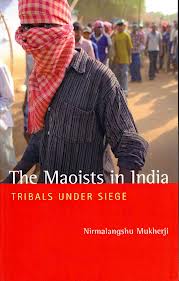
This is a review by JUSTIN PODUR of  Nirmalangshu Mukherji’s book Maoists in India: Tribals Under Siege (Pluto Press 2012)

The Maoists in India, Nirmalangshu Mukherji

Central India is a place where all the fault lines of “development” in today’s world converge. Indigenous people, vast stretches of natural forest, mineral-hungry corporations; media, government institutions, and political parties heavily compromised by private interests; people’s struggles, armed insurgency, counterinsurgency, military occupation, paramilitarism – all are present, and until recently, it has all been a well-kept secret.

The struggles play out differently in different parts of Central India. In Orissa, indigenous people’s movements have battled mining companies and stalled projects for years, in Kashipur and Lanjigarh. In Chhattisgarh, in the northern Bastar region, one of India’s billionaires, Naveen Jindal of the Jindal Group (also a polo player and a Congress Party Member of Parliament for a different district), wields tremendous economic and political power. The mines use captive power plants, coal or hydro, so each mine causes massive ecological and agricultural damage. In a profile by Mehboob Jeelani in Caravan Magazine on March 1, 2013, Jindal explained his philosophy: “We don’t control all the raw materials, but we have captive mines for 60 or 70 percent. This is something my father really believed in—that we must control our raw materials. If we don’t, then other people control us. So we made a conscious effort to acquire coal and iron ore mines.” In southern Bastar in Chhattisgarh, a Maoist insurgency is fighting against government forces, police, paramilitaries, and vigilante groups, from bases deep in the forest, in a war that was largely unknown for decades.

In India, the secret of the insurgency was broken by a series of atrocities committed by a group called Salwa Judum, starting around 2005. Salwa Judum in the Americas would be called paramilitaries, but in India is called a vigilante group. Salwa Judum was organized by the state and headed by a Congress Party politician named Mahendra Karma. It burned hundreds of villages, committed murder and rape, and tried to channel the indigenous people of the forest villages into roadside camps, where their movements could be controlled. This was all done in the name of fighting the Maoist insurgency, and it largely failed on those terms: Maoist numbers increased, the indigenous people went deeper into the forest. But it was a human disaster, and that human disaster has continued. The objective is the lands where the indigenous people (in India called adivasis) live – specifically the minerals underneath those lands, which put them in the way of the extractive development model and hence, in the line of fire. Continue reading To Break a Siege: Justin Podur

Vedanta-Sterlite – Dangerous by Design: Nityanand Jayaraman

Guest Post by  NITYANAND JAYARAMAN 

Tuticorin Oct 2010 298

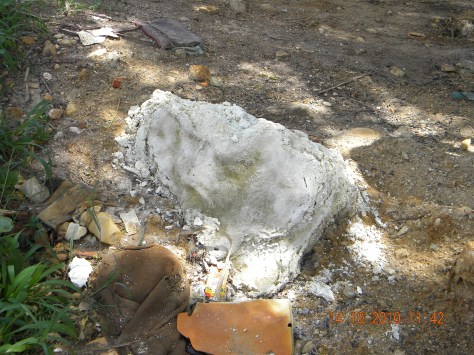
A toxic hotspot in the backyard of a house in Therkuveerapandiapuram, a village adjoining the Sterlite factory.  Dangerous levels of iron and arsenic were found in the soil here. (Picture by Nityanand Jayaraman)

On 23 March, 2013, a toxic gas leak from Vedanta-subsidary Sterlite’s copper smelter in Thoothukudi spread panic and discomfort for several kilometres around the plant. The leak once again highlighted the increased potential for major catastrophes due to an atmosphere of collusion between regulators and polluters. The company, which was shut down for maintenance, resumed operations in the early hours of 23 March. Within hours, people in the nearby areas complained of suffocation and eye and nose irritation. A 35-year old Bihari contract labourer, who was working at Sterlite’s thermal power plant nearly a kilometre away, reportedly succumbed to the effects of the toxic gas. Irate residents rallied to the District Collector’s office demanding permanent closure of the offending factory. Continue reading Vedanta-Sterlite – Dangerous by Design: Nityanand Jayaraman