Category Archives: Everyday Life

Days and Nights in Manesar – Reflecting on the ASTI Workers’ Struggle: Anshita & Arya

Guest Post by Anshita & Arya (Krantikari Naujawan Sabha)

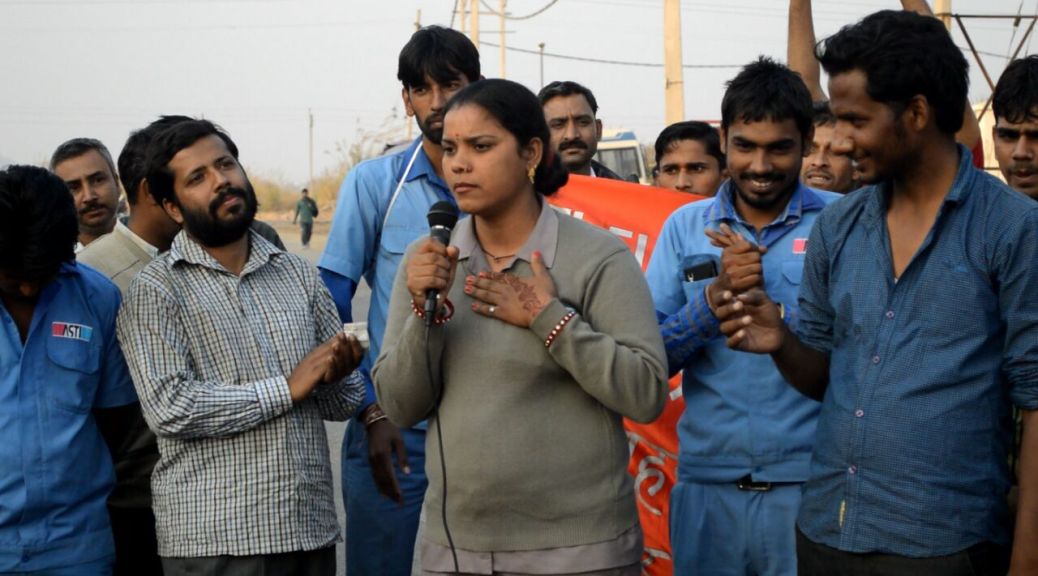
All 310 contract workers in ASTI Electronics factory in IMT Manesar in Gurgaon, Haryana have been on dharna since 3rd November 2014 after they were laid-off on 1st November 2014 citing low work demand. Seven of them are on fast-unto-death from 24th November, while ten workers and pro-worker activists each everyday sit on relay hunger strike.

 In a context where contract workers, increasing exponentially as a demand of the capitalists gleefully forced down by the government through labour law reforms, are finding it ever harder to organize/unite and sustain spontaneous outburts of discontent, due to the precarious nature of their life and work conditions, workers at ASTI Electronics (as a continuation of the 60-70 strikes in various factories in the industrial belt of Gurgaon-Manesar-Dharuhera-Bawal in the last few months) are fighting back and keeping the flame of new emergent struggles alive.

These workers are raising important questions on contractualisation and informalisation within the organized sector which even Central Trade Unions have constantly avoided. Over 250 of these 310 workers are women whose militancy in struggle and leadership is redefining the overall struggle and changing the gender relations within the workers movement.

This struggle for work-livelihood-life is unmasking the heart of the developmental model on DMIC (see current projects in makeinindia.com) which Mr Modi under the supervision of the capitalist class is proposing as the solution to all ills before so-called ‘progress of the country.What follows is a short reflection from the factory gate on the ongoing struggle. Continue reading Days and Nights in Manesar – Reflecting on the ASTI Workers’ Struggle: Anshita & Arya

The deadly land policies planned by Modi’s advisers and the links to Ukraine and Honduras: Aditya Velivelli

This is a guest post by ADITYA VELIVELLI

One year after the Land Acquisition Act was passed in Parliament with bipartisan support, commerce minister Nirmala Sitharaman stated that changes will be made to the Act during the upcoming Winter Session of Parliament.

The earliest indication that this would happen, came from of all people, a first-time MP and microfinance lobbyist Jayant Sinha. Sinha had mentioned in a CNBC interview right after BJP’s win that land acquisition policy was the first priority. For those wondering why CNBC interviewed Sinha and allowed Sinha to lay out the new Government’s priorities, and why Sinha has been appointed junior finance minister, they should refer – Who is guiding Modi’s economic thinking and what is their background? Continue reading The deadly land policies planned by Modi’s advisers and the links to Ukraine and Honduras: Aditya Velivelli

‘Law of the land’ on Kissing in Public: Sanjay Palshikar

SANJAY PALSHIKAR, Professor, Political Science department, University of Hyderabad, clarifies the ‘law of the land’ on kissing in public, to the Committee set up by the Vice-Chancellor to ‘look into the matter of the incident of November 2, 2014.’

Respected Members,

At the centre of the incidents of November 2, 2014, is the alleged act by some students to display demonstratively mutual affection in the form of kissing. Without going into the factual correctness of the charge, let me share with you what I have learnt from legal scholars and activists. I do so in the hope that this will help the Committee “ascertain” “the position of the law of the land” regarding kissing in public.

  1. Indian judiciary at the higher levels has not universally treated kissing in public as illegal. In appropriate context, spelt out variously by the relevant judgments, it has been seen as an expression of love, expression of love and compassion, and its artistic representation as defensible. Absent in all theses cases is the tendency to presume that every kiss is an act of sexual expression and that indulging in this act in public is always obscene. (A & B vs State Thr. N.C.T. of Delhi 2009; Friday vs K.J. Sebastian 2001).
  1. The Supreme Court has observed that the Indian Penal Code “does not define the word obscene and this delicate task has to be performed by courts….” If the Apex Court considers it a delicate task, how much more challenging it would be for university teachers and police officers to say if an act is obscene! (Udeshi vs State of Maharashtra 1965).

Continue reading ‘Law of the land’ on Kissing in Public: Sanjay Palshikar

The voices we didn’t hear: K.S. Narendran

Guest Post by K.S. NARENDRAN

As I write this, we are entering the ninth month after the disappearance of Malaysia Airlines flight MH370. I would not want it to be forgotten soon. My wife Chandrika Sharma was on that flight.

Over the past few months, as public attention has shifted to other issues, the long-drawn search for MH370 has seen many developments, ranging from the disturbing to the outrageous. The ineptitude of the Malaysian authorities was on public display, particularly in the early weeks of March 2014, and so merits no further comment. What is intriguing, even worrisome, though is that relevant institutions have been inaccessible or indifferent, be it in terms of pushing for the truth and seeking accountability, or in responding to the affected families’ needs. What follows is my own experience, my take.

The Indian Government: Mute and invisible

In the first week following the disappearance of Malaysia Airlines’ Flight 370, I had asked whether our government had any view on the incident, and any role in responding to it. After all, Indian citizens were involved. This evoked an interesting, if not distressing, set of responses. Indian Minister of State for External Affairs, E Ahmed, deemed the election campaign a higher priority, and opined that the Indian Embassy (at Kuala Lumpur) ought to have stepped in. In informal conversation, many were sympathetic with this view. The Ministry of Civil Aviation and the DGCA seemed similarly indifferent, or saw no role for themselves in responding to the incident or in assisting the affected families. Even the state governments, otherwise quick to take offence at any perceived slight or injury to sons and daughters of their ‘soil’, remained untouched, conspicuous by their silence. The only face of the government that I saw were the CB-CID Special Branch of the Police, the Indian arm of the Interpol and the Intelligence Bureau.  Each asked the same set of questions, suggesting that they work in silos,  that they don’t trust each other. Continue reading The voices we didn’t hear: K.S. Narendran

A kiss for your thoughts, University of Hyderabad: Anu K Antony, Mohan K Pillai, Sinjini Bhattacharya and Vaikhari Aryat

Guest Post by ANU K ANTONY, MOHAN K PILLAI, SINJINI BHATTACHARYA, VAIKHARI ARYAT 

HYD

The protest meeting organised by the students of the University of Hyderabad on the university campus

‘That is knowledge which liberates’, proudly proclaims the crest of University of Hyderabad, a prominent central university in our country. A University space has been traditionally seen as the vanguard of socio-cultural critique and change. Universities pride themselves in upholding the values of freedom of thought, expression and debate. And yet, the reaction of the administration of the University of Hyderabad (UoH) to a recent event, in an otherwise liberal-tolerant and progressive-leaning campus, leaves much space for thought.

On November 2nd, a group of students organised an event on campus in solidarity with the much discussed “Kiss of Love” protest in Kerala. Titled “UoH Against Moral Policing”, the on-campus event, publicised solely on online social media, was supposed to create a space to discuss issues surrounding moral policing and the chain of Kerala incidents, bring out narratives of moral policing, talk about morality and Indian culture, and recite poetry. Also planned was a symbolic act of kissing on a chart paper, with the slogan “Our lips don’t char”. However, some ABVP and BJYM activists, with the aim of saving the students and the Indian culture from Western “immorality”, barged into campus and tried to attack the student protesters. The Telangana Police and campus security, who had failed to stop the intruders, did later succeed in cordoning them off from the protesting crowd, while insisting that the students call off the protest and disperse.

Unaccustomed to Police chauvinism and empowered enough to insist on their rights, the students managed to continue with their planned activities, although once in a while some right-wing activists managed to break ranks and tried to incite violence. The campus community however showed great restraint and continued protesting peacefully.  In response to such moral policing inside campus, the 250-plus students spontaneously started hugging and kissing each other, before dispersing.  Continue reading A kiss for your thoughts, University of Hyderabad: Anu K Antony, Mohan K Pillai, Sinjini Bhattacharya and Vaikhari Aryat

The Class Politics of Blasphemy in Pakistan: Fatima Tassadiq

Guest Post by FATIMA TASSADIQ

The brutal murders of Shehzad and Shama, a Christian couple in the village of Kot Radha Kishan in Kasur district on 4th November, spawned predictable outrage in the press and social media. The rush of horror, the diagnoses and prescribed course of action against such violence involved the familiar paternalistic discourse of the ‘illiterate masses’ whose ‘ignorance’ evidently leaves them particularly vulnerable to the manipulation of the much maligned mullahs. Such a narrative serves the dual function of reducing religious violence to the faceless masses while at the same time reaffirming the educated urban upper class as the rightful custodian of Islam and Pakistan. This construction conveniently ignores the role played by the state and the elite in producing religious violence and feeds the class-based blind spots that exist in our understanding of what constitutes religious extremism.

Continue reading The Class Politics of Blasphemy in Pakistan: Fatima Tassadiq

There is hatred in the air yet again: Preeti Chauhan

Guest Post by PREETI CHAUHAN on the recent communal tension in Noor e Illahi area of Delhi.

It was around 9 pm on Tuesday, November 11th, I was heading to my parents’ home to go with my sister for an interview the next morning, when my cellphone rang, my sister was asking me frantically where I was. I replied a bit anxiously but with irritation, ‘Kya hai? Pahunch jaaungi thodi der mein’. She said don’t come, turn back. I asked why, ‘yahan dange hone waale hain, saari dukaanein band ho rahin hain’, my sister replied. In those two-three seconds my heart skipped many beats, a strange fear about the safety of my family gripped me. I could for the first time feel what it is to live in fear of communal riots. I called up my close relatives who were out of home to ask where they are. There was such an uncertainty as to how will my sister go for the interview tomorrow? Would I be able to reach home tomorrow morning? Would my vehicle be attacked if I decide to go home now?

In those three- four minutes the world seemed to have taken a terrifying turn for me. Mundane, everyday things, everyday routes suddenly turned hostile and suspicious. I could feel the agony and fear so very close. Then there was a sudden burst of anger that I felt against the communal forces that are so hell bent on creating communal trouble everywhere in Delhi. I had not read the newspaper the whole day yesterday and hadn’t watched TV but just before I was leaving home my spouse told me that my native place is in the news and it was then that I had read about the communal tension and curfew in Noore-illahi. It’s the area, the vicinity of my childhood, adolescence and my adulthood too. It’s the area of the weekly bazaar for us, the Eid bazaar as well from which we had returned at 1 am at times. Noor Chicken is where Noor Jahan furniture once stood if I remember correctly; it belonged to the family of one of my classmates in school. I hear today that Noor Chicken’s owner and his son was badly beaten and the son is rumored to have succumbed to injuries. I shudder to think if he is my primary school classmate Shahnawaaz… Continue reading There is hatred in the air yet again: Preeti Chauhan

Crime and Consent: Vrinda Grover

VRINDA GROVER analyses the recent Delhi High Court judgement on the rape and consequent death of a 65 year old woman, acquitting the accused because the woman was ‘menopausal’ and making a curious distinction between ‘forceful’  and ‘forcible’ intercourse.

In a recent judgment in Achey Lal vs State Govt of NCT Delhi, the Delhi High Court on October 30 set aside the conviction of the appellant for rape and murder. What has provoked discussion are the observations, inferences and conclusions of the court. Briefly, the facts as reported in the judgment are: on December 31 2010, a house maid, aged about 65-70 years, was found dead, with her clothes disheveled to expose her body. The accused, Achey Lal, 45 years old, was present in the room in an intoxicated condition. The husband of the deceased deposed that the accused had come at 8 am that day to his house with a quarter bottle of alcohol and when it finished, the husband left, while the accused stayed on with his deceased wife. The cause of death, according to the doctor who conducted the post mortem, “was asphyxia due to aspiration of gastric contents consequent upon forceful sexual intercourse, which was sufficient to cause death in the ordinary course of nature”.

Read the rest of the article in The Indian Express.

Statement On Sterilsation deaths in Chattisgarh by Public Health groups

The Jan Swasthya Abhiyan, Sama Resource Group for Women and Health, Commonhealth and National Alliance for Maternal Health and Human Rights are shocked at the death of 11 women and the critical condition of 50 other women due to the callous negligence of the Health Department, Government of Chhattisgarh. The deaths and morbidities are a result of a botched-up sterilization operation camp organized by a private hospital under the National Family Planning Programme in Takhatpur Block of Bilaspur District on 8 November 2014. Horrifically, during this camp, 83 women were subject to surgeries in a short span of 5 to 6 hours. Amongst those who have died are Dalits, tribals and Other Backward Classes, leaving behind shattered families and young children. This has resulted in gross violation of the reproductive and health rights of the women.

This tragedy raises grave questions about the unsafe, unhygienic conditions and the slipshod attitude under which these operations were conducted. Moreover, the women who are presently critical continue to get treatment in dismal conditions exposing them to further risks and danger.The surgeries were conducted in complete violation of the Supreme Court orders (Ramakant Rai Vs Govt. of India, 2005 and Devika Biswas Vs Govt. of India, 2012). These orders instruct that a maximum of 30 operations can be conducted in a day with 2 separate laparoscopes only in government facilities. Also, one doctor cannot do more than 10 sterilizations in one day.  Despite this, the surgeon in Chhattisgarh performed about three times the permissible number of surgeries (83) in less than 6 hours in a private hospital which has reportedly remained closed for 15 years. This is evidence of how these operations were not done under standard protocols.

Continue reading Statement On Sterilsation deaths in Chattisgarh by Public Health groups

‘Kiss of Love’ in Delhi, confronting the RSS: Vasundhara Jairath and Bonojit Hussain

Guest Post by Vasundhara Jairath and Bonojit Hussain 

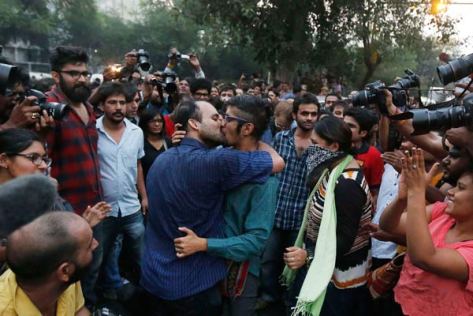
In the first of its kind in India, youth in Kochi launched a campaign called ‘Kiss of Love’ to challenge the moral policing of the Hindu Right. While that protest was attacked by right wing thugs and suppressed by the police, this form of protest has since spread to different parts of the country like Hyderabad, Bombay and Calcutta. Today, the ‘Kiss of Love’ protest was held at nowhere short of the Rashtriya Swayamsevak Sangh (RSS) head office in New Delhi. A few individuals took the initiative and gave a call for this protest on Facebook with the title, ‘Sanghi Gunde Hoshiyar, Tere Samne Karenge Pyaar’ (Sanghi thugs beware, we will love in front you). Continue reading ‘Kiss of Love’ in Delhi, confronting the RSS: Vasundhara Jairath and Bonojit Hussain

This is What Frightens Them….

And the struggle continues, image courtesy Manorama online
And the struggle continues…Kochi, image courtesy Manorama online
“If conservative elements can capture our public spaces and impose their diktat on us, we will do the same in retaliation. Our university spaces, parks and roads are not free any more. We are reclaiming them now. We live in an age where a Dalit man is hacked to 40 pieces because he fell in love with a woman from a higher caste. This Kiss of Love campaign is a defiance of moral policing and a struggle to uphold the spirit of love in all its forms and for everyone,” said Zareen, a campaigner.
Kiss of love Delhi, image courtesy, DNA

Resist the Sangh Parivar’s Hatred of Love: Nayanjyoti and Subhashini

Guest Post by Nayanjyoti and Subhashini

In late October, the youth wing of the Sangh Pariwar among others vandalised a café in Calicut on the pretext that lovers ‘date’ each another sitting in this café. When many young men and women in Kochi gathered together to protest by expressing their love in public, they got beaten up by various right wing groups and the police in response. The students and youths in different regions of the country gathered in solidarity of this protest going by the name of ‘Kiss of Love’. At the same time, as the news spread rapidly through the media and social networking site, a polarization continues to develop in the society, even among the individual activists and similar organizations, for and against the form of this movement.

Continue reading Resist the Sangh Parivar’s Hatred of Love: Nayanjyoti and Subhashini

Statement Condemning Rape on EFLU Campus: EFLU Alumni and Other Concerned Individuals

Guest Post by EFLU Alumni and Other Concerned Individuals

[ This is a statement prepared by some alumni of EFLU, in the aftermath of the rape of a woman student on campus last week. The statement was then shared on the social media for endorsement. Those who had drafter the statement say that they “…were overwhelmed by the support shown by a cross section of people including alumni, not just practicing academics and students of other universities, but also techies and bankers, journalists and professionals.” The statement is intended to be seen as an expression of solidarity with the complainant, in appreciation of her bravery and as a means of extending support to the EFLU community who are trying to fight for gender justice in innovative and inclusive ways. ]

This is a public statement condemning the rape of a girl student in the hostels of The English and Foreign Languages University, Hyderabad. We express our solidarity with the complainant and demand that the guilty be punished. Happening within the university space, this action by the student’s peers shocks and saddens us, but also points at the deep entrenchment of patriarchy even within the most radical of spaces.

Continue reading Statement Condemning Rape on EFLU Campus: EFLU Alumni and Other Concerned Individuals

Understanding the De- Criminalisation Demand: Aarthi Pai and Meena Saraswathi Seshu

Guest post by AARTHI PAI and MEENA SARASWATHI SESHU

STOP Panic around Sex Work; by conflating it with Trafficking

VAMP, SANGRAM and The National Network of Sex Workers, India (NNSW); a network of sex worker organisations, collectives, federations and unions from Karnataka, Tamil Nadu, Maharashtra, Kerala and Andhra Pradesh;  seek decriminalization of sex work. 

First, a quick distinction between ‘decriminalization’ and ‘legalization’.

Decriminalisation is the repeal or amendment of laws or statutes which make certain acts criminal, so that those acts are no longer crimes or offenses.

Legalisation, on the other hand, will mean regulation and control by the state authority ushering a zone specific ‘licence raj’ with mandatory health check-up, criminalizing defaulters. It could also mean criminalizing of some aspects of sex work e.g. clients.

The UNDP Global Commission on HIV and the Law stated that, “Sex work and sex trafficking are not the same. The difference is that the former is consensual whereas the latter coercive. Any point of view that casts “voluntary prostitution” as an oxymoron erases the dignity and autonomy of the sex worker in myriad ways. It turns self – directed actors into victims in need of rescue.”[1] Sex work is adult consensual provision of sexual services and must not be equated with sexual exploitation or sex trafficking. Continue reading Understanding the De- Criminalisation Demand: Aarthi Pai and Meena Saraswathi Seshu

Oh Darling, Kiss is India! Parodevi Pictures

Do you know more words for “kiss” in an Indian language? Send them to Parodevi Pictures.


tumblr_nedtapC07P1u2ecoeo1_r1_1280

Challenging the Empire of Chicken Littles – Kiss of Love at Kochi

So the Kiss of Love event in Kochi did make waves that will stay in our memories for long. A very small group of young people did manage to publicly express affection and love at Kochi as planned despite all kinds of intimidation in the days leading up to the event. The lead organizers were constantly heckled and harassed; the event was grossly  misrepresented; there were attempts to stop it legally; threats galore were openly brandished against anyone who dared to participate; the police and the media, who ought to have been neutral, participated in the general hysteria that painted the event as a law-and-order problem. The core group was arrested and removed before the event to prevent trouble, apparently. Yet they did not back off; this event will indeed be remembered in the history of twenty-first century Kerala.

No one who knows life in Kerala would have expected it to ‘succeed’. The right-wing troll brigade has been celebrating obscenely, but then they clearly can’t see beyond their precious noses, because anyone who knows the strength of the united tightass coalition in Kerala and the depth of their irrational fear of touch (which, no doubt underlies much of the everyday mental and emotional pathologies in Kerala, the subject of much hand-wringing among the tightasses themselves) would know that there is no victory worth the name there. But of course they are also devoid of basic moral sense which would have made it evident that it is no big deal for an idiotic bully of a child, many times the size of a firefly, to kill it in a single swat. Nor can they be expected to have any inkling of the fact that the stupid hulk might crush the firefly with its sheer weight but is incapable of producing that speck of light which the firefly alone can ignite. Continue reading Challenging the Empire of Chicken Littles – Kiss of Love at Kochi

On The Recent Communal Disturbances in Trilokpuri: People’s Alliance for Democracy and Secularism

Guest Post by People’s Alliance for Democracy and Secularism (P.A.D.S)

NOVEMBER 2, 2014

(Members of P.A.D.S. have been interacting with and visiting residents of Trilokpuri ever since the communal disturbances started on Oct 23. Along with many other citizens we are involved in efforts to re-establish peace and in providing legal aid to those wrongfully arrested. This statement is based on the experiences of P.A.D.S members.)

The inhabitants of Trilokpuri, a densely populated neighbourhood of working people in Delhi, went through a harrowing week after Diwali night on 23 October. A brawl around two places of worship that night proved to be the first event. Although the situation appears to have settled down that night, some motivated planning and mobilisation must have taken place that night itself, because the next day it was a full scale communal clash. Armed mobs from outside the locality are reported to have joined the rioting that involved brick throwing. Firearms were also used and two boys suffered critical bullet injuries.  Inhabitants are emphatic that the police fired into the crowd. The police first denied firing at all. Its latest claim is that it fired only in self defense. One apparel show room owned by a Muslim resident was gutted. Police intervened in force only two days after the clashes started. It turned the neighbourhood into an occupied war-zone. More than fifty men and minor boys were arrested randomly, many picked up forcibly from their houses amid verbal abuse and physical violence. Road intersections were barricaded and entry and exit points were closely monitored. Drones were used in surveillance and houses systematically searched. Essential supplies were in short supply. Daily wage earners, contract workers, and self employed who could not go out lost their source of livelihood. Seriously wounded and ill had no access to medical aid. While the entire neighbourhood suffered in one form or another, inhabitants of three blocks in particular, nos 15, 27 and 28, and attached  jhuggi clusters, mainly occupied by citizens who are Muslims bore the brunt of police action.

Thirty Years On (from November, 1984): Jaspreet Singh

Kafila normally never publishes poems. But sometimes, we make an exception. Because poetry give voice to memory in ways that prose can’t always. And because we must never forget November, 1984.

Guest Post by Jaspreet Singh

30 YEARS ON

One hears that the grass has grown again

and old domes have been plated

with gold. Children of ashened fathers

have acquired autos and crystals, and Lutyens’

stones have bloomed

Continue reading Thirty Years On (from November, 1984): Jaspreet Singh

Sophie Joseph’s Sikh Neighbours: John Dayal

Guest Post by JOHN DAYAL

My aunt and God-mother Sophie Joseph had lived in Delhi a long time, and as a young woman, was witness to the communal frenzy art the 1947 Partition of India.

She would also tell stories of heroism, and greed. Many Hindus saved lives, in return for all the cash they could carry, or for rights over the house that would soon be vacated. Others saved their neighbours out of love. Many lived to cross the borders not because the Armymen protected them, but because the neighbours risked their lives to save them from other marauding neighbours. Sophie, then in her teens, remembered all this. She was no heroine and her lower middle class family was not the stuff of which role models are made, but they were happy they connived in the saving of lives.

That lives could be saved if there was courage of conviction was a lesson she learnt. Her lesson would come in handy almost thirty five years later, save many more lives of other neighbours.

Continue reading Sophie Joseph’s Sikh Neighbours: John Dayal

Witness Account of the Trilokpuri Clashes on October 25, 2014: A.M

AM, a journalist,  writes on Sabrang. Excerpts below and link to the whole piece at the end.

I with a colleague of mine reached East Delhi’s Trilokpuri by 12:00 pm on Saturday. News about alleged clashes had reached us late on Friday night. We were told that the clashes had broken out at around 8:00 pm on Friday but no one was visibly injured. Bricks and empty beer bottles were hurled to and fro interspersed with occasional gunshots. The police reached the area and restored calm. Heavy police presence in the area restored confidence and sent people back into their homes. This is what we had heard.

When we reached the spot on Saturday afternoon at around 12:00 pm, both of us happened to walk right into a mob which had assembled on the main road. Then they started hurling bricks into the air, upped with roaring jubilation and thrill. All at a physical enemy that was not visible. Terrified and taken by surprise, we ducked and ran over to a nearby car parked by the curb. We crouched behind it for over five minutes till we could run farther down to a relatively deserted and safer stretch next to a mother dairy kiosk. That was only one of the many such walk-ins we had and had walked in and out of…

This senseless and directionless fury, we realised, was being whipped up for the fun of it. And, as journalists, we sensed individual families had gathered ammunition, mainly bricks and beer bottles, over the night for a final showdown on Saturday morning. A couple of hours later, my colleague followed a rag picker collecting in a sack bricks strewn over various roads. He saw the rag picker climb into a house and he heard him saying, “Chalo bhai, aaj ke raat ka intezaam ho gaya hai.”…

The atrocities started when policemen began arbitrarily searching houses and rounding perpetrators in the absence of clean evidence or proof. Almost 1000 persons were actively involved in the stone throwing and no one knows which blocks they belonged to and where they had walked to to participate in the violence. Police, clueless and worked up, therefore, randomly began banging on closed doors and shoving their lathis into houses to drive fear and establish control over residents. Most of these houses, however, happened to be in Muslim dominated areas especially in Blocks 14 and 27. The Indian Express reported that “the police have arrested 44 people — 32 Muslims and 12 Hindus” on charges of rioting as listed in the FIRs. This despite Trilokpuri comprising 80 per cent Hindus ( Balmikis) and 20 per cent Muslims. Lopsided statistics and arrests say much about what was happening on the ground…

I was witness to how the Delhi police, had brazenly, in view of  journalists, albeit without cameras employed anarchic, illegal arrests, communal and extrajudicial tactics to impose what they call ‘law and order’- a phrase which constantly equivocates with us, we who lie on the “clean” side of law and those who live outside its underbelly.

READ THE WHOLE ACCOUNT HERE.

Goodbye Politics, Hello Social Science 
- A Reply to Ranabir Samaddar and Others on Recent Students’ Politics in Jadavpur: Rajarshi Dasgupta

Guest Post by RAJARSHI DASGUPTA

[ This post by Rajarshi Dasgupta continues the debate with Ranabir Samaddar’s piece on the character of the students’ movement that has begun in Jadavpur University which was published recently in DNA, also critiqued in a recent post in Kafila by Uditi Sen ]

Nobody knows why social science routinely condemns the lack of radicalism in society when social scientists with radical pasts so easily dismiss new radicalisms as harmful and shallow. I was attending a meeting on students’ politics in the campus I work on the other night, when some colleagues, who have long been part of progressive politics since their student life, voiced such sentiments. I was struck by the arguments they made against what they saw as merely fancy and passing fashion. They were rather similar to a set of arguments made by an older generation of teachers about my colleagues when they were young and radical students. I think these arguments are worth a little discussion since they show something like a pattern that is predictable to some extent, and which may reveal a more uneasy relationship between social science scholarship and social transformation than we usually care to admit. They also have a deep affinity with the criticisms aired about the recent students’ unrest in Jadavpur university, by Ranabir Samaddar among others. Unlike some who have written in support of the students, there are senior scholars like Samaddar who have expressed profound and serious misgivings that must be tackled head on. I will argue in the following that such misgivings result from a muddle of liberal and leftist understanding of the student’s place and the academy’s role in society. A more clear understanding becomes possible, incidentally, in this case, if one returns to a basic capitalist framing of the university.

Continue reading Goodbye Politics, Hello Social Science 
- A Reply to Ranabir Samaddar and Others on Recent Students’ Politics in Jadavpur: Rajarshi Dasgupta