Category Archives: Everyday Life

A Short Memoir On the Arabisation of Islam in India: Shireen Azam

This is a guest post by SHIREEN AZAM

A Pakistani writer Mina Malik Hasan recently wrote about the Arabisation of Islam in Pakistan, (The Sheepification of Bakistan), a movement of sorts which is transforming Islam in the Indian subcontinent by the day, even though it is remarkably dispersed and often subtle. The Arabisation of Islam seeks to “correct” Islam as Muslims in the subcontinent have understood, practiced and lived it, and instead replace it with an Islam which is uniform, seemingly universal and which need not have any affiliation with our cultural and local identities and beliefs. Having been a participant observer of this change in India, I wish to supplement Mallik’s experience in Pakistan with my own, in the form of a short memoir of the nearing extinction of the urdu phrase “Khuda Hafiz”, a customary way to bid goodbye, with the phrase “Allah Hafiz”. While both the phrases literally mean ‘May god keep you safe’, the reason for the shift was likely because of a lack of clarity in the particular god being invoked term by the term ‘Khuda’, since Khuda has Persian roots. If anything, “Khuda” speaks of Muslims’ age-old assimilation in the Indian subcontinent, something that ‘Arabisation’ of Islam would conveniently want to ignore, and is sadly becoming successful in. Continue reading A Short Memoir On the Arabisation of Islam in India: Shireen Azam

Demolitions in Aya Nagar, Delhi: Thomas Crowley

Guest Post (and photographs) by THOMAS CROWLEY

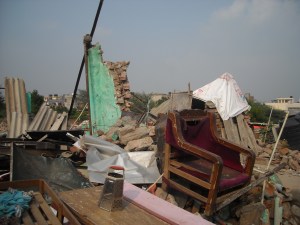
The media is all praise for the central government’s rescue efforts in Kashmir, despite the evident hollowness of the government’s claims to heroism. But the press has little to say about the brutal destruction authored by the government in its capital city. Thursday, September 11, saw another demolition drive in a city that has seen far too many of them, from the Emergency to the Commonwealth Games. The demolition took place in the South Delhi neighborhood of Aya Nagar, where residents say about 250 houses were destroyed.

Aya Nagar 1

Continue reading Demolitions in Aya Nagar, Delhi: Thomas Crowley

Sailaab Nama – An Insider’s View of the Flood in Kashmir from the Outside: Gowhar Fazili

Guest Post by Gowhar Fazili

The floods in Kashmir can provide an outsider a momentary glimpse into the reality of Kashmir behind the corporate media propaganda smokescreen that is fumbling at the moment and like Truman Show (1998) exposing bits of the backstage. At the moment there are three key actors in Kashmir. There are the floods, the state and the people. Each one is on its own. One limb of the state—the state government was the first to crumble before the approaching waters.   The other limb—the mammoth military apparatus that has already inundated Kashmir since several decades, took two days to wake up to the crisis and when it finally did, its priority was to fish out the rich Indian tourists and the people close to the establishment out of the state. In the initial days, local people had to risk their own lives to get their marooned relatives to safety. Some hired local boats, some swam or waded through water, some made makeshift rafts out of anything that floats, including water tanks, car tubes, foam sheets, inflated baby bathtubs, so on and so forth to save their dear ones. The rest either drowned or kept moving up the floors of their houses as the waters kept rising until they reached their attics.

Continue reading Sailaab Nama – An Insider’s View of the Flood in Kashmir from the Outside: Gowhar Fazili

When David Became Goliath: Lee-Alison Sibley

Guest post by LEE-ALISON SIBLEY

Back in the 1960s when Hollywood was making a number of movies based on biblical stories, they came out with Orson Welles as King Saul in “David and Goliath.” I was a little kid when I saw this movie, but I remember identifying with little David who yes, played beautifully on his harp, and used his slingshot with divine accuracy. I also remember the monster Goliath – he was huge and ugly and represented the Philistines, our enemies.  I cheered in my head and my heart for David to defeat the monster and he did, so that I could feel the good guys won and God was indeed on our side, the side of the Israelites.

Like any idealistic Jew, though not religious, I went to Israel to work on a kibbutz in the summer of 1971.  I was in the south, near Eilat and the border with Jordan.  Young and naïve, I was friendly with everyone I met — the Sabras of Israel, the Christians in Bethlehem, and Arabs in Gaza. In Gaza?  Yes, I was there with a British fellow from the kibbutz who was picking up some cane furniture he had ordered.  I wasn’t supposed to be there, of course, and when an Israeli army jeep spotted me, my friend was in big trouble.  “Get her out of here immediately!” was the order he shouted.  I guess it had something to do with my appearance and that there were no other women on the street at that time.  Like I said, I was friendly with everyone – my parents did not raise me to hate, they raised me to love.  The Israelis tried to make me feel guilty for not staying in Israel, but I kept saying, “I’m an American, my home is the U.S.A.”  Still, I certainly supported Israel and every person I met there had lost someone, a family member or a friend in a war and I felt very sad for them and angry that they lived with the constant threat of attack. Continue reading When David Became Goliath: Lee-Alison Sibley

Happy Independence Day India, Blessings from Kashmir: Onaiza Drabu

Guest post by ONAIZA DRABU

??????????????????????????????????????Dear India,

As you celebrate yet another year of the glorious independence; the independence that was the beginning of an era of doom for most of us here, I must inform you that I was unable to get my morning bread. Sixty Eight is a big number and I’m sure the proceedings will be aplenty and that and you have plenty of ‘ache din’. Somehow, I have my doubts but then again, I’m sure our definitions of good differ greatly. However it may be, I have one tiny request.  Please let me eat my breakfast in peace.

It is still two days to go for the Independence Day Parade in Srinagar and I am one of the privileged few who live within a two-kilometer radius of the Bakshi Stadium, the place where the annual flag hoisting ceremony is held. Excess army is deployed all around and as in all such times, our local baker wasn’t allowed to open shop this morning.

As a child, I read your textbooks in school. I read about how Pinky and Shyam would go to their school for the flag hoisting on Independence Day and of course I’d wonder where this would happen. Independence day meant a crackdown or a curfew for all us kids here. Independence day meant that the morose army guy I hated to look at would stand at my gate, staring straight ahead with a blank, yet frightening constancy. Independence day meant my dedicated doctor of a mother had to walk to work for sometimes, they’d not even allow ambulances to ply.

The independence you celebrate to commemorate freedom has forever been associated with barbed wires on streets that restricted access to locations. It is ironical how roadblocks, surprise checks and general inconvenience is what I have forever associated with this independence. General inconvenience here also includes times where each one of the dozen, army-men on every street eyes you with contempt and suspicion. I snigger if you tell me we celebrate freedom on this day. To the many things that are already restricted here this day adds more. Continue reading Happy Independence Day India, Blessings from Kashmir: Onaiza Drabu

Rape and Rakhi – Patriarchal-Communal Narratives: Kavita Krishnan

Guest Post by KAVITA KRISHNAN

Even as the communal cauldron in UP is kept on the boil, there is news that the RSS has launched a campaign to tie Rakhis to lakhs of Hindu men, asking them to pledge to protect their sisters from Muslim men and “love jehad.” The VHP has been running a helpline urging Hindus to approach them “if your daughter is being harassed by Muslim boys.” And a khap panchayat in Muzaffarnagar has imposed a ban on mobile phones and jeans for girls, claiming that these result in ‘eve-teasing’.

Woven into the above events is an old, familiar theme – that of patriarchal restrictions packaged as ‘protection’. In the wake of the anti-rape movement that followed December 16 2012, the streets of Delhi and many other parts of India had resounded with the voices of women declaring ‘Don’t take away our freedoms in the name of ‘protection’ – protect our right to fearless, fullest freedom instead’. Those women had raised their voice demanding freedom from sexual violence – and also freedom from rape culture that advices women to dress decently to avoid rape; and freedom from the khap panchayats, freedom even from the restrictions imposed by one’s own fathers and brothers.

Continue reading Rape and Rakhi – Patriarchal-Communal Narratives: Kavita Krishnan

Last Night in Gaza: Mads Gilbert

This correspondence has been received from Mads Gilbert

Dearest friends

The last night was extreme. The “ground invasion” of Gaza resulted in scores and carloads with maimed, torn apart, bleeding, shivering, dying – all sorts of injured Palestinians, all ages, all civilians, all innocent.

The heroes in the ambulances and in all of Gaza’s hospitals are working 12-24hrs shifts, grey from fatigue and inhuman workloads (without payment all in Shifa for the last 4 months), they care, triage, try to understand the incomprehensible chaos of bodies, sizes, limbs, walking, not walking, breathing, not breathing, bleeding, not bleeding humans. HUMANS! Now, once more treated like animals by “the most moral army in the world” (sic!).

My respect for the wounded is endless, in their contained determination in the midst of pain, agony and shock; my admiration for the staff and volunteers is endless, my closeness to the Palestinian “sumud” gives me strength, although in glimpses I just want to scream, hold someone tight, cry, smell the skin and hair of the warm child, covered in blood, protect ourselves in an endless embrace – but we cannot afford that, nor can they. Continue reading Last Night in Gaza: Mads Gilbert

Why its hard for me to accept the killing of Mohsin Sheikh in Pune: Sameer Khan

Guest Post by SAMEER KHAN

The nation was outraged with the news of the murder of Mohsin Shaikh in Pune following the riots after the suspected defaming face book post. Many people were horrified by the killings of the young techie. The news media and the social media used the word Pune in a very generic manner but the fact was much of Pune remained unaffected with the violence. The initial protest that started on the day of FB rumors took place mainly in selected places and appeared to have been clearly organized by some group that was closely coordinating its cadres by use of social media and other communication by circulating fake planted stories and directing the mobs to target specific places.

The place Mohsin Shaikh was murdered, and where the worst damage occurred was the Hadapsar area of Pune which is actually on the outer limits of Pune towards the Sholapur road.Hadapsar was a sleepy town couple of decades ago. It is Hadapsar that is the native place of the author of this article. My father was raised in Hadapsar and completed his primary education from the local Bunter School, one of the oldest surviving schools in the region

I was born and raised in South Mumbai and my world came crashing down when my father decided to move back to his native Hadapsar in mid 1980’s. I was in 7th grade and my transition from a south Mumbai boy to sleepy Hadapsar town was a very painful one. It took my very long to reconcile the fact that Hadapsar the sleepy semi rural town was now my new home. Continue reading Why its hard for me to accept the killing of Mohsin Sheikh in Pune: Sameer Khan

Life in a ‘Sterilized’ Zone, Hebron, Palestine: Ravinder Kaur

Guest Post and Photograps by RAVINDER KAUR

Map of Hebron, Courtesy ‘Breaking the Silence

On 12th June, 2014, the kidnapping of three Israeli teenagers near Hebron resulted a massive military search operation in the area. Since 30th June when their dead bodies were found north of Hebron, a Palestinian teenager has been abducted and killed in a revenge attack in East Jerusalem, and concerted air strikes have been launched on Gaza by the Israeli forces as punishment to Hamas who Israel holds responsible for the abduction and murder of the teenagers. In ten days of Israeli air strikes more than 216 have been killed in Gaza, and rocket firing by Hamas has claimed one life in Israel. A ground invasion began yesterday evening. Even as talks of a possible ceasefire, and resuming normal life, take shape, one might consider what ‘normality’ constitutes in a place like Hebron that has been at the center of the current conflict. It is in the normal, the routine that the spectacular violence takes shape.

Continue reading Life in a ‘Sterilized’ Zone, Hebron, Palestine: Ravinder Kaur

Delhi Police Prevents Peaceful Protest in Front of Israeli Embassy – Students, Others, Injured and Detained

A Tale of Two Protests, On Two Days.

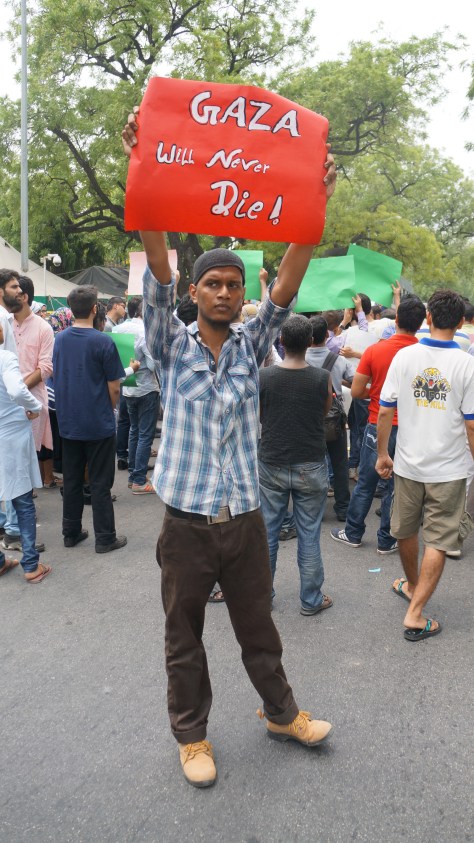
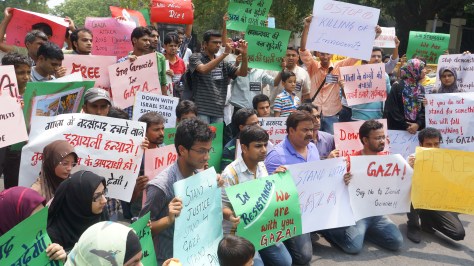
Protests against the situation in Gaza have been held in Delhi yesterday, (Sunday, 13th July, and today, 14th July, in the morning). Yesterday, on Sunday morning, there was a peaceful protest in front of the Israeli Embassy – this came out of a call for protest by individuals. Yesterday, about a hundred odd people, including many young people, had gathered. I was present at this gathering. Some people made statements condemning the Israeli state’s aggression against the Palestinian people. The Delhi Police was present, but did not try to disrupt or disturb the protest. The protest happened right in front of the Israeli Embassy gates on Aurungzeb Road.

Protestor in front of the Israeli Embassy in Delhi on Sunday, 13th July 2014
Protestors with Signs against Israeli State's Aggression on Gaza, in front of the Israeli Embassy in New Delhi, 13th July, 2014
Protestors with Signs against Israeli State’s Aggression on Gaza, in front of the Israeli Embassy in New Delhi, 13th July, 2014

Continue reading Delhi Police Prevents Peaceful Protest in Front of Israeli Embassy – Students, Others, Injured and Detained

The Crisis of Devendran’s Father Muthu P.


One question I have faced umpteen times in my career as a Malayali feminist academic is the following: what is peculiar about patriarchy in Kerala? I have offered many answers to non-Malayalis but it is time now, I feel, to offer one which is non-technical makes unique sense to Malayalis. Why? Because the most conspicuous thing in Kerala’s contemporary cultural scene is the insecurity of the Malayali patriarchal-male, now bulging out like the paunches gifted to us by our recent prosperity. Like a feminist colleague once commented, patriarchy in Kerala is so ubiquitous, it is almost like air, all over the place. But a whole new generation of Malayali women have, mostly unwittingly,have caused it to condense into threatening dark clouds of male insecurity. What if the monsoon has been playing truant over my fair land, from these ominous clouds we now receive the copious showers of misogyny. Continue reading The Crisis of Devendran’s Father Muthu P.

From Baghdad to Bolangir – Labour Laws in India: Saba Sharma

Guest post by SABA SHARMA

From the crisis in Iraq, a story is emerging of 40 construction workers in Mosul who have gone missing, some reports claim because they were trying to escape from the city and were captured by militants in the process. Many of these workers, feared kidnapped by ISIS, refused both their employers’ and the Indian government’s help to evacuate, as many have not been paid up to five months’ wages. Another report reveals that a group of 46 nurses from Kerala, working in a hospital in Tikrit, have refused to leave despite an offer from Delhi to help them evacuate. They need the money, as do their families back at home, so they would rather move to a safe zone in Iraq than return. Two nurses in the same hospital, who are on holiday in India, told the BBC that they would return despite the travel advisory issued by India advising citizens not to travel to Iraq. For them, failing to return means defaulting on loans taken to pay recruitment agents.

A few days before, on June 16, the NDA government announced that it was looking at liberalizing labour laws, primarily to make easier the retrenchment of workers. The UPA, and former PM Manmohan Singh in particular, also had labour law reform as an agenda, propelled by constant laments from industry saying ‘obsolete’ labour laws hindering growth and holding back the economy. The Vansundhara Raje government is already amending some state-level acts in Rajasthan to ‘liberate the corporate sector from the shackles of stringent requirements of the laws’, as one report put it.

Continue reading From Baghdad to Bolangir – Labour Laws in India: Saba Sharma

Eta Kolkata (This is Kolkata): Kaveri Gill

Guest post by KAVERI GILL

Today comes the surreal news that anyone painting their house or apartment white or sky blue in Kolkata can claim a waiver on property tax for a full year, a horror conjuring up a city that looks like a crumpled weave of Mother Teresa’s saree. Now, towns of Regency England and the Cornwall coast have uniform building and color restrictions to maintain historical continuity, but this idea is more in the perverse vein of babus suggesting that the burning ghats at Varanasi be “white-washed” for “freshness”.

The Chief Minister's radio and music in public places scheme
The Chief Minister’s radio and music in public places scheme

Thankfully, another Humphrey shot that idea down, yet the decimation of the architectural integrity of the façade of these famous ghats continues apace, with sealed air-conditioned buildings overlooking the burning bodies at Manikaran. Bengal’s Chief Minister has been known to remark that the colours “promote happiness” and accordingly, the Trinamool Congress (TMC) Mayor has incentivised citizens to embrace the “theme colours of the city”[1]. Coming on the heels of a general election, where the TMC won 34 seats out of 42, up from 19 in 2009, and compared to only 2 each for the Communist Party of India (Marxist) and the Bharatiya Janata Party (with 18% of the vote share, not to mention an almost win in the city), even discounting for dirty tricks appropriated by their cadres from the Left of old, the scorn must be tempered by what this result says about the contemporary citizen of this state and city. Continue reading Eta Kolkata (This is Kolkata): Kaveri Gill

Waiting on Biafra and Lanka

As May turns into June the quiet loneliness of war-torn Jaffna lies before me. For how much longer, years or decades into the future, will I look back into the past? And who will help me reflect on that past?

Some, fifty years ago, the tragedy of Biafra unfolded. I grew up hearing about the legacy of Biafra. During the early years of Tamil militancy, my father and a few other Tamil intellectuals of his generation warned that we may end up like Biafra. That many intellectuals perished in the struggle for Biafra I knew, but what they did I did not know back then.

It is over the last year, that I returned to Biafra, through the powerful novel of Chimamanda Adichie, Half of a Yellow Sun. A novel sometimes helps us think about questions we find difficult to ask. Adichie made me think about how long it takes for us to grasp the suffering that comes with a devastating war. Indeed, Adichie writes about Biafra some forty years after. From Adichie, I moved to Chinua Achebe’s There Was a Country: A Personal History of Biafra. What struck me most about Achebe’s memoir, is that almost fifty years later, he is still struggling to come to terms with what Biafra meant to him, shackled by lingering nationalist sentiment. It takes a life time or even more to deal with the past in places like Biafra and Lanka.

Mid-May marked the fifth year since the end of the war in Sri Lanka. Continue reading Waiting on Biafra and Lanka

Fly, Manju, fly!

For some time now, I have been arguing that the apparent acceleration of tension around gender in Kerala, especially on the male-female axis,is because Malayalee women of this generation, as a group, have become far more individuated than their mothers.

Several friends have been quick to point out that I may be wrong — there seems to be quite a bit of evidence that women of this generation, despite improved access to higher education, are crawling before patriarchy when asked to bend. I do not deny this, but I would still argue that it may not be evidence for their lack of agency and that their subversive behaviour may, in the long term, actually confuse the system enough to render it ineffective. My fieldwork of the last seven years has only made my belief stronger: wherever I go, I have met women who struggle within the system, whose fights may not be feminist in a certain familiar sense but yet contain a noticeable anti-patriarchal charge.

But more importantly, I say this because it is hard to ignore what I experienced for eleven whole years of my life when I was a housewife-cum-research student, in a very middle-class, upper caste, very average Malayalee family that typically embodied the uniquely modernised patriarchy of twentieth century Malayalee society. More than ten years after I escaped its confines, Manju Warrier’s comeback movie, How Old are You? made me return there. Fourteen years ago when Manju decided to quit acting, she was admittedly the most successful female actor in Malayalam, and perhaps the most talented as well. Before she became a successful actor, she had shown tremendous potential as a classical dancer. She chucked all this, to become an ‘ideal’ housewife, retreating behind the fame enjoyed by her husband, the actor, the very ordinary Dileep – in fact so ordinary that he almost symbolizes the ‘average’, mediocre, insecure, young-to-middle aged Malayalee male both in his roles and his off-screen behaviour.That was the time when I had begun to plot my escape. I knew how wrong her decision was — and it saddened me that members of yet another generation of Malayalee women were mistaking what was a gaping cellar-hole to be a snug refuge. Continue reading Fly, Manju, fly!

The UAPA in Madhya Pradesh – The JTSA Report in Perspective, and Beyond: Sharib Ali

Guest Post by SHARIB ALI

REPEAL UAPA: JTSA REPORT IN PERSPECTIVE, AND BEYOND

The state fabricates terror. There is enough evidence to take it to court on that count. Yet, how does one construe ‘fabrication’- what is implied by it? First, that the state has orchestrated elaborate attacks- violence to terrorize its people for certain legal, electoral and political ends. Second, that it has, through the use of laws like Unlawful Activities Prevention Act (UAPA)  against specific segments of its population has consciously manufactured a state of terror- a collectively imagined perception of threat that the nation faces from a particular people. The ends, always remain the same.

Though there is evidence of the agencies of the state, or actors within them, expressly participating in orchestrating large scale terror attacks (think col. Purohit), it is the latter- where terror within specific communities is manufactured in the eyes of the law and the people- that I deal with here, today. ‘Guilt by Association’The JTSA (Jamia Teachers Solidarity Association) report on UAPA cases in Madhya Pradesh, is a crucial case in point.

Continue reading The UAPA in Madhya Pradesh – The JTSA Report in Perspective, and Beyond: Sharib Ali

भगाणा कांड के पीड़ितों ने इंसाफ की मांग की: भगाणा कांड संघर्ष समिति

Press statement issued by the BHAGANA KAAND SANGHARSH SAMITI in New Delhi, 11 May 2014


Latthmar Mahila Sena
A call for direct action – an armed women’s squad – Latthmar Mahila Sena

हरियाणा के भगाणा गांव में सामूहिक बलात्कार की शिकार हुई चार नाबालिगों के हक में न्याय की मांग के समर्थन में आज पीड़ितोंके साथ भारी संख्या में दिल्ली के सामाजिक कार्यकता, बुद्धिजीवी और विद्यार्थी भी जुटे। यहां दिल्ली में पंत मार्ग पर स्थित हरियाणा के मुख्यमंत्रीआवास पर धरना देते हुए आंदोलनकारियों ने पीड़ितों के प्रति हरियाणा सरकार के रवैए की तीखी आलोचना की और कहा कि ऐसा लगता है कि हरियाणा सरकार सामंती उत्पीड़नकर्ताओं के पक्ष में खड़ी हो गई है और दलितों-पीड़ितों की आवाज को जानबूझ कर दफन किया जा रहा है।

बड़े पैमाने पर जुटेलोगों ने यहां दिल्ली में सरकार और प्रशासन से यह मांग की कि पीड़ितों पर जुल्म ढाने वाले दोषियों को  सख्त सजा दी जाए और फास्ट ट्रैक अदालतों का गठन कर पीड़ितों को जल्द से जल्द इंसाफ दिलाई जाए। Continue reading भगाणा कांड के पीड़ितों ने इंसाफ की मांग की: भगाणा कांड संघर्ष समिति

Bittersweet Gujarat: Reena Patel

This is a guest post by REENA PATEL

I looked around the room and my gaze was met with the kohl lined eyes and stares of bewilderment and distrust. My heart pounded as I listened to three Muslim women describe their latest attempt to find their father and brother after they disappeared in the riots. They were speaking to Rahidbhai* from a local NGO who was accompanying me into the Ahmedabad relief colonies for the first time. Why was I so scared? Why was my heart pounding? The eldest woman of the home disrupted my thoughts, she asked me for my name. I looked around and looked at Rahidbhai, who looked back uneasily. “Mera naam Reena hai.” I said, almost choking on the words, knowing what the next question would be. “Aap ka surname kya hai?” The room grew thick with silence. “Patel.”

As far back as I could remember, I was taught to regard Muslims differently from the rest of the general population. My parents, both from Surat, Gujarat moved and met in the United States in their twenties. They both lived in England and spent time in Gujarat, and had families that were deeply involved in the Gujarati community. My brother and I were born in Long Beach California. I went to Gujarati school on Sundays, went to every function, picnic, and cultural show put on by the Leuva Patidar Samaj in Southern California. Many of my family members were apart of the organization. In fact, my great grandfather Vallabhai Patel was one of the first Patels to land upon the shores of the United States, now estimated at a population of over 140,000. We went to religious camps that were meant to teach us about Hindu ideology, handed out saffron prayer books and modeled how to become ideal Hindu men and women for our communities.

Continue reading Bittersweet Gujarat: Reena Patel

Save the AP State Archives: Coalition of Concerned Citizens and Academics

This petition is being circulated by a coalition of concerned citizens, local and international academics and scholars

The historical collections at two major archives in Hyderabad, the Andhra Pradesh Government Oriental Manuscripts Library (APGOML) and the Andhra Pradesh State Archives and Research Institute (APSARI), are under threat in the bifurcation of Telangana and residuary Andhra Pradesh. The institutions’ collections are slated for division between the two new states. These collections have long suffered from neglect, and now face the likelihood of irreparable damage from arbitrary division, handling, and transfer.

Local and international scholars and activists have organized a petition to preserve these historical documents. Our primary concern is for the integrity of the collections and we seek to avoid entanglement in the Telangana/Andhra debates. The petition is aimed, in part, at demonstrating that there is a concerned audience of international scholars and interested parties who care about and use these collections. This wider expression of concern will help support the efforts of local citizens who plan to submit the petition to the Governor before the end of the month.

Please take a moment to add your voice:

http://www.ipetitions.com/petition/protect-the-andhra-pradesh-state-archives-and Continue reading Save the AP State Archives: Coalition of Concerned Citizens and Academics

Attitudes towards Menstruation – Notes from Assam: Priyanka Chakrabarty

This is a Guest Post by PRIYANKA CHAKRABARTY 

GOOD NEWS, GOOD NEWS…They are blessed with a child! Oh, what child, boy or girl? This is the most common response that new parents will encounter, one that indicates what people find most interesting about a new birth. We examine its genital parts and then say, it is a boy or girl. During this time, the difference between male and female is only the biological difference of sex,  of the presence of the penis or the vagina. Gradually the child is ‘socialised’ (read normalised) into a ‘woman’ or a ‘man’.

One of the key aspects of a girl’s socialization is her introduction to the bodily process of menstruation. Superficially, and as a purely biological process, menstruation is the discharge of blood from the vagina. This is widely considered to be the ‘development’ of the female body and after the start of menstruation, a girl is believed to have attained womanhood –attained puberty. Continue reading Attitudes towards Menstruation – Notes from Assam: Priyanka Chakrabarty

EFLU Hyderabad Rusticates Students for Wanting to Keep Library Open: Sudha and Muhammad Afzal

Guest Post by Sudha K F and Muhammed Afzal P

The semester break seems to be the most active time for the English and Foreign Languages University (Hyderabad) administration. What are these activities that the administration invests so much of its energies in, when most students have left the campus for their vacation? It is sending memos, show cause notices and the latest: the RUSTICATION of two significant student leaders on the EFLU campus.

When the word ‘fascist’ has become an everyday term, to talk about the Modi nightmare and its anxieties, we have more to add to that list from EFLU, Hyderabad. Mohan Dharavath, President of Dalit Adivasi Bahujan Minority Students’ Association and Satish N, General Secretary of Telengana Students’ Association, have been rusticated from the University for two years, the latest in a series of draconian and undemocratic moves, on the part of the autocratic EFLU administration. The two students, along with another student, Subhash Kumar, were given show cause notices by the Proctor’s office on 24 March, to which they responded, denying the baseless charges levelled against them. The rustication is part of the disciplinary action against these students who were part of a massive protest that took place against the administration, called forth by the EFLU Students’ Union. This protest was against the absolute closure of the only 24-hour reading room, and library, on the small EFLU campus in the first week of March 2014.

Continue reading EFLU Hyderabad Rusticates Students for Wanting to Keep Library Open: Sudha and Muhammad Afzal