Category Archives: Everyday Life

Caste in Urdu Prose Literature: Ajmal Kamal

Cover of "The Adventures of Amir Hamza (M...
A cover of 'The Adventures of Amir Hamza'

Guest post by AJMAL KAMAL

The historical division of society in South Asia on caste lines is now an acknowledged sociological, political and economic fact. However, caste as a literary or social discourse does not, for several reasons, form a part of the predominantly Muslim culture of Urdu. Nor has there been much academic exploration of the role caste plays in the life of South Asian Muslim communities as against others. As far as the Urdu literary writing is concerned, it has traditionally focused exclusively on the lives and concerns of conquerors, their cohorts and their descendants, who typically prided themselves on their real or perceived foreign origins. Even after modern, socially committed writing began in Urdu around the 1930s, caste as a variable for social exploration was largely ignored in favour of economic class. Continue reading Caste in Urdu Prose Literature: Ajmal Kamal

Baba Ramdev, Baba Ramdev

Make Delhi Metro safe for women! Please Mend The Gap

PLEASE MEND THE GAP is a citizen- led initiative to promote gender equality and commuter safety in public spaces. 

Follow these two links for some background:

A few weeks ago, a friend was molested on the Yellow line of the Delhi Metro

A flash mob of citizens got together to protest against the Delhi Metro, claiming that it is promoting a gender divide.

Sign PMTG’s Petition to Chief Minister and DMRC

We believe that a majority of women do not feel safe while travelling in the Delhi Metro. We have spoken to a cross-section of Metro commuters who have shared with us their experiences most of which include instances of verbal and physical harassment mostly faced by women, specifically in the women’s-only compartment. In fact, a few days ago, some of the members of our group who were traveling at night observed that the women’s-only compartment was populated with men who had occupied almost all the seats forcing the women to stand, leaving them with no choice but to actively demand the seats they were entitled to. The men were unapologetic and dismissive. Most shrugged off the women’s protest by claiming falsely that the women’s-only compartment turns general post 9 p.m..

Women who choose to travel in the general compartment are also harassed. There have been many instances where men have told women that they are not welcome in this compartment and should use the compartment reserved for them. This attitude has become so deeply entrenched in commuters’ mindsets that most accidentally refer to the general compartment as the ‘men’s compartment’. There have been times when authorities have driven out men from the women’s-only compartments, but without having imposed any fine whatsoever…

The situation needs to change. It is the duty of the State and the DMRC to spearhead this change.

Read the full petition and sign.

Dominique Strauss-Kahn and the union maid: Dean Baker

A little-reported fact of the Dominique Strauss-Kahn case is that his accuser is a union member – with rights the IMF opposes, says Dean Baker in the Guardian.

But do listen to this song first!


“The reason that this is an important part of the story is that it is likely that Strauss-Kahn’s alleged victim might not have felt confident enough to pursue the issue with either her supervisors or law enforcement agencies, if she had not been protected by a union contract. The vast majority of hotel workers in the United States, like most workers in the private sector, do not enjoy this protection.

Received via Mini Mathew

The Power of Crowdsourcing

Young Women in Kerala : Between Empowerment and Death? — Part II

[With inputs from Sudeep K S]

Are there honour killings in Kerala? No, perhaps. However, like in everything else, Kerala has a way of telling the world that things can be done differently. Well, it appears that we can continue to claim another kind of exceptionalism — in national evils. Kerala has its own special way of ‘doing’ caste and patriarchy as well, which researchers and activists have forcefully argued recently. It is possible that the deadly consequences of stepping out of community-ordained boundaries in love and marriage can visit Kerala in  ways that we cannot really detect with our usual instruments.

Continue reading Young Women in Kerala : Between Empowerment and Death? — Part II

School Days…

I sometimes wonder if Foucault had gone to school in India if he would not have written his opus on punishment on the school rather than the prison. Anyone who has gone to school in India will tell you there is no institution that combines discipline and punishment in quite the same way as school. Everyone has tales to tell. Continue reading School Days…

The Poet of Romance and Revolution

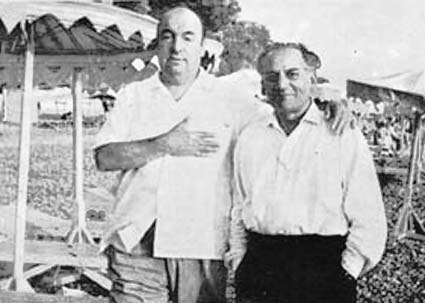
Pablo Neruda with Faiz Ahmed 'Faiz'

If you met him on the street you would never imagine that he was a poet, and not your run of the mill poet, but  among the most important poets of the 20th century, not only in Urdu, not only in  the subcontinent but in the entire world of the 20th century. I have always wondered how could someone who invariably dressed in rather unimpressively stitched, unromantic terry-cot Safari suits, someone who could at best pass off as a joint secretary in the ministry of shipping or something similar, be such a wizard with words and not only with words but with content and with form?

Continue reading The Poet of Romance and Revolution

Punjabi Qissas and the Story of Urdu

Heer-Ranjha
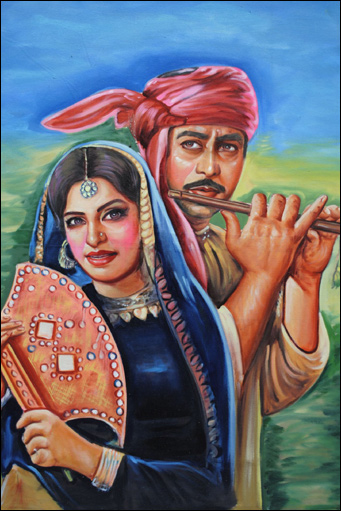
Heer-Ranjha in a Pakistani film poster, circa 1970s

The Social Space of Language: Vernacular Literature in British Colonial Punjab
by Farina Mir
Permanent Black, Ranikhet, 2010.
ISBN-817824307-5
pp-277, price Rs 695

This book straddles several anomalies that are rather obvious once stated but are rarely formulated as such. How is it that the world of Urdu literature becomes so dominated by people from the Punjab in a span of fifty years, beginning circa 1900s, and in a sense, continues to remain so? Iqbal, Faiz, Meeraji, Rashid, Bedi, Manto, Krishan Chander and down to our times Mushtaq Ahmed and Zafar Iqbal, a top twenty or top fifty list of modern Urdu litterateurs would likely contain eighty percent Pubjabis. And how is it that Punjabi, which produced such a brilliant and varied repertoire of stories, epics and poems until the late medieval era by such extraordinary luminaries as Baba Farid, Bulle Shah, Waris Shah, Haridas Haria seems to drop out of our horizon in the modern era, where all we know of is an Amrita Pritam or, less likely, a Surjit Patar. Where such poverty after such riches, where such preponderance from such invisibility? And yet, how is it that Punjabi still continues to enjoy immediate and even aural connotations that transcend nationality, religion and, even as it defines a community, a specific ethnicity. What then is a Punjabi community and where and how has it existed specifically in the colonial era but, in many resilient ways, down to our times? Continue reading Punjabi Qissas and the Story of Urdu

Who Killed Jugni? Shiraz Hassan

Guest post by SHIRAZ HASSAN

It was many summers ago. I was visiting my village on the banks of the Jhelum. I saw the people of my village go towards the Eidgah, across the chappaD, or the pond. When I asked my grandfather about them, he said. “Ajj mela ay putter!” [Son, today is a fair!] The mela ground was bustling with makeshift shops and people thronging them. At one end of the mela a circus had come up. The mithai stalls were packed with customers and curious on-lookers, some of them were buying and eating. And that’s when I heard the sound of their music. There they were, surrounded by a circle of spectators. A couple of local artists sang a song I had not heard before. I couldn’t understand a word, other than ‘O mereya Jugni, O mereya Jugni’ – which they chorused, over and over again.

That was my introduction to Jugni. I had no idea who Jugni was, and for I long time I didn’t care. Continue reading Who Killed Jugni? Shiraz Hassan

Choice in the labour market – sex work as “work”

The summary of preliminary findings of the first pan-India survey of sex-workers is now available on-line.  3000 women from 14 states and 1 UT were surveyed, all of them from outside collectivised/organised and therefore politically active spaces, precisely  “in order to bring forth the voices of a hitherto silent section of sex workers.”

The significant finding is this: About 71 percent of them said they had entered the profession willingly.

(The data on male and transgender sex workers has not been processed yet).

The study was conducted by Rohini Sahni and  V Kalyan Shankar under the aegis of the Center for Advocacy on Stigma and Marginalisation (CASAM),  supported by Paulo Longo Research Initiative (“a collaboration of scholars, policy analysts and sex workers that aims to develop and consolidate ethical, interdisciplinary scholarship on sex work to improve the human rights, health and well being of women, men and transgenders who sell sex.”). The study was supported by a large number of groups, organizations and individuals in each state, who helped to conduct the surveys.

This background is important, because it appears to be a study that is well grounded, and drawing on large networks of local interconnections.

Continue reading Choice in the labour market – sex work as “work”

Osama and Obama: Or How Much Work Can One Death Do…

Yesterday Osama Bin Laden was killed in an operation by American troops in Abbottabad, Pakistan. Barack Obama addressed the American nation in a televised address at 11:30 P.M. at night. It is a curious address. You can watch it below.

Continue reading Osama and Obama: Or How Much Work Can One Death Do…

Brilliant Tutorials: Trisha Gupta reviews Siddharth Chowdhury’s “Day Scholar”

Guest post by TRISHA GUPTA

On the face of it, Siddharth Chowdhury’s Day Scholar, is a coming of age novel. The book’s own inside cover actually describes it as a “crazed and profane coming of age tale”, whose plot is ostensibly about how Patna boy Hriday Thakur (“who hopes to be a writer some day”) is first “trapped… by a series of misjudgements” and later “saved from a terrible end”. But much like Chowdhury’s previous offering, Patna Roughcut (also billed as “a story of love, idealism and sexual awakening” that takes us to “the heart of an aching, throbbing youth”), Day Scholar – despite a self-referential moment when its protagonist is asked by his father about how his Bildugsroman is coming along – is not a book that seems containable within the neat boundaries of the coming-of-age genre. Continue reading Brilliant Tutorials: Trisha Gupta reviews Siddharth Chowdhury’s “Day Scholar”

Music and politics – the power of minimalism: Prasanta Chakravarty

Guest post by Prasanta Chakravarty

I want to tell you about a song.  A song and a singer that few will call political. I want to talk about a song called Daya Karo (Have Mercy) sung by Mousumi Bhowmik, which appears originally in her album Ami Ghor Bahir Kori/ In and Out of My Room (2001).

Though she would routinely perform in certain public events and campus fests in Kolkata, Bhowmik has always been a peripheral figure in the popular imagination on Bangla singers who appear in the last couple of decades. She does not qualify as a mainstream modern popular singer. It is an equally barbed proposition to accommodate her within a new group of singers who would tilt the popular musical scenario in Kolkata and its suburbs by some straight talking, angst ridden compositions and solo performances throughout the nineties. Some of these singers have of late plunged into active politics and one of them has even become a Member of Parliament.

Continue reading Music and politics – the power of minimalism: Prasanta Chakravarty

Cultures of Corruption: Kalpana Kannabiran

Guest post by KALPANA KANNABIRAN

We are a country given to idolatry – both the erection and demolition of idols a favourite pastime that buries under the rubble questions of ethics and constitutional morality.   While this penchant for idolatry raises larger questions,  I will concern myself at this point with the effigy (or the idol upside down) called corruption.

While there has undoubtedly been a marked shift in the languages of corruption in the neo liberal era, calling for new and different strategies to combat it, the fight against corruption is not new.  When women’s groups campaigned decades ago against the testing of banned drugs and contraceptives on poor people by the ICMR, the question that was raised was about the nexus between pharmaceutical companies and state actors that involved deals for which poor and vulnerable communities were pushed to the guillotine.  With Bhopal, the question came up again on the deals between multinational companies (Union Carbide in this case) and the government that violated every principle of human rights, natural justice, constitutional morality and the ethics of care in governance.  Was the derailment of justice effected without corruption at every level? Apart from providing care to the affected, was not the struggle for justice in Bhopal a struggle against corruption?  When the People’s War Group (as it was then called) abducted an elected representative two decades ago (who was later released), the reason they gave to the negotiators was that he misused public funds in the district and asserted that theirs was a fight against corrupt representatives.

Continue reading Cultures of Corruption: Kalpana Kannabiran

The gospel according to a divine identifier – An essay on the biblical origins of UID: Taha Mehmood

Guest post by TAHA MEHMOOD

1.

Simon Bar Jona was a fisherman based in small town called Bethaida. They say one day Simon’s brother, Andrew, led him to a man who called himself Jesus. They say Simon and Andrew became disciples of Jesus.

One day Jesus asked his disciples, “Who do you think I am?”

His disciples looked at each other. They did not know anything about him. They did not know who he was. Some disciples said Jesus was actually John the Baptist: some said he was Elijah; and others though he was Jeremias. Jesus could have been any of these or none of these. But Jesus was not satisfied with the answer, so he asked again, “Who do you think I am?”

At that point Simon Bar Jona, the fisherman answered, “Are you not Christ, the Son of the living God?’“

Jesus was pleased, he replied, “Bless you, Simon Bar Jona: for flesh and blood has not revealed it to you, but my Father who is in heaven.” Continue reading The gospel according to a divine identifier – An essay on the biblical origins of UID: Taha Mehmood

Do I look painDoo?

This post is dedicated to Nadeem F. Paracha.

Photo by 'Life Church Burnley' Flickr: "shoorkot road toba tek sing love this palce.but need much improvement"

[Photo by ‘Life Church Burnley’ on Flickr: “shoorkot road toba tek singh love this place but need much improvement”]

So on Facebook I saw a fellow Punjabi who lives in vilayat has listed his hometown as Toba Tek Singh, Pakistan, which I thought was very cool. Why didn’t I get this idea? Never mind, I thought, like all good ideas this must be stolen. My hometown on Facebook now is also Toba Tek Singh, Pakistan. It was only much after going mad over Manto’s story did I discover that Toba Tek Singh was a real place in west Punjab. Always wondered what its people thought about the story. Continue reading Do I look painDoo?

Cricket, Azadi and Pakistan: Mir Laieeq Ishtiyaq

Guest post by MIR LAIEEQ ISHTIYAQ

As all of India celebrated the well-deserved Indian victory in the cricket world cup finals, the mood in the Kashmir valley was different. Their favourite team was ousted in the semi-final itself. On the eve of the semi-final between India and Pakistan at Mohali, a friend asked on Facebook: “That Kashmiris don’t support the Indian cricket team is well understood, but why is there so much support for Pakistan? Seems INDEPENDENCE IS JUST A MYTH…” There are no simple answers to this question.

This slideshow requires JavaScript.

[Pictures taken in Kashmir during the India-Pakistan Mohali semi-final by ISHAN TANKHA for Open magazine.] Continue reading Cricket, Azadi and Pakistan: Mir Laieeq Ishtiyaq

Still Bangali: Reflections on a New Year: Jyoti Rahman

Guest post by JYOTI RAHMAN

Exactly ten years ago yesterday, upon arriving at a friend’s place, instead of ‘Shubho Nobo Borsho’ (Bangla new year greeting), I was greeted with: ‘Have you heard the news? Call home now. Hope family’s okay!’ Militant jihadis struck the new year’s dawn cultural events in Ramna, the major park at the heart of Dhaka, killing over half a dozen people. Since these events are attended by most of my family in Dhaka, and by most of my friends, we were worried. Frantic phone calls and MSN chats (or did we still do ICQ then, I forget) ensued. Fortunately, the families were safe. But this wouldn’t be the last time such phone calls were made.

Over the following years, militants bombed cinema halls, killed progressive politicians, carried out suicide attacks against judges, and tried to enforce shariah rule in rural northern parts of the country. Things got so bad that when a friend called to tell me about Muhammad Yunus winning the Nobel Peace Prize, upon hearing, ‘Have you heard about Yunus?’, my first reaction was ‘Oh no, another assassination’. Continue reading Still Bangali: Reflections on a New Year: Jyoti Rahman

A Lesson in Kashmiri: Hilal Mir

Guest post by HILAL MIR

On a clear spring day in the year 2000, the first year of my masters in journalism at Kashmir university, the class was taken to Sogam for a field trip. Zafar Hyderi, our esteemed teacher much respected for his integrity than scholarship was keen on students having practical experience. We were supposed to visit areas where only radio works because the mountains girding these areas don’t allow television signals from Srinagar Doordarshan to enter the homes. Imagine the relief of not having to watch 24X7 the official propaganda. Since Zafar Sir taught radio, these places provided him a cathartic vindication of the superiority of his medium (though secretly he might have aspired to make a name in TV). Such places are aptly called Shadow Zones. These could well be called shadow zones for other reasons too, as much of the barbarity unleashed by the state in such areas remains buried under shadows, itching to be put into words or images. Continue reading A Lesson in Kashmiri: Hilal Mir

Dastan-e-Sedition

Free Binayak Sen Campaign

Justice on Trial:
three days of cultural events
April 4 – 6, 2011
@ Alliance Francaise de Delhi
72, Lodhi Estate, New Delhi 110003

Justice on Trial (Facebookers RSVP here) is a collaborative programme put together by leading contemporary artists, photographers, film makers, musicians, performers, and activists to commemorate struggles for democracy, freedom and rights. An exhibition of photographs and art works, talks performances and screenings all are directed at drawing renewed attention to the trial of Dr. Binayak Sen, who has emerged in recent times as a symbol of courageous resistance, and a reminder of the many injustices that surround us. Our aim is to provoke a dialogue with the colours and sounds that emerge from the idea of what Dr. Sen represents.  Continue reading Dastan-e-Sedition