
Our panel was a queer one in all the wonderful senses of that word. At trainings with lower court judges on sexual violence laws in the Saket District Courts in Delhi, the five of us would find ourselves next to each other every few months. On a dais surrounded by that distinctly sarkari flower arrangement, first sat Suzette, a survivor of a brutal rape in a moving car in Park Street in Kolkata. Then in line: a survivor of an acid attack; a representative of a sex workers union; a well known hijra activist and I, speaking as a gay man. We were usually on the third day, right after lunch, when we would face nearly a hundred slightly sleepy judges from the region. They had been updated on new sexual violence laws, gone through a case exercise on how to apply them, been given a CD, a folder, the requisite handouts. The boxes were ticked. Technically, they were up to date. Ours was a different job: to animate, if such a thing is possible, a sense of empathy in the judges, to shift even slightly the way they thought of the rainbow of dubious morality that we represented.
Category Archives: Feminism
Fairy Tales and Feminist Theory in the Face of Fear: Indus Chadha
This is a guest post by INDUS CHADHA
For about a year now, I have been teaching 33 wide-eyed and wise middle schoolers. As we have read fiction, studied history, exchanged stories, and tried to understand the world together, I have found my students to be wonderfully curious and innately compassionate. As the school year drew to a close, I wondered how to conclude our time together. Because our parting at the end of a fulfilling year together was bittersweet, I was looking for something both lighthearted and meaningful. I settled on an old favorite of my own, The Paper Bag Princess, an unconventional fairy tale that turns the ‘prince saves princess from the dragon’ stereotype upside down. As always, I was amazed by my students’ heartfelt and fresh responses to the story. Continue reading Fairy Tales and Feminist Theory in the Face of Fear: Indus Chadha
An Open Letter to the Protestors at the National Law University: Space Theatre Ensemble
Guest post by SPACE THEATRE ENSEMBLE
Thank you for renewing this much needed dialogue on freedom of expression.
We happen to be, by sheer coincidence, a four-piece all-women theatre group that performs poetry, and have been following the correspondence over the sexist performance of stand-up comedian Avish Matthew with some interest – all the more so since we are now touring in Delhi and its environs.
The protestors are absolutely right when they point out that domestic violence is not a laughing matter and we completely endorse their views on why Avish’s jokes just weren’t funny.
We do not believe in laughter as just therapy to laugh off the stress of living the good life.
However, as a professional theatre ensemble we also strongly disagree with the predictable, and frankly irrelevant form of agitprop used by the protestors against Avish. Protest need not be chaotic, so far more vehemently we condemn the supposedly liberal students and others who heckled, booed, poked and shoved but stopped just short of physically molesting the protestors. Continue reading An Open Letter to the Protestors at the National Law University: Space Theatre Ensemble
An Open Letter to Kerala Khap Managers and Madam Principal, CET, in Particular, and to Malayalees in General
Dear Madam(s) and Sirs
Greetings from a long-suffering woman, a shocked and appalled parent, a worried social scientist, an angered citizen, a furious teacher, a firm believer in the Indian Constitution determined to defend it, a irredeemable feminist — I greet you in all these capacities.
Respected Madam(s) and Sirs, my grievances are all about you, in fact, about the incalculable damage you are collectively doing to young people in Kerala, to the future of democracy here. They are about your utter disregard for the spirit and the letter of the Indian Constitution and your and powerful hatred of young people in general and young women in particular, clearly manifest in your despicable efforts to deny them their rights as Indian citizens. My grievances are also about your utter lack of humane concern for the students under your care, your rank cruelty and disregard of their humanity and dignity.
Dealing with ‘sexist pigs’? Reflections on the feminist protest against AIB’s Avish Mathew at National Law University, Delhi: A Statement
A statement from concerned students and teachers
What does one do sitting in the middle of an audience roaring with laughter at jokes that one might find downright humiliating? Laugh along, retire hurt, or ask people to stop? It’s a dilemma that many of us on the ‘wrong’ side of various lines of privilege (caste, class, gender, race) and those sensitive to these divisions often find ourselves in. Some students at the National Law University, Delhi seem to have been put in a similar situation when during their annual college fest, comedian Avish Mathew of AIB Roast fame would not stop amusing his audience with one offensive joke after another. They first decided to walk out and then came back with a placard saying, “Get out you sexist pig!”
#PadsAgainstSexism campaign at Jamia Milia, Delhi
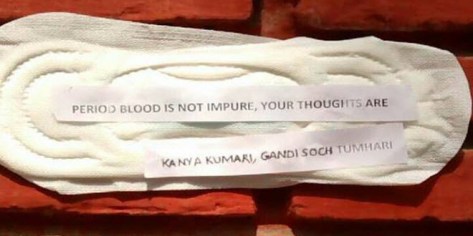
Sanitary pad with message against sexism on Jamia campus
19-year-old Elona Kastrati started the #PadsAgainstSexism campaign in her hometown of Karlsruhe, Germany.
“I thought about how society gets offended by a normal pad. I thought about it so much, the idea came to me to write quotes on them,” she says. So she did.

Continue reading #PadsAgainstSexism campaign at Jamia Milia, Delhi
Politicians Say the Darndest Things: The Ladies Finger
THE LADIES FINGER gives the finger to politicians and their charming attitudes towards women.
Yesterday in Parliament, Sharad Yadav, head of the Janata Dal (United) and member of the Rajya Sabha, tried to prove he was cool. During a debate on the Insurance Bill, he broke off to talk about south Indian women. What this had to do with the matter at hand is questionable, but here’s what the Indian Express reported from Parliament:
The women of the south are dark but they are… their bodies…”
At this point members sitting around him tried to bring him back to the topic at hand with cries of “Sharadji Bill”. But, Yadav was not finished yet and talked about the “dancing skills” of south India women.Soon, Trinamool Congress’s Derek O’Brien frantically waved at Yadav to stop.
Want to bet that when he spoke of “dancing skills”, this is what he had in mind?

But it didn’t end there.
Read the rest of this devastating take down at The Ladies Finger.
Paying tribute to Meera Kosambi: Uma Chakravarty
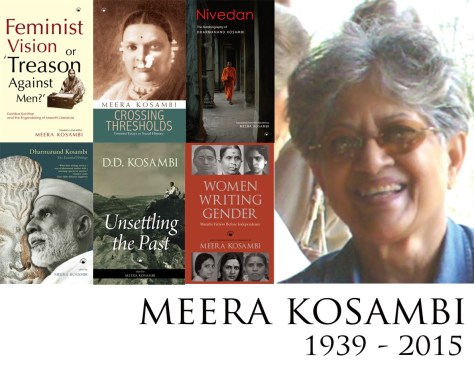
Image courtesy Permanent Black
Meera Kosambi, best known for her scholarship on Pandita Ramabai, passed away at the end of February. Uma Chakravarty, feminist historian, writes on FeministsIndia about the work of Meeratai, as she sternly admonished me to address her, when I casually called her Meera! I met her only once, a few years ago, and was enthralled through the lovely Maharashtrian dinner she had prepared, by her personal warmth and sharp intellect. ‘I dont like these Western ways of addressing older people’, she had said, ‘We have such lovely words of respect and affection, why not use them?’
Meeratai, you will live through your work. Salaam.
And here is Uma Chakravarty:
Many years ago, before Meera Kosambi began to write on women in 19th Century Western India, a region that I wrote on in my work on Pandita Ramabai, the only Kosambi on my intellectual horizon was D.D. Kosambi, her father, who towered over the history writing scene.
So it was not surprising that when I first met her sometime in the 1990s, a lot of our conversation was about her father and also about her grandfather Dharmanand Kosambi because of my interest in Buddhism. Belonging to such an illustrious family it would have been difficult to carve a distinctive space for herself as Meera Kosambi certainly did.
Indian feminists, ‘India’s daughter’, and sexual violence: The issues at stake*

Today, on International Women’s Day I am proud to acknowledge the deeply contested terrain that we call feminism in India, in which no claim goes unchallenged, no issue is undisputed (and some might say, no good deed goes unpunished!) In which over the decades, every stand and every understanding on practically every issue, has been painfully rethought and reformulated in the face of intense questioning from newer claims and voices.
In the clamour of feminist responses both to Leslee Udwin’s documentary ‘India’s Daughter’, as well as to the Indian state’s crackdown on it, some themes have emerged that reflect profound fault lines in our (feminist) understanding – not so much of sexual violence itself – but of what to do about it; how to act upon the knowledge of widespread misogyny and pervasive masculinist violence; how to acknowledge that sexual violence cannot be understood except as refracted through prisms of caste, class, Indian state militarism and… a list that will inevitably end in ‘etc’ regardless of how long it is; and in this particular case, above all, what sorts of representations of sex and sexual violence will further our ethical ambitions, and what others will undo decades of work.
In what follows, I will try to uncover some of these themes, on the explicit understanding that I do not claim to have resolved any of the debates, nor even to have highlighted all of them. This is a partial, personal attempt to make sense of the recurring ideas in a tumult of intelligent, concerned and strongly articulated opinions, in the course of which I will of course, make my own views explicit too.
First, perhaps I should state immediately that I saw ‘India’s Daughter’ and liked it very much. This is just to get it out of the way, because my opinion on the film is irrelevant to my belief that freedom of speech and expression ought to be a value that feminists defend at all costs. I did not hold such a strong view on freedom of expression in an earlier decade, but I do now, at the beginning of the 21st century, when it has become increasingly clear that the silencing of uncomfortable voices, even unto murder, has become the preferred mode of snuffing out debate globally.
Continue reading Indian feminists, ‘India’s daughter’, and sexual violence: The issues at stake*
Bread and Roses in Kerala today – the Kalyan Sarees Women Workers’ Struggle, and an Appeal on Women’s Day-Eve: Malavika Narayan
This is a Guest post by MALAVIKA NARAYAN
Drive through any road in Kerala, one sees enormous showrooms of silks and jewellery, glittering with all the riches they contain.
Who says that the Kerala model of development is slow on growth and only high on human indicators? The most literate ‘progressive’ state is evidently doing well enough in business and investment too it would seem. We are also an expanding consumer market now, willing to finally shed some of that humility and simplicity once perceived to be characteristic of us. We have what claims to be Asia’s biggest mall, and other international chains setting shop here. In Maveli’s land, there really appear to be no poor or oppressed who would destroy this image of perfection. Continue reading Bread and Roses in Kerala today – the Kalyan Sarees Women Workers’ Struggle, and an Appeal on Women’s Day-Eve: Malavika Narayan
Shuddhikaran of Hindu Mahasabha by Lovers of Love in Delhi
Well, they tried, and more power to them.
A shuddhikaran of that hate-filled, divisive, toxic organization (and others of the Hindutva brigade) would have considerably reduced pollution in the only vasudha we have, which is our kutumb, but the attempt was foiled by a compliant Delhi Police. However, Parliament Street Police Station was very shuddh indeed by the end of the day, its noxious atmosphere cleansed by the cosmic vibrations of music, dance and “marriages” among all sorts of human beings.
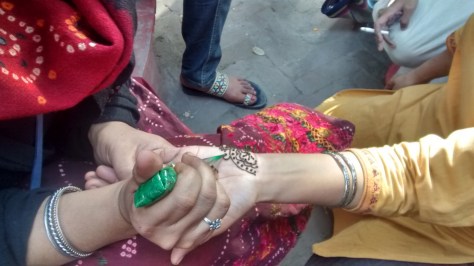
Mehndi ceremony inside parliament Street Police Station
Image courtesy feminisminindia.com
This hilarious subversion of the idea of marriage, with which Hindu Mahasabha threatened lovers, is in fact a deeply political gesture against the institution of patriarchal, heterosexual marriage with all its violent hierarchies of age and gender, in which disobedient women and younger people are in the custody, much like prisoners in jail, of the patriarchs of the family, which include compliant women. There are no honour killings – these are custodial deaths, when families violently separate couples who chose to marry outside their caste or religious community, often killing one or both of them.
Continue reading Shuddhikaran of Hindu Mahasabha by Lovers of Love in Delhi
Open Letter to Hindu Mahasabha – we’ll be there on February 14th!
To the National President, Akhil Bharat Hindu Mahasabha
Dear Chandra Prakash Ji,
It has come to our notice that you and your self-appointed brigade of protectors of ‘Bharatiya Sanskriti’ have openly vowed to undertake a massive programme on the 14th of February where you promise to marry off anyone who openly expresses their love, whether on the streets or on Facebook. Since you have taken on this gigantic task of marrying so many people on a single day, we would like you to answer some questions that have ‘unnaturally’ crept into our heads as a result of ‘westernization’.

Will you marry a boy to a boy he likes, or a girl to a girl? Will you acknowledge their love for each other, repeal section 377? Or will you send them to jail or Baba Ramdev? Continue reading Open Letter to Hindu Mahasabha – we’ll be there on February 14th!
Women Strike Back!
Just to share with Kafila readers two wonderful performances against misogyny by two cool young women, Rene Verma and Vasundhara Kaul, putting down sexism with a light touch that cuts very deep indeed – take a look at the string of comments that follow Vasundhara’s performance , from scared and threatened men unable to deal with it.
These are already ‘going viral’ as they say – just wanted to add Kafila’s contribution to viralizing them!
Here’s Rene Verma taking on Honey Singh. Unfortunately we cannot skip the compulsory advertisement for Modi and His Technicolour Dream Coat That Costs as Much as a Small Village Hospital.
(Oh, okay, the ad seems to have gone now, but that coat – that coat!! Ain’t going nowhere, to use the slang of the land of Modi’s new unilateral BFF).
Here’s an interview with Rene Verma on The Ladies Finger:
I’ve always been invested in performance art and its relation to policy and society. My piece was never intended to be a takedown of an individual rapper or two, it was a beleaguered response to a culture that privileges narratives of violence, restrictive norms, and ideals of beauty that are often untenable. Pop music, and pop culture at large has been perceived as a sanitized area of operation, where anything and everything goes, but songs and the discourses they promote operate in insidious ways. There is a silencing of body diversity, queer voices, dissent, and anything perceived as ‘not-the-normative’, both in overt and covert ways. I love rap, but I often find myself confounded over the lyrics packaged within these catchy, and annoyingly pervasive songs. This piece was actually part of an inter-college competition where I was given an hour to prepare a spoken word piece on the theme, “Portrait of a ‘Lady’”. And I thought it would be nice to construct a normative portrait of a ‘lady’ through a rap parody and deconstruct it through contrasting voices.
And here is Vasundhara Kaul, telling “Men With their Big Penises – rahendo beta, tum se nahin ho payega…”
Is economics sexist? Divya Bhagia
Guest Post by DIVYA BHAGIA
On the face of it, it is hard to believe that our beloved science of economics that has provided enough space to discuss, and at some levels promote, the idea of women’s empowerment could actually be sexist itself. Earlier, I would have offered an aggressive defence of the dscipline. So before I move on, I need to convince you with some facts, just as I had to convince myself that not everything is as it appears and there is enough reason to probe further in this direction.
Leaky Pipeline
The 2012 Annual Report of the Committee on the Status of Women in the Economics Profession reported that there were only 32.5% women amongst all the people who attained a PHD degree in 2012 at 122 economic departments with doctoral programs, and there were only 28.3% women amongst assistant professors, 21.6% amongst associate professors and 11.6% amongst full professors. The fact that an already skewed women-men ratio of 3:7 in the field skews up to 1:9 ratio as we move up does ring the ‘sexist bell’. This pattern which has characterised the participation of women in economics profession for the longest time is referred to as the ‘leaky pipeline’, where we see that women are being dropped out at each step of the academic ladder.
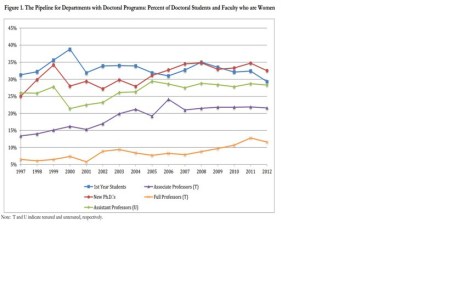 One reason not to dwell deeper on these numbers maybe that the percentage of women as full professors today should depend on the percentage of women as assistant professors say fifteen years back. But as the figure above shows that the numbers for each category remain more or less the same throughout the fifteen years. Also if we look at similar numbers confining ourselves to only top 10 or top 20 Economic departments in the sample, the ‘pipeline’ is even more ‘leakier’. Continue reading Is economics sexist? Divya Bhagia
Matargashti on New Year’s Eve, Take Back the Night 2015: Citizen’s Collective Against Sexual Assault
Citizen’s Collective against Sexual Assault (CCSA) is a Delhi/NCR-based group of individuals and organisations that works towards preventing and addressing issues of sexual violence against women, girls and transgender people, including raising awareness among the public, media, administration and the police on issues of women’s rights. CCSA organized for the third year in succession, a Take Back the Night rally on December 31, 2014, ending at 12.30 am on January 1, 2015. The New Year was welcomed with songs of protest, dance, street plays, with everyone meeting at PVR Anupam Saket, walking towards Saket Metro Station. Below is the statement they produced for the occasion, and some photographs.
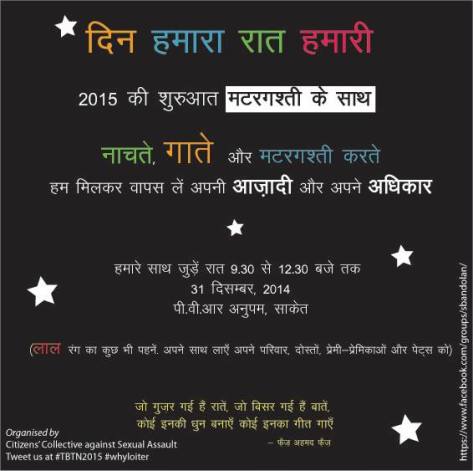
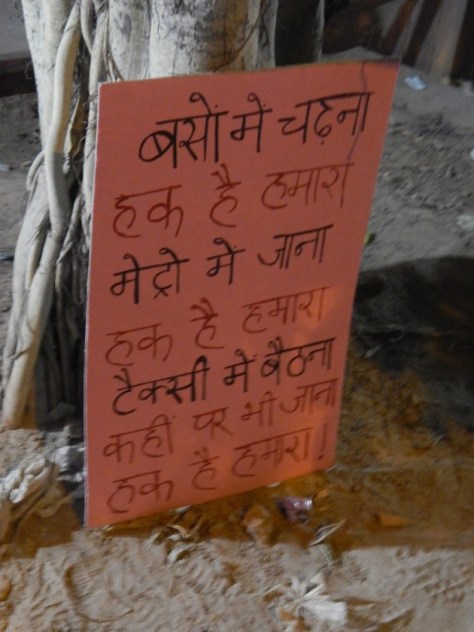
Matargashti is an expression of freedom, vibrancy, happiness, consent, confidence like reaching out to the clouds and bursting them like bubbles! Matargashti (or “loitering”) should be an essential part of each one’s life. Fearlessly roam on the roads, sprawl in the park, jump on to buses, metro and trains or laze around at a chai stall. I may be anyone — woman, man or transgender. Fearlessly be out at any time, travelling by public transport or in my own car. Proudly flaunting my wheelchair or crutches or tap-tapping my way around with my white cane. Someone who lives on the streets because I have nowhere else to call home. Fearlessly wear whatever clothes I feel like. And regardless of which region of India I belong to – North, South, the Northeast or anywhere else.
ചുംബനസമരവിരോധികളുടെ സംശയങ്ങളും അവയ്ക്കുള്ള സമാധാനങ്ങളും: ആലപ്പുഴയിലെ ചുംബനസമരത്തിന് അഭിവാദ്യങ്ങൾ
[പല വേദികളിൽ പല തവണ ഉത്തരം പറഞ്ഞുവെങ്കിലും ചുംബനസമരക്കാർ നിരന്തരം നേരിടുന്ന ചോദ്യങ്ങളാണിവ. ഈ ചോദ്യങ്ങളും മറുപടികളും പല സുഹൃത്തുക്കളോടും സഹപോരാളികളോടുമുള്ള സംഭാഷണങ്ങളിൽ നിന്നുണ്ടായവയാണെങ്കിലും അവയുടെ പൂർണ്ണ ഉത്തരവാദിത്വം എനിക്കു തന്നെ.]
ചുംബനസമരങ്ങളിൽ പങ്കെടുക്കുന്നവർ കേവലം പബ്ളിസിറ്റിക്കു പിന്നാലെ നടക്കുന്നവരല്ലേ?
നിലനില്പിനു വേണ്ടിത്തന്നെയുള്ള സമരം : ഫാസിസ്റ്റ് വിരുദ്ധ ചുംബനസമരം തിരുവനന്തപുരത്ത്
നിങ്ങൾക്ക് സദാചാരപ്പോലീസിനെതിരെയുള്ള സമരം ഓപ്ഷണൽ ആയിരിക്കും. ഞങ്ങൾക്ക് അത് ജീവൻമരണപോരാട്ടമാണ്.
അടക്കാൻ ഞങ്ങൾ ശവങ്ങളല്ല.
ഒതുക്കാൻ ഞങ്ങൾ വീട്ടുസാമാനങ്ങളല്ല.
ഫോട്ടോ എടുത്തുകളിക്കാൻ ഞങ്ങൾ
കടമുന്നിൽ തുണി ഉടുത്തും ഉടുക്കാതെയും
ചിരിച്ചു കൈകൂപ്പുന്ന പാവകളല്ല. Continue reading നിലനില്പിനു വേണ്ടിത്തന്നെയുള്ള സമരം : ഫാസിസ്റ്റ് വിരുദ്ധ ചുംബനസമരം തിരുവനന്തപുരത്ത്
Before the Killing, the End of Honour: Rina Ramdev and Debaditya Bhattacharya
Guest Post by RINA RAMDEV AND DEBADITYA BHATTACHARYA
For daring to elope and marry outside the dictates of caste-community honour codes, a young Delhi University undergraduate came to a brutal death at the hands of her family. The incident since then has become part of public discourse, thanks to our newspaper-educated sensibilities. But the ‘popular’ set of responses that this event has generated from our newsreaderly selves is worth some reviewing. While there has been a large-scale condemnation of this incident from ‘civilized’ quarters of the media-enlightened, the most commonly employed terms of this debate have veered around an imagination of a ‘civilizational modernity’ versus an ‘aggressive-savage primitivism’. Are we still in the Dark Ages, most have asked. Is not ‘love marriage’ a civilizational mandate of the age of the modern, others have comfortably posed and then gone on to conclude that the fact that we – as a ‘society’, metropolitan-converts in this case – have not yet made our peace with a civil code of morality relegates us to a ‘rustic-primitive mindset’. The muse of Indian judicial processes and imaginations of penal justice – ah! the “collective conscience” – has spoken thus and gone back to catching up on Ramzaadas and terror attacks on national ‘honour’. And just while we were conveniently conceding to the relative insignificance of an undergraduate girl’s ‘honour’ compared to the prime-time rhetorical spectres of ‘national honour’ in Jammu & Kashmir, a leading English daily attempted to bring back a few ‘dark’ images from Bhawna Yadav’s past. Continue reading Before the Killing, the End of Honour: Rina Ramdev and Debaditya Bhattacharya
A Women’s Charter for Delhi Elections: Women against Sexual Violence and State Repression
Guest Post by Women Against Sexual Violence and State Repression
The elections in Delhi are approaching.
Violence, as well as discrimination against women, and sheer denial of women’s dignity and rights, has been a huge concern for Delhi’s citizens.
This is the time when women are looking towards the political parties, to see what place women’s rights and freedoms have on their agenda.
We are disturbed to see that while most parties pay lip service to the cause of women’s rights, they blithely field candidates accused of violence against women, and they play to the patriarchal gallery on a range of issues, ignoring the voices of the women’s movement.
We, the undersigned would like to put the following concerns on the agenda of the Delhi elections, and we ask the political parties contesting Delhi elections to respond to them with urgency and seriousness. We appeal to all women voters to place this charter before every candidate and every party campaigner, and ask them for a clear position on each of its points.
1. We are alarmed at the spiralling of communal violence towards the Delhi elections. We are shocked that, instead of nabbing those who are fuelling the violence in a planned way, the Delhi Police has instead beaten up and brutalised innocent women in Trilokpuri. Above all, we are appalled at the attempts to justify communal, caste, racial or homophobic/transphobic violence in the name of ‘protecting women’. We assert that women are invariably rendered most unsafe by such violence. We seek a commitment that no party will promote leaders – either as candidates or as campaigners – who are accused of stoking violence against women, as well as communal, caste, racial or homophobic/transphobic violence. Specifically, we do not want the notorious 1984 duo Jagdish Tytler and Sajjan Kumar, we do not want to see Gugan Singh (who made communal speeches in Bawana) or Sunil Vaidya (who incited riots at Trilokpuri), or Somnath Bharti (charge-sheeted for racist and anti-women violence at Khirki) to be candidates or campaigners. Continue reading A Women’s Charter for Delhi Elections: Women against Sexual Violence and State Repression
Appeal to Stay the Execution of Surinder Koli: Concerned Women, Individuals and Groups
Guest Post by Concerned Women, Womens’ Groups and Others against the Death Penalty Awarded to Surinder Koli
To,
The President of India
Rashtrapati Bhavan, New Delhi, India.
2 December 2014
Subject: Execution of Surinder Koli Would be a Travesty of Justice:
Plea for Mercy from Women’s Groups, Lawyers, Academics, Students and Activists
As women who have been engaged in the struggles for women’s rights and justice, (and their allies) we appeal to you to commute Koli’s death sentence or at least to stay his execution till the completion of the other cases involving other Nithari victims in which he is an accused.
അഴിക്കാനും ആടാനും തുനിഞ്ഞിറങ്ങിയവർ തന്നെ നാം : തെരുവിൽചുംബനസമരക്കാർക്ക് ഒരു സന്ദേശം
സുഹൃത്തുക്കളെ,
കിസ് ഒഫ് ലൌ സമരങ്ങളുടെ രാഷ്ട്രീയത്തെക്കുറിച്ച് പലതരം ആശങ്കകൾ കേട്ടുതുടങ്ങിയിരിക്കുന്നു.
അത് ആഗോളീകരണ അഴിഞ്ഞാട്ടമാണെന്നും,
അതല്ല, മദ്ധ്യവർഗ്ഗ സന്തതികളുടെ എടുത്തുചാട്ടമാണെന്നും,
അതുമല്ല, അതിനു രാഷ്ട്രീയമേ ഇല്ലെന്നു വരെയും, കേരളത്തിലെ ബദൽരാഷ്ട്രീയങ്ങളിലെ പ്രമുഖവ്യക്തിത്വങ്ങൾ അടക്കമുള്ള പലരും മുറുമുറുക്കുന്നു.
Continue reading അഴിക്കാനും ആടാനും തുനിഞ്ഞിറങ്ങിയവർ തന്നെ നാം : തെരുവിൽചുംബനസമരക്കാർക്ക് ഒരു സന്ദേശം
 KAFILA - COLLECTIVE EXPLORATIONS SINCE 2006