Category Archives: Frontiers

Shahid in Srinagar: Arif Ayaz Parrey

Guest post by ARIF AYAZ PARREY
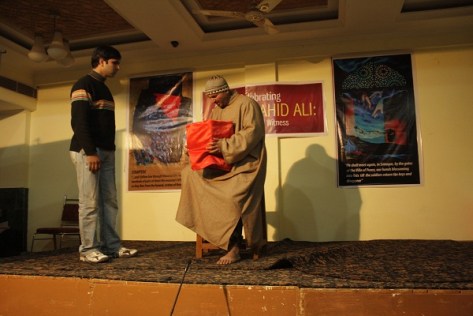
Photo by Muhabit-ul-Haq / TheKashmirWalla.com

I must go back briefly to a place I have loved
to tell you those you will efface I have loved [i]

Exactly ten years after he left us, Aga Shahid Ali returned to his Kashmir. A couple of days earlier, many parts of the valley were blessed with the season’s first snowfall, signalling an end to Harud, the autumn season in Kashmir, and ushering in Wande, the winter. The sky over Srinagar was overcast too, as it has been for the past few days, maybe because this year Moharram has been particularly demanding, with mourners not being allowed to mourn because “the processions might be used by separatists to whip up anti-India sentiments”. The reason for the ban is announced from the same bureaucratic offices which, during the summer, employ the entire state machinery to ensure that people from the plains can climb up the mountains into a cave where Amarnath wants to spend some private time with Parvati so that he can explain to her the mysteries of immortality (Which must include, one would like to presume, the secrets of the longevity of a fragile mountain ecology.) Some like to define this variance in state policy and practice as “secularism”. The connection between the tyranny of Karbala and the present-day Kashmir is firmly established, once again. Continue reading Shahid in Srinagar: Arif Ayaz Parrey

Parveena Ahangar rejects CNN-IBN’s nomination for ‘Indian of the Year 2011’

This press release has been issued by the PARVEENA AHANGAR-led ASSOCIATION OF PARENTS FOR DISAPPEARED PERSONS

Srinagar, December 10, 2011:  On this ‘International Human Rights Day’, December 10, 2011, the APDP (Association of Parents of Disappeared Persons), Srinagar, wishes to state that there is something obscene and perverse in the manner the CNN-IBN has nominated our organization for the ‘Indian of the Year 2011’ award. Sometimes, human rights can be violated by merely mocking those who struggle for human rights. Continue reading Parveena Ahangar rejects CNN-IBN’s nomination for ‘Indian of the Year 2011’

Hindi and Urdu: Sa’adat Hasan Manto

This is MUHAMMAD UMAR MEMON‘s translation of an article by SA’ADAT HASAN MANTO. The translation first appeared in The Annual of Urdu Studies.
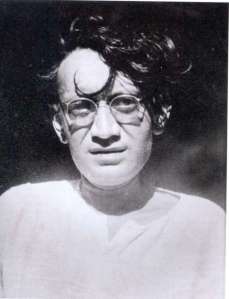
The Hindi-Urdu dispute has been raging for some time now. Maulvi Abdul Haq Sahib, Dr Tara Singh and Mahatma Gandhi know what there is to know about this dispute. For me, though, it has so far remained incomprehensible. Try as hard as I might, I just haven’t been able to understand. Why are Hindus wasting their time supporting Hindi, and why are Muslims so beside themselves over their preservation of Urdu? A language is not made, it makes itself. And no amount of human effort can ever kill a language. When I tried to write something about this current hot issue, I ended up with the following long conversation:

Munshi Narain Parshad:  Iqbal Sahib, are you going to drink this soda water?

Mirza Muhammad Iqbal: Yes, I am.

Munshi: Why dont you drink lemon?

Iqbal: No particular reason. I just like soda water. At our house, everyone likes to drink it.

Munshi: In other words, you hate lemon. Continue reading Hindi and Urdu: Sa’adat Hasan Manto

The need to influence the trajectory of one’s own life: Ruchi Gupta

Guest post by RUCHI GUPTA

The Arab Spring demonstrations in Tunisia, Egypt, Libya, Bahrain, Yemen, Syria, Jordan, Morocco were hailed in much of the democratic world. However the Occupy Wall Street protests, which till date have spread to 100 cities in the United States and 1500 globally have met with mixed response.

The Arab people are fighting for democracy, and thus their resistance must be respected and supported. But the OWS folks, proudly leaderless and having framed no concrete demands are vulnerable to all manner of criticism, even from those expected to be supportive. Bill Keller, the former editor of arguably one of the most influential newspapers in the world, the ostensibly liberal, New York Times derides,  “the Occupiers have been pandered to (“Love your energy!”); patronized (“Here, I’ve drafted you a list of demands …”); co-opted by unions, celebrities and activists for various causes; demonized by the right; arrested and tear-gassed in some cities; and taken lightly by the likes of me”.

However the uprisings in the Arab nations, the OWS demonstrations and even the wave of anti-corruption protests that swept India this year are all ultimately an expression of people’s resistance to disenfranchisement. Whether it’s those fighting for democracy or those who find themselves powerless in face of a system that’s been hijacked by the illegitimate nexus between the financial and political elite (the metaphorical 1%), the underlying sentiment is a demand for fair play and the right of self-determination. Continue reading The need to influence the trajectory of one’s own life: Ruchi Gupta

Pundit Manto’s First Letter to Pundit Nehru

This is M. ASADUDDIN‘s translation of a letter written by SA’ADAT HASAN MANTO to Jawaharlal Nehru in 1954. This translation first appeared in The Annual of Urdu Studies (volume 11, 1996).

Pundit-ji, assalamu alaikum!

This is the first letter I’m sending you. By the grace of God you’re considered very handsome by the Americans. Well, my features are not exactly bad either. If I go to America, perhaps I’ll be accorded the same status. But you’re the Prime Minister of India, and I’m the famed story writer of Pakistan. Quite a deep gulf separating us! However, what is common between us is that we are both Kashmiris. You’re a Nehru, I’m a Manto. To be a Kashmiri is to be handsome, and to be handsome … I don’t know. Continue reading Pundit Manto’s First Letter to Pundit Nehru

Apples and Oranges in Egypt’s Historic Election: Alia Allana

This guest post by ALIA ALLANA, a despatch for Kafila from Cairo, is the eleventh in a series of ground reports from the Arab Spring. Photos by Alia Allana

This slideshow requires JavaScript.

“Votes and rocks: just two ways to get heard,” said Salma.

Continue reading Apples and Oranges in Egypt’s Historic Election: Alia Allana

A case for remission of punishment for Dr Khaleel Chishty under Article 161 of the Constitution of India: Kavita Srivastava

Guest post by KAVITA SRIVASTAVA

Pardon and or Remission of Punishment for Pakistani prisoner Dr. Khaleel Chishty under Article 161 of the Constitution of India by the Governor of Rajasthan

Continue reading A case for remission of punishment for Dr Khaleel Chishty under Article 161 of the Constitution of India: Kavita Srivastava

An open letter from a photojournalist assaulted by Indian security forces in Kashmir: Yawar Kabli

Guest post by YAWAR KABLI

AP photo by Yasin Dar: Local Kashmiri photographers Yawar Nazir, left, and Showket Shafi wait for treatment after they said they were assaulted by police and paramilitary forces during a protest in Srinagar, India, on Nov. 25. At least four journalists said they were assaulted by police and paramilitary forces Friday as they covered a protest in Indian-controlled Kashmir.

All freedoms enshrined in the Constitution of India are being violated or altogether thrown away by the Jammu and Kashmir Police. One could substantiate that with any number of examples. We were not the first pressmen to be thrashed by the police while covering the stone-hurling protests in the Kashmir. On Friday, 25 November 2011, without any rhyme or reason policemen along with the Central Reserve Police Force (CRPF) thrashed four of us, including me, and snatched away our expensive cameras. They did not even hesitate to bundle us into police vehicles while taking us to the Khanyar police station.

Continue reading An open letter from a photojournalist assaulted by Indian security forces in Kashmir: Yawar Kabli

‘Did the generals think we were fools?’ Alia Allana reports from Cairo

This guest post by ALIA ALLANA, a despatch for Kafila from Cairo, is the tenth in a series of ground reports from the Arab Spring. Photos by Alia Allana

A week into protesting, the revolution became about preservation lest someone forgets.

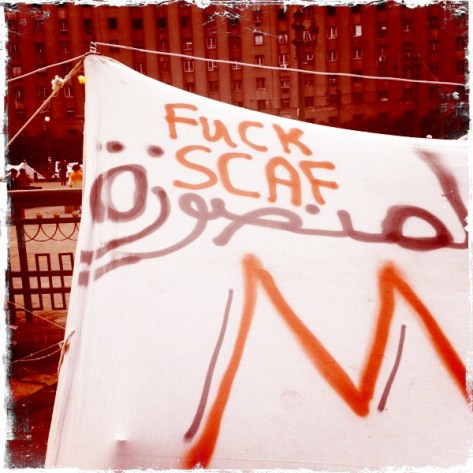
Mohammed Mahmoud Street, the sight of intense fighting was officially off-limits for protestors. A concrete wall separated the protestors and police. Atop the wall army soldiers kept guard. The aim was simple: to keep protestors from barging past and facing-off with the authorities, like they had done for the past few days. But sometime in the night, a maverick with a graffiti can had his way and the beige concrete wall now read, “Change is coming soon.”  Continue reading ‘Did the generals think we were fools?’ Alia Allana reports from Cairo

Uthao, uthao video ab, won’t you make the video now?

This photograph shows photojournalist Shahid Tantray being assaulted by the Central Reserve Police Force in Srinagar on 25 November 2011

No tears will be shed for press freedom for attacks on journalists in Srinagar by the Central Reserve Police Force and the Jammu and Kashmir Police. Fahad Shah reports what happened in Srinagar yesterday:

Journalists were beaten up and one of them detained, today, when they were covering the post-Friday prayers protests in the Old City, here at Srinagar. Umar Mehraj, who works as video journalist for Associated Press says he, along with other journalists, was covering protests when Central Reserve Police Force (CRPF) and local policemen start beating. He said while beating, the forces were shouting, “Uthao, uthao video ab (Shoot, shoot the video now.).” Umar says his camera was broken and they were abused too.

Continue reading Uthao, uthao video ab, won’t you make the video now?

Egypt, Revolution 2.0: Alia Allana reports from Tahrir Square

This guest post by ALIA ALLANA is a despatch from Cairo for Kafila, the ninth in a series of ground reports from the Arab Spring. Photographs by Alia Allana

This slideshow requires JavaScript.

The police lobbed another tear gas canister and soon the feeling of suffocation would take over. But he didn’t move, instead he stood in the center; he continued to wave the Egyptian flag. The sound of rubber bullets being fired drowned under the sound of the drum. The drum was the harbinger of doom: when it was sounded by protestors, when the cacophony cut through the air, the message was simple – run, run as fast as you can because the police would begin their attack, again.

Continue reading Egypt, Revolution 2.0: Alia Allana reports from Tahrir Square

An account of deadly clashes in Tahrir Square: Alia Allana

This guest post by ALIA ALLANA is a despatch for Kafila from Cairo, the eighth in a series of ground reports from the Arab Spring. Videos and photos by Alia Allana

This slideshow requires JavaScript.

A peaceful protest with men selling candyfloss and making chai turned into an orgy of violence.

Tahrir Square had been quiet for the earlier part of the day today. The Sunday afternoon saw couples strolling, a mother carried her sleeping child, his face was buried in her bosom, scooters with loud speakers blared music.  There was no chanting and very few slogans. Small and sporadic groups of people protested. They called for change.

Continue reading An account of deadly clashes in Tahrir Square: Alia Allana

Trading with the Enemy: Raza Rumi

Guest post by RAZA RUMI

Reports suggest that Pakistan has decided, in principle, to grant the Most Favoured Nation (MFN) status to India. Much progress has taken place since the earlier announcement and several parleys between the officials suggest that trade relations may finally ‘normalise’. India already conferred MFN status to Pakistan in 1996. India and Pakistan have no formal trade agreement. Until now Pakistan maintained a Positive List of importable items from India consisting of 1075 items.

Most Favoured Nation: Under the WTO agreements, countries cannot normally discriminate between their trading partners. Grant someone a special favour (such as a lower customs duty rate for one of their products) and you have to do the same for all other WTO members. This principle is known as most-favoured-nation (MFN) treatment. It is so important that it is the first article of the General Agreement on Tariffs and Trade (GATT), which governs trade in goods. MFN is also a priority in the General Agreement on Trade in Services (GATS). Continue reading Trading with the Enemy: Raza Rumi

Dr Khaleel Chishty’s family in Ajmer to appeal for his release: Kavita Srivastava

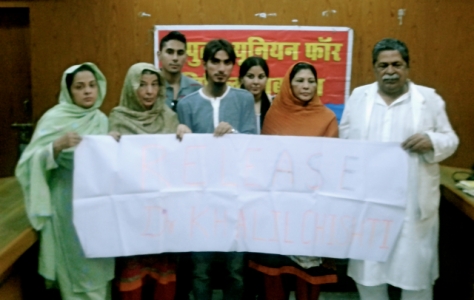
This press release comes from KAVITA SRIVASTAVA of the People’s Union for Civil Liberties. It was released after a press conference in Ajmer on Friday, 18 November 2011

  • Family appeals to Governor Shivraj Patil to sign the mercy petition of Dr. Khalil Chishty pardoning him at the earliest
  • Government of Rajasthan grants perrmission to the family to meet Dr. Chishty in Jail

In Search of Ram and Kabir

You may have seen this documentary film before. If you have, you will, I’m sure, want to see it again. It is not about Ram or Kabir. It is about you and me.

Had Anhad is a documentary film, part of the Kabir Project, released in 2008.

A film by Shabnam Virmani
Language: Hindi & Urdu with English Subtitles
Duration: 103 min

Kabir was a 15th century mystic poet of north India who defied the boundaries between Hindu and Muslim. He had a Muslim name and upbringing, but his poetry repeatedly invokes the widely revered Hindu name for God – Ram. Who is Kabir’s Ram? This film journeys through song and poem into the politics of religion, and finds a myriad answers on both sides of the hostile border between India and Pakistan.

Watch it on Culture Unplugged.

Govt must do more to protect minorities: Human Rights Commission of Pakistan

This press release was put out by the HUMAN RIGHTS COMMISSION OF PAKISTAN, Lahore, on 9 November 2011

The brazen murder of three brothers from the Hindu community in Shikarpur district on Eid day demonstrates that the perpetrators believe they can get away with murder simply because the victims are non-Muslim, the Human Rights Commission of Pakistan (HRCP) has said.

In a statement issued on Wednesday the Commission said: “HRCP is shocked at the brazen murder of the three Hindu citizens in Shikarpur and shares the sense of outrage of the Hindu community, not least because of the utter failure of the police to prevent the killings or arrest the killers even though threats of violence had been brought to their notice. Continue reading Govt must do more to protect minorities: Human Rights Commission of Pakistan

Rain, Eid and Geelani: Sameer Bhat

Guest post by SAMEER BHAT

A fine rain was falling as I disembarked the aircraft. Srinagar was shivering at 7 degrees centigrade. Rams and ewes, all set for slaughter on Eid, looked forlorn. Meat-market persons in untidy pherans haggled with locals for rates. Half the male population, I noticed, had not seen a shaving blade for weeks, a very Kashmiri trait most noticeable in winters. While it continued to drizzle, queues outside ATM machines got fretful. At least three people entered the cashpoint at one time to witness your transaction. The invasion of financial privacy has a very harmless ring to it, which is very indigenous. Continue reading Rain, Eid and Geelani: Sameer Bhat

Mistaken Identity: Arif Ayaz Parrey

Guest post by ARIF AYAZ PARREY

The Indian army in Kashmir must be reading a lot of Manto these days. Or Borges. Or Kundera. Or –and this is most likely, given the approaching winter season and their ‘hearts and minds’ programme– Kashmiri folklore.

Not three months have passed since they made a highly publicized acknowledgement of “mistaken identity” after they had killed a mentally “challenged” “Hindu” youth in Poonch and declared that he was a “fierce” “Pakistani terrorist Abu-Usman killed after a 12-hour long gunbattle” (such valour exhibited by the Indian security forces is the stuff of legends in Kashmir) that they have followed it with another announcement of a (dis)similar “mistaken indentity”.

This time, like always, the culprits are the Kashmiri people (whose synonym in the Indian army’s dictionary is “miscreants”) Apparently, people beat to pulp a “member of a covert team of the army and J&K police” who were “sent to Sopore Town on getting info of presence of terrorists in the public rally addressed  by SA Geelani”. The person was carrying a camcorder and his service pistol. The people thought he was the terrorist.

Democracy? History? Or “mishtake”? Choose your option.

Kundera writes, “When the institutions of a state no longer feel the need to make sense or to give plausible explanations, the state can only survive as long as people allow it to lie shamelessly.”

See also:

Previously in Kafila by Arif Ayaz Parrey:

Bhupen Hazarika – The Sub-nationalist Imagination of a Universalist: Bikram Bora

Guest post by BIKRAM BORA

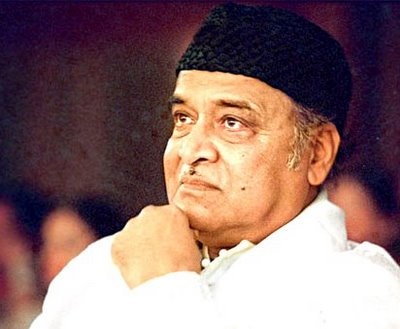
The unprecedented number of mourners crowding the otherwise sleepy streets of Guwahati at night following the demise of the maestro, proves testimony to his genius. In his life, there was no dearth of followers, some logical, some blind; while in his death, grief engulfs both the sections. What could be the reasons for Hazarika’s powerful grip over people’s emotions? It can’t be just his musical dexterity; it’s more the aura surrounding him, emanating from his multi-dimensional persona and life-span.

Continue reading Bhupen Hazarika – The Sub-nationalist Imagination of a Universalist: Bikram Bora

Adib Shishakly – The Rebel in the Hotel Room: Alia Allana

This guest post by ALIA ALLANA, a despatch from Istanbul, is the seventh in Kafila series of ground reports from the Arab Spring. Photos by Alia Allana unless otherwise mentioned

Adib Shishakly’s rebellion starts with a small pin on his blue blazer.

Embellishing the the blue of his jacket, clipped on to the left collar is a flag of Syria not seen since the days following the French mandate. Today the flag flies in the besieged areas of Homs, Hama and Dera’a where the protestors have posed Bashar al Assad’s regime with it’s biggest challenge to date. It’s this very flag, with its three golden stars that was outlawed by the Ba’ath Party, by strong man Hafez al Assad.

Continue reading Adib Shishakly – The Rebel in the Hotel Room: Alia Allana

Kathmandu to Peshawar

Himal Southasian editor Kanak Mani Dixit and his wife Shanta Dixit, an educator, are driving from Kathmandu to Peshawar, via Lucknow, Delhi and Lahore, to raise money for Nepal’s only Spinal Injury Rehabiliation Centre, which he started after Kanak’s own miraculous recovery from a spinal injury. The journey was flagged off yesterday by Nepal President Ram Baran Yadav. Do join them!