Category Archives: Genders

On the SC judgement on Sec 377: Statement from TISS teachers

It is with deep shock and disappointment that we received the regressive judgment of the Supreme Court dated 11-12-13, on the reading down of Section 377 of the IPC related to the rights of queer (lesbian bisexual gay and transgender…) people in this country, which reverted the decriminalisation of non-normative sexualities following the Delhi High Court judgement in 2009.

The Delhi High Court had based its expansive judgement on the eloquent discussion of constitutional morality by the framers of our Constitution, especially Dr. Ambedkar. Constitutional morality, they argued is the basis for equality of citizens since public morality which is largely the morality of the dominant forces in society can never guarantee democracy, and perhaps even more importantly equality and dignity to its citizens, especially its most marginal citizens. Additionally, The Delhi High Court judgement evoked the spirit of dignity, inclusiveness and non-discrimination, thereby emphasizing equality of all citizens that Nehru spoke of during the Constituent Assembly debates, so necessary for the deeply hierarchical social fabric that our country represents. Continue reading On the SC judgement on Sec 377: Statement from TISS teachers

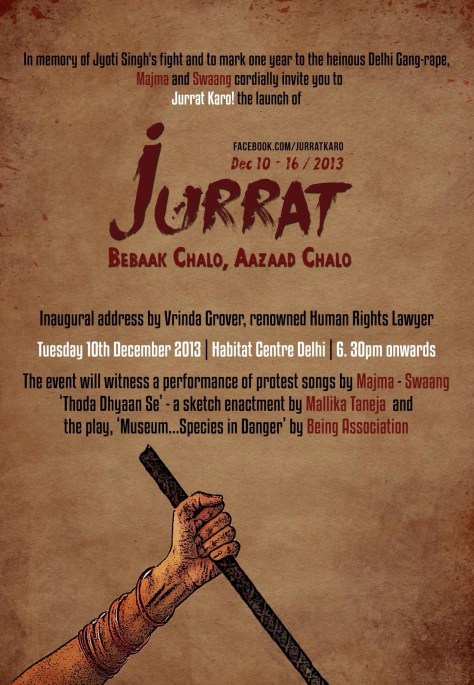
Jurrat – 10 to 16 December 2013, Delhi

Majma and Swaang are organizing JURRAT – A week long campaign on violence against women, from Dec 10-16.

image

About Jurrat

On 16th December 2013 one year would have passed since the shameful, horrific and brutal gang rape of a 23-year-old girl in Delhi. And yet this whole year, city after city and village after village has screamed ‘Rape’ ‘Gang Rape’ in the months after the much publicized and condemned Delhi-gang rape. Continue reading Jurrat – 10 to 16 December 2013, Delhi

A hunt, the aftermath, angry Indian men and a tragedy: Rahul Roy

Guest Post by RAHUL ROY

Nivedita Menon ends her commentary on the unfolding Tehelka sexual assault case in Kafila by asserting – “the time has come. It is now”. It should be, but is it? Are we witnessing the end game of an old Indian patriarchal sport called sexual assault? The sport is akin to another old game called the royal hunt that was an important part of elite political culture of South Asia. The rules of the sport were then as now heavily loaded in favour of the royal huntsman – weapons, support teams, timing, everything required for the thrill of a kill were with powerful men out to conquer. The expeditions however were not just about the kill. The sport was also a means of asserting authority over tracts of the wild and those that lived there and were by some misfortune not aware of prevailing authority structures. The royal hunt was an event to showcase to subjects the might, prowess and authority of the elite rulers. It was the stamping of power over human as well as animal kingdom. The royal huntsman could not but win. He could not but kill.
Continue reading A hunt, the aftermath, angry Indian men and a tragedy: Rahul Roy

Presenting the Perpetrator as Victim

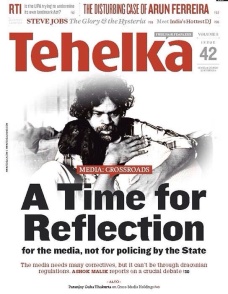
Meet Tarun Tejpal’s spin doctors

image

Unlike Justice (Retd.) Ashok Kumar Ganguly, Tarun Tejpal’s defenders cannot cry innocence given that Tejpal has confessed to his crime, albeit disputing the degree of it. He has even confessed having told his colleague that suffering the sexual assault was the “easiest way of keeping your job”. Even his two decades old comrade Shoma Choudhury is unable to defend him beyond saying that he has his versions. Nobody buys Tejpal’s ludicrous retractions.

This put Tejpal’s friends, fellow molesters and self-defeating secularists in a bind. Many of his friends have chosen silence, which is understandable. It is only human to recuse oneself from the difficult choice between principle and friendship. Though some like Arundhati Roy and Sankarshan Thakur have admirably chosen principle over personal association. But those who wanted to come out and actually defend Tejpal were at a loss for words. How do they defend a crime whose perpetrator has confessed to it? So they came up with a few sly defences which pretend to be nuances. Some like BG Verghese are writing as though they were ghostwriting Shoma Choudhury’s defence.

So let us lacerate these defences one by one.

‘Trial by media, lynch mob’

Continue reading Presenting the Perpetrator as Victim

The Tangled “Tonalities” of Mr. Tejpal

By now the details are well known: a young journalist describes a harrowing encounter with Tarun Tejpal, owner and editor of Tehelka, in an elevator during Tehelka’s Think fest in Goa. The description of the incident alleges gross sexual misconduct and bodily violation of an aggravated nature.  Her description does not make for easy reading: it clearly demonstrates the incredibly vulnerable position in which young women are placed when confronted with the sexual misdemeanors of powerful men in positions of managerial authority. Indeed Mr. Tejpal says as much, that to cooperate with him is the best way for her to keep her job. She writes to Ms. Shoma Chaudhury the managing editor describing the incident and asks that she be tendered an official apology, and that Tehelka’s senior management constitute an enquiry and anti-sexual harassment committee as per the Vishaka guidelines. Instead what she is offered is a pathos-laden tale of fall and redemption: directed by and starring Mr. Tejpal, producer Ms. Shoma Chaudhury. There has been near continuous discussion across the web and the news and it can get difficult to keep track of all the various versions being produced on an hourly basis by Tehelka’s bullshit factories. So at this stage it might be useful to simply collate and compare various accounts. Continue reading The Tangled “Tonalities” of Mr. Tejpal

Protect the Privacy of the Tehelka Journalist: Report Responsibly

GUEST POST BY ‘REPORT RESPONSIBLY’
To all editors, journalists, bloggers, users of social media, and the public:

Some websites and blogs are posting the Tehelka journalist’s complaint to the magazine’s management or reproducing parts of it, perhaps with intent to expose a grave act of sexual assault by a man occupying a powerful position. However, in doing so, they are violating basic ethical and legal injunctions on the way cases of sexual assault must be reported.

The journalist’s complaint to her company is a private document and not a public one. While private documents can be leaked in the ‘public interest’, this principle is applicable to the emails of Tarun Tejpal and Shoma Chaudhury sent to Tehelka staffers, not to the journalist’s emailed complaint. In cases of sexual assault, it is a well established principle that the media can name the perpetrator, but not the victim. The identity and privacy of a victim must be protected at all costs.We are distressed that many people are circulating the journalist’s emails, and other journalists, bloggers and users of social media are publishing it in parts or whole.

Continue reading Protect the Privacy of the Tehelka Journalist: Report Responsibly

Ka Tvam Baale? Kaanchana Maatha! Or, the University of Calicut experiments with the Grotesque!

Now let me confess, it is high-time in life that I got an award — I am 46, nearly. It isn’t really a question of whether I desire it or not. If you are in the business of reading and writing in Kerala then you MUST receive some award by mid-career — it’s a bit like experiencing nausea and tiredness in early pregnancy. You MUST have it, it is the surest sign of being pregnant, and sometimes to enjoy people’s kindness towards a pregnant woman, you need to get vomiting soonest possible. You can’t get into a conversation about pregnancy with other women without being able to recount your experience of being nauseous and tired. Continue reading Ka Tvam Baale? Kaanchana Maatha! Or, the University of Calicut experiments with the Grotesque!

Will Logarani Be The Last Victim Of Violence Against Women? Cayathri. D

GUEST POST BY CAYATHRI D via Ground Views

All photographs by the author, or sent by the author (in the original post)

Around 5pm on 17 October 2013, within the Jaffna municipality, one of our friends (a male youth resident of Jaffna) came to our home (a few friends were gathered there) looking very disturbed.…

READ MORE HERE

Securing Justice for Rape Survivors from Kashmir and Northeast is An International Human Rights Crisis: Ayesha Pervez

Guest Post by AYESHA PERVEZ

The events preceding the recent death sentence awarded to the rapists of December 16th  Delhi gang rape case from 2012 have certainly broadened  the canvas of discourse on sexualized violence in India. Not only was the institutional sexism that pervades India’s criminal justice system been challenged, but also patriarchal values and norms that sanction and reinforce gender biases were openly questioned.  It was remarkable to watch the unprecedented outpouring from the Indian citizenry from all across  which resulted in the decision of the government to constitute a committee which had the mandate for recommending amendments to the Criminal Law. Recommendations by the Justice Verma Committee in early 2013, undoubtedly paved a way for much needed reform of laws and criminal justice practices relating to crimes of sexual violence. However, this was not true for all the survivors of sexual violence, particularly from the “disturbed” peripheral states of India. For the victims and survivors of sexualized violence from the conflict zones of India – Jammu and Kashmir and Northeast, the discourse ended uneventfully with a reserved/muted  submission of the Committee’s report to the government. Continue reading Securing Justice for Rape Survivors from Kashmir and Northeast is An International Human Rights Crisis: Ayesha Pervez

Jazeera in Delhi: Who Can Speak Against the Sand Mafia? : Bindu Menon M

This is a guest post by BINDU MENON M

Jazeera V, who began her fight against sand mining mafia in Kerala one and a half years ago in the North Kerala coastal hamlet Neerozhukkumchal, is now on a sit-in, in front of the Kerala House near Jantar Mantar New Delhi.  She had first approached the village office, the local panchayat, police station, the district authorities and Kerala State government with the appeal to stop sand mining in the beach which grossly violated the Coastal Zone regulations. Ridiculed by the local media and intimidated and physically assaulted by the supporters of the sand mining mafia, she sat in front of Kerala State Secretariat for several weeks before moving to Delhi.  She demands that the central government should immediately take action against the gross violation of laws for protecting the coastal zones. Her struggle in front of the Kerala secretariat at Thiruvananthapuram for 68 days against the inaction of Kerala Government forced Chief Minister Oommen Chandy to invite her to his chamber for discussion. Although he assured her that he would take necessary actions against sand mining on the coast, he was reluctant to give her any written reply. She finally decided to shift her sit in from Kerala to Delhi in protest of Chief Minister’s callous attitude.

Continue reading Jazeera in Delhi: Who Can Speak Against the Sand Mafia? : Bindu Menon M

In Delhi’s defence

Reuters photo
Reuters photo

By SHIVAM VIJ: The census counts ’urban agglomerations’, and the Census of India says that Mumbai is India’s largest urban agglomeration. This includes Mumbai’s suburbs. In counting Delhi, the suburbs are not added because They are separated by state boundaries. If you were to add suburbs of the ’National Capital Region’, Delhi’s population would be not 16 million but over 22 million, making it the world’s largest urban agglomeration after Tokyo. This bustling urban centre is made of its people. Today’s Delhi cannot be stereotyped as just the seat of power. There is more to Delhi than the endless roundabouts of Lutyens’ capital.

Delhi’s core – the Partition refugee Punjabi – is not xenophobic like the Marathi ’manoos’ of Mumbai. In fact Delhi today is what Bombay once was, India’s foremost cosmopolitan metropolis. It is the city of choice for people from across India to migrate to with dreams of riches.

A lot has been written about “the Delhi gang-rape”. 16 December 2012 started a conversation that doesn’t seem to end. This conversation has largely been about rape, not about Delhi.
Continue reading In Delhi’s defence

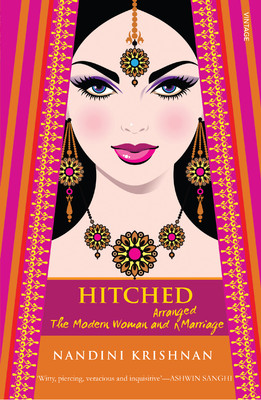
‘Marriage for men is like puberty for women’: Nandini Krishnan

nandini-krishnan-hitched-400x400-imadmuhyuygmg2xeThis is an extract from Hitched: The Modern Indian Woman and Arranged Marriage by NANDINI KRISHNAN

Saurabh laughs that he had the advantage of knowing what the process of spouse-hunting involves. A year before he went through the drill, his sister did.

[…]

However rosy the courting period may be, once you’re married, you get a rude wake-up call when you’re living in the same space. ‘Living with a strange person takes adapting. You could be in love for a few years and then get married, but even that doesn’t prepare you for sharing your personal space with another person. Of the other gender. Who has a different set of bodily smells, and opinions on the way your clothes smell.’

He has an interesting comparison for what men go through after marriage. ‘Remember when you, as a girl, got up close and personal with menstruation. That’s what most guys go through in the first month of marriage, unless they’ve been in a live-in relationship before. The first month is very chaotic because you’re experiencing another gender’s physicality and emotions.

Curiosity and disgust go hand in hand. Men see that their wives menstruate. Women begin to appreciate that belching and farting are natural human processes, but somehow they never manage to complete this process of appreciation.’ Continue reading ‘Marriage for men is like puberty for women’: Nandini Krishnan

A Burden of Proof: A Response to “White Woman’s Burden” by Ameya Naik

This is a guest post by AMEYA NAIK

[On the 26th of August 2013, Newslaundry carried a piece by Rajyasree Sen titled “White Woman’s Burden“. This post is offered as a rebuttal of the views expressed in the essay.]

Dear Rajyasree,

Michaela Cross, aka RoseChasm’s CNN blog piece about her experience of India is, as you say, currently unavoidable on the internet. It does seem to be provoking a dialogue on women and safety in India – at least in social media circles. If the result is that Indian girls and women acknowledge and share their own negative experiences, perhaps thereby to make some Indian men re-examine their perceptions and behaviour, it would still be a step forward.

Unfortunately, some responses represent two steps backwards instead. Your writing (“White Woman’s Burden”, 26 Aug, 2013) is one such; it made me profoundly uncomfortable. The gist of your argument appears to be this: Michaela was not suitably prepared, and she *SHOULD* have known better. Indeed, given her account of her actions and experiences, and the trauma she has experienced therein, it is surprising (to you) how unprepared she was.

Did I just read a young, educated Indian woman entrepreneur – from the hospitality industry, no less – say that an exchange student left traumatised after experiencing molestation (and worse) because she was unprepared? I describe myself as a cynic, but surely this is a new low!

What, pray tell, would suggest she was sufficiently prepared? That she came here, had the experiences she did, and considered them “par for the course” in India? Or that she came here aware of (what you call) the skewed psycho-sexual dynamic between Indian men and women in all its rich and diverse forms, behaved in the most conservative and appropriate fashion – only dancing in “safe places”, avoiding public transport entirely, staying only with trusted hosts or in one of Goa’s five star hotels – and left having experienced only milder forms of violation, like the persistent gaze (which she would know to expect)?

This assertion of yours does have one unexpected benefit – it lets us ignore the fair skin debate. If complexion plays no role, she should still be at least as careful as any Indian woman. If complexion does play a role, she should be even more careful! As silver linings go, though, this is pewter on a thundercloud.

How, pray tell, would the students or the University prepare for their visit to the land of the skewed psycho-sexual dynamic? With little docu-dramas of all the kinds of harassment you can expect, and how to be safe at all times? Would you not seed the most pernicious mistrust in your potential visitors? In fact, why would any of them come at all? Surely the University would simply cancel the trip!

And, while you seem to suggest that this is precisely what the “easily traumatised” should do, we would be the first to protest. Already we cry ourselves hoarse over travel advisories saying India is unsafe for women. That, apparently, is an insult to our national pride. And that seems to be the source of this article: “how dare this unprepared white girl write about India this way?” Only Indian writers can suggest that India has a skewed psycho-sexual dynamic, right? (An interesting dynamic which, of course, makes some – but not all – lechers or potential rapists. And on current evidence, I shudder to ask you who these corrupted ones are, and why only they succumb to this taint.) Because Indian women are prepared for such behaviour, and they know – even when they face it abroad – that it is only an aberration.

Too many responses, too many comments, seem to be in this vein. Why this parochial-with-my-fingers-crossed-so-as-not-to-offend-gendered-perspectives reply at all? My thesis is that it is because Michaela’s account makes us ask a few uncomfortable questions. Such as, how many aberrations to make a norm? How much preparation is enough?

Answering those questions is not a White Woman’s Burden – the onus to answer to them lies on us. Discrediting the person who asked them as “easily traumatised” – and really, as someone who says she has lived through incidents enough of her own, how dare you! – is a thoroughly inadequate reply.

[Ameya Naik is currently in a graduate programme in Boston. A psychologist and lawyer by qualification, he worked in New Delhi across 2012-13.]

Mathura too did not scream: Forum Against Oppression of Women

Guest Post by FORUM AGAINST OPPRESSION OF WOMEN

As a feminist collective that was formed in the aftermath of the historic Mathura rape case in 1980, in which two police men had sexually assaulted a tribal girl within the police station, two recent cases of sexual assault (in Mumbai) have become matters of grave concern for us. These were filed by women against medical professionals who had committed the crime within their clinic or hospital,

On May 17th 2013, a 26 year old woman had gone, accompanied by her husband, to meet Dr. Rustom Soonawala who had been treating her for TB and later infertility since August 2012. This was at around 6 pm as per appointment. Upon examination, the doctor told them that the TB was almost cured and then asked the husband to go out of the examination room, locked the room, and raped her while covering her mouth with his hand. Continue reading Mathura too did not scream: Forum Against Oppression of Women

To travel or not to travel to India: Karen Dias

This is a Guest Post by KAREN DIAS

The most recent ‘Incredible India’ video ad campaign shows a young woman of seemingly European descent traveling alone through India. She is seen drinking coconut water and being friendly with a man, playing chess with holy men, being helped after a fall by two men, cheering at a snake boat race on a boat filled with men, playing Holi surrounded by more men and strolling on what looks like a deserted beach with a male mahout and his elephant. Sadly, the truth is far from what the video depicts for foreign women traveling in India, and most of them will try their best to not find themselves alone in situations like the ones shown in the video.  Stories of foreign women being verbally and sexually harassed are not new in this country and being accompanied by male friends or relatives is almost never a deterrent. Continue reading To travel or not to travel to India: Karen Dias

The Curious Case of Hamid Ansari

large-p-9-aa

You may think he is a spy or a saboteur. If he is one, would he have spent months trying to reach Kohat from Mumbai and then get caught in just two days?

Sitting in Mumbai, Hamid Ansari fell in love with a Pakistani Pashtun girl over Facebook. He was a 26 year old management teacher, she was a B.Ed. student. After over a year of obsessing about each other over the internet, phone and phone messengers, she called him one day, crying. She had confided in her sister about this online affair, but the sister told the parents, who decided it was time to find her a husband. It was the last phone call. She soon disappeared from Facebook too. Continue reading The Curious Case of Hamid Ansari

Gendered Violence and the Hall of Mirrors: Parnal Chirmuley

Guest Post by Parnal Chirmuley

A very young man, who should have been cheerfully devouring the world of ideas over samosas and tea from the canteen, tries instead to hack an equally young woman, his classmate, to death. With an axe, some say. Tries to shoot her too, but the pistol is too stubborn, they say. Then turns the blade and the poison on himself. There he sees success. Succumbs to both.

This leaves behind rivers of blood in the classroom and gashes in the minds of those who witnessed this, bravely intervened, or ran away from it. It leaves everybody entangled in a sea of Gordian knots that are just questions.

Continue reading Gendered Violence and the Hall of Mirrors: Parnal Chirmuley

The Affective Claims of Violence – Reflections on the JNU Campus Tragedy: Pratiksha Baxi

Guest Post by Pratiksha Baxi

Many competing frameworks have given expression to shock, disbelief, rage, grief, guilt and fear after the violence witnessed as the new semester kicked in, with a monumental tragedy, on the JNU campus. Everyone is stunned by the tragic turn of events that has resulted in a young woman battling for her life in a neuro–ICU in Safadarjung hospital. Confusion gripped the campus as the classroom became a scene of crime, a classmate became a bloodied body and the familiar transformed into the incomprehensible. It was devastating that the assailant, who succeeded in extinguishing his own life, aimed to unite in death the object of his obsession through a planned and highly performative act of violence in the routine setting of a classroom.

Continue reading The Affective Claims of Violence – Reflections on the JNU Campus Tragedy: Pratiksha Baxi

Unrequited love or simply ‘self love’? – Reflections in the wake of a Campus Tragedy at JNU: Shivani Nag

Guest Post by Shivani Nag

In the days following the brutal rape and murder of a young woman in December last year, I remember waking up each day and being out on the streets raising slogans on women’s freedom and liberation. For months after that, there were a series of mobilizations, vigils, parades and protests, and my strongest recollection of those events is the resounding reverberation of ‘mahilaayein maangi azaadi… khaap se bhi azaadi aur baap se bhi azaadi, shaadi karne ki azaadi aur na karne ki azaadi…’. It WAS about justice for that one woman, but it wasn’t ONLY about that… it was also about many other such women – some forgotten, some not, some dead and some still around… it was also about all women, demanding not just justice but their right to life as equal citizens. We did not come out on the streets to be told how to be safe, but to convey it loud and clear that we cannot spend our entire lives trying to be safe without actually getting to live it. We came out to demand and defend our right to choice!! Continue reading Unrequited love or simply ‘self love’? – Reflections in the wake of a Campus Tragedy at JNU: Shivani Nag

Ilavarasan: At a deadly new junction of caste and electoral politics: Rajan Kurai Krishnan

ilavarasan_divya-350_070513040519This is a guest post by RAJAN KURAI KRISHNAN

The gruesome death/alleged murder of Ilavarasan, a Dalit youth, at the outskirts of Dharmapurai on the afternoon of 4th July has come as a shock to all those who have heard of his case. Murders, ironically called honour killings, and socially abetted suicides as outcomes of inter-caste marriages are of course as common as catching cold in most parts of India. However, what has made Ilavarasan’s case something that could penetrate the armour of the middle class everyday plated with trained nonchalance to extract a possible expletive under their breath is the fact that his case has been in the limelight for more than eight months now.

It was a few weeks after his marriage with Divya, a girl belonging to the caste of Vanniars, a Most Backward Caste in the official description of Tamil Nadu Government,  in October 2012, Divya’s father was found dead allegedly having committed suicide due to the “dishonour” caused by his daughter’s marriage. Making the suicide an excuse, the Vanniyars organized riots in which three Dalit hamlets, about 250 houses, were destroyed. The scale of violent destruction caught the national attention and so did the love story behind the riots. The young couple earned a media profile while trying to live in peace beyond the reach of the raging Vanniyar caste men. It was fated that was not to be. The Vanniar caste leaders used Divya’s mother to temporarily separate Divya from Ilavarasan by using the well known tactics of emotional blackmail. They then broke the communication link between Ilavarasan and Divya. When Ilavarasan saw Divya in the court on the first of July, Divya told the court that she would live with Ilavarasan after convincing her mother. Divya’s lawyer, however, managed to make her tell the press that she is separated from Ilavarasan forever. Ilavarasan, on the other hand, told India Today, that he was highly hopeful of re-uniting with Divya. After two days, he was found dead near a railway track in broad daylight. Given this history, the news had some potential to shock people. Continue reading Ilavarasan: At a deadly new junction of caste and electoral politics: Rajan Kurai Krishnan

Salaam, Sharmila Rege!

2006112210820401

Sharmila (right) receiving the Malcolm Adiseshiah Award (2006) from Padmini Swaminathan, Director of Madras Institute of Development Studies (Source: The Hindu)

Sharmila Rege passed away yesterday, aged 48, a month after she was diagnosed with cancer. Sharmila described herself as a Phule-Ambedkarite feminist, and was a dear friend to many of us, a political activist of enormous integrity and the moving spirit behind Krantijyoti Savitribai Phule Women’s Studies Centre at Pune University. Her scholarship was immense and inspiring, consistently traversing the minefields of caste and gender, constantly complicating one with the other. Writing Caste, Writing Gender: Reading Dalit Women’s Testimonios brought together first-person accounts of eight Dalit women from the 1920’s to the present – the voices of Babytai Kamble, Shantabai Kamble, Muktabai Sarvagod, Shantabai Dani, Kumudtai Pawde, Urmila Pawar, Janabai Girhe and Vimaltai More, emerge powerfully and relentlessly in their matter-of-fact assault on caste society’s smugness and violence. Sharmila worked with these ‘testimonios’ (a term she drew from Latina feminism) in a series of’ ‘translations’ – translating from Marathi, translating time and place, translating herself, and encouraging  readers to translate themselves too, in terms of Phule and Ambedkar’s scholarship and politics, to read themselves through the lens of the non-Brahmin and Dalit movements in Maharashtra. Continue reading Salaam, Sharmila Rege!