Category Archives: Government

Life without YouTube: Haseeb Asif

Guest post by HASEEB ASIF

Graphic via Dawn
Graphic via Dawn

A young man wearing faded jeans and a t-shirt too unpleasantly tight around his middle, sits on his end in front of a laptop, weeping. The tears aren’t exactly the gushing springs of fresh grief, more the trickling of nostalgic streams. He misses his favourite website. Everything bookmarked in his browser that isn’t pornography is from that site. He contemplates an incalculable loss. Today, as many times before, he’s come home from a hard day of not doing anything at work, just wanting to lose himself in the magical world of user uploaded videos. Continue reading Life without YouTube: Haseeb Asif

Why the Govt’s Ordnance is Fraud & Mockery of the Justice Verma Committe Recommendations: Bekhauf Azaadi Campaign

Guest post by BEKHAUF AZAADI CAMPAIGN

The UPA Govt, in a Cabinet meeting held on 1 February, has introduced an ordinance that it claims will address the most urgent concerns on sexual violence. In fact, the Government has been completely reluctant to acknowledge and implement the Justice Verma Committee recommendations: the PM refused to accept it from Justuce Verma, the Ministry of Home Affairs removed it from their website, the Govt never adopted any transparent process of discussion to decide the way forward on implementing the recommendations, rather they said Justice Verma ‘exceeded his brief’. Now, they claim that their ordinance has ‘implemented’ the Justice Verma recommendations. Is this true?

The fact is that the Government’s ordinance is a mockery of the letter and spirit of the Justice Verma recommendations. Why? Let us take a closer look.

Continue reading Why the Govt’s Ordnance is Fraud & Mockery of the Justice Verma Committe Recommendations: Bekhauf Azaadi Campaign

Water Cannons, Tear Gas, Ordinance: How the State Responds to Protests Against Rape and the Justice Verma Committee

20130203-075541.jpg

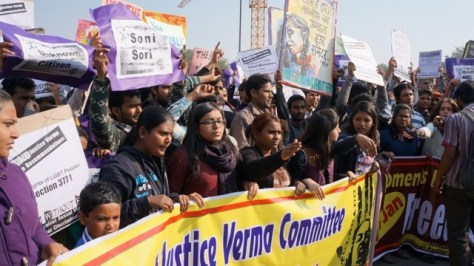
  • [ Protestors from the Bekhauf Azaadi/Freedom Without Fear Campaign Demanding Complete Implementation of the Justice Verma Committee Recommendations during the Freedom Parade to Reclaim the Republic on Republic Day, 26 January, 2012 in New Delhi. ]

So, first they come with water cannons and tear gas, and then they come with an ordnance.

Yesterday, the Union Cabinet decided to rush drafting an ordinance in response to the massive protests against rape and sexual violence that have been occurring ever since the 16th of December, 2012. According to preliminary reports, the ordnance, which will be signed into law by the President of India before Parliament even meets, flies in the face of the detailed and exhaustive list of recommendations made by the Justice Verma Committee (JVC) which had been hailed by the protesting young people and a large number of women’s organisations. In other words, the government feels no need to discuss the JVC in parliament. It feels no need to even give time and an opportunity for its recommendations to sink in, for there to be more thinking, more ideas, more awareness of the issues and questions at stake. No wonder, the government had so hastily pulled down the JVC report from its own websites after it had been released. Continue reading Water Cannons, Tear Gas, Ordinance: How the State Responds to Protests Against Rape and the Justice Verma Committee

Why the Parliament should reject the standing committee’s recommendations on the Food Security Bill: RTFC

This statement was put out by the RIGHT TO FOOD CAMPAIGN on 24 January

The much awaited recommendations of the Standing Committee on Food, Consumer Affairs and Public Distribution on the National Food Security Bill are a letdown to those who wrote to the Committee urging it to ensure justice to the people of India.  The Committee despite taking a year since December 2011 when the Bill was tabled in the Lok Sabha, has undermined the goal of food security for all the people of India through its recommendations given to the Parliament on 17 January, 2013. Instead of moving forward, the Committee’s recommendations are a leap backward by removing even existing entitlements. If the Committee’s recommendations are to be legislated, then it is the Campaign’s reasoned position that it rather not have a food security law rather than accept one which: Continue reading Why the Parliament should reject the standing committee’s recommendations on the Food Security Bill: RTFC

On Hindutva terrorism

This joint public statement, signed by 34 citizens whose names are given at the end, was put out on 25 January

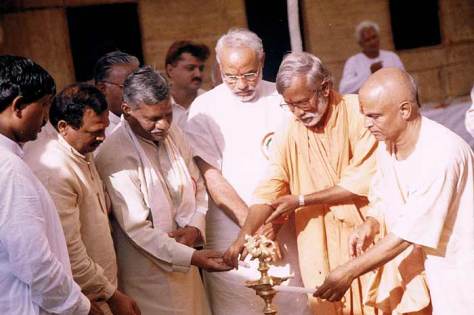
Swami Aseemanand (second from right): Terrorist?

While one may or may not agree with the terminology employed by the Home Minister in his recent speech at Jaipur, we feel that for long prejudice has ruled investigations, obscuring the role of organizations and their multiple affiliates in planning and executing of attacks and bombings in the country. The veneer of ‘nationalism’ — narrow, exclusionary and based on hatred for minorities as it is– cannot hide the violence that Sangh and its affiliates beget and peddle.  Continue reading On Hindutva terrorism

The Justice JS Verma committee report

For a summary with commentary, see this guest post by Arvind Narrain.

Reclaiming the Republic from the Alleged Perpetrators of Violence

As I sit writing this, on the 26th of January, 2013, in various parts of the territory of the Republic of India, soldiers either already have, or are about to begin marching in formation. In New Delhi, the capital of India, their parade is accompanied by tanks, heavy artillery and replicas of nuclear warheads. In the part of the province of Jammu & Kashmir administered by the Indian Union, in several provinces of the north-east, and other areas where the writ of the state runs entirely on the basis of its armed might, Republic Day, as this date is called, is an occasion for search and cordon operations, ‘crackdowns’ and the creation of a Potemkin village like ambience in the zones (usually heavily guarded stadia) where the republic insulates itself from the public. In New Delhi, the naked, obscene exhibitionism on the axial avenue of Rajpath of a nuclear weapons power that maintains the second largest armed forces in the world, even as millions of its subjects subsist at sub-Saharan levels, is an annual ritual. Apparently, this ritual is conducted to commemorate the founding of the Indian republic through the coming into force of its constitution in 1950.

Continue reading Reclaiming the Republic from the Alleged Perpetrators of Violence

Seven Propositions and One Challenge from Ejipura

The recent eviction of over 1500 Economically Weaker Section (EWS) households from Ejipura in Bangalore (see here, here and here) to make way for a high-end mixed-use development (with some EWS housing for “original residents”) is just one a series of millennial evictions that have scarred the landscape of Indian cities and yet another instigated by an order of a High Court. Below are seven quick propositions on how to understand these evictions, how to respond in the immediate and near-term.

Continue reading Seven Propositions and One Challenge from Ejipura

This Troll Has a Very Long Nose

Ironically, the random arrest of people for tweets or Facebook postings made some of us happy—happy that, at last, citizens have started showing concern about internet censorship. But lock-up gates had to clang at night on the faces of a few people before we realised that, in our pompous democracy, the might of the state is Ctrl-Alt-Deleting opinion with such serious zeal. The arrests have been made under Section 66A of the Information Technology (Amendment) Act, 2008, notified in October 2009. This section makes punishable with up to three years’ imprisonment anything that is perceived as “grossly offensive” but does not set out the parameters of how to decide on that—even if we were to believe that could at all be done. Questions about these arrests are deflected: the government blames the police, the police says a vague law is the problem, and those who file the complaints that lead to such arrests say that they are free to seek enforcement of an existing law.
Anyone can see that the section is not designed to nudge a case towards a conviction verdict. It is designed only to harass. Arrests, courtwork, bail. You are ground down, but the government spokesman is able to say, “The law is taking its own course.” The implication: “Aren’t you grateful you have obtained bail?” But the recent arrests have caused outrage. Taking up a PIL against the section, the Supreme Court had said in December that had it not been filed, it would have taken up the matter anyway. Despite this, the government defended the section in the Rajya Sabha, refusing to repeal it and merely adding guidelines that such arrests should be made by an officer of a higher rank—as if that would make it better.

Read more, here.

In Multiples of Ten Ravanas

Some (more) thoughts on Indian and Pakistani soldiers beheading each other at the ceasefire line in Jammu & Kashmir

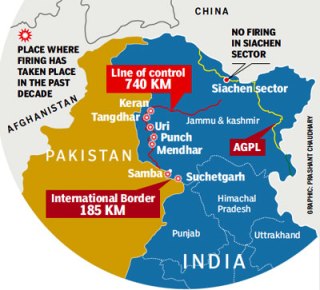
Hindustan Times Graphic
From the Hindustan Times

In the early hours of 10 January 2013, I published a post here that asked, “Was an Indian soldier decapitated at the Line of Control or not?” Soon thereafter, the family of Lance Naik Hemraj Singh of 13 Rajputana Rifles cremated his body and went on a hunger strike, demanding the government get the head. Several readers commented that now that it was clear a beheading did take place, I owe them an apology. I do not see why I owe them such an apology considering  I never said that an Indian soldier wasnot beheaded. I only pointed to the conflicting reports, the absence of official mention about whether or not a soldier was beheaded, a quoted a Reuters report that categorically said that according to the official spokesperson of the Northern Command, no soldier was beheaded, though the two soldiers’ bodies were mutilated. Despite such an official denial quoted in a trusted news source, I had written, “It is possible the anonymous sources are right, because this is not the first time both sides are blaming each other of showing disrespect to bodies of dead soldiers in violation of the Geneva convention.” Continue reading In Multiples of Ten Ravanas

An open letter to Madhu Purnima Kishwar: Zahir Janmohamed

Dear Madhu ji,

I was very excited when I learned you were coming to Ahmedabad and I was honoured that you expressed interest in possibly meeting with me.

I was sitting with a journalist friend when I read your Tweet about visiting Ahmedabad and he told me you are a “pioneering feminist who did ground breaking work.” He also told me that in 2005 you signed a very strong petition calling for Gujarat Chief Minister Narendra Modi’s dismissal because of Modi’s role in the 2002 Gujarat riots. He also added that you have been very vocal on behalf of Kashmiri Pandits. After I witnessed the Gujarat riots in 2002, I returned to the United States—where I was born and raised—and I gave lectures for six months about the violence I saw. In each lecture, an audience member would inevitably shout at me that I have ignored the plight of the Kashmiri Pandits. It is true. I know very little about Kashmir, and for that matter Kashmiri Pandits, and I would have enjoyed and benefited from listening to your views on the conflict there.

I understand from your Twitter feed that you have left Ahmedabad. I know your days in Ahmedabad were limited and I fully understand that you were not able to meet. Therefore in this letter I will try to convey some of the things I had hoped to tell you in person, in particular about your Tweets. Continue reading An open letter to Madhu Purnima Kishwar: Zahir Janmohamed

Stalking, Delhi Police and Memory – Another Encounter: Kavita Krishnan

Guest Post by Kavita Krishnan

I have been wanting to post about an experience with Delhi police since yesterday, but haven’t found the time yet… Here goes.

Some days ago, (early this month if I recall rightly), I got a call from a woman worker living in Usmanpur near Seelampur. She got my number through the son of one of our Trade Union comrades, who is a friend of her brother’s. She said she was being stalked by a man who made calls to her thretening an acid attack. She has 3 children and was concerned for their safety too. She told me she was scared to complain to the police, and asked for advice. I was reluctant to advice a police complaint without her being fully ready, knowing that it might not yield satisfactory results. So I suggested we meet and talk things over before deciding.

But soon after, she called again: feeling buoyed by a sense of hope arising from the ongoing movement, she had gone to the police station – alone – and written out a complaint, giving the stalker’s mobile number, the number of his bike, and offering to share recordings she had made on her phone of the threat calls. She said, though, that the police had not given her any proof of having received or recorded her complaint (in spite of her asking).

Continue reading Stalking, Delhi Police and Memory – Another Encounter: Kavita Krishnan

Breaking the Collective – Notes from Jantar Mantar & Koodankulam: Vivek Vellanki

Guest Post by Vivek Vellanki

The death of the young girl brought incommensurable grief for the ‘Indian’ people. A national angst ensued with divergent voices seeking divergent ends: justice, death penalty, fast track courts, end to patriarchy, chemical castration, and a long list that cannot be spelt out here. There was a glimmer of hope that the discursiveness would ensue a quintessentially democratic process of debate, discussion, and deliberation amongst the people. The Indian state with its long-standing reputation wouldn’t allow for that to happen. It had to continue on its pet peeve of Breaking the Collective! The people’s movement in Koodankulam, the anti-corruption movement, the movement for seperate Telangana are some of the many instances that remind us of this pet avocation of the Indian state being pursued in recent times, almost, vocationally. However cynical it may sound, amidst the entire candle lighting and sloganeering, we failed to realise that the protest in Delhi was happening on the terrain that the government decided, in a manner that it wished for it to play out, and was party to the people it wanted to see there. I wish to argue that the closing down of the metro stations has a relation to the nature of the protests at Jantar Mantar. Furthermore it concurs with the tactics of chocking people’s movements logistically and stifling the collective by pathologizing the everyday life of masses. The tragedy of this lies in the fact that such actions of the state have become so recurrent that they have entered our common sense and they present themselves as normal and logical responses. Albeit they have been rationalized by invoking a specious reference to law, order, and safety, there is a need to unpack such a rationalization. My attempt is to extract these actions from that location of common sense and present them for public scrutiny. Through this essay, I would like to draw the connections between the democratic protests happening in locations across the country and state action in dealing with them. In doing so, I hope to bring to notice how the Indian state uses its machinery to purge protests of their democratic tenor and eventually, at least, attempts to break the collective. Continue reading Breaking the Collective – Notes from Jantar Mantar & Koodankulam: Vivek Vellanki

January 6, 1993 – A Town Torched: Remembering the Sopore Massacre Twenty Years After: Sameer Bhat

Guest post by SAMEER BHAT

In Memory of the Massacre in Sopore, Kashmir, by the 94th Battalion of the Border Security Force on January 6, 1993.

[YouTube Video – Compiled from various sources – including a report by Savyasachi Jain, now with NDTV, for Eyewitness – a VHS delivered video news magazine active in the early 1990s.]

There was sound of a huge bang that morning, like someone blowing up a cartful of dynamite. Just before the cockcrow. Most of the townspeople were asleep. The dawn prayers had thin attendance, mostly because it gets very cold in January. By nine o’clock a military patrol was out, doing rounds of the main marketplace. Suddenly gunmen emerged from a narrow alley and shot random bullets at the party before quickly disappearing in the maze that old Sopore is. Taken rather off guard, the security detail ran back to their barracks only to emerge again as Frankenstein’s monsters, spitting hell fire. In the next fifty odd minutes, they murdered fifty five people in cold blood. And burnt the town down. Continue reading January 6, 1993 – A Town Torched: Remembering the Sopore Massacre Twenty Years After: Sameer Bhat

The Bitter Truth Regarding Delhi Police’s Womens’ Help-Line: Kavita

Guest post by KAVITA, an activist with the Stree Mukti League

Translated from Hindi by Shuddhabrata Sengupta

It would be natural to expect that in the wake of the barbaric Delhi gang-rape of December 16 and subsequent popular upsurge of anger the police and the state machinery would betray a modicum of sensitivity and alertness. The reality is just the opposite of what you expect. We have heard this from many women in the past few days, and a few evenings ago, came face to face with this sad fact ourselves.

For the last few days, we (activists of the Stree Mukti League) have been going to different places in Delhi to hold meetings, demonstrations and to distribute leaflets against sexual violence. The leaflet has a contact phone number for the Stree Mukti League. Since the evening of the 1st of January this year a perverted male individual has been continuously ringing that number, abusing us, threatening us, using obscene and unprintable language. He even said ‘I know all you girls, and you cannot escape me. What I will do to you will terrify people…’, and several other things which cannot be repeated. Continue reading The Bitter Truth Regarding Delhi Police’s Womens’ Help-Line: Kavita

The epiphanic moment of the lathi charge

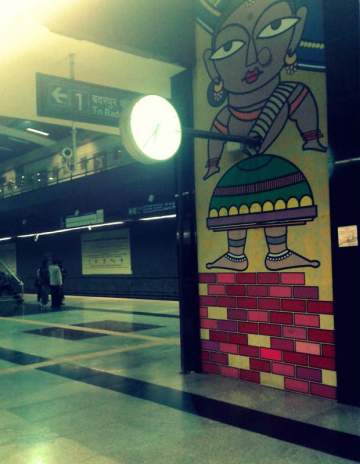
At the Khan Market Metro station

The girl wasn’t aware that the Udyog Bhavan Metro station in central Delhi had been shut down. In the Metro going to Gurgaon, she needed to get down at Udyog Bhavan. Her friend was waiting in a car outside the station. She waited at the door. The train stopped too, but the gates didn’t open. The PA system — the annoying PA system of the Delhi Metro that never stops saying something or the other — – fell silent. The station was deserted. Not a soul in sight.

The girl asked fellow passengers — all of us men around her — which would be the nearest station that would be open. All the options were far off. Ramakrishna Ashram station on one end, for instance, was four kms. away. “Now what?” the girl asked her friend on the phone in a tone that blamed him, in a way only lovers can. “Now what?” she kept repeating. Continue reading The epiphanic moment of the lathi charge

An ‘I Witness’ Account of Delhi Police and RAF Violence at India Gate on 23 December: Sangeeta Das

Guest post by SANGEETA DAS

[The Delhi Police has begun systematically lying about what has been happening in the past few days. We have seen spin doctoring around the unfortunate death of Constable Subhash Tomar. There has been efforts to plant generalized and unsubstantiated rumours about the presence of ‘terrorists’ amongst the crowds at India Gate. We have even seen the Chief Minister of Delhi, Shiela Dikshit and a sub divisional magistrate complain about the Delhi Police trying to interfere and influence that process of the recording of testimonies. Here is an important account by an eyewitness, Sangeeta Das, about the way the police behaved on the evening of the 23rd of December. Please note the kind of language that she says policemen were using. Can we trust the city to be safe in their hands.]

I am appalled at the lop-sided relay of events and incomplete images being telecast by some of the NEWS channels on TV, regarding the incident that happened at India Gate yesterday (this is an account of what happened on 23rd of December) at around 5:30 PM.

I was there. We were all on the other side of India Gate towards the Dhyan Chand Stadium.

I think I need to paint the correct picture for the nation. Except for CNN IBN and NEWS X, most other channels are not showing the peaceful gathering. Thus it gives out the wrong message to the nation, to the politicians, to other women that there was violence. Continue reading An ‘I Witness’ Account of Delhi Police and RAF Violence at India Gate on 23 December: Sangeeta Das

Armed Forces Special Powers Act provides impunity for rape: Warisha Farasat

Guest post by WARISHA FARASAT

The protests against the brutal gangrape of a young 23 year-old girl in Delhi have been unprecedented. Finally, it appears that the impunity with which crimes against women in our country are committed is causing outrage, and both men and women are demanding justice. What is encouraging is that although the protests were triggered by the recent incident of rape in Delhi, it has also forced us to reflect on the larger issue of impunity for rape and other crimes against women, particularly when it happens against women belonging to the marginalized communities. Moreover, it is also politicizing an entire generation of young people that are realizing that their voice can create ripples in the political establishment in Delhi.

Shuddhabrata Sengupta in his earlier post has lucidly articulated about how our response to sexual violence should not be selective, and our protests should recognise the brutality of crimes against women in the conflict areas of Kashmir, Manipur and Chhattisgarh. In Kashmir, accusations of rape have been repeatedly made against the security force personnel. It has been alleged that rape and assaults have occurred during crackdowns, cordon and search operations. During these operations the men were held for identification outside their houses, near mosques or in a common ground while the security forces searched their homes. During these search operations, safeguards such as inclusion of a women officer in the search teams were never followed. Continue reading Armed Forces Special Powers Act provides impunity for rape: Warisha Farasat

Sexual Violence and Sexuality Education – The Missing Link: Ketaki Chowkhani

Guest post by KETAKI CHOWKHANI

Over the last few days there seems to be sudden explosion in talking about sexual violence and other forms of violence on women. A huge discourse is being created around what rape cultures are and how we are part of these cultures which produce and construct these very acts of violence. Sexual violence has been linked to sexist, misogynist attitudes, remarks and behaviour, and ranging from scriptural affirmations to popular songs. The rape cultures are discussed as existing within the spaces of homes, streets, offices, courts, police stations, public transport, universities and so on. Continue reading Sexual Violence and Sexuality Education – The Missing Link: Ketaki Chowkhani

Misogyny, Politics and Zombiedom: From Sonia Gandhi to Botsa Satyanarayana

After Sushma Swaraj called a rape survivor a zombie – ‘Zinda Laash’,  it is now the Congress Party’s turn to field its prime misogynists and women haters. If the stalwarts of the BJP have unleased their righteous blood-lust by calling for capital punishment (which they do routinely for many things)  how can the good men and women of the Congress party allow themselves to be left behind in the competition for civilised discourse?

The Times of India has a report which I am quoting below that spells out Andhra Pradesh Congress Chief Botsa Satyanarayana’s thoughts on women’s safety.

“Andhra Pradesh Congress chief Botsa Satyanarayana on Monday opened his mouth to put his foot right in, saying women are asking for trouble if they venture out at night. Worse, he described the assault on the physiotherapy student as a “minor incident” for which party president Sonia Gandhi had reached out to agitating people. Continue reading Misogyny, Politics and Zombiedom: From Sonia Gandhi to Botsa Satyanarayana

How the God of Death Changed His Mind: Images from the Protest Against Rape at Jantar Mantar

Kavita Krishnan, AIPWA speaking at Jantar Mantar
Wanting Safety
Wanting Safety

Protests against sexual violence continued for the third day in Delhi. The venue had shifted from the India Gate-Rajpath environs to Jantar Mantar. Despite the fact that the government had closed metro stops in central New Delhi (from Rajiv Chowk to Khan Market) so that Vladimir Putin was spared the embarrassment of having to encounter protestors against rape, even as he sold gas and guns, a motley crowd of mostly young women and men were able to make their way to Jantar Mantar. Here are a few images and vignettes from this afternoon. Continue reading How the God of Death Changed His Mind: Images from the Protest Against Rape at Jantar Mantar