Sometimes a minor cut on the surface of the skin will do to reveal the rot beneath. This is precisely what the film Papilio Buddha, made by the New York-based Malayalee film-maker Jayan Cherian, which draws broadly upon contemporary caste politics in Kerala, has achieved for us. In fact, its achievement on this count is simply amazing. At a single stroke, it has brought to light several stinking sores above which Malayalees, especially many Malayalee intellectuals who occasionally don the garb of public intellectuals, strut. Continue reading Stuck Between Gandhi and Cultural Crap: Papilio Buddha Reveals Much
Category Archives: Government
JTSA responds to Delhi Police’s comments on their report “Framed, Damned, Acquitted”
This guest post by the JAMIA TEACHERS’ SOLIDARITY ASSOCIATION is a response to the Delhi Police’s comments on their report, “Framed, Damned, Acquitted”

Did you think that the Special Cell or the Delhi Police would introspect on its ways after the publication of Framed, Damned, Acquitted? How wrong you were. It is now attempting desperately to defend the indefensible by hiding behind a maze of statistics, ignoring the real questions that the report has raised: namely the brazen and systematic violation of all established legal norms and due process. Continue reading JTSA responds to Delhi Police’s comments on their report “Framed, Damned, Acquitted”
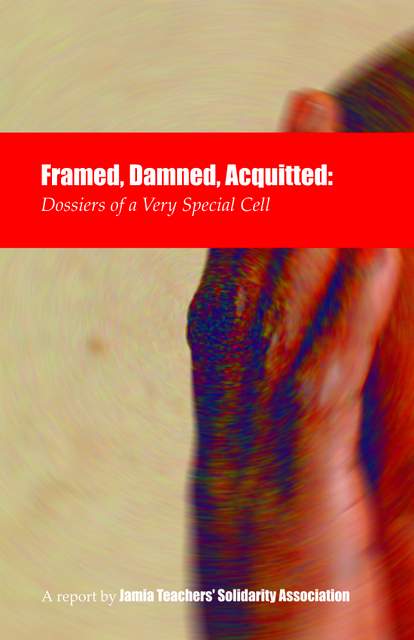
Framed, Damned, Acquitted: Dossiers of a ‘Very’ Special Cell
Given below is the report Framed, Damned, Acquitted: Dossiers of a ‘Very’ Special Cell, released yesterday in Delhi by the JAMIA TEACHERS’ SOLIDARITY ASSOCIATION.

When human rights activists, or families of those arrested on charges of terrorism, allege foul play on part of the investigating agencies, the usual response is this: Surely, there must have been some involvement, or else why would the police arrest him, and not me? Continue reading Framed, Damned, Acquitted: Dossiers of a ‘Very’ Special Cell
‘Big Ticket’ Reforms and Bigger Deceptions: Shankar Gopalakrishnan
Guest post by SHANKAR GOPALAKRISHNAN
When the country’s rulers have to tell barefaced lies to get their policies through, you know that there’s something wrong. Consider the recent “big-ticket reforms,” of which the two biggest (in terms of direct impact) have been the diesel price hike and the opening of the retail sector to FDI. The diesel hike, we’re told, was a “tough decision” necessary to “prune subsidies.” Except that diesel isn’t subsidised in this country. To repeat: there is no subsidy on diesel in India. As for FDI in retail, the Cabinet statement on the policy cites four justifications, accompanied by a “Studies show…” claim. Except that the data in the government’s sole study on the issue does not support three of these four justifications. As for their much touted “safeguards”, at least one has been said to be illegal by the Commerce Ministry itself, while the very same CCEA meeting diluted a similar safeguard for single brand retailers. Continue reading ‘Big Ticket’ Reforms and Bigger Deceptions: Shankar Gopalakrishnan
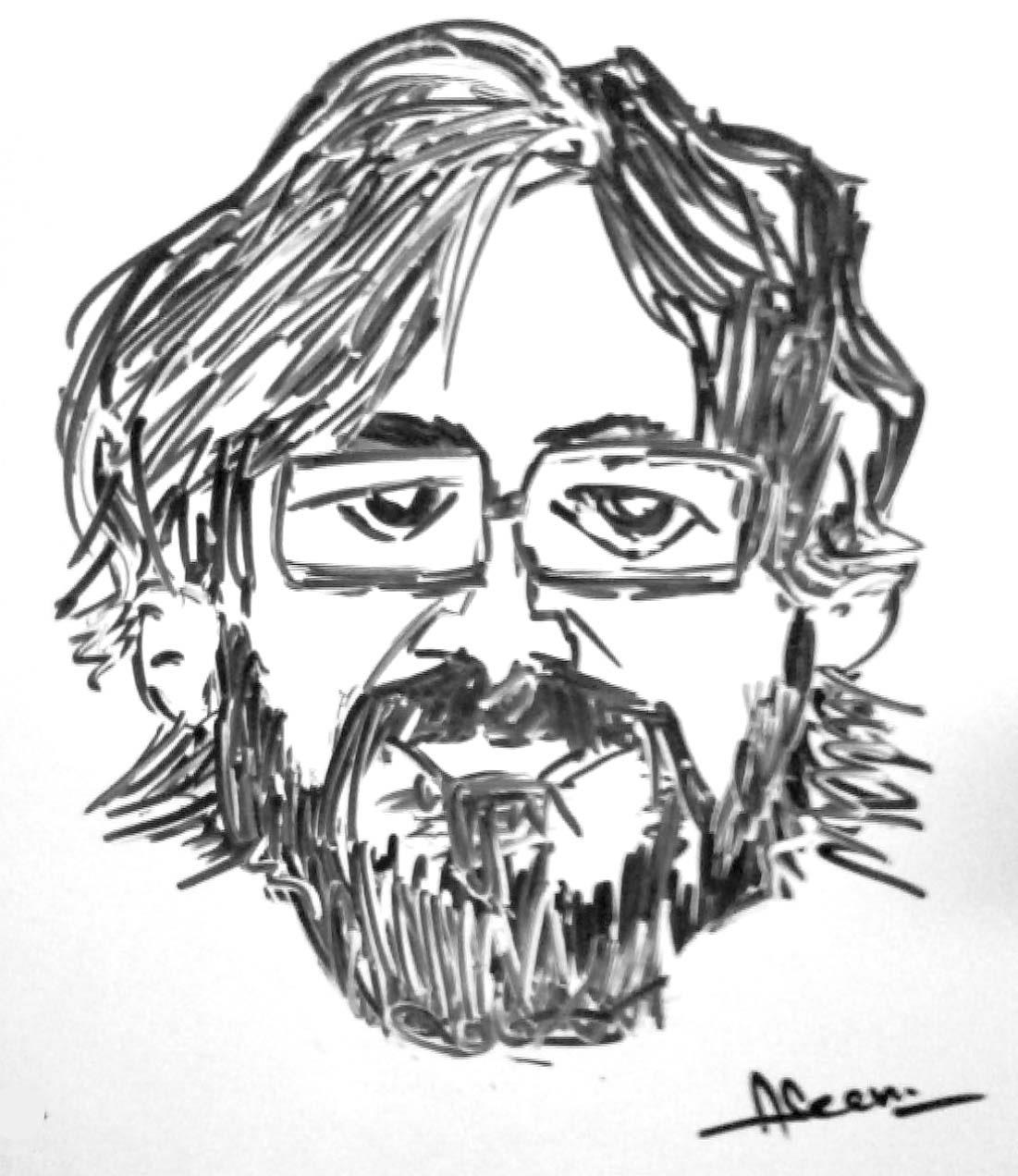
Aseem Trivedi and the guardians of good taste
There’s a time for everything. When a cartoonist is being arrested for his cartoons, for cartoons that caused no harm, incited no violence, killed no people, then do you discuss his art or his incarceration? Continue reading Aseem Trivedi and the guardians of good taste
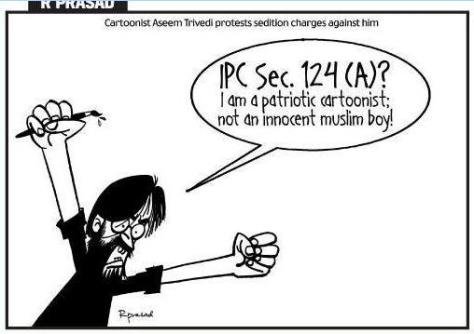
Sedition? Who, me?
I am taking the liberty of sharing here this brilliant cartoon by R PRASAD of Mail Today

On the Violence Unleashed against Protesting Citizens in Koodankulam: Chennai Solidarity Group
A Statement issued by the Chennai Solidarity Group
Background
For more than a year the people of Idinthakarai village, along with fellow citizens from nearby villages have been protesting the setting up of a nuclear power plant at Koodankulam in Southern Tamil Nadu. The protests have been peaceful and have included people from different strata of society. Women have been in the forefront of the struggle, and over the last year even children have learned about the perils of nuclear power plants and the need to look for alternative energy sources.
In spite of this being a peaceful citizens’ protest, the state has chosen to treat it as dangerous – and arrested hundreds of people, intimidated many others and have more than once treated Idinthakarai village and its environs as if it were ‘enemy’ territory. Sedition charges have been slapped against the protesters, along with other criminal charges. The legality of these measures has since been subject to questioning. A high level Public Hearing, presided over by Former Chief Justice A B Shah has in fact called attention to the manner in which the law has been misused in this instance, and in fact abused to harass and prevent ordinary citizens from exercising their right to protest, and defend their constitutionally guaranteed right to life and livelihood. Continue reading On the Violence Unleashed against Protesting Citizens in Koodankulam: Chennai Solidarity Group
If speaking the truth is sedition then I am guilty of sedition: Aseem Trivedi writes from jail

This is the text of a statement issued by ASEEM TRIVEDI from inside a jail in Mumbai. Trivedi has been remanded to judicial custody till 24 September for displaying and publishing cartoons that are allegedly seditious, insult national honour and, under the IT Act, are “grossly offensive” and of “menacing character”. An English translation of his letter is followed by the Hindi original.
Friends,
I am a true citizen of this country, not someone who has committed sedition.
If speaking the truth is sedition, then I am indeed guilty of sedition. If raising one’s voice against injustice is sedition, then I am guilty of sedition. If patriotism and the definition of patriotism have changed, then you could say I am guilty of sedition. If Gandhi, Bhagat Singh and Azad were guilty of sedition, so am I.
Even a small child of this country can understand my motive. I oppose the insulting of the people and the Constitution of India. I have been opposing the insulting of the people and the Constitution of India through my cartoons. Continue reading If speaking the truth is sedition then I am guilty of sedition: Aseem Trivedi writes from jail
Ten Reasons Why You Should Sign the Petition at RepealSeditionLaw.in
- Section 124(A) of IPC criminalizes the ‘disaffection’ towards the government by words, either spoken or written, or by signs or by visible representations
- This 1860 draconian colonial law was created to stifle dissent during colonial rule.
- Tilak, Gandhi, Maulana Azad and Annie Besant were convicted under this law
- Today, the law is used to suppress legitimate criticisms of the government
- Journalists, Human rights activists, political dissenters, public intellectuals, and even farmers and tribals are targetted by this law
- The law goes against the inalienable fundamental right to expression enshrined in our Constitution
- The law goes against the very nature of democratic process which relies on active consent and dissent/opposition
- The law goes against the Universal Declaration of Human Rights, which guarantees freedom of speech and expression
- All major world democracies have either repealed this law or discontinued prosecutions
- The existence of sedition laws in India’s statute books and the resulting criminalization of ‘disaffection’ towards the state is unacceptable in a democratic society.
To sign the petition, go to RepealSeditionLaw.in
See also:
Protesting the Forced Repatriation of Visiting Sports persons and Others from Sri Lanka
Previously posted on dbsjeyaraj.com
We the undersigned are aghast and anguished by the recent decision of the government of Tamil Nadu, acting on the Chief Minister’s orders, to send back two sports teams from Sri Lanka that were in Chennai to play matches against local school teams.
Two days after the Chief Minister issued her orders, members of a Tamil nationalist group, Naam Tamizhar Iyakkam protested against a group of pilgrims from Sri Lanka visiting a church near Thanjavur.
There have been similar protests in the past against visiting teams – by members of the Periyar Dravidar Kazhagam. Continue reading Protesting the Forced Repatriation of Visiting Sports persons and Others from Sri Lanka
A Visa for Mahiwaal: Maheep Singh
Guest post by MAHEEP SINGH

As a child I gave my mother a tough time with all sorts of questions about the world; she would often not have answers. I would ask, for instance, why we couldn’t just go to Nankana Saheb as and when we wanted. Nankana Saheb is the birthplace of Guru Nanak, founder of the Sikh faith. It is in Pakistan, on the outskirts of Lahore.
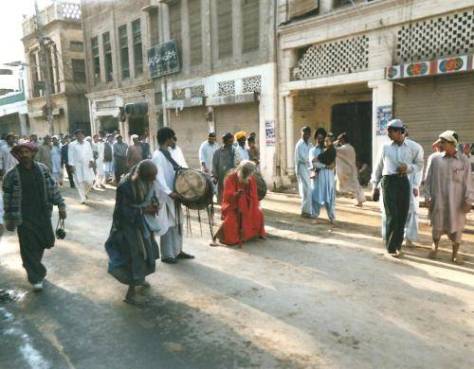
Sikhism must be the only religion in the world whose official prayers include a plea for visa relaxation. Believe it or not, millions of Sikhs all over the world do that as part of their daily prayer, the Ardas, in which we pray to almighty to grant us free access (“khulle darshan deedaar”) to the birth place of Guru Nanak and other places in present-day Pakistan, considered holy by Sikhs. Continue reading A Visa for Mahiwaal: Maheep Singh
India and Pakistan: Let people meet
This online petition has been put out by AMAN KI ASHA
The people of Pakistan and India, people of Indian and Pakistani origin around the world, and friends of India and Pakistan, are fed up of the visa restrictions that prevent them from visiting families in the other country. There isn’t even a tourist visa protocol between these two biggest neighbours of South Asia. People in the region want the right to travel and to trade, to walk along coastlines and roads that represent their collective past, to seek and spread harmony across a subcontinent not divided by politics and propaganda. In this modern age of interdependence, it is a tragedy that the citizens of India and Pakistan are left peering over a border made indomitable and intimidating. There is little space for the hand of friendship to be extended across this border. This must change.
The governments of India and Pakistan must: Continue reading India and Pakistan: Let people meet
Are We Not Alive: Women’s Voices from Kudankulam
Guest post by ANITHA. S
As I sit here in my home village of Idinthikara watching the hot sun light up the waves rolling onto the shores, I think of the news that has hit the world today about the Koodankulam Nuclear Power Plant. All of you must have seen the news that Madras High Court has given the go-ahead for the KKNPP.
When we carried the dead body of democracy and burnt it in the outskirts of our village on Aug15th, 2012, little did we realize that so soon we would witness the real death of democracy. As this last nail is being tightened on our lives, we realize how insignificant has been our voice. But this has only strengthened our vow to be together. Continue reading Are We Not Alive: Women’s Voices from Kudankulam
On the International Day of the Disappeared: APDP
Quietly censors the nanny state: Mishi Choudhary
Guest post by MISHI CHOUDHARY

The recent curbs on social networking websites in India demonstrate the unpredictability of the legal environment, both for businesses and the citizens. Whether its the Government of India’s (GoI) insistence on getting access to corporate emails and text messages sent via BlackBerry devices, or changing stances on “pre-screening” user generated content, the authorities seem to be doing a tap dance around legal issues. The implementation of rules seems surreptitious as they are bent conveniently in the name of “security”. Continue reading Quietly censors the nanny state: Mishi Choudhary
Borderline madness: Sajan Venniyoor
Guest post by SAJAN VENNIYOOR
Now that government agencies in India — some half a dozen of them working with the exceptional coordination we have come to expect from government agencies — have blocked Facebook accounts, Twitter feeds and YouTube videos supposedly originating in Pakistan, perhaps we could contemplate other trans-border electronic transgressions committed by our neighbours.
In August 2011, The Times of India reported that Punjab border farmers still tune into Pak FM radio stations. According to villagers on the fringes of Ferozepur, the limited range of India’s “national radio” broadcasts and the absence of any local FM station have made radio services from Pakistan the most popular source of entertainment in border areas.
About the same time last year, the Indian government had become alarmed by the popularity of Nepal’s FM radio channels in Bihar along the Indo-Nepal border. According to various sources, some half a dozen Nepal FM radio stations are broadcasting programmes – “anti-India advertisements and vulgar songs”, according to one outraged newspaper report – into Bihar, especially Madhepura, Supaul, Madhubani, Kishanganj, Araria, Sheohar, Saharsa, Muzaffarpur, and East and West Champaran districts. Continue reading Borderline madness: Sajan Venniyoor
Full text: The Indian government’s recent orders to Internet Service Providers to block websites, webpages and Twitter accounts
Joji Thomas Philip has put out these documents in The Economic Times.
18 August:
An Analysis of the Latest Round of Internet Censorship in India (Communalism and Rioting Edition): Pranesh Prakash
Guest post by PRANESH PRAKASH
How many items have been blocked?
There are a total of 309 specific items (those being URLs, Twitter accounts, img tags, blog posts, blogs, and a handful of websites) that have been blocked. This number is meaningless at one level, given that it doesn’t differentiate between the blocking of an entire website (with dozens or hundreds of web pages) from the blocking of a single webpage. However, given that very few websites have been blocked at the domain-level, that number is still reasonably useful. Continue reading An Analysis of the Latest Round of Internet Censorship in India (Communalism and Rioting Edition): Pranesh Prakash
Kashmir civil society express concern over Amarnath construction plans
The press release below has been jointly issued by a number of eminent citizens and civil society members in Kashmir. Full list of signatories at the end.
Srinagar, 18 August 2012: Civil society groups of Kashmir express their serious concern over the recent Supreme Court directions to the J&K government for undertaking civil engineering works leading to construction of roads and other infrastructure in the environmentally fragile Himalayan habitat around the Amarnath cave shrine in the valley of Kashmir. This move comes even as the committee formed by the Hon’ble court for recommending ways and means to promote safe journey of pilgrims to the cave shrine is yet to submit its report.
At a joint meeting of various civil society groups held on 16 August at Srinagar, the following resolution was adopted: Continue reading Kashmir civil society express concern over Amarnath construction plans
Celebrating Tyranny and Victimisation in Kashmir: JKCCS
This press statement comes from the JAMMU AND KASHMIR COALITION OF CIVIL SOCIETY
Srinagar, 15 August 2012: It is despicable that the police officers responsible for serious human rights violations are receiving awards despite the crimes they have perpetrated. Today’s awards to some of the Jammu and Kashmir Police officers are an act of celebrating tyranny and victimization.
Superintendent of Police, Altaf Ahmad Khan is one of the officers who has been awarded with the President’s Police Medal for Gallantry. Altaf Ahmad Khan is notoriously known for perpetrating human rights violations in the areas where he has served. Continue reading Celebrating Tyranny and Victimisation in Kashmir: JKCCS
The Nightmare of the Chaavunilam and the Illusions of Well-Meaning Scholars
Chaavunilam (“Dead Land”)is the title of one of Sarah Joseph’s well-known short-stories in Malayalam. In it she relates a myth of devastation and revival — it describes a scene of terrible devastation through the eyes of the last woman left there, the Mother — who witnesses the terrible violence between her children which leaves the earth shattered, verdure destroyed, and which ends in the death of all the combatants. This is the tale of her immense suffering — she is torn apart by birthing-pains, at the same time as she is devastated by the death of all her children. Continue reading The Nightmare of the Chaavunilam and the Illusions of Well-Meaning Scholars