
Category Archives: Identities

A Hundred Years to Valentine’s Day

The Manglore-style of violence against women is clearly not the style of the politically powerful guardians of sexual morality in Kerala. But maybe the style is more or less redundant over here: there are very few pub-going local (or local-looking) women over here. How convenient for us women of Kerala that we Malayalees live in social arrangements that insist on sexual segregation in public spaces and institutions.

This is of course related to the particular history of gender and spatiality that unfolded between the mid-19th and 20th centuries in Kerala.Spatial categories have always underwritten caste and gender exclusion in Malayalee society. Take for instance, the derogatory term chanthapennungal (‘market women’) that refers to women who get their way through loud and vociferous argument – who work for their livelihood in market-space and reject feminine modesty. The chanthapennu is the very antithesis of taravattil pirannaval (‘she who was born in an aristocratic homestead’). Thus the woman whose daily life and labours involves traversing spaces outside the domestic and the familial is forever poised at the brink — she is who may, at any instant, collapse into being chantappennu.In traditional Malayalee society, family spaces were named by caste and constructed through caste practices and gender norms. For instance, the Brahmin home was referred to as Illam or Mana; the Nair homestead as Taravadu or Idam.In other words, a generalized notion of domestic space housing the family was absent.  Indeed, the observance of spatial regulations was often taken to be crucial in shaping feminine moral qualities found characteristic of the aristocracy — and hardly vice-versa.
Continue reading A Hundred Years to Valentine’s Day

The Caste of a Scam: A Thousand Satyams in the Making

Guest post by D.PARTHASARATHY

Industry leaders, CEOs, and Corporate big-wigs have been falling over each other to portray the Satyam scam as an isolated case, as a simple failure of corporate governance. On the other hand critics from the left once again have had a field day with their “I told you so” condemnation of capitalist free market economies. There is also a moralistic middle class which blames it on greed pure and simple. The fact that the Indian private sector is largely dominated by family owned and controlled businesses of sundry sizes, that caste, community, gender, and social networks play a significant role in who gets nominated to top positions within the companies, and how businesses are run, that these have significant implications for corporate governance as well as corporate loot – these are issues that are too dangerous and embarrassing at the same time, and so are conveniently ignored.

Continue reading The Caste of a Scam: A Thousand Satyams in the Making

Interview with Jacques Ranciere

Interview with Jacques Rancière
Conducted by Lawrence Liang
Lodi Gardens, Delhi, 5th February 2009

Jacques Rancière (born Algiers, 1940) is Emeritus Professor, Philosophy, at the University of Paris (St. Denis). He came to prominence when he co-authored Reading Capital (1968), with Louis Althusser, the Marxist philosopher. He subsequently broke away from Althusser and wrote The Nights of Labour, a work that examined the philosophical and poetical writings of workers in 19th century France. Through an examination of the lives of these worker autodidacts, Rancière introduced a new way of thinking about the idea of the worker, and of the injunction that divides between those entitled to a life in thought and those born to do manual labour.

He went on to write The Philosopher and His Poor which looks at the figure of the poor artisan from classical philosophy down to Marx and Sartre. In The Ignorant Schoolmaster, inspired by the experiences of a radical early 19th century teacher, Joseph Jacotot, Rancière sought to rethink the idea of pedagogy away from the idea of moving form the unknown to the known and from those who possess knowledge to those who don’t, to look at how all forms of ignorance are also conditions of knowledge.

He was in Delhi recently, on the occasion of the release of the Hindi language edition of The Nights of Labour.

Continue reading Interview with Jacques Ranciere

India’s Terror Dossier. Further Evidence of a Conspiracy: Raveena Hansa

This guest post has been sent to us by RAVEENA HANSA

On 5 January 2009, the Indian government handed a 69-page dossier of material stemming from the ongoing investigation into the Mumbai terrorist attacks of 26-29 November 2008 to the Pakistani government. This was subsequently made accessible to the public, so it is possible for us to examine it.

The most striking point about the dossier is its vague and unprofessional character. Enormous reliance is placed on the interrogation of the captured terrorist, Mohammed Amir Kasab, despite the fact that there is an abundance of other evidence – eyewitness accounts, CCTV and TV footage, forensic evidence, etc. – which could have been called upon to establish when, where, and what exactly happened during the attacks. This gives rise to the suspicion that the interrogation is being used as a substitute for real investigation because it can be influenced by intimidation or torture, whereas other sources of evidence cannot be influenced in the same way.

Continue reading India’s Terror Dossier. Further Evidence of a Conspiracy: Raveena Hansa

Jayampathy Wickramaratne on Political Solution in Sri Lanka

I am posting a longer version of an interview with Jayampathy Wickramaratne.  The February 2009 issue of Himal Southasian, a special issue on Sri Lanka, has a shorter version of this interview.  At a time when there is much concern about the ongoing humanitarian catastrophe there have also been increasing voices calling for a political solution.  On the history of displacement and humanitarian concerns with the twenty-fire year war in Sri Lanka, I recommend Rajan Hoole’s article in Himal.  This interview with Jayampathy Wickramaratne might engage those interested in past attempts at a political solution as well as the problems with the 13th Amendment (which came out of the Indo-Lanka Accord of 1987 and is currently being talked about both in Sri Lanka and India).

Ahilan Kadirgamar talked to Jayampathy Wickramaratne, who is President’s Counsel, a constitutional lawyer, a former senior advisor for the Ministry of Constitutional Affairs, and a member of the team that drafted the 2000 Constitution Bill.  Wickramartane was a member of the panel of experts to assist the All Party Representative Committee and signatory to the “Majority Report” (December 2006) that proposed extensive restructuring of the state, with extensive devolution and power sharing at the centre.   Wickramaratne is a politburo member of the Lanka Sama Samaja Party. Continue reading Jayampathy Wickramaratne on Political Solution in Sri Lanka

Viva ‘Academic Untouchability’ !

Jantar Mantar, a unique historical place in the capital, which today acts as a ‘sanctioned abode of protest’ under a liberal bourgeois regime, witnessed a protest dharna in the first week of February. Looking at the participation level, one could easily say that, it was indistinguishable from similar protest actions held on the same date. But it is incontestable that the raison detre for the dharna carried very large import which pertained to the entitlements of dalits, tribals or OBCs in higher education. It brought forth the surreptitious manner in which the Congress led UPA government is pushing a bill which would do away with reservation at faculty level in institutions of ‘national importance’.

As expected for the media managers and the pen pushers (or byte takers) employed by them the whole protest action was a non event. Question is why the articulate sections of our society, which yearn for justice, peace and progress, has joined the conspiracy of silence about this particular issue.

The return of ‘academic untouchability’ with due sanction of the parliament and the further legitimisation it would provide to the ‘merit’ versus ‘quota’ debate need to be questioned and challenged uncompromisingly. Continue reading Viva ‘Academic Untouchability’ !

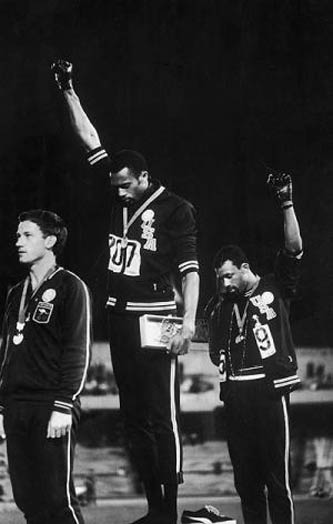
The meaning of “Obama” and the history of a friendship

At the Mexico Olympics in 1968, this photograph of American athletes Tommie Smith and John Carlos standing on the victory podium with heads bowed and black-gloved fists raised in a Black Power salute in protest at racism in the USA, became the iconic image of the age.

1968_salute

In the fraught years since 1968, the weight of living through the aftermath put a heavy burden on the friendship of Carlos and Smith. In separate interviews with the Los Angeles Times it was revealed that they have barely spoken to each other since the early 1990s, despite living just a short drive apart in southern California. Smith described their relationship as “strained”. Carlos would call his former team-mate only “Mister Smith”.

Continue reading The meaning of “Obama” and the history of a friendship

ग़ाज़ा, इस्राइल और इस्राइल बनने की मंशा

प्रणव मुखर्जी से किसी पत्रकार ने पूछा कि क्या भारत पाकिस्तान में वैसी ही कार्रवाई करेगा जैसी इस्राइल गाज़ा में कर रहा है. शुक्र है कि हमारे विदेश मंत्री ने  यह कहना ज़रूरी समझा कि इस्राइल की तरह भारत ने किसी और की ज़मीन पर कब्जा नहीं कर रखा है. इस सादे से तथ्य को कहना आजकल गनीमत है क्योंकि हमारे आदर्श बनते जा रहे अमरीका में फिलीस्तीनीयों को ही इस रूप में पेश किया जा रहा है मानो वे ही शांति से रहने वाले इस्राइलियों को चैन से नहीं रहने दे रहे. तो क्या यह मान लिया जाय कि हमारी याददाश्त भी ‘गजनी’ की तरह सिर्फ पंद्रह मिनट की रह गई है? क्या हम यह भूल गए है कि गाज़ा के उस पतली सी पट्टी में जो पिछले साठ  साल से पीसे जा रहे हैं वे एक ज़िओनवादी राज्य इस्राइल की स्थापना के लिए उनकी अपनी ज़मीन से उखाड कर फेंक दिए गए लोग हैं?

ग़ाज़ा पर इस्राइली बामबारी, सा�ार बीबीसी
ग़ाज़ा पर इस्राइली बामबारी, साभार बीबीसी

अगर हम साठ साल की बात को याद नहीं रखना चाह्ते तो क्या हम यह भी भूल गए हैं कि  अभी दो ही साल बीते हैं कि फिलीस्तीन की जनता ने हमास को चुनाव में बहुमत दिया था! क्या हमें यह भी याद दिलाना होगा कि हमास की चुनावी जीत को इस्राइल, अमरीका , युरोप और उनके पिट्ठू फतह ने मान्यता देने से इंकार कर दिया था?

एपी
बमबारी का एक और नज़ारा, तस्वीर: एपी

हमास एक आतंकवादी संगठन नहीं है, जैसा अमरीका और इस्राइल चाह्ते हैं कि उसे माना जाए, वह फिलीस्तीनी जनता का वैध प्रतिनिधि है. क्या चुनाव में उसकी जीत को मानने से इनकार  वैसा ही नहीं जैसा मुजीबुर्रहमान की जीत को मानने से तब की पकिस्तानी हुकूमत का इंकार ? उसका नतीजा था  पाकिस्तान का  विभाजन और बांग्लादेश के रूप में एक नए राष्ट्र का जन्म. यहां अंतर सिर्फ यह है कि हमास ने गाज़ा पट्टी पर संघर्ष के बाद नियंत्रण कर लिया. तब से इस्राइल के कहने पर अमरीका समेत पूरे विश्व ने हमास का बहिष्कार कर रखा है. क्या हम इसकी कल्पना कर सकते हैं कि भारत में भारतीय जनता पार्टी के चुनाव में जीतने के बाद उसकी राजनीति से असहमति रखने के कारण उसे मान्यता न दी जाए?

Continue reading ग़ाज़ा, इस्राइल और इस्राइल बनने की मंशा

In Cold Blood: Abuses by Armed Groups

India, Pakistan, Sri Lanka, Nepal, Bangladesh, Afghanistan, Iraq, Saudi Arabia, Israel and the Occupied Territories, Indonesia, Egypt, Jordan, USA, UK, Spain, the Russian Federation, to name a few, are a testimony to the cruel attacks on civilians and other human rights abuses in the recent past by non-state armed groups, including terrorist groups. They are showing utter disdain for the lives of civilians and others, continuing a pattern of serious crimes and crimes against humanity. They fail to abide by even the most basic standards of humanitarian law. The attacks and other abuses by armed groups are so frequent and the security situation so grave, that it is impossible to calculate with any confidence the true toll upon the civilian population, let alone the long term consequences that so many people inevitably suffer.

Continue reading In Cold Blood: Abuses by Armed Groups

Fight Terror – Stop Thinking

Oxford Book Store in Mumbai was visited by a cop about ten days ago, and offered a friendly caution to be “careful” about stocking books and CDs related to Pakistan, as the shop might be “targeted” after the recent terror strikes in Mumbai.

Trick question: The reason the cop dropped in was

a) to reassure the store that they would receive police protection in case such threats materialize

b) to pass on a message from Raj Thackeray

(Hint. Looks like there are two options, but there is only one)

Continue reading Fight Terror – Stop Thinking

The Israeli Attack on Gaza: Chris Floyd

Shock, Awe and Lies: The Truth Behind the Israeli Attack on Gaza by Chris Floyd

DEMONSTRATION IN TEL AVIV AGAINST THE ISRAELI ATTACK

The Alternative Information Center
Courtesy: The Alternative Information Center, photo by Meni Berman

Award winning American journalist, Chris Floyd, author of Empire Burlesque: High Crimes and Low Comedy in the Bush Regime, writes:

Here is a simple, stone cold fact. You cannot read or hear the truth about what is happening in Gaza from any corporate media in the United States. The only thing you will find there are regurgitations of Israeli spin, which are themselves only regurgitations of the kind of spin that American militarists have put on their own depredations — for centuries now….”
“This is of course a damnable and deliberate lie. Papers in Israel — in Israel, but not the United States — are reporting the truth: the murderous assault on Gaza was planned not only before the six-month ceasefire ended — it was planned before the cease-fire even took effect.

Read the rest of the post here.

Families and Dynasties, Lettered and Unlettered – Monobina Gupta

Minister in the Rajasthan government
Golma Devi, Minister in the Rajasthan government

Guest Post by MONOBINA GUPTA

It is jarring, to put it mildly, that Times of India, a leading daily, engaged in a high-profile ‘Teach India’ campaign should publish a front page story mocking the unlettered. This story exhibits a strange callousness in its reporting about the very constituency of people the campaign is hoping to address…or ‘uplift’…
The story published in the TOI on December 20, smacks of arrogance as it speaks disdainfully of an unlettered woman legislator recently elected in Rajasthan’s assembly elections. Golma Devi, elected from the Mahuwa constituency is the butt of ridicule and lament in this article authored by P J Joychen. The author, it seems, cannot get over the fact that an unlettered person like Golma Devi has been elevated to the rank of a minister in the Ashok Gehlot government.

No, she is not a history sheeter; nor does she have a scam hot on her heels. She is nevertheless an offender – in the sense of ‘offending’ your ‘sensibilities’ – in the supercilious eye of the media; an object of ridicule. Her offense: her of lack of reading and writing skills.

Continue reading Families and Dynasties, Lettered and Unlettered – Monobina Gupta

A cruel joke called elections in Kashmir

The Indian media has been expressing surprise about the high voter turnouts in the Kashmir elections. The expression of surprise sounds genuine. I am not sure how genuine it is. Is patriotism coming in the way of truth? How can we not see what a Wall Street Journal reporter can?

In the village of Samboora, residents said that Indian Army troops went from house to house on Saturday morning, rounding up families and taking them to a polling station. As a reporter drove into the village Saturday afternoon, an army vehicle with several soldiers stopped by the walled compound of Ghulam Mohammad, pulling the 59-year-old retiree onto the road. Seeing a foreign reporter, the soldiers jumped into their vehicle and quickly drove off. “They asked me why I’m not voting, and I said that’s because I don’t like any of the candidates,” Mr. Mohammad said moments later. “They said, if I don’t vote, I’ll be sorry later.” [Must Read]

And wasn’t this predicted anyway? Didn’t we tell you about Gentle Persuasion? Oh, and they already know who the CM is going to be.

Mumbai terror, the revolt of the elites and Life itself

You have said everything there is to say, and felt everything there is to feel. You have shouted angrily or reflected seriously or stated in the calm tone of conviction that terrorists are as authoritarian as the states they target, that terrorists have no religion, that terrorists are cowards who target soft civilian populations. You have despaired at the carnage wreaked on a city sick and tired of having to be “resilient”; of having faced one disaster after the other – from floods to targeted attacks on specific communities to bomb blasts – and “emerged with its spirit intact”. Your heart has clenched painfully at the inconsolable tears of baby Moshe; at the blood-spattered, newly motherless one-year old Viraj in an exhausted Head Constable Salunkhe’s arms, entrusted to him by his father, a utensil seller wounded by bullets at CST. You have gazed numbly at the image of Maharashtra ATS Chief Hemant Karkare’s young son with drawn countenance bearing the ritual paraphernalia of his father’s cremation ceremonies. Despite yourself you felt a sudden glimmer of hope steal into you at the stony dignity in Kavita Karkare’s dry-eyed grief at her husband’s funeral, at her steadfast bindi and her coloured sari. You have hated yourself for being relieved that those you know in that poor torn city are safe, when hundreds you did not know were not.

In fear and foreboding the feeling has overcome you – “What lies ahead of us now?”

But after all of that, after all of the sorrow and the grieving, in the midst of absolute despair, when you start to think again – STOP. Continue reading Mumbai terror, the revolt of the elites and Life itself

Thinking Through the Debris of Terror: After Bombay

Last week’s terror attacks on Bombay/Mumbai, for which there can be no justification whatsoever, have targetted railway stations, restaurants, hospitals, places of worship, streets and hotels. These are the places in which people gather. where the anonymous flux of urban life finds refuge and sustenance on an everyday basis. By attacking such sites, the tactics of the recent terror attack (like all its predecessors) echo the tropes of conventional warfare as it developed in the twentieth century. These tactics valued the objective of the escalation of terror and panic amongst civilians higher than they viewed the neutralization of strictly military or strategic targets. In a war without end, (which is one way of looking at the twentieth century and its legacy) panic is the key weapon and the most important objective.

Continue reading Thinking Through the Debris of Terror: After Bombay

“Mindless,” “Muslims”

Those two M’s recur, on this blog and elsewhere, in the heated discussions around the tragic, provocatove events that have unfolded this past week. I am reminded of this point Martha Nussbaum wrote after Obama won: Continue reading “Mindless,” “Muslims”

The Fascist Mind: Reading Mein Kampf Today

NOTES ON THE THEORY OF IDEOLOGY

It is highly instructive to go through the range of comments that some of our recent posts on terrorism and violence have elicited. Apart from some of the more mindless ones, there have also been some that raise supposedly substantive questions but in a manner that presupposes the answers. The very manner of raising the ‘questions’ is such that any answer but the one contained in the ‘question’ is bound to bring forth a volley of charges to which the comments themselves stand witness.

Continue reading The Fascist Mind: Reading Mein Kampf Today

An SMS and an online signature

An SMS doing the rounds: Continue reading An SMS and an online signature

Ecstatic Archaisms of Aurobindo Ghose – Prasanta Chakravarty

Guest post by PRASANTA CHAKRAVARTY

In Reflections on Revolutionary Violence Aditya Nigam makes some nuanced points about the nature of Maoist violence and by contrast, comments on the bedrock character of democracy itself. Can we trace the sublime cult of blood and gore further down, to the founding principles of Forward Bloc, for instance? Or espy it in the millennial longings of a few Gita wielding swadeshis, for that matter? One may begin to see a pattern.

Continue reading Ecstatic Archaisms of Aurobindo Ghose – Prasanta Chakravarty

The ‘Obama Moment’: Sangay Mishra and Jinee Lokaneeta

The ‘Obama Moment’ and Conversations on Race
Guest post by SANGAY MISHRA and JINEE LOKANEETA

[The ‘Obama moment’ is much more than the man. Elementary, one would have thought. But maybe not. For, it has been intriguing to watch and listen to people – radical and nonradical liberal alike – mock this moment in a cynical, ‘we-know-it-all’ and ‘what-do-you-expect?’ mode. Intriguing, because, somewhere the insinuation is that those who celebrate are just being carried away by an ephemeral event. Maybe. It seems however, and the authors argue below, that this persona we now know as ‘Obama’ was not there even a year or two ago; he emerged in this present form, through a series of ‘encounters’ – with race, with his own history and with ‘blackness’. In his present form, Obama is produced by a certain African American investment in the earlier Obama (of, say, the pre-campaign Obama). – AN]

Much as the Obama victory on the 4th of November was expected and already predicted by a number of polls, the reaction to his victory both inside and outside the United States was breathtaking.

Continue reading The ‘Obama Moment’: Sangay Mishra and Jinee Lokaneeta

Muslim Madrasa Modernisation

A rather animated debate is on among different sections of the Muslims as also among the civil and the uncivil society in India about the Madrasa, their importance, the role they play and the need to make them more modern, thereby converting them into institutes that are more relevant to the contemporary requirements of both the Muslims and the market. The former is openly stated while the latter is rarely articulated.

Before proceeding with an exploration of some of these concerns and to try to understand the trigger behind the proselytising zeal to modernise the madrasa, let us understand the institution of the madrasa itself. Continue reading Muslim Madrasa Modernisation