Category Archives: Law

परवेज हुदभॉय क्यों चिन्तित हैं ?

Image result for pervez hoodbhoy quotes

परवेज हुदभॉय (Pervez Hoodbhoy) भारतवासियों के लिए अपरिचित नाम नहीं है!

जानेमाने भौतिकीविद और मानवाधिकार कार्यकर्ता के अलावा उनकी पहचान एक ऐसे सार्वजनिक बुद्धिजीवी के तौर पर है जिनके अन्दर बुनियादपरस्त ताकतों से लोहा लेने का माददा है। पाकिस्तान में इस्लामीकरण की बढ़ती आंधी में वह ऐसे शख्स के तौर पर नमूदार होते हैं, जो सहिष्णुता, तर्कशीलता, की बात पर जोर देते रहते हैं। नाभिकीय हथियारों से लैस दोनों पड़ोसी मुल्कों में आपस में अमन चैन कायम हो इसके लिए आवाज़ बुलंद करते रहते हैं।

पिछले दिनों ‘डॉन’ अख़बार में लिखे अपने नियमित स्तंभ में उन्होंने पाठयपुस्तकों के माध्यम से प्रचारित किए जा रहे विज्ञान विरोध पर लिखा।( http://www.dawn.com/news/1300118/promoting-anti-science-via-textbooks  ) खैबर पख्तुनख्वा में प्रकाशित जीवविज्ञान की पाठयपुस्तक का जिक्र करते हुए उन्होंने बताया कि किस तरह उसमें चार्ल्स डार्विन के सिद्धांत को सिरेसे खारिज किया गया है। किताब में लिखा गया है कि चार्ल्स डार्विन द्वारा प्रस्तावित इवोल्यूशन अर्थात विकासवाद का सिद्धांत ‘अब तक का सबसे अविश्वसनीय और अतार्किक दावा है।’ किताब इस धारणा को ही खारिज करती है कि संश्लिष्ट जीवन सरल रूपों से निर्मित हुआ। किताब के मुताबिक यह विचार कामनसेन्स/सहजबोध का उल्लंघन करता है और यह उतनाही ‘बकवास’ है जब यह कहा जाता हो कि दो रिक्शा के टकराने से कार विकसित होती है। हुदभॉय के मुताबिक प्रस्तुत किताब अपवाद नहीं है। खैबर पख्तुनवा की एक अन्य किताब बताती है कि ‘‘एक सन्तुलित दिमाग का व्यक्ति पश्चिमी विज्ञान के सिद्धांतों को स्वीकार नहीं कर सकता। /कहने का तात्पर्य सिर्फ पागल लोग स्वीकार सकते हैं ?/ सिंध की भौतिकी की पाठयपुस्तक स्पष्ट लिखती है कि ‘ब्रहमाण्ड तब अचानक अस्तित्व में आया जब एक दैवी आयत/श्लोक का उच्चारण किया गया।’ विज्ञान का यह विरोध निश्चित ही पाठयपुस्तकों तक सीमित नहीं है। वहां विज्ञान और गणित के तमाम अध्यापक अपने पेशे से असहज महसूस करते हैं। Continue reading परवेज हुदभॉय क्यों चिन्तित हैं ?

On Indian Exceptionalism and Kashmir: Dia Da Costa

This is a guest post by Dia Da Costa

‘If Trump is elected, I will move to Canada,’ many Americans noted in passing, in jest, and then in all seriousness once the results were out.

If it has taken this election result to make people recognize the pervasive racism in the US, that is because of the success of US exceptionalism and its ability to deflect attention from its ongoing colonization of indigenous land, relentless imperialism, Islamophobia, and ongoing brutalities against black people in the aftermath of abolition and the civil rights movement. If it has taken this election result to make people really want to move to Canada, that too is because of the success of Canadian multicultural exceptionalism. Apparently, Canadian exceptionalism is still able to pass as not-as-racist by deflecting attention from its ongoing colonization of indigenous land, relentless participation in imperialism cloaked all too often as humanitarian development, growing Islamophobia, and its self-congratulatory representation of itself as having no history of slavery even as its anti-Black violence pervades cities and small towns alike.

For those of us who can recognize these forms of exceptionalism, I want to ask if we acknowledge Indian exceptionalism, and its specific relation to Kashmir? ‘If Trump is elected, I will move back to India’, I saw many Indians say on social media. If it has taken this US election result to make Indians really want to move back to India, that is not just because of the apparent success of US exceptionalism among Indians, who could see racism but could ultimately deal with, and even love life in the US. It is also because of Indian exceptionalism. To be sure, Indian exceptionalism is nurtured by the caste and class privilege that allows some Indians to declare that they will simply up and leave when the going gets tough (whether it is in India or in the US), or joke about the same.

But there is more to it. Indian exceptionalism is a state projected discourse turned commonsense perception of India as a complicated and diverse nation that is ultimately unified against all odds by the absolute commitment of its people to democracy. Whether we believe it at face value or we critique the many excesses of the Indian state, ultimately something draws us to this idea of India as the world’s largest democracy. Continue reading On Indian Exceptionalism and Kashmir: Dia Da Costa

Neocaligulaism: Thoughts from Kerala


In these insane times in our country and the world, one searches in the past desperately to make sense of the unfolding madness of the present. No wonder people have recalled Muhammad bin Tughlaq in the face of what has been described (rather misleadingly) by the neutral word ‘demonetisation’ – but as many have already pointed out in considerable detail, what we face is much more than a foolishly, irresponsibly-conceived act of monetary governance gone horribly wrong. Caligula is back, and neocaligulaism is the flavor of the season, across the world, one might say. Continue reading Neocaligulaism: Thoughts from Kerala

The Cult of the Angry Pointed Finger, or How I learned to Stop Worrying and Love the Father

The recent order by the I&B Ministery to NDTV India to suspend broadcast for 24 hours drew a range of reactions from outrage to bewilderment. The supporters of the ruling party were of course triumphant – Subhash Chandra of Zoo, er sorry Zee News was so excited he wrote a whole article on this. But even outside the partisan responses, many well-meaning self-declared neutral janta declared that national security is not a matter to be trifled with, and that it was right for the government to admonish NDTV. Wait, ADMONISH?! Never mind that the government’s allegation of NDTV having compromised national security simply doesn’t survive a fact-check. Here is how the largest section of (English-speaking, online) popular opinion sees it.

This token punishment was good and important to show that someone is there who is monitoring the media who always thinks behind the mask of freedom of expression that they can do anything in the world. So it is important that the Government of the Day makes its presence felt otherwise there will more chaos and issues like the UPA government where everyone was going around like headless chicken and no one is bothered or cared if a Govt of Man Mohan Singh existed or NO. Even small timers like the Delhi CM AK and his Guru Anna were threatening and taking morcha in Ram leela Maidan every second day and doing expose every third day putting the Govt. of India on the back foot and in defensive mode running for shelter. Now Arvind Kejriwala and his team is running for shelter as every day a Delhi MLA is shown the door of the JAIL and Anna Hazare has been locked in a shell in his hometown watching the sunrise and the sunset. This means business, It is important that Govt of the India should show it exist otherwise human mentality is that then everyone shows that everyone exist and everyone is the BOSS. Cannot allow to happen like this MESS. PM Modi please keep it up and keep the heat on this reckless media, on AK and his gang, on others who are trying to show unnecessary activism and also the Judiciary, keep all the appointments on hold and let them slog day and night. Show who is the BOSS ! Show who is the BOSS !

Yes, Modi ji, show who is the BOSS!

joffrey_nskwqom3fi1tcgpa7o1_500-1

Continue reading The Cult of the Angry Pointed Finger, or How I learned to Stop Worrying and Love the Father

It Is About Women: Debating the Violence of the Uniform Civil Code – Kartik Maini

This is a guest post by KARTIK MAINI

The performative art of choice, like most habitations of discourse, is deeply political. To oppose the mythical creature of the Uniform Civil Code (UCC), as heralded by the Bhartiya Janata Party (BJP) and its parent votaries, is to find oneself in the august company of the All India Muslim Personal Law Board (AIMLB); both part, or so I must argue, of the same physics of power. Once again, if one does indeed trace the history of debating the suttee in what is now called the ‘colonial’ period, the spectre of representation (or lack of) haunts us: women are merely the grounds of debate, and the female body a site of contestation in the name of faith. As creatures of active agency, the figure of the woman disappears – not into a pristine nothingness, as Gayatri Spivak cautioned us, but into a violent shuttling of displaced figuration. It is, therefore, time to ask of ourselves the fundamentality of thought. What is the politics of rendering unintelligible the variegated nature of religious traditions and their pronouncements unto ‘uniformity,’ particularly so through the rationale of national integrity in a time when supposed dangers to the same are declared seditious? Is it not our collective responsibility to be virulently against the employment of the expressed and expressive agony of women to insidious political ends? What, finally, of those who lie at the interstices of ‘men,’ ‘women,’ and the compulsory heterosexual matrix?

Even in precluding Shayara Bano’s infamous claim on the immediate necessity of all, especially Muslims, to say ‘Bharat Mata ki Jai,’ the communal in the demand for the Uniform Civil Code is an effortless inscription. For one, the Hindu Code, which seeks the creation of uniform laws governing all Hindus, is itself not so – embedded in its semblance of pervasive homogeneity is heterogeneous pliability to the customs and traditions of different communities, as also the restriction in its uniform applicability to social groups that are now designated as the Scheduled Tribes. While Article 44 of the Indian Constitution exhorts the nation state to create a ‘uniform civil code’ for all, the Constituent Assembly had no perspectival clarity on what it would look like; B.R. Ambedkar elucidates that such a code ‘need not necessarily be mandatory.’ In fact, beyond the obvious ambiguity of Article 44, the glorious prospect of the Uniform Civil Code only finds silence, and in not being addressed in specificity, is subsequently regaled with the obstructions of political autonomy, detailed as they are in the articles and schedules on Kashmir, Nagaland, Mizoram, Assam, Tripura, and Meghalaya. In other words, the binary between the Uniform Civil Code and communalism, between Hindutva and the mythical uniformity that must now be forged against this ‘problem’ of diversity is a fundamentally false one – there is no independent discursive existence of the Uniform Civil Code, if the circular ruins of its debate are to tell us anything, besides its violent deployment against the personal laws of the Muslim community, Muslims in particular, and as it may now be said, against the idea of India in general. The indivisibility of the undivided Hindu family, tangential, if not absent, as it has been to the contention on the Uniform Civil Code, is a loud, almost resounding declaration of its essential purpose; to collapse unto its exercise the subjective agency of the patriarchal paradigm of ‘women’ collapses its very structure.

In a strongly worded missive, Noorjehan Safia Niaz of the Bharatiya Muslim Mahila Andolan (BMMA) expounds, ‘We condemn the attempt to politicize the debate by mixing up of the abolition of triple talaq – the demand for whose abolition we strongly reiterate, with the move by the Law Commission seeking views from the public on the Uniform Civil Code. These are two separate issues, and should not be treated as similar.’ Of the many meanings that azaadi has now taken, this statement of the BMMA is instructive in the difficulty of politics: as Muslim women today stand at the altar of the supposedly emancipatory modern state, complete with its accompanying structures of governmentality, their courageous struggle against the maulana-headed jamaats has reached a befitting crescendo. ‘The court is our jamaat,’ they declare, in Jyoti Punwani’s eloquent piece. Truly, the progressive thrust of judgements as Shamim Ara v. State of U.P.(2002) has faltered in its promise of remedying the inscription of subordination in the Muslim personal law, and revolution, as we know it, is in the offing. It is not my case, or, for that matter, of progressive groups that are now in the line of fire for having ‘lost the plot,’ to stand against this calling, indeed, this making of history. But history is replete with its uncomfortable lessons. It tells us tales of progression hindered by violent appropriation, of causes obfuscated by the malevolent reasons of statecraft, and of representation that fails to present its subjects. To struggle against the patriarchy of laws, then, is a struggle of its own, and therein is the opposition to the Uniform Civil Code. Historians are forgiving. History, and we need not search too arduously, is not.

Yet, appreciating the struggle that asks of the state must not presuppose an unproblematic depiction of the state itself. Indeed, if the state legitimises, then it must also render illegitimate. Such has been the case of a people who are, in a very particular expression of otherness, called the queer. Even as the Indian state, in all its time of being a modern, independent republic, debates the realm of the personal, it is our collective ignominy that what is debated as the personal eludes the queer. It is a denial, not merely of recognition, but of personhood. As the queer have sought to enter state registers of legitimation, they have had to confront the always already heterosexual nature of kinship; the governmentality manifest in personal laws and cultural politics, a totalising pontification of the compulsory heterosexual matrix, the violent institution of marriage, and, invariably, of monogamy. To queer the question of personal laws, even of the infamous Uniform Civil Code, is thus to challenge their fundamental premise: the systematic, seamless reproduction of heterosexuality, patriarchal relations, and above all, of violence. Is not, then, the making of queerness a simultaneous unmaking of how we debate the personal?

[Kartik Maini is at St Stephen’s College, Delhi]

Resist the Draconian and Undemocratic Ban Order on the Kashmir Reader Newspaper: Junaid Nabi Bazaz

Guest Post by Junaid Nabi Bazaz. Photos by Abid Bhat and from Kashmir Reader Online

kashmir-reader-ban-759


In a move unprecedented in the last three decades in the strife torn Kashmir valley, the Jammu and Kashmir government published an order in early October that stated that Kashmir Reader (KR), a vocal newspaper with circulation of less than10000 copies, contained material and content ‘which tends to incite violence and disturb public peace and tranquility.’ This was then used as a justification for placing a ban on the publication of KR. Today, on the 25th of October, Journalists assembled in Srinagar to protest this arbitrary ban.

Continue reading Resist the Draconian and Undemocratic Ban Order on the Kashmir Reader Newspaper: Junaid Nabi Bazaz

Ezhuka Tamil – A Conversation about Democracy :Dharsha Jegatheeswaran and Gajen Mahendra

This is a guest post by DHARSHA JEGATHEESWARAN AND GAJEN MAHENDRA


On Saturday September 24, 2016, Ezhuka Tamil, organized by the Tamil People’s Council, became the largest rally to happen since the end of the war in the North-East of Sri Lanka. Over 10,000 people took to the streets to demand an end to ongoing human rights violations, particularly militarization and Sinhala-Buddhisization of the North-East,reiterate their demand for genuine accountability and justice and voice their expectations regarding the ongoing political processes. The political elite in Colombo and their supporters elsewhere have however chosen to read Ezhuka Tamil as an expression of ‘Tamil extremism’. This response requires us to critically interrogate the nature of democratic spaces in post-war Sri Lanka available to the numerically smaller communities and more largely what our understanding of democracy is. This is very necessary if we believe in the need for public participation in the constitutional and transitional justice process currently underway. Continue reading Ezhuka Tamil – A Conversation about Democracy :Dharsha Jegatheeswaran and Gajen Mahendra

Killings in Kaziranga, Dantewada Hazaribagh – ‘National Interest’, ‘Internal Security’ and ‘Development’: Kamal Nayan Choubey

Guest post by KAMAL NAYAN CHOUBEY

In the last few weeks there were at least three gruesome incidents of killing of tribals or forest dwelling persons in different parts of the country. In the first incident two persons from Muslim community were killed in police firing near Kaziranga National Park (KNP) of Assam on 19 September 2016. These people were peacefully protesting against their eviction drive carried out by local administration, which was implementing the judgment of Gauhati High Court related to evictions. In the second incident two young boys were killed by police in the Bastar area of the Chhattisgarh, and following the long tradition of all such killings, the police claimed that they were Maoists. The third incident occurred on the 1st October in the Hazaribagh, Jharkhand where the police used its brutal power and killed four persons in an open firing. These people were peacefully protesting against land acquisition for a Thermal Power Plant, which would cause their displacement. It is should be asked that why the State used its brutal power against one of the most marginalized sections of the society? Was firing on these unarmed and, at least in two cases, peacefully protesting tribal and forest dwelling people necessary? Could it be claimed by the State authorities that they fulfilled all constitutional obligations in the context of the demands of these people, in other words, could it be claimed by authorities that their demands were absurd and unconstitutional? Or would it be more correct to underline that tribals represent the marginal voices of the Indian nation-state, and mainstream notions of ‘national interest’, ‘internal security’ and ‘development’ have meager or no space for their claims or rights?

Continue reading Killings in Kaziranga, Dantewada Hazaribagh – ‘National Interest’, ‘Internal Security’ and ‘Development’: Kamal Nayan Choubey

Women Of The World Stand With Sharmila – Repeal AFSPA Now!

Statement from Stand With Irom Sharmila campaign

sharmila_20151105

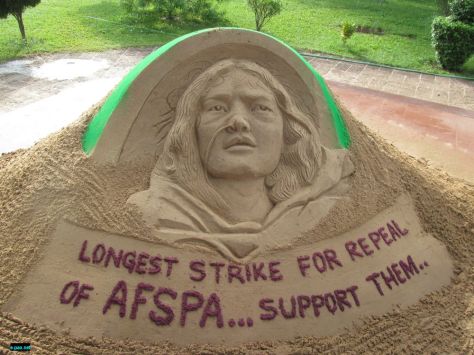
Sand Sculpture at Cuttack, Orissa by artist Himanshu Shekhar Parida, in solidarity with Irom Sharmila’s struggle for repeal of AFSPA,  to mark 15 years of completion of  her hunger protest in 2015. (Image courtesy E-Pao)

“My struggle will continue until AFSPA is struck down” said Irom Sharmila Chanu, the poet and activist from Manipur whose 16-year long hunger strike against the Armed Forces Special Powers Act has made her a global symbol of non-violent resistance. Sharmila was speaking at a press conference organised on October 1, 2016 by the “Stand With Irom Sharmila: Repeal AFSPA” Campaign, a global campaign endorsed by nearly 1000 women – from pioneers of global women’s movements to grassroot activists who have dedicated their lives to the struggle for women’s rights and freedoms.

The Armed Forces Special Powers Act (AFSPA) is a colonial law first promulgated by the British rulers of India in 1942 to try and quell the freedom struggle. It has been continuously operative in several north-eastern states, including Sharmila’s home state of Manipur since 1958. It was also imposed in Jammu and Kashmir in 1990. Under this law, armed forces and other security forces in “disturbed areas” have the license to shoot to kill anyone on suspicion; make arrests without warrants; enter and search any home or establishment; detain and question anyone. Armed forces personnel and security forces have complete immunity for actions taken under this law, and their prosecution requires prior sanction of the government, under Section 6 of the AFSPA. RTI information has disclosed that Sanction for prosecution of armed forces even for egregious human rights violation has never been granted. Nor is the government’s decision on declaring an area “disturbed” subject to judicial review.
Continue reading Women Of The World Stand With Sharmila – Repeal AFSPA Now!

Oppose the Communally Motivated Proposed Amendments to the Citizenship Act, 1955 : Delhi Action Committee for Assam

Guest Post by Delhi Action Committee for Assam

The proposed amendment to India’s Citizenship Act, 1955 has raised grave concern among democratic circles in Assam and in other parts of the country. The proposed amendment reads that “persons belonging to minority communities, namely, Hindus, Sikhs, Buddhists, Jains, Parsis and Christians from Afghanistan, Bangladesh and Pakistan, who have been exempted by the Central Government by or under clause (c) of sub-section (2) of section 3 of the Passport (Entry into India) Act, 1920 or from the application of the provisions of the Foreigners Act, 1946 or any order made thereunder, shall not be treated as illegal migrants for the purposes of this Act” and that for persons belonging to the aforementioned minority communities, “the aggregate period of residence or service of a Government in India as required under this clause shall be read as ‘not less than six years’ in place of ‘not less than eleven years’.” The proposed amendment which is being considered by a Joint Parliamentary Committee is indeed is a matter of grave concern for the whole of India. Government officials have claimed that the decision to grant Indian citizenship to the above mentioned discriminated religious communities in neighbouring countries is premised on ‘humanitarian grounds’. Notwithstanding this benevolent claim by the government, one needs to carefully place this proposed amendment in perspective.

The proposed amendment is premised on the religious persecution of non-Muslim minorities in neighbouring Muslim majority countries. While religious basis have ‘softly’ underlined India’s approaches to the issue of immigration since the Partition, what is alarming with the amendment proposed by the current government is its vehement attempt, in the garb of humanitarianism, to upturn the Constitution of India by slyly trying to introduce religious right-to-return. The current government displays zero or very little humanitarian concern for non-Hindu marginalised communities in the country and in neighbouring countries.

Unlike Israel, Korea (both South and North), and few other countries, Indian law and the Constitution till today doesn’t recognise any notion of ‘Right to return’. This is the first time, when a sort of religious ‘right to return’ – is being advocated by the law-makers. To reiterate, this runs contrary to the secular fabric of the Constitution.

Further apart from complicating the already vulnerable demographic cauldron of the state of Assam, the circumstances under which the amendment is sought to be carried out raise questions about the federal structure of the country. The proposed amendment overrides the Assam Accord of 1985 which sets the date of 24 March 1971 as the cut off date for categorisation of illegal foreign immigrants to Assam, irrespective of Muslims or Hindus. In 1986 the Citizenship Act was amended and Article 6A was inserted. Retrospectively Article 6A granted citizenship to all those who entered Assam on or before 24 March 1971. How many amendment to Citizenship Act is required? Ain’t the amendments made after the Assam Accord of 1985 not enough?

We strongly demand that the proposed amendment to the Citizenship Act 1955 be immediately withdrawn.

Join the Protest Demonstration Against Citizenship (Amendment) Bill, 2016, at 2 pm, 29th September, Jantar Mantar

The Orphaning of ‘Women’s Collective Interests’ in Kerala


There is considerable outrage in Kerala about how the accused in the murder of the young woman worker Soumya in 2011 has slipped the noose at the Supreme Court. There is considerable doubt remaining on how the murder of the young dalit woman student Jisha was handled by the present government. In both cases, the accused are not men who would earn the sympathy of the Malayali middle-class – in one case, a tamil homeless man, and in the other, a Muslim migrant worker. Not surprisingly, the cry for their blood has been particularly shrill. Outrage at the Supreme Court’s refusal to endorse the lower court’s judgment in the first case is particularly striking – not only because of its loudness, but also because one is unable to forget the Suryanelli case. The difference between the present cases and the Suryanelli case is that in the latter, the victim has been condemned to living death, though she has persistently fought to be heard as a survivor of the most horrific violence. Yet her pleas that the powerful Malayali politician P J Kurien be also tried never roused the kind of outrage was have heard recently. It appears that the Malayali public is kinder to dead violated women than women who survive violation; it also seems harsher towards abjected males than to .powerful males who occupy the pedestal of elite masculinity. Continue reading The Orphaning of ‘Women’s Collective Interests’ in Kerala

Self and Other : Indus Chadha

This is a guest post by INDUS CHADHA

The summer that I was 5-years-old, I took my first flight alone because I wanted to spend my holidays with my grandparents. My parents prepared me well—they even read aloud and recorded my favourite stories on an audio cassette which we put into our Walkman for my long solo journey. But there was one question they neglected to answer. “What should I do if the flight crashes?” I had asked. “It won’t…” they had brushed my question away. So when the flight attendant came out into the aisle and announced that one of our engines had failed and we would have to turn back to our point of origin to make an emergency landing—I wondered what I should do.

A man a few rows ahead of me got up from his seat and started shouting at the flight attendant. He was obviously afraid and seemed to hope oddly that he could frighten some comfort out of her. I remember him saying over and over again that he had a young child with him on the flight and that made me conscious of both the gravity of the situation and the fact that I was so young and all alone. I felt tears start to well up in my throat and took small sips of my orange juice to wash down the urge to cry. And then, out of the blue, the young man sitting beside me started talking to me. He asked me what I was studying at school and when I told him our theme for the last term had been pirates he exclaimed that he was a ‘shippie’ and knew all about them.

Continue reading Self and Other : Indus Chadha

Statement in Support of Khurram Parvez from Groups and Individuals in Karnataka

Over the past 70 days, there have been over 84 deaths, hundreds have lost their eyesight to pellet wounds and thousands have been injured in Kashmir. As news reports of the death of 11 year old Nasir Shafi, son of Muhammad Shafi, a resident of New Theed Harwan in Srinagar emerge, we also hear about Showkat Ahmed Misger, a person with mental disabilities from Safa Kadal who was admitted in hospital in a critical condition with pellet wounds. Though the people of Chandpora were told by the police that Nasir Shafi was mauled by a bear, pictures of his body with pellet wounds and torture marks stand in contradiction to this official version of events. The violence unleashed by the armed forces continue unabated in Kashmir inspite of extensive social media outrage and mass protests in  Indian cities like Patna, Kolkatta, Chennai, Bangalore, Delhi etc.

Continue reading Statement in Support of Khurram Parvez from Groups and Individuals in Karnataka

Historic Delhi High Court Judgement Dismisses Publishers’ Copyright Infringement Petition

In its much awaited judgment in the Delhi University photocopying case (The Chancellor Masters and Scholars of the University of Oxford v. Rameshwari Photocopy Services), the Delhi High Court has dismissed the copyright infringement petition initiated in August 2012 by three publishers (Oxford, Cambridge and Taylor & Francis) against a photocopy shop located in the premises of Delhi University. This case, which was being closely tracked by students, teachers and the publishing industry alike, was seen as one with immense significance for questions of access to knowledge. While initially involving only the publishers, the photocopier and the university, the case also saw intervention petitions being filed by a student group (Association of Students for Equitable Access to Knowledge) as well as by teachers and academics (Society for Promoting Educational Access and Knowledge). While the publishers made the argument that the creation of course packs and the photocopying of academic material for the same amounted to an infringement of the exclusive copyright of the authors and publishers, the defendants argued that the reproduction of materials for educational purposes fell within the exceptions to copyright under Section 52(1)(i) of the Copyright Act.

Not a moral right

In his considered and sharply reasoned judgment, Justice Rajiv Sahai Endlaw examines the gamut of arguments made by both sides and arrives at the conclusion that copyright is a statutory right and not a natural right, and hence any right that is granted to owners is also limited by exceptions carved out by law. The nature of Section 52 of the Copyright Act is such that any act falling within its scope will not constitute infringement. Section 52(1)(i) allows for the reproduction of any work i) by a teacher or a pupil in the course of instruction; or ii) as part of the questions to be answered in an examination; or iii) in answers to such questions.

Continue reading Historic Delhi High Court Judgement Dismisses Publishers’ Copyright Infringement Petition

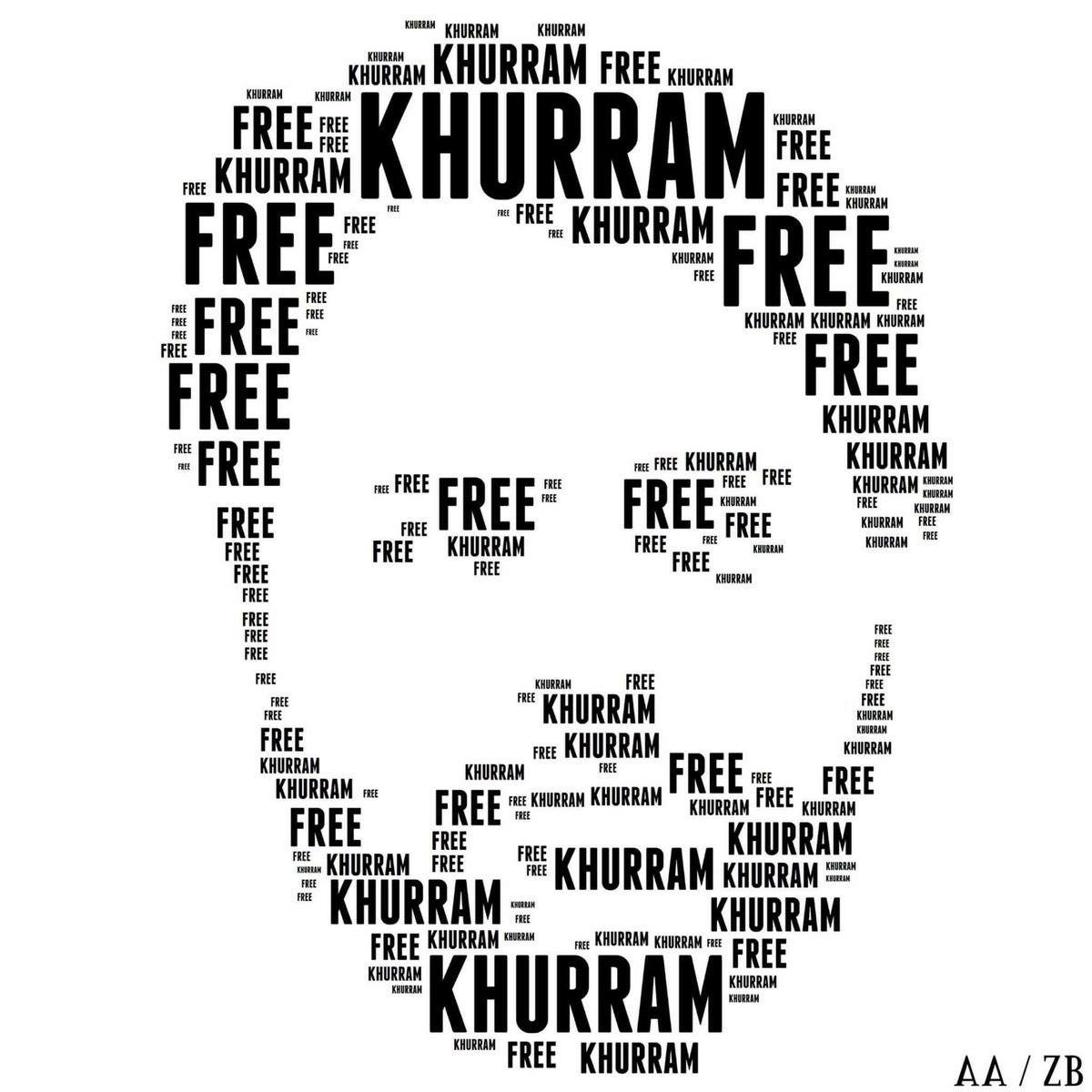
Free Khurram Parvez – An Open Letter to Civil Society: JKCCS

Guest Post by Jammu and Kashmir Coalition for Civil Society on behalf of the signatories of the statement in support of Khurram Parvez

14355569_670864076420404_7479719579066415935_n
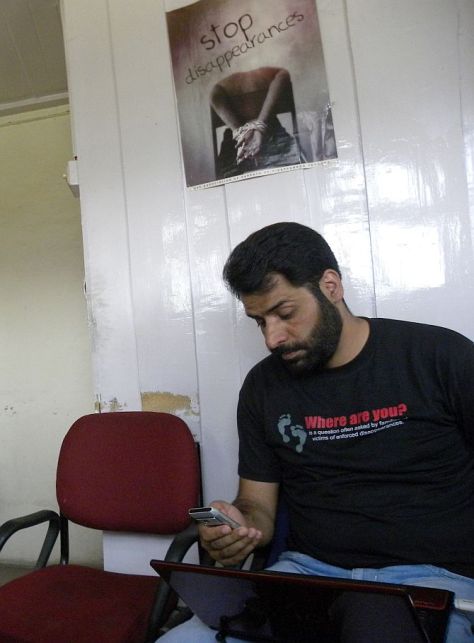
Khurram Parve, Image, courtesy JKCCS

We, the undersigned, call for the immediate release of Khurram Parvez, a distinguished and courageous human rights defender, and write in support of the enclosed statements issued by Advocate Parvez Imroz

As we write this, Khurram Parvez has been remanded to preventive custody in a sub-jail in the highly militarized Kupwara District of Kashmir. He is expected to be produced before the court on 21 September 2016.

An executive magistrate in Srinagar issued the order against Khurram Parvez, invoking Sections 107 and 151 of the Code of Criminal Procedure (CrPC) (pertaining to detention for breach of peace and design to commit a cognizable offence).

The actions against Mr. Parvez are symptomatic of the escalated repression in Kashmir by institutions of state since July 8.

We note with horror that since July 2016, over 80 persons have been killed, over 11,000 persons have been injured, over 1,000 persons have been arrested and over 100 ambulances have been attacked. For 70 days now, curfew has been imposed in various parts of Kashmir. Continue reading Free Khurram Parvez – An Open Letter to Civil Society: JKCCS

Victory for Students and Access to Knowledge in DU Copyright Case :ASEAK

Guest Statement by Association of Students for Equitable Access to Knowledge (ASEAK)

Victory for Students and Access to Knowledge in DU Copyright Case : Corporate Publishers Market ends at the gates of the University

In a rare and incredible order today, the Delhi High Court has dismissed the copyright infringement case filed by Oxford University Press, Cambridge University Press and Taylor and Francis (Routledge) against Rameshwari Photocopy Shop in Delhi School of Economics and Delhi University. Justice R.S Endlaw in a 94 pages long judgment interpreted educational exception under section 52(1)(i) of the copyright act in broad enough manner to cover the acts of photocopying.

The publishers sought to claim damages to the tune of 60 lakh rupees from the shop citing infringement of copyright which the publishers claimed was happening through photocopying of parts of books published by them. However, the publishers themselves stated that this case, for them, was a test case where they wanted to introduce licensing systems across universities in India. These licensing systems intended to control the extent to which material could be photocopied and also direct a share of profit from these reproductions to the publishers. We, the Association of Students for Equitable Access to Knowledge (ASEAK) demanded to be made a defendant in this case as we believed that it is the rights of students to access reading material that was at stake in this case- “Association of Students for Equitable Access to Knowledge (ASEAK) filed IA No.3454/2013 for impleadment in the present suit and which was allowed vide order dated 1st March, 2013 and ASEAK impleaded as defendant No.3.” (from the judgment). Continue reading Victory for Students and Access to Knowledge in DU Copyright Case :ASEAK

Statement against All India Muslim Personal Law Board’s affidavit claiming triple talaq is Islamic: Bebaak Collective

Statement by Hasina Khan, Roshni Rina, Geeta Thatra, Shirin Dalvi  on behalf of Bebaak Collective (Voices of the Fearless).

Contact details: bebaakcollective@gmail.com/ 9870162113

We, as part of women’s movement and practising feminists working with Muslim community and the women of the community for years in India, take the liberty to write this statement condemning the recent affidavit posed by All India Muslim Personal Law Board (AIMPLB). The claims of this affidavit are:

First, abolition of triple talaq is (un) Quranic;

Second, since women lack decision making abilities, it is only men of the community who should have this right;

Third, polygamy is Islamic, though not promoted by Islam, and this practice ensures marital rights for Muslim women, banning of which will result in promiscuous sexual practices or murder of women at the hands of their husbands;

Fourth, the honorable Supreme Court of India has no right to intervene in the religious law of the community.

This statement has been issued by the AIMPLB in the context of the growing number of Muslim women’s petitions challenging the constitutionality of triple talaq in the apex court.

We strongly condemn this statement based on all the four premises.

Continue reading Statement against All India Muslim Personal Law Board’s affidavit claiming triple talaq is Islamic: Bebaak Collective

The Surrogacy Debate and the Missing ART Bill: Chayanika Shah

Guest Post by CHAYANIKA SHAH

Altruistic. Meaning: showing a disinterested and selfless concern for the well-being of others; unselfish.

So once again the government is asking women to be unselfish and show selfless concern for the well being of others. The “others”, however, have been clearly marked. It has to be people within the close family. Women dare not feel selfless or altruistic concern for anyone other than those that are connected to them genetically or through marriage (since that is what defines a family by law and dominant customs). This concern should be so selfless that they should also not worry about their health after the pregnancy, they should not care for the loss of employment or any other changes that may happen in their lives as a result of this concern that they show for a family member. After all we are living in the “Indian ethos” where women are supposed to sacrifice for their “families,” and for none other. And in any case, till very lately, until all these new fangled ideas of women being natural guardians etc. came up, women were giving this altruistic services to their husbands. They are used to it and this is merely an extension of their familial labour. Simple!

It is such a waste of women’s reproductive potential that they bear children just for their husband. The family may as well benefit from the labour of the woman, and it be shared with other family members too. Especially for those who have married as per all the caste and community norms and have even stuck together for five years in spite of not having a child. Why should the hard earned money of “the family” be squandered on someone else? Is that not wasting the potential of women? After all why have we have saved the girl child? So that our boys can have the right girls to marry and also so that we can continue with our eugenic marriage and child bearing practices within the right caste and gotra unions.

Continue reading The Surrogacy Debate and the Missing ART Bill: Chayanika Shah

Adventures in Creepland: An Open Letter to the District Collector, Calicut, Kerala

This letter is jointly written by the signatories.


Dear Mr Prasanth Nair

We, the undersigned participants of the 7th Queer Pride March held on 12 August 2016 in Calicut, would like to bring to your attention the unforgivably irresponsible attitude of the Kozhikode police towards the rights of young people who identify themselves as queer, and their allies. In what should have been a completely joyous event, their attitude cast a dark shadow, for sure. Continue reading Adventures in Creepland: An Open Letter to the District Collector, Calicut, Kerala

एक विद्रोहिणी का अकेलापन

इरोम हम जैसा होना चाहती है ?
Image result for irom sharmila
(Photo Courtesy : Times of India)
कुछ कुछ तस्वीरें ताउम्र आप के मनमस्तिष्क पर अंकित हो जाती हैं।
चंद रोज पहले टीवी के पर्दे पर नज़र आयी और बाद में प्रिन्ट मीडिया में भी छायी उस तस्वीर के बारे में यह बात दावे के साथ कही जा सकती है। इस फोटोग्राफ में इरोम शर्मिला – जो आज़ाद भारत के सबसे खतरनाक दमनकारी कानून सशस्त्र बल विशेष अधिकार अधिनियम (Armed Forces Special Powers Act) के खिलाफ संघर्ष की एक प्रतीक बनी रही हैं – अपना सोलह साल से चल रहा अनशन तोड़ती दिख रही हैं। उन्हें एक चम्मच में शहद आफर किया जाता है और वह बेहद भावुक हो जाती हैं, महज एक बंूद लेकर उसे लौटा देती हैं।
ईमानदारी की बात है कि इस तस्वीर को कई कोणों से पढ़ा जा सकता है – एक कोण हो सकता है कि एक किस्म का हताशाबोध कि दुनिया के पैमाने पर ऐतिहासिक कही जा रही इतनी लम्बी भूख हड़ताल के बावजूद इस खतरनाक कानून को टस से मस नहीं किया जा सका, एक अन्य कोण हो सकता है इस एहसास का कि यह सरकार इस कदर संवेदनाशून्य हो चुकी है कि उससे लड़ने के लिए एक नयी किस्म की रणनीति की जरूरत है – बेकार में जान देने के बजाय, अपनी उर्जा को नए सिरेसे एक नए किस्म के संघर्ष मंे लगाने का – तीसरा कोण यह भी हो सकता है कि  महामानव या महामानवी घोषित किए गए किसी व्यक्ति का उस आरोपित प्रतिमा से तौबा करते हुए यह बताने का कि वह भी एक साधारण मानवी है, जिसके अन्दर बाकी लोगों जैसा जीवन जीने की हसरत है।

Continue reading एक विद्रोहिणी का अकेलापन

Not Pakistan, but Modi has pushed Kashmir on the Brink : Ashok Swain

This is a guest post by ASHOK SWAIN

Since the death of a young and charismatic separatist named Burhan Wani, Kashmir has erupted into violence and chaos. Weeks of violent protests in the Valley have resulted in the deaths of at least 50 people and over 5,000 injuries. Kashmir is not new to violent protests and civilian deaths, but this time the intensity of the protest and the passion of the protesters is unprecedented. Continue reading Not Pakistan, but Modi has pushed Kashmir on the Brink : Ashok Swain