Category Archives: Law

Good Muslim, Bad Muslim – A Response to Ashish Khetan on the ‘IM’: Warisha Farasat

Guest Post by Warisha Farasat

The recent opinion piece by Ashish Khetan in the Hindu has yet again reiterated the false and malicious stereotype: that Muslims somehow have something or the other to do with terror, either when they are directly involved or when they are silent about others of the community being involved. It is disappointing that the debate is framed in the stereotypical, “good Muslim”, “bad Muslim” tenor rather than a real engagement with issues of shoddy investigation and communal bias that marks terror investigations in the country. Perhaps the greatest disservice that has been done to idea of justice has been linking an entire community to terrorism.

Continue reading Good Muslim, Bad Muslim – A Response to Ashish Khetan on the ‘IM’: Warisha Farasat

Terror and the Indian Mujahideen – A Response to Ashish Khetan: Sharib Ali

Guest Post by Sharib Ali

There is something disquieting in what Ashish Khetan has written and said recently on terror in India (in The Hindu and on Tehelka.tv), and centrally within it, the Indian Mujahideen. More so, because it comes from one of the most credible journalist’s today, who has done some commendable work over the years. A journalist I personally respect. But there are several reasons which compel this response. And yet, this is not just a response, but also an attempt to elucidate the many complex processes within which ‘terror’ is located today, and the way the discourse has transformed, and has implications for a people’s negotiated relationship with their state.

Continue reading Terror and the Indian Mujahideen – A Response to Ashish Khetan: Sharib Ali

Minority Report – Deaths followed by Executions : Ramray Bhat

This is a guest post by RAMRAY BHAT

The collective conscience of our prominent democracies works in very strange ways. India is yet to come to terms with the killing of a nineteen-year-old Mumbaiite student Ishrat Jahan in an encounter by officers of the Gujarat Police in collaboration with the Intelligence Bureau. Along with three other individuals, Javed Sheikh (for whom Ishrat worked as a secretary), Amjad Ali Rana and Zeeshan Johar, Ishrat was first announced to have died in police firing and the alleged plan hatched by these four individuals to assassinate prominent politicians of India, thereby thwarted. Inquiries at the level of the Ahmedabad metropolitan magistrate court as well as by the Central Bureau of Investigation (CBI) as directed by the Gujarat High Court confirmed what had been suspected all along, that Ishrat had been murdered in cold blood while she was in police custody. Continue reading Minority Report – Deaths followed by Executions : Ramray Bhat

Beyond Reasonable Doubt? The Conviction of Shahzad Ahmad: JTSA

Guest Post by Jamia Teachers’ Solidarity Association ( JTSA ), Delhi.

Beyond Reasonable Doubt? The Conviction of Shahzad Ahmad is a detailed analysis and critique by the Jamia Teachers’ Solidarity Association of the judgment awarded on the 25th of July by the 2nd Additional Session Judge, Delhi-South East (Saket) Court in the ‘State vs. Shahzad Ahmad@Pappu’ case, also known as the ‘Batla House Encounter’ case. Yesterday, on the 30th of July, the judge confirmed his verdict of ‘guilty’ and awarded Shahzad Ahmad the punishment of imprisonment for life and a fine of Rs. 95,000/-. The JTSA, which has been following the Batla House Encounter since 2008 presents its findings on the trial in this booklet, and disputes the guilty verdict awarded to Shahzad Ahmad. Kafila is carrying this publication (as part of a series of posts on the Batla House Encounter) as a downloadable pdf format file.

The Batla House Judgement and the Impossibility of Closure

The word ‘closure’ has a reassuring, comforting resonance, particularly when it comes to matters of death. One achieves closure. It is granted.  Those who are fortunate receive it as recompense for the necessary tasks of grief and mourning. We move on.

On the 25th of July, last week, after Rajender Kumar Shastri, 2nd Addiitional Sessions Judge of the South East (Saket) Court in New Delhi announced in open court that a young man named Shahzad Ahmad of Khalispur village in Uttar Pradesh’s Azamgarh Disttrict was guilty of causing the death of Inspector Mohan Chand Sharma of the Special Cell of the Delhi Police in Flat No. 108, L-18, Batla House, in South Delhi’s Jamia Nagar on the 19th of September, 2008, the word ‘closure’ began to ring out on prime time television.  We were given to believe that the infamous ‘Batla House Encounter’ case had finally achieved closure. That the ‘martyrdom’ and sacrifice of Inspector Mohan Chand Sharma had now been vindicated. That all unseemly controversy could now be put to rest. We were told that it was time to move on.

Continue reading The Batla House Judgement and the Impossibility of Closure

GUANTANAMO II : K Satchidanandan

This is a guest post by K SATCHIDANANDAN

A poem by Ibrahim al-Rubaish, a Guantanamo Bay prisoner written in the tragic circumstances of illegal incarceration  has given rise to a baseless controversy in Kerala as it was included in a section titled ‘Literature and Contemporary Issues’ of the English  text book for the third semester undergraduates in the University of Calicut. The poem was recommended for inclusion by the Board of Studies chaired by Dr K. Rajagopalan, and rightly so as the section dealt with creative writing based on contemporary issues including the issue of human rights. The poem goes like this: Continue reading GUANTANAMO II : K Satchidanandan

The media monster of the juvenile offender: Enakshi Ganguly and Anant Asthana

This is a guest post by ENAKSHI GANGULY and ANANT ASTHANA

July 17 was an important day. Supreme Court announced its judgment refusing to interfere with the Juvenile Justice Act. This was with respect to the eight petitions that were filed in the wake of the alleged involvement of a juvenile in the rape and murder of a 23 year young girl on December 16, 2012. The boy, who was found to be below 18 years, was described by the media as the most heinous of the rapists, a monster and a beast, and even the main accused—and this even before the police had filed the charge –sheets based on statements of the witnesses and evidence gathered. Should there be a fair judicial process that decides the case based on scrutiny of relevant facts or should we let media undertake a trial? Continue reading The media monster of the juvenile offender: Enakshi Ganguly and Anant Asthana

Katiyabaaz – the grid thief of Kanpur

Katiyabaaz Loha Singh in a still from the film

By SHIVAM VIJ: A new documentary film, Katiyabaaz, presents a problem that I’ve been struggling with. Although the film is set in Kanpur, it’s a problem that faces many parts of South Asia. The film-makers, Fahad Mustafa and Deepti Kakkar, obstinately refuse to offer possible solutions. With catchy lyrics and music, the film celebrates Kanpur, its people, and this messed-up system. It’s a snapshot of who we are. It’s when you think about the film that it disturbs you.

The film’s anti-hero is a thief — Loha Singh helps a lot of people steal electricity in Kanpur. He connects the illegal wire that is known in north India as katiya. Katiya is the sort of simple solution to life’s problems that South Asians feel very smart about. It’s an example of jugaad, the shortcut to problem solving that’s now integral to pop management theories. Continue reading Katiyabaaz – the grid thief of Kanpur

The David Headley Lies Continue: There is Nothing ‘New’ About It

This release from the JUSTICE FOR ISHRAT JAHAN CAMPAIGN comes to us via Manisha Sethi.

“If you tell a lie big enough and keep repeating it, people will eventually come to believe it.” This is a quote often misattributed to the Nazi propagandist Joseph Goebbels. So widely is it believed to have been the key to Goebbelsian propaganda that it often employed by those whose politics is inspired by Goebbels’s Feuhrer.

This is exactly what we are seeing in this frenzied rush to pronounce Ishrat Jahan as a Lashkar operative by a section of media and commentators friendly to the ‘IB sources’.

Knowing full well that CBI’s mandate is only to enquire into the nature of the encounter – to probe whether Ishrat Jahan and three others were killed in cold blood – and realizing increasingly that the CBI investigation is leading to the unraveling of a plot so sordid that serious questions are going to be raised about the manner in which certain elements within the IB and agencies cynically used national security issues for vested interests, there is an attempt to pop up red herrings. False questions, planted stories, lies, fabrications – anything that will take the focus away from the guilt of those who conspired to abduct, drug and kill a teenaged college girl.

Continue reading The David Headley Lies Continue: There is Nothing ‘New’ About It

Ilavarasan: At a deadly new junction of caste and electoral politics: Rajan Kurai Krishnan

ilavarasan_divya-350_070513040519This is a guest post by RAJAN KURAI KRISHNAN

The gruesome death/alleged murder of Ilavarasan, a Dalit youth, at the outskirts of Dharmapurai on the afternoon of 4th July has come as a shock to all those who have heard of his case. Murders, ironically called honour killings, and socially abetted suicides as outcomes of inter-caste marriages are of course as common as catching cold in most parts of India. However, what has made Ilavarasan’s case something that could penetrate the armour of the middle class everyday plated with trained nonchalance to extract a possible expletive under their breath is the fact that his case has been in the limelight for more than eight months now.

It was a few weeks after his marriage with Divya, a girl belonging to the caste of Vanniars, a Most Backward Caste in the official description of Tamil Nadu Government,  in October 2012, Divya’s father was found dead allegedly having committed suicide due to the “dishonour” caused by his daughter’s marriage. Making the suicide an excuse, the Vanniyars organized riots in which three Dalit hamlets, about 250 houses, were destroyed. The scale of violent destruction caught the national attention and so did the love story behind the riots. The young couple earned a media profile while trying to live in peace beyond the reach of the raging Vanniyar caste men. It was fated that was not to be. The Vanniar caste leaders used Divya’s mother to temporarily separate Divya from Ilavarasan by using the well known tactics of emotional blackmail. They then broke the communication link between Ilavarasan and Divya. When Ilavarasan saw Divya in the court on the first of July, Divya told the court that she would live with Ilavarasan after convincing her mother. Divya’s lawyer, however, managed to make her tell the press that she is separated from Ilavarasan forever. Ilavarasan, on the other hand, told India Today, that he was highly hopeful of re-uniting with Divya. After two days, he was found dead near a railway track in broad daylight. Given this history, the news had some potential to shock people. Continue reading Ilavarasan: At a deadly new junction of caste and electoral politics: Rajan Kurai Krishnan

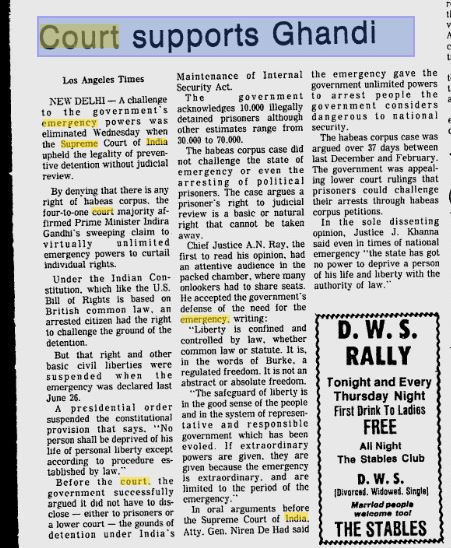
The shameful role of the Indian Supreme Court in the Emergency of 1975: Rajinder Sachar

This guest post by RAJINDAR SACHAR comes to us via the PEOPLE’S UNION FOR CIVIL LIBERTIES.

Lewiston Morning Tribune - Google News Archive Search - Mozilla Firefox_2013-07-14_19-25-11

Nations which do not remember their immediate past are in danger of repeating their tragic mistakes. This thought came to me on June 26th, 2013 (the Emergency day of 1975) when on random questioning of age group of 35 in the country (who are said to make up about half the population) I found that most of them did not know of any particular significance of the day – and more tragic, fairly large number of people above the age of 35 fared no better. Continue reading The shameful role of the Indian Supreme Court in the Emergency of 1975: Rajinder Sachar

IB says Headley says it’s too hot…

…CBI says it’s the humidity.

While the implausibility of David Headley having named Ishrat Jahan as an LeT operative has already been called out, there’s another problem here. How does anyone cross-check IB’s claim considering none of us has access to Headley?

In other words, the IB can make any insinuation and say Headley said it and we’ll have to believe at as truth.

This is apart from the fact that the judicial process in the news is not about whether or not Ishrat Jahan was an LeT terrorist. It’s about whether she was murdered in cold blood by Gujarat police. To that extent the IB does have a point in arguing that it cannot be blamed for how a state government interprets its inputs. Technically, the IB cannot be held responsible for murder by Gujarat police. But does that mean the IB cannot or should not be held accountable for what inputs it sends across?

Anyway, I posted a series of satirical tweets the other day making fun of the use of David Headley to justify the murder of Ishrat Jahan. Here are some of them.

Continue reading IB says Headley says it’s too hot…

‘Ladies Still not Empowered in Kerala?’ Questions Raised by the Solar Scam

How does one respond critically and effectively when non-politics, non-government, and non-sense, all rolled together, assail the political public? I have been thinking about this recently — surely, this is a question that troubles all those who would wish to keep the focus of public life on politics and power. We witness, in present-day Kerala,politics being reduced to the internal bickerings over power indulged in by the powerful elite interest-groups that constitute the ruling UDF. Or, reduced to ‘sex scandals’ or ‘domestic squabbles’ when gender politics surfaces.  Simultaneously, we are witnessing the era of non-government and the severing of the link between public politics and government. While the bickerings between the coalition partners of the UDF continues unabated, news of infant deaths and severe malnutrition continue to flow from tribal hamlets in Attappady; the problems of mounting waste in both towns and rural areas continues to be criminally neglected; dengue and other dangerous fevers continue to exact daily, rising tolls all over the state. And even as the consequences of widening social inequalities become more and more visible, this government’s discourse of welfare remains pegged insistently on human mercy and charity. It continues to be dismissive of concerns of social justice and power — even as these harrowing tales continue to appear in the press, there is no dearth of advertisement of the goverment’s kaarunyam. And in the midst of all this, the Chief Minister being projected as the exemplar of human goodness and chairty! Or, the UN, ever-interested in ‘innovation’, conferring an award on his Mass Contact Programme at a time when his government has been least innovative or imaginative in solving problems that now stare us in the face. the This of course is the non-sense — the absurdity of it all. Continue reading ‘Ladies Still not Empowered in Kerala?’ Questions Raised by the Solar Scam

Media Campaign and the Ishrat Jahan Case: Faraz Ahmad

Guest post by FARAZ AHMAD: Even after the Central Bureau of Investigations (CBI) presented of its charge-sheet in CBI special court in Ahmedabad on July 3 in the infamous Ishrat Jahan encounter case of Gujarat of 2004 charging the Gujarat police, together with the IB of faking the encounter with Ishrat and three others, the media campaign, more particularly of the Times of India to damage CBI’s credibility continued unabated, with Bharti Jain’s lament on behalf of the IB.

However it is obvious that Bharti Jain’s is neither the first nor the last spirited defence of the questionable activities of our security and intelligence officers committing all kinds of crimes under the cover of protecting the nation from supposed external and internal threat. Unmindful of this, the media campaign is so visibly influenced by the BJP, attempting to discredit the CBI investigations and label these as biased before these are examined by the rightful authority, the courts, guided by competent lawyers of both the prosecution as well as Defence. Continue reading Media Campaign and the Ishrat Jahan Case: Faraz Ahmad

‘After falling in love, I saw the reality of caste’: E. Ilavarasan

Dalit youth E. ILAVARASAN, whose marriage to a Vanniyar girl had resulted in caste violence in Tamil Nadu last year, was found dead on a railway track yesterday. Given below is an interview Ilavarasan gave to KAVIN MALAR and was published in the Tamil edition of India Today magazine. This translation is by PRAKASH VENKATESAN.

ilavarasan_divya-350_070513040519

Did you realise you were going to be in the headlines in TN when you got married?

No. Certainly not. I thought ours would be just like any other marriage. Divya thought so too. We thought they (Divya’s parents) would be angry initially but can be eventually reconciled. We simply did not expect these things would happen. I now can really understand the horrendous nature of caste and the heinous things it is capable of after falling in love.

Why do you think Divya is suddenly saying now that she wants to go with her mother? Continue reading ‘After falling in love, I saw the reality of caste’: E. Ilavarasan

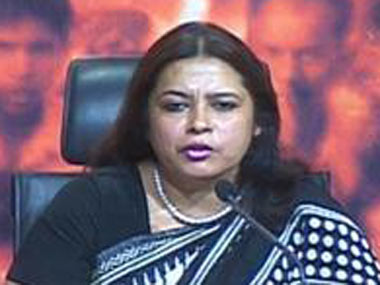
Women condemn Meenakshi Lekhi’s sexist slandering of Ishrat Jahan

Meenakshi Lekhi
Meenakshi Lekhi

Over 115 women have signed a letter seeking an apology from Ms. Meenakshi Lekhi for her sexist slandering of deceased Ishrat Jahan in a television channel. The letter has also been sent to the Chairperson of the National Commission for Women for appropriate action.

As the noose is tightening around the conspirators who cynically and coldly planned and executed the killing of teenaged Ishrat Jahan and three other people in 2004, there is a concerted campaign – the final, last ditch bid to save their skins – by tarnishing the image of this college student. There have been planted stories in the media linking her to a terrorist group –all of them false and concocted, even as the Gujarat High Court has clearly said that the CBI’s mandate is to simply investigate whether Ishrat and others were killed in cold blood. Continue reading Women condemn Meenakshi Lekhi’s sexist slandering of Ishrat Jahan

Will ACP Kisan Shengal of Mumbai ATS be prosecuted?: Yug Mohit Chaudhry

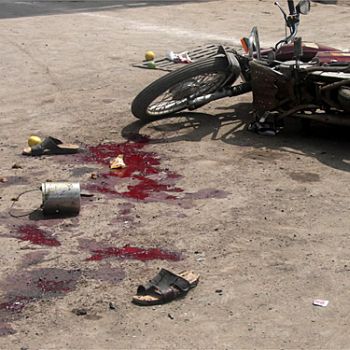
malegaon_blast_2

Guest post by YUG MOHIT CHAUDHRY: On Friday, 8th September 2006, four bomb blasts occurred in Malegaon killing thirty-one persons and injuring three hundred and twelve others. The case was originally investigated by the Maharashtra Anti-Terrorist Squad (ATS). After re-investigating the case, the National Investigation Agency (NIA) has concluded that the ATS fabricated evidence against nine persons. This unprecedented acknowledgement raises important questions about how terrorist cases are investigated, police misconduct and the rule of law in India. It remains to be seen whether the government will take action against the ATS investigating officer, Assistant Commissioner of Police (ACP) Kisan Shengal, for fabricating evidence on a capital charge. Continue reading Will ACP Kisan Shengal of Mumbai ATS be prosecuted?: Yug Mohit Chaudhry

The curious case of the Tamil Nadu police preventing ex-Maoists’ return to electoral path!

Guest post. A statement by Prof A. MARX and other rights activists

We, the undersigned, wish to bring to the public’s notice a curious case of doublespeak by the state. The central and state governments constantly advise Maoists to give up arms and join the mainstream. But, in Tamil Nadu, the government in collusion with the police is torturing a group of ex-Maoists who have joined the mainstream. These comrades have given up armed struggle and have come out to function in the open under a party named People’s Democratic Republic Party (PDRP). They have also accepted the electoral path to pursue their mass line. It is clear from their case that the intention of the state is not to mainstream the armed fighters but to incapacitate anyone who dares to criticize the state’s policies, without any compromise.

Background

Earlier, many PDRP members were part of CPI (Maoist). Some of them were arrested and imprisoned under POTA in 2002, on charges of undergoing arms training in Uthangarai, Tamil Nadu. They eventually came out of the prison with women getting bail in 2005 and men in 2007. Many of the comrades who came out criticized the armed struggle line of CPI (Maoist) and stressed for a mass line. The CPI (Maoist) reacted to this by dismissing them from the party towards the end of 2007. Continue reading The curious case of the Tamil Nadu police preventing ex-Maoists’ return to electoral path!

‘Documentary Evidence of Sexual Relationship’: Is companionship necessary when adults cohabit?: Rukmini Sen

This is a guest post by Rukmini Sen The Madras High Court on 17th June 2013 has delivered a judgment where it unambiguously states that ‘the main legal aspect for a valid marriage is consummation’ (pg 13). Consummation of a marriage, in many traditions and statutes of civil or religious law, is the first (or first officially credited) act of sexual intercoursebetween two people, either following their marriage to each other or after a prolonged sexual attraction. Its legal significance arises from theories of marriage as having the purpose of producing legally recognized descendants of the partners, or of providing sanction to their sexual acts together, or both (last accessed 22nd June 2013). In a country like India, where Section 377 of the Indian Penal Code still exists (although decriminalization of consensual sexual acts between two adults in private has been declared by the Delhi High Court in 2008), what constitutes the status of consummation in a gay/lesbian union or when two heterosexual adults live together, when the legal significance of consummation is connected only with giving birth to a ‘legitimate’ child? What about relationships where there are willfully no children, biological, adopted or surrogate? This is one of the many questions that this judgment raises and leaves me more bewildered about my legal identity as a cohabiting partner in a heterosexual relationship.

Continue reading ‘Documentary Evidence of Sexual Relationship’: Is companionship necessary when adults cohabit?: Rukmini Sen

Shahrukh Khan, Surrogacy and Sex-Selection: Sneha Banerjee

Guest post by SNEHA BANERJEE: It was a Monday morning that didn’t bring me blues, after many weeks of sweltering heat I could keep the door to my balcony open without fearing the skin-burning ‘loo’ and my room filled with the pleasant breeze which had the promise of bringing in rains once again.  I decided to keep my diligently prepared to-do list aside and embarked on staring at the neem tree observing the avian cohabitants of my neighbourhood with the radio on my phone tuned to a FM station.  It was then that the unnecessarily loud, over-enthusiastic voice of a radio-jockey broke the serenity of the surroundings.  His shrieky voice exhorted a promise to keep Dilliwalon up-to-date with the latest controversies in Bollywood.  Now, that was not something that I was very interested in – imagined competition among biggies, who ate what, who holidayed where and with whom and after betraying whom was going to be too depressing to handle, but before I could reach out to change the station, he took somebody’s name that still makes my heart skip a beat even after couple of leap-years have come and gone since I was sweet-sixteen.  Yes, any and every news about this ‘star’ interests me and I want to know it all, true or untrue, gossip or through ‘reliable sources’.

But what I heard then, broke my heart.  The RJ quoted a Mumbai tabloid, that Shah Rukh Khan (SRK) is having a third child through surrogacy and that he has ensured it is a son through sex-selection.  Continue reading Shahrukh Khan, Surrogacy and Sex-Selection: Sneha Banerjee

IB’s desperate and dirty tricks to scuttle the Ishrat Jahan investigation

This is a press statement put out on 14 June 2013 by a group of individuals whose names are given at the end.

It is a clear indication of the desperation being felt by the IB establishment as the heat turns on its senior officers in the Ishrat Jahan probe, that they are down to doing what they do best: use pliant sections of the media to plant stories to deflect scrutiny and create a favourable public mood.  Following the summons issued to IB Special Director Rajender Kumar by the CBI (which is probing the case on the direction of the Gujarat High Court), the IB Director first sought to sell the familiar old story of ‘investigation will hit the morale of the IB’ – it seems as though a blanket immunity from any scrutiny and accountability is the only guarantee of IB morale.  The IB then ran complaining to the Prime Minister; and when nothing worked, it used the agency’s tried and tested trick of enlisting the support of discredited ‘journalists’.  Continue reading IB’s desperate and dirty tricks to scuttle the Ishrat Jahan investigation