Category Archives: Media politics

Beaten, tortured, forced to do drugs, wrists slashed with razors

There have been so many ragging incidents coming out in the news, but the media is done with ragging and there’s no hype beyond the singular news report. It would be a mistake to presume that there’s been a spurt in ragging incidents; the spurt has instead been in the reporting of incidents, in punishment and implementation of the law.
A student in Howrah was subjected to the things mentioned in the headline of this post, but it became a news story when the fresher tried to commit sucide by consuming poison. So the headline in the Times of India goes, “Howrah student attempts suicide after ragging“. A reader flipping through news reports could well think, another loser, another victim, another case. The attention is not on the victimiser, the perpetrator.

On Friday, Nayan was waiting at Uluberia station to catch a train home when four seniors grabbed him and took him to a house in the locality, says his uncle. Once inside, the door was barred and the torture began. Nayan was beaten and forced to smoke a cigarette. Then an unknown drug was forced down his throat. When he lay delirious, his wrists were slashed with a razor. Then, one of the seniors asked another to fetch an empty syringe, the FIR says. As Nayan desperately struggled, he was held down and air injected into his left hand.

Surely, the FIR named the four seniors? Why could they not be named in this news report?

The Times report also misses the point, mentioned in the Telegraph report, that the wrist slashing happened because Nayan Adak refused to obey orders to undress and dance. Ragging always does boil down to the fresher’s body, doesn’t it? The Telegraph and Express reports don’t mention names of the four accused either.

Watching Films Blindfolded

(Published in Himal, September 2009)

Sometime in 1996, the High Court of Andhra Pradesh received an anonymous letter informing the court that pornographic films were being shown in a cinema hall called Ramakrishna 70MM. The court proceeded to send two ‘lady advocates’ to ascertain the facts. In their subsequent affidavit, the advocates informed the court that they had gone to watch a film in the theatre and, after repeated obstacles – the ticket seller refusing to sell them tickets, the doorman asking them to go home, etc – they finally managed to find a seat inside the theatre. There, they were promptly informed by the manager that the film that was to be screened could not be seen by ladies, and they were ordered to leave. Following the report by the advocates, the court proceeded to have all the prints seized, and arranged for a screening for various officers of the court. The officers found the films to be a hodgepodge of short films, films-division features, advertisement films, political-party propaganda films, Hindi and Telugu feature-film bits and, of course, lots of porn clips thrown in for good measure. The court then ordered the closure of the theatre.

This would seem like just another day at the office for someone interested in the relationship between law, cinema and sleaze. But let us pause and consider one moment in this narrative a bit longer, as it contains a key to understanding the secret relationship between law and cinema. Let us look more closely at the moment when the officers of the law are huddled together in a small dark room, with notepads and pens, watching a montage of images – what must that have been like? Was there a conspiratorial silence when the nude descended the stairs, or a nervous giggle when the camera lingered for a second too long on the French kiss?

Continue reading Watching Films Blindfolded

Search No More

A new search engine ImHalal.com promises a more spiritually cleansed experience of the internet (“Search Halal, I am Halal!”). With three levels of Haram content defined, the search engine either throws up no results or warns you that a particular search  term is rated at  2 and could  and have potentially haram content before you proceed at your own moral peril

Jailing Journalists: Pradeep Jeganathan

This is a guest post by PRADEEP JEGANATHAN from Colombo.

The sentencing of J.S. Tissainayagam is deeply distressing.

While I’m neither a attorney, nor conversant with the details of the evidence presented by the prosecution, nor the text of the judgment delivered — and so can not comment on those areas, it seems clear that this judgment and sentence was only possible given the Prevention of Terrorism Act, of 1979. Two features stand out, given the PTA– the narrow bounds allowed for freedom of expression, on certain themes, and the admissibility of a ‘confession’ as ‘evidence,’ which is not allowable under the penal code. Taken together they make for a curtailing of freedom which is telling. There is an appeal pending, I understand, and there may be a possibility of a pardon, if that process is exhausted to no avail.

Continue reading Jailing Journalists: Pradeep Jeganathan

The (‘Quotation’) Gangs of Kerala

The media in Kerala is in a tizzy  these days over ‘quotation’ gangs and their influence on everyday life. Like evil spirits dancing upon the bodies of fallen heroes in abandoned epic battle-fields, ‘quotation gangs’, it seems, now dance upon the dead political heroism of the Malayalees. Suddenly, the media finds, they are everywhere, settling every kind of dispute. The institutions of law and order are turning, slowly, into adjuncts or versions of ‘quotation gangs’. The recent murder of the real-estate businessman Paul Muthoot, who was apparently traveling with two of the most notorious ‘quotation gang’ leaders in Kerala, has brought matters to a head. The papers are clogged these days with advertisements feeding Onam-time consumer-frenzy and news of the Paul Muthoot murder and they don’t see any connections between the two.

Continue reading The (‘Quotation’) Gangs of Kerala

A Tale of Two Encounters – Dehradun and Batla House: Jamia Teachers Solidarity Group

We publish below a statement from Jamia Teachers Solidarity Group, formed after the “encounter” at Batla House in Jamia Nagar, Delhi. For background information on this issue, see Some questions about the Delhi encounter; A little less melodrama, a lot more forensics; Shame is a revolutionary sentiment.

Jamia Teachers’ Solidarity Group extends its heart-felt condolences to the family of Ranbir Singh, the youth who was killed in a police encounter in Dehradun last week. This encounter again brings to the fore the trigger happy ways of the Indian police who kill and torture for medals and promotions. We demand exemplary punishment for the guilty policemen. Continue reading A Tale of Two Encounters – Dehradun and Batla House: Jamia Teachers Solidarity Group

The Day After the Judgement

So now that we have one group of criminals less to deal with, I have a proposal: Criminalize English TV news channels.

'Debate,' the Times Now way
‘Debate,’ the Times Now way

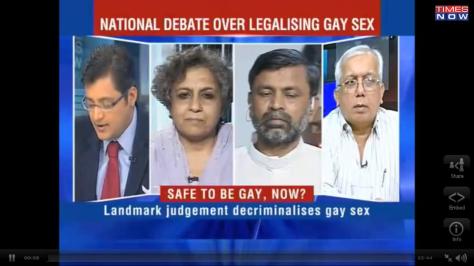
Watching Times Now yesterday after the Delhi High Court ruling on Section 377, I was overcome by a growing sense of bewilderment. I could hear Dominic Emmanuel (Director of the Delhi Archdiocese of the Roman Catholic Church) and Kamal Farooqui (Chairman of the Delhi Minorities Commission), saying quite cearly and more than once, to my surprise, that they welcome the decriminalization of homosexuality, that homosexuals should not be treated as if they were criminals. Okay, correct that – I could barely hear these statements over the insistent, aggressive and disruptive interruptions  of the anchor Arnab Goswami, who had obviously pre-set this “discussion” rigidly as a face-off between Reactionary Clerics/Minorities and Gay Rights Activists, while he himself was super hero, Anchorman. So each time they said “we welcome” etc.,  Anchorman would swoop in, bellowing, “So are you saying that they dont have rights, Sir, are you saying they should not have rights. Over to Anjali Gopalan (Naz) – Anjali, they say homosexuals should not have rights, what do you say?”

Continue reading The Day After the Judgement

Information Access and Transparency

In the recent national elections, we saw several initiatives that were implemented to provide more information to people about their elected representatives. The purpose of providing this information was to enable people to make more informed choices about who they cast their votes for. Some among these initiatives aim at achieving the larger goals of transparency, accountability and good governance i.e., their goal in providing information about elected representatives is not only to help people to vote more responsibly; it is also expected that citizens will use this information to monitor the performance of their elected representatives and hold them accountable after they have been voted in. Consequently, there is an attempt to collate information beyond that which is made available through candidate affidavits, i.e., about the state of development in parliamentary constituencies, election manifestoes and promises, news about elected representatives and constituencies, etc. These initiatives fulfill one aspect of the larger discourse about transparency i.e., providing access to information about “the state”. It is presumed that providing such information will encourage people to engage with the state and participate in monitoring its activities. My aim in this post is to dissect this logic somewhat further and to highlight some of the political dynamics which complicate any simple understandings of transparency and information access. I will conclude this post by making some tentative remarks on the possible ways in which information access can be configured in order to serve certain local needs. Continue reading Information Access and Transparency

When a Guinness world record isn’t news

Every little entry from India in the Guinness Book of World Records makes it to our Delhi papers. But, a recent one didn’t. News editors are proud patriots.

An Ounce of Panic is Worth a Quintal of Surveillance!

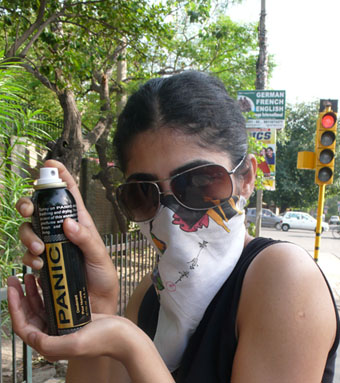
Panic

Did you know terrorists are running amok in Delhi University??

Continue reading An Ounce of Panic is Worth a Quintal of Surveillance!

How to be TV-free on election results day

Avoid the pundits on the nauseating news channels, keep your peace of mind, cut the noise and save your aspirin bills. Watch the results live tomorrow morning 8 am onwards on http://eciresults.nic.in/


Barter – is that what they’re calling it now?

It’s a world on the downturn out there.

And new and creative ways of handling the situation emerge. Imagine a journalist accepting some old jeans (in very good condition), some rice, atta and vegetables (and also sugar)  from the newspaper proprietor in exchange for her reporting. Meanwhile, an ad agency employee  opts for day-old newspapers and fruits for every successful slogan he coins.

Impossible?

Continue reading Barter – is that what they’re calling it now?

The nationalist Delhi media and elections in Kashmir

How free can an election under the gun be?

There are times when nationalism supercedes journalistic objectivity. Such interesting times are often witnessed in the Delhi media’s relationship with that ‘integral’ part of India called the Kashmir valley, as we have seen before.

And this time:

If the participation of the people in the J&K assembly elections was a vote for India why is the non-participation this time being attributed to broken promises… [Naser A. Ganai]

On April 30 the turnout in the Anantnag constituency as in many other parts of the country was low, but the contrast in how the story was reported (and framed) in the national press, and in the local English press in Srinagar is significant. [Sevanti Ninan]

Ajmer Blasts: Revisiting Hindutva Terror

It has been more than one and half years that the great Sufi shrine of Khwaja Moinuddin Chishti based in Ajmer, Rajasthan, which is equally revered by the Hindus and Muslims, reached headlines for unforeseen reasons. On 11 th October 2007 it witnessed a bomb blast which saw deaths of two innocents and injuries to many. In fact it was for the first time in its few centuries old history that blood of innocents lied splattered in those areas where thousands and thousands of people use to gather daily to offer their prayers.
As was the routine procedure then – when Hindutva terror had not reached headlines – a few fanatic Islamist groups were blamed for this ignoble incident. There were interrogations, arrests, quite a few people were illegally detained supposedly to extract their confession for this act. Media was not to be left behind, it had juicy stories about the plans and the execution of this inhuman and barbaric act, and definite clues about its real ‘masterminds’ remote controlling from across the border. Witch-hunting of the community went on for a while. And as usually happens in such case(s), after some initial hullabaloo Ajmer blasts were relegated to the inner pages of newspapers in one small corner. People also lost interest. Perhaps they had more exciting news awaiting them. Continue reading Ajmer Blasts: Revisiting Hindutva Terror

The Art of Not Writing: Shubhranshu Choudhary

Shubhranshu Choudhary from Chhattisgarh:

How does the media in Chhattisgarh report the conflict between the Naxalites and the Salwa Judum, or the conflict between local communities and corporations? Quite simply, it doesn’t. The pressures on journalists in Chhattisgarh are unique. They are paid not to report stories that are critical of the powers-that-be, whether they are industrial lobbies or state authorities.

Posted on Free Binayak Sen Campaign

About Warped Minds

Update: See this FAQ by Sundeep Dougal.

Guest post by DILIP D’SOUZA

All over again, timed with the run up to voting, there’s plenty of uproar over Gujarat. A Times of India journalist called Dhananjay Mahapatra wrote a report (NGOs, Teesta spiced up Gujarat riot incidents: SIT, April 14) which casts doubt on a number of aspects of the violence in Gujarat in 2002.

In his report, Mahapatra mentions the Special Investigation Team that has been looking into the violence. On April 13, writes Mahapatra, “the SIT led by former CBI Director RK Raghavan told the Supreme Court on Monday that [Teesta Setalvad] exaggerated macabre tales of wanton killings.” (Note the impression he gives that Raghavan himself was in Court on Monday to say this). Mahapatra’s report also tells us several things that Gujarat counsel Mukul Rohatgi said in Court. Continue reading About Warped Minds

A sham called election reporting

A ‘Kashmiri’ ‘Gurjar’ ‘Muslim’ is contesting the Dausa Lok Sabha seat. As an independent. For the simple reason that after delimitation, Dausa became a reserved constituency. Rerseved for the Scheduled Tribes. Meenas are ST’s. Gurjars wanted to be ST’s. Not only didn’t they not get that, they were deprived of Dausa, where the feudal PIlots had been Gurjar kings.

So someone thought of this simple idea: get a Kashmiri Gurjar. Kashmiri Gurjars are ST’s.

That candidate is campaigning around Dausa, and I gather that even the Brahmins of the area are supporting him! Him! A Kashmiri Muslim Gurjar! Continue reading A sham called election reporting

Is Desh Ka Kuch Nahin Ho Sakta

Of the many excitements on offer at election time are the pious ads by luminaries of the film fraternity exhorting the peoples of India to vote. This one is my favourite…

“Parties come and parties go”, smiles Isha Koppikar,

“But the rubbish on the roads,” says a glum Ritesh,

“Is still there,” notes Farhan astutely.

“Why?”

“Why?”

“Why?” ask Shahid, Priyanka, and Sonam in anguished tones. The answer my friend, as the bard and Kareena said is, “Kyonke Kuch Nahin Ho Sakta Is Desh Ka”. Bhaiiyon aur behenon! Ungli uthao aur button dabao! Ah! TV! But the disastrous acting and terrible scripting aside, there are few things more hilarious than watching Abhishek Bacchan, who distinguished himself by declaring himself a farmer and stealing land from farmers in Barabanki, waxing eleoquent on criminalization of politics. Truly, after watching this ad, I am forced to concur: Is Desh Ka Kuch Nahin Ho Sakta…

Dignifying Jade Goody, or, What Jade Goody actually connotes: D. Parthasarthy

guest post by D. PARTHASARTHY

When newspaper columnists become self-righteous, it is usually because they see a good way of capturing reader interest by moralizing about an issue. After all, tabloids around the world regularly make fortunes by generating a false sense of moral outrage and indignation through stories of the indiscretions and ineptitudes, sufferings and misfortunes of celebrities and of not so famous people. It is a sign of irony as well as an indication of the way in which neo-liberal capitalist media works, that the consequences of alienation engendered by an individualist ideology is fodder for sensationalist reporting, but also a tool for mobilizing collective conscience against alienated individuals, and for preventing communities from understanding the real reasons for alienation.

Continue reading Dignifying Jade Goody, or, What Jade Goody actually connotes: D. Parthasarthy

Fifteen Reasons Why Your Rant is Not Even a Good Rant

‘In the wake’, as journalistic cliches go, of the Pink Chaddi campaign there’s a curious phenomenon of the Pink Chaddi campaigners finding more critics than those who went to a pub to and beat up women to get prime time attention. The latest is an article that, yawn, critiques internet activism as an echo chamber of the elite.

Since all that it does is nit-picking about online activism in India, it may not be a bad idea to do some similar frisking of the article itself. Continue reading Fifteen Reasons Why Your Rant is Not Even a Good Rant

Exclusive TV tamasha at Ashoka Road

I was in Delhi for a few days last week to cover, among other issues, the pre-election mood for a few Nepali publications.

Now, it is not as if I am totally unfamiliar with the Indian media scene. We watch Indian news channels here in Kathmandu and know the nature of the beast. I have friends in the Indian TV business who had come to cover Nepal elections last year but ended up reporting on adventure sports despite the huge Maoist win. “Boss, no one is interested in Nepali politics. Rafting will sell,” they had said. And we saw India TV go hysterical when the Maoist government appointed Nepali priests in the Pashupati Temple to replaces the ones from Karnataka – the media induced pressure forced ‘secularists’ like Mulayam Singh and Amar Singh, on a visit to Kathmandu, to force the government to retract and got venom spewing Ram Yatris like L K Advani to make calls to Prachanda to convey his ‘disappointment’. Continue reading Exclusive TV tamasha at Ashoka Road
