Category Archives: Mirror Worlds

The Class Politics of Blasphemy in Pakistan: Fatima Tassadiq

Guest Post by FATIMA TASSADIQ

The brutal murders of Shehzad and Shama, a Christian couple in the village of Kot Radha Kishan in Kasur district on 4th November, spawned predictable outrage in the press and social media. The rush of horror, the diagnoses and prescribed course of action against such violence involved the familiar paternalistic discourse of the ‘illiterate masses’ whose ‘ignorance’ evidently leaves them particularly vulnerable to the manipulation of the much maligned mullahs. Such a narrative serves the dual function of reducing religious violence to the faceless masses while at the same time reaffirming the educated urban upper class as the rightful custodian of Islam and Pakistan. This construction conveniently ignores the role played by the state and the elite in producing religious violence and feeds the class-based blind spots that exist in our understanding of what constitutes religious extremism.

Continue reading The Class Politics of Blasphemy in Pakistan: Fatima Tassadiq

‘Downtown’ – Where the Kiss of Love Began: Sudha K. F.

Guest post by SUDHA K. F.

[This article was written in response to the recent incident of vandalism and violence meted out by BJP- affiliated Yuvamorcha activists against a restaurant called Downtown in Kozhikode, Kerala. This was the incident that led to the protest – the Kiss of Love at Kochi, Kiss of Love in Kolkata, and now, most audaciously outside the RSS Office in Jhandewalan. Wherever it goes, it acquires a flavour of its own. Thus in Kolkata, hokkolorob (let there be turmoil) mutated into another set of slogans – hokchumban (let there be kiss – or, let us kiss) and now, Sanghi gunde hoshiyar, tere saamne karenge pyar (beware Sangh goons, we will (make) love right before you. Sudha K. F. gives a sense of what it felt like after the goons attacked, the sense of indignation that subsequently burst forth.]

Kiss of love, Delhi
Kiss of love, Delhi, from the official facebook page

The now “notorious” Downtown restaurant is 5 minutes away by foot, from my home in my hometown Kozhikode. During my schooldays, that place was an old workshop. The restaurant came up after I had been away from my hometown for quite a while for my higher education. I remember being thrilled at the sight of this fine looking restaurant/coffee shop with glass windows, near my home during one of my visits. Earlier a few establishments had replaced the old workshop but didn’t do well commercially and closed down hastily. As I passed Downtown one evening, its busiest hour, my father remarked that this might have a longer life because it is so crowded with so many people frequenting the place for dinner. Still I remained a stranger to that place. Continue reading ‘Downtown’ – Where the Kiss of Love Began: Sudha K. F.

On The Recent Communal Disturbances in Trilokpuri: People’s Alliance for Democracy and Secularism

Guest Post by People’s Alliance for Democracy and Secularism (P.A.D.S)

NOVEMBER 2, 2014

(Members of P.A.D.S. have been interacting with and visiting residents of Trilokpuri ever since the communal disturbances started on Oct 23. Along with many other citizens we are involved in efforts to re-establish peace and in providing legal aid to those wrongfully arrested. This statement is based on the experiences of P.A.D.S members.)

The inhabitants of Trilokpuri, a densely populated neighbourhood of working people in Delhi, went through a harrowing week after Diwali night on 23 October. A brawl around two places of worship that night proved to be the first event. Although the situation appears to have settled down that night, some motivated planning and mobilisation must have taken place that night itself, because the next day it was a full scale communal clash. Armed mobs from outside the locality are reported to have joined the rioting that involved brick throwing. Firearms were also used and two boys suffered critical bullet injuries.  Inhabitants are emphatic that the police fired into the crowd. The police first denied firing at all. Its latest claim is that it fired only in self defense. One apparel show room owned by a Muslim resident was gutted. Police intervened in force only two days after the clashes started. It turned the neighbourhood into an occupied war-zone. More than fifty men and minor boys were arrested randomly, many picked up forcibly from their houses amid verbal abuse and physical violence. Road intersections were barricaded and entry and exit points were closely monitored. Drones were used in surveillance and houses systematically searched. Essential supplies were in short supply. Daily wage earners, contract workers, and self employed who could not go out lost their source of livelihood. Seriously wounded and ill had no access to medical aid. While the entire neighbourhood suffered in one form or another, inhabitants of three blocks in particular, nos 15, 27 and 28, and attached  jhuggi clusters, mainly occupied by citizens who are Muslims bore the brunt of police action.

Hok Kolorob! A Strange Chatter in the Air – Ranabir Samaddar’s Fictofacts: Anindya Sengupta

This post continues the ongoing debate on Kafila occasioned by the charge made by Prof. Ranabir Samaddar in the DNA Newspaper about what he thinks is the ‘elitist’ character of the students movement that is continuing at Jadavpur University, Kolkata.

Guest Post by Anindya Sengupta

Now Ranabir Samaddar has done it. This charge of elitism – as evident in his article’s title ‘Elitist Protest in Jadavpur’ – is not new; it was in the air right from the onset of the movement, evident in numerous threads of comments in social networks. But when such labelling, as is regularly dished out by a Trinamul Congress backed Bengali daily like Khobor 365 Din, finds an echo in left-wing scholars, it hurts. It was almost a relief that Prof. Samaddar didn’t repeat the accusation that these rebelling students are a doped and debauched lot.

Looking up for the word ‘elite’ in the dictionaries yielded this among many: “A group or class of persons enjoying superior intellectual or social or economic status”.

Continue reading Hok Kolorob! A Strange Chatter in the Air – Ranabir Samaddar’s Fictofacts: Anindya Sengupta

Goodbye Politics, Hello Social Science 
- A Reply to Ranabir Samaddar and Others on Recent Students’ Politics in Jadavpur: Rajarshi Dasgupta

Guest Post by RAJARSHI DASGUPTA

[ This post by Rajarshi Dasgupta continues the debate with Ranabir Samaddar’s piece on the character of the students’ movement that has begun in Jadavpur University which was published recently in DNA, also critiqued in a recent post in Kafila by Uditi Sen ]

Nobody knows why social science routinely condemns the lack of radicalism in society when social scientists with radical pasts so easily dismiss new radicalisms as harmful and shallow. I was attending a meeting on students’ politics in the campus I work on the other night, when some colleagues, who have long been part of progressive politics since their student life, voiced such sentiments. I was struck by the arguments they made against what they saw as merely fancy and passing fashion. They were rather similar to a set of arguments made by an older generation of teachers about my colleagues when they were young and radical students. I think these arguments are worth a little discussion since they show something like a pattern that is predictable to some extent, and which may reveal a more uneasy relationship between social science scholarship and social transformation than we usually care to admit. They also have a deep affinity with the criticisms aired about the recent students’ unrest in Jadavpur university, by Ranabir Samaddar among others. Unlike some who have written in support of the students, there are senior scholars like Samaddar who have expressed profound and serious misgivings that must be tackled head on. I will argue in the following that such misgivings result from a muddle of liberal and leftist understanding of the student’s place and the academy’s role in society. A more clear understanding becomes possible, incidentally, in this case, if one returns to a basic capitalist framing of the university.

Continue reading Goodbye Politics, Hello Social Science 
- A Reply to Ranabir Samaddar and Others on Recent Students’ Politics in Jadavpur: Rajarshi Dasgupta

I am a Muslim, an Atheist, an Anarchist: Salmaan Mohammed

Guest Post by Salmaan Mohammed

[ Salmaan Mohammed, a twenty five year old philosophy student was arrested in Thiruvananthapuram on 19 August 2014 for sedition, and for allegedly dishonouring the national flag and national anthem. The complaint against him originated as a response to his refusing to stand while the national anthem was played in a cinema during a screening. Salman is currently out on bail, but still faces the prospect of a life term in prison if he is found guilty of sedition by the judicial process. We at Kafila have been in touch with Salman and he has recently sent us a translation of an audio interview he did after coming out of prison on bail so that the world outside Kerala (and those who do not read or speak Malayalam) can understand what he has been thinking.]

Continue reading I am a Muslim, an Atheist, an Anarchist: Salmaan Mohammed

Unwrapping the Soldier from the Flag – Kashmir after the Flood: Chirag Thakkar

Guest Post by Chirag Thakkar

Witnessing a culture of wounds trying to put itself together in times of a grave catastrophe is a difficult pursuit. For the archivist of State violence, the horror with which TRP-hungry television studios build a spectacle that is acutely wedded to a deep-rooted, pungent nationalism around catastrophe and relief in Kashmir, is frustrating. The insensitivity with which the Indian media has rubbed salt in the wounds of a people is appalling. One wonders if ours is a culture of calculated amnesia or of sightless apathy.
There is something very unique about the way in which we relate with the pain of the other. What is unique is the precision with which we reproduce perceptions about the masculine, hardened sons of soil – the security forces – and yet, at the same time, remain unmoved in failing to recognise the state of exception Kashmir has been in. What is also unique is how measured and stingy we are with our sympathy. Continue reading Unwrapping the Soldier from the Flag – Kashmir after the Flood: Chirag Thakkar

#Hokkolorob – The Politics of Making Noise: Rajarshi Dasgupta

Guest Post by RAJARSHI DASGUPTA

We must not celebrate every time we see a movement. Movements can be very popular without being very meaningful, disturbing only the surface of society. Some can be pretty and harmless like candle light vigils; others dangerous and ugly like ‘love jihad’. Some want efficient governance like Hazaare; others regime change like Nandigram. For those tired with political apathy, it is of course good news that a spate of new movements is emerging thanks to new technologies and media coverage. But it is equally true that they seem to be going indifferent directions, without any common end. The picture is not clear. Who knows better than us how ‘change’ can be purely rhetorical? It is not difficult to imagine why people are weary of dramatic social unrest. They hardly fail to bring yet more conservative and unscrupulous sections to power. If we don’t want to get carried away, it is because of repeated disillusionments with the promise of change that everybody makes but nobody keeps. Politics is not, we better understand, about promise but manipulation, bargaining for daily needs, livelihood and resources, and so it should be. Movements may come and go like fashion, they are incidental to reality, which changes very slowly if at all. There is an institutional process of elections we have put in place, and it has proven to be resilient and reliable.

Bandh Bhengey Dao – Break All Bonds –
Lyrics and Music – Rabindranath Tagore & Asian Dub Foundation
From the Original Sound Track of ‘Tasher Desh’ a film adaptation by Q
of Rabindranath Tagore’s Joyous Anarchist Opera

Continue reading #Hokkolorob – The Politics of Making Noise: Rajarshi Dasgupta

Prose of Power and the Poetry of Protest – An Outsider’s Attempt to Make Sense of the ‘Kolorob’ in Kolkata: Uditi Sen

Guest Post by UDITI SEN

51288650-29337-hokkolorob
#Hokkolorob – Embodied

It’s been more than a week since tens of thousands of students marched in a rain drenched Saturday in Kolkata, in solidarity with Jadavpur University students and their fight for justice. Much has happened since to delegitimise this mammoth, genuinely popular and student-led march. A counter-march, the co-optation of the victim’s father by the ruling party, adverse propaganda in the press and fatigue and confusion amongst the protestors have been some of the dampening developments that followed the unexpected show of student power. True to their clarion call, hok kolorob (let there be clamour), the marchers made a lot of noise. A week later, as the numbers of protestors on the streets have dissipated as fast as they had congregated, it is perhaps time to step back from the euphoria of the gathering and the intimidation and murky co-optation of protest that followed, to reflect on the political meanings and potential of this uprising.

The march was not organised by any single political party, though many with experience or background in student politics of one ilk or the other, marched. The vast majority, however, were students who had never marched before and had no experience of politics. The question therefore arises, what, if anything is the unifying ideology of this body of protestors? What goals motivate them? Above all, the question that is doing the rounds the most, on social media, on mainstream news and on the streets is what are the politics of the protestors? The question of politics is seldom posed directly. Its ubiquitous presence, however, can be clearly read in the answers provided regarding the nature of the march, the motivations of the protestors and the identity of the marchers. Unsurprisingly, diametrically opposite sets of answers emerge from members of the ruling party, inside and outside Jadavpur University; and the people who took to the streets on Saturday. From the Vice Chancellor, the Education Minister and officially ordained leaders of the ‘youth’, such as Abhishek Banerjee and Shankudeb Panda, characterisations emerge that focus on indiscipline on campus, presence of Maoist and other outsiders and deep conspiracies. From students of Jadavpur University and their sympathisers, assertions emerge that this protest is about justice and not about politics. Both characterisations fail to capture what is at stake.

Continue reading Prose of Power and the Poetry of Protest – An Outsider’s Attempt to Make Sense of the ‘Kolorob’ in Kolkata: Uditi Sen

Remembering Maqsood Pardesi

Shiite_Calligraphy_symbolising_Ali_as_Tiger_of_God

On 23rd September 2014 Maqsood Pardesi lost his life. He had gone to the National Zoological Gardens in Delhi to meet a tiger. The tiger killed him. He was 20 years old. Maqsood worked as a daily wage laborer and lived with his family under the Zakhira flyover in central Delhi. He is survived by his father Mehfuz Pardesi, his mother Ishrat, his brother Mehmood and his wife Fatima.

There are conflicting reports as to how Maqsood found himself en face a tiger. Several reports state that, despite being discouraged by a guard on two occasions, he managed to climb into the tiger’s enclosure when the guard’s attention wavered. Some reports suggest that he accidentally fell into it. The authorities have vigorously denied the possibility of accidental entry and contested the assignation of blame on the zoo, or the tiger, for Maqsood’s death. Other reports have dwelt on Maqsood having a history of mental illness. Some state that he was drunk when he entered the enclosure. Some claim that he threw stones at the tiger, lost his balance and fell. Like the dissection of Maqsood, there has been speculation about Vijay, the tiger. The zoo authorities defend against charges that Vijay is aggressive. The tiger is not at fault many say: how can it be held responsible for the death of a man who enters its enclosure? The head zoo keeper has said, “Maqsood was mentally unstable otherwise why would a sane person jump into the tiger’s enclosure.” Why indeed? Continue reading Remembering Maqsood Pardesi

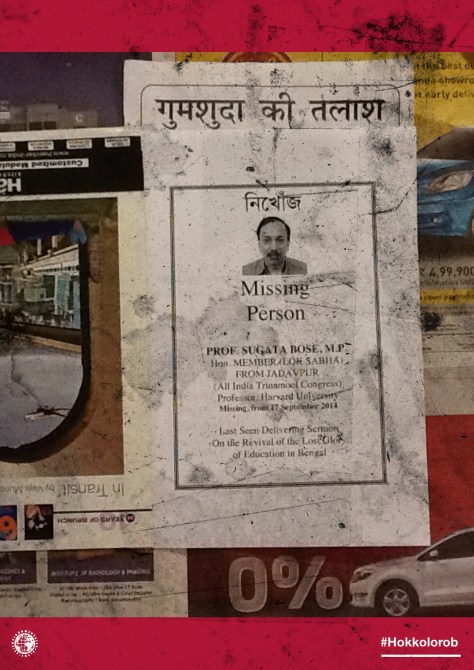
Missing Person Notice: Ben Zachariah

Guest Post by Benjamin Zachariah

Looking for Prof. Bose

It was not so long ago that Sugata Bose, now Lok Sabha Member for Jadavpur, made his way back from Harvard to serve his people. West Bengal had voted for ‘poriborton’, ‘change’, and as everybody assumed that Bengalis loved their fellow-men who had been anointed abroad, Sugata Bose returned to conquer the heights of Bengali higher education. The plan was to use a brand name within a brand name to shore up another brand name : Harvard, Netaji, Presidency. The Trinamul Congress, Bose was confident, would not interfere with his plans. Or so he said in public; his mother, Krishna Bose, had been the Trinamul Congress’s Presidential candidate, and long regarded as the force behind the attempted bhadramahilafication of Didi, apparently a prerequisite for political acceptability in West Bengal (otherwise known as Waste Bengal or Poschimbongobongo). It was therefore no surprise that his plans did not diverge from the plans of the TMC, although ‘internal differences’ were often heard of. It was also no surprise that, as the attempts to turn Presidency ‘University’ into the font of moral and intellectual legitimation for the TMC faltered, Bose took the mantle of his great-uncle upon himself and stood as a candidate for the TMC in the Lok Sabha elections, from the Jadavpur constituency. There was not even the pretence that Sugata Bose stood on his own credentials: his campaign marches were led by a child in Netaji uniform and Netaji glasses, prompting a complaint to the National Commission for Protection of Child Rights.

Now, in the Jadavpur constituency, duly won by Netaji’s heir, and not by a hair’s breadth, developments at Jadavpur University are cause for concern.

Continue reading Missing Person Notice: Ben Zachariah

Note of Solidarity with the Students of Jadavpur University: Jagriti

Guest Post from Jagriti, Women’s Development Cell, Bharati College, Delhi University

(The authors of this post sent it to us at Kafila saying –  “…since we don’t have any direct mean of contacting them (Students of Jadavpur University), we wish to do so through, if possible, your website”. Accordingly, we are uploading this post to honour their wishes and their sense of solidarity)

Dear students of Jadavpur University (JU),

We, members of Jagriti, the Women’s Development Cell of Bharati College, University of Delhi, pledge our support to your struggle for gender justice and administrative and pedagogical accountability. We are deeply disturbed to receive news of administrative indifference to sexual harassment and of the consequent police brutality in JU campus. We unanimously and unequivocally condemn JU administration and the West Bengal police for ignoring students’ valid demands and for orchestrating violence onto students.

In iterating our support to you, we iterate also the belief that the entire administrative mechanism of JU failed to protect its own students. We hold the Vice-Chancellor (VC) and the Dean of Students responsible for not ensuring that the students’ demands were satisfactorily addressed; we also hold the Internal Complaints Committee responsible for letting what could have been only a campus-specific issue escalate into a major humanitarian and academic crisis. This incident is a lesson not just for JU but for educational institutions and workplaces globally to comprehensively commit themselves to gender justice and to accountability. University administrations are in anyway obliged to engage with their students in healthy and open dialogues on each and every issue that the students, persons whom the university is supposed to service, feel pertinent, and to do the complete opposite, to break down all communication and instead call armed police personnel to violently disperse students is totally unacceptable. JU has been known nationally as well as internationally as a hub of free and liberal thinking, and this shocking attempt to choke dissent out of it attracts our unstinting condemnation.

We support your demand for the non-extension of the tenure of Mr. Chakrabarti, the current interim VC. This issue is political, but it does not belong to any political party, and we commend your transcending political barriers in pursuance of your struggle against the JU administration. We commend your courage, strength and commitment to gender justice and to human rights, and offer our condolences for the losses which you have suffered these past few days. Through this note, we also appeal to the Governor of West Bengal to initiate a magisterial enquiry into the police brutality on JU campus, and have all officials, JU as well as police, who ordered this dismissed from service and tried in a court of law for gross dereliction of duty and for grievous injury to innocent lives.

Jagriti unanimously stands in solidarity with the complainant and the students of Jadavpur University.

This post was sent to us by Pallavi Rohatgi on behalf of Jagriti at Bharati College, Delhi University.

Jadavpur’s Infectious Autumn Thunder Goes Viral: Kasturi

Guest post by Kasturi

One of the slogans churned out of the womb of turbulent Paris in the Maydays of 1968 was ‘Don’t trust anyone over 30’. The student uprising of May ‘68 with its audacity and exaggeration might have failed. Yet the mahamichhil (grand rally) called by students which took command over the heart and pulse of Kolkata on 20th September was a literal, vivid, living embodiment of this slogan. As I stood with a video camera on a spot on the Jawaharlal Nehru Road, with hope to capture the moments and 50,000 faces that made history with each footstep, all I could see was an ocean of people most of who had perhaps not even reached their twenty fifth year, and many of who were walking their very first rally. Those slightly older, those weathered yet young at heart paced alongside them in solidarity. ‘Such a student gathering – so huge, determined and disciplined – I have not seen in my life’, wrote poet Sankha Ghosh, ‘This really moved me. It’s very early to say if this will mark the beginning of a new era but I will reiterate this is one of the biggest student rallies I have seen in my life’.

The rally was replete with slogans reflecting basic demands of the movement, but there was a unifying chant, rather a call to action, that instantly bonded with and caught the fancy of the first timers that hit the street – Hok, Hok, Hok Kolorob (‘let there be clamour’). A call, ripped off from a popular song by Bangladeshi singer Ornob and used as hashtag on social media to mobilize – was surreal, refreshing, imaginative enough to break the deafening silence, stupor and suffocation strangling students’ aspirations for democracy, freedom of expression and association across education campuses of Bengal. The other interesting aspect of this call was that unlike regular slogans where someone leads and the rest follow, here there was no single lead but many voices all chanting the four words in unison, accompanied by clapping of hands. As a comrade observed, ‘the zeitgeist and slogan of the contemporary present is #hokkolorob’!’ (‘Kolorob’/ ‘kalrav’, roughly translated here as ‘clamour’, conveys the sense of a symphony of birdsong in many Indian languages.) Continue reading Jadavpur’s Infectious Autumn Thunder Goes Viral: Kasturi

A Letter to the Vice Chancellor of Jadavpur University, Kolkata: Ahona Panda

Guest Post by AHONA PANDA

[Ek Je Cchilo VC / Once There Was a VC – Thanks to Utsavdan, and to Manik-da of Bishop Lefroy Road]

To

The Vice Chancellor,
Jadavpur University,

and the Education System of West Bengal.

Respected Sir,

I would like to return to this university a gold medal that it awarded me, then a girl of 21, in the year 2009. I’ve never worn that medal since my convocation, and it lies in the box it was awarded in. I was a student of the English department in this university, and went on to study at Oxford and University of Chicago. Continue reading A Letter to the Vice Chancellor of Jadavpur University, Kolkata: Ahona Panda

Partha Chatterjee on Partha Chatterjee – An Interview with an Impostor: Partha Chatterjee

Guest Post by PARTHA CHATTERJEE

Continue reading Partha Chatterjee on Partha Chatterjee – An Interview with an Impostor: Partha Chatterjee

From Jadavpur University, Kolkata – ‘I am, one of those survivors, who has experienced a nightmare last night’: Tanumay Naskar 


Guest Post by TANUMAY NASKAR

[ This is an account of the events of last night in Jadavpur University, Kolkata, were students sitting in on a peaceful protest against university authorities inaction on a recent complaint of sexual harrassment. What followed (an attack from two fronts, by police and goons affiliated to the Trinamool Congress) brought back memories of the many times that students have been attacked mercilessly in JU. Currently, around 40 students have had to receive medical attention, and 38 are in police detention. Protests against this event are being organized today in Kolkata (at 4:00 in the afternoon, at Jadavpur University, and at 6:00 PM at JNU in Delhi, by the JNU Students Union]

Follow this link to read a detailed time-line of the events as they unfolded.

Follow this hashtag – ‪#‎hokkolorob‬ for details of how people are responding to the situation.


I am one of those survivors who has experienced a nightmare last night.
We were singing. We were dancing. We were peacefully protesting. 
When someone yelled, “Let’s make the barricades, the police is coming”. 
After that, we saw police (READ GOONS) of grade A, barred all the entrances and charged us with Lathis.

Continue reading From Jadavpur University, Kolkata – ‘I am, one of those survivors, who has experienced a nightmare last night’: Tanumay Naskar 


Demolitions in Aya Nagar, Delhi: Thomas Crowley

Guest Post (and photographs) by THOMAS CROWLEY

The media is all praise for the central government’s rescue efforts in Kashmir, despite the evident hollowness of the government’s claims to heroism. But the press has little to say about the brutal destruction authored by the government in its capital city. Thursday, September 11, saw another demolition drive in a city that has seen far too many of them, from the Emergency to the Commonwealth Games. The demolition took place in the South Delhi neighborhood of Aya Nagar, where residents say about 250 houses were destroyed.

Aya Nagar 1

Continue reading Demolitions in Aya Nagar, Delhi: Thomas Crowley

Sailaab Nama – An Insider’s View of the Flood in Kashmir from the Outside: Gowhar Fazili

Guest Post by Gowhar Fazili

The floods in Kashmir can provide an outsider a momentary glimpse into the reality of Kashmir behind the corporate media propaganda smokescreen that is fumbling at the moment and like Truman Show (1998) exposing bits of the backstage. At the moment there are three key actors in Kashmir. There are the floods, the state and the people. Each one is on its own. One limb of the state—the state government was the first to crumble before the approaching waters.   The other limb—the mammoth military apparatus that has already inundated Kashmir since several decades, took two days to wake up to the crisis and when it finally did, its priority was to fish out the rich Indian tourists and the people close to the establishment out of the state. In the initial days, local people had to risk their own lives to get their marooned relatives to safety. Some hired local boats, some swam or waded through water, some made makeshift rafts out of anything that floats, including water tanks, car tubes, foam sheets, inflated baby bathtubs, so on and so forth to save their dear ones. The rest either drowned or kept moving up the floors of their houses as the waters kept rising until they reached their attics.

Continue reading Sailaab Nama – An Insider’s View of the Flood in Kashmir from the Outside: Gowhar Fazili

‘Son, you outgrew my lap but never my heart’ – Fauzia Ansari in search of her son: Debangana Chatterjee

On August 14, 2013, Shivam Vij wrote in Kafila  about Hamid Ansari, a young Management Studies graduate from Mumbai who crossed the border illegally to Pakistan in November 2012, to meet a young woman, and has been missing since. At the time Shivam wrote the post, there were indications that Hamid had been picked up by Pakistani security agencies.

Beena Sarwar, Pakistani human rights activist, wrote in July this year about the possibility of ‘cautious optimism’, following the directive of Peshawar High Court to Pakistan’s defence and interior ministries to provide full information about the forced disappearance of Hamid Ansari and of 25 others, who are Pakistani nationals. Her account is worth reading in full, outlining as it does, the ways in which cross border solidarities of democratic forces consistently work to soar above and also to undermine the barbed wire fences of nation-states.

DEBANGANA CHATTERJEE, a Delhi-based MA student, met Hamid’s mother a few days ago, and wrote this piece after talking to her, outlining some new developments in the case. We have retained Fauzia Ansari’s voice as far as possible in this narrative.

The story of Hamid Ansari, a 28 year old IT engineer and management studies graduate, started unfolding when I came across his mother, Fauzia Ansari at a conference on ‘Challenges to Indian Democracy’ organized in Delhi by the Coalition for Nuclear Disarmament and Peace a few days ago, on August 30-31. Fauzia Ansari is a lecturer of Hindi at a college in Mumbai. Like other mothers, Fauzia says she too had vibrant dreams of her son’s bright future. But a nightmare has unfolded instead. Continue reading ‘Son, you outgrew my lap but never my heart’ – Fauzia Ansari in search of her son: Debangana Chatterjee

Breaking the Silence about Gaza from Israel: Yehuda Shaul

Guest Post by YEHUDA SHAUL

In November 2012, Israel launched a military operation in the Gaza Strip called “Amud Anan”, the literal English translation of which is, “Pillar of Clouds”. Though, the official name in English was deemed, “Pillar of Defense”. A few days ago we launched another operation named, “Mighty Cliff”, which is officially called, “Protective Edge”. Both chosen titles are highly defensive in their essence. When I hear the names given to military operations in Gaza – especially the versions chosen for an international audience – I am reminded of my military service as a combatant in the Israeli army, whose full name (both in Hebrew and English) is: the “Israel Defense Forces” (IDF).

Continue reading Breaking the Silence about Gaza from Israel: Yehuda Shaul

Anti-Semitism Cannot be the Response to Israeli Attacks on Gaza

Extremely disturbing reports of anti-Israeli sentiments spilling over into generalized attacks in France have been coming in lately.  This is completely unacceptable. The just cause of the Palestinian people is about occupation of their land by Zionists and all Jews are by no means responsible for the brutality that Israel is exhibiting in its attacks on Gaza, sparing no one and even specifically targeting small children. This is not a religious or a racial issue but one of political justice. Let us make no mistake that any attempt to make it into either a religious or race issue will only harm the Palestinian cause in the long run. Here is an extract from a report in Huffington Post:

France’s politicians and community leaders have criticised the “intolerable” violence against Paris’ Jewish community, after a pro-Palestinian rally led to the vandalizing and looting of Jewish businesses and the burning of cars.

It is the third time in a week where pro-Palestinian activists have clashed with the city’s Jewish residents. On Sunday, locals reported chats of “Gas the Jews” and “Kill the Jews”, as rioters attacked businesses in the Sarcelles district, known as “little Jerusalem”…

Religious leaders gathered for an interfaith service on Monday to call for calm, and Haim Korsia, the chief rabbi of France, and Hassen Chalghoumi, the imam of Drancy shook hands on the steps of the synagogue.  Read the full report here

That said, it also needs to be underlined that in this no-holds-barred war, Zionists themselves have been keen and eager to see that the anti-Zionist feeling is transformed rapidly into an anti-Semitic one. Thus Mondoweiss published a Youtube video along with a report that showed that the attack on the synagogue was actually provoked by members of the Jewish Defense League. Mondoweiss’ story has since been confirmed by the President of the Synagogue de la Roquette. His words:

In an interview broadcast Friday on the 24-hour news channel i-Télé, Serge Benhaïm said that there was “not a single projectile thrown at the synagogue” and that “at no moment, were we ever physically in danger.” (“Pas un seul projectile lancé sur la synagogue”. “A aucun moment, nous n’avons été physiquement en danger.”)

While Benhaïm did not describe the street fight outside as resulting from a JDL “provocation”, he did say that the extremist group smashed up a cafe on Rue de la Roquette (“le président de la synagogue de la rue de la Roquette confirme également que la LDJ a ‘cassé des chaises et des tables’) in order to confront pro-Palestinian demonstrators (“pour aller livrer ce face-à-face”). He added that he did not condone the action, and described the JDL as having a “bad reputation” using a French phrase – “une renommée un peu sulfureuse — that is not done justice by a literal translation. Read the full Mondoweiss report here.

There will be – as there are – desperate attempts to drown the groundswell of anti-Israeli sentiment in a flood of outcries of anti-Semitism, by all interested quarters. There is need therefore to see that no quarter is yielded to those who wish to transform the present mood of anti-Zionism into anti-Semitism.