Category Archives: Movements

POSCO Pratirodh Sangram Samiti to Jairam Ramesh

This is a press release issued last week by PPSS, pointing out the illegalities   being committed by the Orissa government and the Central Ministry of Environment and Forests in connection with the POSCO project.

POSCO PRATIRODH SANGRAM SAMITI

Dhinkia, Nuagaon, Gadkujang; Jagatsinghpur District, Orissa

11.08.2010

To:

Shri Jairam Ramesh

Minister of Environment and Forests

Paryavaran Bhavan

New Delhi

Sub: Regarding POSCO project – need for withdrawal of illegal final clearance; new Meena Gupta Committee clearly aimed at delaying matters Continue reading POSCO Pratirodh Sangram Samiti to Jairam Ramesh

Have I Joined the Popular Front?

In the past few weeks, I have been asked over and over again, not always in jest, if I had joined the Popular Front. I am not surprised. The police investigation around the violence against the college teacher at Muvattupuzha has broken all previous records in not only the violation of human and civil rights, but also in the silence of Kerala’s enlightened intellectuals. If I recall right, only Nandigram evoked such a dense and deliberate silence from them. No wonder, anyone who speaks up against the manner in which the police is being armed and authorized against ‘bad muslims’ is immediately dubbed a supporter of the Popular Front. But I am intrigued by this simple question, by which the entire history of that person’s engagement with discussions around religion and the state is erased. Continue reading Have I Joined the Popular Front?

What Went Wrong in Kashmir? Rekha Chowdhary

Guest post by REKHA CHOWDHARY

This article was also published in Kashmir Times
What went wrong in Kashmir? This is one pertinent question that needs to be addressed seriously before any corrective measures can be applied. Situation would certainly normalise after some time, but apparently ‘normal’ situation in case of Kashmir does not indicate anything. The vibrancy of ordinary life and the day-to-day routine followed for days and even months, takes only moments to break. Underneath the normalcy, the turbulence is ever present and can surface at any point of time. Every turbulent period however provides clues to the real problem, and one should hold on to these clues, if one really wants to do something about it.

So what do we see in the present turbulence? Firstly, though the crisis revolves around the stone-pelting youth, one can clearly say that the real problem is not that of the stone-pelters. Neither the theory of LeT being responsible for it, nor the issue of money being paid to stone pelters, nor the vested interests making the most of the situation explains the crisis.

The Great Incendiary Hunt Takes Off in Kerala

I have been watching the whole drama that has been unfolding after the unspeakable and utterly condemnable act of violence at Muvattupuzha in central Kerala early this month, which has been widely interpreted as the first instance of ‘Talibanist’ violence here, with a sinking feeling in the pit of my stomach. A whole manhunt has followed it and this continues to be front-page news in many Malayalam newspapers, especially the Mathrubhumi. Continue reading The Great Incendiary Hunt Takes Off in Kerala

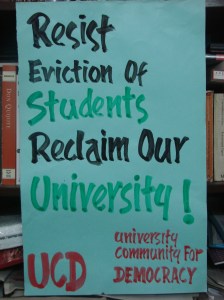
Down with Students’ Eviction from College Hostels!: University Community for Democracy

A Guest Post sent to us by BONOJIT HUSSAIN and NAINA MANJREKAR

[This is a leaflet issued by the University Community for Democracy which has come up in the wake of the arbitrary and authoritarian eviction of students from the hostels of Delhi University for the Commonwealth Games. Initially starting off as a facebook discussion among students, the anger has now snowballed into a movement that seeks to go beyond the immediate question of evictions. – AN]
Down with eviction of students from College Hostels!
Onwards to students self-activity!!
University Community for Democracy poster

The current administration of Delhi University has attempted to reshape the University through a series of sinister agendas – be it the introduction of semester system, the European Studies Programme or the biometric identification system. All of them have shared one thing in common: the thwarting of democratic debate on proposals for change, and the routine violation of regulatory protocols.

The latest episode has been the eviction of students (2,000 students according to reports) from a number of hostels in Delhi University in order to make them available for the Commonwealth Games. Hostels are being renovated and beautified for the officials and visitors of the Games, while students are scrambling around for their own accommodation. The students, like the 40,000 families on the Yamuna bank, are now among the many that have been displaced in the name of national glory. What comes into question is the fact that the University has agreed to avail of 20 crores of rupees from the Commonwealth Games project without taking any cognisance of how and where such resources are generated. It has thus become an accomplice in the larger process of reckless corporatisation that the whole city is undergoing in the bid of becoming a “global city”.

Notes on the Jaffna Economy

One of my friends in a discussion group in Colombo on ‘Democratising State and Society’ put forward the following challenge couple weeks ago.  He said, a year after the end of the war, many of us who had been following the situation of the displaced people in the North, including the lack of freedom of movement and the militarization of the North have done little to engage the oppressive economic conditions of those affected by the war and now being resettled.  That challenge was in the back of my mind as I visited Jaffna for ten days over the last two weeks.  I tried to grasp what one could on a short visit.  The following are very preliminary notes on the Jaffna economy, with a particular emphasis on agriculture and fisheries which ¬- despite technocratic and diasporic dreams of an information economy – continue to determine the economic life of the larger Jaffna population.  These tentative notes I hope will stimulate some interest towards much needed research on the economy of the Jaffna District and the war affected Northern and Eastern Provinces. Continue reading Notes on the Jaffna Economy

युद्ध के रूपक का जाल

अपने नए बंद के दौरान सी.पी.आई.( माओवादी) ने छत्तीसगढ़ और बंगाल में अर्ध-सैन्य बल के सदस्यों के साथ बस में सफ़र कर रहे साधारण ग्रामीणों की हत्या करने के बाद जो बयान दिया है उससे यह साफ़ है कि अभी शायद इससे भी क्रूरतापूर्ण कार्रवाइयां देखने को मिल सकती हैं. उनके प्रवक्ता ने कहा कि उन्होंने पहले ही छतीसगढ़ के ग्रामीणों को यह बता दिया था कि उन्हें इस युद्ध की विशेष परिस्थिति में क्या करना है और क्या नहीं करना है. मसलन, पुलिस या सैन्य बल के लोगों के साथ किसी भी तरह का कारोबार या सामजिक व्यवहार प्रतिबंधित है, उनके साथ किसी सवारी गाडी में सफ़र नहीं करना है. इसके आगे उनसे यह भी कहा गया है कि उन्हें पुलिस या सैन्य बल की गतिविधियों पर नज़र रखनी है, उनके पास हथियारों का अंदाज़ करना है और इसकी खबर जनता सरकार को देते रहना है. इस दल के प्रवक्ता ने कहा कि साधारण लोगों का मारा जाना अफसोसनाक है लेकिन एक तरह से वे खुद इसके लिए जिम्मेदार थे क्योंकि उन्होंने चेतावनी का उल्लंघन किया था. Continue reading युद्ध के रूपक का जाल

To P Chidambaram: Response from a member of civil society, by AK Agrawal

By ARUN K AGRAWAL

Dear Shri Chidambaram,

This is in response to your repeated taunts on NDTV that the civil society must respond to the wanton killing by the Naxals. It appears that the interview was tailor made for getting the consent of the Cabinet for more firepower and airpower to combat the Maoist. The diabolic support of Arun Jaitly, be it by describing you an injured martyr, was designed to achieve his ambition through the support of the mining barons of the BJP ruled states.

As a member of society I hope I am being civil in disagreeing with you on your hard line approach against the innocent tribal. I also hope you will not find it too shocking for being accused of being largely responsible for the rise and growth of Naxalism, as the following happened on your watch as Finance minister.

Continue reading To P Chidambaram: Response from a member of civil society, by AK Agrawal

Death of villager mired in controversy

Sukma: Chhattisgarh police confirmed the death of Mediyum Bandhi, a 27
year old adivasi from Aitpal village, in the Sukma police station in
Chhattisgarh’s Dantewada district. Police claim they shot Bandhi
as he tried to escape from the lock-up. Bandhi was shot three times in
the back with a Self Loading Rifle (SLR).

Bandhi’s death comes three days after an explosion, triggered by the
Communist Party of India (Maoist), killed 15 civilians and 16 members
of the security forces.  Many of the policemen killed were Special
Police Officers based out of Sukma.

According to Sukma police, Bandhi, 27, and Podiyam Kosa, 25,
were apprehended on Wednesday morning from Aitpal
village as they were wanted in a number of criminal cases including
murder.  The two villagers were first taken to Gadiras police
station for questioning and then brought to Sukma as Gadiras does not
have a lock-up.

The Maoist Killings Once Again

The news of  killing of more than 40 people travelling in a bus  blown by a blast in Dantewada is only a new chapter in the  book of brutalities that is  being scripted in Chhatisgarh and other parts of India in the name of ‘the People’. Six people were found slain in Rajnandgaon just a day before this blast. A day before that four villagers were killed in Bengal  because they were thought be close to the CPM and were labeled as informers. Two days before these killings in Bengal, two villagers who were Gram Rakhis were killed in Orissa. This list does not include the death of 6 Para Military persons in Chhatisgarh who were killed a land mine detonated by the Maoists in Chhatisgarh.

Are these operations  a response to the Operation Green hunt launched by the government? Or are they part of the Protracted  People’s War that is being carried out by the purest revolutionaries of our earth who do not waver and shiver at the sight of blood? Or, as some friends caution us  from rushing to any conclusion, as Shuddhabrata Sengupta has done, are they “ ‘ false flag operations’ conducted by some rogue elements of the state machinery” or directly endorsed by the state ? How are we to know who is the perpetrator of these crimes? Do we wait for a statement from the Maoists and if they deny their involvement, launch an investigation to find out the real culprit? It took nearly a month for the Maoists to officially own the attack which extinguished the lives of 76  CRPF men. The Maoist leadership congratulated the bravery of its combatants who had achieved the feat of eliminating a whole company of Indian para military force.
Continue reading The Maoist Killings Once Again

Arms and the Maoists

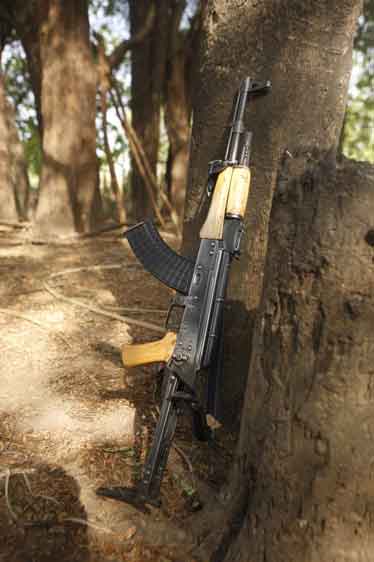
Ramana's AKS series Kalashnikov Rifle. A variant of the AK-47, the 'S' references the 'Skladnoy' or 'folding' metallic shoulder stock. Photo: Ishan Tankha/Open Magazine
In 1988, Ravula Srinivas paid Rs 100,000 for a black-market AKS series Kalashnikov rifle with a light-wood finish and a folding metal shoulder stock.  On April 6 this year, the same rifle was pressed into service in an ambush that killed 75 members of the Central Reserve Paramilitary Force and one Head Constable of the Chhattisgarh police in Chhattisgarh’s Dantewada district.
In the intervening years, Ravula has grown from a young student from Warangal into Ramana, Secretary of the South Bastar Regional Committee of the CPI (Maoist) and chief architect of the April 6 attack; unchanged by the years, the rifle has never left his side.
On April 14, The Hindu was offered access to Maoist leaders Ramana and Ganesh Ueike. in the Jagargunda forests in Dantewada.  The visit offered a rare, though by no means comprehensive, insight into how the CPI (Maoist) sources, maintains and distributes weapons among its cadres.

Rahul Gandhi and the Dalit votebank in Uttar Pradesh

This article by me has appeared (.pdf) in the Economic and Political Weekly.

On 14 April this year party general secretary Rahul Gandhi launched the Congress’ biggest campaign to revive itself since 1989. The date was carefully chosen, Ambedkar Jayanti, because he is trying to win over dalit votes in Uttar Pradesh (UP). In 1989 the Congress’ support base in UP was made up of a rainbow coalition of brahmins, Muslims and dalits. The Congress has to woo these communities again to regain power in UP.

The brahmin community took to the now ruling Bahujan Samaj Party (BSP) in small numbers in the 2007 Vidhan Sabha election primarily because there was no strong brahmin leader after Bharatiya Janata Party (BJP) leader Atal Behari Vajpayee became politically inactive. Brahmins see in Rahul Gandhi a potential “brahmin” leader. The UP Congress president, legislative leader and Youth Congress president in the state are all from the brahmin community.

Muslim support is no longer enchained to the Samajwadi Party (SP) because their bete noire, the BJP, is powerless these days in both the centre and the state. As a result the Muslim vote is being fought for, as a three-way contest between BSP, SP and Congress. BSP head and Chief Minister Mayawati’s stratagem is to therefore change her party’s core support base constructed out of the “brahmin-dalit” alliance into a Muslim-dalit alliance.

The dalits, wooed away en masse by the Kanshi Ram-Mayawati duo of the BSP for years, would be the hardest to win back for the Congress. In fact, a year ago the very idea would have sounded ludicrous. But today, Mayawati’s angry reaction to the Congress’ bid to woo dalits is indication that the Congress may be winning over dalits. How is this happening? Continue reading Rahul Gandhi and the Dalit votebank in Uttar Pradesh

Tata sponsored ‘Green Hunt’ in Kalinga Nagar to destroy democratic tribal movement

[We publish below a press statement released by Prafulla Samantra and others, received via Biswajit Mohanty, which highlights just how the struggle of the tribal people in Kalinganagar is being met with the most ferocious repression by the local administration acting at the behest of the Tatas. Kalinganagar is emblematic of the many democratic mass movements and struggles that are being crushed by a predatory state in cahoots with corporate capital. – AN]

Yesterday the Collector of Jajpur district assured Dabar Kalundia, a tribal leader of Bisthapan Birodhi Jan Manch (BBJM) that he would come to Baligotha village on 28 March for a meeting with the dissenting villagers and find a solution to the prevailing conflict. But within a day the Collector has broken his word as today about 24 platoons of armed policemen have been deployed in Kalinga Nagar to suppress the democratic and non-violent movement of the BBJM. It is feared that there will be bloodshed at a larger scale than 2 Jan 06 when 14 tribal men, women & children were killed in a police shootout. The villagers fear the police will attack tomorrow morning.
Continue reading Tata sponsored ‘Green Hunt’ in Kalinga Nagar to destroy democratic tribal movement

The Rumour of Maoism

This essay has been published in the current issue of Seminar (No. 607, March 2010).

In his classic Elementary Aspects of Peasant Insurgency in Colonial India, Ranajit Guha outlines a certain methodological imperative for the historian who wanted to ‘get in touch with the consciousness of [peasant] insurgency’ when access to it is barred by the discourse of counter-insurgency that structures official records. How does one look beyond this discourse of the state that frames the archives in order to gain access to the voice of the rebels? Guha’s solution was relatively simple: Counter-insurgency, he argued, derives directly from insurgency and is so determined by the latter that ‘it can hardly afford a discourse that is not fully and compulsively involved with the rebel and his activities.’1

Unlike British Marxist historian E.J. Hobsbawm who had tried to track the story of ‘social bandits’ through a somewhat problematic reading of folklore,2 Guha warned that ‘folklore relating to peasant militancy can be elitist too’, for many singers and balladeers belonged to upper-caste families who had fallen on hard times and were, therefore, often suspicious of the revolt of the lower castes or tribals. Guha underlined that though the records of the colonial state and its police officials registered the voice of those hostile to the insurgents – including landlords and usurers – they could not avoid being shaped by the will of the insurgents. His conclusion therefore was that the presence of rebel consciousness could be read in the body of evidence produced by the discourse of counter-insurgency itself.

The burden of Guha’s argument was that in order to decode the language of counter-insurgency, it was often enough to simply reverse the values in the terms used by the official discourse: thus ‘badmashes’ simply meant peasant militants and not ‘bad characters’; ‘dacoit village’ would indicate an entire village involved in the resistance and ‘contagion’ would most likely refer to the solidarity generated by the uprising.

Those were happier days from the historian’s point of view. For the peasant and tribal insurgencies that Guha was discussing were organic struggles which drew their leadership from amidst the peasants or tribal communities themselves. Whether it was Sidhu Kanoo, Birsa Munda or Titu Mir – the leadership of the movements and their ‘ideologies’ derived directly from the world of the tribals. The context of colonial India was also, in a significant sense, quite clearly polarized and the possibility of written records being produced from a multiplicity of sources was simply out of the question. It may, therefore, be possible to follow Guha’s suggestion and merely reverse the values in order to get a sense of that other discourse. Continue reading The Rumour of Maoism

A Believer’s Obeisance: Soumitra Ghosh

SOUMITRA GHOSH is with the National Forum of Forest Peoples and Forest Workers (NFFPFW). A guest post received via Dilip Simeon

Does the Outlook article [by Arundhati Roy] tell us anything new? The Maoists have built a dream world in Dandakaranya, and the gun has heralded that dream. The Green Hunt is meant to shatter this dream, period…Apart from good anecdotes, there’s no political analysis of the movement, and the problematique of the Maoist movement was cursorily mentioned.

It seems rationality is banished. You oppose Green Hunt means that you see in the Maoists an unending series of dreamers and visionaries, and the making of a new world order. She doesn’t even bother to be historical, the history is what her contacts tell her.

What is utterly unacceptable is this woolly-headed,mushy and journalistic portrayal of a political movement. The Maoist movement was never,and won’t be a ‘adivasi’ movement,in the sense we use the term to describe a range of social movements.

Continue reading A Believer’s Obeisance: Soumitra Ghosh

‘constitutional’ Realities: Priya Thangarajah

Guest post by PRIYA THANGARAJAH

The piece is unfinished, consciously so. The thought is unfinished and needs to be fleshed out and thus posting this, so that this important idea can be evolved collectively. It raises a range of questions and contributes to existing debates on constitutional law from a social change/human rights perspective. (consciously the words ‘constitution’ and ‘india’ are not capitalised. ) It contributes significantly to an understanding, not just of north east india but the realities of chattisgarh, jharkhand, bihar, kashmir to name a few. It helps us understand all the wars fought within the country – ‘constitutionally’ about which much is being said in the media and elsewhere by state and non-state actors.

The constitution, some argue, is an aspirational document. Baxi states that it is created to protect the rights of the impoverished. Created to protect the weaker sections of society and that’s how the Dworkinian trumping of rights works. Rights of the weaker parties always trumps that of the stronger. But whatever the aim of the constitution maybe, its sacrosanct. Sacred. Amendments can be made with great difficulty but the constitution per se cannot be done away with for a new one. Continue reading ‘constitutional’ Realities: Priya Thangarajah

Sree Narayana Guru, the Left, and Chitralekha: Joe.M.S.

This is a guest post by JOE M. S.

The recent controversy associated with the brutal persecution of a Dalit working woman, Chitralekha  by the hoodlums of a ‘leftist’ union has gained wide attention, bringing into limelight the plight of  Dalits in Kerala. The men who participated in this ’festival of masses’, according to reports, predominantly belong to the  backward caste Ezhava/ Theeya community. Anybody with a bit of social concern would have definitely condemned the incident . They would even have expressed their regrets at the deviation of the people belonging to Ezhava caste, the disciples of Srinarayana guru, the famous social reformer, from the avowed policies advocated  by him. But I think, here lies a problem. A re-look at the social history of Kerala is needed   to understand whether the Chitralekha incident is a deviation from the pronounced objectives of the Srinarayana movement as  such, as it is popularly understood, or  the roots for  such a development  was inherent in the   trajectory of   the Narayana movement itself. This does not belittle  the genuine intentions Guru had for social emancipation, at a personal level.

In spite of the cultural specificities of northern Kerala  where  these atrocities were perpetrated on Chitralekha, I think a general study of the impact of Srinarayanism on the whole of Kerala may be of some help to analyse the increasing backward caste arrogance vis-a-vis Dalits. This is particularly so as the discourse on the assumed efficacy of Sri Narayana Guru’s thought is  invoked constantly  by the civil society of Kerala, eternalising his importance  in all spheres. So  I think, a glance at the  impact of his life and efforts  can shed light on the of the constitution/ construction of modern Ezhava identity and the problems associated with it.

Continue reading Sree Narayana Guru, the Left, and Chitralekha: Joe.M.S.

‘Non-violent terrorism’ and India’s dirty war in Kashmir

Guest post by MOHAMAD JUNAID

Dozens of young boys have been arrested across Kashmir under draconian laws over the last few weeks. The charges that have been filed against them range from “waging war against the state” to defiling “state honor”. In recent months Indian military and police commanders have described protests in Kashmir as “agitational terrorism” and “non-violent terrorism” in order to justify violent clampdown on protests by Kashmiris.

As the headlines go, Stone-pelting an act of war: J-K gov.

In the same period around 8 people, mostly teenagers, have been either shot to death or fatally injured by indiscriminate use of tear-gas shells. Over the last two years the number of dead in shootings is more than a hundred. Meanwhile thousands of people have been injured. Many of them will be left with permanent physical disabilities. The police authorities have banned any peaceful assembly of people. Many places in downtown Srinagar and other towns have reported police brutalities. Even the villages are not being spared. Only yesterday, mourning villagers were attacked by CRPF troopers in Redwani in South Kashmir. Dozens of them were injured by CRPF’s indiscriminate firing. Most of the injuries were inflicted above the waist showing an intention to kill Continue reading ‘Non-violent terrorism’ and India’s dirty war in Kashmir

“Twenty million out of twenty-seven million Nepalis are with the Maoists”: Interview with Prachanda

(This interview of Pushpa Kamal Dahal by me appeared in the Nepali Times a few days ago, along with another report.)

A conversation with Maoist supremo Prachanda this week not only brought out the party’s new line, but also offered a glimpse into his analysis of current politics and future strategy.

The root of the problem, according to Prachanda, is that the 12-point understanding was ‘tactical’ for everyone who signed the agreement. “The other side felt they could get us into the mainstream and weaken us. We thought we could use the process to create a new mainstream, which would include political competition.” Neither side got what they wanted, entirely. This paradox has forced the parties to make a more fundamental strategic choice. “This was inevitable and we are now heading for a crisis climax.”

The army issue is key. Neither side feels it lost the war. Prachanda concedes that no one won the war in material terms, but believes the Maoists won the war politically. “It was the then Royal Nepalese Army’s mandate and goal to protect the monarchy and block a republic,” he says. “They failed, and the PLA played a big part in bringing about this change.” The way forward for these “recognised and legitimate” outfits, he says, is “sticking to the peace accord, democratising the army and professionalising the PLA.” Continue reading “Twenty million out of twenty-seven million Nepalis are with the Maoists”: Interview with Prachanda

Presidential Elections, Minorities and Political Space

The following is the write up of my talk given at the Centre for Society and Religion on January 11th, 2010.  I have articulated some of these concerns in greater depth in my recent article in the January 9th, 2010 issue of the Economic and Political Weekly titled, ‘State Power, State Patronage and Elections in Sri Lanka’.

Presidential Elections, Minorities and Political Space

First, I want to thank the organisers for inviting me to speak here at the Centre for Society and Religion (CSR), an institution that embodies a great tradition of conscious political engagement.  It is an honour to be given this privilege and I hope this series of discussions at CSR on the upcoming presidential and parliamentary elections is the beginning of many discussions and debates on important political issues facing the peoples of our country.  Indeed, the space that has opened up in recent weeks in the context of the elections should be expanded by all social institutions and social forums concerned about peace, justice and democracy.  I for one believe that the debates, the social pressures and the mobilisations in the lead up to and after elections are at times even more important than the act of electing a President or other political representatives. Continue reading Presidential Elections, Minorities and Political Space

Jyoti Basu and the Passing of an Era

Jyoti Basu, Promode Dasgupta and Saroj Mukherjee

With the passing away of Jyoti Basu, the curtain comes down on an entire chapter of communist history in this country. Basu may have been the last of a generation that learnt its politics in the stormy days of the anticolonial struggle and who lived through the ups and downs of politics – from the underground days of the 1930s and 1940s to the initiation into the ways of parliamentary democracy. The long engagement with parliamentary democracy was to lead to Basu’s – and the communists’ – long stint in power. And Basu was one of those rare communists for whom democracy was not a mere strategic imperative but a value to be internalized.

Basu belonged to a generation of communists who worked their way from the bottom up. Trained in Law in England, Basu returned to India, determined to work in the communist movement. Muzaffar Ahmed, the then secretary of the undivided communist party sent him to work among the railway workers. It was there, working among and organizing the railway workers that Basu entered mass politics.  It was probably in this process that Basu developed his distinctive style of politics – a style that we have yet to understand fully.

Continue reading Jyoti Basu and the Passing of an Era