Category Archives: Movements

Rahul Gandhi and the Dalit votebank in Uttar Pradesh

This article by me has appeared (.pdf) in the Economic and Political Weekly.

On 14 April this year party general secretary Rahul Gandhi launched the Congress’ biggest campaign to revive itself since 1989. The date was carefully chosen, Ambedkar Jayanti, because he is trying to win over dalit votes in Uttar Pradesh (UP). In 1989 the Congress’ support base in UP was made up of a rainbow coalition of brahmins, Muslims and dalits. The Congress has to woo these communities again to regain power in UP.

The brahmin community took to the now ruling Bahujan Samaj Party (BSP) in small numbers in the 2007 Vidhan Sabha election primarily because there was no strong brahmin leader after Bharatiya Janata Party (BJP) leader Atal Behari Vajpayee became politically inactive. Brahmins see in Rahul Gandhi a potential “brahmin” leader. The UP Congress president, legislative leader and Youth Congress president in the state are all from the brahmin community.

Muslim support is no longer enchained to the Samajwadi Party (SP) because their bete noire, the BJP, is powerless these days in both the centre and the state. As a result the Muslim vote is being fought for, as a three-way contest between BSP, SP and Congress. BSP head and Chief Minister Mayawati’s stratagem is to therefore change her party’s core support base constructed out of the “brahmin-dalit” alliance into a Muslim-dalit alliance.

The dalits, wooed away en masse by the Kanshi Ram-Mayawati duo of the BSP for years, would be the hardest to win back for the Congress. In fact, a year ago the very idea would have sounded ludicrous. But today, Mayawati’s angry reaction to the Congress’ bid to woo dalits is indication that the Congress may be winning over dalits. How is this happening? Continue reading Rahul Gandhi and the Dalit votebank in Uttar Pradesh

Tata sponsored ‘Green Hunt’ in Kalinga Nagar to destroy democratic tribal movement

[We publish below a press statement released by Prafulla Samantra and others, received via Biswajit Mohanty, which highlights just how the struggle of the tribal people in Kalinganagar is being met with the most ferocious repression by the local administration acting at the behest of the Tatas. Kalinganagar is emblematic of the many democratic mass movements and struggles that are being crushed by a predatory state in cahoots with corporate capital. – AN]

Yesterday the Collector of Jajpur district assured Dabar Kalundia, a tribal leader of Bisthapan Birodhi Jan Manch (BBJM) that he would come to Baligotha village on 28 March for a meeting with the dissenting villagers and find a solution to the prevailing conflict. But within a day the Collector has broken his word as today about 24 platoons of armed policemen have been deployed in Kalinga Nagar to suppress the democratic and non-violent movement of the BBJM. It is feared that there will be bloodshed at a larger scale than 2 Jan 06 when 14 tribal men, women & children were killed in a police shootout. The villagers fear the police will attack tomorrow morning.
Continue reading Tata sponsored ‘Green Hunt’ in Kalinga Nagar to destroy democratic tribal movement

The Rumour of Maoism

This essay has been published in the current issue of Seminar (No. 607, March 2010).

In his classic Elementary Aspects of Peasant Insurgency in Colonial India, Ranajit Guha outlines a certain methodological imperative for the historian who wanted to ‘get in touch with the consciousness of [peasant] insurgency’ when access to it is barred by the discourse of counter-insurgency that structures official records. How does one look beyond this discourse of the state that frames the archives in order to gain access to the voice of the rebels? Guha’s solution was relatively simple: Counter-insurgency, he argued, derives directly from insurgency and is so determined by the latter that ‘it can hardly afford a discourse that is not fully and compulsively involved with the rebel and his activities.’1

Unlike British Marxist historian E.J. Hobsbawm who had tried to track the story of ‘social bandits’ through a somewhat problematic reading of folklore,2 Guha warned that ‘folklore relating to peasant militancy can be elitist too’, for many singers and balladeers belonged to upper-caste families who had fallen on hard times and were, therefore, often suspicious of the revolt of the lower castes or tribals. Guha underlined that though the records of the colonial state and its police officials registered the voice of those hostile to the insurgents – including landlords and usurers – they could not avoid being shaped by the will of the insurgents. His conclusion therefore was that the presence of rebel consciousness could be read in the body of evidence produced by the discourse of counter-insurgency itself.

The burden of Guha’s argument was that in order to decode the language of counter-insurgency, it was often enough to simply reverse the values in the terms used by the official discourse: thus ‘badmashes’ simply meant peasant militants and not ‘bad characters’; ‘dacoit village’ would indicate an entire village involved in the resistance and ‘contagion’ would most likely refer to the solidarity generated by the uprising.

Those were happier days from the historian’s point of view. For the peasant and tribal insurgencies that Guha was discussing were organic struggles which drew their leadership from amidst the peasants or tribal communities themselves. Whether it was Sidhu Kanoo, Birsa Munda or Titu Mir – the leadership of the movements and their ‘ideologies’ derived directly from the world of the tribals. The context of colonial India was also, in a significant sense, quite clearly polarized and the possibility of written records being produced from a multiplicity of sources was simply out of the question. It may, therefore, be possible to follow Guha’s suggestion and merely reverse the values in order to get a sense of that other discourse. Continue reading The Rumour of Maoism

A Believer’s Obeisance: Soumitra Ghosh

SOUMITRA GHOSH is with the National Forum of Forest Peoples and Forest Workers (NFFPFW). A guest post received via Dilip Simeon

Does the Outlook article [by Arundhati Roy] tell us anything new? The Maoists have built a dream world in Dandakaranya, and the gun has heralded that dream. The Green Hunt is meant to shatter this dream, period…Apart from good anecdotes, there’s no political analysis of the movement, and the problematique of the Maoist movement was cursorily mentioned.

It seems rationality is banished. You oppose Green Hunt means that you see in the Maoists an unending series of dreamers and visionaries, and the making of a new world order. She doesn’t even bother to be historical, the history is what her contacts tell her.

What is utterly unacceptable is this woolly-headed,mushy and journalistic portrayal of a political movement. The Maoist movement was never,and won’t be a ‘adivasi’ movement,in the sense we use the term to describe a range of social movements.

Continue reading A Believer’s Obeisance: Soumitra Ghosh

‘constitutional’ Realities: Priya Thangarajah

Guest post by PRIYA THANGARAJAH

The piece is unfinished, consciously so. The thought is unfinished and needs to be fleshed out and thus posting this, so that this important idea can be evolved collectively. It raises a range of questions and contributes to existing debates on constitutional law from a social change/human rights perspective. (consciously the words ‘constitution’ and ‘india’ are not capitalised. ) It contributes significantly to an understanding, not just of north east india but the realities of chattisgarh, jharkhand, bihar, kashmir to name a few. It helps us understand all the wars fought within the country – ‘constitutionally’ about which much is being said in the media and elsewhere by state and non-state actors.

The constitution, some argue, is an aspirational document. Baxi states that it is created to protect the rights of the impoverished. Created to protect the weaker sections of society and that’s how the Dworkinian trumping of rights works. Rights of the weaker parties always trumps that of the stronger. But whatever the aim of the constitution maybe, its sacrosanct. Sacred. Amendments can be made with great difficulty but the constitution per se cannot be done away with for a new one. Continue reading ‘constitutional’ Realities: Priya Thangarajah

Sree Narayana Guru, the Left, and Chitralekha: Joe.M.S.

This is a guest post by JOE M. S.

The recent controversy associated with the brutal persecution of a Dalit working woman, Chitralekha  by the hoodlums of a ‘leftist’ union has gained wide attention, bringing into limelight the plight of  Dalits in Kerala. The men who participated in this ’festival of masses’, according to reports, predominantly belong to the  backward caste Ezhava/ Theeya community. Anybody with a bit of social concern would have definitely condemned the incident . They would even have expressed their regrets at the deviation of the people belonging to Ezhava caste, the disciples of Srinarayana guru, the famous social reformer, from the avowed policies advocated  by him. But I think, here lies a problem. A re-look at the social history of Kerala is needed   to understand whether the Chitralekha incident is a deviation from the pronounced objectives of the Srinarayana movement as  such, as it is popularly understood, or  the roots for  such a development  was inherent in the   trajectory of   the Narayana movement itself. This does not belittle  the genuine intentions Guru had for social emancipation, at a personal level.

In spite of the cultural specificities of northern Kerala  where  these atrocities were perpetrated on Chitralekha, I think a general study of the impact of Srinarayanism on the whole of Kerala may be of some help to analyse the increasing backward caste arrogance vis-a-vis Dalits. This is particularly so as the discourse on the assumed efficacy of Sri Narayana Guru’s thought is  invoked constantly  by the civil society of Kerala, eternalising his importance  in all spheres. So  I think, a glance at the  impact of his life and efforts  can shed light on the of the constitution/ construction of modern Ezhava identity and the problems associated with it.

Continue reading Sree Narayana Guru, the Left, and Chitralekha: Joe.M.S.

‘Non-violent terrorism’ and India’s dirty war in Kashmir

Guest post by MOHAMAD JUNAID

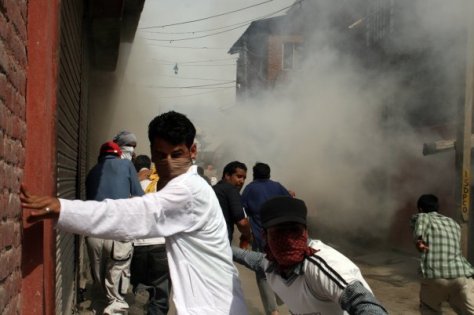
Dozens of young boys have been arrested across Kashmir under draconian laws over the last few weeks. The charges that have been filed against them range from “waging war against the state” to defiling “state honor”. In recent months Indian military and police commanders have described protests in Kashmir as “agitational terrorism” and “non-violent terrorism” in order to justify violent clampdown on protests by Kashmiris.

As the headlines go, Stone-pelting an act of war: J-K gov.

In the same period around 8 people, mostly teenagers, have been either shot to death or fatally injured by indiscriminate use of tear-gas shells. Over the last two years the number of dead in shootings is more than a hundred. Meanwhile thousands of people have been injured. Many of them will be left with permanent physical disabilities. The police authorities have banned any peaceful assembly of people. Many places in downtown Srinagar and other towns have reported police brutalities. Even the villages are not being spared. Only yesterday, mourning villagers were attacked by CRPF troopers in Redwani in South Kashmir. Dozens of them were injured by CRPF’s indiscriminate firing. Most of the injuries were inflicted above the waist showing an intention to kill Continue reading ‘Non-violent terrorism’ and India’s dirty war in Kashmir

“Twenty million out of twenty-seven million Nepalis are with the Maoists”: Interview with Prachanda

(This interview of Pushpa Kamal Dahal by me appeared in the Nepali Times a few days ago, along with another report.)

A conversation with Maoist supremo Prachanda this week not only brought out the party’s new line, but also offered a glimpse into his analysis of current politics and future strategy.

The root of the problem, according to Prachanda, is that the 12-point understanding was ‘tactical’ for everyone who signed the agreement. “The other side felt they could get us into the mainstream and weaken us. We thought we could use the process to create a new mainstream, which would include political competition.” Neither side got what they wanted, entirely. This paradox has forced the parties to make a more fundamental strategic choice. “This was inevitable and we are now heading for a crisis climax.”

The army issue is key. Neither side feels it lost the war. Prachanda concedes that no one won the war in material terms, but believes the Maoists won the war politically. “It was the then Royal Nepalese Army’s mandate and goal to protect the monarchy and block a republic,” he says. “They failed, and the PLA played a big part in bringing about this change.” The way forward for these “recognised and legitimate” outfits, he says, is “sticking to the peace accord, democratising the army and professionalising the PLA.” Continue reading “Twenty million out of twenty-seven million Nepalis are with the Maoists”: Interview with Prachanda

Presidential Elections, Minorities and Political Space

The following is the write up of my talk given at the Centre for Society and Religion on January 11th, 2010.  I have articulated some of these concerns in greater depth in my recent article in the January 9th, 2010 issue of the Economic and Political Weekly titled, ‘State Power, State Patronage and Elections in Sri Lanka’.

Presidential Elections, Minorities and Political Space

First, I want to thank the organisers for inviting me to speak here at the Centre for Society and Religion (CSR), an institution that embodies a great tradition of conscious political engagement.  It is an honour to be given this privilege and I hope this series of discussions at CSR on the upcoming presidential and parliamentary elections is the beginning of many discussions and debates on important political issues facing the peoples of our country.  Indeed, the space that has opened up in recent weeks in the context of the elections should be expanded by all social institutions and social forums concerned about peace, justice and democracy.  I for one believe that the debates, the social pressures and the mobilisations in the lead up to and after elections are at times even more important than the act of electing a President or other political representatives. Continue reading Presidential Elections, Minorities and Political Space

Jyoti Basu and the Passing of an Era

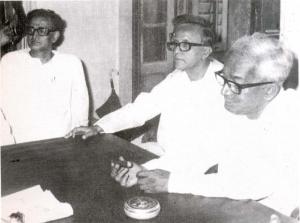
Jyoti Basu, Promode Dasgupta and Saroj Mukherjee

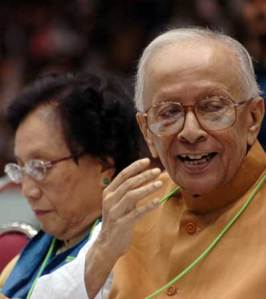
With the passing away of Jyoti Basu, the curtain comes down on an entire chapter of communist history in this country. Basu may have been the last of a generation that learnt its politics in the stormy days of the anticolonial struggle and who lived through the ups and downs of politics – from the underground days of the 1930s and 1940s to the initiation into the ways of parliamentary democracy. The long engagement with parliamentary democracy was to lead to Basu’s – and the communists’ – long stint in power. And Basu was one of those rare communists for whom democracy was not a mere strategic imperative but a value to be internalized.

Basu belonged to a generation of communists who worked their way from the bottom up. Trained in Law in England, Basu returned to India, determined to work in the communist movement. Muzaffar Ahmed, the then secretary of the undivided communist party sent him to work among the railway workers. It was there, working among and organizing the railway workers that Basu entered mass politics.  It was probably in this process that Basu developed his distinctive style of politics – a style that we have yet to understand fully.

Continue reading Jyoti Basu and the Passing of an Era

Remembering Jyoti Basu: Monobina Gupta

This is a Guest Post by MONOBINA GUPTA

Jyoti Basu
Jyoti Basu

While waiting endlessly at the CPI-M headquarters in Delhi, we, the Left-beat reporters, often used to say how incredibly dull the beat would be in the absence of Jyoti Basu, Indrajit Gupta, and Harkishen Singh Surjeet. With their distinctive personalities and distinct style, each one had livened up the tedious job of keeping track of the Left parties and their leaders. Indrajit Gupta would speak in a baritone voice, trotting out gruff answers; the ever-amiable Harkishen Singh Surjeet, never failed to pick up the phone, was always ready to share a laugh with us. But of these three colourful Communist stalwarts, it was Basu who used to keep us most preoccupied, with his ‘read-between-the-line’ one-liners, exasperatingly short, brusque replies, sometimes even with outright sarcasm or rudeness.

Continue reading Remembering Jyoti Basu: Monobina Gupta

The Žižekian Counter-Revolution

[Slovenian Lacanian-Marxist-Hegelian philosopher and cultural theorist, Slavoj Žižek is visiting India currently and will be delivering a few lectures here. This post is prompted by his visit. Interested Delhi-ites can catch him speak on

4 Jan 2010. 5 p.m. on
“Ideology in the Post-ideological World: The Case of Hollywood”
at Sarai-CSDS. 29 Rajpur Road, Civil Lines, Delhi
and
5 Jan 2010. 7 p.m.
“Tragedy and Farce”
Stein Auditorium, India Habitat Centre, New Delhi]


imaaN mujhe roke hai jo khiNche hai mujhe kufr
ka’aba mere peeche hai kaleesa mere aage

[Faith holds me back when infidelity beckons/
Behind me, the Kaaba; before me, the Church]

It is difficult to miss the immense subversiveness of the  dilemma encapsulated in Ghalib’s couplet above.  This dilemma of the believer is produced by the constant threat of corruption – the Kaaba behind the believing Muslim holds him back from indulging in, or falling prey to, the infidelities and temptations that always lie in wait.

Substitute Marxism for Kaaba  and ‘postmodernism’ for Church, and you have the perfect Žižekian incarnation of this classic Ghalibian dilemma: Not quite at home in the Faith (Lacan, jouissance, surplus-enjoyment, the Real…) and yet, not able to leave it either, for the fear of what might befall one deserting the Order. Faith is the anchor that holds one back from committing all kinds of blasphemies. Nevertheless, the seductions of infidelity force our philosopher to turn for sustenance precisely to the philosophers and ideas he mistrusts: unlike most members of the Marxist faith, he repeatedly returns to Nietzsche, Heidegger, to Derrida, Foucault, Laclau and Deleuze. He takes over their language and makes himself at home in it. Is there a hidden jouissance in thus frequenting this forbidden territory?

Continue reading The Žižekian Counter-Revolution

Savarna Terror Erupts in Kerala

(with inputs from Mythri Prasad Aleyamma)
I admit, this title sounds sensationalist. But one can hardly avoid resorting to it when confronted with utterly stupefying news of attacks on dalit colonies almost next door to Kerala’s capital city and nerve centre of Malayalee politics, and that too, by a minor anti-political force that has a legacy of anti-South Indian hatred — the Siva Sena. And of course when one is confronted with the hard, stony silence of almost all sections of the media about this. The mystery of the murder of an elderly, innocent morning-walker in Varkala, a town close to Thiruvananthapuram (of which I wrote in an earlier post) still remains a mystery; the police story is so full of holes that it looks like a sieve. But the Guardians of our Free Press are still lapping police versions and not conducting independent investigation. Activists who have dared to do so have been heckled and hounded, even senior and respected human rights activists like B.R.P.Bhaskar, by the Siva Sena, and their protests have been ignored. Meanwhile violence continues to be unleashed against the supporters of the group that has been accused of murder, the Dalit Human Rights Movement (DHRM).

Continue reading Savarna Terror Erupts in Kerala

Social Boycott of Dalits in MP: Uncivil Society, apathetic administration

(A Fact Finding Report issued by Nagrik Adhikar Manch and Yuva Samvad.)

(The situation in the Gadarwara Sub Division of District.Narsinghpur (MP) has been in a state of constant flux since last 3-4 months. The Dalits living in the villages adjoining Gadarwara have been condemned to a life of fear and intimidation.Their human rights and dignity are being at stake.

Obviously there is a concrete reason behind this sudden spurt in violence against them.They have refused to remain subservient to the interests of the upper/dominant castes and have decided to speak up.

Instead of taking concrete steps to guarantee the human rights of dalits granted to them under constituion, the administration has preferred to remain silent or at best supportive of the interests of the dominant castes only. One can easily see why Madhya Pradesh happens to be the state which tops the list of atrocities on tribals and stands second when it comes to cases of atrocities against dalits.)

Dist: Narsinghpur(Madhya Pradesh)
Tehsil: Gadarwara
Affected Area: Dalits (Ahirwar community) in Gadarwara and adjoining villages
Villages visited by the Fact Finding Team: Nander, Madgula, Devri and Tekapar

Date: 7th and 9th November 2009
Members of Fact Finding Team

Jai Bhim, Moolchand Ahirwar, Javed, Skand Shukla, Manoj, Satyam, Shivkumar, Nishant Kaushik

Brief Introduction to Narsinghpur District. Continue reading Social Boycott of Dalits in MP: Uncivil Society, apathetic administration

Maoist Revolution, Liberal Naivete

Responding to the call by the Home Minister and prime Minister of India to halt violence to facilitate talks, Maoist leaders ridiculed them and asked them to get their history right. According to them it was wrong to say that the ‘war’ that is now being played out in the theatre of the jungles of  Chhatisgarh, Jangalmahal of Bengal, Jharkhand , Orissa and other states is of recent origin. This is only the latest   phase of the “people’s war” that is being waged since 1967 and would not stop until the ultimate objective of establishing Communism is achieved.  The Constitution of the CPI(Maoist) is very unambiguous, “The ultimate aim or maximum programme of the party is the establishment of communist society. This New Democratic Revolution will be carried out and completed through armed agrarian revolutionary war i.e. the Protracted People’s War with area wise seizure of power remaining as its central task.”

Area wise seizure of power is what the Maoists are busy with. They have succeeded, partially or fully in many areas of different states. What needs to be understood is that it is not development they are opposed to as is evident from the statements of their leaders.  They are ready to let development activities take place, provided it is under their supervision. They are interested more in making themselves the lone political voice of the people. One should ask why do they keep abducting, harassing, threatening or killing the members and leaders of other political parties in the areas where they rule using the strength of their guns? Why do they force people to resign from other political parties? Their answer is very simple: whoever is seen to interrupt or impede the armed people’s war is either a class enemy or an agent of the class enemy represented by the state and is therefore on the other side of the war.
Continue reading Maoist Revolution, Liberal Naivete

WHOSE LAND IS IT ANYWAYS? Public Meeting organized by National Alliance of People’s Movements

An open discussion on the relevance and implications of Land Acquisition (Amendment) Bill  and Rehabilitation and Resettlement Bill 2009
Saturday, November 21, Gandhi Peace Foundation, Deen Dayal Upadhyay Marg, New Delhi 2 – 6 pm.

Friends,

The current economic model of growth prevalent in India , with strong neo-liberal leanings, needs to be re-assessed in the wake of increasing alienation and dispossession of vast populations from their land and the wave of resistance, both violent and non-violent, against such activities that are being played out in many parts of the country.

In the wake of an armed operation against escalating Maoist insurgency; adivasis, particularly in Chhattisgarh, Jharkhand, West Bengal Orissa, Andhra Pradesh and Maharashtra are stiffly resisting the industrial development that threaten their traditional way of life; farmers around the country raging against acquisition of their lands in the name of growth and development – the importance of revisiting the proposed Land Acquisition (Amendment) Bill, 2009 (LAA) and Rehabilitation and Resettlement Bill 2009 (R&R) is paramount, if not imperative.

We the struggling communities from different regions of the country have resisted the government’s machinations of enacting a faulty Resettlement and Rehabilitation Act and introducing amendments to the Land Acquisition Act, promoting private and corporate interests over public good. We gathered recently in Delhi in July 2009 and our struggle gained a significant boost when the Acts could not be passed in the Budget session of the Parliament. We have been in Delhi since 18th November and held meetings at Kanjhawala, Jantar Mantar and JNU and explained our concerns on these two Bills but also on the fires raging in the country and the path of growth on which the country is being pushed today.

It is in this context that we invite you to discuss the relevance and implications of these half hearted measures for the millions of people who are struggling to retain their means of livelihood and seek meaningful rehabilitation from a system in which they no longer seem to have faith.

The panelists for this meeting are :

K B Saxena, Former Secretary, Ministry of Rural Development and Agriculture, Union of India now at Council for Social Development, New Delhi

Ramaswamy Iyer, Former Secretary, Ministry of Water resources, Union of India and Government’s nominee on the Sardar Sarovar review Committee now at Centre for Policy Research, New Delhi

Sanjay Parikh, Senior Counsel, Supreme Court of India.

Roma, Kaimur Kshetra Mahila Mazdoor Kisan Sangharsh Samiti, NFFPFW  (Sonbhadra)

Gautam Bandopadhyay, Nadi Ghati Morcha , Chattisgarh

Dayamani Barla, Adivasi Mulnivasi Astitva Raksha Manch, Jharkhand, INSAF [to be confirmed]

Sandhya Devi, Kalahandi Mahila Mahasangh, Orissa

Praffula Samantray, NAPM Orissa

Medha Patkar, Narmada Bachao Andolan & NAPM

MODERATOR : Anand Mazgaonkar, Paryavaran Suraksha Samiti, NAPM Gujarat

Mass Politics, Violence and the Radical Intellectual

With the debate on Maoist violence and Operation Green Hunt hotting up, things are taking a disturbing turn. The danger really is that all spaces of radical political movements and indeed the entire space of the Left, part of it gradually vacated by the parliamentary ‘Left’ in recent decades and finally completely abandoned in the last few years, will now be virtually erased. In its place will be installed the phantom of an ‘armed struggle’ that threatens to completely swallow up the spaces once occupied by different shades of the CPI(ML) and the Naxalite movement and other Continue reading Mass Politics, Violence and the Radical Intellectual

Debating “Political Islam”

A number of activists from the South Asia Solidarity Initiative (SASI) in New York have initiated a reading group on South Asia.  The notes below are the second in a series of commentaries following reading discussions that some members of the reading group are posting on Kafila.  This is an attempt to broaden the discussions and in the process make it a productive dialogue to understand developments in the region and deepen our solidarity.

Debating “Political Islam”

– Svati Shah, Biju Mathew, Sumitra Rajkumar, Prachi Patankar and Ahilan Kadirgamar

The recent debate between Samir Amin and Tariq Amin-Khan on a left perspective on “political Islam” in the context of imperialism, published in Monthly Review (December 2007 and March 2009), provides an opportunity to reflect on a number of issues that have vexed the anti-war movement and the left with respect to the on-going wars in Iraq and Afghanistan.  The most vexing of these issues has been the question of whom the left should target as its allies in those countries, and what position the left should take toward so-called “political Islam,” represented by Islamist groups calling for an end to foreign occupation.  The definition of “political Islam” is presented below in relation to each critique.  Both Amin and Amin-Khan are in agreement that both “political Islam” and imperialism have to be challenged simultaneously.  There are no strategic questions here, in terms of joining one to fight the other.  The defeat or withdrawal of both is desirable in the interests of a people-centred politics.  In imperialism’s projection of capitalism and reactionary Islam’s comfort with capitalism (that class and gender do not trouble it) they are objective allies even if on the ground their adherents are military enemies.  This initial agreement then delves into a number of nuanced questions that must be considered in order to foster the return to a people centred politics in both of these countries, and the regions as a whole.

Continue reading Debating “Political Islam”

Complicating the ‘Naxalite’ debate

(An edited version of this piece appeared as the cover story in Himal Southasian in December 2007. The report is based on travels across Andhra to Bihar in October of the same year. At a time when most of the media is pushing the same binaries we must avoid, this may help in conveying the enormous complexity of the issue. Some facts may be outdated, and Kafila readers will be more familiar with certain issues like Salwa Judum than this reporter, but the broad argument may still have some relevance. I will follow this up with posts on the Nepali process and Indian Naxalites.)

A people’s movement. The greatest internal security challenge. Struggle for the rights of the poor, tribals, Dalits, landless. Compact Revolutionary Zone with influence in almost 200 districts. A socio economic problem rooted in exploitation and idealism. A law and order threat . True people’s democracy. A criminal, authoritarian and opportunistic outfit. The revolution will smash the Indian state. The Maoists are ants and can be crushed anytime .

Neat black and white portrayals have come to characterise one of the most complex stories of our times. The Naxal as the saviour and the state as the oppressor. The state as protector and Naxal as the villain. Numbers and scale of action act as the judge of Maoist spread and activity. 1608 incidents of Naxalite violence and 677 people killed in 2005; 1509 incidents and 678 killed in 2006; 249 persons killed till June 2007. Continue reading Complicating the ‘Naxalite’ debate

Open Letter to Noam Chomsky: Nirmalangshu Mukherjee

[We publish below an open letter to Noam Chomsky, written in the wake of his endorsement of a statement against ‘Operation Green Hunt’, issued recently by a large number of intellectuals in India and in the US. Nirmalangshu’s letter is important because it raises some very serious questions that are being brushed under the carpet by sections of the radical intelligentsia.  Unlike Nirmalangshu, I would not put ‘radical’ within scare quotes, since it is precisely this that highlights the immense tragedy of our times. Radical intellectuals – truly radical intellectuals – once again find themselves caught in this situation where in order to oppose state violence, they will wilfully turn a blind eye to the violence of armed nihilist gangs, simply because these claim to speak on behalf of the oppressed – a claim that Nirmalangshu’s letter exposes in all its falsity. He lays bare how the politics that goes by the name of ‘Maoism’ (i.e. CPI-Maoist) believes in violently erasing all other voices of opposition to and criticism of the state, but that of itself. This brand of politics in fact lives in symbiosis with the state – delegitimizing all forms of mass democratic politics. At this moment one deeply misses the courageous voice of the late Balagopal – recently slightingly dubbed a ‘liberal humanist’ by a spokesperson of the Maoists, at a meeting meant to salute his memory. I cannot help recalling here the feeling of immense sadness many of us were overcome by, watching and hearing speakers at this meeting (in Delhi) for Balagopal – speakers who were ungenerous, if not carping and outright dismissive of the courage of conviction that was Balagopal. AN]

Dear Prof. Chomsky,

I saw your support to the statement issued by Sanhati in the form of a letter to the prime minister— endorsed by some intellectuals from India and abroad. Three points are transparent: (a) the Indian government is planning a massive armed operation in the tribal-hilly areas in the eastern part of the country, (b) the poorest of the poor and the historically marginalised will suffer the most in terms of loss of lives, livelihood and habitat, and (c) for whatever it’s worth, an all-out campaign by democratic forces is needed to resist the armed invasion of people’s habitat by any party. To that extent, the statement does bring out the urgency of the matter.

Continue reading Open Letter to Noam Chomsky: Nirmalangshu Mukherjee

More on Murder from Kerala

These are happy days in which everyone in Kerala wants too settle the land dispute at Chengara. A happy consensus between the Left and the Right seems to be growing there, after the Congress leader of the Opposition, Oommen Chandy, decided to take on Godfathership of the land struggle. The very language of the struggle had changed – interestingly, from ‘we are landless squatters’ to ‘we are settlers’! Now, it is well-known in Kerala that these terms have had different sorts of political associations – ‘squatter’ with the Left, and ‘settler’ with (largely) the Right. Indeed, this was inevitable perhaps, given the fact that the New Left didn’t look very keen on ‘squatters’. However, it is clear that neither dalit or tribal organisations are going to be part of the negotiations towards the final package –today’s newspapers report that prominent tribal and dalit leaders have protested against the state’s reluctance to negotiate with them. It would be very convenient for both the Left and the Right to delegitimize – indeed criminalize – tribal and dalit organizations. And what luck that precisely that boon has been granted to them by the sudden eruption of a ‘lower-caste terrorist group’ (according to the police), the ‘Dalit Human Rights Movement’!

Continue reading More on Murder from Kerala