Category Archives: Politics

Can accessibility alone create an inclusive society for persons with disability? Tony Kurian

Guest Post by TONY KURIAN

Amidst the noisy campaigns of “Make In India and Digital India”, a campaign called “Accessible India” was launched by the Central Government recently and unsurprisingly this did not catch much media attention. Department of Persons with Disabilities, Ministry of Social Justice & Empowerment has launched the Accessible India Campaign (Sugamya Bharat Abhiyan), as a nation-wide flagship campaign for achieving universal accessibility for Persons with Disabilities.

The campaign is an extremely welcome initiative in a country like India which is home to more than 2.1 million officiallyrecognized disabled and a lot more who are not counted by the decadal exercise of census. While the campaign disserves much appreciation, it offers an appropriate opportunity for us to rethink some of our common sense, or at least that of majority about disability and disabled. Continue reading Can accessibility alone create an inclusive society for persons with disability? Tony Kurian

Sursuri: Swaang

SWAANG is a Mumbai based cultural group, whose members include actors, writers, directors, singers and composers primarily working with the Hindi Film Industry in Mumbai. The members come from different parts of India and have been associated with progressive arts in the past.

Sursuri, their melodious new song, its melody in stark contrast to the bitterness of the lyrics, reflects on the indifference to growing injustice and intolerance in our country. It asks – What do you do when freedom, pluralism and rationalism are under relentless attack? Relax, don’t speak up, slurp up that hot tingling tea…and fall asleep.

Why the Ban on Cow Slaughter is not Just Anti-Farmer but Anti-Cow as Well: Sagari R Ramdas

SAGARI R. RAMDAS writes in The Wire:

The recent killings of Mohammad Akhlaq, Noman and Zahid Ahmad Bhatt on the claim that they were slaughtering cows is not only an attack on the right to life, livelihood and diverse food cultures but an assault on the entire agrarian economy.

The cynical fetishisation of cows by Hindutva politicians is not only profoundly anti-farmer but, paradoxically, also anti-cow.

What these bigots fail to realise is that the cow will survive only if there are pro-active measures to support multiple-produce based cattle production systems, where animals have economic roles. The system must produce a combination of milk, beef, draught work, manure and hide, as has been the case in the rain-fed food farming agriculture systems of the sub-continent over the centuries.

In meat production systems – whether meat from cattle, buffaloes, sheep, goat, pigs or poultry – it is the female which is reared carefully in large numbers to reproduce future generations, and the male that goes to slaughter. It is only the sick, old, infertile and non-lactating female that is sold for slaughter. In every society where beef consumption is not politicised, farmers known that eating the female bovine as a primary source of meat will compromise future production, and hence they are rarely consumed.

Read the rest of this article here.

Statement of outrage against police crackdown on students at #Occupy UGC: Faculty Feminist Collective, JNU

The Faculty Feminist Collective of JNU stands in solidarity with the students protesting the revocation/review of the UGC non-NET fellowship. We are outraged at the brutal police action against students gathered in a protest demonstration since yesterday, without a single convincing response from the UGC or the MHRD that could allay the anxieties of thousands of students across India that the non-NET fellowship will not be discontinued. Prevarication on this basic demand by press releases announcing the setting up of a review committee has only indicated a malafide intent.

We are deeply dismayed to hear of the reports of significant injuries to unarmed protestors and the detention of a number of students by the police until late last night.

The MHRD Minister and the UGC Chairperson should understand that the situation can only be defused by their unequivocal assurance to the academic community that there shall be no rollback or any other amendment of the eligibility of students for the UGC Non-NET Fellowship scheme for the universities that are already in receipt of these fellowships in this or future academic years.

Furthermore, it should take positive and visible steps to meet students’ demands for an enhancement of fellowship remuneration and undertake to extend this fellowship scheme to state universities as well.

Education is a right, not a privilege, and as members of the academic community, we will resist all moves to subvert this basic understanding.

We fully endorse the JNUSU’s call for a strike, and in protest at state action and in solidarity with students, we will not be taking classes today.

The students have returned to UGC. Let us assemble there to show that we stand with them.

Palestinian Women from Occupied East Jerusalem Call for Protection: Jerusalemite Women ’s Coalition

A Statement by the JERUSALEMITE WOMEN’S COALITION

We women of occupied East Jerusalem call for immediate protection as we witness and suffer the widespread and serious violations of Palestinian human rights, including physical attacks and injuries, severe psychological threats, and persecution by the Israeli settler-colonial state and settler entities.

We urge the international community to act and defend the rights of Palestinian children, women, and men, including the right to a safe life amidst the constant attacks, excessive and indiscriminate use of force used by the Israeli oppressive apparatus, acts of violence and daily terror committed by Israeli Jewish civilians, including settlers. This brutality is intimidating our lives, provoking our youth, willfully causing death and bodily and psychological harm, and disabling and injuring of our community members.

We, a group of Palestinian women, mothers, sisters, daughters and youth—and in the name of the “Jerusalemite Women’s Coalition”—call upon the international community to protect our families, community, and children. We are calling for the protection of our bodily safety and security when in our homes, walking in our neighborhood, reaching schools, clinics, work places, and worships venues. Continue reading Palestinian Women from Occupied East Jerusalem Call for Protection: Jerusalemite Women ’s Coalition

When I see them, I see us

Received via LINDA GORDON

Produced by Black Palestinian Solidarity

Low Intensity, High Impact Communalism Targeting better off Muslims: Janhastakshep Report on Dadri killing

See also another fact-finding report earlier published on Kafila.

National Minorities Commission report on Dadri killing here.

JANHASTAKSHEP REPORT:

On 2nd October 2015 a team of Janhastakshep comprising of academics, journalists and a student went to Basehada village in Dadri tehsil of Gautam Buddh Nagar District to investigate the incidence of communal lynching of a Muslim man Akhlaq and attack on his son Danish (who is battling for life) on the 28th of September for allegedly killing a calf and eating beef. The team comprised of academics Dr Vikas Bajpai from Jawaharlal Nehru University and Prof Ish Mishra from Hindu College, Delhi University; journalists – Anil Dubey, Rajesh Kumar and Parthiv and student activist of Hindu college, Delhi University, Sheetal.

The Context

It is noteworthy that the incident at Bishara village comes in wake of uninterrupted controversies and communal tensions that have been kept alive around the issue of cow slaughter / ban on beef in different parts of the country; as also several incidents of communal violence; intimidation and killing of intellectuals who have opposed the Sangh parivar’s communal designs and its retrogressive sociopolitical agenda. i

It is in this context that the present incident of communal lynching at Bishara village cannot but be seen as another link in the chain of above mentioned developments.

Bishara Village

The village itself has a long existence in time that was claimed to date back to at least four to five centuries. It is a big village with as many as 9,500 votes corresponding to a population of around 15,000 and up to 2,500 families approximately. The village is part of a satta i.e. a grouping of seven villages dominated by Rajputs. Apart from the Rajputs the other Hindu castes are the Brahmins, the Lohars (blacksmiths), the Kumhars (earthen ware artisans), the Jatavs (leather workers), Dhimars (a caste of fishermen and palanquin bearers) and the Balmikis (the sweepers). Along with these there are between 35 to 40 Muslim families in the village. Continue reading Low Intensity, High Impact Communalism Targeting better off Muslims: Janhastakshep Report on Dadri killing

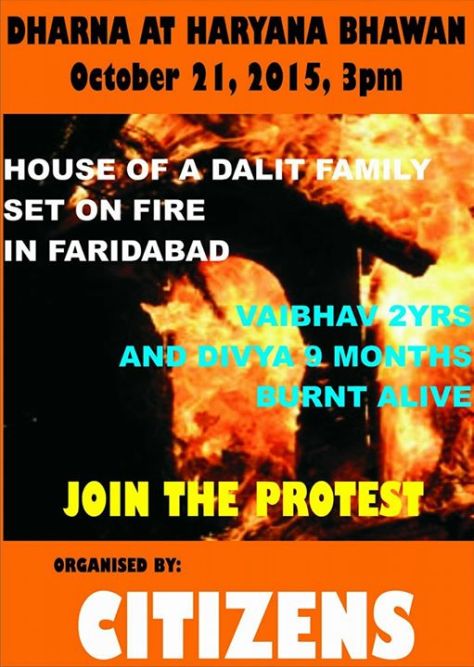
Protest Demonstration Against Burning of Dalit House and Children in Haryana

The endless violence that has always been part of Dalit life is now acquiring new dimensions as Dalits refuse to carry out upper caste diktat and confront aggressive upper castes emboldened by the Hindutva brigade.

Citizens call for demonstration

You are wrong Mr Prime Minister – It was not a fight, but plain murder : Sanjay Kumar

Guest Post by Sanjay Kumar 

In an election rally in Bihar on 8 October, country’s Prime Minister exhorted his audience with a homily pretty standard in India’s secular discourse. He asked Hindus and Muslims to decide whether they want to fight each other, or fight poverty together. His call against communal strife had come ten days after a Muslim man was lynched by a mob in Bisada, a village near the mofussil town of Dadri, 50 km from the national capital. There was no reference to events in Bisada in Mr Modi’s speech, yet ‘PM has spoken on Dadri lynching’ became the prime news on TV, and headline news in every newspaper the next day. If nations are imagined communities, then the media in the neo-liberal era imagines itself to be the prime mover and shaker of national imagination. And, when the ‘national leadership’ had remained silent on an important national news for more than a week, a subtle disquiet had indeed settled; as if, the story maker was not getting suitable yarn to complete the web and tie open leads. This may explain media’s eagerness to combine Mr Modi’s election rally remarks with Dadri lynching, about which he actually said nothing. Perhaps the media is expecting too much, and has a rather pompous self image. The women of Bisada had assaulted reporters and TV crews on 3 October, accusing them of presenting only one side of the story, bringing a bad name to their village and disrupting normal life. We have a Prime Minister who is pained even when a pup is killed under a motor car. Is not it unjust to expect him to express his anguish publicly every time some one is murdered in this  huge country of ours? The PM has declared many times that his one motivation and project is to build a strong and vibrant India. Should not his country men and women be content with the nation’s highest elected official using his exemplary social media skills for projecting a happy and confident mood. Would not shouting from the roof top on issues about which he is genuinely worried tarnish the very image he has been so painstakingly trying to build? Continue reading You are wrong Mr Prime Minister – It was not a fight, but plain murder : Sanjay Kumar

The Fiction of Fact Finding: Harassment of Delhi University Teachers Union President


PLEASE JOIN PROTEST AGAINST SHAMEFUL HARASSMENT OF DR. NANDITA NARAIN – MONDAY THE 19TH OF OCTOBER, VICEREGAL LODGE, DELHI UNIVERSITY 10.30 AM- 1.30 PM.


01Fir08-09.qxp
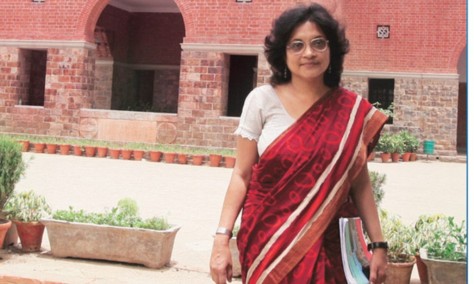
Dr. Nandita Narain, President of the Delhi University Teachers Association.

With apologies to Manoj Mitta’s excellent book on 2002 by the same name, it appears that yet another fact-finding commission has made a mockery of the process of law, not to mention truth and justice. Dr. Nandita Narain – yes that blood-curdling, fearsome figure in the picture above – has been accused of disrupting the work of 3 colleges in Delhi University and asked to appear before a fact finding committee appointed by the University, 10 days before the term of the current Vice Chancellor Professor Dinesh Singh ends. For those not acquainted with Dr. Narain, she is the popular President of the Delhi University Teachers Association, beloved Mathematics professor in St. Stephens’ College and a brilliant scholar in her own right. Having contested and won the recent Delhi University Teachers Association elections against the V.C’s relentless pressure tactics and a blitzkrieg of campaigning and publicity by other parties including the government-friendly National Democratic Teachers’ Front, Dr. Narain has evidently had nothing but her enormous personal integrity going for her.

Continue reading The Fiction of Fact Finding: Harassment of Delhi University Teachers Union President

Neoliberalism, Hindutva Supremacism and Challenges before Revolutionary Movement

Dear Comrades

I feel honoured to be here to be part of the sixth conference of Human Rights Forum*. Many thanks are due to the organisers to invite a left activist like me to this deliberations and giving me an opportunity to share my ideas.

For me it was a belated realisation that the conference is taking place around sixth death anniversary of the legendary activist for human rights and for justice late K Balgopal, who played a key role in the formation of the Forum. It does not need underlining that late K Balagopal was a rare combination of a scholar – mathematician by passion and lawyer by commitment – and activist who not only broke new grounds in the discourse around civil liberties and human rights but did not hesitate to raise uncomfortable questions when the time came. One can still imagine the loss you all must have felt when he suddenly left six years ago. As rightly mentioned by the late K G Kannabiran in his obituary then, how he was ‘one in a century rights activist’ who brought on agenda ‘jurisprudence of insurgence’. Continue reading Neoliberalism, Hindutva Supremacism and Challenges before Revolutionary Movement

A Letter to Modi from a Former Supporter: Bhawni Mehrotra

Guest post by BHAWNI MEHROTRA

Dear Modiji,

I’m glad you spoke. Even though it was devoid of any personal remorse and limited to calling the Dadri lynching an “unfortunate and unwarranted” incident at Sasaram. Even though it was to cash in on ‘communal harmony’ during an election rally in Bihar. Even though it was a mere paraphrasing of the President’s quote once before at Nawada (we know of your limited vocabulary beyond acronyms and your “may-the-force-be-with-you” love for quoting). Still, I’m glad that you managed something! However, the one thing that you have failed miserably to manage (and let’s leave the ambling economy and your familial relations out of this) is the ‘fringe elements’ that come as part of the ‘BJP family pack’ offer.  Sadly, under your ‘good governance’, the fringe has been asserting itself as the mainstream. Even sadder is that under ‘you’, the fringe is the mainstream.

The icing on the cake are your own MPs and ministers. Initially, what I thought of as verbal diarrhea on their part is actually proving to be a string of comments that are a part of a larger orchestrated communication message. Each message has a defined audience suited to their language and idioms. They all suffer from a dangerous saffron strain, exactly the kind that has fathered the ISIS, the Taliban and so on. Whether it be Yogi Adityanath’s remark, calling on Hindus to organize themselves; or Sadhvi Niranjan Jyoti’s unparalleled comparison between a “Ramzaada” and a “Haramzada”; or Nitin Gadkari’s reminder of the government being one of “Rambhakts”- all seem to be competing for being the most ridiculous. Did you mean “Hindutva First” and not “India First”? I’m sorry that I was so awestruck by your gazillion rupee election campaign (the one thing that you managed brilliantly) that I didn’t read the fine print. Therefore, it is not your failure, it’s mine. Had I voted sensibly, Mohammad Akhlaq wouldn’t be dead today. Continue reading A Letter to Modi from a Former Supporter: Bhawni Mehrotra

The Indian Unconscious : Ravi Sinha

Guest Post by Ravi Sinha

There is yet another head on the political platter of the world’s largest democracy. This head is not metaphorical. It does not signify a disgraced leader or a government that has fallen. It is a literal head dripping with literal blood – battered with bricks that supported a leg-less bed. The bed belonged to one Muhammad Akhlaq who lived in a village called Basehara in Dadri, Uttar Pradesh, not too far from the national capital of India. The head too belonged to him.

It has been only a few days but this latest episode in the long-running Indian serial is already well-known to the world. On a late September night it was announced over the loudspeakers of the village temple that there was going to be beef on Akhlaq’s dinner plate. A mob hundreds-strong – some say thousands – gathered within no time. It attacked the family killing Akhlaq on the spot and badly injuring his son, Danish.

In the meantime, meat-loafs confiscated from the family fridge have been sent for forensic examination. The system of justice must check whether it actually was beef, although, as one commentator points out, “…mere possession of beef isn’t illegal in Uttar Pradesh.”[1] Shedding helpful light on feebly lit corners of the Hindu moral universe, a prominent Hindutva ideologue wrote in a national daily, “Lynching a person merely on suspicion is absolutely wrong, the antithesis of all that India stands for and all that Hinduism preaches.”[2] The lynch-mob should have waited till the forensic reports came.

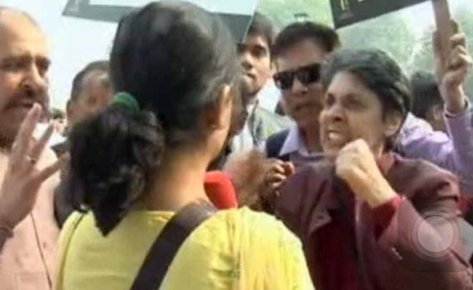
A few suspects have been apprehended for the murder. This has made the village livid with anger. There are protestations that those arrested are innocent. Journalists have been attacked for making such a big thing out of a small matter and bringing a bad name to the village. Cameras have been broken and OB vans damaged. There is a pertinacious wall of angry women guarding the village against any further intrusion by outsiders who can neither understand the village mind nor the Indian culture.

It is not easy to understand the collective mind of an Indian village. Even learned anthropologists are of little help. Their ethnographic techniques of studying a form of life from its internal standpoint are particularly susceptible to the rationalizations of a complex cultural species. If anyone has a chance, it would, perhaps, be a villager who has stepped out – an Archimedean Point created out of the same cultural universe. Ravish Kumar, by now a near iconic journalist and anchor of a prominent Hindi news channel, stood out for this very reason.[3] His eyes could see the natural rhythm and the instinctual response of an Indian village in the immediate aftermath of a collective crime. Nearly everyone had disappeared from the village. Whoever could be found claimed that he was miles away at the time of the incident. The lynch-mob had materialized instantaneously out of thin air. It had as quickly melted away after the job was done. Everyone has now returned to defend the honor of the village and strategize about how to deal with the unwarranted intrusions of modernity including that of the law. Continue reading The Indian Unconscious : Ravi Sinha

The Indiscreet charm of Narendra Modi: Joyojeet Pal

Guest post by Joyojeet Pal

Why the Silicon Valley (Generally) Loves Narendra Modi

“Indians are the most prosperous group in the United States of America,” said comedian Rajiv Satyal, the compère of the Narendra Modi speech at the San Jose Arena in the Silicon Valley on Sept. 27. No flash of Gandhian embarrassment stood in the way of the booming cheer that followed. Later on when repeated technical bungling (ironic next to the tech bombast of the setting) led the compère to step back on stage, he kept repeating this idea alongside “Bharat Mata ki Jai!” to keep the ardor up among the 17,000-strong crowd. There appeared to be a few thousand more outside, either supporting or protesting the event. Several U.S. legislators were present, including House Minority Leader Nancy Pelosi.

Continue reading The Indiscreet charm of Narendra Modi: Joyojeet Pal

The Curious Case of a Study on Bihar Elections: Kamal Nayan Choubey and Nishant Kumar

Guest post by KAMAL NAYAN CHOUBEY and NISHANT KUMAR

[This article is a response to the lead news-cum-article written by Sanjay Kumar and Suhas Palshikar and published in The Indian Express as well as Jansatta on 7th October about the pre-poll survey related to the Bihar Legislative Assembly Election. We had sent this article to the The Indian Express, but they could not give any space to our views. – Authors]

Politically, Bihar is one of the most complex states in India. It is often difficult to provide a substantially cogent electoral prediction because of the multivariate factors that impact the political outcome in the state. The other obvious reason is the political maturity of the electorates of Bihar, who decide the fate of the candidates based on several considerations including caste orientation and the candidates’ performance in the past. Still many analysts have tried to provide a picture regarding the possible outcome of electoral fray for the Bihar Assembly Elections based on quantitative surveys. The opinion poll conducted by Lokniti-CSDS and published in The Indian Express and Jansatta, two of India’s most respected newspapers, on 7th October, 2015 was one such attempt. In the last two decades election studies in India has seen a dramatic evolution with poll surveys gaining immense popularity among both analysts as well as electorates. Lokniti-CSDS has been one of the most reliable institutions for such studies because unlike other market oriented institutions it has always focused on serious academic and intellectual understanding of electoral competition. Many reputed academicians have been part of its election studies and its publications have given new dimensions to the study and understandings about the dynamics and churnings of Indian democracy. However, the pressure of media as well as the rush to publish opinion polls seems to have affected the way CSDS-Lokniti is known to release its analysis.

The news-item in the front page of The Indian Express read ‘Advantage BJP as Bihar gets ready’. It was claimed in that news-cum-article that BJP led NDA had an advantageous edge in the forthcoming Bihar Assembly Elections over Nitish Kumar’s Grand Alliance. We are not sure whether it was the editors who chose the headline to attract attention of its readers or it was consciously decided by the poll conductors based on their analysis. Whatever the case may be, the projection of ‘Advantage BJP’ exposes fissures at several levels, most of which are evident from the data itself. The publication also forces us to pose significant questions about the way in which such opinion polls are conducted both in terms of methodology as well as the analytical categories used to understand electoral politics in a complex society as in the case of Bihar. It further creates doubts about the aim of such published opinion polls. Continue reading The Curious Case of a Study on Bihar Elections: Kamal Nayan Choubey and Nishant Kumar

House of Cards


Courtesy Indian Express
Courtesy: Indian Express.

Anybody with a passing interest in consistency or coherence might be forgiven for being stumped at the political spectacle unfolding right now. Yesterday, Prime Minister Narendra Modi assured us that his government was committed to reservations. The statement was made at a ceremony to inaugurate the Ambedkar memorial at the Indu Mills compound in Mumbai. The fact that ordinary Dalits, in the habit of thronging any joyous celebration on Ambedkar in big numbers, were kept out of the ceremony, is possibly irrelevant. After all, officialese is officialese, and no political party – certainly not the BJP – has a monopoly on stiff-necked commemorations of people’s leaders that want nothing to do with the people. It is Modi’s commitment to reservations and the Indian constitution that is of interest. In some ways a statement of this nature made at the inauguration of an Ambedkar memorial, makes perfect sense. Apart from the occasion and locale, also not coincidental was the timing of Modi’s statement – one that he himself alluded to, when he referred to the bitterly fought Bihar elections now underway, “With a BJP government in power and polls getting under way, a malicious propaganda is being spread that the government is against reservation…”. The fact that the anti-BJP mahagathbandhan (grand alliance) in Bihar has made reservations one of their chief planks, with Lalu Prasad Yadav declaring in his inimitable style that he will kill himself if reservations are removed, is relevant.

Zooming back from the Ambedkar memorial event, the PM was clearly also responding to the threat to his Sabka Saath Sabka Vikas model begun a couple of months ago by the irrepressible Hardik Patel. Patel – erstwhile BJP supporter, self-styled Patidar-Patel revolutionary and a wild child in imminent danger of being silenced (or coopted) by the BJP – was temporarily subdued by the Gujarat administration following the wave of violence over his first call for reservation, but resurfaced a couple of days ago to be the nightmare Modi hadn’t dreamed yet – saying his aim was to expose the “Gujarat model of development”. This is for the current party nothing short of the youngest born of a rambling illustrious family running into the street from the family mansion saying our house is made of mud! our house is made of mud!

Continue reading House of Cards

श्रीराम सेने से नफरत, सनातन संस्था पर इनायत !

उत्तरी गोवा के बंडोरा गांव की पंचायत का एक फैसला पिछले दिनों राष्ट्रीय स्तर पर सुर्खियों में आ गया। उन्होंने न तो किसी नए सड़क की मांग की न किसी स्कूल की। वे एक संस्था पर पाबंदी चाहते थे। वे चाहते थे कि उस संस्था का मुख्यालय गांव से हटे। उनका कहना था कि उस संस्था के चलते गांव की बदनामी हो रही है। उसी के कारण आए दिन पुलिस और गुप्तचर एजेंसियों के लोग वहां पहुंचते रहते हैं। उनका कहना था कि अगर उनकी मांग नहीं मानी गई तो इसके लिए वे जल्द ही आंदोलन शुरू करेंगे। गौरतलब है कि कुछ साल पहले भी उन्होंने यह मांग की थी, जिस पर ध्यान नहीं दिया गया था। दरअसल हाल के दिनों में नए सिरे से चर्चा में आई ‘सनातन संस्था’ का मुख्यालय इसी गांव में है।

नैतिक पहरेदारी

यह वही संस्था है, जिससे जुड़े सांगली के समीर गायकवाड़ को पिछले दिनों कॉमरेड गोविंद पानसरे की हत्या की साजिश रचने के आरोप में गिरफ्तार किया गया। इस साजिश में उसके अन्य साथी भी पकड़े गए। पुलिस को उसके अन्य कार्यकर्ताओं रुद्र पाटिल और सारंग अकोलकर की भी तलाश है, जिन्हें अक्टूबर 2009 के मडगांव बम विस्फोट में फरार घोषित किया गया है। महाराष्ट्र के मुख्यमंत्री ने बयान दिया कि लंबी निगरानी के बाद ठोस सुरागों के आधार पर ही ये गिरफ्तारियां हुई हैं। पानसरे की हत्या की जांच के आगे बढ़ने के क्रम में इस बात के भी संकेत मिल रहे हैं कि 2013 में हुईर डॉ. नरेंद्र दाभोलकर की हत्या और पिछले दिनों कर्नाटक में हुए प्रोफेसर कलबुर्गी के मर्डर में भी आपसी रिश्ता रहा है।

आध्यात्मिकता की बात करने वाली, मगर अपने कार्यकर्ताओं की हिंसक कार्रवाइयों के कारण विवादास्पद बनी ‘सनातन संस्था’ पर पाबंदी की मांग कांग्रेस और आम आदमी पार्टी के अलावा वामपंथी दलों ने भी की है। फिलवक्त बीजेपी इस बात को लेकर असहज है कि संस्था पर पाबंदी की मांग उठाने वाले अपने ही विधायक विष्णु वाघ को क्या जवाब दे? वाघ ने अतिवादी संगठनों पर पाबंदी को लेकर सरकार के दोहरे रुख को उजागर किया है। उन्होंने सनातन संस्था की तुलना प्रतिबंधित संगठन ‘सिमी’ (स्टूडेंट्स इस्लामिक मूवमेंट ऑफ इंडिया) से करते हुए दलील दी है कि इस संस्था पर अगर बाहर के कई देशों में पाबंदी लग सकती है, तो यहां क्यों नहीं? अगर प्रमोद मुतालिक की अगुआई वाली श्रीराम सेने की गतिविधियों पर रोक लगाई जा सकती है तो सनातन संस्था पर क्यों नहीं? Continue reading श्रीराम सेने से नफरत, सनातन संस्था पर इनायत !

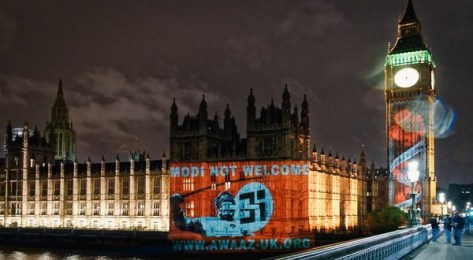
Modi’s Speech, his Silence and Dadri Redux in Mainpuri

Every newspaper in India carried the same headline on Friday, the 9th of October: ‘Modi breaks silence on Dadri lynching.’ It says something about the breathless desperation of the Indian press to hear the prime minister say something, anything, that could be interpreted as his disapproval of political barbarism, that there wasn’t, in fact, a word in his speech about the Dadri lynching. – Mukul Kesavan in ndtv.com

You know what has been agitating the minds of millions of us, Indians — the future of our pluralism. You have stated your position in terms of ‘sabka sath, sabka vikas‘. And this is quoted and cited on your behalf repeatedly as a mantra. But, Pradhan Mantriji, this is certainly not adequate. We need to hear you, our Prime Minister, directly and clearly and with an urgent reference to the present situation, which is nothing less than a tragedy. Over the last few months we have had more than one tragedy. Can we really not see the connections between the so-called stray incidences all over the country, from the murders of Dabholkar, Pansare and Kalburgi to that of Mohammad Akhlaq. Your direct voice needs to be heard now, unless you do not consider this an event of significance. And now, the ambiguity of what you said yesterday only makes me send you this appeal for your truthful intervention. TM Krishna’s Open Letter to the Prime Minister

While Modi’s cheer leaders in the media were telling us that the prime minister had finally ‘broken his silence’ (see Apoorvanand’s piece on this here), there were others who read the meaning of his speech far more  accurately.They knew exactly what Modi was saying; they knew without having to do a content analysis of His speech that, if anything, despite being shamed to an extent by the President, Pranab Mukherjee’s statement the previous day, he actually refused to say anything about the Dadri incident let alone condemn the crime or its perpetrators. They understood clearly that his speech was merely a continuation of his sinister and devious silence. They understood like no media commentator or analyst did that what he said in Munger was a green signal for them to go ahead with their activities. Thus what happened in Mainpuri today is nothing to be surprised about.

Mainpuri: Police in action after villagers vandalised properties and resorted to arson in Mainpuri district on Friday over rumours of cow slaughter in the area. PTI Photo (PTI10_9_2015_000290B)

Continue reading Modi’s Speech, his Silence and Dadri Redux in Mainpuri

Dadri Beef Rumour and Lynching – A Report from Bisara village

The following is a report on the Dadri beef rumour and lynching, prepared by a fact finding team from NEW SOCIALIST INITIATIVE, PEOPLE’S ALLIANCE for DEMOCRACY and SECULARISM, SAHELI and DELHI SOLIDARITY GROUP, released in New Delhi on 05/10/2015

 The investigation team with the following members visited the village on 3 October 2015: Bonojit Hussain (New Socialist Initiative), Deepti Sharma (Saheli), Kiran Shaheen (writer and activist), Naveen Chander (New Socialist Initiative), Sanjay Kumar (People’s Alliance for Democracy and Secularism and New Socialist Initiative) and Sanjeev Kumar (Delhi Solidarity Group)

Akhlaq's house
Akhlaq’s house

On the night of 28 September, in a heinous instance of hate crime Mohammad Akhlaq a resident of Bisara village of Dadri in western Uttar Pradesh was lynched to death and his son Danish brutally assaulted by a mob of villagers over a rumour that Mr. Akhlaq and his family had slaughtered a calf and consumed its meat. Just before the lynching, an announcement was made from the local temple to spread the rumour, and within moments a mob constituted itself and attacked Mr. Akhlaq resulting in his lynching. Mr. Akhlaq’s son Danish has been in hospital since that night and despite undergoing two brain surgeries his condition is still said to be critical. Continue reading Dadri Beef Rumour and Lynching – A Report from Bisara village

अखलाक़ की मौत उठा रही है हमारी सभ्यता और जनतंत्र पर सवाल

दिल्ली के करीब दादरी के बिसराड़ा गाँव की अस्करी गमी में है। अपने पचास साल के बेटे मोहम्मद इख़लाक़ की मौत का गम वह मना रही है।  और साथ में उसका  परिवार। बाईस साल का उसका पोता दानिश हस्पताल में मौत से जूझ रहा है।यह शोक मामूली नहीं है और न यह मौत साधारण है। यह आपको तब मालूम होता है जब आप देखते हैं कि  गम की इस  घड़ी में अस्करी के कंधे पर रखने वाला कोई पड़ोसी हाथ नहीं है।

अस्करी पूछती है, जहां कोई हमारा पुरसाहाल न हो, उसे हम अपना देस  कैसे कहें! हमारे यहाँ  गाँव को देस कहने का रिवाज है।  अस्करी का  सवाल वाजिब है: जहां गम बँटाने पड़ोसी न आएं, वह अपना देस कैसे हुआ!

Akhlaq's family, image courtesy rediff.com
Akhlaq’s family, image courtesy rediff.com
इख़लाक़ की मौत का शोक  कितना ही एकाकी क्यों न हो मौत उसकी एकाकी न थी. वह मारा गया, ऐलानिया, खुलेआम-शोर-शराबे  के बीच।
बिसाराड़ा गाँव में मोहम्मद अखलाक़ की हत्या जितनी दिल दहलाने वाली है, उसके बाद की प्रतिक्रियाएं उस ह्त्या से अधिक चिंतित करने वाली हैं। सबसे ज़्यादा मुखर भारतीय जनता पार्टी के नेता हैं। मोहम्मद अखलाक़ के घर पर हमला करके उन्हें पीट-पीटकर मार डालने और उनके बेटे को गंभीर रूप घायल करने वाली भीड़ के छह  लोगों को पुलिस ने नामजद किया है। लेकिन भाजपा के नेताओं ने इस पर गहरा ऐतराज जताया है। उनका कहना है कि यह इरादतन किया गया क़त्ल न था, इसलिए ह्त्या की धाराएँ न लगा कर गैर इरादतन ह्त्या की धारा लगानी चाहिए। तर्क यह यह है कि  अखलाक़ की ह्त्या की कोई पूर्व योजना न थी, वह तो ‘गोवध’ और ‘ गोमांस’ खाने की खबर से हिंदू ग्रामीणों की धार्मिक भावनाएं भड़क उठीं। उन्होंने कुछ कड़े रूप में  अपनी भावनाएं व्यक्त कीं, जिसके नतीजे में अलखलाक़ की मौत हो गयी। वे उलटे अखलाक़ के परिवार पर गोवध और गोमांस भक्षण के लिए आपराधिक मामला दर्ज करने की मांग आकर रहे हैं। धमकी दी जा रही है की अगर ऐसा न किया गया तो महापंचायत की जाएगी।

Continue reading अखलाक़ की मौत उठा रही है हमारी सभ्यता और जनतंत्र पर सवाल

NBA Welcomes SC Dismissal of MP Govt Application Denying Right to Land to Sardar Sarovar Oustees

We are publishing below the text of a statement issued by the NARMADA BACHAO ANDOLAN in New Delhi today following a significant Supreme Court order on the rehabilitation of Sardar Sarovar oustees

In a significant Order, the Social Justice Bench of the Supreme Court comprising Jst. Madan Lokur and Jst. Uday Umesh Lalit today dismissed an Application filed by the Government of Madhya Pradesh (GoMP) / Narmada Valley Development Authority (NVDA) seeking a ‘modification / clarification’ of the Apex Court’s previous judgements of 2000 and 2005, thereby denying right to land of a few thousand adult sons of the Sardar Sarovar Project (SSP) affected farmers.

The Hon’ble Court held among other things that the Application by State of MP suffers from gross delay / laches having being filed many years after the judgements were issued (upholding the right to land of the SSP adult sons) and the rights / entitlements already accrued to the oustees in principle cannot be taken away. The Bench also had to take note of the fact that while the entitlement of most of the adult sons have already been recognized many many years ago, one set of oustees have been offered land / Special Rehabilitation Package (5.5. lakhs for 5 acres) since the judgement of 15/3/2005 of the Apex Court and another set of oustees are being denied the same; this would result in a clear violation of Article 14 of the Constitution which guarantees a fundamental right to equality. Terming this “not to be good governance”, the Court summarily dismissed the Application.   Continue reading NBA Welcomes SC Dismissal of MP Govt Application Denying Right to Land to Sardar Sarovar Oustees