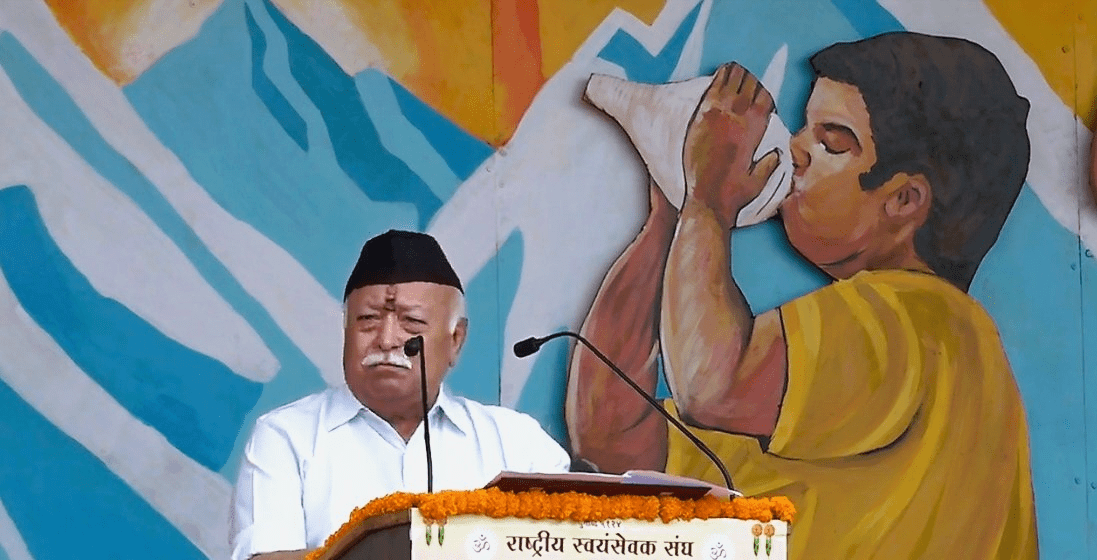
कहीं ऐसा तो नहीं कि ‘सांस्कृतिक मार्क्सवादी’ और ‘वोक पीपल’ (Woke People) को लेकर संघ सुप्रीमो की ललकार एक तरह से उत्पीड़ितों की दावेदारी और स्वतंत्र चिंतन के प्रति हिंदुत्व वर्चस्ववाद की बढ़ती बेचैनियों को ही बेपर्द करती है.
मुल्क की दारूल हुकूमत अर्थात राजधानी दिल्ली- आए दिन कुछ न कुछ सेमिनार, संगोष्ठियां, विचारोें के अनौपचारिक आदान-प्रदान की मौन गवाह बनी रहती है. आम तौर पर वह ख़बर भी नहीं बन पाते, अलबत्ता कुछ तबादले खयालात कभी-कभी सुर्खियां बन जाते हैं.
पिछले दिनों यहां के भव्य ताज एम्बेसेडर होटल में एक विचार-विमर्श चला, जो अलग कारणों से सुर्खियां बना. आयोजक के चलते और जिस मसले पर वहां गुफ्तगू चली उसे लेकर. दरअसल इसका आयोजन भारतीय जनता युवा मोर्चा ने किया था, जो आम तौर पर ऐसी बौद्धिक गतिविधियों के लिए जाना नहीं जाता है.
दूसरी अहम बात थी कि इस विचार-विमर्श में अमेरिका, जर्मनी और चंद अन्य पश्चिमी मुल्कों के कई अनुदारवादी, रूढ़िवादी विचारक, अकादमिशियन जुटे थे और भारत के शिक्षा संस्थानों से जुड़े कई अकादमिशियन भी थे. बातचीत किन मसलों पर चली इसके आधिकारिक विवरण उपलब्ध नहीं है, लेकिन इतना तो समाचार में सुनने को मिला है कि वहां ‘वोकवाद’ (Wokeism-वोक़िज़्म) पर भी बातचीत चली थी. ( Read the rest of the article here)
We publish below a statement circulated by Lalit Kala Kendra(Gurukul) alumni, art educators, visiting faculty and theatre/cine artistes regarding the recent attack on the students making an examination presentation of a play woven around a Ram Leela rehearsal, where routinely men play women’s roles. This attack took place on 2 February. This incident was preceded by an attack on FTII students on 23 January by a group of right-wing goons. We also present in this post, for the record, a statement on the previous incident by the FTII Students’ Association and a solidarity statement by FTII Alumni.
Statement from Lalit Kala Kendra(Gurukul) alumni, art educators, visiting faculty and theatre/cine artistes
We would like to begin by saying that despite our diverse ideological, cultural, social, religious and geographical backgrounds and identities, we write this note together as informed and sensitive artists, and citizens of India. We would like to strongly emphasise that we have great respect for all religions, castes, creeds, sects etc. We are proud of and value our rich Indian culture and traditions.
UGC led by Chairman Jagdeesh Kumar refuses to remain beyond controversy for long time.
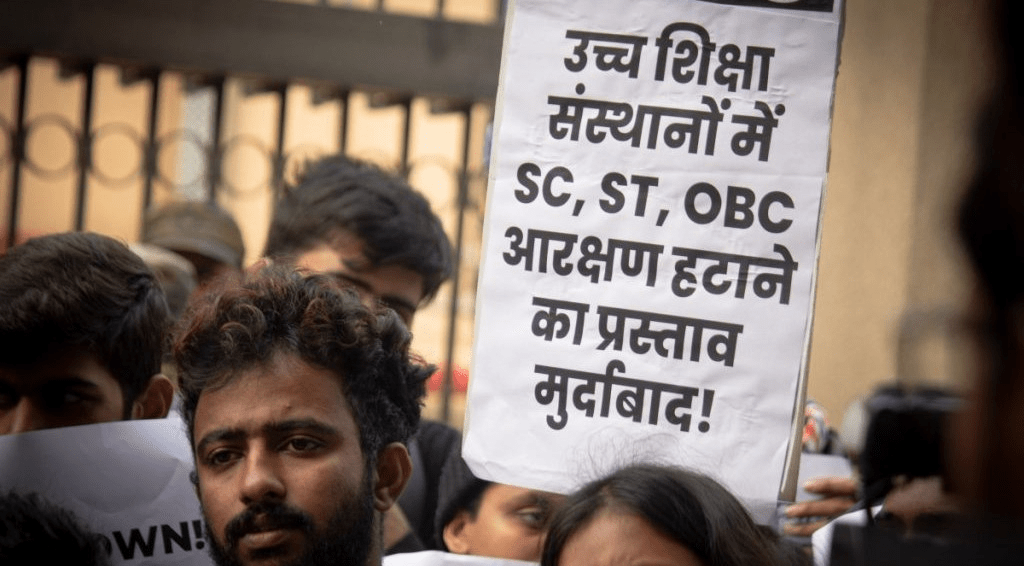
The latest being its draft proposal of ‘dereservation’ of seats if not a suitable candidate from reserved category is found wherein it asked people’s views till 28 th January.
As expected this proposal which smacked of the ruling dispensation’s surreptitious and even direct attempts at attacking or biting away at the affirmative action policies emanating from the Constitution rightly led to protests in various quarters, There were protests opposing this proposal on JNU and other campuses and even opposition parties attacked the ruling party for its compromising attitude towards reservation rights and its desire and moves to either dilute or hollow out the provisions of these socially progressive policies and this led to an intervention from the Human Resources Ministry underlining that there is no such proposal.
Text of a petition initiated by SWASA, signed by 3640 sex workers and allies, sent to the UN Special Rapporteur on Violence Against Women, Reem Alsalem on January 31, 2024. This is in response to a call for inputs towards the Special Rapporteur’s report on violence against women to be presented to the UN Human Rights Council in June 2024.
Sex workers and allies at a rally demanding sex work be recognized as work under government labor rules, on the eve of International Labor Day, in Kolkata, April 30, 2022. AP Photo/Bikas Das. Image courtesy Human Rights Watch
We, the undersigned write to bring to your attention our concerns regarding the problematic terminology used in the call for inputs to the report of the Special Rapporteur (SR) on violence against women (VAW) and girls to the Human Rights Council. The thematic report of the SR on VAW that will be presented to the UN Human Rights Council at its 56th session in June 2024 proposes to examine the nexus between the global phenomenon of prostitution and violence against women and girls.
The call for inputs states that the Special Rapporteur would like to receive inputs to better understand the relationship between prostitution and violence against women, to clarify terms, approaches and actions States should take in order to maintain the spirit of international human rights law and to effectively protect women and girls from all forms of violence. Continue reading Demanding respectful and inclusive language for sex workers: Sex Workers and Allies South Asia (SWASA)→
2024 की शुरूआत में भारत एक प्रचंड बदलाव की दहलीज पर खड़ा है। सभी जनतंत्र प्रेमी, इन्साफ पसंद और अमन के चाहने वालों के सामने यही बड़ा सवाल मुंह बाए खड़ा है कि 2024 के संसदीय चुनावों में- जो मई माह के अंत तक संपन्न होगा तथा नयी सरकार बन जाएगी (अगर उन्हें पहले नहीं कराया गया तो)- का नतीजा क्या होगा?
क्या वह सत्ता के विभिन्न इदारों पर भाजपा की जकड़ को ढीला कर देगा, क्या वह जनतंत्र की विभिन्न संस्थाओं को निष्प्रभावी करने की या उनका हथियारीकरण करने की सोची समझी रणनीति को बाधित कर देगा, क्या वह धर्म के नाम पर उन्मादी तक हो चुकी जनता में इस एहसास को फिर जगा देगा कि 21वीं सदी में धर्म और राजनीति का घोल किस तरह खतरनाक है या वह भारतीय जनतंत्र की अधिकाधिक ढलान की तरफ जारी यात्रा को और त्वरान्वित कर देगा, भारत के चुनावी अधिनायकतंत्र ( electoral autocracy) की तरफ बढ़ने की उसकी यात्रा आगे ही चलती रहेगी
‘Men never do evil so completely and cheerfully as when they do it from religious conviction.’ Blaise Pascal, French Mathematician and Physicist who lived some 400 years ago and died young (1623 to 1662 AD)
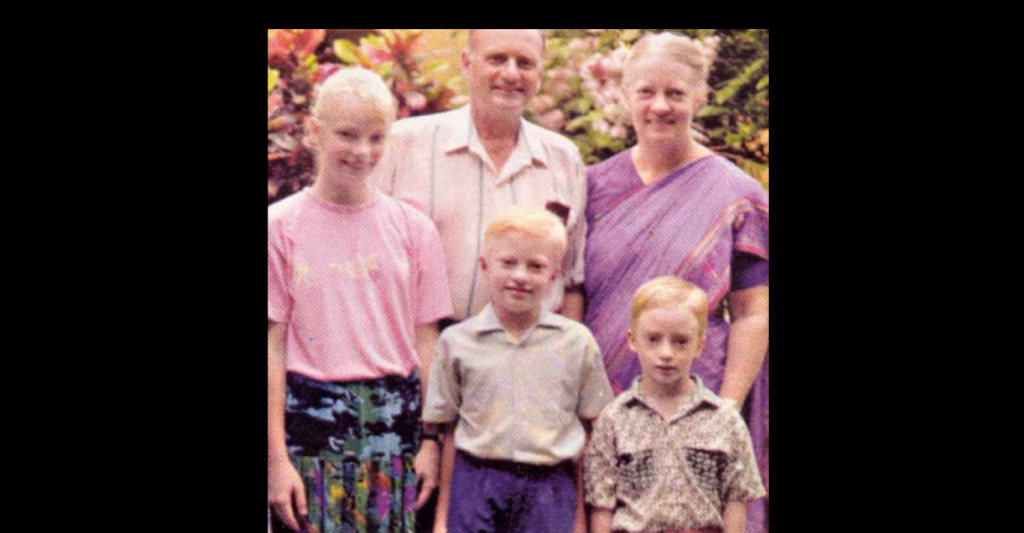
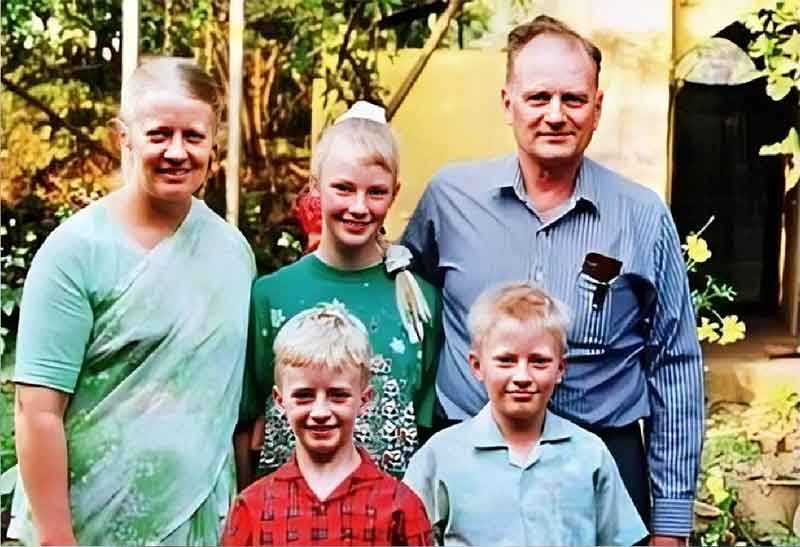
ग्राहम स्टेंस, जो ऑस्ट्रेलिया से भारत पहुंचे ईसाई पादरी थे और ओडिशा के बेहद पिछड़े आदिवासी बहुल इलाकों में गरीबों एवं कुष्ठरोगियों की सेवा में संलग्न थे, उन्हें और उनकी दो संतानों फिलिप और टिमोथी को कथित तौर पर हिंदुत्ववादी जमातों से जुड़े मानवद्रोहियों ने 22 जनवरी 1999 को जिंदा जलाया था.
22 जनवरी की तारीख की बीती तारीख को इस घटना की पच्चीसवीं सालगिरह थी.
राम मंदिर आयोजन की चकाचौंध में किसी ने इस बर्बर हत्या और उसके निहितार्थों को याद करना भी मुनासिब नहीं समझा, जबकि हम पाते हैं कि इस बर्बर हत्याकांड में वह तमाम संकेत मिलते हैं, जिन्हें 21वीं सदी की बहुसंख्यकवादी राजनीति में भरपूर प्रयोग में लाया गया.
The life of the dead is placed in the memory of the living.
– Marcus Tullius Cicero
Politics is nothing but theology in action
– Ambedkar
Right-wing politics suffers from a common syndrome everywhere.
It never feels confident to project its own icons for the rest of the humanity, whatever might be their claims about their worldview, it knows that its own icons are detested by a wide spectrum of people.
The easiest way it finds to overcome this lacunae is to appropriate already established icons – who were even opposed to their world view as well and claim them their own. In fact, it does not have any qualms in utilising dates – bearing special significance for exploited and oppressed and marginalised of the world – to put their stamp on it.
The project of Hindutva Supremacism – which yearns / strives to transform a Secular, Socialist, Democratic and Sovereign Republic into a Hindu Rashtra has perhaps achieved near perfection in this kind of politics.
Prof Romila Thapar, great historian and public intellectual , will be delivering the 28 th Lecture in the Democracy Dialogues Series on Sunday 28 th January 2024 at 6 PM (IST).
Please reserve the time and date for the lecture. Details are given below
Democracy Dialogues – 28 th Lecture
Organised by
New Socialist Initiative (NSI)
Theme : Our History, Their History, Whose History?
The zoom invite will be shared closer to the date.
Abstract: My purpose in this talk would be to examine the link between history and particular kinds of nationalism. I hope to show that nationalism can be a process, bringing together and uniting all the communities that inhabit a particular territory in support of a change in society or opposing a target common to all. This earlier form is what I would like to call a unitary, integrative nationalism that cut across communities and drew them together in a particular country to support a single purpose. This I would differentiate from the latter forms in some countries which identified with units of society or communities according to certain common features, such as a particular religion or language, or caste or ethnicity. I would call it segregated nationalism, where each community is segregated and treated as having a distinctly different identity and its own separate goal. History is brought in when the community that gives an identity to its nationalism insists on tracing its origins to a historical past. This pattern of integrated and segregated nationalisms would seem to apply to India of the twentieth century. There was the all-inclusive national movement whose participants were from every community; its objectives were to maintain the unity of the Indian people and overthrow colonial rule. The other nationalism, segregated nationalism, was seeded in the 1920s and assumed the existence of two nations – the Hindu and the Muslim – which, it was argued, go back to earlier times. Integrated nationalism succeeded in 1947 in bringing about independence, but its foundations needed strengthening, for we are now witnessing the strong presence of religious nationalism in the attempt to inaugurate a Hindu Rashtra in India.
– Romila Thapar
About the Speaker:
Internationally renowned scholar of Ancient History, Prof Thapar was elected General President of the Indian History Congress in 1983 and a Fellow of the British Academy in 1999. In 2008, she was awarded the prestigious Kluge Prize of the US Library of Congress which complements the Nobel, in honouring lifetime achievement in disciplines not covered by the latter. Prof Thapar has been a visiting professor at Cornell University, the University of Pennysylvania, and the College de France in Paris and holds honorary doctorates from the University of Chicago, the Institut National des Langues et Civilisations Orientales in Paris, the University of Oxford, the University of Edinburgh (2004), the University of Calcutta and from the University of Hyderabad
Here is a select list of Prof Thapar’s publications Ashoka and the Decline of the Mauryas, 1961 ( Oxford University Press) ; A History of India : Volume 1, 1966 ( Penguin) ; The Past and Prejudice, NBT ( 1975) ; Ancient Indian Social History : Some Interpretations, 1978 ( Orient Blackswan) ; From Lineages to State 1985 : Social Formations of the Mid-First Millenium B.C. in the Ganges Valley, 1985 ( Oxford University Press) ; Interpreting Early India, 1992 ( Oxford University Press) ; Sakuntala : Text, Reading, Historie, 2002 ( Anthem) . Somanatha : The Many Voices of History, Verso ( 2005) ; The Aryan : Recasting Constructs, Three Essays ( 2008) ; The Past As Present: Forging Contemporary Identities Through History, (2014) ;Voices of Dissent: An Essay, (2020); The Future in the Past: Essay ( 2023)
Whether Modi will get a third term in 2024 or these elections can spring a surprise?
India at the beginning of the year stands at the cusp of a Momentous Change
The biggest question before everyone is whether the elections for the Parliament – the lower house – which will be over by end of May ( if they are not advanced by the ruling dispensation) would be able to disturb the stranglehold of the BJP-RSS over the levers of power at the Centre, whether it will lead to loosening of sorts of the grip it holds over the various institutions of Democracy ( critics even call that they have been subverted, weaponised) or it will slide the Indian Democracy further into the electoral autocracy mode much to the chagrin of well wishers of democracy everywhere.
यह पोस्ट सोशल मीडिया पर कई लोगों ने साझा की थी । बताया जा रहा था कि इसके लेखक सरोज मिश्र हैं। इस बीच इसके असल लेखक से हमारा संपर्क हुआ है जिनका नाम विवेक कुमार उर्फ़ विवेक असरी है। मूल लेख 2010 में छपा था जिसे यहाँ पढ़ा का सकता है।
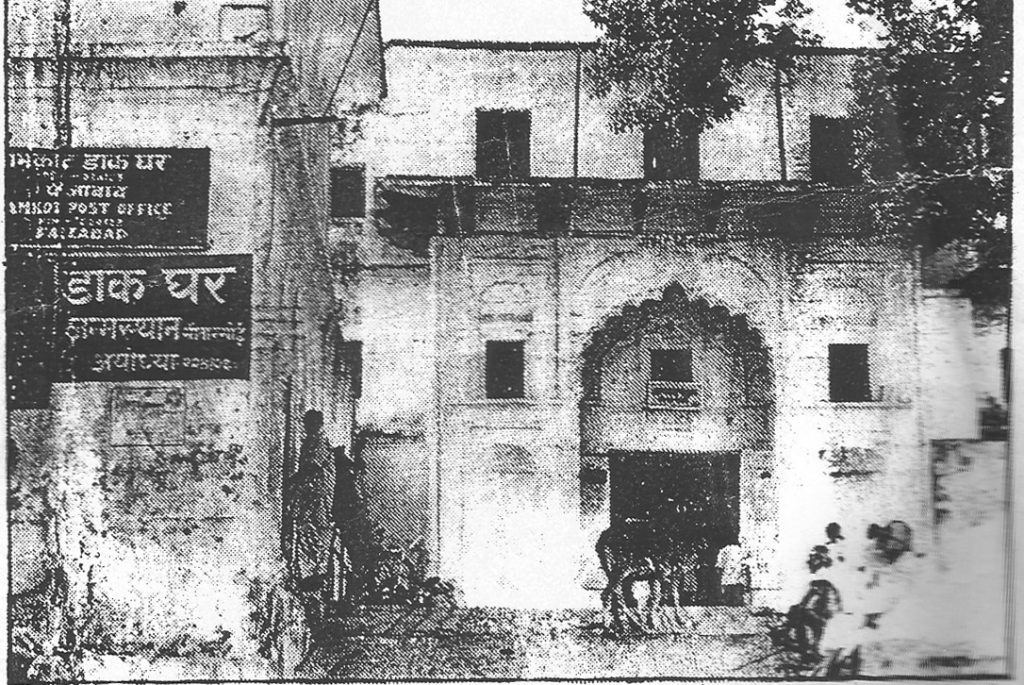
अयोध्या का यह 300 साल पुराना जन्मस्थान मंदिर था जिसके लिए ज़मीन एक मुसलमान ज़मींदार के दान की थी। नए राम मंदिर के विस्तार के लिए अगस्त 2020 में इसे ढहा दिया गया। (छवि साभार द वायर)
कहते हैं अयोध्या में राम जन्मे, वहीं खेले-कूदे, बड़े हुए, बनवास भेजे गये, लौटकर आये तो वहाँ राज भी किया। उनकी ज़िंदगी के हर पल को याद करने के लिए एक मंदिर बनाया गया। जहाँ खेले, वहाँ गुलेला मंदिर है। जहाँ पढ़ाई की, वहाँ वशिष्ठ मंदिर हैं। जहाँ बैठकर राज किया, वहाँ मंदिर है। जहाँ खाना खाया, वहाँ सीता रसोई है। जहाँ भरत रहे, वहाँ मंदिर है। हनुमान मंदिर है, कोप भवन है। सुमित्रा मंदिर है, दशरथ भवन है। ऐसे बीसियों मंदिर हैं, और इन सबकी उम्र 400-500 साल है। यानी ये मंदिर तब बने, जब हिंदुस्तान पर मुगल या मुसलमानों का राज रहा।
(Translated by Nivedita Menon from a widely circulating post earlier attributed to Saroj Mishra, on social media, originally in Hindi.
UPDATE: We have since heard from the author himself. This post was written in 2010 by VIVEK KUMAR (Vivek Asri) and so we have made the necessary changes. Here is the link to VIVEK KUMAR’s original post.
This 300 year old Janmasthan temple in Ayodhya, built on land donated by a Muslim zamindar, was demolished in August 2020 to accommodate an expanded vision of the new Ram Mandir. Image courtesy The Wire
They say Ram was born in Ayodhya; in Ayodhya he played and roamed around as a youth, grew into adulthood, was sent from there into exile in the forest, and then returned to rule there. There are temples in Ayodhya to commemorate every moment of his life. Where he played, there is Gulela Mandir. Where he studied there is Vashishta Mandir. Where he sat and ruled, there is a mandir. Where he ate his meals, there is Sita Rasoi. Where Bharat stayed, there is a mandir. There’s Hanuman Mandir, Kop Bhavan. There’s Sumitra Mandir, Dashrath Bhavan. There are many many such temples and all of them are about 400 to 500 years old. That is to say, these temples were built when Hindustan was ruled by the Mughals, by Muslims.
The following statement was issued by the CAMPAIGN AGAINST STATE REPRESSION (CASR) yesterday, 14 December 2023
It has come to light that the police have slapped the draconian UAPA on Neelam Verma, Sagar Sharma, Manoranjan D, Amol Shinde, and Vishal Sharma, the five persons held for releasing gas canisters in both the outside premises and inside the Lok Sabha mid-session on 13th December. The Indian state is treating this incident as a ‘terror attack’ and is charging these five individuals under the draconian anti-terror laws. It’s pertinent to point out that all four individuals committed the act as a form of political protest and exploding harmless coloured gas canisters is part of their protest, not an act “terror.” Sagar Sharma is an e-rickshaw driver and the son of a carpenter, Amol Shinde comes from a family of Dalit landless peasants unable to get a job in the Indian armed forces while Neelam Verma and Manoranjan D are MPhil and Engineering degree holders respectively who are both unemployed, with Neelam even cleared the Haryana Teacher Eligibility Test but still not landing a job. Vishal Sharma has also been roped into this case after he provided shelter to the four individuals and was not even involved in the act. Lalit Ojha, a sixth accused and also an unemployed youth is yet to be brought into police custody but has been charged. The political protest of these individuals against the Indian state and its brahmanical Hindutva fascist nature represents the angst of the working class, the peasantry, the academics and the middle class, all of whom are bearing the brunt of the BJP’s Hindutva-corporate nexus politics. The protest slogans raised by the four were slogans of both patriotism towards the people of India as well as dissent against the dictatorial politics of the ruling class.
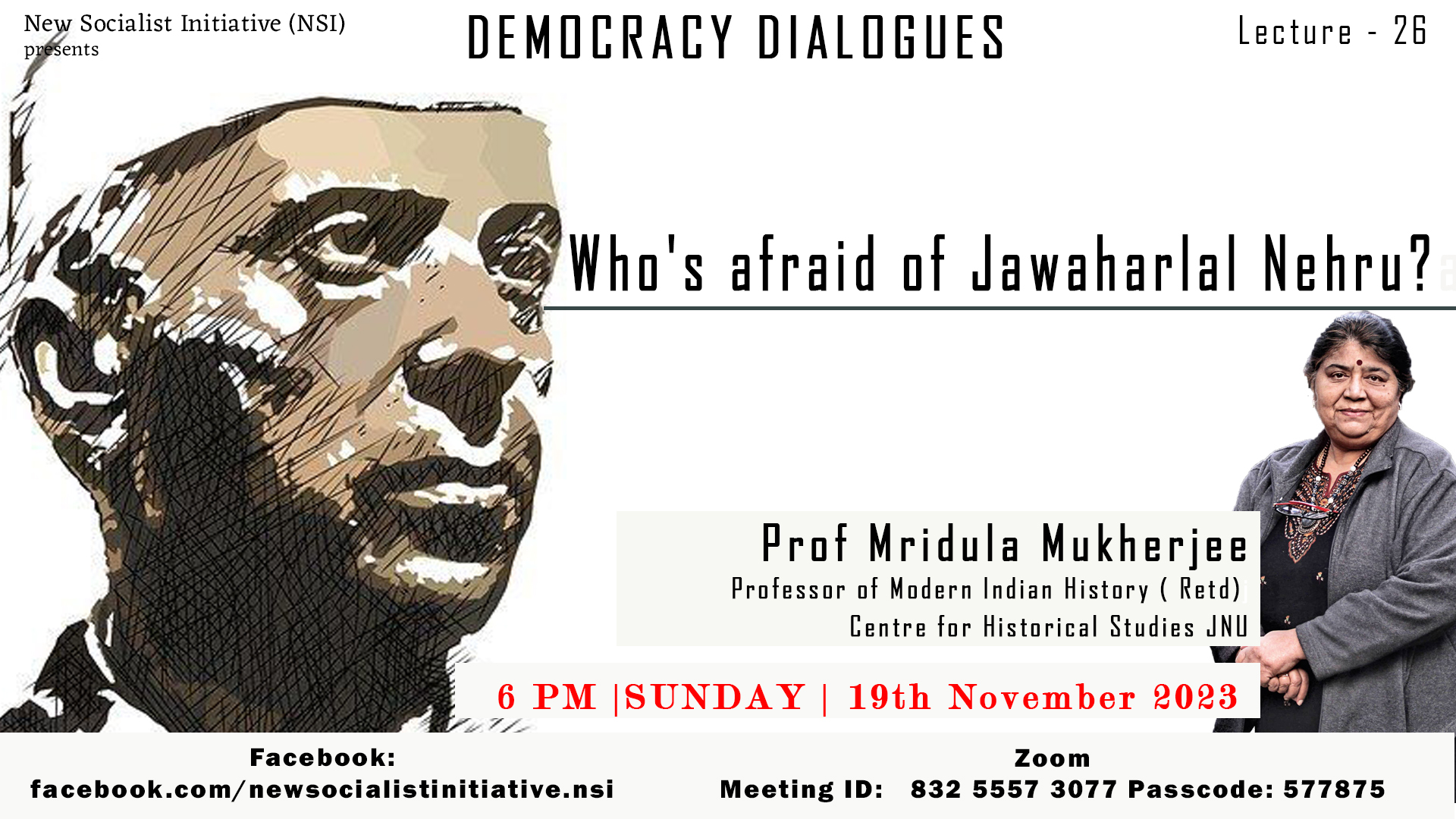
Professor Mridula Mukherjee, Professor of Modern Indian History ( Retd), Centre for Historical Studies, JNU, will be delivering the 26 th Democracy Dialogues Series lecture on Sunday, 19 th November 2023 at 6 PM (IST).
Theme : Who’s Afraid of Jawaharlal Nehru? Time: Nov 19, 2023 06:00 PM India
Summary : In his lifetime, Jawaharlal Nehru was recognized the world over as a statesman and an Indian leader second only to Gandhiji. A foremost leader of the freedom struggle, who gave it a decided socialist orientation, he remained unrivaled as Prime Minister after independence and built the solid foundations of a sovereign, secular, democratic, and egalitarian republic. He evolved the concept of non-alignment which enabled many ex-colonial countries to avoid becoming a part of the two power blocs engaged in the Cold War.
However, he is today the favourite whipping boy of the establishment. We are told he was responsible for the partition, for the mess in Kashmir, for the death of Subhash Bose, for delaying the integration of Hyderabad, and of Goa, for the defeat at the hands of China in 1962, for neglecting agriculture, and primary education, and much else. The reason for the defamation is of course that he stood for the exact opposite of what is valued today. His life and work present a continuous question mark to the regressive trends in fashion.
This will become evident as we focus in the talk especially on two areas of great relevance today in which we are facing a grave crisis: Democracy and Civil liberties, and Communalism/Secularism. We will also focus attention on Nehru’s evolving understanding of Mahatma Gandhi’s vision and method of non-violent struggle, of which he became the most ardent advocate after his death.
Speaker :
Author of many books, Prof Mukherjee has been a visiting Scholar at Duke University, USA, and at the Institute of Oriental Culture, University of Tokyo and was also Director of Nehru Memorial Museum and Library, ( NMML), New Delhi. She has published widely in the areas of agrarian history, peasant movements, social movements and the Indian national movement.
Here is a list of a few of her publications : Colonializing Agriculture, The Myth of Punjab Exceptionalism Sage (2005) ; Peasants in India’s Non Violent Revolution : Practice and Theory (Sage 2004).
This list also includes India’s Struggle for Independence (1999) and India After Independence 1947–2000 (2000), RSS, School Texts and the Murder of Mahatma Gandhi The Hindu Communal Project (2008) co-authored with Prof Bipan Chandra and others.
The first week of the coming month of November will witness a huge public festival in Kerala organized by the ruling power through the government called ‘Keraleeyam‘. It begins on 1 November, celebrated every year as the ‘Kerala Piravi Dinam’ or the day of Kerala’s birth, marking the amalgamation of the three Malayalam-speaking regions into a single unit, a cherished dream of many in early twentieth century Kerala. The organizers of this celebration claim that this massive show seeks to highlight Kerala’s achievements which they hint, have an unbroken continuity from the twentieth century to the present. They claim to have furthered it, and not frittered it.
This post is based on a presentation at a panel discussion on “Israeli war against Palestinian people in Gaza” organised by Janhastakshep in Delhi on October 20, 2023.
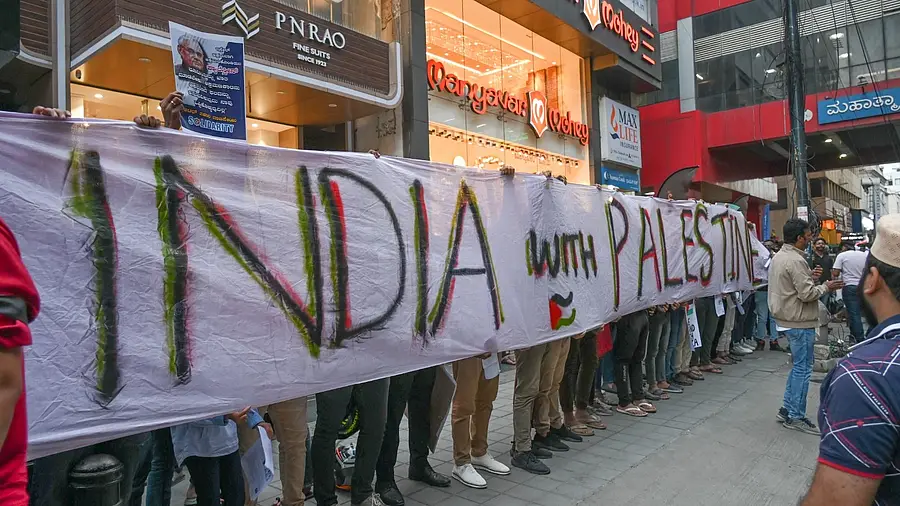
Palestine solidarity protest in Bangalore
But do you condemn…
We are expected to begin every discussion on the latest phase of the ferocious 75 year old war Israel has been waging on the Palestinian people, by answering the question – “But do you condemn the Hamas action?”
Sometimes, because stronger words are needed, they say “dastardly” Hamas action, as a television anchor recently did, trying to push Palestinian writer Susan Abul Hawa to place on Hamas the responsibility for the ongoing “humanitarian crisis” She did not. Nor did she accept the banal term humanitarian crisis, terming it instead, an intentional genocidal war.
This belligerent question comes from beginning with “secondly”, as the Palestinian poet Mourid Barghouti said –
“If you want to dispossess a people, the simplest way to do it is to tell their story, starting with ‘secondly’ “.
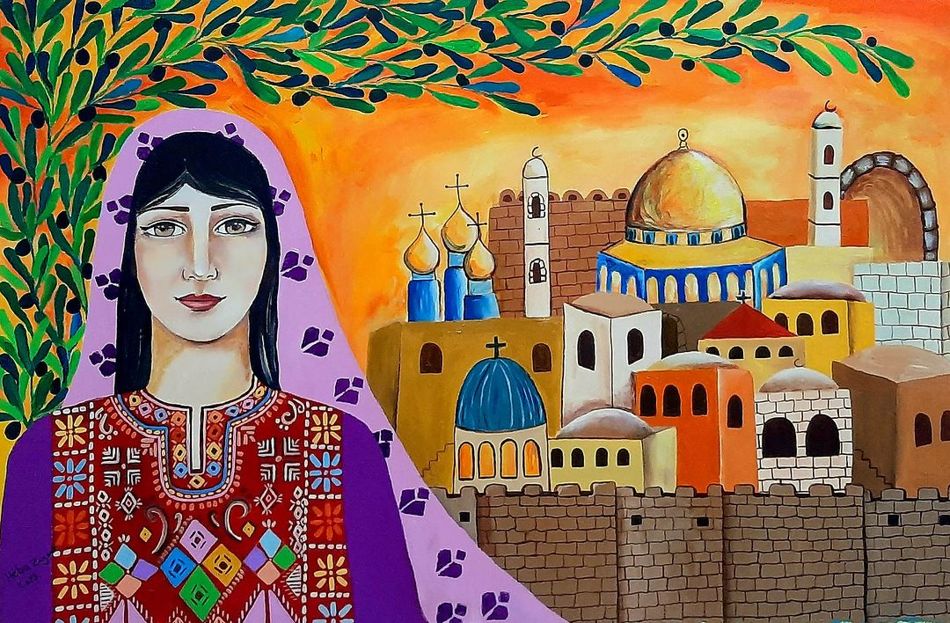
“Jerusalem is my city” by the artist Heba Zagout, killed by Israeli bombardment in Gaza along with two of her children, in October 2023
The 111th session of the International Labour Conference (ILC) held in Geneva from 5th to 16th June deliberated on climate change along with other issues concerning the situation of decent work in the globe. The issue of climate change was dealt with from the perspective of changes in the nature of work in future. The deliberations were based on a report issued by the ILO named “Achieving a Just Transition towards Environmentally Sustainable Economies and Societies for All”. After deliberations in the concerned committee for Just Transition, conclusions on the same have been published by ILO. The present article looks into the perspective on climate change adopted by the ILO based on the above mentioned documents.
क्या बुद्धिजीवी वर्ग को पालतू बनाए रखने की सरकार की कोशिश या विश्वविद्यालयों में इंटेलिजेंस ब्यूरो को भेजने की उनकी हिमाक़त उसकी बढ़ती बदहवासी का सबूत है, या उसे यह एहसास हो गया है कि भारत एक व्यापक जनांदोलन की दहलीज़ पर बैठा है.
So you are the little woman who wrote the book that made this great (American) civil war’
( ‘‘‘तुम हो वह महिला जिसने उस किताब को रचा जिसने इस महान /अमेरिकी/ गृह युद्ध को मुमकिन बनाया)
[गुलामी प्रथा की समाप्ति के लिए छेड़े गए गृह युद्ध के खात्मे के बाद तत्कालीन अमेरिकी राष्टपति अब्राहम लिंकन द्वारा गुलामी प्रथा के खिलाफ लिखे गए उपन्यास ‘अंकल टाॅम्स केबिन’ / 1852/ की लेखिका हैरियट बीचर स्टोव Harriet Beecher Stowe से मिलने पर प्रगट उदगार]
लेखक, कलाकार, विद्वान आदि से हुक्मरान हमेशा ही चिंतित रहे हैं।
मिसाल के तौर पर क्रांतिपूर्व फ्रांस के बारे में यह बात मशहूर है कि वहां की राजशाही ने अपने पुलिस महकमे को अपने दौर के अहम लेखकों, कलाकारों की जासूसी करते रहने के निर्देश दिए थे। हम अठारहवीं सदी के पुलिस महकमे की मुलाजिमों की मुश्किलों को समझ सकते हैं जिन्हें ‘खंूखार अपराधियों और राजनीतिक व्यक्तियों’ के अलावा लेखकों, कलाकारों पर अपनी फाइल रखनी पड़ती थी। (द स्टेटसमैन, हिन्दुस्तान टाईम्स, नई दिल्ली, 26 सितम्बर 2006)
एक क्षेपक के तौर पर बता दें कि इस जासूसी का विधिवत विवरण जनाब ब्रूनो फुल्गिनी की किताब में मिलता है जिसका शीर्षक है ‘राइटर्स पुलिस’ – दरअसल फ्रेंच संसद के इस कर्मचारी को यह जिम्मेदारी मिली कि वह पार्लियामेंट लाइब्रेरी के पुराने दस्तावेजों को खंगाले और इस बेहद उबाउ काम के दौरान उसे यह ‘खजाना’ मिल गया था।
अगर हम अपने यहां निगाह दौड़ाएं तो मौजूदा हुक्मरानों का रूख इस मामले में कोई अलग नहीं दिखता, बल्कि वह ढाई सौ सदी पहले के फ्रांसिसी सम्राटों से कभी कभी एक कदम आगे ही दिखते हैं। ( Read the full text here)




 KAFILA - COLLECTIVE EXPLORATIONS SINCE 2006