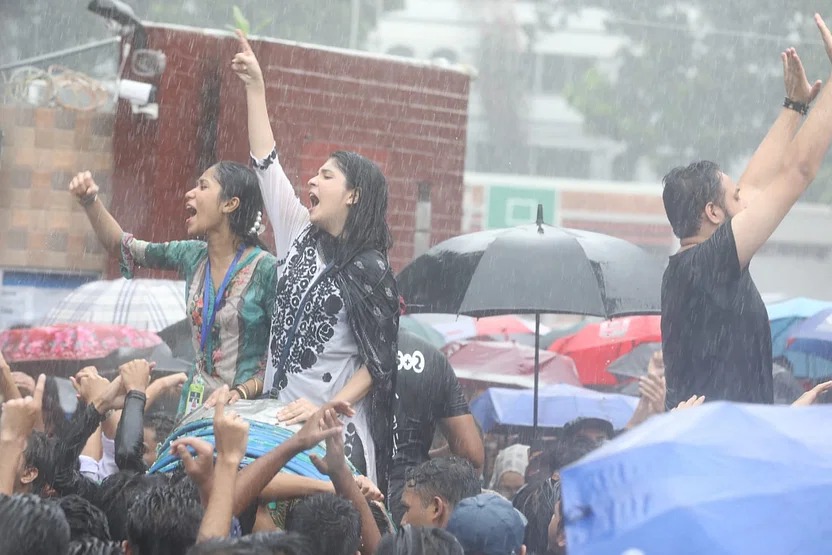
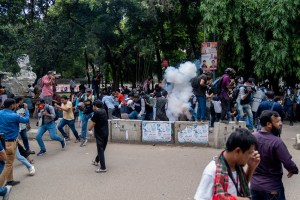
Students protesting in Uttara, Dhaka, August 2, 2024. Photo: Ashraful Alam
Sheikh Hasina, often labelled as fascist and autocratic leader in Bangladesh, was forced to flee the country following a popular uprising in July-August 2024. Many writings have appeared exploring the character of the movement and the consequent developments. Recently, renowned Indian historian and journalist Vijay Prashad published an article titled ‘Will Bangladesh be another Egypt?’, where he expressed the concern that Bangladesh could follow a path similar to Egypt’s. Vijay presents the popular uprisings as both a continuation and, to some extent, a counter-response to the Shahbagh movement, while drawing parallels to the Arab Spring. However, his disregard for certain political realities in Bangladesh—such as the country’s long tradition of democratic movements and the presence of major centrist parties like the BNP—makes his comparison uneven and incomplete in some respects.
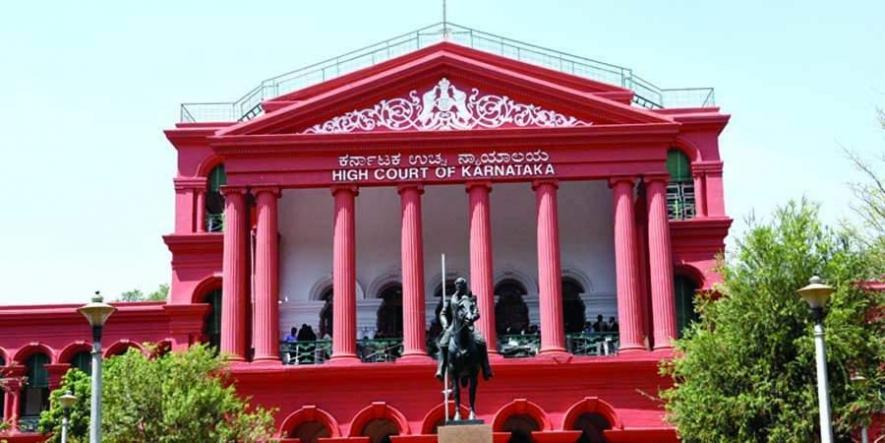
The judiciary in Karnataka is once again the focus of discussion in the national media.
The judiciary in Karnataka is once again in the news.
The latest case in a series of such cases is the Karnataka High Court’s recent judgment saying that shouting ‘Jai Shri Ram’ inside a mosque does not outrage religious feelings.
In an ambience where Right-Wing forces are hell bent upon creating more discord in the society, this judgement can easily be used by those who wish to further vitiate the atmosphere in the country. There are instances galore when such elements have tried to mount atop religious places of ‘other’ communities and deliberately create tension.
There is a feeling of sadness and surprise that despite the incident being caught live on CCTV, where the duo was seen entering a mosque late at night on their motorcycle, the courts did not look into the intention behind their act.
No doubt legal eagles in the country or civil liberty activists would be looking into the Karnataka HC judgement to formulate a suitable response and possibly challenge it at higher levels. For example, at the immediate level, it is being argued by analysts that the single-judge bench’s comparison of this issue with the highest court’s ruling in ‘Mahendra Singh Dhoni vs. Yerraguntla Shyamsundar’ case was notably different. ( Read the full article here : https://www.newsclick.in/who-entitled-hurt-religious-sentiments)
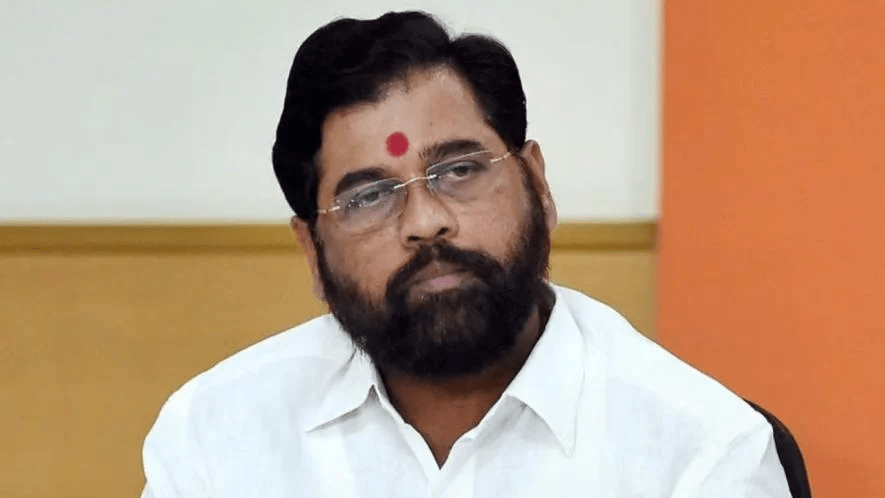
Ahead of Maharashtra Assembly polls, announcement of schemes like the Ladki-Bahin scheme reduce citizens to being ‘subjects’ rather than persons with basic constitutional rights.
Image Courtesy: PTI
Times have definitely changed.
There was a time earlier when a postcard sent by an ordinary citizen had spurred the judiciary into action, not any more.
One does not know whether the legal notice sent by a conscientious journalist to the Maharashtra government will similarly have any impact or not.
The focus of this legal notice is on the recent scheme launched by the Maharashtra government, called Ladki Bahin, under which women will be given Rs 1,500 per month. Launched on the eve of the elections to the state, the notice raises issues of the scheme’s timing, the claim that Rs 1,500 given to women would be sufficient; how such doles create a dependency culture and how it effectively punctures the whole idea of a welfare state. (Read the full article here :https://www.newsclick.in/goodbye-welfare-state-welcome-labharthis)—————————-
नरम हिन्दुत्व या ‘सेकुलर’ दलों की लड्डू पॉलिटिक्स?
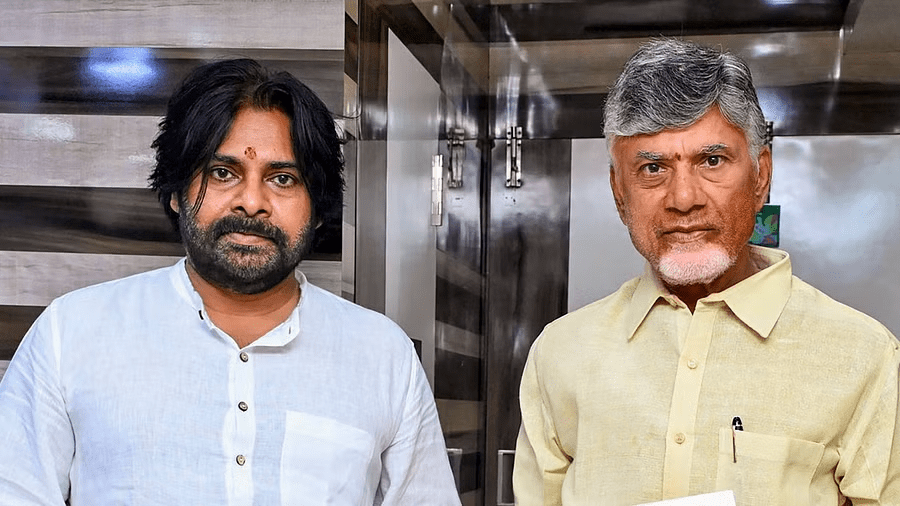
Credit: PTI photo
(क्या आंध्र प्रदेश दक्षिण में हिंदुत्व प्रयोग की नई प्रयोगशाला बनाने जा रहा है। दक्षिण के अग्रणी अख़बार डेक्कन हेराल्ड ने पिछले दिनों इस मसले पर विशेष सामग्री पेश की थी ा गौरतलब है कि इस सूबे की आंतरिक गतिविधियों पर शेष मुल्क की तब निगाह पड़ी, जब तिरुपति के लड्डू के मसले को सुर्खियां मिली . मगर ‘हिंदुत्व लाइट’ का यह सम्मोहन महज वहीं तक सीमित नहीं है )
सियासत भी अजीब होती है। अकसर इस बात का अंदाजा भी नहीं लग पाता कि कैसे वह शैतानों के सन्त में रूपांतरण को मुमकिन बना देती है और कैसे अन्य समुदायों के जनसंहारों को अंजाम देने वालों को ‘अपने लोगों’ के हृदयसम्राट या रक्षक के तौर पर स्थापित कर देती है।
शायद इसी विचित्रता की यह निशानी है कि अमेरिका के पूर्व राष्ट्रपति डोनाल्ड ट्रम्प द्वारा हैती से आए आप्रवासियों को लेकर फैलायी जा रही झूठी ख़बरें कि वे कुत्तों का भक्षण करते हैं, अमेरिका की आबादी के अच्छे-खासे हिस्से को अविश्वसनीय नहीं लग रही- जिनका लगभग अस्सी फीसदी हिस्सा साक्षर है। इन झूठी और नफरती ख़बरों को लेकर हैती से जुड़े समूहों को ही अदालत का दरवाजा खटखटाना पड़ रहा है।
जहां दुनिया का सबसे ताकतवर जनतंत्र कुत्तों को लेकर पैदा किए गए एक विवाद में उलझा दिखता है, वहीं खुद को दुनिया में डेमोक्रेसी की माता कहलाने वाले भारत में लड्डू के इर्द-गिर्द खड़े किए गए इसी किस्म के एक फर्जी विवाद में पिछले दिनों लचीले हिन्दुत्व की राजनीति के नए रणबांकुरे उलझे दिखे थे । ( Read the full article here : https://junputh.com/open-space/soft-hindutva-and-laddoo-politics-of-naidu/)
[Maya John has been part of the Left Movement for the past two decades and this piece is in response to ongoing dialogues with Sri Lankan comrades.]
Anura Kumara Dissanayake, photo courtesy AP News
The recent presidential election has installed Anura Kumara Dissanayake (“AKD”) from the Janatha Vimukthi Peramuna (JVP)-led National People’s Power (NPP) alliance as the new president of Sri Lanka. This victory is seen as a result of rising popular hostility towards mainstream parties and rogue dynasts. Consequently, we find that AKD garnered an overwhelming share of the votes from those same electoral constituencies which had earlier voted in bulk for the corrupt Rajapaksas. Prior to this presidential election, the frustrated Sri Lankan masses, plagued by growing economic and political crises, generated the powerful people’s movement – the janatha aragalaya – that ushered in a huge legitimacy crisis for the ruling elites.
After the ascent of Hindutva Supremacists at the Centre, avowedly secular parties also seem to be falling prey to it under mass pressure for short-term electoral gains.
Politics is a strange beast.
It looks incredulous how at times it helps Satans being metamorphosed into Saints and biggest murderers of hapless communities emerging as the defenders or ‘heartthrobs’ of their ‘own people.’
Perhaps it is a sign of this weirdness that Donald Trump’s vitriolic speeches targeting Haitian immigrants – that they eat pets — have not appeared incredulous to a large section of the US population, which is 79% literate, as the records show. Finally, Haitian groups themselves had to approach the courts to expose “racial animus against Haitian immigrants” over the years.
Interestingly, while the strongest democracy in the world is in the midst of a manufactured controversy around pets, the biggest democracy in the world, is witnessing another fabricated controversy around Laddoo – a spherical sweet from the Indian subcontinent — thanks to the intervention of what can be called as ‘new converts’ to Hindutva Lite politics. ( Read the full article here : https://www.newsclick.in/fascination-hindutva-lite-among-opposition-parties)
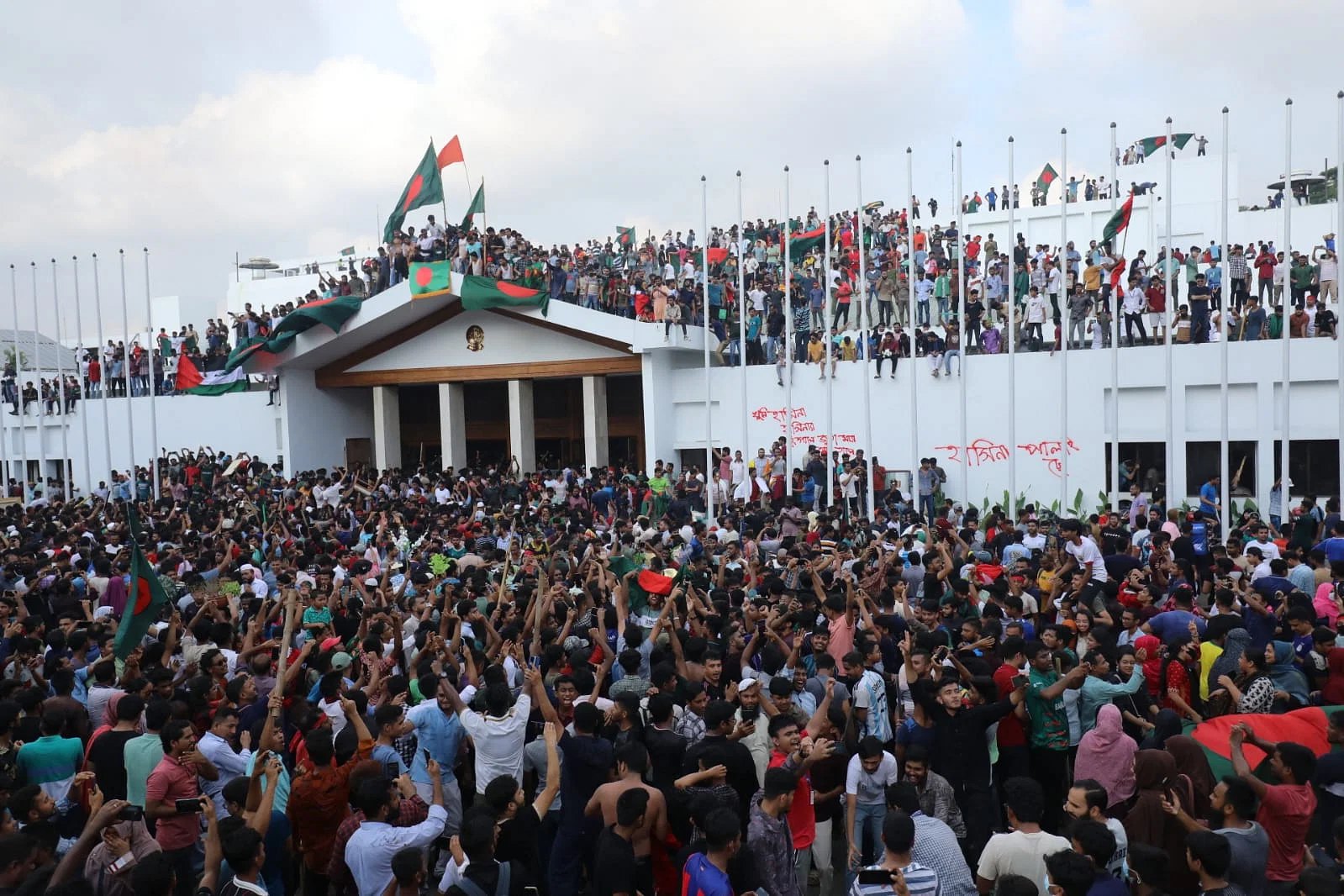
Crowds outside the prime minister’s office during the Uprising. Photograph by Dipu Malakar, courtesy Prothom Alo
The statement issued on 24 September 2024 by the Lemkin Institute for Genocide Prevention titled ‘Statement on Threats to Democracy in Bangladesh’[1] has drawn our attention not only due to misrepresentation of facts but also because it aligns more with the narrative of the ousted autocratic regime led by Sheikh Hasina and her party Awami League than with the aspirations of the people of Bangladesh. The statement has failed to capture the complexities of the situation in Bangladesh and thereby presents a misguided narrative about the uprising and its aftermath. Under the circumstances we feel obligated to respond to set the record straight and point out the inaccuracies in the statement.
Truth, as they say, has an uncanny ability of bursting out into the open, unannounced. This seems to have happened with the controversial Agniveer Scheme – the introduction of contract based employment in the military for four years – which even cost the ruling dispensation a few seats in the recent parliamentary elections.
What Prafulla Ketkar, who has been editor of ‘Organiser’ for the last eleven years, underlined in an event merits close attention in this connection. To a pointed question where he was asked ‘[w]hether India should prepare civilians for situations similar to those faced by Israel’, he specifically mentioned that ‘[t]he Agniveer scheme was introduced for this purpose only. The scheme aims to train military-ready individuals who can be deployed during crises.’
It has been more than four days since Ketkar made this explosive statement, which obviously contradicts what the government wants us to believe. But there has been neither any denial of the statement from the highest level nor has he been reprimanded by top bosses of the Sangh Parivar for making such outrageous statements.
Professor Emeritus, School of Social Sciences, Jawaharlal Nehru University, New Delhi
Theme :Dr. Ambedkar’s Interpretation of Present National Crises
Number of scholars have tried to explain the present crisis by drawing insights from the experience of Fascism of Hitler in Germany 1930’s and/or similar viewpoints . Without undermining these attempts, I feel that Ambedkar’s theoretical perspective on Indian history presumably helps us more to grapple with the present crisis .In Ambedkar’s view it is continuation of the non-stop efforts from ancient times to bring back Brahmanism . Ambedkar observes that “that there was in ancient India, a great struggle between Buddhism and Brahmanism. It is not even a struggle but a quarrel over some creed ,The Buddhism was revolutionary and while Brahminsm was counter-revolutionary. It was a revolution and counter revolution in doctrine by a revolution in political and social philosophy”. The present attempt is an on-going legacy of the ancient Indian where it began , and carried through the medieval to British and to the present time with tenacity and stubbornness to maintain the privileges that the Brahmanical ideology bestowed on those who coined this ideology .The lecture will try to bring insights on Ambedkar’s perspective .
About the Speaker Prof Sukhdeo Thorat, Professor Emeritus, School of Social Sciences, Jawaharlal Nehru University, New Delhi ; former Chairman of University Grants Commission and former Chairman of ICSSR (Indian Council of Social Science Research) is a leading economist, educationist and writer. A renowned Ambedkar scholar Prof Thorat graduated with a B.A. from Milind College of Arts, Aurangabad, Maharashtra and has done PhD in Economics from Jawaharlal Nehru University. He was a Faculty Member at Jawaharlal Nehru University, New Delhi and visiting faculty at Department of Economics, Iowa State University, Ames, USA and has been associated with various national-international institutes and organisations. Recipient of many awards including Dr Ambedkar National Award (2011) and Padmashree ( 2008), he has authored and edited many books and monographs. Here is a list of his major publications : – Ambedkar on Social Exclusion and Inclusive Policy – Dalits in India? Social and Economic Profile (Sage) – Ambedkar in Retrospect: Essays in Economics, Society, and Politics (edited) with Aryama & Negi. (Rawat Publication) – Social Science Research in India : Status, Issue and Policies ( co-authored with Samar Varma) – Oxford University Press ( 2016) – Politics of Representation : Historically Disadvantaged Groups in India’s Democracy ( co edited with Prof Sudha Pai) Palgrave Macmillan ( 2012) – Untouchability in Rural India Sage, 2006 (with G. Shah, Harsh Mander, Satish Deshpande & Amrita) – Caste, Race, and Discrimination – Discourse in International Context (edited) (with Umakant), Rawat Publication, Jaipur (2004)
Following is an Open Letter from ALIFA (All India Feminist Alliance ) to Gauri Lankesh, marking 7 years of her cowardly killing.The Open Letter is in both English and Kannada. The Kannada version follows after the English one. ALIFA is linked to NAPM (National Alliance of People’s Movements).ಆತ್ಮೀಯ ಗೌರಿ ಲಂಕೇಶ್ ಅವರ ಹೇಡಿತನದ ಹತ್ಯೆಗೆ 7 ವರ್ಷಗಳಾಗಿ, ಅವರಿಗೆ ಅಲಿಫಾದಿಂದ (ALIFA) ಬಹಿರಂಗ ಪತ್ರ
Gauri Lankesh, image courtesy Asianet Newsable
Gauri, dear sister, dear comrade!
It has been seven years. We still remember the day, the night! 5th September, 2017 – in fact the very moments – when the ‘news’ hit us. Gauri Lankesh shot in cold blood. Details poured in. Number of bullets. At your residence. By two men. We reeled with shock under immeasurable grief, loss and helplessness. Abandoning so many unfinished conversations, you left a void in all our hearts, the shape and size of a star!
This is the second part of the two-part article by Shahed Suvo, published earlier in Bangla in Ekak Matra on 10 August 2024. The first part appeared yesterday and can be accessed here. This part deals with the last days of the Sheikh Hasina regime and the transition that immediately followed. It has been translated for Kafila by ARUN SINHA.
Responding to the call of the anti-discrimination student movement, student-citizens gathered at Shaheed Minar on August 3. Young people continued to gather at Shaheed Minar with separate protest processions. At this time, elderly citizens were also seen participating in the protest march with them. At around 5:30 PM in the afternoon, the coordinator of the organization leading the quota reform movement Md. Nahid Islam announced a one-point demand in a speech to the students-people gathered at Shaheed Minar – Prime Minister Sheikh Hasina and her cabinet must resign.
Asif Mahmud, another coordinator of the movement, announced the outline program of the non-cooperation movement.
The Hema Committee Report has led to a welcome flurry of feminist activism in Kerala, both among the mainstream feminists as well as others. All political viewpoints within Malayali feminism have stood strongly with the WCC and sought to further their fight, with the implicit agreement that the WCC should not perceived as responsible for all further work.
विख्यात अमेरिकी इतिहासकार, नाटककार, दार्शनिक और समाजवादी विचारक हॉवर्ड जिन- जिनकी लिखी किताब ‘ए पीपुल्स हिस्ट्री ऑफ युनाइटेड स्टेट्स’ की लाखों प्रतियां बिक चुकी हैं- के ये शब्द आज भी दुनिया के मुल्कों में दोहराए जाते हैं जब-जब वहां की जनता हुक्मरानों के हर फरमान को सिर आंखों पर लेती है।
बहुत कम लोग इस वक्तव्य के इतिहास से वाकिफ हैं, जिसे उन्होंने अमेरिका के युद्ध-विरोधी आंदोलन के दौरान बाल्टिमोर विश्वविद्यालय के परिसर में रैडिकल छात्रों और परिवर्तनकामी अध्यापकों के विशाल जनसमूह के सामने दिया था। यह वह दौर था जब अमेरिकी सरकार की वियतनाम युद्ध में संलिप्तता को लेकर- जिसमें तमाम अमेरिकी सैनिकों की महज लाशें ही अमेरिका लौट पाई थीं- जनाक्रोश बढ़ता गया था और अमेरिकी सरकार पर इस बात का जोर बढ़ने लगा था कि उसे अपनी सेनाओं को वहां से वापस बुलाना चाहिए।
याद किया जा सकता है कि इस ऐतिहासिक साबित हो चुके व्याख्यान के एक दिन पहले क्या हुआ था। एक युद्ध विरोधी प्रदर्शन में शामिल होने के चलते उन्हें संघीय पुलिस ने गिरफ्तार किया था और हॉवर्ड जिन को कहा गया था कि वह अगले दिन अदालत में हाजिर हों। सवाल यह था कि क्या वह दूसरे ही दिन अदालत के सामने हाजिर हों, जहां उन्हें चेतावनी मिलेगी और फिर घर जाने के लिए कहा जाएगा या वह बाल्टिमोर जाने के अपने निर्णय पर कायम रहें? यानी, रैडिकल छात्रों ने उनके लिए जो निमंत्रण भेजा था पहले उसका सम्मान करें और उसके अगले दिन अदालत के सामने हाजिर हों? जाहिर था कि इस हुक्मउदूली के लिए उन्हें कम से कम कुछ दिन या महीने तो सलाखों के पीछे जाना ही होता।
हावर्ड जिन ने बाल्टिमोर जाना ही तय किया। यहां उन्होंने अपना भाषण दिया। छात्रों एवं अध्यापकों में उसकी जबरदस्त प्रतिक्रिया हुई। वे लौट आए और अगले ही दिन अदालत के सामने हाजिर हुए। जैसा कि स्पष्ट था, उन्हें कुछ सप्ताह के लिए जेल भेज दिया गया। ( Read the full text here : https://junputh.com/open-space/remembering-howard-zinn-in-the-times-of-bulldozer-justice/)
As a lot of motivated propaganda continues to be dished out about the uprising in Bangladesh, with weird and utterly nonsensical stories of it being ‘engineered’ by ‘the CIA’ at one end, and ‘the Islamists’ at the other, we reproduce here this article that gives a virtually blow by blow account of the developments. Published earlier in Bangla in Ekak Matra on 9 August 2024, Twenty Days that Shook the World in two parts, it has been translated for Kafila by ARUN SINHA. This is the first part. Part II can be read here.
Bangladesh protest before 5 August, image courtesy Ekak Matra
The students’ community revolution in July 2024 will be etched as one very important and characteristic event in the annals of history of deconstruction of state in Bangladesh. After declaration of Pakistan as a state, the first voices of protest were raised against Jinnah’s policy of declaring Urdu as the state language. That was Bhasa Andolan (Language Movement) in 1952, then came the movement on 1962 education commission, the mass uprising in 1969 culminating in the glorious Liberation War in 1971. The student community always participated in bringing these momentous changes walking hand in hand with the people in Bangladesh. Whenever people lost their way and paths in independent Bangladesh, it is the movement of the students that showed the road ahead. Therefore, for the people of Bangladesh the student community has always been the symbol of truth and justice.
[More than 900 organizations and individuals speak out against brutal rape and cultures of impunity from Kolkata and Manipur to Uttar Pradesh, Gujarat and other parts of the country. Published below is their statement issued on 26 August 2024.]
WOMEN RIGHTS NOW!
CITIZENS SPEAK OUT AGAINST BRUTAL CASES OF SEXUAL VIOLENCEFROM KOLKATA TO MANIPUR, GUJARAT, UTTARAKHAND, BIHAR, UTTAR PRADESH…
DEMAND URGENT, INDEPENDENT AND UNBIASED INVESTIGATIONS ANDINSTITUTIONAL ACCOUNTABILITY!
NO MORE SHIELDING OF PERPETRATORS AND THEIR PROTECTORS
‘Reclaim the Night’ is a mass movement demanding justice for the RG Kar rape and murder incident. It has united many people across West Bengal, across the country and even outside India in several places. It has brought people out onto the streets, united them in rage, and one could say it is making – not “history” – but her/queer/trans* story. This movement has brought school and college students, women working in call centres, nurses, doctors, health workers and women working in several other sectors out onto the streets to protest. Women from many villages and rural areas have added their voices to this movement and thousands upon thousands of people have occupied the streets at night, throughout the night, till the wee hours of morning. Muslim women have stepped out to reclaim the streets in several areas and Trans- queer persons have taken part and brought forward their demands. Everyone’s participation has really lifted ‘Reclaim the Night’ to a different height.
Our main objectives are to secure justice in all unresolved cases of sexual violence, including the RG Kar incident, and to secure safety and freedom for women and communities of marginalized genders/sexuality everywhere and at all times. We extend solidarity to all those who are working towards achieving this goal.
[Even as the massive Long March in Dhaka’s Shahbagh is going on, reportedly with lakhs and lakhs of people demanding Sheikh Hasina’s resignation, rumours of her having already resigned are coming in. The statement is of course in support of Bangladesh’s struggle for democracy and against the brutal repression unleashed by her Awami League regime.]
We, the undersigned citizens of India, writers, artists, intellectuals and activists, express our deep concern over the recent developments in Bangladesh. As fellow South Asians, we share a common destiny and the destruction of democracy in any part of it is obviously a matter of concern for all of us. The current government that has unleashed massive violence on its own citizens has brazenly hijacked the elections three consecutive times in the last ten years.
The world has been watching in horror the violent crackdown on protesting students and youth in Bangladesh since mid-July. On 15th July, a peaceful protest by students of Dhaka University demanding reform in the quota system was violently attacked by a group of goons said to be from the student wing of the ruling party. The crackdown followed statements by the Awami League general secretary and an important minister that the Chhatra League would teach a lesson to the students, whom the prime minister, Sheikh Hasina had earlier labelled ‘razakars’ – a term used for the collaborators with the Pakistan army during the 1971 Liberation Struggle. Expectedly, the Bangladesh Police, rather than acting against the attackers, started a full-scale crackdown on protesters all across the country from the next day. On 16th July, the police killed Abu Saeed, a student of Begum Rokeya University, as he stood with open arms, without any weapon, in front of the approaching police forces who aimed their guns at the protesters. The murder of Abu Saeed, who posed no threat to the approaching police forces, manifests how the intention behind the crackdown on protesters was not to maintain law and order but to forcefully silence voices of dissent arising from all across Bangladesh.
Interview with SARWAR TUSHER, writer and activist in Dhaka. Sarwar is one of the leading critical intellectuals associated with the important journal of political thought in Bangladesh, Rashtrochinta Journal and is also member of its editorial panel.In this detailed interview Sarwar explains not just the movement but also the larger politics of Bangladesh.The interview was taken by Aditya Nigam over email.
Turbulent July, Photo courtesy Rahat Karim
[After a round of massive repression and killings, the details of which the reader will find below, the movement is now back with renewed strength. This time it is not just the students and youth demanding an end to quotas but rather huge popular movement that is demanding nothing less than resignation of the Sheikh Hasina government and radical reform of the state. The conception behind this demand for “radical reform of the state” has been spelt out by Sarwar Tusher in detail below and the reader can see how it has grown in conjunction with mass movements of the past. Critical political thinking in tandem with the experience of mass movements has now led to the demand also of a new Constituent Assembly and the drafting of a fresh Constitution. It is also significant that “July” is no longer the name of a month but the name of the struggle itself as it reappears with greater vigour. I should add one more point here, which as to do with some misgivings in India about the quota and reservation question. Though Sarwar deals with it at greater length in different part of the interview, my own sense on reading his responses as well as following the discussions over the past one month, is that the situation is more akin to what might have been (and still is) in countries of state-socialism where the communist party certification was crucial in getting jobs and rising in the bureaucracy and other state institutions. The party certified whether you were “revolutionary” (muktijoddha) or “counter-revolutionary” (razakar) and it is not difficult to see why those regimes became so seriously unpopular (to put it mildly) in their own countries. AN]
This is a guest post by the well known Bangladesh photographer, SHAHIDUL ALAM. The article was earlier published in NEW AGE BANGLADESH and sent to us by SIMONE RUDOLPHI. The photographs are courtesy DRIK.Shahidul’s article actually answers many question that have been on Indian readers’ minds, including, not the least, the question of “quotas.”Interested readers may also find this article by academic Naveeda Khan useful, written as it is from within Dhaka, though she herself is based in the USA.
It would be a mistake to see this as simply a demand for more jobs. The quota movement, justified as it is, is simply the tip of the iceberg. A rampant government running roughshod over its people for so very long has led to extreme discontent. The quota issue has merely lit the fuse to this tinderbox. As citizens counted the dead and the injured, the prime minister fiddled, advising attendees at an aquaculture and sea food conference on tourism prospects in Cox’s Bazaar.
The original quota had been designed, shortly after independence in 1972 to be an interim arrangement to acknowledge the contribution of freedom fighters who constituted less than 0.25% of the population. Since a government known to be incredibly corrupt is responsible for creating the list of freedom fighters, over 50 years later the 120 fold allocation through a 30% quota has become an easy back door for party cadres to much sought after government employment. Confirmation came through senior Awami Leaguers saying, ‘just get through the initial screening and we’ll get you through in the viva’ and more tellingly, ‘government jobs will only go to party people.’
[भारत में 1 जुलाई से लागू हुई नई न्याय संहिताओं के साथ-साथ महाराष्ट्र में एक नया जनसुरक्षा कानून भी आया है। यह कानून उस ‘शहरी नक्सल’ के खतरे पर अंकुश के लिए बनाया गया है, जिसके बारे में इस देश का गृह राज्यमंत्री संसद में कह चुका है कि गृह मंत्रालय और सरकार की आधिकारिक शब्दावली में यह शब्द है ही नहीं। ऐसे अनधिकारिक और अपरिभाषित शब्दों के नाम पर बनाए जा रहे कानून और की जा रही कार्रवाइयों के मकसद और मंशा पर नजर ..]
ऐसे अवसर बहुत कम आते हैं जब कोई साधारण सा ट्वीट सामने आ रही वास्तविकता को स्पष्ट शब्दों में रेखांकित कर दे। जानी-मानी वकील और मानवाधिकार कार्यकर्ता इंदिरा जयसिंह का 30 जून को किया ट्वीट ऐसा ही था, जिसमें उन्होंने अगली सुबह से लागू होने वाले तीन नए फौजदारी कानूनों पर चिंता जाहिर की थी।
इंदिरा जयसिंह के ट्वीट में ‘पुलिस राज’ का रूपक इस बात का संकेत था कि सत्ताधारी केवल ताकत की भाषा समझते हैं। वे न तो संवाद में विश्वास करते हैं और न ही किसी के साथ संवाद करने को तैयार हैं- सिवाय अपने मित्रों के एक चुनिंदा गिरोह के।
इस चिंता में वे अकेली नहीं थीं। अन्य प्रमुख वकील और मानवाधिकार कार्यकर्ता भी इस बारे में समान रूप से चिंतित हैं।
ऐसे खतरों को समझते हुए भी उस वक्त शायद किसी को इस बात का जरा सा भी अंदाजा नहीं था कि इसके आगे भी कुछ और होने वाला है, जिसके संकेत आम चुनाव के बाद महाराष्ट्र के मुख्यमंत्री एकनाथ शिंदे ने अपने एक भाषण में दे दिए थे। ..उस समय किसी को भी यह अनुमान नहीं था कि इस भाषण के एक महीने के भीतर ही राज्य सरकार अर्बन नक्सल के ‘खतरे’ को रोकने के लिए एकविधेयक लेकर आ जाएगी। [ Read the full article here :https://followupstories.com/politics/a-police-state-in-the-becoming-the-maharashtra-special-psa-2024/]
One of the innumerable anti-quota protests across Bangladesh, image courtesy Pressenza – International Press Agency
This post is dedicated to the innumerable young students of Bangladesh who have lost their lives in the last few days of struggle. This wasn’t supposed to be our first post on the Bangladesh students’ struggle because our friend Sarwar Tusher, one among the group of dynamic young critical intellectuals associated with the journal Rashtrochinta, was supposed to write a first hand analytical account. Meanwhile, from Thursday night (18 July) the Sheikh Hasina government enforced a total internet shutdown as the Army moved in to quell the protests. Tanks had already been seen moving in some streets and the protesters were expecting an exponential increase in state violence. Another Tienanmen Square seemed to be in the offing.