Category Archives: Politics

A Brief Introduction to Indian Secularism

The Telegraph's "File picture of suspected illegal migrants detained by police"

I think that should be the title of a poem, but since I can’t write poetry, I want to bring to your attention in pithy prose the Congress party’s time-worn ‘soft Hindutva’ election strategy is back in Assam. Which means that while the Congress, BJP and others in Assam want to welcome Hindus from Bangladesh, the Muslims from there are as ever the “illegal” immigrants, the terrorists, the jehadis, the infiltrators.

They want citizenship for Bangladeshi Hindus and the Bangladeshi Muslims kicked out.

As per India’s non-existent refugee policy, Hindus from Pakistan and Sikhs from Afghanistan have been getting citizenship, but so many other persecuted peoples from all over the world come to India and find it very difficult to get by and soon seek resettlement in a developed country.

This, then, is how I want to introduce Indian secularism to you.

Thanks.

Think Freely, but Obey: Indu Vashist

Guest post by INDU VASHIST

In recent years, we have seen a number of filmic representations of Delhi, (Love Aaj Kal, Delhi 6, Band Baaja Baraat, to name a few.) Amit Trivedi has even given Dilli a new anthem. All of these artist representations have been trying to capture or at least showcase the contemporary social, political and economic layers of India’s Powerpolis. Implicit within these depictions is that Delhi is actually Dilli, a place mired in contradictions and tensions, but still dil wali, a city with heart.

Vishwajyoti Ghosh’s graphic novel Delhi Calm (Harper Collins Press, 2010) recounts the 21-month period from 25 June 1975 – 21 March 1977 that is known in this country as the Emergency. This book shows another side of the city, one that does not talk about or acknowledge the atrocities committed in the name of the nation. In fact, Ghosh’s Delhi functions on the principle that silence or “self-censorship” is the key to survival in this city and by extension the mythical nation. Continue reading Think Freely, but Obey: Indu Vashist

Talking to ULFA: Assam’s Peace Myths and Reality: Tanmoy Sharma

Guest post by TANMOY SHARMA

Last week, when an eight member delegation of the outlawed United Liberation Front of Asom (ULFA) returned to Guwahati after the first round of peace-talks with the central government in New Delhi, the response in Assam is a mixed bag of emotions. Arabinda Rajkhowa, the ULFA chairman who led the delegation, while addressing the press, said that they had been assured of an honourable solution to the three decade long Assam conflict by the Prime Minister.  Earlier, on 10th February the ULFA made history by coming to the talks table in New Delhi for the first time with no firm pre set conditions on its agenda.  It is understood as of now, that no substantial talks would begin before the Assam assembly elections which are expected to be held in April-May this year.  However  this ‘familiarisation exercise’ of the centre with one of India’s most influential and violent separatist outfits at such a crucial time is a hugely significant move in contemporary history of  the insurgency-hit election bound Assam. Continue reading Talking to ULFA: Assam’s Peace Myths and Reality: Tanmoy Sharma

Hypocrisy beneath hammer-and-sickle sign: Sankar Ray

Guest post by SANKAR RAY

Sankar Ray is a veteran journalist based in Kolkata

[This article presents the sordid tale of land acquisitions for the New Rajarhat Township and the involvement of important CPI(M) personnel in this game. One of them, the key protagonist of the story below, was mentioned by Pranab Mukherjee in parliament yesterday, taunting the CPI(M) over its claims to be a crusader against corruption, arousing the ire of its MPs. – AN]

Calling it a ‘shocking experience”, after a visiting a segment of oustees in the Narmada Valley in mid- August 2002,  Sarla Maheswari, then CPI(M) member of Rajya Sabha member told the media – as if her heart bled, and with revolutionary conscience ablaze:  “How can a development project create a disaster in the lives of the most downtrodden tribal people and also thousands of farmers of a huge area? How can it ravage their lives without any protest by mainstream political parties?  Truth indeed is stranger than fiction as the same fire-eating  ‘communist MP’s demagoguery is now in a hot soup as I-T sleuths raided  at  her residence, as a sequel to  detection of an unaccounted sum of Rs 31 crores and 26 benami companies, belonging to the Canopy Group whose chairman is her husband Arun Maheswari. And the CPI (M) brass at the Muzaffar Ahmed Bhavan, Bengal CPI(M)’s state headquarters keep up their recalcitrance, not even demanding a ‘show cause’ of the cash-rich ‘comrade’ . Former MP and CPI(M) CC member Mohd Selim, a spokesman of state party leadership too, ruled out any punitive step until specific indictment by the I-T department, leave alone criticizing the shady land transactions in the controversial New Town project at Rajarhat fully with the knowledge of ‘comrade Sarla Maheswari’  and her family.

Continue reading Hypocrisy beneath hammer-and-sickle sign: Sankar Ray

“dissenting dialogues” on Egypt, Sri Lanka and other debates

The editorial and the list of articles in the dissenting dialogues Issue No 2, February 2011 are posted below. The entire issue can be downloaded as a pdf file from the Sri Lanka Democracy Forum website.

Editorial

As the second issue of dissenting dialogues goes to press, we join in worldwide celebrations of the ongoing democratic revolution in Egypt, itself sparked off by an uprising in Tunisia. The Egyptian uprising, which has tremendous regional and possibly global consequences, came against a background of simmering unrest directed at a dictator who presided over a brutal, authoritarian regime. This regime was distinguished by its incarceration and torture not only of its own dissidents but of prisoners “renditioned” to it by the CIA, the denial of basic democratic rights on the pretext of fighting Islamism, and rising youth unemployment and inflation.

Although the timing and form of Egypt’s popular revolt could not have been predicted, an examination of the recent history of Egypt contextualises the forces at work. For a start, we cannot avoid looking at the recent history of neoliberalism in Egypt, its relationship to the authoritarianism of President Hosni Mubarak’s government, and the regime’s relationship to imperialism. The post-war history of Egypt also charts and indeed defines the historical trajectory of Third World sovereignty. Egypt’s revolt has to be understood in the context of the progressive socialist, anti-colonial struggle for national self-determination of the Bandung era from the 1950s until the liberalisation of the economy in the 1970s, the International Monetary Fund’s “restructuring” in the early 1990s, and the recent capitulation to the accumulation strategy of global finance capital.
Continue reading “dissenting dialogues” on Egypt, Sri Lanka and other debates

Anbulla kaadu (My beloved forest): Madhumita Dutta

Thervoy Kandigai Industrial Complex. The Government issued orders alienating 1127 acres of poramboke land in favour of SIPCOT for formation of a new Industrial Complex in Thervoy Kandigai village of Gummidipoondi Taluk, Thiruvallur District. The land development work is in progress now.

From the website of Industries Department, Government of Tamil Nadu

What this “land development work” involves, and the price that will be paid in human and ecological costs is something that MADHUMITA DUTTA encountered recently.

“A forest that was once ours is now private, a land that was once green now stands barren, a forest where we played, where we wandered freely is now fenced, men in uniform now guard the forest which we protected for generations.”

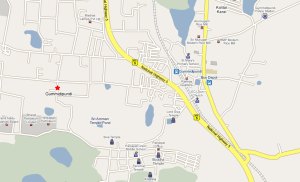
Thervoy Kandigai. A small nondescript village in Gummidipoondi Taluk of Thiruvallur district, 50 kms north of Chennai.  Surrounded by dense shrubby forests, natural lakes, rice fields and undulating terrain with misty mountain range of Sathyavedu in Andhra as the back drop. This small dalit village of about 1000 families is in the eye of a storm.  A storm that can blow away the dreams of Tamil Nadu government to hand over hundreds of acres of land to French tyre company Michelin, a big ticketed investment worth Rs 4000 crore for the state.   Continue reading Anbulla kaadu (My beloved forest): Madhumita Dutta

The ‘Viral’ Revolutions of Our Times – Postnational Reflections

The Arab Turmoil

According to a  report in The Guardian, the movement in Egypt that overthrew the regime of Hosni Mubarak is “a movement led by tech-savvy students and twentysomethings – labour activists, intellectuals, lawyers, accountants, engineers – that had its origins in a three-year-old textile strike in the Nile Delta and the killing of a 28-year-old university graduate, Khaled Said”. It has emerged, says the report, “as the centre of what is now an alliance of Egyptian opposition groups, old and new.” The April 6 Youth Movement (primarily a Facebook network), came into existence in in 2008, in support of the ongoing workers’ struggle in the industrial town of El-mahalla El-Kubra primarily on issues related to wages. The struggle in the past few years, also moved towards a restructuring of unions with government appointed leaders. The list of demands for the April 6 strike also included a demand for raising the national minimum wages that had remained stagnant for over two and a half decades. Increasing workers militancy over the past few years was a direct response to the World Bank imposed ‘reforms’ that had pushed lives of industrial labour to the brink. It was this sharpening conflict, consequent upon the serious impact of structural adjustment policies, that provides the backdrop in which the middle class youth decided to rally in support of the April 6 2008 strike. It was they who converted the call for an industrial strike into a general strike, according to some reports.  It is virtually impossible to get a sense of any of this in the ecstatic reports of the ‘networking babalog’ making a revolution that is now all over the Indian media.

Continue reading The ‘Viral’ Revolutions of Our Times – Postnational Reflections

Why does the RSS dread the terror tag?

1.
Ram Madhav, the bespectacled ex-spokesperson of RSS is not known for his sense of humour.

It is a different matter that some of the media people just could not control their smiles when sometime back (second week of Feb 2011) in a press conference in the capital he enlightened the journos about l’affaire Aseemanand and the broader phenomenon of Hindutva terror.

Giving a completely new and almost unforeseen twist to the Aseemanand episode he said that he (i.e. Aseemanand) had in fact left the RSS in 2006. Of course, as a good spokesperson – although he has become an ex- he had the usual disclaimers in the beginning: RSS does not believe in violence and is a cultural organisation… One does not know whether much on the lines of the School Leaving Certificate, with which lesser mortals like us are more familiar with, Ram Madhav distributed photocopies of ‘Sangh Leaving Certificate’ of Aseemanand or anything similar to give authenticity to his claims or not. Continue reading Why does the RSS dread the terror tag?

‘We are aware of India’s interests’: Jhalanath Khanal

Interview with Nepal Prime Minister Jhalanath Khanal.

After seven months of living with a caretaker government, Nepal’s Parliament on February 3 elected Jhalanath Khanal, chairman of the Communist Party of Nepal (Unified Marxist Leninist), as the Prime Minister, with the support of the Unified Communist Party of Nepal (Maoist). He spoke to Prashant Jha at the prime ministerial residence in Kathmandu on February 10. Excerpts, as first published in The Hindu:

What’ll be your priorities?

My first priority is to complete the ongoing peace process. Second, my aim is to help complete the Constitution-writing process. Third, I’ll strengthen the institutions of governance, improve law and order, and guarantee security to the common citizens. Fourth, my focus will be on taking the country towards an economic revolution through development, reconstruction and socio-economic transformation.

Your predecessors had similar priorities, and had pledged to complete the peace and constitutional process. What’s different about your government? Continue reading ‘We are aware of India’s interests’: Jhalanath Khanal

Blasphemy, Sedition, Democracy

Have you ever wondered?

Why does our media get so worked up when someone in Pakistan is accused of or convicted for blasphemy but is not overly perturbed when someone is charged with or convicted for Sedition in India?

Is this differentiated response occasioned by the belief that a modern state should overlook things like blasphemy but give no quarter to sedition?

Do anti-Blasphemy laws encroach upon Individual freedom while anti-sedition laws protect national interests? Is convicting someone for blasphemy essentially undemocratic but doing the same for sedition not so?

Let’s for the time being leave these major issues aside and engage ourselves with more mundane issues. Continue reading Blasphemy, Sedition, Democracy

A Photo Album of Women of the Egyptian Revolution: Leil-Zahra Mortada

A photo collection by various photographers, compiled by Leil-Zahra Mortada

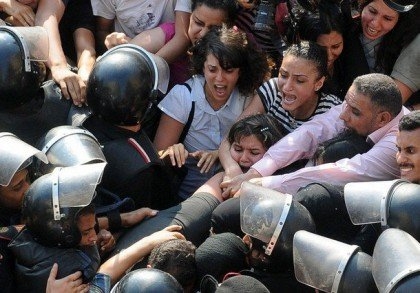
This is a homage to all those women out there fighting on the streets of Egypt, to those whose voices and faces were hidden from the public eye during the first days of the revolution! The album by now has traveled the world back and forth via online social networks, blogs and websites.
First and foremost the credit for this album goes to the courageous people of Egypt who are teaching us that freedom is taken and not given.
Second, to the women who by their courage, determination and strength are inspiring millions of us around the world.
Third to the photographers who took these photos and especially to those who have caused absolutely no problems when it came to copyright issues.


See the album and read more here

Tahrir at Midan Tahrir

This slideshow requires JavaScript.

These six photos come to Kafila from an art collective in Cairo. Photographs by artist HR and other members. They do not want their identities revealed for their safety. Note how that gas canister says Made in USA!

Also see this video doing the rounds, perhaps its not the only effort that brought about the 25 January uprising in Egypt but may still be an important one.

Previously on Kafila: A Phone Call From Alexandria

Release Binayak Sen! Repeal Section 124 A!

Pictures of the rally in Delhi yesterday, January 30th, by PRASHANT TALWAR

This slideshow requires JavaScript.

Egypt today: A first hand account.

Transcript of a land line phone conversation between my friend NAHED MANCYP (based in Toronto) and her mother a (a blogger herself) and grandmother (both currently in Alexandria). Her mother will write a piece soon which can get to Nahed only after the ban on the internet is lifted in Egypt. Thank you Nahed.

My mom:

We arrived in Alexandria from Cairo right after Friday prayers. The streets where completely empty. I actually made a bet with dad. Dad said, I don’t think anything is going to happen. I said, no something will. Half an hour later I began feeling really embarrassed because it looked like nothing would happen. The streets where deserted, there were no officers or cars. Continue reading Egypt today: A first hand account.

Open Letter to the Home Minister: Indian Association for Women’s Studies

Dear Mr.  Chidambaram,

We, the members of the Executive Committee of the Indian Association for Women’s Studies (IAWS), write to you in shock in the face of our recent experiences of intimidation and harassment at the hands of the Anti Terrorism Squad during the XIII National Conference of the IAWS in Wardha at the Mahatma Gandhi Antarrashtriya Hindi Vishwavidyalaya (MGAHV), from January 20-24th 2011. The IAWS (established in 1982) is an academic and professional association of nearly two thousand Women’s Studies scholars, teachers, students and activists. A National Conference is held once in three years, which deliberates on various scholarly and social concerns focussing on women’s lives in the country.  The programme included 5 plenary sessions and 10 subtheme sessions, totalling over 300 submitted papers and 19 plenary speakers.  The highest standards of excellence were demonstrated over the course of the conference. There were 750 participants from different parts of the country, including a few South Asian and other participants who had come to understand gender issues in an atmosphere of intellectual exchange and learning.  A South Asia plenary is an old practice of the IAWS—this time eminent writers and poets from Sri Lanka, Bangladesh and Pakistan spoke, for whom full clearance had been obtained from the respective Ministries.  The university authorities supported the conference throughout, including dedicated volunteers and enthusiastic students and staff. Continue reading Open Letter to the Home Minister: Indian Association for Women’s Studies

Branding Binayak: Balmurli Natrajan

Guest post by BALMURLI NATARAJAN

Writing on the history of insanity in the age of reason in seventeenth century Europe, French philosopher Michel Foucault notes: “People know what they do; frequently they know why they do what they do; but what they don’t know is what what they do does.” Foucault’s insight into the workings of power is an incitement for us to think boldly in public, sadly an endangered species in today’s India.

The recent judgment on the Guha-Sen-Sanyal case prompts one to wonder: Could state functionaries know what what they do does? Could ruling elites who watch silently or goad and guide the guardians of law and order to perform at their bidding know what what they do does? Could the state’s branding of Binayak and thousands of others as Naxalites, Maoists, terrorists or seditionists (terms that it conflates but without scholarly or legal basis) allow civil-liberties activists to create a brand Binayak? Continue reading Branding Binayak: Balmurli Natrajan

The Republic of Exploitation

On this Republic Day, while armoured tanks muscle across Rajpath in New Delhi, little ossified museums of culture called tableaux charm the assembled pass-holding citizenry and the Prime Minister sits like a barely-sentient caricature of himself behind a bullet-proof screen, it may do well to think about the other republic that remains hidden within the bosom of Superpower India – the republic of unfree labour.

This is a world where the laws of the upside world are inverted – where the more you work, the less you are paid, the more your company profits, the poorer you end up and if you find yourself the victim of an injustice and god forbid complain about it, the police put your family in jail. It’s a great irony of our times that we believe the choice before us is between loving the Nation and loving the Corporation, not realising that most of the time its the same person wearing two grotesque masks.  All those who believe that the world begins with their newspapers and television sets and ends at their white picket fences (and all those who don’t), please take a minute to go through the excellent documentation of the war that is raging for workers in this country, put together by the Gurgaon Workers’ Solidarity Group, the Faridabad Mazdoor Sangathan and several other exemplary organisations.

GurgaonWorkersNews – Newsletter 35 (February 2011)

Continue reading The Republic of Exploitation

Ilina Sen harassed again. Long live the Republic!

FINAL UPDATE: Over a hundred names (113) that were received by 9 am on 27th morning have now been added. Apart from the press, the statement will be sent also to the Union Home Minister, Chief Minister of Maharashtra and Chairpersons NHRC and NCW. Final list of names now posted here.

UPDATE: Close to a hundred endorsements from all over the country have been received from academics, social activists, lawyers, film-makers, theatre persons, students, journalists and office bearers of PUCL and IAWS . This will now be sent to the press, and may be circulated widely. All names received by  3 pm are now listed at the end of the statement.


Below is a statement being circulated by some of us for endorsement. Please endorse by 3 pm tomorrow (26th January)

Continue reading Ilina Sen harassed again. Long live the Republic!

The doom-sayers are wrong about Pakistan. Here’s proof


If you click on it, you can also see the rest 3 parts of the show with Veena Malik and a maulvi on Pakistan’s Express TV.

The New Cellu-lar Jail: Madhumita Dutta & Venkatachandrika Radhakrishnan

Guest post by MADHUMITA DUTTA and VENKATACHANDRIKA RADHAKRISHNAN
The writers are activists based in Chennai working on issues of land, labour, industry and SEZs.

Sriperumbudur grabbed media attention in 1991 when former Prime Minister Mr Rajiv Gandhi was assassinated during an election rally. Since then, this nondescript little village-town in west Chennai, dotted with paddy fields and large expanses of natural water-bodies, has transformed itself into a little ‘Shenzen’- world’s largest special economic zone in Southern China, which churns out one out of every eight mobile handsets sold anywhere in the world. Slated to attract investments worth $4 billion in electronics and automobile manufacturing, Sriperumbudur is now home to the largest mobile handset making factory of Nokia, a Finnish company that can churn out 7.5 lakhs handsets a day. This town and its neighbouring region is also known as the Detroit of India, churning around 12,80,000 cars every year. With a booming manufacturing industry and a promise of 2 lakhs jobs, Sriperumbudur is touted as the jewel in the industrial crown of Tamil Nadu. But of recent this seemingly success story has turned a little sour. Continue reading The New Cellu-lar Jail: Madhumita Dutta & Venkatachandrika Radhakrishnan

Ambika’s Death: Madhumita Dutta & Venkatachandrika Radhakrishnan

Guest post by MADHUMITA DUTTA and VENKATACHANDRIKA RADHAKRISHNAN
The writers are activists based in Chennai working on issues of land, labour, industry and SEZs.

A view of Nokia's Sriperumbudur plant. Photo credit: Economic Times

S Ambika, a 22 year old woman factory-worker, died in the middle of the night in a posh hospital in Chennai on 31st Oct. She was a permanent employee of Nokia Telecom Special Economic Zone (SEZ) in Sriperumbadur in Kancheepuram district of Tamil Nadu. Her agonising death was due to a fatal accident at a panel loading machine in the factory.

Continue reading Ambika’s Death: Madhumita Dutta & Venkatachandrika Radhakrishnan