Category Archives: Right watch

Resist the Sangh Parivar’s Hatred of Love: Nayanjyoti and Subhashini

Guest Post by Nayanjyoti and Subhashini

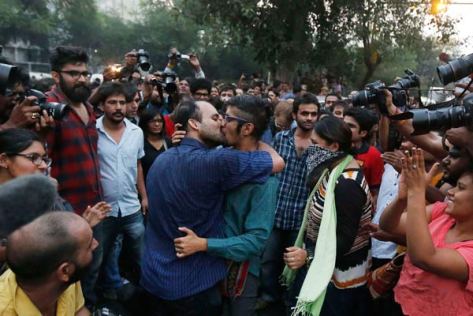
In late October, the youth wing of the Sangh Pariwar among others vandalised a café in Calicut on the pretext that lovers ‘date’ each another sitting in this café. When many young men and women in Kochi gathered together to protest by expressing their love in public, they got beaten up by various right wing groups and the police in response. The students and youths in different regions of the country gathered in solidarity of this protest going by the name of ‘Kiss of Love’. At the same time, as the news spread rapidly through the media and social networking site, a polarization continues to develop in the society, even among the individual activists and similar organizations, for and against the form of this movement.

Continue reading Resist the Sangh Parivar’s Hatred of Love: Nayanjyoti and Subhashini

धर्मनिरपेक्ष दक्षिणपंथ – एक कल्पना का सच: सुशील चन्द्र

Guest post by SUSHIL CHANDRA

पिछले जयपुर साहित्योत्सव (हालांकि मैं उसे ‌‌‌तमाशा-ए-अदब कहना अधिक पसंद करूंगा) के दौरान अमर्त्य सेन ने अपनी सात अभिलाषाएं व्यक्त कीं। दिलचस्प यह है कि उनमें से एक अभिलाषा उलटबांसी अधिक नजर आती है – कि वह देश में एक धर्मनिरपेक्ष दक्षिणपंथ चाहते हैं । यह मासूम सी सदिच्छा न सिर्फ कई प्रश्न उठाती है बल्कि एक साथ कई सारी विवेचनाओं की मांग भी करती है। सच तो यह है कि यह कामना कोई नई बात नही है और पश्चिम की अधिकांश दक्षिणपंथी पार्टियां जैसे रिपब्लिकन पार्टी़, कंजरवेटिव पार्टी़, क्रिश्चियन डेमोक्रेटिक पार्टी इत्यादि इसी संकल्पना की उपज हैं। वस्तुत: यह संकल्पना इस अवधारणा से निकली है कि दक्षिणपंथ के धार्मिक-सामाजिक पक्ष (जिसकी परिणति कठमुल्लावादी रूढि़वाद में होती है) और आर्थिक पक्ष (जो अंतत: नव रूढि़वाद में प्रतिफलित होता है) बिल्कुल अलग अलग हैं और उनके बीच कोई पारस्परिक निर्भरता नहीं है।

पहली नजर में यह सही भी लगता है जहां फ्रांस में लंबे समय तक दक्षिणपंथी शासन के बावजूद प्रशासन राज्य और धर्म के बीच संपूर्ण अलगाव के प्रति समर्पित नजर आता है। यहां तक कि भारत में भी न सिर्फ स्वतंत्र पार्टी बल्कि मनमोहन सिंह सरकार भी अपने सारे नवउदारवादी आग्रहों के बावजूद धार्मिक रूढि़यों से मुक्त नजर आती थी। मैंने जानबूझ कर नजर आती शब्दों का इस्तेमाल किया है क्योंकि सचमुच ऐसा है या नहीं इसकी जांच अभी बाकी है। लेकिन इसके पहले कि हम इस बिंदु की पड़ताल करें, इन दो बहुचर्चित शब्दों ‍- वामपंथ और दक्षिणपंथ को समझना जरूरी है । जरूरी इसलिए है कि इन दो शब्दों का अर्थ संदर्भ के साथ बदलता जाता है । Continue reading धर्मनिरपेक्ष दक्षिणपंथ – एक कल्पना का सच: सुशील चन्द्र

On The Recent Communal Disturbances in Trilokpuri: People’s Alliance for Democracy and Secularism

Guest Post by People’s Alliance for Democracy and Secularism (P.A.D.S)

NOVEMBER 2, 2014

(Members of P.A.D.S. have been interacting with and visiting residents of Trilokpuri ever since the communal disturbances started on Oct 23. Along with many other citizens we are involved in efforts to re-establish peace and in providing legal aid to those wrongfully arrested. This statement is based on the experiences of P.A.D.S members.)

The inhabitants of Trilokpuri, a densely populated neighbourhood of working people in Delhi, went through a harrowing week after Diwali night on 23 October. A brawl around two places of worship that night proved to be the first event. Although the situation appears to have settled down that night, some motivated planning and mobilisation must have taken place that night itself, because the next day it was a full scale communal clash. Armed mobs from outside the locality are reported to have joined the rioting that involved brick throwing. Firearms were also used and two boys suffered critical bullet injuries.  Inhabitants are emphatic that the police fired into the crowd. The police first denied firing at all. Its latest claim is that it fired only in self defense. One apparel show room owned by a Muslim resident was gutted. Police intervened in force only two days after the clashes started. It turned the neighbourhood into an occupied war-zone. More than fifty men and minor boys were arrested randomly, many picked up forcibly from their houses amid verbal abuse and physical violence. Road intersections were barricaded and entry and exit points were closely monitored. Drones were used in surveillance and houses systematically searched. Essential supplies were in short supply. Daily wage earners, contract workers, and self employed who could not go out lost their source of livelihood. Seriously wounded and ill had no access to medical aid. While the entire neighbourhood suffered in one form or another, inhabitants of three blocks in particular, nos 15, 27 and 28, and attached  jhuggi clusters, mainly occupied by citizens who are Muslims bore the brunt of police action.

Communal Hatred the Mahapanchayat Way – A Report From Bawana, Delhi: Mohit Pandey

Guest Post by MOHIT PANDEY

An All India Students Association  team visited Bawana on Sunday (November 2, 2014), met local people, witnessed the Mahapanchayat and the developments around it. This report is based on that visit.

Long standing communal tension in Bawana (at the outskirts of Delhi) took a vicious inflammatory turn, when a Mahapanchayat was called on 2nd November to provoke hatred against the Taziya (Moharram procession) in Bawana. Since Bakrid, the blatant lie of ‘cow slaughter’ in the JJ Colony (nearby Bawana) was used as a pretext to mobilize the whole Hindu community against Muslims. India’s ruling party BJP, as well as an entire battery of RSS backed Hindutva outfits were involved in the campaign to divide Hindus and Muslims of the poorest classes.

Our observations about the Mahapanchayat are as follows :

  • People were mobilized from Bawana and many places close to Bawana, from both Haryana and Delhi.
  • The agenda of Mahapanchayat was to prevent the Taziya procession in Bawana. But residents of the JJ Colony told us that the Muslims of the colony had already agreed, in a meeting on 28th October where leaders from both communities and the ACP were present, to limit their procession to the JJ Colony itself. If the issue of the route of the Taziya procession had already been settled, why did the police even allow the mahapanchayat to be held? Continue reading Communal Hatred the Mahapanchayat Way – A Report From Bawana, Delhi: Mohit Pandey

Love for Fawad Khan vs Jihad against Love: Charu Gupta

Guest post by CHARU GUPTA

Fawad Khan, a Pakistani Muslim male, has become an endearing and enduring metaphor, a fascinating icon, the new heartthrob and fantasy of Indian girls and women. Zindagi, an Indian entertainment television channel, launched just four months ago, which telecasts cross-border serials from Pakistan, has captured our imagination. The central idiom of the channel has proven to be Fawad Khan, who besides having looks to die for and undeniable charm, portrays a sensitive, emotional and mature lover and husband in top of the charts serials Zindagi Gulzar Hai and Humsafar. He has entered Bollywood through the film Khubsoorat. Fan mails from women have poured over websites. One of them says: ‘You have to be living under a rock if you have not heard of Fawad Khan yet…. Did your mother just tell you she has a crush on Fawad Khan? Your female colleagues are probably head-over-heels in love with him too…. Women maybe have more photos of Fawad Khan in their phones than their own.’ Describing the film Khubsoorat, Shobha De articulates: ‘So, who is the real “khubsoorat” in the movie….Any guesses? You’ve got it! It’s a slim, bearded bloke from across the border…. He’s as yummy as those irresistible Lahori kebabs, and desi ladies want him.’

Fawad Khan’s religious and national identity is not hidden or muted; it is explicit and out there. But Indian women, most of them Hindu, are totally disinterested or unconcerned with the fact. While the ‘love jihad’ hysterics are crying themselves hoarse, Indian girls are not giving a damn whether Fawad Khan is a Muslim or a Pakistani. Instead, they are dreaming of having someone like him in their lives to romance and to love, who can make them feel so very special. This swooning over Fawad Khan by Indian girls and women of all ages reveals a religious and national liminality that can stump the hysteria over the constructed bogey of love jihad. The representation of Fawad Khan and the construction of love jihad, both in very different ways are part of fictive imaginations, myths and rhetoric, spectacles and obsessions. At the same time, they undercut each other, reflecting women’s desires on the one hand and Hindu male fears on the other. Love for Fawad Khan personifies allegories of intimacy and romance, while the love jihad campaign embodies hatred and anxieties. One contests power, the other attempts to reinstate it. It is these disjunctive representations that make their juxtaposition stimulating. Continue reading Love for Fawad Khan vs Jihad against Love: Charu Gupta

Organized Fundamentalist Hindutva Forces trying to Instigate Communal Tension in Bawana, Delhi

Pressurize the Administration to immediately intervene and stop the communal Mahapanchayat on 2nd November!

Organized Hindutva forces are again trying to instigate communal polarization and spread terror in Bawana area of North-West Delhi in the last few days. They have called for a ‘Mahapanchayat’ at 4 pm on Sunday, 2nd November 2014 to oppose the Taziya procession taken out for Moharram in the area, calling it supposedly a ‘terror procession’.

Only three-four policemen loiter in the area tonight on 1st November, while the administration, including the Lt. Governor and Police Commissioner, has been alerted in the afternoon itself  by various pro-people forces and local people on the rabidly communal ‘parcha’ that has been circulated in the area. This parcha explicitly gives a ‘call for Bawana’ to stop the supposed terror procession and ‘show of arms’, ‘display of strength’, disruption of peace and other baseless allegations on the Muslim community.

The situation of communal tension in Bawana is not spontaneous, but is being instigated by organized Hindutva forces, much like Trilokpuri in the past week. Earlier, on 2nd-6th October, just before Eid celebrations, the ‘Hindu Krantikari Sena’ outfit of the RSS tried to make a case out of imaginary ‘cow slaughter’ and instigate terror and communal tension among residents of Bawana JJ Colony and nearby Bawana village. They had also put up communal posters then calling for a gathering in Bawana Gaushala on 5th October. Continue reading Organized Fundamentalist Hindutva Forces trying to Instigate Communal Tension in Bawana, Delhi

Witness Account of the Trilokpuri Clashes on October 25, 2014: A.M

AM, a journalist,  writes on Sabrang. Excerpts below and link to the whole piece at the end.

I with a colleague of mine reached East Delhi’s Trilokpuri by 12:00 pm on Saturday. News about alleged clashes had reached us late on Friday night. We were told that the clashes had broken out at around 8:00 pm on Friday but no one was visibly injured. Bricks and empty beer bottles were hurled to and fro interspersed with occasional gunshots. The police reached the area and restored calm. Heavy police presence in the area restored confidence and sent people back into their homes. This is what we had heard.

When we reached the spot on Saturday afternoon at around 12:00 pm, both of us happened to walk right into a mob which had assembled on the main road. Then they started hurling bricks into the air, upped with roaring jubilation and thrill. All at a physical enemy that was not visible. Terrified and taken by surprise, we ducked and ran over to a nearby car parked by the curb. We crouched behind it for over five minutes till we could run farther down to a relatively deserted and safer stretch next to a mother dairy kiosk. That was only one of the many such walk-ins we had and had walked in and out of…

This senseless and directionless fury, we realised, was being whipped up for the fun of it. And, as journalists, we sensed individual families had gathered ammunition, mainly bricks and beer bottles, over the night for a final showdown on Saturday morning. A couple of hours later, my colleague followed a rag picker collecting in a sack bricks strewn over various roads. He saw the rag picker climb into a house and he heard him saying, “Chalo bhai, aaj ke raat ka intezaam ho gaya hai.”…

The atrocities started when policemen began arbitrarily searching houses and rounding perpetrators in the absence of clean evidence or proof. Almost 1000 persons were actively involved in the stone throwing and no one knows which blocks they belonged to and where they had walked to to participate in the violence. Police, clueless and worked up, therefore, randomly began banging on closed doors and shoving their lathis into houses to drive fear and establish control over residents. Most of these houses, however, happened to be in Muslim dominated areas especially in Blocks 14 and 27. The Indian Express reported that “the police have arrested 44 people — 32 Muslims and 12 Hindus” on charges of rioting as listed in the FIRs. This despite Trilokpuri comprising 80 per cent Hindus ( Balmikis) and 20 per cent Muslims. Lopsided statistics and arrests say much about what was happening on the ground…

I was witness to how the Delhi police, had brazenly, in view of  journalists, albeit without cameras employed anarchic, illegal arrests, communal and extrajudicial tactics to impose what they call ‘law and order’- a phrase which constantly equivocates with us, we who lie on the “clean” side of law and those who live outside its underbelly.

READ THE WHOLE ACCOUNT HERE.

The ‘new and improved’ Love Jihad formula, unethical media and ‘social science’ votaries

Caught on the back foot by the humiliating backfiring of their fantastical Meerut scenario of ‘gangrape and forcible conversion’, in which the role of the BJP as well as of sundry Hindutvavaadi organizations in breaking up a consensual Hindu-Muslim relationship have been thoroughly exposed, the Hindu Right appears to have arrived at a new formula. This formula has made its appearance in several spaces – in comments on Kafila (some of which have been passed, many more deleted; mostly pseudonymous or anonymous, and in varying degrees of abusiveness); on the social media and in personal blogs; and more respectably, in newspapers, in signed op-eds and articles, the most recent of them by the perennially amusing Madhu Kishwar.

The formula is patented across these sites and involves all or several of the following claims:

a) Hindutvavaadi groups are not the only ones to fear ‘Love Jihad’ – the Church in Kerala and the Akal Takht have also expressed their anxieties about this campaign. So there must be some fire generating all the smoke.

b) So real is the danger that the claims have been investigated by the police, as directed to do so by courts.

c) Hindutvavaadi groups have no objection to inter-faith marriage, what they object to is the cheating of Hindu women into marriage in a well orchestrated campaign by Muslim men who trap them in polygamous marriages only to convert them and produce several children, thus raising the Muslim population.

d) What is happening in India is only a small part of the Global Islamic Terror Machine’s global campaign to use non-Muslim women as sex slaves, to prostitute them, or to seduce them in order to convert them. The recent exposure of a pedophile ring in the UK run by Pakistani men is treated as proof of the existence of such a globally coordinated campaign in which all Muslims are suspect – from Al-Baghdadi of ISIS to your classmate.

e) As irrefutable proofs, three links are generally circulated: a) a programme of IBN7 that ‘exposes Love Jihad’, and b) two videos of young women who supposedly speak about being victims of Love Jihad.

Madhu Kishwar in her article asserts all of these claims produced by the RSS Myth Machine, although she is probably not yet aware of the last item – which I will address at length in conclusion. Continue reading The ‘new and improved’ Love Jihad formula, unethical media and ‘social science’ votaries

Sanskrit and Language Politics Then and Now: Muruganandham

Guest post by MURUGANANDHAM*

When all the arrangements were made by the corporate media and Hinduist forces for ensuring that Modi became the next Prime Minister, the democratic forces and progressive political organizations were still trying hard to make people understand his real agenda of imposing corporate capitalism and Brahminical Hinduism, in a rapidly fascist manner, in the guise of “development”. Middle class voters were lured by the media and believed him to be the harbinger of “development”. After taking over the rule at the center, Modi’s government has taken up the burden of disproving the undue trust placed on it by the unfortunate Indian middle class – through an array of anti-people activities like cutting of the gas subsidy, privatization of the public sector and substantial hike in train-fare, not to mention the red-carpet rolled out to FDI investments in defense and railway sectors. The Modi government has also been quite manipulative, and has tried to distract people’s attention from these vicious schemes, by working out cultural and social programs with attractive sounding slogans.  The imposition of Sanskrit week, Hindi usage for official purposes, Guru Utsav and more recently the Svach Bharat Abhiyan are only some of those programs which rely purely upon empty rhetoric, hardly having any logic or working mechanism. Invoking people’s imagination towards the “national” symbols is a constant resort of the rulers for political mobilization. More often than not in the Indian context, Sanskrit has been used for this political end in order to sustain the eternal hegemony of Brahminical forces. The present politics behind imposing Sanskrit as the symbol of national heritage and culture by the BJP government certainly demands a much broader understanding of the historical role played by Sanskrit and other languages in shaping the societal structure and cultures. The language which was once denied to the people is now promoted to be the language of all Indians. Let’s attempt to unearth this irony of imposing Sanskrit as the language of “ALL” so as to reveal the ridiculousness of these announcements and the urgent need to oppose them. Continue reading Sanskrit and Language Politics Then and Now: Muruganandham

Love Jihad and the roots of hate: John Dayal

JOHN DAYAL writes:

Three parallel strands of India’s cultural history have merged in recent times into a lethal phenomenon that has been termed “Love Jihad”, which has not only obtruded into the personal lives of young men and women of Hindu, Muslim, Sikh and Christian religious communities, but has put to grave risk individual security and community peace.

A attitude to Muslims that verges on Islamaphobia, a pathological hatred for conversions to Christianity – both seen as disturbing the demographic equation in India to  overwhelm the Hindu majority take the traditional national culture of feudalism and patriarchy to a new and explosive level. The current crisis in the Middle east and on the borders with Pakistan in Jammu and Kashmir provide the trigger, as it were, to the short fuse.

The Indo-Gangetic plans of North India are the main sites of this confrontation but its repercussions have been seen deep in the states of southern India, and the Indian and south Asian diaspora in the United Kingdom and the United states of America.

Political encouragement and patronage to lumpen and criminal moral vigilante groups, administrative and police impunity have led to targetted violence, a wave of hate campaigns, a polarized landscape, and deeply traumatised young couples who have dared, and sometimes married across religious borders. The media has taken sides, the Hindi language newspapers and  television news channels  exhibiting majoritarian bigotry. Civil society has found itself outnumbered.

The church, willy nilly, has found itself dragged into this unsavoury situation. Senior  episcopal and lay leadership of both Catholic and  protestant  denominations have so far not been audible in the defence of what, at the end of the day, are issues of human rights guaranteed under the Indian Constitution  and the Charter of the United Nations.

Read the rest of this article here.

‘Make in India’ – Modi’s War on the Poor

For some months now, I have been thinking of someone whom I saw on television during the parliamentary election campaign. The place was Benaras and Modi’s candidature from the seat had just been declared. The television journalist was interviewing a group of clearly poor people, taking their reactions on this new, though expected development. This person, fairly drunk in his Modi-elixir – and perhaps also a bit literally drunk – swaggered as he answered, affirming his support for Modi: Modi bhi chaiwala hai, hum bhi chaiwala hain (Modi is also a tea-seller and I am also a tea-seller). His words reflected the success of the remarkable gamble – that of projecting the new poster boy of corporate capital as a humble tea-seller. It was clear how so many of the poor had bought into this campaign.

What reminded me of this person initially, was that very soon after the election results were out, even before the government was formed, ‘team Modi’ announced a series of measures for the development of Benaras, which included the building of 60 flyovers – ‘to ease traffic congestion’. Mainly meant for the benefit of smooth flow of motorized traffic (rikshas, cycles and pedestrians, after all, have little place in the economy of the flyover), this was the beginning of a plan that would transform this holy city. If the experience of building flyovers anywhere in India is any experience, this would additionally mean mass demolition of settlements of the poor, shops and even entire informal markets – including tea shops that have long been part of life of local communities.

Then the government took office. Within a couple of months, the plan for Varanasi’s upgradation started being drawn up more concretely. Not everything in the proposed subsequent plan (end July 2014) seemed objectionable -not the least the idea to work on a possible mono rail, improvement of the bus network, and a Bus Rapid Transit System (BRTS) like the one in Ahmedabad. Except that this would mean more and more dislocation of the poor and destruction of their livelihoods. We have seen this happen in city after city in India, including in Delhi. Continue reading ‘Make in India’ – Modi’s War on the Poor

‘The Meerut Girl’, desperate Hindutvavaadis and their Jihad against Love

[With two updates added on October 15, 2014]

The phrase ‘Jihad Against Love’ is Janaki Nair’s in The HinduWhy Love is a Four Letter Word. I can’t think of a better description of this sick, twisted, violent campaign, in which local Hindutvavaadi thugs ally with families desperate to control their young sons and daughters from – quite simply – falling in love. Families that have no qualms in violently separating their children from relationships outside their caste or religious community, often killing one or both of them. Such murders have come to be dubbed ‘honour killings’ by the English media, but a starker, more revealing term is suggested by Pratiksha Baxi – ‘custodial deaths’. Indeed, the young people killed in such cases are in the custody, much like prisoners, of their own families.

If you haven’t had enough of tragic love stories, take a look at Perveez Mody’s book, The Intimate State: Love-Marriage and the Law in Delhi (Routledge, Oxford and New Delhi, 2008) for  heart-breaking accounts of of treachery and betrayal by parents, of their own children who fall in love with the wrong people, and the kinds of physical violence unleashed on rebellious couples by their own families.

The Hindutvavaadi campaign has an able ally in the Christian Right. A report in 2009 in The Times of India said:

‘Love Jihad’, a religious conversion racket which lures gullible girls by feigning love, has brought rivals Vishwa Hindu Parishad and Christian groups in Kerala together.

“Both Hindu and Christian girls are falling prey to the design. So we are cooperating with the VHP on tackling this. We will work together to whatever extent possible,” said K S Samson, an office-bearer of Kochi-based Christian Association for Social Action (CASA), a voluntary Christian association.

Samson said some days ago, CASA got to know about a Hindu family in a Christian parish where a school going girl was the victim. ”We immediately referred it to the VHP,” he said, adding the saffron outfit has helped them in many cases.

Continue reading ‘The Meerut Girl’, desperate Hindutvavaadis and their Jihad against Love

Challenges to “Islamic State” from within Islam

This news was not as widely reported in the Indian media, to my knowledge, but on September 24, 204, 120 Islamic scholars wrote an Open Letter to to the “fighters and followers” of the Islamic State, denouncing them as un-Islamic, using the most Islamic of terms.

Lauren Markoe wrote in Huffington Post a report reproduced in NewAge Islam:

Relying heavily on the Quran, the 18-page letter released Wednesday (Sept. 24) picks apart the extremist ideology of the militants who have left a wake of brutal death and destruction in their bid to establish a transnational Islamic state in Iraq and Syria.

Even translated into English, the letter will still sound alien to most Americans, said Nihad Awad, executive director of the Council of American-Islamic Relations, who released it in Washington with 10 other American Muslim religious and civil rights leaders.

“The letter is written in Arabic. It is using heavy classical religious texts and classical religious scholars that ISIS has used to mobilize young people to join its forces,” said Awad, using one of the acronyms for the group. “This letter is not meant for a liberal audience.”

Even mainstream Muslims, he said, may find it difficult to understand.

Awad said its aim is to offer a comprehensive Islamic refutation, “point-by-point,” to the philosophy of the Islamic State and the violence it has perpetrated. The letter’s authors include well-known religious and scholarly figures in the Muslim world, including Sheikh Shawqi Allam, the grand mufti of Egypt, and Sheikh Muhammad Ahmad Hussein, the mufti of Jerusalem and All Palestine.

Continue reading Challenges to “Islamic State” from within Islam

Open Letter to the Prime Minister – Stop the Dilution of MGNREGA

We are publishing below an Open Letter written by concerned citizens to the Prime Minister opposing the dilution of MNREGA

Dear Prime Minister,

We are very disturbed by impending moves of this government to undermine the Mahatma Gandhi National Rural Employment Guarantee Act (MGNREGA) and the support it provides to crores of vulnerable rural families. We write this letter to seek your immediate assurance that these retrograde, anti-poor and anti-labour measures will be withdrawn, and that every attempt will be made by your government to implement the MGNREGA in its true spirit.

Based on recent public statements from Shri Nitin Gadkari, Union Minister of Rural Development, and other available information, we learn that the Central Government has initiated the following changes under MGNREGA:

  • Restriction of NREGA to tribal/backward districts of the country through an amendment to the Act.
  • Reduction of the minimum labour-material ratio from the current level of 60:40 to 51:49.
  •  Severely restricting the MGNREGA through a budget squeeze. There have been unprecedented communications by the Central Government to States capping MGNREGA expenditure for the rest of the financial year, undermining the fundamental principle of demand-driven employment.

These changes are inimical to the spirit of the Act and compromise its basic objectives. They will only benefit the contractor class and other middlemen, and severely undermine the employment generating potential of the MGNREGA. The changes are also being undertaken without any public consultation. The MGNREGA was passed unanimously by all parties and all members of Parliament. We fundamentally object to this critical social legislation being undermined through casual use of executive powers and even a parliamentary majority.

The illegal and unwarranted budget squeeze has led to widespread reports of employment rationing and acute delays in wage payments. Even as MGNREGA workers are struggling to be paid for work already done, the Central Government is sending the message that money is going to be further rationed.

The undersigned demand that your Government immediately revoke the above decisions and renounce any dilution of MGNREGA. We urge you to ensure that MGNREGA employment remains a legal right of every rural household across the country and that there is no dilution of any MGNREGA entitlements. The MGNREGA budget should be based on work demand, keeping with the spirit of the act, without any discretionary cuts. Continue reading Open Letter to the Prime Minister – Stop the Dilution of MGNREGA

‘Nirmal Gujarat’ – Chronicle of ‘Swachh Bharat’ foretold? Rohit Prajapati

ROHIT PRAJAPATI, indomitable Vadodara-based activist, invites Narendra Modi to read 2 reports:

Report of the Task Force on Waste to Energy (In the context of Integrated MSW Management)’ and

Comprehensive Environmental Pollution Index (CEPI) Report of 2009, 2011 & 2013 of CPCB’.

These reports reveal the hollowness of Modi’s political sloganeering.

Mr. Modi launched the “Swachh Bharat Mission” on 2 October 2014 and in his message on his website, he says, “A clean India is the best tribute we can pay to Bapu when we celebrate his 150th birth anniversary in 2019. […] Today, I appeal to everyone, particularly political and religious leadership, mayors, sarpanchs and captains of industry to plan and wholeheartedly engage in the task of cleaning your homes, work places, villages, cities and surroundings.”[1]

I want to remind Mr. Modi that earlier as the  Chief Minister of Gujarat,  Mr. Narendra Modi had also launched a similar campaign ‘Nirmal Gujarat – 2007’[2] and made tall claims during that campaign. But reality is best seen in Ahmedabad at illegal solid waste dumping site, the ‘Gyaspur-Pirana Dumping Site’ – a Waste Mountain near Sabarmati River adjacent to the main road.

Mr. Modi should know the basic facts as revealed in the ‘Report of the Task Force on Waste to Energy’ dated 12 May 2014 by the Planning Commission of India. This report states “As per CPCB report 2012 – 13 municipal areas in the country generate 1,33,760 metric tonnes per day of MSW, of which only 91,152 TPD waste is collected and 25,884 TPD treated.”[3]

Continue reading ‘Nirmal Gujarat’ – Chronicle of ‘Swachh Bharat’ foretold? Rohit Prajapati

On The Real Tragedy of Secular Modernity: Anand Vivek Taneja

This is a guest post by ANAND VIVEK TANEJA

anandpost

In the discussion around Aarti Sethi’s essay on Remembering Maqsood Pardesi some very important questions arose. As these questions are directly relevant to my work, but also to the larger concerns of the Kafila community, I decided to dwell on them at some length. As these reflections were written in response to the comments of one particular person, I address him directly in what follows below.

Dear Imtiaz,

In your comments on Aarti’s essay, you say the following things about my work:

The tragedy of secular moderns of India is their fascination with Islam… And it appears secular modern Hindus are too busy analyzing jinns of Delhi, which is really sad!

… what do I do with the knowledge of emerging liberal ideologues working for the empire writing enchanting texts about chattan baba or the jinns?


I think that your opening statement is profound. But to understand its true depth, we need to revisit the terms “secular”, and “modern”, as well as our understandings of “Hinduism” and “Islam.” As an entry point into these questions, I will address your (rhetorical) question about what one should, and can do with “enchanting” texts about jinns. Continue reading On The Real Tragedy of Secular Modernity: Anand Vivek Taneja

Marginalized Sections Living Under Fear – A Letter to NHRC

[We are reproducing below a letter to the NHRC Chairperson by Teesta Setalvad, Secretary, Citizens for Justice and Peace, Mumbai]

October 6, 2014
To the Chairperson Mr Balakrishnan, National Human Rights Commission.

Dear Sir,

There are extremely disturbing reports about the climate of abject fear that the poor and marginalised communitoies of JJ Colony, Bawana are living in, following recent incidents. Prominent residents of Delhi have carried out an independent fact finding into allegations of cow slaughter and the systematic intimidation of local Muslims. The team consisting of Dr. Mrigank (Delhi Committee, Indian Federation of Trade Unions, IFTU), Poonam Kaushik (Gen. Secy. Pragatisheel Mahila Sangathan, PMS), Rajeev (Convener, Progressive Democratic Students’ Union, PDSU) visited JJ Colony Bawana.

This report available here.

We urge Sir that the National Human Rights Commission carries out a suo moto inquiry into the incident and especially inquires into the following;-

From the above Report (see below) the observations made are :

1. That the allegations that there is plan of cow slaughter is bogus. There is no possibility of hiding the cows. And no cows were found.

2. That there is intimidation of Muslims and they are living amidst fear. The police protection is not enough.

3. That the organizations like Hindu Krantikari Sena are not spontaneous organizations. It is clears from the fact that among the main organizer was the nephew of BJP MLA. Also total inactivity of BJP MP is a clear indication.

4. That there is total communal harmony in JJ Colony and even today they are together. Continue reading Marginalized Sections Living Under Fear – A Letter to NHRC

Towards a Rational Literacy – Education and Beyond: Shivali Tukdeo

[Anyone who is familiar with the writings and positions of various Kafila authors will see, we do not subscribe to or share many of the views expressed by Shivali Tukdeo in this essay. Several of us have our own fairly strong critiques of the processes of colonial and post-colonial knowledge formation which condemned a whole host of practices, and the lifeworlds in which they were located, as “andhvishwas”. However there is also a simultaneous extremely interesting history of efforts at the inculcation of a “rational temperament” that used emergent discourses of science and modernity to question traditional hierarchies of caste and so on. Maharashtra is an especially vibrant locale for such experiments and their location within long histories of oppressed caste mobilizations. Recent violent assertions by the Hindu Right on the grounds of “tradition”, as evidenced in the tragic murder of Dr. Dabholkar, further complicate the terrain within which these questions arise. So we are carrying this essay as an offering and opening to what we hope will be a spirited conversation around reason, science and faith of all varieties – andh, kana and trilochan. AS]

This is a guest post by SHIVALI TUKDEO

In what can only be termed as an ultimate irony and deep embarrassment, the Maharashtra police allegedly resorted to relying on planchet tricks of a self-claimed god-man to investigate the brutal murder of Dr. Narendra Dabholkar, a rationalist and organiser of Andhashraddha Nirmoolan Samiti (ANS)—Committee against Eradication of Blind Faith[i]. The ‘supernatural intervention’ in this high-profile murder case is painfully damaging, no doubt; however, it is neither an isolated instance nor is it confined to the police department alone. As reportage in the aftermath of the case reveals, police departments routinely subscribe to such practices. Moreover, the widespread practice of offering prayers to Thirupathi before a space launch or the decision to conduct excavation based on a Sadhu’s dream aptly illustrate the powerful hold superstitions have. Such instances also point to the deep and long standing crisis in India’s education. Continue reading Towards a Rational Literacy – Education and Beyond: Shivali Tukdeo

Urgent demand to bring Normalcy to Vadodara: Letter to Commissioner of Police by concerned citizens

To Mr. E. Radhakrishan, Commissioner of Police, Vadodara.

Take concrete steps to bring normalcy in the city of Vadodara and take immediate action in the cases of assault on women by police.

Sir,

A team of social activists visited some of the affected areas on 27th September 2014 on the request of affected people.  A detailed report of our visit is under process  but after visiting the area we have personally discussed with you and informed you about the role of Police, (particularly plain clothes police, also known as D Staff). The police should prevent violence and arrest those who undertake violence. Instead many people particularly women, complained about the verbal abuse and physical assault on them by police. The marks of injury were visible on their bodies. You had promised to look in to the matter and assured us that this will not be repeated.

We are shocked to know that brutal police attacks continued on the night of 27th September 2014.

Continue reading Urgent demand to bring Normalcy to Vadodara: Letter to Commissioner of Police by concerned citizens

Koni koni chhe Gujarat: Rita Kothari

Guest post by RITA KOTHARI

[‘Koni koni chhe Gujarat’ is a poem by Narmadashankar Lalshankar Dave, popularly known as Narmad, who is understood to have introduced the notion of Gujarat in the 19th century, by identifying the region of Gujarati-speaking people. In the poem ‘Koni koni chhe Gujarat’ Narmad wrote that Gujarat belongs to people from different religions and also to those who belong to other parts of the country or globe.]

In 2006, St.Xavier’s College in Ahmedabad (where I then taught) hosted a conference on “Ahmedabad: Past and Present.” Towards the end of the conference a panel discussion focused on religious, linguistic, and other minorities to discuss how for instance, Jews, Muslims, Christians and Parsis felt about the city. Did they feel they belonged to the city, was their experience of citizenship complete, the panel moderator had asked. It was saddeningly clear that Ahmedabad, despite being multi-religious and multi-ilingual, did not hold the same social meaning and comfort for all. The reasons why this city, like some others, has been losing its historical contours of experience and pluralism are not far to seek. Some of the answers could be found in the history of Ahmedabad by Achyut Yagnik and Suchitra Sheth. I would only be reiterating the familiar and well established story of a majoritarian hegemony that has transformed lives irrevocably. Anyway, of the many stories that emerged during this panel, one in particular stayed in mind, reappearing intensely at some times, but receding again in ‘normal’ times.

Continue reading Koni koni chhe Gujarat: Rita Kothari

Fast Track to Troubling Times: The Ghadar Alliance

1400132554-1045_1

A promise fulfilled? File photo from scroll.in of what was left in the wake of Modi’s helicopter on the election campaign trail (Image by Ravi Mishra)

The first 100 days of the Modi government points to emergent disaster, says this report by The Ghadar Alliance, a US-based educational/watchdog coalition created by concerned citizens in the wake of the BJP victory. The report points to the Economy, Religious Extremism and Human Rights as areas of biggest concern, and is released on the eve of Modi’s visit to the USA as Prime Minister of India.

The entire report can be downloaded at Fast Track to Troubling Times.

In a press release, The Ghadar Alliance said:

The report is the first independent ‘people’s’ report to be published since Modi came into office, and identifies the economy, religious extremism and human rights as grave areas of concern. Continue reading Fast Track to Troubling Times: The Ghadar Alliance