Guest post by MANISHA SETHI: It has been seven months since the Jamia Teachers’ Solidarity Association brought out its report, Framed, Damned, Acquitted, chronicling in detail how the Delhi Police’s Special Cell implicated innocents – former militants, police informers, businessmen, and just ordinary, unlucky men – as terrorists. It is one of the few documents that lends evidentiary credence to the widespread sense amongst Muslims that they are being targeted in the war against terror. Apologists for the police and investigative agencies however do not tire of contesting its conclusions, namely that there is a systemic and systematic bias against minorities when it comes to terror investigations. What bias, they ask. As does our chief National Security ‘analyst’ Praveen Swami, who has stressed that “liberals are compromising the war against jihadi terror“.
Could such ‘analysts’ be echoing the sentiments of a judge of the Allahabad High court, who less than two decades after India gained independence, noted, that “in the entire country there is not another criminal force whose misdeeds can come anywhere near the list of crimes of that organised body called the Indian Police force” (All India Reporter, 1964, Vol. 51, 702). Do they mean, that our extraordinarily brutal police force is even-handed in its application of cruelty across the spectrum of our citizenry, and is not especially biased against the Muslims, or Dalits, adivasis and so on?
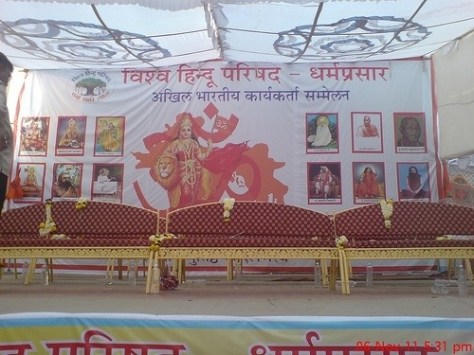

 The Vishwa Hindu Parishad (VHP) is a powerful organization founded on the belief that the Hindu religion is eternal and unvarying, that it has existed in India for thousands of years (the VHP’s chronological estimates vary between 8,000 and 50,000 years), and that its essence has never been affected by any foreign influence or borrowing. Hinduism is unique to India, and India is a uniquely Hindu country: such is the logic of the VHP. And yet, occasionally, the VHP is assailed by a sense of doubt. It is all very well to thunder at Muslims and Christians in self-congratulatory public meetings, its leaders say to themselves, but it would be nice to have some proof with which to fight off the scoffing scientists. And so, as documents recently made available to researchers reveal, the high command of the VHP decided to sponsor a time travel project, sending a fact-finder back to the glorious Vedic age to collect evidence of how the ancestors of the Hindus performed their rituals, worshipped their gods, and conceived of their relationship to the Divine.