Category Archives: Right watch

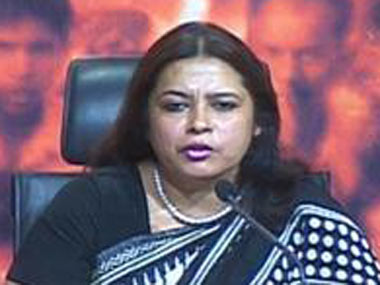
Women condemn Meenakshi Lekhi’s sexist slandering of Ishrat Jahan

Meenakshi Lekhi
Meenakshi Lekhi

Over 115 women have signed a letter seeking an apology from Ms. Meenakshi Lekhi for her sexist slandering of deceased Ishrat Jahan in a television channel. The letter has also been sent to the Chairperson of the National Commission for Women for appropriate action.

As the noose is tightening around the conspirators who cynically and coldly planned and executed the killing of teenaged Ishrat Jahan and three other people in 2004, there is a concerted campaign – the final, last ditch bid to save their skins – by tarnishing the image of this college student. There have been planted stories in the media linking her to a terrorist group –all of them false and concocted, even as the Gujarat High Court has clearly said that the CBI’s mandate is to simply investigate whether Ishrat and others were killed in cold blood. Continue reading Women condemn Meenakshi Lekhi’s sexist slandering of Ishrat Jahan

A letter to Chetan Bhagat from Indian Muslim Youth

Given below is the text of a letter that was initially written by a group of individuals and sent as a rejoinder to the article written by Chetan Bhagat titled,Letter from an Indian Muslim Youth published in The Times of India on 30 June 2013. The letter was sent to The Times of India The signatories include non-Muslims, because a large number of the emails read, ‘I am not a Muslim but I am equally disgusted by Chetan Bhagat’s letter’. Given below is the text of letter followed by more than 200 signatures:

A Letter to Mr. Chetan Bhagat from Indian Muslim Youth

3rd July 2013

Dear Mr. Bhagat, Continue reading A letter to Chetan Bhagat from Indian Muslim Youth

Will ACP Kisan Shengal of Mumbai ATS be prosecuted?: Yug Mohit Chaudhry

malegaon_blast_2

Guest post by YUG MOHIT CHAUDHRY: On Friday, 8th September 2006, four bomb blasts occurred in Malegaon killing thirty-one persons and injuring three hundred and twelve others. The case was originally investigated by the Maharashtra Anti-Terrorist Squad (ATS). After re-investigating the case, the National Investigation Agency (NIA) has concluded that the ATS fabricated evidence against nine persons. This unprecedented acknowledgement raises important questions about how terrorist cases are investigated, police misconduct and the rule of law in India. It remains to be seen whether the government will take action against the ATS investigating officer, Assistant Commissioner of Police (ACP) Kisan Shengal, for fabricating evidence on a capital charge. Continue reading Will ACP Kisan Shengal of Mumbai ATS be prosecuted?: Yug Mohit Chaudhry

मोदी: तिलिस्म और हक़ीकत

– सुभाष गाताडे

जुल्म

तशद्दुद

झूठ

बग़ावत

आगजनी

खूं

कर्फ्यू

फायर ….

हमने इन्हें बिरसे में दिए हैं

ये बच्चे

क्या देंगे हमको ???

(कविता: बच्चे – मुसाफि़र पालनपुरी,

‘कुछ तो कहो यारों!’ सम्पादन: आयशा खान)

1

नूरा कुश्ती की समाप्ति के बाद


सियासत में आपसी सत्ता-संघर्ष अक्सर व्यक्तियों के इर्दगिर्द सिमटते दिखते हैं। Continue reading मोदी: तिलिस्म और हक़ीकत

IB’s desperate and dirty tricks to scuttle the Ishrat Jahan investigation

This is a press statement put out on 14 June 2013 by a group of individuals whose names are given at the end.

It is a clear indication of the desperation being felt by the IB establishment as the heat turns on its senior officers in the Ishrat Jahan probe, that they are down to doing what they do best: use pliant sections of the media to plant stories to deflect scrutiny and create a favourable public mood.  Following the summons issued to IB Special Director Rajender Kumar by the CBI (which is probing the case on the direction of the Gujarat High Court), the IB Director first sought to sell the familiar old story of ‘investigation will hit the morale of the IB’ – it seems as though a blanket immunity from any scrutiny and accountability is the only guarantee of IB morale.  The IB then ran complaining to the Prime Minister; and when nothing worked, it used the agency’s tried and tested trick of enlisting the support of discredited ‘journalists’.  Continue reading IB’s desperate and dirty tricks to scuttle the Ishrat Jahan investigation

Madhu Mausi, Namo Mamu and the Ghost of Uncle Pepper

I’ve been thinking a lot about magic lately. The kind of magic that gets pulled at fairgrounds and birthday parties, or on stage, where the impossible is made to appear possible, where material objects dematerialize and specters appear, tantalizing us into suspending our disbelief. Some magicians, including those I would like to think of as friends, do what they can with consummate skill, so that we attain a state of wonder while they effect transformations using ordinary things for extraordinary purposes. They make us inhabit parallel universes on a table top. There is a kind of poetry and grace in that kind of magic. That is the kind of magic that makes men out of god-men, and re-affirms even a non-patriot’s faith in the ‘waters of India’.

There is another kind of magic, a bag of tricks that relies on the cheapening of our impulses, on our addictions to false premises, on our giving in to our basest instincts. And because sometimes old cliches are useful, we could call this kind black magic. The greatest practitioner of this art, at this moment, seems to me to  be none other than the man who is setting himself up as the caudillo of the future, the chief minister of Gujarat, our prime-minister in waiting, Narendrabhai Damodardas Modi. We,a stunned would be electorate, are the rabbit he is aiming to pull out of his hat.
Continue reading Madhu Mausi, Namo Mamu and the Ghost of Uncle Pepper

Three questions for Madhu Kishwar: Dilip D’Souza

Guest post by DILIP D’SOUZA

Dear Madhu,

20+ years ago, I picked you up at the airport in Austin and you stayed at my home there for a few days. You had come there to deliver a lecture, as I’m sure you remember. We developed a friendship based on a degree of mutual respect and liking. I think you’ll agree? Several years after that I remember a stimulating afternoon sitting with you in Panchgani, catching up on many things and discussing various issues threadbare.

We haven’t met in some years now, but I’m going to call on the privilege of our 20+ years of friendship as I write these lines.

I have no problem at all with your desire to learn about Gujarat and Narendra Modi for yourself. Nor with your desire to see beyond what you’ve called the “targeting” of Modi. Nor with your speaking in support of Modi: if there are people who criticize Modi, I understand and accept that there are those who support him — it’s a democracy we live in after all. Nor with your speaking your mind: you have always done so and it’s the least I expect from you. (In turn, it’s the least you should expect from me). Continue reading Three questions for Madhu Kishwar: Dilip D’Souza

Disinformation and Journalistic Ethics: A Letter from Harsh Mander

We are publishing below a communication received from Harsh Mander, a former member of the National Advisory Council, regarding misrepresentation of his position and his politics by no less a person than the editor-in-chief of the Indian Express. The misrepresentation could easily have been corrected, had the mistake been really a mistake but by not publishing the letter or even an editorial correction, newspaper and the editor seem to be acknowledging that the error was in fact, intended. In the language of the Cold War, acts such as these were called ‘disinformation’. 
Response to Mr Shekhar Gupta’s article ‘The Bleeding Heartless’ in the Indian Express, June 1 2013
 

In response to an article by Mr Shekhar Gupta ‘The Bleeding Heartless’ in the Indian Express, June 1 2013, I sent the letter reproduced below on 3 June 2013, which has not yet been carried by Indian Express. I try not to respond polemically to articles which disagree with my views on public policy or other issues, as these differences are perfectly legitimate in a democracy. And who is to be sure that I am right, and my critics are wrong? But this was different, because it utterly falsely described my ideological position on Maoism as sympathetic, whereas I have always been passionately and publicly opposed to all forms of violence, including Maoist violence. Moreover it linked this to my membership in the NAC, and through that by implication to the many pro-poor agendas I sought to bring into and support within the NAC in the two years that I was a member. Finally Indian Express did not check with me the full facts reported in the opinion piece. I therefore felt I should respond formally to the report. But since this response has not been carried, and on the other hand it is being publicly referred to by others as well, I felt it would be best to place this reply in the public domain. – Harsh Mander Continue reading Disinformation and Journalistic Ethics: A Letter from Harsh Mander

Gujarat and the Illusion of Development: Shipra Nigam

This Guest post by SHIPRA NIGAM is a review of a volume of essays edited by Atul Sood Poverty Amidst Prosperity: Essays on the Trajectory of Development in Gujarat (Aakar Books 2013).

gujarat-farmers_507544e

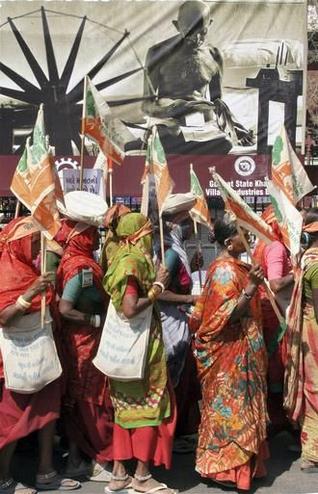
Thousands of farmers protested in March this year in Ahmedabad against the state’s industrialization policies

This volume of essays is the outcome of a detailed study by a team of contributing research scholars led by Atul Sood. This timely evaluation provides an insight into many crucial questions: What are the constituent elements of Gujarat’s growth story? To what extent can the successful features of Gujarat’s growth story be attributed to the political regime fashioned by Narendra Modi? Is it possible to replicate even this limited success story at the national level – as Modi’s starry eyed upper and middle class following would like to believe? More significantly: what are the implications of Gujarat’s Development Model in terms of its sustainability and its desirability? What happens when we assess this development through a set of comprehensive   measures, judge its implication for the average citizen’s material wellbeing, and see what it means for the political and economic rights of citizens?  Continue reading Gujarat and the Illusion of Development: Shipra Nigam

Asghar Ali Engineer (1939-2013)

B_-_portrait.Ashgar_Ali_Engineer-Salzb05__c__RLA_Foundation__Ulrike_AltekruseAn obituary by ZAHIR JANMOHAMED: I first met Asghar Ali Engineer in January 2002 in Mumbai. I was a fellow with the America India Foundation and a few weeks later I would be posted to work with an NGO in Ahmedabad.
A few minutes before his presentation, I noticed him standing off to the side in silence, staring at the ground. I walked up and introduced myself. I was young, in my twenties, and I did not know what to say.

“As-salaam alaikum,” I said.

“Wa-alaikum salaam,” he replied.

I am not sure what response I expected but I thought that perhaps because he and I share the same faith that we might have a special bond, that my greeting would spark a conversation. After all, I always thought phrases like these serve less as greeting and more as an announcement, as in, I am part of the same religion as you.

But Asghar saab just held my hand and then put his hand on his heart. “Nice to meet you,” he said, and then stared at the ground again in silence. I thought it was odd, rude even.

As I continued to meet Asghar saab, I realized that he had very little patience for superficial connections. I witnessed this when I saw him greet crowds after his lectures. If you told him you were from the same caste or city he would not be as excited as if you told him that you also believe that we must fight patriarchy with the same vigor that we must fight communalism. Continue reading Asghar Ali Engineer (1939-2013)

Naya Pakistan, an old fable: Ayesha Siddiqa

pakvotes-election-symbols

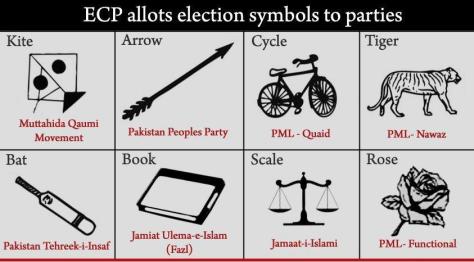
Guest post by AYESHA SIDDIQA: The renowned television anchor Quatrina Hosain was in tears. A day after the incident of her being sexually assaulted at a Pakistan Tehreek-e-Insaaf (PTI) jalsa by party workers in Wah Cantonement, she talked about how the bruises may heal but not her emotional scars. She was covering election rallies and got invited by a PTI candidate Mohammad Sarwar to his rally in Wah. It was a sudden plan so no one could have conspired to misbehave. This is important to note, as  many PTI workers have subsequently tried to blame the incident on Pakistan Muslim League (Nawaz)’s workers. However, when confronted with facts, PTI workers tried to hide behind the argument that women should not provoke people by coming out and mixing with them. Continue reading Naya Pakistan, an old fable: Ayesha Siddiqa

Sinful liberals and the war against jihadi terror: Manisha Sethi responds to Praveen Swami

Guest post by MANISHA SETHI: It has been seven months since the Jamia Teachers’ Solidarity Association brought out its report, Framed, Damned, Acquitted, chronicling in detail how the Delhi Police’s Special Cell implicated innocents – former militants, police informers, businessmen, and just ordinary, unlucky men – as terrorists. It is one of the few documents that lends evidentiary credence to the widespread sense amongst Muslims that they are being targeted in the war against terror. Apologists for the police and investigative agencies however do not tire of contesting its conclusions, namely that there is a systemic and systematic bias against minorities when it comes to terror investigations. What bias, they ask. As does our chief National Security ‘analyst’ Praveen Swami, who has stressed that “liberals are compromising the war against jihadi terror“.

Could such ‘analysts’ be echoing the sentiments of a judge of the Allahabad High court, who less than two decades after India gained independence, noted, that “in the entire country there is not another criminal force whose misdeeds can come anywhere near the list of crimes of that organised body called the Indian Police force” (All India Reporter, 1964, Vol. 51, 702). Do they mean, that our extraordinarily brutal police force is even-handed in its application of cruelty across the spectrum of our citizenry, and is not especially biased against the Muslims, or Dalits, adivasis and so on?

Continue reading Sinful liberals and the war against jihadi terror: Manisha Sethi responds to Praveen Swami

Savar Tragedy: Solution in Solidarity: Navine Murshid

This is a guest post by Navine Murshid The grief surrounding the collapse is unimaginable with more than 500 dead and hudrends still missing. It is clear that the accident was a culmination of the alignment of corruption, greed, inefficiency, and a bid to cut costs, at every level from acquiring lands through illegal means, using sub-standard materials for construction, and forcing workers to work despite life-threatening risks, to foreign buyers who show little regard for human life. It is clear too that the wealthy elite with political connections have capitalized on the textile industry by exploiting the poor; it reveals the evils of capitalism where the bid to minimize costs have led to the complete disregard for human lives, perpetuating the “race to the bottom.”

Thousands of RMG workers have gone on strike and taken to the streets to demand justice for what has happened and to demand changes in working conditions. Many have demonstrated in front of the BGMEA office. On the occasion of May Day, different groups came forward to support the working  class’ struggle for a work environment that is safe and well-equipped for emergency situations and a justice system that actually does them justice. Indeed, such support and solidarity with workers can end these “murders.”

The relevance of Shahbag

Shahbag’s main contribution to the political culture in Bangladesh, arguably, has been to empower people, particularly urban youth, to speak up and realize that even ordinary people can make a difference when they unite; that they do not need political patronage to voice their demands and dissatisfaction. The outpouring of support in the wake of the Savar disaster can be attributed to the understanding of “taking back the nation” that Shahbag had instilled in people to encourage them to be active citizens instead of waiting for the state to take action.

The Savar disaster reveals some key points of convergence between the interests of Shahbag activists and the working classes.

Continue reading Savar Tragedy: Solution in Solidarity: Navine Murshid

Same Difference? The Politics of Development in Rajapakse’s Sri Lanka and Modi’s Gujarat: Anonymous

This is a  guest post by ANONYMOUS

President Mahinda Rajapakse in Sri Lanka and Gujarat’s Chief Minister Narendra Modi in India have positioned themselves as champions of development and good governance. Hardly a day passes without a media comment in the two countries on their respective development achievements. By and large, claims and counter-claims regarding development in Gujarat and Sri Lanka have tended to focus on mobilising data and ‘facts’ pertaining to a range of vital indicators—economic growth, levels of foreign investment, per capita income, employment, industrial or agricultural output, housing, rural infrastructure, roads, electrification, social welfare allocations, etc.

While working with development data is useful and necessary, an approach that relies too heavily on them tells us little about why development matters to the two regimes and how and to what ends it is actually deployed and leveraged by them at this point in time—the focus of this commentary. The question is not just what Modi and Rajapakse are doing for development but also what development is doing for them. Notwithstanding the significant differences between Gujarat and Sri Lanka, as argued herein, there are many striking similarities with respect to how and why Modi and Rajapakse are constructing, invoking and championing the cause of development. Continue reading Same Difference? The Politics of Development in Rajapakse’s Sri Lanka and Modi’s Gujarat: Anonymous

On the social fabric in Narendra Modi’s Gujarat: Nilanjan Mukhopadhyay

This is an excerpt from the chapter, ‘The Enemy Within’ in NIIANJAN MUKHOPADHYAY’s book, Narendra Modi: The Man, The Times.

20130420-121828.jpg
Stage set for a Vishwa Hindu Parishad function next to the Pirana shrine in Ahmedabad, 2011. Photo via twocircles.net

From the label of “Master Divider” in India Today in January 2003 to the tag of “The Great Polariser” in the Outlook in July 2012 — Narendra Modi’s image remained static: self-declared champion of one community of people. But the strain Gujarat faced in the course of his tenure has increased manifold. Wherever I travelled in Gujarat, there was a clear distinction between “us” and “them”. This difference was articulated by several Hindus every time the conversation veered in this direction. In contrast, counterparts among Muslims denied this. The disagreement with the hypothesis stemmed not from a belief and perception that they faced no discrimination but because of a “fear” that accepting such a viewpoint could be interpreted as levelling an allegation that they were being targeted — a risk no Muslim is willing to take after the post-Godhra violence.

Continue reading On the social fabric in Narendra Modi’s Gujarat: Nilanjan Mukhopadhyay

Spin Doctors, Propagandists and the Modi Make-over

Elsewhere on Kafila, we have published a 7000 word long response by Madhu Kishwar to Zahir Janmohamad’s open letter to her which appeared on 15 January, followed by Zahir Janmohamad’s response. Perhaps a few things need to be stated here clearly with respect to her ‘response’. It seems to me to violate every tenet of reasoned debate and argument and is replete with name calling and stereo-typing of not just the secularist ‘other’ [who is her real other, not the Muslim] but even of the adversary she is arguing with. So if Zahir is a  Muslim, he has to be X, Y, Z and has to be believing in A, B, C. Everything starts and ends in bad faith. But then that is what distinguishes Madhu Kishwar from others. She is in her element especially in relation to those whom she disagrees with. With her there can be no disagreement – you have to be sneered and jeered at, irrespective of whether you are a Medha Patkar or an Aruna Roy. I suppose these are matters of personal style and I shall not dwell on them further.

Let me rather, turn to some of the more substantive issues raised in Madhu’s response. Zahir has answered most of them but it seems to me that a couple of vital questions still remain. Even here, though, a caveat is necessary. I have great admiration for Madhu Kishwar’s battle in defense of the rikshaw pullers in Delhi and have often said so openly to her as well as others. However, I do know that it is possible to talk to her when only we agree, which is very rare. On matters that we disagree about, I have decided that I do not want to enter into any kind of an argument with her. In any case, large parts of her ‘response’ are like Modi’s PR handouts, served to us without any sense of critical examination. Therefore, what follows below is not my reply to her but my reactions to a set of allegations she has raised about whosoever is opposed to Narendra Modi – all lumped together in a breathtaking move of reductio ad absurdum, first as secularists , who are reduced to Leftists/ NGO activists and finally to Congress-supporters (because, she says in her Modinama1, the Congress has been equally responsible for all the riots till date). I therefore, lay my cards on the table at the outset: I am an inveterate Modi-hater (and a Congress-hater as well, if that makes sense to anyone in her dichotomized universe) and Kafila is a forum with a certain, if very broad, politics that, at the minimum rules out being pro-Modi. Continue reading Spin Doctors, Propagandists and the Modi Make-over

बंगलादेशी जनउभार और भारत की मुर्दाशान्ति: किशोर झा

Kishore Jha is a development professional and is working in the field of children’s rights for the last two decades. This piece was originally published on the NSI blog.

सन २०११ में भ्रष्टाचार के खिलाफ अन्ना आन्दोलन में उमड़े हजारों लोगों की तस्वीरें आज भी ज़ेहन में ताज़ा है। उन तस्वीरों को टी वी और अख़बारों में इतनी बार देखा था कि चाहें तो भी नहीं भुला सकते। लोग अपने-अपने घरों से निकल कर अन्ना के समर्थन में इक्कठे हो रहे थे और गली मोहल्लों में लोग भ्रष्टाचार के खिलाफ नारे लगा रहे थे। इंडिया गेट से अख़बारों और न्यूज़ चैनलों तक पहुँचते पहुँचते सैकडों समर्थकों की ये तादात हजारों और हजारों की संख्या लाखों में पहुँच जाती थी। तमाम समाचार पत्र इसे दूसरे स्वतंत्रता आन्दोलन की संज्ञा दे रहे थे और टी वी देखने वालों को लग रहा था कि हिंदुस्तान किसी बड़े बदलाव की दहलीज़ पर खड़ा है और जल्द ही सूरत बदलने वाली है। घरों में सोयी आवाम अचानक जाग गयी थी और राजनीति को अछूत समझने वाला मध्यम वर्ग राजनैतिक रणनीति का ताना बाना बुन रहा था। यहाँ मैं आंदोलन के राजनितिक चरित्र की बात नहीं कर रहा बल्कि ये याद करने की कोशिश कर रहा हूँ कि उस आंदोलन को उसके चरम तक पहुचाने वाला मीडिया अपने पड़ोस बांग्लादेश में उठ रहे जन सैलाब के जानिब इतना उदासीन क्यों है और कुछ ही महीने पहले बढ़ी आवाम की राजनैतिक चेतना आज कहाँ है? Continue reading बंगलादेशी जनउभार और भारत की मुर्दाशान्ति: किशोर झा

A conversation that didn’t take place in Juhapura: Madhu Purnima Kishwar and Zahir Janmohamed

On 15 January, Kafila published an open letter to MADHU PURNIMA KISHWAR by ZAHIR JANMOHAMED. Three months later, Kishwar has sent us a response. Given below her response are comments by Zahir Janmohamed.

*

Dear Zahirbhai,

My apologies for the delay in responding to your “Open Letter” addressed to me through Kafila on January 11 2013.

Unlike most of those upset at my articles on Gujarat, you have been remarkably measured in your tone and tenor and also respectful in questioning my observations. However, the content of your letter annoyed me no end. I kept postponing my response in the hope that my annoyance at the absurdity of your chargesheet would subside over time. I honestly did not want to give you an angry or discourteous response so that the dialogic mode you established remained undisturbed.

However, as I began processing the enormous load of material I had gathered from Gujarat, my annoyance kept increasing at your jaundiced viewpoint. Therefore, I thought of letting the series of articles I am writing answer some of your questions. I had made it a point to ask all the questions you raised from Gujaratis I interviewed. At the end of my first series on Gujarat I would have written to ask you if you got your answers. Continue reading A conversation that didn’t take place in Juhapura: Madhu Purnima Kishwar and Zahir Janmohamed

Melbourne Academics in Solidarity with UPenn Professors

Statement from Melbourne Academics in Solidarity with Ania Loomba, Suvir Kaul, Toorjo Ghosh and others at the University of Pennsylvania.

24wharton1

The statement follows the brief background to the issue below:

Ashley L Cohen in The Daily Pennsylvanian

In the pages of The Daily Pennsylvanian and elsewhere, supporters of Narendra Modi have framed the issue of Modi’s disinvitation from the Wharton India Economic Forum as one of free speech. The framing is a clever one. Narendra Modi is a rather unsavory figure, and he is difficult to defend on any other terms. Continue reading Melbourne Academics in Solidarity with UPenn Professors

The Silence of the Protector: Anonymous

This is a guest post by Anonymous

It is over two months since policemen and others allegedly molested women students of Delhi University as they protested against Narendra Modi’s presence at a college event within the University Campus. Not a word of support or concern has emerged from the Vice Chancellor. Instead, cases have been filed by the police against students and teachers who participated in the protest. The Vice Chancellor’s silence is probably among the less hypocritical responses that he could have had. At least students don’t have to hear assurances about their safety once more, and that lie has been laid to rest.

Sometime last year I happened to be present at an interaction between the local Delhi police and women hostel residents of Delhi University. The police had informed three hostels of a ‘meet the public’ programme at which we were required to be present and urge students to attend as well.  The students, who were preparing for exams at the time, attended the event somewhat reluctantly, but in the course of the evening, provided the feedback that was asked for with unexpected vigour. A woman DCP and other police representatives who had been called to address us, chose to assure us that the city was in fact safe despite a lot of media noise to the contrary, and that the reliability of the police could be counted on in all instants. This did not go down well. Various students asked what they should do when the police leered at them, exposed themselves to the women, urinated deliberately in front of them, lolled in their chairs chatting with security guards while cars slowed down threateningly in front of the hostel gates. The DCP, flummoxed by this flood of complaints, finally said that the police were after all a part of society and would reproduce its problems. This rare if honest admission should be taken seriously as a sign of how women should regard the question of their own safety.

Continue reading The Silence of the Protector: Anonymous

In Delhi for Dhaka: A solidarity vigil for Shahbagh

The New Socialist Initiative (NSI), Jamia Teachers’ Solidarity Association (JTSA), Nishant, Anhad, Krantikari Lok Adhikar Sangathan and the Stree Mukti Sangathan have put out this statement in advance of the demonstration tomorrow (9 April) 2 pm before the Bangladesh High Commission in Delhi.

The neighbouring country of Bangladesh is going through a new churning. Hundreds and thousands of people have hit the streets of Dhaka, demanding strict punitive action against ‘war criminals’ and their organisations, who forty-two years ago—at the time of the liberation struggle/war of the then East Pakistan (now Bangladesh)—colluded with the Pakistan army and committed untold acts of atrocities on the general public.

Basically, there are two main demands of the protesters: war criminals should be strictly punished and organisations like the Jamat-e-Islami, Bangladesh, should be banned and all commercial and other kinds of establishments run by it should be proscribed. Continue reading In Delhi for Dhaka: A solidarity vigil for Shahbagh