Category Archives: Scams

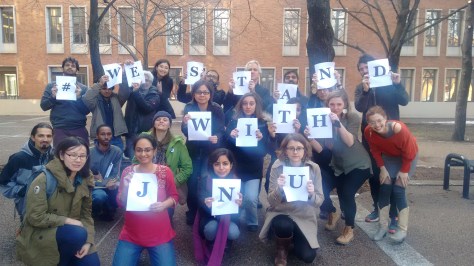
Purdue University Stands in Solidarity with JNU

We, the undersigned faculty and students at Purdue University, strongly condemn the arrest of JNUSU President Kanhaiya Kumar. We oppose the systematic and deliberate attempts to humiliate, bully and terrorize the university’s community of scholars and political activists. It is unethical for a government to spread canards about students with the hope of distracting attention away from its over-zealous, slapdash interventions in academic institutions. We demand that this scapegoating and hounding of Umar Khalid, and all other students, cease immediately.

We salute the courageous JNU community that stands proud and resolute in the face of physical violence, media trials, and sectarian, antediluvian discourses that confuse students for enemies, and dissent – the cornerstone of democracy – for sedition.

More generally, we detect a pattern in this government’s deployment of the state machinery against young adults committed to addressing the inequities and discriminations so blatant in our country today. We insist, therefore, that the central government end its programmatic assault on public educational institutions and the spirit of free-thought. Institutions of higher education must be created and preserved as spaces where caste oppression, gender and minority-exclusion can be studied, and their resistance practiced. JNU exemplifies a dual commitment to combining academic rigor with a political-ethical conscience. We stand in solidarity with JNU’s vision of a diverse campus, charged with a robust polity, where no monolithic, auto-corrected version of the nation or patriotism dominates. We believe that university campuses, like society at large, can thrive only when celebrations of the myriad manifestations of the nation are accompanied by an honest and fearless capacity to criticize its inadequacies. Continue reading Purdue University Stands in Solidarity with JNU
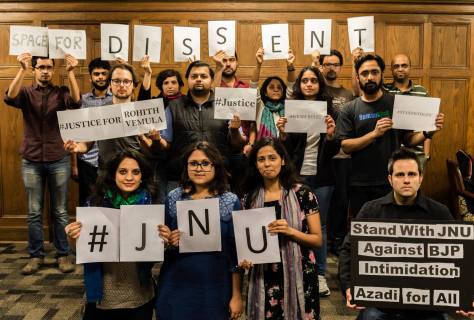
Resolution in support of the student protests in India against the militant suppression of intellectual freedom and dissent by the BJP-government

This is a resolution passed by the Doctoral Students’ Council, City University of New York (CUNY)

WHEREAS, on 12 February, the Delhi Police raided student hostels at the Jawaharlal Nehru University (JNU) and arrested the JNU Students’ Union President Kanhaiyya Kumar on the arbitrary and anti-democratic charge of sedition; and

WHEREAS, this application of a draconian, colonial law which criminalizes dissent stands in stark contradiction to the very democratic character of the nation that affirms an individual’s right to free speech, however radical and unpopular the opinion; and

WHEREAS, this arrest of an elected student representative and the subsequent militarization of the campus with an overwhelming police presence is sanctioned and sponsored by the Bharatiya Janata Party (BJP) led ruling regime, in conjunction with its affiliate organizations RSS and ABVP, its student wing; and

WHEREAS, this coercive presence of the police on the university premises and elsewhere is compounded by their complicity in the physical assaults by lawyers of the Hindu Right on JNU teachers and students at the courthouse before Kanhaiyya’s hearing; and

Continue reading Resolution in support of the student protests in India against the militant suppression of intellectual freedom and dissent by the BJP-government

University of Minnesota Stands in Solidarity with Jawaharlal Nehru University

IMG_20160219_151429805

We, the undersigned at the University of Minnesota, strongly condemn the concerted attack on the students, faculty and academic culture of Jawaharlal Nehru University. At the behest of the government, the Delhi police has pressed sedition charges on unnamed students of the university. Reminiscent of the Emergency, the students’ union president Kanhaiya Kumar has been arrested, several students have been suspended and the Delhi police has been hounding students in hostels, homes as well as public spaces in the city. Sections of the mainstream media have launched a vicious campaign to declare JNU an “anti-national” university, and some journalists have gone so far as to spin lies about the “terrorist connections” of student activist Umar Khalid. As a consequence, mob violence against JNU students and faculty has spread across the city and even entered the courtrooms where the case against the JNU students’ union president was being heard. We strongly condemn this hate campaign and demand the immediate release of the JNU students’ union president. We also demand that the suspension of students is revoked and unsubstantiated sedition charges are withdrawn immediately.

Continue reading University of Minnesota Stands in Solidarity with Jawaharlal Nehru University

Sambit Patra Flying the Tricolour on Times Now, in JNU and on Iwo Jima – History Re-Imagined (Once Again) by the BJP

http://www.youtube.com/watch?v=rQNDEwBirLg

A recent ‘Newshour’ non-debate on Times Now on whether or not an order emanating from the Ministry of Human Resources Development to erect 207 feet high steel flagpoles and giant tricolour flags in Central Universities across India featured a wonderful intervention by Sambit Patra, BJP spokesman and digital magician extraordinaire.

Continue reading Sambit Patra Flying the Tricolour on Times Now, in JNU and on Iwo Jima – History Re-Imagined (Once Again) by the BJP

UNIVERSITY OF ILLINOIS STANDS WITH JNU

Students and Faculty, University of Illinois Urbana Champaign in Solidarity with JNU

We, the undersigned students, faculty, staff, and other members of the University of Illinois community are in solidarity with students, faculty and staff at Jawaharlal Nehru University (JNU), India, against the ongoing anti-democratic actions by the Indian state. We demand an immediate end to the police action against students on campus, and withdrawal of all charges against Kanhaiya Kumar, President of the JNU Students’ Union. We unequivocally condemn the witch hunting of students, using archaic laws of sedition, who organized the cultural event questioning capital punishment and the deliberate vandalism and violence unleashed by those affiliated with Hindu Nationalist groups. We are also dismayed at the violence used by lawyers aligned with the government in their acts of vigilantism which are aimed at using the garb of patriotism to impose their ideology through violence.

We strongly believe that the charge of sedition against Kanhaiya Kumar, Umar Khalid and the other 6 students are based on spurious evidence. This arrest is an excuse for the state to root out dissenting voices on JNU campus, a move towards converting educational institutions like JNU into an arm of the authoritarian state. Attempts of a similar nature have been witnessed recently at other Indian educational institutions such as Film and Television Institute of India (FTII) and Hyderabad University. The growing threat to academic freedom and the practice of fundamental thinking and critique, posed by the current political climate is transnational, and extends beyond India to other parts of the world–it is a threat we face here in the United States, too.

Continue reading UNIVERSITY OF ILLINOIS STANDS WITH JNU

Solidarity Statement for JNU by IIT Scholars

This is a statement issued by the undersigned, scholars of Departments of Humanities and Social Sciences of IITs across the country.

We, the undersigned, scholars of Departments of Humanities and Social Sciences of IITs across the country, condemn the police action in JNU and the arrest of the JNUSU President Kanhaiya Kumar on the charge of sedition. We also denounce the repeated acts of violence unleashed by some lawyers and others at the Patiala House Court against faculty, students and the media, as well as police inaction regarding the same.

In addition, we appeal for media and public trials to cease and for civil society to instead focus on debating issues in an amicable and reasonable manner, without slandering JNU or questioning the academic integrity or patriotic fervour of JNU and its supporters. We criticise the general atmosphere of fear and intimidation that is being created to target the entire university. Given the fast polarizing political atmosphere in the country, we appeal to the media organisations to display greater responsibility and conduct television debates in such a manner that no prejudicial public opinion is created while there is an ongoing enquiry into the entire episode by the authorities concerned. Resorting to jingoism and sensationalism may cause avoidable hazards. Continue reading Solidarity Statement for JNU by IIT Scholars

JNU Teachers Statement

After the arrest of JNUSU President Kanhaiya Kumar on 12 February and the entry of the police into JNU Campus, the situation has worsened for our students over the last few days. Sections of the mainstream and social media have carried unsubstantiated rumours targeting students, and organised groups have been making threats against them and indulging in hate speech in order to intimidate. The viciousness of this section of the media and amounts to a public trial and the frightening abuses being hurled at them make us feel deeply concerned for their personal safety and possibilities of their obtaining justice.

We strongly condemn these acts that create an environment of extreme prejudice and potential violence. We demand that the campus be allowed to return to normalcy at the soonest, so that students can return to their regular academic life in an atmosphere of trust and safety. The slander campaign against the University based on unsubstantiated claims not only tarnishes JNU’s image as one of best regarded institutions of higher education in the country, it also destroys JNU’s peaceful academic life. We are deeply concerned about the students’ future, which is being affected by this malicious campaign against JNU.

We the teachers of JNU wish that the Indian people should see through this orchestrated design to transform JNU into a space which will be unable to encourage or sustain critical thinking, so vital to the functioning of our democracy and our nation. It will also endanger the futures of thousands of students who are uncertain about the consequences that such a sustained campaign will have on their futures. We call upon the broadest possible sections of the Indian people to preserve the character of this much cherished national institution.

 C.P. Chandrasekhar

G. Arunima

Ayesha Kidwai

Udaya Kumar

Pratiksha Baxi

Chirashree Dasgupta

Saradindu Bhaduri

Rajat Datta

Vinay Kumar Ambedkar

Ranjani Mazumdar

Jayati Ghosh

Navaneetha Mokkil

Rohith Azad

Ameet Parameswaran

Joy Pachuau

Yashadatta Alone

Rajarshi Dasgupta

Mohan Rao

Vikas Bajpai

Sujatha V

Parul Mukherjee

Ramila Bisht

Surinder Jodhka

Happymon Jacob

Supriya Varma

Mallarika Sinha Roy

Parnal Chirmuley

Nivedita Menon

Hemant Adlakha

Lata Singh

Urmimala Sarkar

Rajib Dasgupta

Rama Baru

Prachin Ghodajkar

Vikas Rawal

Partho Datta

Papia Sengupta

Ira Bhaskar

Sandesha Rayipa-Garbiyal

Veena Hariharan

Pradipta Bandyopadhyay

Biswajit Dhar

Neera Kongari

Geetha Nambissan

Brahma Prakash

Brinda Bose

Maitrayee Chaudhuri

Rashmi Barua


Statements of Solidarity For JNU From Various Quarters

We at Kafila have been receiving amazing statements of solidarity with JNU and its elected students’ President Kanhaiya Kumar over the past three days. We are posting them below, along with affiliations: South Asia University (teachers and students); Grinnell College, USA, Ambedkar University Delhi Faculty Association, Democratic Teachers Network, Hyderabad, and over a hundred students from Department of English, Delhi University.


STUDENTS OF SOUTH ASIA UNIVERSITY

We, the students of South Asian University, New Delhi (comprising of students from eight SAARC nations – Afghanistan, Bangladesh, Bhutan, India, Maldives, Nepal, Pakistan and Sri Lanka) strongly oppose the idea that one’s nationalism be defined in terms of hatred towards another nation (for example, Indian nationalism be defined as hatred towards Pakistan, or vice versa). We cherish the common cultural and social heritage of the South Asian region, and shall not let any kind of jingoist nationalism being endorsed by any religious group, political party or state hinder our shared solidarity. However, in recent times, such groups and establishments have unleashed an attack on democratic and critical voices in our universities across the South Asian region, masked under religious conformity, state intervention or sometimes in the form of an act of terrorism.

Thus, we stand in complete solidarity with the student and faculty community of Jawaharlal Nehru University (JNU) in their collective struggle against the ongoing police intervention by slapping the baseless charges of sedition on many students, including the arrest of JNUSU President – Kanhaiya Kumar, and against the massive propaganda terming the JNU as ‘a den of anti-nationals’. We would like to reiterate that our collective nationalism stands responsible only to the interests of our people and our land, and not to the divisive forces which have had and are still trying to create boundaries between us.

STATEMENT OF SOLIDARITY WITH STUDENT PROTESTS IN INDIA, FROM STUDENTS, FACULTY, AND STAFF OF GRINNELL COLLEGE

Grinnell-JNU Solidarity

Continue reading Statements of Solidarity For JNU From Various Quarters

On framing JNU for an imaginary crime: Aditya Sarkar

This is a guest post by ADITYA SARKAR

JNU has entered an indefinite state of siege. Police have been swarming all over campus, raiding hostels, picking up students and interrogating them. The ABVP, predictably, have been directing them to the lairs of ‘anti-national elements’. When immense demonstrations of public solidarity with the accused students were organized, ABVP activists have attacked these, in one case mounting a violent physical assault on a visiting speaker. The JNU administration has gone to the extent of cutting off the power supply to the microphones used at a protest meeting. At Patiala House on Monday the 15th of February, the BJP’s MLAs and what appear to be a group of lawyers have assaulted JNU students, faculty and supporters in full view of the police, with what can only be regarded as smug impunity. More than one observer has remarked that this is the Emergency all over again.

It is clear that the arrayed forces of the central government are pitted against a campus which has long been an object of hatred for the Right. There’s no telling how matters will develop in the days and weeks to come. So it might be necessary to step back a bit and consider the sequence of events that led to the current situation.

In the past month, JNU students organized a protest meeting which raised the issue of Kashmiri rights, and drew attention – just as Rohith Vemula’s protest in Hyderabad had done – to the execution of Afzal Guru in 2013. Since the mainstream news outlets systematically censor any attempt to reopen that extremely murky case, it’s worth reminding ourselves of precisely why the execution was so controversial. The terrorist attack on Parliament in December 2001 produced a police investigation on which serious doubt was cast from the beginning. Afzal Guru’s laptop and mobile phone, key pieces of evidence, had not been sealed prior to investigation. One of the other accused in the case, a Delhi University lecturer (who was later emphatically acquitted) was viciously framed by Zee News, which used the police charge-sheet to make a documentary ‘establishing’ his guilt. The court proceedings were even more revealing. The Supreme Court admitted that there was no hard evidence to conclusively establish Afzal Guru’s involvement in criminal conspiracy. But these admissions were merely qualifications to what was perhaps the most extraordinary decision in the history of the judiciary in independent India. Afzal Guru was eventually hanged in 2013 on the basis that only this would appease ‘the collective conscience of the nation society’.

Continue reading On framing JNU for an imaginary crime: Aditya Sarkar

JNU Bashing is an old pastime, but things just got much, much worse

In light of the glorious vigilantism being witnessed today, in which the lumpen lawyers at Patiala House are joining hands with Guardian of the Nation Horn-nob Go-Swamy on primetime TV A few years ago, finding myself in a heated but very enjoyable argument on why women change their surnames after marriage, somebody yelled from across the room, “What has JNU done to you?!”

I wasn’t surprised, only annoyed. Reducing my entire biography and political beliefs to an institution I attended once upon a time is a favourite pastime in India, when that institution happens to be JNU. I could have explained to the genius who shouted this that if I do have political opinions, neither were they surgically implanted in me at JNU nor will they wither away like the bourgeois state in Marxism if JNU ceases to exist. I should have been grateful that the JNU-phobia was posed through the formal courtesy of a query. Usually, it takes the form of a statement, “You JNU folk are all lunatics!”

In family settings, JNU-bashing is the preferred insult to shut down an argument, “It’s the JNU in you speaking!” At seminars, a question or a paper can be made illegitimate with the simple investigative exercise of determining if you’re from ‘a particular institution with a particular ideology’. Of course, the person asking the question has miraculously escaped institutions and ideology, remaining gloriously neutral in this fractured world.

Continue reading JNU Bashing is an old pastime, but things just got much, much worse

So Was it an ABVP/ RSS Game – Who Shouted ‘Pakistan Zindabad’ in JNU?

While some television channels, through a combination of unethical playing to the gallery (and to the Modi regime), have portrayed ‘JNU students’ as antinational Leftists, Pakistani agents etc, a video has surfaced that has gone viral over social media that allegedly shows identifiable ABVP students shouting ‘Pakistan Zindabad’ slogans.

The four students who are seen in the video shouting ‘Pakistan Zindabad’ slogans, have been identified as ABVP activists (one of them has even been identified by name as Shruti Agnihotri), seen leading protests elsewhere in ABVP  demonstrations.

It is of course, a question that no one in the electronic media (print was different this time) sought to even ask themselves – as to who would be interested in shouting ‘Pakistan Zindabad’ slogans? This is a purely RSS/ABVP/Hindutva obsession. No Leftist that I know of (and I think I know almost all shades by now) would have any reason to shout something as stupid and meaningless as ‘Pakistan Zindabad’! Now, the exchange below also puts things in perspective.

We do not of course, vouch for the authenticity of this video. We wait to be refuted and to be  told that all this  is doctored but the point will still remain, as one of the participants in  the exchange below states, what a curious coincidence that only Zee News  had access to the video that showed ‘students’ shouting pro-Pakistan slogans!

Any enquiry into the incident must take into account this video, investigate its authenticity, and take stern measures if it is proved to be accurate.

In closing, here is an exchange on twitter by ‘BJP Insider’ :

BJP Insider@11AshokaRoad
Thz fools @sudhirchaudhary & @sardanarohit just ruined all our conspiracy by playing that video of AVBP members shouting ‘Pakistan Zinadabd’
330158
BJP Insider

19h19 hours ago

BJP Insider@11AshokaRoad
Now since our involvement is proved in JNU incident, boss has ordered DP to go soft on arrest of AVBP members who shouted Pakistan Zindabad
460190
BJP Insider Retweeted
Pradeep Mittal

19h19 hours ago

Pradeep Mittal@PradMitt
@11AshokaRoad what an coincidence that only zee news camera man was their to record Pakiatan Zindabaad slogans.. hain na !
17981
BJP Insider

19h19 hours ago

BJP Insider@11AshokaRoad
It was a gud conspiracy but @ZeeNews ruined it by broadcasting this video by mistake https://www.youtube.com/watch?v=Xs1sCRVxoHY&feature=youtu.be & we got caught our pants down

Embedded image

Who’s Afraid of JNU? Or, The Sedition That Wasn’t: Sania Hashmi

This is a guest post by SANIA HASHMI

JNU Sedition

Over the past couple of days, Zee News has been declaring to the world that Lance Naik Hanumanthappa died because he’d rather not breathe the same air as we at JNU do. That this statement is the worst possible trivialisation of a martyr’s death which is being exploited for petty sensationalism by our own version of the fourth estate is a separate issue, too nerve-wracking to be given precedence over the tragedy that unfolded in our campus yesterday with the arrest of our democratically-elected President Kanhaiya Kumar. A Zee News screen grab showed the word ‘Deshdrohi’ in 72-pt screeching yellow font pasted across Kanhaiya’s unsuspecting face. What was his fault? As an eyewitness from ground zero who was present at Sabarmati at the time of the protest, let me begin by answering the obvious questions that despite the numerous clarifications on part of the students and the JNUSU on social media and elsewhere are meeting deaf ears. It is interesting how despite being told that the Students Union and the student body in general had nothing to do with it and have in no uncertain terms condemned any alleged slogan against our country, the trolls are still putting decibels to shame with the very same questions. And no, I am not just talking about Nupur Sharma. So yes, let me begin by putting a few things on record in respect of Kanhaiya’s arrest. Did Kanhaiya organise the event? NO. Did he raise anti-India slogans? NO. Did he hail Pakistan? NO. Did he intervene to prevent ABVP-instigated violence in his capacity as the President? YES. Has he been vocal against the brahmanical tyranny of the RSS? YES. Has he been tirelessly fighting for the Rohith Vemulas of this world? YES. Has he been a torchbearer for students’ rights across the country? YES. Is this why you have arrested him? Is this your justice? If this struggle for a just society is anti-national in your eyes, we all plead guilty! If this is your witch-hunt for people who cannot conform to your ideological blinkers, we all plead guilty! If we must be party to the violent hooliganism of the ABVP in order to be called patriotic, rest assured, we all plead guilty!

WATCH KANHAIYA KUMAR’S SPEECH HOURS BEFORE HIS ARREST TO SEE WHAT THE GOVERNMENT OF INDIA CONSIDERS ANTI-NATIONAL. Clearly, Kumar’s fault was that he said in this speech that he doesn’t need the RSS’s certificate to be called a nationalist.

Continue reading Who’s Afraid of JNU? Or, The Sedition That Wasn’t: Sania Hashmi

Tibetan Artists Silenced at Dhaka Art Summit: Ahmad Ibrahim

This is a guest post by AHMAD IBRAHIM

20160207_200806
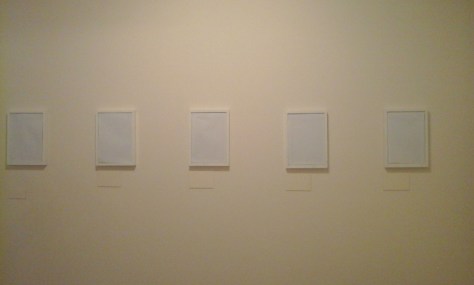
These pictures, which depict blank walls, are symbolic of the attack. Pictures of the original art cannot be shared due to copyright issues.

On the 7th of February, Tibetan artist Nortse and Indian artists Ritu Sarin and Tenzing Sonam had their photographs and art installations removed at the behest of the Chinese ambassador to Dhaka from the Dhaka Art Summit taking place in Shilpakala Academy in the capital of Bangladesh. The art project by Nortse was titled Prayer Wheel, Big Brother and Automan (2007) which showed the artist don traditional Tibetan clothes along with modern objects to show the surveillance that marks their lives. .Ritu Sarin and Tenzing Sonam produced a piece called “Last Words”, which consists of five facsmilies of five last messages written by the self-immolators in Tibet, along with their English translations. Ritu Sarin and Tenzing Sonam depicted Tibetan monks in the act of self-immolation as a way of political and religious protest against the occupation of Tibet by the Chinese government. At the end of the 6th of February, both artists were still depicted on the walls of the Art Summit. On the 7th, what greeted the visitors and patrons were blank stretches of white wall with white frames. It was as if the works had never existed. This is not the first time the Chinese government has tried to shut down political art work that aims to show the real face of Chinese occupation of Tibet. What is even more reprehensible is that it happened inside the walls of an institution that was proclaiming itself to be a haven of bold art and artistic expression. That the Chinese government could go to such lengths to silence an exhibition happening thousands of miles away shows the depth of their oppression over an entire country. Since February 2009, 142 Tibetans have self-immolated in their homeland, 120 dying from their actions.

A link to Tenzing Sonam’s twitter:

A Facebook link to a picture when the exhibit was still standing. 

Ahmad Ibrahim is a Dhaka based journalist.

Survey Report on Losses Sustained during Chennai Floods: Concerned Citizens and Activist Groups

Guest Post on Chennai floods by CONCERNED CITIZENS AND ACTIVIST GROUPS  

[Earlier today we had published a post on the Chennai floods. The following is a report of a Survey on losses sustained during the floods, conducted by Arunodhaya: Centre for Street and Working Children; Bhavani Raman; Citizen consumer and civic Action Group (CAG); Karen Coelho, Kavin Malar; Krishnaveni; Madhumita Dutta; Vettiver Collective; Prem Revathi; Priti Narayan; Students of Madras Christian College; TN Labour blog; and V. Geetha]

Sample Survey of Losses Sustained During Chennai Floods

With special reference to losses and damages of possessions, loss of workdays and damage to homes

January 2016

Executive summary

A group of concerned citizens involved in relief work post-Chennai floods, 20015 undertook a sample survey of 610 households (including migrants) across the city to assess losses suffered/damages incurred to homes, goods, occupational tools and also to get an idea of loss of working days. The purpose of this survey was to identify the exact quantum of losses sustained by the population and to direct government to compensate the populace for damages/loss accruing on account of the floods.

  • Places surveyed: Eekaduthangal, Jaffarkhanpet, Saidpet, Kotturpuram (Adyar flood plains), Mudichur (badly affected suburb), Semmencheri, Perumbakkam (resettlement/new housing tenements for low-income groups), Kodungaiyur, Ponneri (outlying suburbs with poor infrastructural developments.
  • More than 95% of people surveyed had not received warnings about impending flooding.
  • Inhabitants of over 85% of households surveyed have lost 25-40 working days and concomitant wages, ranging from Rs 250-500/per day.
  • Almost all households had lost or were left with irretrievably damaged certificates, household articles, including fridge, washing machine, grinder, mixers, lights, fans, stoves, tools of trade, children’s books, cycles and in some cases bikes and scooters.
  • Total losses sustained by households range from Rs 75,000 (including wages lost and cost of damage to homes) to Rs 50,000.

Continue reading Survey Report on Losses Sustained during Chennai Floods: Concerned Citizens and Activist Groups

Slow violence and the Spectacle – Dispossession, segregation, and the Chennai Floods: Priti Narayan

Guest post by PRITI NARAYAN

[This article is followed by a detailed survey report on the losses sustained by people during the Chennai floods, which can be read here.]

“How, in an age that venerates the instant and the spectacular, can one turn attritional calamities starring nobody into stories dramatic enough to rouse public sentiment,” asks scholar Rob Nixon, in his discussion of Rachel Carson’s seminal 1962 book Silent Spring. It is a question worth asking now, in the aftermath of the floods in Chennai.

The floods were spectacular, the initial neglect by the national Indian media notwithstanding. Enough has been written about both about the floods themselves, and the spectacle of thousands of Chennai residents pouring onto the streets and into the water to undertake rescue, relief and rehabilitation work. Now that the spectacle is fading and the celebration of the city’s spirit is dying down, perhaps we can examine the floods more objectively. Not that the deluge has not deserved the attention it has received – reports estimate that over 400 lives have been claimed, and anywhere between 1.8 to 2 million people have been displaced.

But we do not talk as much about the “attritional calamity” that involves the dispossession of the poor of their land  and their subsequent displacement to the peripheries of the city.The lack of affordable housing stock has historically led the poor to occupy land in the central city, from where they access livelihood and educational opportunities. Their location in the city has enabled them to contribute invaluable labour and services to the city’s economy. Off late however, development projects are putting immense pressure on land in the Indian city. Strategies to make a world class city –“beautification”, “development” and “eco-restoration” – envision no place for the poor in Chennai.Transparent Cities Network estimates that at least 1,50,000people from 63 slums have been displaced for development projects over the course of the last 15 years. Not all those displaced have been rehabilitated: at least 22,000 people have been left homeless. There are no estimates of the number of people who have died during displacement or after resettlement, but the instances of crime(including trafficking, prostitution, and mafia-style murders) and suicides in these government-created ghettoes tell a sordid tale. Continue reading Slow violence and the Spectacle – Dispossession, segregation, and the Chennai Floods: Priti Narayan

More than 500 jhuggis demolished in Shakur Basti, slum dwellers left on their own to grapple with bone chilling winter.

Report by BIGUL MAZDOOR DASTA

IMG_20151214_095246

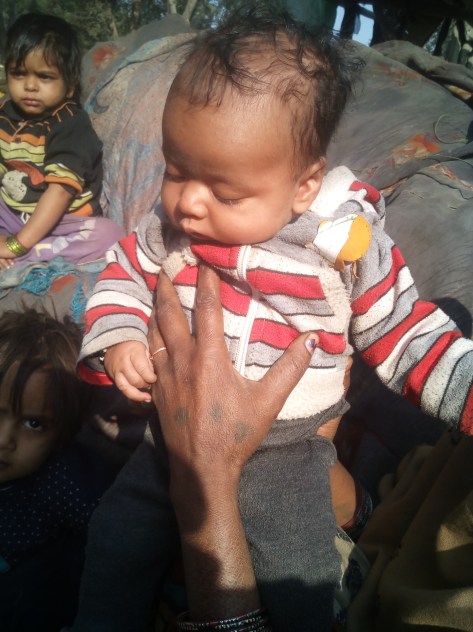
More than 500 jhuggis have been demolished by the Railways in Shakur Basti, Delhi. The demolition took place on last Saturday leading to the death of a six month old child, leaving many injured and an odd 10,000 people homeless in the chilling Delhi winters. The Railway minters Suresh Prabhu is allegedly shocked and unaware. Mr Kejriwal took to twitter to condemn the demolition. Ajay Maken of congress too condemned the demolition. On Monday Rahul Gandhi briefly visited the razed down site where once the shanties stood and thats that! All these electoral political parties have even made what is a tragedy and a very difficult time for the slum dwellers an opportunity of mud slinging onto each other which also doesn’t come as a surprise.

Continue reading More than 500 jhuggis demolished in Shakur Basti, slum dwellers left on their own to grapple with bone chilling winter.

Of Flags and Fetishes – The Paris Attacks and A Misplaced Politics of Solidarity: Debaditya Bhattacharya

This is a guest post by DEBADITYA BHATTACHARYA

Megan Garber’s article ‘#PrayForParis: When Empathy Becomes a Meme’, published in The Atlantic (November 16, 2015) has claimed that Paris hashtags and French flag filters on Facebook make for an “act of mass compassion” – a “compassion that has been converted, via the Internet’s alchemy, into political messaging”.

flag filter2

I have absolutely no problems with flag filters on Facebook. Or for that matter, profile-picture revolutions that happen all too often. I’m not, in the least bit indignant about such a competitive exhibitionism of feeling – indexed through a currency of memes and emoticons. In an age of such mass-production of violence (‘terroristic’ or ‘humanitarian’), it is no surprise that the event of mourning must become a symptom of the incompatibility between ‘act’ and ‘response’.

A funereal Facebook must therefore bleed profile pictures, because that seems the only charter of our most intimate emotions. We naturally do not care if Facebook is using the Paris tragedy as a marketing platform, as long as it helps us reclaim a deeply ‘personal’ angst in the face of more-than-a-hundred ‘spectacular’ deaths.

Continue reading Of Flags and Fetishes – The Paris Attacks and A Misplaced Politics of Solidarity: Debaditya Bhattacharya

We agree passionately: one world, one struggle, education is not for sale!

Dangerous Vandals, Goths and Visigoths: Students Demanding the Impossible at #OccupyUGC

The Occupy UGC movement looks irrelevant or ridiculous to the middle and upper classes in India because it can be made to appear so by the media. Not surprisingly, television channels and leading dailies either ignored the protests altogether, or worse, focused on the apparently far more *critical* issue of the “vandalism” and “disfigurement” of the ITO metro station by the protesting students. Times of India said they were “brazening it out” after their acts of vandalism, and on social media including Kafila, these student vandals have been additionally belittled by some as misguided pawns in the hands of an apparent conglomerate of ambitious lefty professors from JNU! Basically, anything but a legitimate set of demands, some of which this poster from the movement tries to explain…

Dekh Bhai UGC
Translation: Look here UGC, if you don’t give us the scholarship, I will face marriage pressure, but you will have to face the pressure of the entire student population!!

(Incidentally, it was this image that was painted on the walls of the ITO metro station. Personally I found it cheerful).

Anyway, as Camalita Naicker reminded us in her excellent article on South Africa here on Kafila, student protests against rising student fees and shrinking scholarships and fellowships are no flash in the pan but a burgeoning worldwide phenomenon cutting across political affiliations. This is because you don’t need to be a leftist to understand that in contemporary conditions, pursuing a higher education is both the only guarantee to economic security, and the one thing that may be denied to you if you are from the wrong side of the tracks. 

We post below statements from #OccupyUGC and #Occupy SOAS in support of each other. These have been sent to us by Akash Bhattacharya, research scholar in history at JNU.

Continue reading We agree passionately: one world, one struggle, education is not for sale!

Which COURT of Justice for Vinay Sirohi?

Yesterday, in a corner of Delhi-NCR known as Keshopur, a 22-year old sewage worker breathed his last, a final tortured breath inhaled inside a part of the vast network of sewage pipelines that map the city in their own cartography of waste. The pipeline was owned by the Delhi Jal Board, so its function was not simply to transport sewage, but to transform it into potable water through a portion of the pipeline that resembles a septic tank – a portion known as the ‘digester’.

djb_body_759
The portion of the pipeline containing Vinay Sirohi’s body. Courtesy Indian Express online edition.

That Vinay Sirohi, 22-year old contract worker with the Delhi Jal Board, who got married last year and had taken up part-time employment to help him get through college, lost his life in a part of the sewage pipeline called the ‘digester’ imparts something so grotesquely apposite to this tragedy that one almost doesn’t want to think about it. One often doesn’t, of course. One has the option of of flipping the page of the newspaper, of resting one’s eyes on more life-affirming images – English Premier League, Bollywood, Modi-Cameron Cameron-araderie…even Kejriwal’s homely navy-blue sweater and baggy trousers are a pleasant distraction. Anything that tells us that life as it was meant to be – humans wearing a clean sweater and trousers with a sofa to sit on after their stomachs and minds are fed and sated – is better than the thought of a body inside a pipe under the city. When I tried to save the image that you see above, the caption read djb_body_759. I don’t want to think about what that caption means. Does it mean the 759th body found inside the DJB’s sewage network? Does it mean the 759th body to have been recovered by the police this year, 2015? Does it mean the 759th body to have died in sewage pipelines across the country, or ever?

Continue reading Which COURT of Justice for Vinay Sirohi?

A Dalit Employee’s Death and Its Aftermath – in a Central University: Solidarity for Amar Singh

The following is a guest post by SOLIDARITY FOR AMAR SINGH

We are writing this quite late. On 27 July 2015, a Monday, a young person named Amar Singh passed away in Lucknow. We came to know it very late, only on the other day, since we no longer reside in the city and, to confess, do not remain in regular touch with the happenings there. A leading Hindi daily’s Lucknow edition had reported this death two days later in a small column which we have just recovered. The report provided information about his father as well as about his native place, Faizabad. Though the daily did not state his caste in its description of what could be discerned like an accident, it made a note of his name, his age, his father’s name, and the job he was doing. But we knew Amar’s background. Amar was a dalit. He was Hela by caste and hailed from a poor family. His death could well be an accident, though what exactly happened remains mysterious. People who know a little about the incident are however emphatic that it was not suicide. But what appeared very intricate is how his death was reported and how the whole incident was handled since then, in the well-known public spheres—not only of Lucknow but also of other places.

The daily, Dainik Jagran, indeed reported it on 29 July 2015, stating that on Monday night at Nishatganj, a young man passed away under mysterious circumstances, and that he was a sanitation worker at the Moti Mahal lawns. It also informs that his relatives had asked for an investigation by the police. The report reads further like this: “Originally from Faizabad, the son of Ram Ratan, Amar Singh (23) had gone to his employer’s house at Nishatganj on Monday. Soon after leaving the premise there, he was found on the road in a state of unconsciousness. The passersby took him to a private hospital where he passed away.” The report ends there. It had appeared as an insignificant column at the left bottom of page 9 of the daily, with one of the most common headings one can come across, “a young man dies under suspicious circumstances”. But who was this employer here? Who were the passersby? Continue reading A Dalit Employee’s Death and Its Aftermath – in a Central University: Solidarity for Amar Singh

The Fiction of Fact Finding: Harassment of Delhi University Teachers Union President


PLEASE JOIN PROTEST AGAINST SHAMEFUL HARASSMENT OF DR. NANDITA NARAIN – MONDAY THE 19TH OF OCTOBER, VICEREGAL LODGE, DELHI UNIVERSITY 10.30 AM- 1.30 PM.


01Fir08-09.qxp
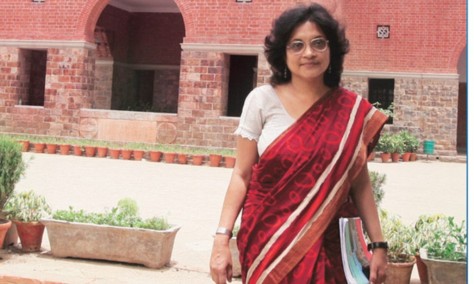
Dr. Nandita Narain, President of the Delhi University Teachers Association.

With apologies to Manoj Mitta’s excellent book on 2002 by the same name, it appears that yet another fact-finding commission has made a mockery of the process of law, not to mention truth and justice. Dr. Nandita Narain – yes that blood-curdling, fearsome figure in the picture above – has been accused of disrupting the work of 3 colleges in Delhi University and asked to appear before a fact finding committee appointed by the University, 10 days before the term of the current Vice Chancellor Professor Dinesh Singh ends. For those not acquainted with Dr. Narain, she is the popular President of the Delhi University Teachers Association, beloved Mathematics professor in St. Stephens’ College and a brilliant scholar in her own right. Having contested and won the recent Delhi University Teachers Association elections against the V.C’s relentless pressure tactics and a blitzkrieg of campaigning and publicity by other parties including the government-friendly National Democratic Teachers’ Front, Dr. Narain has evidently had nothing but her enormous personal integrity going for her.

Continue reading The Fiction of Fact Finding: Harassment of Delhi University Teachers Union President