Category Archives: Sex

Understanding the De- Criminalisation Demand: Aarthi Pai and Meena Saraswathi Seshu

Guest post by AARTHI PAI and MEENA SARASWATHI SESHU

STOP Panic around Sex Work; by conflating it with Trafficking

VAMP, SANGRAM and The National Network of Sex Workers, India (NNSW); a network of sex worker organisations, collectives, federations and unions from Karnataka, Tamil Nadu, Maharashtra, Kerala and Andhra Pradesh;  seek decriminalization of sex work. 

First, a quick distinction between ‘decriminalization’ and ‘legalization’.

Decriminalisation is the repeal or amendment of laws or statutes which make certain acts criminal, so that those acts are no longer crimes or offenses.

Legalisation, on the other hand, will mean regulation and control by the state authority ushering a zone specific ‘licence raj’ with mandatory health check-up, criminalizing defaulters. It could also mean criminalizing of some aspects of sex work e.g. clients.

The UNDP Global Commission on HIV and the Law stated that, “Sex work and sex trafficking are not the same. The difference is that the former is consensual whereas the latter coercive. Any point of view that casts “voluntary prostitution” as an oxymoron erases the dignity and autonomy of the sex worker in myriad ways. It turns self – directed actors into victims in need of rescue.”[1] Sex work is adult consensual provision of sexual services and must not be equated with sexual exploitation or sex trafficking. Continue reading Understanding the De- Criminalisation Demand: Aarthi Pai and Meena Saraswathi Seshu

Love for Fawad Khan vs Jihad against Love: Charu Gupta

Guest post by CHARU GUPTA

Fawad Khan, a Pakistani Muslim male, has become an endearing and enduring metaphor, a fascinating icon, the new heartthrob and fantasy of Indian girls and women. Zindagi, an Indian entertainment television channel, launched just four months ago, which telecasts cross-border serials from Pakistan, has captured our imagination. The central idiom of the channel has proven to be Fawad Khan, who besides having looks to die for and undeniable charm, portrays a sensitive, emotional and mature lover and husband in top of the charts serials Zindagi Gulzar Hai and Humsafar. He has entered Bollywood through the film Khubsoorat. Fan mails from women have poured over websites. One of them says: ‘You have to be living under a rock if you have not heard of Fawad Khan yet…. Did your mother just tell you she has a crush on Fawad Khan? Your female colleagues are probably head-over-heels in love with him too…. Women maybe have more photos of Fawad Khan in their phones than their own.’ Describing the film Khubsoorat, Shobha De articulates: ‘So, who is the real “khubsoorat” in the movie….Any guesses? You’ve got it! It’s a slim, bearded bloke from across the border…. He’s as yummy as those irresistible Lahori kebabs, and desi ladies want him.’

Fawad Khan’s religious and national identity is not hidden or muted; it is explicit and out there. But Indian women, most of them Hindu, are totally disinterested or unconcerned with the fact. While the ‘love jihad’ hysterics are crying themselves hoarse, Indian girls are not giving a damn whether Fawad Khan is a Muslim or a Pakistani. Instead, they are dreaming of having someone like him in their lives to romance and to love, who can make them feel so very special. This swooning over Fawad Khan by Indian girls and women of all ages reveals a religious and national liminality that can stump the hysteria over the constructed bogey of love jihad. The representation of Fawad Khan and the construction of love jihad, both in very different ways are part of fictive imaginations, myths and rhetoric, spectacles and obsessions. At the same time, they undercut each other, reflecting women’s desires on the one hand and Hindu male fears on the other. Love for Fawad Khan personifies allegories of intimacy and romance, while the love jihad campaign embodies hatred and anxieties. One contests power, the other attempts to reinstate it. It is these disjunctive representations that make their juxtaposition stimulating. Continue reading Love for Fawad Khan vs Jihad against Love: Charu Gupta

The ‘new and improved’ Love Jihad formula, unethical media and ‘social science’ votaries

Caught on the back foot by the humiliating backfiring of their fantastical Meerut scenario of ‘gangrape and forcible conversion’, in which the role of the BJP as well as of sundry Hindutvavaadi organizations in breaking up a consensual Hindu-Muslim relationship have been thoroughly exposed, the Hindu Right appears to have arrived at a new formula. This formula has made its appearance in several spaces – in comments on Kafila (some of which have been passed, many more deleted; mostly pseudonymous or anonymous, and in varying degrees of abusiveness); on the social media and in personal blogs; and more respectably, in newspapers, in signed op-eds and articles, the most recent of them by the perennially amusing Madhu Kishwar.

The formula is patented across these sites and involves all or several of the following claims:

a) Hindutvavaadi groups are not the only ones to fear ‘Love Jihad’ – the Church in Kerala and the Akal Takht have also expressed their anxieties about this campaign. So there must be some fire generating all the smoke.

b) So real is the danger that the claims have been investigated by the police, as directed to do so by courts.

c) Hindutvavaadi groups have no objection to inter-faith marriage, what they object to is the cheating of Hindu women into marriage in a well orchestrated campaign by Muslim men who trap them in polygamous marriages only to convert them and produce several children, thus raising the Muslim population.

d) What is happening in India is only a small part of the Global Islamic Terror Machine’s global campaign to use non-Muslim women as sex slaves, to prostitute them, or to seduce them in order to convert them. The recent exposure of a pedophile ring in the UK run by Pakistani men is treated as proof of the existence of such a globally coordinated campaign in which all Muslims are suspect – from Al-Baghdadi of ISIS to your classmate.

e) As irrefutable proofs, three links are generally circulated: a) a programme of IBN7 that ‘exposes Love Jihad’, and b) two videos of young women who supposedly speak about being victims of Love Jihad.

Madhu Kishwar in her article asserts all of these claims produced by the RSS Myth Machine, although she is probably not yet aware of the last item – which I will address at length in conclusion. Continue reading The ‘new and improved’ Love Jihad formula, unethical media and ‘social science’ votaries

‘The Meerut Girl’, desperate Hindutvavaadis and their Jihad against Love

[With two updates added on October 15, 2014]

The phrase ‘Jihad Against Love’ is Janaki Nair’s in The HinduWhy Love is a Four Letter Word. I can’t think of a better description of this sick, twisted, violent campaign, in which local Hindutvavaadi thugs ally with families desperate to control their young sons and daughters from – quite simply – falling in love. Families that have no qualms in violently separating their children from relationships outside their caste or religious community, often killing one or both of them. Such murders have come to be dubbed ‘honour killings’ by the English media, but a starker, more revealing term is suggested by Pratiksha Baxi – ‘custodial deaths’. Indeed, the young people killed in such cases are in the custody, much like prisoners, of their own families.

If you haven’t had enough of tragic love stories, take a look at Perveez Mody’s book, The Intimate State: Love-Marriage and the Law in Delhi (Routledge, Oxford and New Delhi, 2008) for  heart-breaking accounts of of treachery and betrayal by parents, of their own children who fall in love with the wrong people, and the kinds of physical violence unleashed on rebellious couples by their own families.

The Hindutvavaadi campaign has an able ally in the Christian Right. A report in 2009 in The Times of India said:

‘Love Jihad’, a religious conversion racket which lures gullible girls by feigning love, has brought rivals Vishwa Hindu Parishad and Christian groups in Kerala together.

“Both Hindu and Christian girls are falling prey to the design. So we are cooperating with the VHP on tackling this. We will work together to whatever extent possible,” said K S Samson, an office-bearer of Kochi-based Christian Association for Social Action (CASA), a voluntary Christian association.

Samson said some days ago, CASA got to know about a Hindu family in a Christian parish where a school going girl was the victim. ”We immediately referred it to the VHP,” he said, adding the saffron outfit has helped them in many cases.

Continue reading ‘The Meerut Girl’, desperate Hindutvavaadis and their Jihad against Love

Letter to the Chancellor of Jadavpur University: Concerned Citizens and Academics

To
Sri Keshari Nath Tripathi, Governor, West Bengal.
Dear Shri Tripathi,
We, the undersigned academics and concerned citizens, are writing to you with grave concern, about the situation in Jadavpur University, as you are also the Chancellor of the University.We have read in newspapers, seen on television, or read through social media posts, enough to understand that the following serious problems occurred.

First, in late August, a young woman, a student of Jadavpur University, brought in a charge of sexual harassment against some hostel students. This was handled extremely badly by the Vice Chancellor of Jadavpur University, who seems to have advised her to stay at home, and to have rebuffed attempts by the victim and her friends to get speedy justice.

‘लव जेहाद’ की असलियत – इतिहास के आईने में: चारू गुप्ता

Guest post by CHARU GUPTA

लव जेहाद आंदोलन स्त्रियों के नाम पर सांप्रदायिक लामबंदी की एक समकालीन कोशिश है. बतौर एक इतिहासकार मैं इसकी जड़ें औपनिवेशिक अतीत में भी देखती हूँ. जब भी सांप्रदायिक तनाव और दंगों का माहौल मज़बूत हुआ है, तब-तब इस तरह के मिथक गढ़े गए हैं और उनके इर्द गिर्द प्रचार हमारे सामने आये हैं. इन प्रचारों में मुस्लिम पुरुष को विशेष रूप से एक अपहरणकर्ता के रूप में पेश किया गया है और एक ‘कामुक’ मुस्लिम की तस्वीर गढ़ी गयी है.

मैंने 1920-30 के दशकों में उत्तर प्रदेश में साम्प्रदायिकता और यौनिकता के बीच उभर रहे रिश्ते पर काम किया है. उस दौर में लव जेहाद शब्द का इस्तेमाल नहीं हुआ था लेकिन उस समय में भी कई हिंदू संगठनों — आर्य समाज, हिंदू महासभा आदि –- के एक बड़े हिस्से ने ‘मुस्लिम गुंडों’ द्वारा हिंदू महिलाओं के अपहरण और धर्म परिवर्तन की अनेकोँ कहानियां प्रचारित कीं. उन्होंने कई प्रकार के भड़काऊ और लफ्फाज़ी भरे वक्तव्य दिए जिनमें मुसलमानों द्वारा हिंदू महिलाओं पर अत्याचार और व्यभिचार की अनगिनत कहानियां गढ़ी गईं. इन वक्तव्यों का ऐसा सैलाब आया कि मुसलमानों द्वारा हिंदू महिलाओं के साथ बलात्कार, आक्रामक व्यवहार, अपहरण, बहलाना-फुसलाना, धर्मान्तरण और जबरन मुसलमान पुरुषों से हिंदू महिलाओं की शादियों की कहानियों की एक लंबी सूची बनती गई. अंतरधार्मिक विवाह, प्रेम, एक स्त्री का अपनी मर्जी से सहवास और धर्मान्तरण को भी सामूहिक रूप से अपहरण और जबरन धर्मान्तरण की श्रेणी में डाल दिया गया. Continue reading ‘लव जेहाद’ की असलियत – इतिहास के आईने में: चारू गुप्ता

Enough is enough: Anand Teltumbde

ANAND TELTUMBDE in The Hindu today

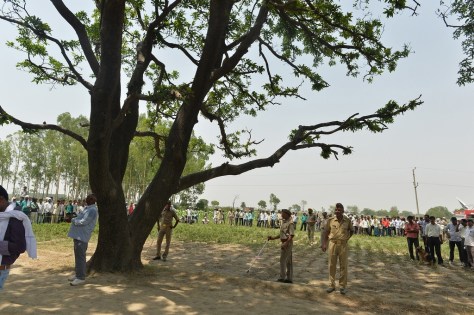
http%3A%2F%2Fmedia.npr.org%2Fassets%2Fimg%2F2014%2F05%2F31%2F494819135_custom-58300287d01c3c0d94b0654967811781d07b8f74

The tree in Katra Shahadatganj village (Badaun district) from which two young Dalit women, sisters, were found hanging after being gang-raped on May 27, 2014. Their bodies were found on May 28th.

The images of two innocent Dalit girls hanging from a tree in Katra village in Badaun district of Uttar Pradesh and a crowd of spectators looking bewildered at them best describes our national character. We can endure any amount of ignominy, can stand any level of injustice, and tolerate any kind of nonsense around us with equanimity. It is no use saying if those girls were our own daughters or our own sisters, we would still stare at them, bewildered and resigned like anyone in that crowd did. In just the past two months, while we as a country were busy playing fiddle to Narendra Modi and his promise of acche din, there have been a series of gory rapes and murders of Dalit teens across the country.

But beyond the residual anger, there is hardly any real concern for these atrocities. The rulers are not concerned, the media is hardly interested, and then there is indifference of the progressive lot and Dalits’ own frigidity towards them. It is shameful that we take the rape and murder of innocent Dalits as an adjunct of our social environment and forget about them.

Queer Eye for Narendra bhai – Affect, Memory, and Politics in Desperate Times: Pronoy Rai

This is a guest post by Pronoy Rai

There is something awfully nostalgic about May 16. The election results brought with them a sense of melancholy-laden déjà vu. For the queers and allies on the political Left, the sinking feeling that May 16 brought with it, was reminiscent of yet another day, December 11, 2013; the day the Indian Supreme Court reversed the decision of the Delhi High Court decriminalizing homosexuality in India. It was once again criminal to be gay in India; once again the legal State apparatus had rendered queer bodies vulnerable to violence, from the State and from the political Right. There was a sense of desperation and disheartening injustice; what avenues remained to be sought when the country’s highest courts had us disappointed?

The Rashtriya Swayamsevak Sangh (RSS) and the Bharatiya Janata Party (BJP) had vehemently welcomed the Supreme Court judgment then, but our incoming Prime Minister, Narendra Modi, remained silent. It was perhaps too trivial an issue for him to address; when were rights anyway a matter of importance for him? If the indigenous people and forest dwellers of Gujarat could make the Indian mass media listen to them, they would tell us the story of Gujarat’s abysmal performance in settling land claims and distributing title deeds. Rights, especially of the fragments, are a roadblock for the Modi-style Development machine.

Continue reading Queer Eye for Narendra bhai – Affect, Memory, and Politics in Desperate Times: Pronoy Rai

Anatomy of a Rape and Its Immediate Aftermath – A Report from Kolkata: Kasturi

Guest post by KASTURI

Time flew fast. Over the last two days and sleepless nights. A girl I knew, a cheerful bubbly college first-year, eyes wide open with dreams, has been subjected to sexual violence. We had walked together in many marches against injustice, oppression, gender violence. I remember the day I first met her, several months back. It was opposite the Indian Coffee House on College Street. She had become an activist of the radical left students’ organization AISA by then. After that I met and chatted with her on many occasions. On the very day she was raped, she had participated in a students’ demonstration against the corporate-communal onslaught personified by Narendra Modi. She was slated to participate in another program the very next day. When night struck.

The night that rolled on to dawn
Continue reading Anatomy of a Rape and Its Immediate Aftermath – A Report from Kolkata: Kasturi

If you can’t join ‘em, beat ‘em: Ayesha Kidwai

AYESHA KIDWAI on FeministsIndia

Ayesha Kidwai on the need for Left-Secular people to take sexual harassment seriously when it comes home to “us”.

The burning question is why Mustafa and Joseph have done this? Are they misogynistic ‘supporters’ of Tejpal or fearless worshippers of fact and intrepid journalism? While the latter question may be good for an author’s self-image, and the former one can be dismissed as presupposing too tidy a critique, the real issue is a general failure amongst the professionals to come up with an adequate response to what the changed mood in the middle class demands. Mustafa and Joseph’s failures are just repeats of ones that we have witnessed over and over again, and each profession has plunged into a crisis when a colleague has been accused: How does a ‘senior’ professional approach the fact that some young woman has gone and complained about something that wasn’t even a grievance just a few years ago? After all, it is ”her’ word against ‘his’ and we know him; and while he may have his faults, he has done so many good things, and he is above all, secular. In any case, why are these outsiders, this “bunch of feminists” getting so involved in these matters (which are always so stippled with grey when seen from our side)?

For an outsider feminist like me, the answer is obvious: no one but this bunch knows what to do when a complaint is made from within one’s own kind. When the complaints have been made from within academia or within the judiciary, it is this bunch that has fought for them to be addressed, protested and thwarted the misuse of hierarchical power and its machinery of slander and intimidation, and reminded their professions that the ideal of equality must first be expressed in the creation of conditions conducive to its access. In doing so, they have imbued the phrase “let the law  take its own course” with substantive meaning.

READ THE FULL ARTICLE HERE

Tabloid Law – Framing Sexual Violence: Pratiksha Baxi

Guest Post by PRATIKSHA BAXI

When an ongoing rape trial becomes a controversial ‘story’, much rests on journalistic practice: how the story is plotted, the metaphors used, and the visuals that accompany the text. Writing about sexual violence is challenging if one wants to resist voyeurism, yet sell a ‘story’. It means resisting reproducing ‘tabloid’ pictures of law.

Given that there is very little literacy about the newly amended rape law, it is not apparent to many why forms of sexual violence, other than forcible penile penetration of the vagina, should be called rape. Nor is it acceptable to many people that a man be sentenced for ten years (or more) for rape when it is not accompanied by annihilating physical violence.

Is it then incumbent on journalists to indicate that the 2013 amendments to the rape law create new meanings of rape, some which are not accepted as rape in society? Indeed, what role do journalists have in interrogating the social and collective toleration of sexual violence?  Continue reading Tabloid Law – Framing Sexual Violence: Pratiksha Baxi

If a Woman is Raped in the Middle of a Forest and No Camera Sees it Was She Actually Raped? Fulana Detail

This is a guest post by FULANA DETAIL

When I was 19 years old I developed persistent headaches. My mother took me to the eye doctor to get my eyes checked. The doctor lived in our neighborhood. He was our family’s eye surgeon, he’d operated on both my grandfathers’ cataract, he was (and presumably continues to be) a well-respected doctor.

After the routine eye tests were done, the doctor noted I had slight myopia and that it, “appeared there was a weakness in the eye muscle that may be indicative of a general weakness.” I was anemic and underweight and he recommended a general physical examination. My mother said, “No problem, we’ll go to our GP”. “Why bother?”, he responded, “after all eye doctors are doctors first and receive the same medical training as everyone else”. Rather than bother with a separate visit he would be happy to do it himself, it would only take a few minutes. It sounded odd, but well he was the doctor. My mother knew him, and who were we to question the doctor? Why didn’t my mother step out, he suggested. I would be more comfortable that way. My mother looked at me: was I ok with that? I didn’t see why not, so she walked out.

He closed the door, I sat on the bed. He walked up to me, stood behind my right shoulder, began pressing my neck, unhooked my bra, felt my breasts, moved his hands down my stomach, pushed his hand into my underwear and began pushing his fingers into me. At this point I pushed him away, jumped off the bed and walked out. I didn’t go back in and my mother concluded the consultation. I said nothing to my mother at that point. She dropped me off at college. I felt strange and upset through the day, but I didn’t speak of this to anyone. In the evening I met my then boyfriend told him some of what had happened, but not the details. That evening, or perhaps it was the next day, I told my mother a version of what had happened but again, not in any detail. She asked if I wanted to lodge an official complaint. I didn’t. So my mother went back and confronted him. At which he flat denied anything untoward had occurred. If I were a victim, it was of a grievous misunderstanding. He had two daughters, he was terribly sorry if I had misunderstood, but really it was not his intention. He was only conducting a medical examination. I was not a child. I was a 19 year old, college educated woman. And I had let an eye doctor do something for which the new law prescribes a seven year jail sentence.  Continue reading If a Woman is Raped in the Middle of a Forest and No Camera Sees it Was She Actually Raped? Fulana Detail

What do Tejpal supporters choose to see? Team FeministsIndia

[FROM THE BLOG FEMINISTSINDIA]

Tarun Tejpal, who was the editor of Tehelka magazine, is alleged to have sexually assaulted his junior journalist in a lift in a Goa Hotel. The past few days have seen subtle and direct statements that seek support for Tejpal based on the CCTV footage of the survivor and Tejpal outside the lift. While senior journalists Manu Joseph and Seema Mustafa wrote articles dissecting the incident in favour of the accused, well known film maker Anurag Kashyap accused the survivor of not telling the truth – they all were basing their opinions on the CCTV footage they saw. The campaign coincides with a bail application made to the Supreme Court.

Feminists Vrinda Grover and Kavita Krishnan analyse flaws in the arguments made in support of Tarun Tejpal in media and social networks by those who have illegally watched sub judicial CCTV footage.

Read the rest here.

Letter to Press Council re Tehelka case from Network of Women in Media

Dear Justice Katju,

The Network of Women in Media, India is deeply concerned about what appears to be a renewed media campaign that threatens the course of justice in the sexual assault and rape case involving the former editor of Tehelka, Tarun Tejpal.

In this connection we would like to call the attention of the PCI to two recent articles on the subject in two publications, The Citizen and Outlook. The article in the former, headlined “Alleged victim’s testimony in the Tarun Tejpal case at variance with CCTV footage” which originally appeared under the byline of senior journalist Seema Mustafa, was later credited, on 31 March evening, to ‘Citizen Bureau’. [This piece has by now been removed altogether]. The article in the latter, headlined “What the elevator saw” is by senior journalist Manu Joseph.

While ostensibly seeking to set the record straight, both articles are clearly biased in favour of the accused and seem to be a deliberate attempt to adversely influence public opinion against the complainant. Indeed, these articles appear to follow the familiar Standard Operating Procedure to silence women in cases of sexual violence, and bolster the impunity of perpetrators. Continue reading Letter to Press Council re Tehelka case from Network of Women in Media

Bourgeois Imagination and Freedom from Gender Crimes – Limits of a Social Category: Sanjay Kumar

This is a guest post by SANJAY KUMAR

(This is an expanded version of the article that has appeared in Stree Mukti, January, 2014)

There is a reason crime fiction is one of the most popular genres in bourgeois societies. Nowhere else, except in the equally fictitious assumptions of the Neo-Classical economic theory, is a human being  made to appear an isolated individual in her motives and abilities, as completely as in crime fiction. Borrowing from a famous Ibsen play, in crime fiction, ‘a criminal stands most alone at the moment of crime’. Only her/his motives and acts determine the crime. Bourgeois law also assumes the same about criminal guilt, though punishment is often given under the light of ‘mitigating circumstances’, which mostly is a back door for all kinds of class and social prejudices. Among the ideologies that inhabit a society’s discursive world there often is a dominant ideology which mainly reflects imperatives of the prevailing economic and political order. The feudal ideological world is dominated by notions of  loyalty, honour, and community, all of which are the essential ideological glue, as well the felt reality of the hierarchical web of a feudal society. Bourgeois society is founded upon private property. Even though their consciousness is socially formed, its members see themselves as formed and ready prior to their social engagements. Their attributes appear to them as their own, inherent qualities. This gives a moral boost to the enjoyment of fruits of private property; that is the charm of bourgeois consciousness. In crime fiction, criminals as sole proprietors of their motives and abilities thrust themselves against social prohibitions in diabolically creative ways. That is its (hidden) charm.

Continue reading Bourgeois Imagination and Freedom from Gender Crimes – Limits of a Social Category: Sanjay Kumar

The Buttocks of Naked Women and Further Meditations on Sacred Art: Sajan Venniyoor

Guest Post by  SAJAN VENNIYOOR

“There is no Hindu canon,” declares Wendy Doniger in The Hindus. “The Vedas did not constitute a closed canon, and there was no central temporal or religious authority to enforce a canon had there been one.”

This is a curious argument in defence of heterodoxy. Canons don’t spring fully formed like Athena from the head of Zeus, or drop from the lips of a passing Archangel. Someone has only to do the hard work, and it’s never too late to make a nice hard canon.

As Doniger says, Hinduism as we know it today “is composed of local as well as pan-Indian traditions, oral as well as written traditions, vernacular as well as Sanskrit traditions, and nontextual as well as textual sources.” That’s good news – plenty of material there to choose a canon from.

Back in the 16th century, the Church found itself up the creek without a canon. Plagued by fifteen hundred years of heresies and heterodoxies, disagreements over the sacraments and the scriptures, not to mention a perfect storm of lusty, busty images in Renaissance religious art, the Catholic Church sat in ecumenical council between 1545 and 1563 and decided, once and for all, what was IN and what was OUT.

Index of Prohibited Books (1)

Index of Prohibited Books 

It took the Church just over 1500 years – from the crucifixion of its founder to the Council of Trent – to decide which of its written books and unwritten traditions were truly sacred and which were profane (and which were to be banned).  Continue reading The Buttocks of Naked Women and Further Meditations on Sacred Art: Sajan Venniyoor

Feminist Reflections on the Tragic Suicide of Khurshid Anwar

THIS ARTICLE HAS BEEN COLLECTIVELY WRITTEN BY THE PEOPLE WHOSE NAMES APPEAR AT THE END

In the aftermath of the suicide of Khurshid Anwar, friend and comrade to many of us, on December, 18th 2013, there has been a concerted attack by some democratic and secular people on ‘feminists’ who supposedly drove him to take this extreme step. The charge is that feminists did not support him when an accusation of rape was made against him by a young woman, and exacerbated the situation by their irresponsible handling of the issue.

As feminists, we feel it necessary at this trying time to recognize that this pitched battle is after all, taking place amongst allies in a bigger struggle for democracy and secularism, and to think seriously about how we can move ahead. Rather than being a definitive statement of any kind, this collectively written piece is an attempt to think through a very messy situation. Continue reading Feminist Reflections on the Tragic Suicide of Khurshid Anwar

Theatres Of Rape: Srimati Basu

Guest Post by SRIMATI BASU

The Birbhum rape has thrown up images of the ‘kangaroo court,’ evoking the savagery of tribal subjects — but rather than feeling complacent at the exception and difference of this location, we might concentrate on the common modes of gendered control achieved by the rapes.

Jyoti Singh’s rape and murder in a Delhi bus in December 2012 seemed to evoke a sense of horror at the ultimate in human depravity. But in the time since, no week seems to go by without yet another gruesome gang rape, almost a one-upping of sadist violence across these uncoordinated episodes. Gang rapes have come to appear as the spectacular trendy crime of the moment. They underline the lethal consequences of women’s daily cultural transgressions: going to school, going to a night show movie, going to work, having a drink, being in politics. Even though we know they are miniscule in the corpus of sexual violence, which overwhelmingly happens in private and domestic spaces and among people who know each other, they have irritatingly given the impression that public spaces have become more unsafe, and further strengthened restrictions by families and communities on women’s mobility and choices.

As if the New Year’s report that a Kolkata schoolgirl was burned alive after being gang raped twice (the burning and second rape allegedly being retaliations to her police complaint) was not ghastly enough, this week we are talking about another woman in West Bengal (Birbhum), gang raped by diktat of the village council, on a public platform erected for optimal viewing. Continue reading Theatres Of Rape: Srimati Basu

Homophobia and Islamobphobia – The Jamaat e Islami Hind and the Supreme Court’s Decision on Section 377: Fahad Hashmi

Guest Post by Fahad Hashmi

[ Yesterday, the Supreme Court of India, dismissed the ‘review petition’ that had been filed with a plea to reverse the Supreme Court’s recent (December 2013) decision to uphold the constitutionality of Section 377 of the IPC. This decision effectively ‘re-criminalized’ Homosexuality in India and is a severe blow to human rights. Various religious groups, Hindu, Muslim and Christian had appealed to the Supreme Court to act against the rights and interests of homosexuals. In a sad instance of the erosion of  secular and democratic values, the Supreme Court has endorsed their view. The Jamaat -e-Islami Hind, a right wing, muslim fundamentalist organization that claims to speak for Indian Muslims has welcomed the Supreme Court’s decision. This post by Fahad Hashmi attacks the Jamaat-e-Islami Hind’s position on homosexuality and challenges its claim to speak in the name of muslims and their faith. We see it as an important contribution to the ongoing discussion on section 377 on Kafila ]

“There was once…a sad city, the saddest of cities, a city so ruinously sad that it had forgotten its name.
In the north of the sad city stood mighty factories in which (so I’m told) sadness was actually manufactured, packaged and sent all over the world, which never seemed to get enough of it. Black smoke poured out of the chimneys of the sadness factories and hung over the city like bad news”.
(Haroun and Sea of Stories, Salman Rushdie)

It is one of the ironies of democracies across the world that minorities of all shades are always in the crosshairs of majoritarianism. This minority-majority is a function of numbers and power though this is not a thorough definition since we have had seen altered power equation of this binary. The apartheid South Africa is a case in point. For stating the obvious the strength of a democracy is a function of safety and rights that minorities enjoy in it. However, minorities on the whole are always drawing majority’s fire. On the subcontinent one could see this happening in Pakistan, Bangladesh, Sri Lanka, and of course India is not an exception.

Continue reading Homophobia and Islamobphobia – The Jamaat e Islami Hind and the Supreme Court’s Decision on Section 377: Fahad Hashmi

For the sake of Form

The Aam Admi Party it seems has now decided to hit back at critics by uploading videos on Youtube to defend the controversial actions of Somnath Bharti, its Law Minister in Delhi done purportedly ‘in public interest’. Bharti has been chastised even by AAP supporters for his vigilantism and for trying to force the Delhi police to raid the house of suspected sex and drug racketeers and who in fact ‘helped’, along with his followers to catch two of the fleeing women.

Eight videos have been uploaded. They, according to the party contain incriminating evidence to prove that sex and drug racketeers were very much active in that area. Reporting the videos The Times of India says “… some of the scenes are not so easy to judge. Two clips show an African national walking around naked in the area. In another, three women in a car are rubbing some substance in their hands. Yet another shows several condoms lying about a car.” .

We do indeed see an African national moving around naked in the video. This is supposed to prove the allegation by the party that drugs are being used as according to one AAP worker “Walking around naked like this is an after-effect of drugs and this is a regular occurrence in the area”. You can also see for yourself condoms lying in the car. Do you need any more evidence to prove that the occupants of the car were indeed prostitutes carrying condoms with them and luring men to indulge in sex? Why are these three women rubbing some substance in their hands or trying to hide something by putting on gloves? Continue reading For the sake of Form

The Politics of Raid Governance – Aam Aurat v. Khas Aurat: Pratiksha Baxi

Guest Post by PRATIKSHA BAXI

Following the terrible gang-rape of a Danish woman in Delhi, Chief Minister Mr Kejriwal castigating the police for dereliction of duty pronounced his theory about how rape tendencies form. We are told that rape tendencies flow from drug and sex rackets; and when police corruption sustains these rackets, rates of gangrape are bound to escalate. Rape in this formulation is not an expression of sexualized power or preferred and targetted male violence against women. Rather it is linked to a series of vices located in certain geographies, circuits, substances and bodies, which produce a specific form of sexual venality. And, the technique of “raid” is a privileged form of sexual governance.

To sustain the technique of raid (or sting operations) as the privileged form of governance to stem sexual violence, a certificatory genealogy is instituted. A leader of AAP recites his gender credentials by tracing raid governance to the “damini” protests and experiences of state violence during these anti–rape protests. Mallika Sarabhai’s gender credentials are now interrogated by citing her purported absence from the “damini” protests. Some of us who did not experience police violence during the protests are now vulnerable to the charge of faking our commitment to the anti–rape movement, since certification comes from one kind of participation in the “damini” protests. However, can the badge of being invested in the kind of transformative politics required to challenge rape culture be so easily earned? When men participate in anti–rape protests, we are expected to applaud them and not feel offended when they deride women like Mallika Sarabhai who risked their being to speak against rightist manifestations of sexual impunity and immunity in Gujarat. Continue reading The Politics of Raid Governance – Aam Aurat v. Khas Aurat: Pratiksha Baxi