
Category Archives: Sex

Barasat Rape, Murder and the Culture of Rape in West Bengal: Soma Marik

Guest post by SOMA MARIK. [We are publishing below two articles by Soma Marik, Visiting Professor, School of Women’s Studies, Jadavpur University. The first deals with the recent case of the rape and murder of a young girl in North 24 Parganas while the second one below was written in 2003 when the Left Front was in power and documents the widespread culture of rape in the state. Between them, the two pieces alert us to the way we tend to respond selectively to such matters. This is particularly so in the case of political parties in power.]

The Barasat Rape and Murder: Some Reflections

On 8th June, a young woman, a second year college student, was returning home, Kamduni, a remote village of Barasat in the district of North 24 Parganas. She was waylaid by some criminals, who took her to a godown, where they gang raped and then proceeded to murder her. Six hours after she was seen alighting from a bus, her body was found by her brothers and other villagers. The police were forced into some action, after the family and people of the locality refused to even let them shift her body without action first. They accused a number of people, including some connected to the ruling Trinamul Congress, of being rapists. The young woman was well known, as she used to help many children of the locality in their study.

The first response from the police was to play it down, till local anger made that an impossible proposition. The first response from the government was to declare it a stray incident, and also to offer jobs and cash compensation to the family. This was angrily turned down, with the family members turning up in Kolkata, meeting Chief Minister Mamata Banerjee, and demanding the death penalty for the rapists and murderers. Continue reading Barasat Rape, Murder and the Culture of Rape in West Bengal: Soma Marik

Interview with Amalia Ziv – queer, feminist and anti-occupation in Israel

KveesaShchora020403CWPsm

On April 3rd, 2002, Israeli peace organizations led by women activists tried to enter Palestine, but were violently rebuffed by Israeli soldiers – 21 required hospitalization when it was all over. The picture shows seven members (six women and one man) of the organization Kveesa Shchora – Lesbians and Gay Men Against the Occupation – as they set out that morning.

It was through Amalia Ziv ‘s work that I came to know about ‘Kvisa Shchora’ (Black Laundry), an Israeli anti-Occupation queer group, which positions itself against both Israeli Zionist queer politics and the Israeli Left, against whose universalist understanding Black Laundry poses its queer identity as a platform for critique. Ziv suggests that Black Laundry tied together ‘sexual deviance’ and ‘national deviance’ with slogans like ‘Free Condoms, Free Palestine’, ‘Bull Dykes, Not Missile Strikes’, ‘Transgender not Transfer’ (that is, forced deportation of Palestinians)  – which break down the hierarchies of Nation and Sex, challenging queer politics in Israel with anti-occupation politics and Left anti-occupation politics with the queer gaze. Ziv argues that through the ‘twin strategies of national betrayal and sexual depravity’, Black Laundry deliberately situated itself outside both  discursive communities – that of Israel/Palestine as well as of hetero/homosexual.

Read this wonderful interview by  TSAFI SAAR with Amalia Ziv in which she talks about queer parenting, pornography, masochistic fantasies, her envy of people who have the capacity to be polyamorous, how tolerance in Israel for queer politics  ‘runs out when queer politics melds with politics against the occupation,’ and about her crush as an adolescent for Woody Allen. ‘Eros is blind’, she says unrepentantly. Continue reading Interview with Amalia Ziv – queer, feminist and anti-occupation in Israel

Mourning Reingamphi Awungshi: Pratiksha Baxi

This is a guest post by PRATIKSHA BAXI:  

imagesWhen the police found Reingamphi Awungshi, a twenty-one year woman from Ukhrul district in Manipur brutalised, assaulted and dead in her rented apartment in Chirag Delhi on 29 May 2013, they did not file an FIR. Rather, the Malaviya Nagar police station, a site of anguished protests, began by designating her death as suicide, even as they waited for a post mortem report! Although the family argued that the state of her bloodied and injured body clearly indicated sexual assault and murder, the police ended up filing an FIR, after three days, as a case of abetment to suicide. 

It seems very clear that the aftermath of the Delhi gangrape protests have not made a dent in practices of policing—it should not take hundreds of protestors to ensure the registration of a police complaint. Nor is it reasonable for the police without thorough investigation and competent medical examination of the body to conclude that the death was a suicide rather than murder; and that the injuries on the body, the outcome of substance abuse rather than assault. This is evidence of bias, rather than an impartial investigation.  Continue reading Mourning Reingamphi Awungshi: Pratiksha Baxi

White Women in the Indian Imagination: Alexandra Delaney

This is a guest post by ALEXANDRA DELANEY: 

“Yeah, Indian guys think white girls are easy”, a British-born Indian remarked nonchalantly to me this week. Normally I’d be shocked by such gross racial stereotyping (of Indians) but in this case I’m inclined to agree. Not because Caucasian women by their very skin colour or cultural preferences are any more promiscuous than their South Asian sisters, but because of their sustained portrayal as loose and morally deficient. The image of the sexually liberated and ‘easy’ white woman runs deep in the Indian imagination, a perception which is drip-fed by the country’s all-pervading mainstream media.

The brutal rape and murder of an Indian student in New Delhi last December followed by numerous sexual attacks on foreign women has sparked international outrage. This year alone, a Chinese woman was date-raped in New Delhi, a Korean woman was raped after being drugged in Bhopal, a Swiss tourist was gang-raped by five men in Madhya Pradesh while holidaying with her husband, and a British woman broke both her legs after jumping off a hotel balcony to avoid an alleged sexual attack by the hotel’s manager. These incidents have led to a shift in how tourists perceive India, resulting in a 25% fall in foreigners travelling to the country and a 35% reduction in women travellers, reports New Delhi-based Associated Chambers of Commerce and Industry. Continue reading White Women in the Indian Imagination: Alexandra Delaney

Capitalism, Sexual Violence, and Sexism: Kavita Krishnan

Sexual violence cannot be attributed simply to some men behaving in ‘anti-social’ or ‘inhuman’ ways: it has everything to do with the way society is structured: i.e., the way in which our society organizes production and accordingly structures social relationships. Once we understand this, we can also recognize that society can be structured differently, in ways that do not require – or benefit from – the subordination of women or of any section of society. 

What are the material structures that underpin sexual violence? As I address this question I will also engage with some of the arguments made in two recent articles which offer a professedly Marxist analysis of sexual violence and women’s subordination in India; one is ‘On the Empowerment of Women’ by Prabhat Patnaik, People’s Democracy, January 27, 2013, and the other is ‘Class Societies and Sexual Violence: Towards a Marxist Understanding of Rape’, by Maya John, Radical Notes, May 8, 2013.    Continue reading Capitalism, Sexual Violence, and Sexism: Kavita Krishnan

Taking Stock of the new Anti Rape law: Madhu Mehra

This is a guest post by MADHU MEHRA: The Criminal Law (Amendment) Bill, 2013, more popularly called the Anti-rape Bill, is now law. The outrage following the homicidal gang rape in Delhi unleashed events that lent force to the longstanding demand by the women’s movement for comprehensive reform of laws relating to sexual assault. These demands were bolstered by the recommendations of the high level committee, headed by retired Justice Verma, that called for reform of criminal laws, police reforms, prevention and education interventions to effectively tackle impunity for sexual violence. With the new bill passed by the parliament, the law stands substantially changed. This article takes stock of the ways in which the new amendments re-framed sexual offences in the law, their significance and the challenges that remain. While being far from comprehensive, these changes substantially transform the way legal redress for sexual offences have been framed in the law. A few examples below contextulise the significance.

Continue reading Taking Stock of the new Anti Rape law: Madhu Mehra

Another rape, still more incompetence: Time to teach Delhi Police a Lesson?

A five year old girl is now in a critical condition in a Delhi hospital after being brutalized and raped by a neighbour. The Delhi police, which has dealt with the situation with its characteristic incompetence, first refused to file an FIR when her parents went to the police station, and then, tried to bribe the girls parents with two thousand rupees so as to ‘hush them up’. Subsequently,a young woman who tried to protest against the behaviour of the police at the Dayanand Hospital were the girl was initially taken for treatment was slapped by a policeman, an Assistant Commissioner of Police, in full public view. His actions have been recorded on video. It is believed that the policemen who tried to bribe the victim’s parents and the policeman who slapped the young woman have been suspended.

But can the suspension of a few individuals address what is obviously a deep rooted culture of misogyny and class prejudice (what else is it but class prejudice – would a policeman in a thana, say in an affluent South Delhi colony be able to offer two thousand rupees as ‘hush money’ to parents of an assaulted child with the same ease with which they could in Gandhi Nagar in East Delhi) within the Delhi Police? Is more severe and strict action that goes right to the top and to the source, not necessary in order to send a signal that this kind of behaviour within the police force cannot be tolerated? Must Delhi’s police commissioner not be compelled to resign, for his abysmal failure in terms of dealing with sexism and for failing to address the contempt for citizens who are not affluent that is now clearly endemic to the Delhi Police’s work culture?

Continue reading Another rape, still more incompetence: Time to teach Delhi Police a Lesson?

Plucked, Consumed and Discarded: Dhruba Jyoti Purkait and Deepshikha Hooda

Guest post by DHRUBA JYOTI PURKAIT and DEEPSHIKHA HOODA.

Sakhra (Yavatmal): Deep in the heartland of Maharashtra’s suicide-ravaged Yavatmal district, the Gond tribal settlement of Sakhra holds a surprise. “There are no husbands here, just children,” explains Kishore Tiwari, president of the Vidarbha Jan Andolan Samiti. A member of the VJAS accompanies us on the bumpy two-hour ride out of Pandarkawada.

We turn onto a dirt trail that runs through a forest clearing; an hour passes before we start spotting cotton fields. We stop and our guide calls out to two female labourers. Only then does it strike us. Most of the labourers picking cotton are women.

It has been 10 years since Laxmi, now 24, gave birth to a son. She met a rich, upper caste boy who had promised to marry her. “Pyaar jataya tha mujhse,” After the delivery, he refused to acknowledge the parentage of the baby. “Congressi tha woh,” she says.

Continue reading Plucked, Consumed and Discarded: Dhruba Jyoti Purkait and Deepshikha Hooda

Myths and Facts About the Criminal Law (Amendment) Bill, 2013

This document has been put together by the group pursuing advocacy related to CLRB 2013, in Delhi. It addresses several myths about the new Criminal Law Amendment Bill that are circulating in the media. The note also explains the one change feminists  continue to push for and did not get – to make the victim of rape a person, that is to say, gender neutral. The new law must be expanded to protect all persons, and not be limited to women – because all persons/ anyone can be raped.

The Justice Verma Committee (JVC) report was a landmark statement, applauded by all citizens, welcomed by all Political Parties. JVC was significant because it showed a mirror to the Constitution of India, and reflected its wise and just guarantees of women’s equality. Today the women and youth of India are looking with hope and expectation towards Parliament, and towards all Political Parties. We urge all Members of Parliament to pass a law upholding the spirit and letter of the Justice Verma Committee; to pass a law that makes a step forward in our collective struggle to end sexual violence in India.

Myth 1: The Criminal Law (Amendment) Bill 2013 is against men

Fact: The new anti-sexual violence Bill is NOT against men. For our fathers, brothers, husbands, partners, neighbours and colleagues are men too. Are these Men in our lives not committed to seeking an end to the constant threat of sexual violence lurking around every corner? Continue reading Myths and Facts About the Criminal Law (Amendment) Bill, 2013

Why was Ram Singh killed in Tihar jail?

The chief accused in the Delhi gang rape “found dead” in his cell? Killed with his own shirt? Hanging from a grill, with his three cell mates sound asleep all the while? The moment I heard the news  on Monday, every conspiracy theory-oriented cell in my body did a quick cartwheel. Promptly I sent out a mail to the sisterhood on the Feminists India e-list:

I’m wondering whether there is something more than police negligence involved here. I have always felt that the role of the police on that night was more than simply their usual laparwahi – that bus may have been used often in the past for such activities, remember they didn’t follow up the complaint of the man who had been earlier that night robbed by the same guys? And how they located the bus from their hafta diaries? I’m wondering – and going to sound paranoid and like a loony conspiracy theorist – whether the key accused in court would have revealed more about police complicity in rapes and other activities on buses like Yadav’s than we imagine. Prisoners in jail often carry out attacks on other prisoners on the orders of the police themselves.

Yes, Indian prisons are violent and brutal, and the police callous and vicious. Yes, there should be an enquiry to assign responsibility. But I’m pretty certain I know who killed Ram Singh – some other prisoners. And I think that they did it on orders from the police. Continue reading Why was Ram Singh killed in Tihar jail?

Why I need feminism

Here’s wishing all men and women across borders and boundaries, in New Delhi and New Haven, Ranchi and Russia, Dublin and Damascus, Srinagar and Sri Lanka, Bhutan and the Bermudas, a very happy International Women’s Day. These images are from the ‘I Need Feminism’ Campaign at the Lahore University of Management Sciences

This slideshow requires JavaScript.

Justice for a rape survivor: Majlis Legal Centre

As we note the unprecedented, if not always productive, attention being drawn to widespread sexual violence in India, we need to remember that in the shadows of media attention, legal activists routinely wage long, arduous and painful struggles in courts. One such set of activists located at MAJLIS LEGAL CENTRE, Mumbai, recently secured the conviction in Sessions Court, of a 60 year old man for the sexual assault of a toddler. Here is the inspiring (and infuriating!) account of this battle in the words of Majlis. Some of us have been making an argument for CCTV’s in police stations, to monitor the behaviour of the police towards complainants, especially of sexual violence. This case only reinforces our belief that the surveillance by citizens, of the coercive apparatus of the state is imperative.

majlisIt’s been two long years of trials and tribulations as we journeyed a difficult path with a very young rape survivor.  In fact, this case started off the ‘Socio-Legal Support to Survivors of Sexual Assault’ Programme of Majlis.
The incident had taken place within the premises of Kalina Education Society in Kalina in February, 2011. When the mother noticed an injury on her child and rushed to the police station, the police, instead of registering a case, recording her complaint and sending the child for medical examination, preferred to call the school principal to the police station.  The Principal, in the presence of the lady Police Sub-Inspector, threatened the mother that if she filed a complaint, her child would be thrown out of the school. This led to valuable medical evidence being lost. The next day the mother was asked to bring to the child to school by the lady Sub-Inspector, for “investigations”.  While the mother was asked to wait outside  the school compound, the child was interrogated alone  by the principal and teachers in the presence of the police, and was threatened.   The case was recorded only when the mother, on the third day, at her own initiative, took the child to a private doctor, who after noticing the injury  referred the child to the Sion Hospital (which is a Government Hospital). Continue reading Justice for a rape survivor: Majlis Legal Centre

People’s Watch Over Parliament: Bekhauf Azadi Campaign

20130220-235633.jpg

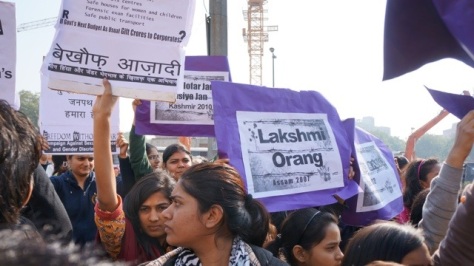
  • Protestors at the ‘Freedom Parade’ Rally of the Bekhauf Azadi Campaign, New Delhi, 26 January, 2013

Guest Post by Bekhauf Azadi (Freedom Without Fear) Campaign.

People’s Watch Over Parliament: February 21, 1st Day of the Budget Session, Jantar Mantar
Gather in large numbers – 12 PM onwards at Jantar Mantar, New Delhi.
Are Our Lawmakers Ready to Listen to the Voice of the Movement Against Sexual Violence?

Continue reading People’s Watch Over Parliament: Bekhauf Azadi Campaign

Health professionals and sexual assault – some resources from CEHAT

These are some resources available from Centre for Enquiry into Health & Allied Themes (CEHAT)

Role of Health Systems in Responding to Sexual Assault – Frequently Asked Questions

What is the role of Health Professionals in responding to survivors of sexual assault?

Health professionals have a dual role to play in responding to survivors of sexual assault. Firstly, they are required to provide medical treatment and psychological care to survivors as sexual assault has short and long-term physical and psychological effects. Secondly, the health professional  is required to perform a ‘medico-legal examination’. This entails accurate documentation, examination, collection of  forensic evidence and provision of a medical opinion related to the assault, which can serve as evidence in the
court of law.

Read the rest of this manual here.

Links to more resources for health professionals dealing with sexual assault


When women ask for it: Veena Venugopal

Guest post by VEENA VENUGOPAL

To me, the most memorable scene in Dev D is the one where Paro takes a mattress from home and ties it to her cycle. When she reaches the edge of the field, she abandons the cycle, lifts the mattress on her shoulder and marches to the clearing where she lays it down and waits for her lover. There are no words spoken and the camera holds her face close. Her expression is one of intense seriousness. You can see her desire is a field force of intensity that fuels every step. She is determined to see it through, to let that desire take over herself completely; not surrender to it but to let it explode out of her. You know that when she meets Dev, the sex would be passionate and powerful.  And yet, in the south Delhi multiplex where I was watching the film, most of the audience burst into rapacious laughter. The women smiled embarrassedly at each other. Which made me wonder, why is female desire a laughing matter? Continue reading When women ask for it: Veena Venugopal

Child sexual abuse in India: the police blames the victims

This is a press release put out by HUMAN RIGHTS WATCH on 7 February; link to full report towards the end


India: Child Sex Abuse Shielded by Silence and Neglect Police, Doctors, Courts Need to Change Policies and Mindset to Support Victims

New Delhi, February 7, 2013:  The Indian government should improve protections for children from sexual abuse as part of broader reform efforts following the gang rape and murder of a student in New Delhi in December 2012, Human Rights Watch said in a new report released today. Continue reading Child sexual abuse in India: the police blames the victims

The Criminal Law Ordinance 2013 on Sexual Assault – Cut, Paste and Shock! Pratiksha Baxi

Guest post by PRATIKSHA BAXI 

Once the Criminal Law Ordinance 2013 was uploaded, circulated and read many times, an overwhelming desire to mark the ordinance to all one’s students as an example on how not to frame laws has grown. Yet, explain one must, why the current law on sexual assault is so bizarre, even if we do not bring in the so-called controversial elements and keep to the text of the ordinance.

The Criminal Law Ordinance 2013 begins with the definition of sexual assault as a gender-neutral offence. It does not make an exception to state that women do not rape men in everyday contexts under s. 375. Since such an exception is not added, and the ordinance specifies that ‘sexual intercourse or sexual acts by a man with his own wife, the wife not being under sixteen years of age, is not sexual assault’, we are faced with a confounding and deeply misogynist legal consequence. Wives, we are told cannot prosecute husbands for sexually assaulting them. But since sexual assault is gender neutral without any exceptions and the marital rape exemption is not extended to husbands, now husbands can accuse wives of sexual assault but wives can never prosecute husbands for sexual assault!  Continue reading The Criminal Law Ordinance 2013 on Sexual Assault – Cut, Paste and Shock! Pratiksha Baxi

Why the law on sexual offences must be changed: Madhu Mehra

Guest post by MADHU MEHRA

The public outrage in the wake of the Delhi gang rape has been as much a reaction to the brutality of the case, as it has been against the pervasiveness of sexual violence in our society. Instead of condemnation and action, rape cases frequently evoke public statements blaming the victims, and calls to reign in women’s freedom. That our social structures and mindsets remain patriarchal is well known. The question however is, to what extent does the law counter societal misogyny in the way it frames and responds to sexual violence? Do the criminal laws establish norms that uphold women’s bodily integrity and dignity in all situations, against all offenders without selectivity or discrimination? Continue reading Why the law on sexual offences must be changed: Madhu Mehra

“The impunity of every citadel is intact” – the taming of the Verma Committee Report, and some troubling doubts

Legal activist Vrinda Grover said in the FeministsIndia e-list about the Ordinance: “The impunity of every citadel is intact – family, marriage, public servants, army, police.” In effect, she said, the Ordinance is simply the pending Criminal Law Amendment Bill 2012, widely criticized by women’s organizations, which has been sneaked in as law without debate or consultation, in Parliament or outside. Feminists activists are rightly suspicious of the sudden sense of “emergency” that has gripped the government, when it has ignored our demands for criminal law reform on sexual violence for over twenty years.

Here I will document two press releases issued by women’s groups, and draw attention to some troubling and unresolved debates within the women’s movement in India today. The post will conclude with a useful table comparing the Ordinance and the JVC Report, issued by the Ministry of Home Affairs. Continue reading “The impunity of every citadel is intact” – the taming of the Verma Committee Report, and some troubling doubts

Sexual Violence, Consumer Culture and Feminist Politics – Rethinking the Critique of Commodification : Sreenanti Banerjee

Guest Post by SREENANTI BANERJEE

I will begin with the by now well-known interview of author and social activist Arundhati Roy, conducted by Channel 4 (a British Media House), about the widespread protests after the horrific December 16th incident of the brutal gangrape of the 23 year old medical student in Delhi. Permit me to quote Roy at length as I do not wish to take bits and pieces from her talk, and pluck them out of their context.

We are having an unexceptional reaction to an event which isn’t exceptional […] But the problem is that why is this crime creating such a lot of outrage is because it plays into the idea of the criminal poor, the vegetable vendor, the gym instructor, the bus driver actually assaulting a middle-class girl. But when rape is used as a means of domination by upper castes, by the army or the police it’s not even punished. Continue reading Sexual Violence, Consumer Culture and Feminist Politics – Rethinking the Critique of Commodification : Sreenanti Banerjee

The Official Emergency Continues – The Ordinance on Sexual Assault: Pratiksha Baxi

Guest post by PRATIKSHA BAXI

The reform of rape law, which was not a priority for more than two decades, seems more like a 20-20 match now. The spectacle of judicial reform has all the elements of cinematic imagination built into it—violence, voyeurism, repression, tears, scandal, redemption and betrayal. We are all consumers and participants of this judicial spectacle. We veer between manic hope and dark despair as we are left conjecturing how this theatre of judicial reform will enact equality and dignity for survivors of sexual assault. The latest twist in the tale is the introduction of an ordinance, following the Justice Verma Committee (JVC) report.

Continue reading The Official Emergency Continues – The Ordinance on Sexual Assault: Pratiksha Baxi