This one image should be issued as a ceremonial postage stamp to commemorate one year of Modi’s rule. We have said it many times already, but here it is, once more, with feeling – this is a bloody, violent Hindutvavaadi regime, with a cool headed, coldly vicious master-mind at its head – he of the Swarovski eye glasses, the 10 Lakh Rupee Suit, the diamond Movado watch – he of the infinite silences on All That Matters.
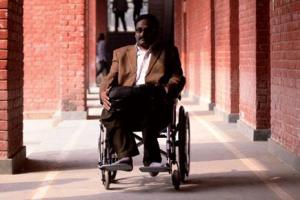
Yesterday, the 9th of May, one day after the court granted what must be the fastest bail and suspension of sentence in the history of India to India’s favourite Dabangg, a diminutive woman stood under the blazing Delhi sun and spoke of her husband who had been in jail for the past one year. In May 2014, lecturer in English at Ramlal Anand College, Delhi University, G. N Saibaba was returning home after evaluating answer scripts when he was abducted by unknown men, who later identified themselves as Maharashtra Police.
Professor Saibaba. Image Courtesy FRS Blog
Saibaba was not produced before a magistrate in Delhi but taken directly to Aheri, a small town in Maharashtra and then to Nagpur, to be put in solitary confinement in the famous anda cell of Nagpur jail. Let’s call this cell famous instead of the usual epithet “notorious” because all over the country, children are probably playing with each other right now saying to each other, “saale main tujhe anda cell mein daal doonga“, while their parents look on indulgently, congratulating themselves on the kid’s excellent G.K.
The labelling of the Seshachalam incident as a ‘law and order’ problem by State actors obfuscates the larger underlying problem deriving from lopsided notions of the human-environment relationship, and flies in the face of ecological concerns and social justice
The massacre of twenty people in the Seshachalam forests in a joint operation by the Red-Sanders Anti-Smuggling Task Force (RSASTF) of the Andhra Pradesh Police and the Andhra Pradesh Forest Department is reflective of the hegemonic control of natural resources by an increasingly militarised state. It is particularly shocking that such a massacre occurred just as calls are being made nationally for a democratic forest management approach that gives local people more rights and powers to manage forests.
Encounter killings in Seshachalam forests, courtesy Hindustan Times
While the state has chosen to depict the killing of 20 people in the Seshachalam forests as a response to a law and order issue, such a draconian response to the cutting of trees by peasants is indicative of a much deeper malaise in the governance of natural resources in India. On the evening or night of 6th of April, 2015, twenty people, purportedly smugglers of red sanders, were shot to death by ten officials of the RSASTF and one official from the Andhra Pradesh Forest Department. The shooting and killing (using automatic weapons) was supposedly an act of ‘self-defence’ precipitated by an attack on the officials by more than 100 people who ‘rained stones and hurled sickles’ during the raid. Three days after the incident, ‘country weapons’ and ‘firearms’ were added to the list of weapons used by the smugglers. That would work in their favor, because who better than the smugglers to know where to buy AK 47 Rifles and assault weapons.
Observer accounts mention that several of those killed were shot in the face, chest, or back. Nobody was apprehended in an injured state. Official post-mortem reports of those killed remain unavailable. No government officials were reported injured immediately after the operation, although mysteriously, all eleven officials involved were placed in isolation in the A-Class ward of a government hospital four days after the incident occurred. Human rights activists, led by the Coordination of Democratic Rights Organization have labelled the incident as a staged encounter, questioned the use of brute force, and have pointed out several inconsistencies in the official version of events. Continue reading An Encounter in the Forest: Bharath Sundaram and Nitin Rai→
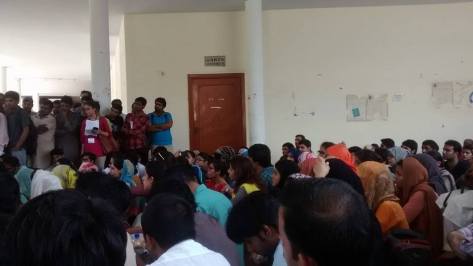
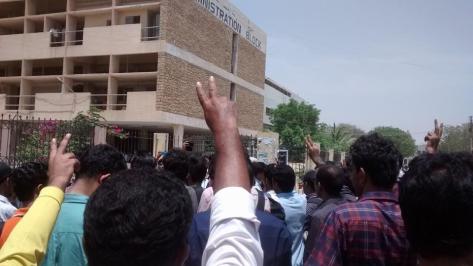
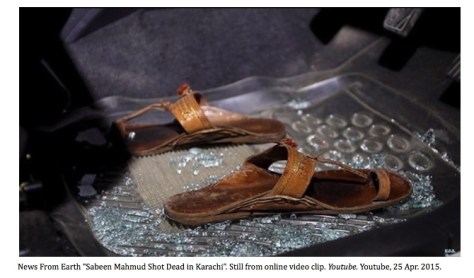
Sabin Mahmud was killed after organizing an event on Balochistan in T2F in Karachi, and more recently, Syed Wahidur Rehman, a Karachi professor was also shot dead. But far from being silenced, the resistance of democratic forces in Pakistan is growing. Today, Karachi University faculty organized a seminar on Balochistan missing persons to massive response, despite the administration refusing permission and locking the doors of the venue. The event was held in the Arts lobby, from where it seems to have spilt outside too.
A determined audience sits on the floor outside the locked room where it was to have taken place.
[ This is a post from two friends in Pakistan responding to the tragic assasination of Sabeen Mahmud, activist and director of ‘The Second Floor’ (T2F) – a space that hosted many wonderful conversations and brave events. Sabeen was killed as she was going home after an event dedicated to a public discussion of disappearances and human rights violation in Balochistan.]
A normally quiet and desolate gali is packed with camera crews and hundreds of attendees for the funeral of Sabeen Mahmud. While there is a steady trickle of mourners entering and exiting the premises of the vibrant community space Sabeen created, the crowd waiting in the gali outside seems to be arrested by a mixture of disbelief, anger and grief.
Similar emotions paralyze us as we write about Sabeen in the past tense. It is difficult to believe she is gone, infuriating to think about the way she went, and, perhaps, the hardest to accept the beginning of her absence.
While watching her interview with PBS NewsHour last month, one is struck by how her cavalier attitude to fear and security, reverberates eerily in the wake of her murder.
“I grew up playing cricket on the streets” she said, “I just feel when the time comes, the time will come”.
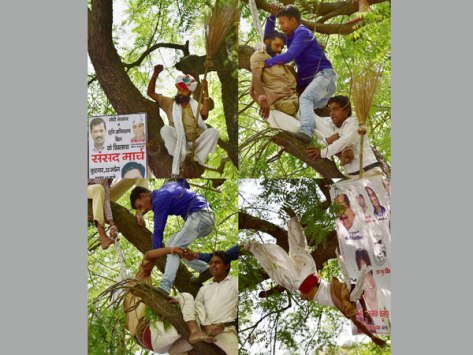
The tragic death of a farmer from Rajasthan occurs at a rally organized by the Aam Aadmi Party on 22 April 2015. The farmer, Gajendra Singh, hangs himself from a tree in full public view of the demonstrators, the media, the police. The electronic media had till then been barely covering the event, generally holding forth instead, in studio ‘debates’ among the opponents of AAP. Once this happened, the media spin doctors swung into action, and as Rajdeep Sardesai tweeted later, they seemed to work on an already decided script. Sardesai’s tweet said that there were clear instructions from the BJP to the media to focus only on the hung/ dying (or dead) man, and forget the rally. It seems, on a closer look, that the the second part of the instructions had perhaps already been given in advance – not to cover the rally and if at all, to attack it in sponsored studio debates. And of course, the BJP, which is the architect of the new Land Acquisition Ordinance, is an interested party in this game.
It is not entirely irrelevant to the overall politics of the media-BJP spin doctoring of ‘reports’ that the AAP government in Delhi was perhaps the first in the country to announce what is without doubt the highest compensation to farmers suffering crop losses – Rs 50, 000/- per hectare for all farmers who have suffered damage. Nor is it entirely irrelevant that the Delhi government had lent full support to the anti-land acquisition struggles and Kejriwal had himself joined in the rally held by Anna Hazare and had now taken up the land issue in all seriousness.
Thus it happens that between the BJP and the big media propaganda machine, which has on at least two previous occasions completely blacked out AAP, the stage was set. Also at work in the media-AAP relationship over a longer term now, is the role of Mukesh Ambani’s media empire, given that on a range of issues AAP has directly challenged the latter. As an aside, let me add that a very senior journalist told a friend at the height of the Delhi election campaign, that in CNN-IBN/ IBN7, clear instructions had been issued to the staff not to give more than 20 seconds exposure to Arvind Kejriwal under any circumstances. If AAP swept the Delhi elections despite that, it must say something about the limits of the media game, at least as far as the majority of the population is concerned.
Gajendra Singh being brought down. Image courtesy Oneindia.com
This time round, there was another constituency that was waiting to move into action – the Delhi elite, especially the radical elite whose hatred of Kejriwal is simply visceral, but which had been just about tempered by the presence in his team of People Like Themselves, darlings of the media. The latter had, to use an old Maoist expression, ‘wormed its way into the party’ and was intent on fighting an ‘ethical battle for inner party democracy’ against the ‘fascist Kejriwal’, a battle in which they were fully backed by the Ambani dominated media.
The recent hologram protest projected on the street before Spain’s Parliament is an innovative attempt to subvert the country’s ‘citizen security’ provisions that criminalises public protest.
The video of the hologram protest is riveting and surreal, as ghostly figures of women and men march shouting slogans amidst night-time traffic. The figures are clearly distinguishable, the faces discernible. This isn’t computer-aided animation. It’s the real thing.
Or as close to real as a virtual thing can be.
The website ‘hologramasporlalibertad’ (Holograms for Freedom) provides for the subscriber to record her own message and, with a click, a hologram is created. An online petition explains that the ‘citizen security laws’, which obtained final assent in Spain in March, will ‘repress the freedom of peaceful assembly’.
Korsa Subba Rao, a man from Koya tribe, cultivates about three acres of forest land in a village in Khammam district. His family has been doing so for several generations. Subba Rao has a ration card, voter identity card, Aadhar Card and a NREGA job card. However, for the land that he tills, he has no papers whatsoever. Ironically the only evidence he has is an FIR issued by the Forest department. For committing a forest offence of encroaching into the forest – cutting down trees and putting it to podu cultivation.
Like Korsa Subba Rao, in Khammam district, there are thousands of farmers belonging to Koya, Konda Reddis and Lambadi tribal communities cultivating one to four acres in forest lands. Most of them have been cultivating since the times of their forefathers. Often this is their only income. However, factors such as scanty rain, untimely rain or pest can drastically reduce this income. The prevalence of malaria and other mosquito borne diseases also adds to the toll.
Here, it needs to be understood that forest lands do not always imply green forests. A forest land can be dense forest, moderate forest, shrub growth and also barren land. In Khammam district, thousands of acres of forest lands have been put to cultivation since several decades. But any cultivation of forest land is considered to be illegal, as it is an offence as per the AP Forest Act, 1967. In this scheme of things, the tribal farmers are seen as “encroachers”. The irony is that they are encroachers inspite of being the original inhabitants of the land. Because of this illegality and because of the power of the Forest Department to register criminal cases, the tribal farmers live in a constant fear of eviction from their lands. Continue reading Why are we always Encroachers? Tribal farmers in Khammam District, Telangana: Vasudha Nagaraj→
For about a year now, I have been teaching 33 wide-eyed and wise middle schoolers. As we have read fiction, studied history, exchanged stories, and tried to understand the world together, I have found my students to be wonderfully curious and innately compassionate. As the school year drew to a close, I wondered how to conclude our time together. Because our parting at the end of a fulfilling year together was bittersweet, I was looking for something both lighthearted and meaningful. I settled on an old favorite of my own, The Paper Bag Princess, an unconventional fairy tale that turns the ‘prince saves princess from the dragon’ stereotype upside down. As always, I was amazed by my students’ heartfelt and fresh responses to the story. Continue reading Fairy Tales and Feminist Theory in the Face of Fear: Indus Chadha→
A Work of Art Vandalized at Gallerie One, Srinagar
On the opening day of Gallerie One, I was in a conversation with Rajendra Tickoo, Masood Hussain, Shabbir Mirza, M A Mehboob, Shaiqa Mohi and several other senior artists from Jammu and Kashmir. The opening of the first ever centre for contemporary arts and research in Kashmir was a dream come true for all of them. They told me that they had waited all their lives for such an initiative and how several great artists had died with the dream of having an art gallery in Kashmir. They were all very excited. They shook my hand again and again and hugged me before and after. Continue reading Kill it Before it Hatches, Attack it Before it Grows – On State Sanctioned Vandalism against Contemporary Art in Kashmir: Syed Mujtaba Rizvi→
Today, on International Women’s Day I am proud to acknowledge the deeply contested terrain that we call feminism in India, in which no claim goes unchallenged, no issue is undisputed (and some might say, no good deed goes unpunished!) In which over the decades, every stand and every understanding on practically every issue, has been painfully rethought and reformulated in the face of intense questioning from newer claims and voices.
In the clamour of feminist responses both to Leslee Udwin’s documentary ‘India’s Daughter’, as well as to the Indian state’s crackdown on it, some themes have emerged that reflect profound fault lines in our (feminist) understanding – not so much of sexual violence itself – but of what to do about it; how to act upon the knowledge of widespread misogyny and pervasive masculinist violence; how to acknowledge that sexual violence cannot be understood except as refracted through prisms of caste, class, Indian state militarism and… a list that will inevitably end in ‘etc’ regardless of how long it is; and in this particular case, above all, what sorts of representations of sex and sexual violence will further our ethical ambitions, and what others will undo decades of work.
In what follows, I will try to uncover some of these themes, on the explicit understanding that I do not claim to have resolved any of the debates, nor even to have highlighted all of them. This is a partial, personal attempt to make sense of the recurring ideas in a tumult of intelligent, concerned and strongly articulated opinions, in the course of which I will of course, make my own views explicit too.
First, perhaps I should state immediately that I saw ‘India’s Daughter’ and liked it very much. This is just to get it out of the way, because my opinion on the film is irrelevant to my belief that freedom of speech and expression ought to be a value that feminists defend at all costs. I did not hold such a strong view on freedom of expression in an earlier decade, but I do now, at the beginning of the 21st century, when it has become increasingly clear that the silencing of uncomfortable voices, even unto murder, has become the preferred mode of snuffing out debate globally.
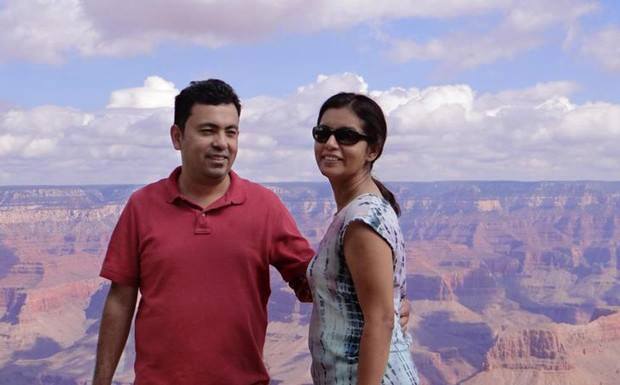
Avijit Roy was brutally murdered in Dhaka a few days ago. His wife, after heroically trying to shield his person with her own body, now lies in an ICU bed, fighting for her life. I was an infrequent visitor to his website, Muktomona. Visiting it was like running your tongue over that tooth you’re missing, or reflexively checking whether you had your keys with you in the morning. Its presence was a reminder that, no matter how circumscribed, the nation-state of Bangladesh still had men and women who liked to think unconventional thoughts; give expression to unpopular ideas; endeavored to stand, as it is, in the very edge of what the societal limit of what could be expressed, and then take another firm step, not back, but forward. Continue reading That Elusive Thing with Feathers – After the Killing of Avijit Roy: Abdul Bari→
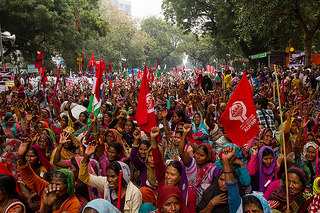
Forcible land acquisition has always been an issue of life and death for millions of people in India, not only farmers but also agricultural laborers and fish workers. With the Land Ordinance it has become a political hot potato. More than 350 people’s organizations gathered at Parliament Street on February 24th, with 25,000 people from Gujarat to Orissa to Assam, and from Himachal Pradesh to Tamil Nadu and Kerala. This show of strength has forced the political parties to take a stand on the issue, leading to heated debates and discussion on the floor of the Parliament. The Ordinance, now Bill, reflects the anti-farmer and anti-poor move of un-democratically amending the 2013 Act on Land Acquisition and Rehabilitation, killing its very spirit and purpose.
The Ordinance brought in by the NDA government just after the Winter session of the Parliament came to an end was an obvious imposition on the country’s common people, of the colonial legacy of a perverted vision of development through an unjust and undemocratic modus operandi. The Ordinance is an attempt to open up the land that is the life support, source of livelihood and shelter for India’s toiling masses, to wealthy investors, including big corporations and builders. Its intention is to forcibly divert India’s agricultural land at the cost of food security, giving a free hand with no ceiling to the private companies as well as private entities i.e. private trusts and expensive profit-making educational and health institutions. The intention is to benefit private interests in the name of public interest. Continue reading The Land Ordinance (now Bill) is Bringing Back the Colonial Legacy: NAPM→
Chances are you have heard about Sureshbhai Patel, a 57 year old man, beaten and left temporarily paralyzed by Alabama police. His only crime: while he was out for a walk, a neighbor reported a ‘suspicious’ and ‘skinny black guy’ in the neighborhood causing him extreme distress and nervousness to leave his wife alone at home.
Several elements of this case bring back the ghosts of Trayvon Martin and Eric Garner, two black lives taken away by police brutality – despite being unarmed, Sureshbhai was subjected to “extreme force” and suspected not because he was Indian but because he resembled a black guy – but also bring to the forefront the enormous emotional and financial support generated not only from Indians but also Americans who rallied behind Sureshbhai and the injustice meted out to him. In a matter of six days, donations worth $190,000 were garnered to help the Patel family with medical bills. The incident also provoked Alabama’s governor to apologize for police’s use of “excessive force” and to initiate an investigation by the Alabama Law Enforcement Agency, along with the one being conducted by the FBI. Continue reading India’s Obsession with Elitism is Leading it to Ignore the Marginalized: Rupande Mehta→
It seems ludicrous that in a civilised democratic society like India, a citizen may be practically abducted by police, charged with perfunctory offences and incarcerated without bail on mere suspicion for an indefinite period of time. But this is indeed the situation in present-day India, with duly passed legislation sanctioning the inhumane state of affairs.
The validity of unjust or immoral laws has long been debated, with two major schools of thought emerging- the positivist school and the naturalist school. The positivist school does not recognise any correlation between the legal system of a society and notions of what ought to be justice. The positivist framework mandates that the law is that ordained by the valid legislator, whereas the naturalist school of thought envisages some rights to be inherent by virtue of humanity of a person. Thus, an unjust law, as per the school of naturalist thought, would be no law at all; positivistic thought, on the other hand, would posit such law to be valid by virtue only of being ascribed to the law-making process. The Hart- Fuller debate devolved around the law made by Hitler; with Hart contending that laws passed using proper procedure would always be valid and Fuller maintaining that no unjust rule could ever be law. India allows “procedure established by law ” to deprive people of their Fundamental Rights; a state of affairs which reflects positivistic thought in the founders of India. India’s judiciary has slowly moved from this strictly positivist setting to a more naturalistic and liberal interpretation of the term. This shift has placed India closer to the guarantee of “due process of law” in the United States of America. Continue reading Reading Between the Lines – A Critique of the UAPA: Avani Chokshi→
Standing up to the killing of Avijit Roy, image courtesy Sudin Chattopadhyay
Soon after this brutal killing of the Bangladeshi-American atheist blogger, protests have begun across Dhaka. We extend our support to the struggle against the dangerous forces of religion-inspired extremism. See more detailed report in Al Jazeerahere and The Guardianhere.
B’desh protests against killing, image courtesy The Guardian
For a child born in Kashmir, the chances of living a normal life and even survival vary greatly from one region to another. Suppose you are born in the seemingly volatile stretch of Downtown. You may well turn out to be someone whose pictures are flashed on social media as the epitome of bravery, someone whose demise is imminent, and someone ready to wear the ‘Shaheed’ label. I arrived at this place at 4:30 on a cold evening. The room was crowded by women sitting with only one recognizable face; Shehzaad’s mother, Rubeena Akhter. Nobody spoke. The air smelled like rain. After a short while, a tall man in a brown-checkered pheran appeared. Leaning on the walls, he helped himself to one corner of the dimly lit but spacious room. He did not want himself to be identified as a ‘victim of conflict’.
For Shehzaad, life had been altogether different before. He had spent happy summers with his family in the town where violence, as it existed, had never appeared to him naked. By now, he is 23. He has become larger and properly bearded. The one thing which you can’t miss about Shehzaad is that he has giant brown eyes like a dairy cow. That’s what prompts my most idiotic lines of inquiry. Could someone who looks like that really pelt stones on streets? Idiotic, I know. “Do I have to tell you how I was supposed to have been killed that day?” he says, sounding like a gull. I hear a slow whimpering strangled with ache. This soon changes into full-throated babbling—a cascade of terrible, terrified pleading wails as he continued naming those who had been killed during the 2010 agitations.
Report produced by PEOPLE’S UNION FOR DEMOCRATIC RIGHTS
Between December 26th and 31st 2014, a PUDR fact-finding team visited 9 villages of Bijapur district, Chhattisgarh to ascertain reports of arrests, intimidation and harassment, including sexual abuse by security forces who are stationed there to fight the Maoists. Predominantly Adivasi villages, the residents of Basaguda, Kottaguda, Pusbaka, Lingagiri, Rajpeta, Timmapur, Kottagudem, Korsaguda and Sarkeguda, narrated the daily acts of violence and violations committed by armed personnel residing in security camps. Apart from documenting the continuance of ‘area domination’ by the security forces, the report draws particular attention to:
The large number of ‘permanent warrants’ issued against the populace, of which a significant number is declared as ‘absconders’. A rough estimate indicates that as many as 15-35,000 people live under the threat and fear of these warrants in Bijapur alone.
The lawless conduct of the armed personnel and Special Police Officers (SPOs) who routinely raid, beat, loot, detain and compel the Adivasi villagers to perform ‘begar’ (free labour) at the security camps. Instances of sexual torture were also noted.
By now it is all beginning to sound very familiar: A woman gang raped, her vital organs missing, stones and blades found in her stomach, other objects found in her anus and vagina and the doctor conducting the post mortem stating it was the most horrific case of his life. This case, however, has one additional parameter – the woman raped and killed was mentally challenged and being treated for her condition at the Post Graduate Institute of Medical Sciences (PGIMS) in Rohtak, Haryana.
There is conflicting information on the mental condition of the woman raped and killed. While some reports state she was suffering mental retardation, others state her as condition as being psychiatric. Never mind that mental retardation is untreatable but the contradiction in reporting highlights a fact we all know – how widely misunderstood mental illness really is.
Mental illness is the most undertreated of all diseases around the world. There is an unspoken stigma around it and most sufferers usually do not want to talk about their “condition.” We have a difficult time grasping its severity and hence victims usually quietly suffer on their own until the situation often gets very serious. Many famous people have suffered mental illness and it has taken many of them years to come out and acknowledge their suffering. Few of them have fallen to their disease, the most notable recent case being that of Robin Williams who suffered from extreme depression. Other personalities who suffered mental illness include: Winston Churchill, the Prime Minister of UK, Buzz Aldrin, the second man on the moon, Beethoven, musical genius, Diana, Princess of Wales who suffered from bulimia, an eating disorder, and depression. Mental illness is the most unrecognized and, perhaps, one of the most damning diseases.
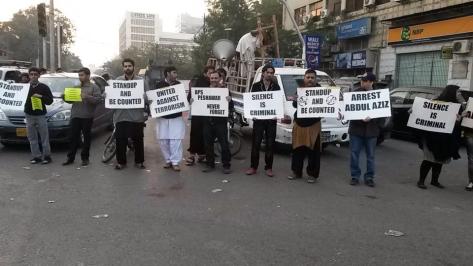
On the night of February 1st, Jibran Nasir Pakistan’s leading activist and a handful of peaceful protesters sat on a road in Karachi near the Sindh Chief Minister’s house for more than 24 hours, demanding the arrest of terrorists responsible for the January 30th Shikarpur attack which killed 65 Shias during Friday prayers, and demanding action against banned sectarian organizations. There were only 20 protesters, their average age 25, outnumbered it seemed by riot police with water cannon and batons at the ready.
Protest in Karachi against Terrorism and Secterian Violence








 KAFILA - COLLECTIVE EXPLORATIONS SINCE 2006