The endless violence that has always been part of Dalit life is now acquiring new dimensions as Dalits refuse to carry out upper caste diktat and confront aggressive upper castes emboldened by the Hindutva brigade.

The endless violence that has always been part of Dalit life is now acquiring new dimensions as Dalits refuse to carry out upper caste diktat and confront aggressive upper castes emboldened by the Hindutva brigade.
Guest post by BHAWNI MEHROTRA
Dear Modiji,
I’m glad you spoke. Even though it was devoid of any personal remorse and limited to calling the Dadri lynching an “unfortunate and unwarranted” incident at Sasaram. Even though it was to cash in on ‘communal harmony’ during an election rally in Bihar. Even though it was a mere paraphrasing of the President’s quote once before at Nawada (we know of your limited vocabulary beyond acronyms and your “may-the-force-be-with-you” love for quoting). Still, I’m glad that you managed something! However, the one thing that you have failed miserably to manage (and let’s leave the ambling economy and your familial relations out of this) is the ‘fringe elements’ that come as part of the ‘BJP family pack’ offer. Sadly, under your ‘good governance’, the fringe has been asserting itself as the mainstream. Even sadder is that under ‘you’, the fringe is the mainstream.
The icing on the cake are your own MPs and ministers. Initially, what I thought of as verbal diarrhea on their part is actually proving to be a string of comments that are a part of a larger orchestrated communication message. Each message has a defined audience suited to their language and idioms. They all suffer from a dangerous saffron strain, exactly the kind that has fathered the ISIS, the Taliban and so on. Whether it be Yogi Adityanath’s remark, calling on Hindus to organize themselves; or Sadhvi Niranjan Jyoti’s unparalleled comparison between a “Ramzaada” and a “Haramzada”; or Nitin Gadkari’s reminder of the government being one of “Rambhakts”- all seem to be competing for being the most ridiculous. Did you mean “Hindutva First” and not “India First”? I’m sorry that I was so awestruck by your gazillion rupee election campaign (the one thing that you managed brilliantly) that I didn’t read the fine print. Therefore, it is not your failure, it’s mine. Had I voted sensibly, Mohammad Akhlaq wouldn’t be dead today. Continue reading A Letter to Modi from a Former Supporter: Bhawni Mehrotra
देश भर में चल रहे लेखकों व साहित्यकारों के विरोध के सन्दर्भ में लेखकों के पांच संगठनों – प्रगतिशील लेखक संघ, जनवादी लेखक संघ, जन संस्कृति मंच, दलित लेखक संघ व साहित्य-संवाद – ने आज दिल्ली में निम्नलिखित बयान जारी किया :
देश में लगातार बढ़ती हुई हिंसक असहिष्णुता और कट्टरपंथ के ख़िलाफ़ पिछले कुछ समय से जारी लेखकों के प्रतिरोध ने एक ऐतिहासिक रूप ले लिया है. 31 अगस्त को प्रोफेसर मल्लेशप्पा मादिवलप्पा कलबुर्गी की हत्या के बाद यह प्रतिरोध अनेक रूपों में प्रकट हुआ है. धरने-प्रदर्शन, विरोध-मार्च और विरोध-सभाएं जारी हैं. इनके अलावा बड़ी संख्या में लेखकों ने साहित्य अकादमी से मिले अपने पुरस्कार विरोधस्वरूप लौटा दिए हैं. कइयों ने अकादमी की कार्यकारिणी से इस्तीफ़ा दिया है. कुछ ने विरोध-पत्र लिखे हैं. कई और लेखकों ने वक्तव्य दे कर और दीगर तरीक़ों से इस प्रतिरोध में शिरकत की है.
दिल्ली में 5 सितम्बर को 35 संगठनों की सम्मिलित कार्रवाई के रूप में प्रो. कलबुर्गी को याद करते हुए जंतर-मंतर पर एक बड़ी प्रतिरोध-सभा हुई थी. इसे ‘विवेक के हक़ में’ / ‘इन डिफेन्स ऑफ़ रैशनैलिटी’ नाम दिया गया था. आयोजन में भागीदार लेखक-संगठनों – प्रलेस, जलेस, जसम, दलेस और साहित्य-संवाद — ने उसी सिलसिले को आगे बढाते हुए 16 सितम्बर को साहित्य अकादमी के अध्यक्ष विश्वनाथ प्रसाद तिवारी को एक ज्ञापन सौंपा जिसमें उनसे यह मांग की गयी थी कि अकादमी प्रो. कलबुर्गी की याद में दिल्ली में शोक-सभा आयोजित करे. विश्वनाथ त्रिपाठी, मुरली मनोहर प्रसाद सिंह, चंचल चौहान, रेखा अवस्थी, अली जावेद, संजय जोशी और कर्मशील भारती द्वारा अकादमी के अध्यक्ष से मिल कर किये गए इस निवेदन का उत्तर बहुत निराशाजनक था. एक स्वायत्त संस्था के पदाधिकारी सत्ता में बैठे लोगों के खौफ़ को इस रूप में व्यक्त करेंगे और शोक-सभा से साफ़ इनकार कर देंगे, यह अप्रत्याशित तो नहीं, पर अत्यंत दुखद था. अब जबकि अकादमी की इस कायर चुप्पी और केन्द्रीय सत्ता द्वारा हिंसक कट्टरपंथियों को प्रत्यक्ष-परोक्ष तरीके से दिए जा रहे प्रोत्साहन के खिलाफ लेखकों द्वारा पुरस्कार लौटाने से लेकर त्यागपत्र और सार्वजनिक बयान देने जैसी कार्रवाइयां लगातार जारी हैं, यह स्पष्ट हो गया है कि लेखक समाज इन फ़ासीवादी रुझानों के विरोध में एकजुट है. वह उस राजनीतिक वातावरण के ख़िलाफ़ दृढ़ता से अपना मत प्रकट कर रहा है जिसमें बहुसंख्यावाद के नाम पर न केवल वैचारिक असहमति को, बल्कि जीवनशैली की विविधता तक को हिंसा के ज़रिये कुचल देने के इरादों और कार्रवाइयों को ‘सामान्य’ मान लिया गया है. Continue reading आज़ादी और विवेक के पक्ष में प्रलेस, जलेस, जसम, दलेस और साहित्य-संवाद का साझा बयान
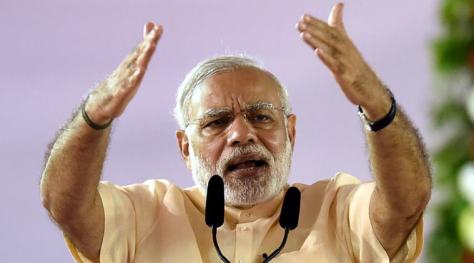
Anybody with a passing interest in consistency or coherence might be forgiven for being stumped at the political spectacle unfolding right now. Yesterday, Prime Minister Narendra Modi assured us that his government was committed to reservations. The statement was made at a ceremony to inaugurate the Ambedkar memorial at the Indu Mills compound in Mumbai. The fact that ordinary Dalits, in the habit of thronging any joyous celebration on Ambedkar in big numbers, were kept out of the ceremony, is possibly irrelevant. After all, officialese is officialese, and no political party – certainly not the BJP – has a monopoly on stiff-necked commemorations of people’s leaders that want nothing to do with the people. It is Modi’s commitment to reservations and the Indian constitution that is of interest. In some ways a statement of this nature made at the inauguration of an Ambedkar memorial, makes perfect sense. Apart from the occasion and locale, also not coincidental was the timing of Modi’s statement – one that he himself alluded to, when he referred to the bitterly fought Bihar elections now underway, “With a BJP government in power and polls getting under way, a malicious propaganda is being spread that the government is against reservation…”. The fact that the anti-BJP mahagathbandhan (grand alliance) in Bihar has made reservations one of their chief planks, with Lalu Prasad Yadav declaring in his inimitable style that he will kill himself if reservations are removed, is relevant.
Zooming back from the Ambedkar memorial event, the PM was clearly also responding to the threat to his Sabka Saath Sabka Vikas model begun a couple of months ago by the irrepressible Hardik Patel. Patel – erstwhile BJP supporter, self-styled Patidar-Patel revolutionary and a wild child in imminent danger of being silenced (or coopted) by the BJP – was temporarily subdued by the Gujarat administration following the wave of violence over his first call for reservation, but resurfaced a couple of days ago to be the nightmare Modi hadn’t dreamed yet – saying his aim was to expose the “Gujarat model of development”. This is for the current party nothing short of the youngest born of a rambling illustrious family running into the street from the family mansion saying our house is made of mud! our house is made of mud!
Every newspaper in India carried the same headline on Friday, the 9th of October: ‘Modi breaks silence on Dadri lynching.’ It says something about the breathless desperation of the Indian press to hear the prime minister say something, anything, that could be interpreted as his disapproval of political barbarism, that there wasn’t, in fact, a word in his speech about the Dadri lynching. – Mukul Kesavan in ndtv.com
You know what has been agitating the minds of millions of us, Indians — the future of our pluralism. You have stated your position in terms of ‘sabka sath, sabka vikas‘. And this is quoted and cited on your behalf repeatedly as a mantra. But, Pradhan Mantriji, this is certainly not adequate. We need to hear you, our Prime Minister, directly and clearly and with an urgent reference to the present situation, which is nothing less than a tragedy. Over the last few months we have had more than one tragedy. Can we really not see the connections between the so-called stray incidences all over the country, from the murders of Dabholkar, Pansare and Kalburgi to that of Mohammad Akhlaq. Your direct voice needs to be heard now, unless you do not consider this an event of significance. And now, the ambiguity of what you said yesterday only makes me send you this appeal for your truthful intervention. TM Krishna’s Open Letter to the Prime Minister
While Modi’s cheer leaders in the media were telling us that the prime minister had finally ‘broken his silence’ (see Apoorvanand’s piece on this here), there were others who read the meaning of his speech far more accurately.They knew exactly what Modi was saying; they knew without having to do a content analysis of His speech that, if anything, despite being shamed to an extent by the President, Pranab Mukherjee’s statement the previous day, he actually refused to say anything about the Dadri incident let alone condemn the crime or its perpetrators. They understood clearly that his speech was merely a continuation of his sinister and devious silence. They understood like no media commentator or analyst did that what he said in Munger was a green signal for them to go ahead with their activities. Thus what happened in Mainpuri today is nothing to be surprised about.

Continue reading Modi’s Speech, his Silence and Dadri Redux in Mainpuri
Modi said nothing about Dadri, he just brought beef into the Bihar election
The media, however, rushed to report that Prime Minister Narendra Modi has finally broken his silence on the Dadri lynching during his speech in Munger. But what has happened is actually the reverse. Modi has cleverly brought beef into the centre-stage of Bihar’s electoral battle.
Beef is now THE issue in Bihar-elections. Modi’s timing was perfect. Remember, these are the last few days of campaigning before the first phase of polling on 12 October. Continue reading Modi Communalises Bihar Elections
The following is a report on the Dadri beef rumour and lynching, prepared by a fact finding team from NEW SOCIALIST INITIATIVE, PEOPLE’S ALLIANCE for DEMOCRACY and SECULARISM, SAHELI and DELHI SOLIDARITY GROUP, released in New Delhi on 05/10/2015
The investigation team with the following members visited the village on 3 October 2015: Bonojit Hussain (New Socialist Initiative), Deepti Sharma (Saheli), Kiran Shaheen (writer and activist), Naveen Chander (New Socialist Initiative), Sanjay Kumar (People’s Alliance for Democracy and Secularism and New Socialist Initiative) and Sanjeev Kumar (Delhi Solidarity Group)
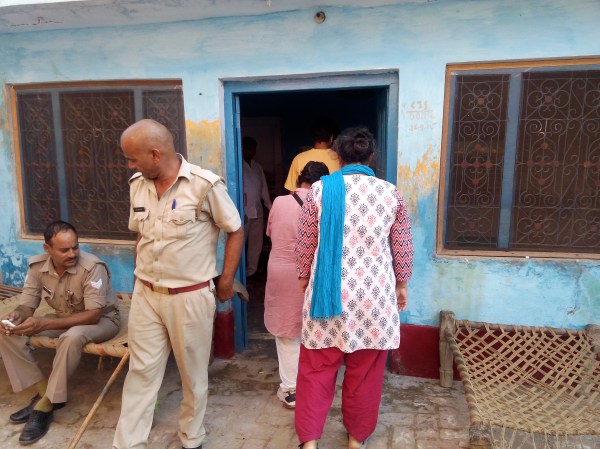
On the night of 28 September, in a heinous instance of hate crime Mohammad Akhlaq a resident of Bisara village of Dadri in western Uttar Pradesh was lynched to death and his son Danish brutally assaulted by a mob of villagers over a rumour that Mr. Akhlaq and his family had slaughtered a calf and consumed its meat. Just before the lynching, an announcement was made from the local temple to spread the rumour, and within moments a mob constituted itself and attacked Mr. Akhlaq resulting in his lynching. Mr. Akhlaq’s son Danish has been in hospital since that night and despite undergoing two brain surgeries his condition is still said to be critical. Continue reading Dadri Beef Rumour and Lynching – A Report from Bisara village
Guest Post by KISHORE

(Image : Courtesy – http://www.huffingtonpost.in)
अख़बारों में आई खबर के अनुसार ग्रेटर नॉएडा में भीड़ ने एक व्यक्ति को इस अफवाह के आधार पर मार दिया कि वह गौमांस के व्यापार में लगा था. यह बताने की जरूरत नहीं कि मरने वाला किस धर्म को मानने वाला था और मारने वाले किस धर्म के अनुयायी थे. अब आ रही खबरों के अनुसार यह अफवाह झूठी थी और जिस पुजारी ने इस अफवाह की शुरूआत करी. उस पुजारी को यह अफवाह उड़ाने के लिए मजबूर किया गया था. कुछ लोग यहाँ तक कह रहें हैं कि यह बर्बर हत्या किसी ग़लतफ़हमी के कारण हुई है, पर मेरे एक मित्र ने बड़ा ही प्रासंगिक प्रश्न उठाया कि हम अगर यह मान भी ले की वह व्यक्ति गौ मांस के व्यापार से जुड़ा हुआ था तो क्या उसकी हत्या को उचित ठहराया जा सकता है.
इस बात में कोई दो राय नहीं कि अगर मेरा धर्म मुझसे अपेक्षा रखता है कि मैं ये खाऊँ और ये ना खाऊँ और मैं उसमे विश्वास रखता हूँ, तो यह मेरा चयन हो सकता है कि मैं कुछ ना खाऊँ. कोई मुझे वह चीज़ खाने के लिए मजबूर नहीं कर सकताण. पर क्या यह जरूरी है कि मेरे खाने या ना खाने के चयन का पालन बाकि लोग भी करें. खाना.पीना, पहनना-ओढना और कुछ अच्छा लगना या न लगना हर किसी का निजी मामला है. क्या समाज यह तय कर सकता है कि मैं क्या खाऊँ और क्या ना खाऊँ ? और एक वर्ग की प्राथमिकताओं के हिसाब से न चलने पर उसको मौत के घाट उतारना किसी न्यायोचित समाज की निशानी है या बर्बर समाज की ? Continue reading बढ़ती असहिष्णुता और फासीवादी प्रवृतियां : किशोर
दिल्ली के करीब दादरी के बिसराड़ा गाँव की अस्करी गमी में है। अपने पचास साल के बेटे मोहम्मद इख़लाक़ की मौत का गम वह मना रही है। और साथ में उसका परिवार। बाईस साल का उसका पोता दानिश हस्पताल में मौत से जूझ रहा है।यह शोक मामूली नहीं है और न यह मौत साधारण है। यह आपको तब मालूम होता है जब आप देखते हैं कि गम की इस घड़ी में अस्करी के कंधे पर रखने वाला कोई पड़ोसी हाथ नहीं है।
अस्करी पूछती है, जहां कोई हमारा पुरसाहाल न हो, उसे हम अपना देस कैसे कहें! हमारे यहाँ गाँव को देस कहने का रिवाज है। अस्करी का सवाल वाजिब है: जहां गम बँटाने पड़ोसी न आएं, वह अपना देस कैसे हुआ!

Continue reading अखलाक़ की मौत उठा रही है हमारी सभ्यता और जनतंत्र पर सवाल
The thing about violence is that it is very hard and very easy to talk about. Describing it is simple, empirical, instinctive. There are facts, logistical details to hide behind. Motives to be ascribed, an “incident” to be explained. Mohammad Akhlaq. Dadri. A mob. A(nother) Muslim (dalit/trans/worker/woman’s) body. Meat that is not beef. A murder. A lynching.
Facts are useful. But they also hide things from us. They make violence about its incidence. It’s not. The act is banal. Ordinary. Expected.
Mohammad began to die a long time ago. When violence against particular bodies becomes legitimate, becomes a series of “misunderstandings,” it is not violence at all. It is the order of things. It is not prejudice but probability. Beef, property, a panchayat election, love jihad, a job, an argument, a WhatsApp message – these are not causes, they are just modes. The last circuits in a motherboard whose pattern is set in place.
Mohammad began to die at least as early in 1992. When we speak of his death in September 2015, it is already too late. The violence is not his death. The violence is that his body lost its right to be murdered because it has slowly been stripped of its life, bit by bit, for years.
Report on the protest by automobile workers in Manesar by BIGUL MAZDOOR DASTA AND AUTOMOBILE INDUSTRY CONTRACT WORKERS UNION
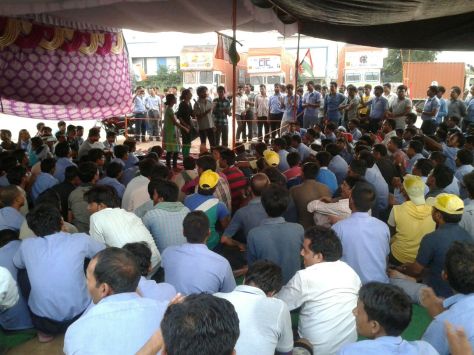
On the morning of 18 September 2015 when the workers employed in the Bridgestone company reached their factory gates they were met with Police officers and hired bouncers at the gate. When the workers tried to enter the factory premises they were resisted by the uniformed and the non-uniformed goons of the Factory Management. The Police beat up the workers and prevented them from entering the premises of the factory in spite of having a court order for tool down and without any prior notice the workers were sacked by the company. More than 400 workers employed in Bridgestone Factory in Manesar have been unlawfully sacked by the Company authorities after the workers demanded to get their Union registered. The workers are currently protesting outside the factory and have gathered there to raise their voice against the injustice and oppression that they are facing at the hands of the factory management.
This is a guest post by DEEPAK NAOREM
Violence and the accompanying disruption of everyday life in Manipur is not a recent phenomenon. This year too, the state was plunged into a spiral of violence following demands for the implementation of Inner Permit Line, a law originating in the colonial period. This demand is based on real or imagined fears that Manipur, like Sikkim and Tripura, would be overwhelmed by the ‘outsiders’ and that the ‘indigenous people’ of Manipur would become a minority in their homeland. Such demands are neither new nor surprising in this part of the world, where a nearly-unfathomable ethnic, demographic and political jigsaw puzzle was created by British colonialism; one that was deepened by even more myopic and inconsistent policy in the post-colonial years. However, this year, following the death of a young student by police firing during a student protest in Imphal, the movement demanding the Inner Line Permit (ILP) gained considerable momentum in Manipur. Subsequently, the legislature was forced to introduce three bills in the Manipur State Legislative Assembly on 28th August, 2015, ensuring the implementation of Inner Line Permit in the state. This in turn triggered another wave of violence with the ‘tribals’ and tribal organizations opposing the three bills, eventually bringing life to a standstill in the state.
Continue reading A Contested line – Implementation of Inner Line Permit in Manipur: Deepak Naorem
These are guest posts by Akash Bhattacharya and Arif Hayat Nairang
The film Muzaffarnagar Baaqi Hai has been in the news recently, and not always for the right reasons, having attracted disruptive and abusive protest at some screenings. Following a day of counter-protest in which the film was screened all over the country, a friend teaching in a Delhi University college suggested screening it in her college, only to be told by the student representative that it would “cause trouble” (“bawwal mach jayega ma’am!!”). She asked what that meant and if he had seen the film, and he simply said, “nahin, bhaiyya logon ne kaha hai ki woh film bahut buri hai” (No, but our elder brothers have said it’s a bad film).
In an atmosphere where political self-censoring comes as easily to the current generation of students as scouring the net for “blocked content” we present below two readings of the reception of the film, the first ruminating on whether the film addresses the complexities of communal mobilisation adequately; and the second inquiring in the context of social media and particularly Facebook, what constitutes the ‘liking’ of an image or idea. The idea of posting these comments is as much to give space to these arguments as it is to make a larger point that the ‘sickular left’ voices that are presumably behind the film love discussion, critique and disagreement. That to my mind is the way forward, not pre-empting the always-already hurt sentiments of the bhaiyya log whosoever they may be.
Guest post by Aman Verma
It is disheartening to see amongst supporters of Hindutva these days a silent acquiescence and at times even active support for extra-constitutional techniques being adopted by organizations like the RSS and its offshoots towards attaining the goal of Ram Rajya. An assessment is necessary of what would ultimately entail on the social, political and economic fronts if such a policy that envisages a supposedly ‘Hindu’ cultural and linguistic hegemony over cultures and languages represented by minority communities becomes reality. However, being a student of law what disturbs me more is the absence of any socio-political entity or civil society movement rooted in values of democracy that can effectively counter the impact of Hindutva organizations on the Indian social fabric. While the BJP has its RSS, every other political party claiming to be the upholder of secularism lacks its equivalent, or at the very least an effective social protégé.
Further, my personal interactions with supporters of BJP reveals that there is some deep sense of hurt and helplessness, part valid for the sake of argument, but for the most part carefully manufactured by Hindutva propaganda, which manifests itself in questions a friend recently put to me, “What are the other ways in which the Hindus can also claim their rights and send out a message that they have been too tolerant for too long?” and another which sounded like “How else to keep our dignity and identity alive in our land?”. These questions, based upon presumptions like those of “Hindu tolerance” of acts perpetrated by other communities supposedly only against Hindus and, protection of a completely vague concept of “Hindu identity” are clearly an outcome of a campaign strategy that relies upon upping the antics on the romantic-nationalist front.
Continue reading Hindutva: A Political Theory of Nationhood?: Aman Verma
Guest Post by SHRINIVAS DHARMADHIKARI
Last month’s killing of Cecil, the 13-year-old, rare black-maned lion by American dentist Walter Palmer, was met with global outrage and condemnation. However, this foolish bravado cannot just be treated as another sign of American (or white) exceptionalism (read sickness) because behind this is a much larger and thriving Trophy Industry.
A few facts will make the size and destructive power of this industry clear. Americans traveling to Africa make up more than 60 per cent of the foreign-participated lion trophy hunts carried out each year. This is according to John Jackson, president of the lobbying group Conservation Force. According to another scientist, Eric Jensen, a University of Warwick professor who studies public engagement in wildlife issues, the Trophy industry caters to the human need for dominance and control of nature and provides in addition a sense of masculinity having hunted a large animal. Continue reading Lions, Liars and Masters of the Universe: Shrinivas Dharmadhikari
On Sunday morning, seventy seven year old scholar Dr. Malleshappa Kalburgi opened his door in Dharwad town in Karnataka to some people who asked for ‘sir’. They pumped bullets into ‘sir’ when he appeared in front of them. Throughout his life, Dr. Kalburgi had the habit of opening doors. His scholarship into Kannada literature opened many doors. Those who killed Kalburgi abused not just his hospitality, and his willingness to open his doors to strangers (he had asked that his security be ‘lifted’ despite threats to his life), they abused all the traditions in the world that promise kindness to strangers, and keep doors open.
Continue reading On keeping Open the Door that was Opened by Dr. Malleshappa Kalburgi
MEERA NANDA has sent us this moving and militant anthem of the Black Lives Matter campaign.

R&B singer Janelle Monáe released a blistering 6 1/2-minute protest song on Friday called “Hell You Talmbout.” [African-American slang for “what the hell are you talking about.”] The song’s premise is simple, and that simplicity is the source of its power. The lyrics are the chanted names of black Americans killed by police and vigilantes, followed by the phrase “say his name” or “say her name.” The chorus is an anthemic, gospel-leaning repetition of the song’s title. Monáe is joined on the track by a drum line and the members of her Wondaland Arts Society collective: Jidenna, Roman GianArthur, Deep Cotton, St. Beauty and George 2.0. All of the vocals are raw, several to the point of breaking. None of the names are sung.
At the moment, Hell You Talmabout is available as a stream only. Here is the link.
And here are the lyrics. Note that some of the names are hyperlinked to tell you about the person being named.
Guest Post by Kavita Krishnan
The ‘Operation Black Rain’ film released by the web portal Cobrapost, based on secretly filmed boasts of the Ranveer Sena terrorists with detailed accounts of massacres of Dalit and oppressed caste labourers in the 1990s, has only confirmed public secrets that everyone in Bihar already knew.
Guest Post by Sharib Ali
With a finality that only history possesses, Yakub Abdul Razak Menon, an accused in the Bombay blast case, has transformed for many over the last few days, including me, into just Yakub. His name pronounced with a deep felt sadness that has come to characterize so many of our days. Days leading to terrible, terrible nights.
It is indeed sad, when a criminal -a sauve 20 year old looking for a way out- is, in death, turned into a rallying symbol of injustice. Flowing white beard, and a bloated body, suddenly turned around into an idea draped in flowers, garlanded, and marched on the shoulders of thousands of men through narrow streets- in complete silence. There were whispers, though, in the sweltering heat of bodies. But the pact was made. There would be no sloganeering. The state was there- to keep peace, no less. And it did what it does best: lined the streets with policemen. The policemen were out there defending a strange paradox: That it is right to kill to punish those who kill, so that others are deterred from killing. Stithi niyantran mein hai, still, they said. The rest, were silent.
Continue reading The State Playing God and Magician – Thoughts after Yakub Memon’s Death: Sharib Ali
Yakub Menon was murdered yesterday morning. Apparently it was his birthday. When his brother Suleman and his cousin Usman met him on Wednesday afternoon his words to them, as reported in today’s Indian Express, were – “Agar woh mujhey mere bhai ke gunahon ke liye sazaa de rahe hain, toh mujhe kabool hai. Par agar unko lagta hai ki mein gunehgaar hoon aur sazaa de rahe hain, toh yeh galat hai. Main bekasoor hoon.” (If they are punishing me for the sins of my brother, then I accept this verdict. But if they are punishing me because they think I am guilty, then it is wrong. I am innocent.)
Continue reading All That Remains for Us to Consider in the Wake of the Death of Yakub Memon
INDIRA JAISING writes in The Times of India
The hounding of Teesta Setalvad is timed to coincide with the publicly articulated urge of the Prime Minister to get a “clean chit” from the courts in relation to the ongoing cases in Gujarat, which Teesta has been doggedly pursuing. She is the victim of the pursuit for justice.
We are being asked to roll back the clock, consign the 2002 Gujarat carnage to the dustbin of history and replace Teesta Setalvad as the villain, who hounded the then chief minister…Can the collective amnesia on the Gujarat riots, and the view that we must move on be legitimized?
All this could possibly happen if Zakia Jafri and Teesta Setalvad, who are doing everything constitutionally and legally possibe to hold the head of the then government accountable, are checkmated, preferably gagged, and put into jail.
Read the rest of this damning indictment of the Indian justice system here.