We, the undersigned, strongly condemn the horrific massacre of leaders and workers of the Congress Party and the security forces accompanying them, carried out by the CPI(Maoist) in Chhattisgarh on Saturday. We also wish to express our deepest condolences to the families of all those killed in the convoy of Congressmen returning from an election rally at Sukma in Bastar dtrict.
Category Archives: Violence/Conflict
Iqbal Chacha and a Voice from the Past: Sameer Khan
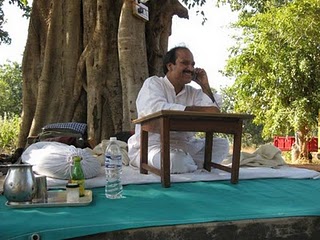
Guest post by SAMEER KHAN: Mr. Chaddha lived in my neighbourhood, a tall lanky elderly gentleman who looked young for his age. I would often see Mr. Chaddha come for a morning walk in our local park, but I stayed aloof, not having an interest in the elderly gentlemen in the park who were either part of laughter clubs or the local residents union. Whenever I managed to struggle out of my bed for my morning exercise I would notice Mr. Chaddha walking ramrod straight like a soldier. He was never generous with his smiles and would simply nod his head whenever I greeted him.
One pleasant winter morning as I passed Mr. Chaddha in the park I was surprised to hear him call my name. I went towards him, and looking at me from his towering height he asked me, “Can you read and write Urdu?” Startled by the question I answered, “Uncle I can read Urdu but I am not too confident of my writing abilities.“
He said, “Well actually I want someone to write a letter for me in Urdu” Continue reading Iqbal Chacha and a Voice from the Past: Sameer Khan
Capitalism, Sexual Violence, and Sexism: Kavita Krishnan
Sexual violence cannot be attributed simply to some men behaving in ‘anti-social’ or ‘inhuman’ ways: it has everything to do with the way society is structured: i.e., the way in which our society organizes production and accordingly structures social relationships. Once we understand this, we can also recognize that society can be structured differently, in ways that do not require – or benefit from – the subordination of women or of any section of society.
What are the material structures that underpin sexual violence? As I address this question I will also engage with some of the arguments made in two recent articles which offer a professedly Marxist analysis of sexual violence and women’s subordination in India; one is ‘On the Empowerment of Women’ by Prabhat Patnaik, People’s Democracy, January 27, 2013, and the other is ‘Class Societies and Sexual Violence: Towards a Marxist Understanding of Rape’, by Maya John, Radical Notes, May 8, 2013. Continue reading Capitalism, Sexual Violence, and Sexism: Kavita Krishnan
Stop the Police Brutality Against Maruti Suzuki Workers: Joint Statement
The following is a joint statement issued by ADR Punjab, PUCL Haryana, PUDR and NTUI against police repression on Maruti Suzuki workers
Kaithal, 19 May 2013: The Haryana Government yet again in a brazen and outright cowardly manner has sought to protect the interest of capital and particularly the management of Maruti Suzuki India Ltd by refusing to allow the victimised workers and their families to undertake a peaceful demonstration planned for today which was expected to draw in ten thousand people from across the state.
A short while ago, police lathicharged a peaceful demonstration of workers families outside the residence of State Industry Minister Randeep Singh Surjewala. Scores have been hurt in the lathicharge and the demonstrators are being arrested.
The Haryana Government, on the eve of this peaceful protest at Kaithal, imposed IPC Section 144 in the town and arrested close to 100 workers and their family members from the dharna site at the Kaithal Mini Secretariat at 11:30 pm last night. Several more were picked up from the entry points to the town including the bus terminus this morning. The workers and their family members have been sitting on an entirely peaceful dharna at the Mini Secretariat from 28 April 2013 demanding release of the 147 workers in Gurgaon Jail and reinstatement of the workers, both permanent and contract, terminated without enquiry following the 18 July incident. Despite the heavy police mobilisation and barricades at entry points of the town, thousands of people from across Haryana have been pouring into the city to gherao the State Industries Minister, Randeep Singh Surjewala at his residence. Wives, mothers and sisters of workers are present in large numbers at this demonstration demanding a just inquiry and an end to the state effort at criminalisation of the workers.
Continue reading Stop the Police Brutality Against Maruti Suzuki Workers: Joint Statement
Letter from Shahbagh: Kalyani Menon-Sen
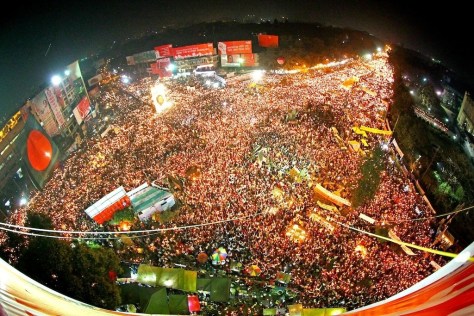
Guest post by KALYANI MENON-SEN: Ever since I came back from Dhaka on 12th April this year, I have been opening my mailbox every morning with a feeling of excitement and anticipation, confident that there will be a mail from Bangladesh with the latest news from Shahbagh. Just brief snippets – a slogan, a comment, a moment captured in a cellphone photo – but they are enough to bring back the feeling of being there, feeling the excitement and the energy, sensing the emergence of a new kind of political space – chaotic and confused, yet alive with radical possibilities.
But last Sunday, 12th May, came a brief one-liner from Habib: “The police have dismantled Projonmo Chottor. Will keep you informed of further developments.” Continue reading Letter from Shahbagh: Kalyani Menon-Sen
Sarabjit, Sanaullah, you and me

I met Sarabjit Singh’s brave lawyer Awais Sheikh in Delhi some months ago, where his book was released. He was very confident Sarabjit wouldn’t be hanged. As was Justice (Retd.) Katju, who launched the book. Justice Katju said there was no point campaigning for Sarabjit’s release until the Pakistan elections were over. I got a similar impression of optimism from people who had been following the Sarabjit case.
Well, they were right. Sarabjit wasn’t hanged. But hanging is only one way of killing. Continue reading Sarabjit, Sanaullah, you and me
Two days in the Srinagar High Court: Shrimoyee Nandini Ghosh
This is a guest post by SHRIMOYEE NANDINI GHOSH
Impressions of the Hearing of the Public Interest Petition on the Mass Rapes at Kunan Poshpora
Day 1: 7th May 2013: I happen to be in Srinagar. I hear through a friend that a Public Interest Petition has been filed by a group of fifty odd Kashmiri women, before the Srinagar Bench of the High Court, asking that the Kunan Poshpora mass rape case be reopened, and re-investigated. It would take a group of very odd women indeed, to ask for something so far fetched. They are students, housewives, teachers, doctors, some of whom were not even born in 1991, when the rape took place on the ‘intervening night’ (as such records always read) of the 23rd and 24th of February during a ‘search and cordon’ operation by personnel of the Indian army.
Continue reading Two days in the Srinagar High Court: Shrimoyee Nandini Ghosh
Sinful liberals and the war against jihadi terror: Manisha Sethi responds to Praveen Swami
Guest post by MANISHA SETHI: It has been seven months since the Jamia Teachers’ Solidarity Association brought out its report, Framed, Damned, Acquitted, chronicling in detail how the Delhi Police’s Special Cell implicated innocents – former militants, police informers, businessmen, and just ordinary, unlucky men – as terrorists. It is one of the few documents that lends evidentiary credence to the widespread sense amongst Muslims that they are being targeted in the war against terror. Apologists for the police and investigative agencies however do not tire of contesting its conclusions, namely that there is a systemic and systematic bias against minorities when it comes to terror investigations. What bias, they ask. As does our chief National Security ‘analyst’ Praveen Swami, who has stressed that “liberals are compromising the war against jihadi terror“.
Could such ‘analysts’ be echoing the sentiments of a judge of the Allahabad High court, who less than two decades after India gained independence, noted, that “in the entire country there is not another criminal force whose misdeeds can come anywhere near the list of crimes of that organised body called the Indian Police force” (All India Reporter, 1964, Vol. 51, 702). Do they mean, that our extraordinarily brutal police force is even-handed in its application of cruelty across the spectrum of our citizenry, and is not especially biased against the Muslims, or Dalits, adivasis and so on?
Gandhi’s fourth monkey: Suvaid Yaseen
Guest post by SUVAID YASEEN: Incredible India is a land of promises. Amnesia and half narratives. Selective remembrance and deliberate forgetting. The national interest is incredibly important. And everything is allowed in this war.
Gandhi’s – the father of the nation – maxim of bura mat kaho, bura mat suno, bura mat dekho (don’t say evil, don’t hear evil, don’t see evil), interestingly forgets to say bura mat karo (don’t do evil). So, you can do it, and forget it. Gandhi should smile. And his monkeys can make merry.
Mohammad Yasin Malik, the Jammu Kashmir Liberation Front commander turned ‘Gandhian leader’ must know this irony very well.
When, in the early nineties, the guns started ringing, Kashmiris were told that they should leave the path of the armed struggle and have a peaceful agitation, and they would be listened to, by India and by the international community. Continue reading Gandhi’s fourth monkey: Suvaid Yaseen
Students vs. SEWA or Dalit Student vs. Dalit Women Workers? Student ‘Politics’ on CDS Campus: Praveena Kodoth, J Devika, Sonia George
There have been reports in the media of an agitation by students of the Centre for Development Studies, Thiruvananthapuram, because a fellow student was asked to leave the hostel to facilitate an investigation of a complaint against him by the Self Employed Women’s Association, which runs the cafeteria on campus. These reports and some exchanges between faculty have been circulated on the web / social media and has led to wider discussion of this event. We consider it imperative to put forward our shared perspective as women activists as well as bring together our views as women faculty members of CDS and co-ordinator of SEWA respectively.
The student was informed in a letter that the action against him was until such time as the investigation was completed. Media reports have portrayed the agitation as having been motivated by the victimization of a Dalit student by the workers of the cafeteria. Also it is being propagated that the student was ‘turned out’ of the campus when the letter from the Director required the student to ‘leave’ the hostel and refrain from using the cafeteria until the investigation was over. Deliberately enough, the action was not to prevent the student from entering the campus. We present here the context in which the student was asked to leave the hostel, the politics of the portrayal of the incident by the students as an infringement of the rights of a Dalit student and the larger implications of their claims, that feminism has been used to victimize students on the basis of caste.
Taking Stock of the new Anti Rape law: Madhu Mehra
This is a guest post by MADHU MEHRA: The Criminal Law (Amendment) Bill, 2013, more popularly called the Anti-rape Bill, is now law. The outrage following the homicidal gang rape in Delhi unleashed events that lent force to the longstanding demand by the women’s movement for comprehensive reform of laws relating to sexual assault. These demands were bolstered by the recommendations of the high level committee, headed by retired Justice Verma, that called for reform of criminal laws, police reforms, prevention and education interventions to effectively tackle impunity for sexual violence. With the new bill passed by the parliament, the law stands substantially changed. This article takes stock of the ways in which the new amendments re-framed sexual offences in the law, their significance and the challenges that remain. While being far from comprehensive, these changes substantially transform the way legal redress for sexual offences have been framed in the law. A few examples below contextulise the significance.
Continue reading Taking Stock of the new Anti Rape law: Madhu Mehra
Let us declare that a state of war exists
“Let us declare that the state of war does exist and shall exist so long as the Indian toiling masses and the natural resources are being exploited by a handful of parasites.” Those are not the words of a member of the Central Committee of the Communist Party of India (Maoist), though the film has that too. These words are of Bhagat Singh, revolutionary freedom fighter who has today been appropriated by everybody for their own purposes.
The most remarkable thing about Sanjay Kak’s new film Red Ant Dream is Punjab. Occupying more than a third of the film, its use of the revolutionary sentiment in today’s Punjab takes forward the debate on the Maoist and other resistance movements in India. Instead of getting into the debates around the Maoist movement in central India, the film makes for a powerful document of the how and why the revolutionary ideal lives in India 2013. Continue reading Let us declare that a state of war exists
Joint statement after the sixth meeting of the India-Pakistan Judicial Committee on Prisoners in Pakistan
This statement was issued yesterday by the JOINT INDIA-PAKISTAN JUDICIAL COMMITTEE ON PRISONERS
May 03, 2013
- Members of the India-Pakistan Judicial Committee on Prisoners visited Pakistani Jails in Karachi, Rawalpindi and Lahore from April 26-May 1, 2013. The members of the Committee, Justice (Retd.) Mr A.S Gill and Justice (Retd) Mr. M.A Khan from the Indian side and Justice (Retd) Abdul Qadir Chaudhry, Justice (Retd.) Mr. Nasir Aslam Zahid and Justice (Retd.) Mian Muhammad Ajmal from Pakistan side visited the Jails.
- A total number of 535 Indian prisoners including 483 fishermen (including 11 juveniles) and 8 civil prisoners, believed to be Indian nationals at District Jail Malir, Karachi, 8 Prisoners, believed to be Indian nationals at Adiyala Jail, Rawalpindi and 36 Prisoners, believed to be Indian nationals at Kot Lakhpat Jail, Lahore were presented before the Committee. Continue reading Joint statement after the sixth meeting of the India-Pakistan Judicial Committee on Prisoners in Pakistan
Evicting the Gandhians: Justin Podur interviews Himanshu Kumar

Himanshu Kumar is a Gandhian activist who, together with his wife, ran the Vanvasi Chetana Ashram in Dantewada, Chhattisgarh for 22 years. He learned the local adivasi language (Gondi) and worked through the Ashram to help adivasis access their rights under the law. Starting in 2005, during the murderous Salwa Judum campaigns of vigilante groups against the adivasis of Bastar in Chhattisgarh, Himanshu worked to try to get villagers back to their homes, get people falsely accused out of jail, and win justice for the victims of police and vigilante crimes. His Ashram was eventually bulldozed and he was forced to move to Delhi, from where he continues to try to follow up with legal cases on the state’s treatment of the adivasis. JUSTIN PODUR interviewed him there in February 2013.
JP: When I first got here, you told me you would probably be in jail shortly. Maybe we should start with that story? Continue reading Evicting the Gandhians: Justin Podur interviews Himanshu Kumar
What Rediff Could Have Done to Support Kavita Krishnan Against Rape Threats: Anja Kovacs
Guest post by ANJA KOVACS: Imagine a TV station inviting a guest and giving the audience the opportunity to freely ask questions, with the guest deciding which questions to respond to. Imagine a member of audience then threatening the guest with rape, and the TV station’s representative responding by simply passing on the microphone to the next person, leaving the guest to fend for herself. Imagine the TV station then also refusing to provide any assistance to the guest following the incident. Outrage would, justifiably, ensue. Last week, Rediff treated a guest in much this way – during a Rediff-organised online public chat.
On 24 April, Kavita Krishnan, Secretary of AIPWA and a leading figure in the anti-rape protests that have been rocking the capital since December 2012, participated in a public chat at the invitation of Rediff. The topic of the chat was the rising incidences of rape and violence against women in the country. During the chat, Krishnan was repeatedly threatened with rape by a participant whose handle read ‘RAPIST’. RAPIST wrote: ‘Kavita tell me where I should come and rape you using condom’. Earlier the same person had made comments such as ‘Kavita tell women not to wear revealing clothes then we will not rape them’, to which Krishnan had in fact responded. All comments by RAPIST were written in capital letters.
Ground Report on the Real Estate Mafia’s Reign of Terror in Noida: Bigul Mazdoor Dasta
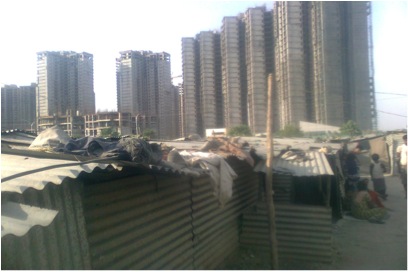
This is a guest post by Bigul Mazdoor Dasta Noida is one among those places which are highlighted as the hub of the ’emerging’ and ‘shining’ India. The glittery shopping malls, world class expressway, flyovers, F1 International circuit, luxury apartments, villas etc. are cited as the symbols of India’s ‘growth story’ and Noida has all of these. For the last couple of decades, the mainstream corporate media has been busy selling this growth story to the emerging urban upper middle class; in the process making them a customer of artificially inflated dreams such as having one’s own luxurious house. But, curiously, the harrowing stories of those whose labour power is responsible for this so called development are conspicuous by their absence in the mainstream media’s narrative. The labourers come into the news only when some untoward incident happens and they are immediately held responsible for any such incidents without carrying out any investigation. One such horrendous incident took place on April, 28 at one of the hundreds of construction sites in Noida in which the security guards of the site opened fire on the labourers and in the process injuring some of them. On the morning of the April 28, the workers of the 3C Lotus Panache company’s constructions site at Noida’s Sector 110 witnessed the naked reign of terror by the company’s management. At the beginning of the morning shift at around 8 a.m., the workers had reached the construction site to join the construction work of the multi-story apartment complex, but they had to stand in a big queue because the security guards at the gate were taking a long time to intensively check each worker and make an entry. When some workers protested against this lax attitude of the guards, saying that they had to listen to the supervisor’s abuses if they were late even by one minute, a heated exchange took place between the security guards and workers and suddenly the guards started firing indiscriminately over the workers. As per the media reports, two workers were injured, but when a team of Bigul Mazdoor Dasta visited the workers settlement adjacent to the construction site, some workers said that the number of the injured workers could be four which includes a child as well and one of the workers is seriously injured and his life is in danger. As per the records of the district hospital in Noida, only one worker was admitted on April 28. Other workers were admitted to some private hospital.

The workers settlement adjacent to the construction site where the incident took place
A Report from the Protests: Kavya Murthy
Guest post by KAVYA MURTHY.
In the middle of the day a few days ago, a group of around ten people held hands and blocked the traffic on the road opposite the police headquarters at ITO, Delhi, protesting and calling for the removal of the Police Commissioner after a young, young child had been raped and the police had done nothing, not file an FIR, nor act.
In this instance, it was not only the brutality of the act that had shaken us up. A young child, five years of age, raped by neighbours, bad enough to hold one’s head in shame – yes. There was outrage. But there was also outrage that a police officer had tried to bribe the family of the girl – with two thousand rupees – to avoid filing an FIR. Then, to add insult to injury, a young woman protester slapped repeatedly by an impatient policeman, an Assistant Commissioner of Police no less, when she tried to get inside the hospital where the child was in a critical condition.
Why were we there, that afternoon outside the Delhi Police Headquarters? What had prompted people to gather at the AIIMS metro station the day the child was shifted there for care, what was being said, who was being addressed? Was it a silent vigil, in hope that this little child does not meet the same fate as the 23 year old woman gang raped just a few months ago? Was it also to say, this is not the first time it is happening after that fateful day on December 16, 2012? 363 rapes already in just around the NCR the last few months, and here we are again, not exactly happy to be standing outside in outrage thinking of a little girl with bottles in her vagina and terrible infections. Continue reading A Report from the Protests: Kavya Murthy
1984: Gauri Gill
This pamphlet, titled 1984, has been released by GAURI GILL
GAURI GILL writes: This pamphlet contains photographs of the ongoing impact of the 1984 anti-Sikh pogrom in New Delhi – taken by me for Tehelka magazine in 2005 (after the release of the Nanavati Commission report) and Outlook magazine in 2009 (to mark the 25th anniversary of the event); in Trilokpuri, Tilak Vihar and Garhi, as well as at protest rallies in the city. The captions that appear below them are as they were inscribed in the media then. Last month, I decided to ask some artist friends, who were living in Delhi at the time, or have since or prior, or see themselves as somehow participants of the city, to write a small comment alongside each photograph. It could be about the image or a more general observation related to the event; it could be abstract, poetic, personal, fictional, factual or nonsensically true in the way that were Toba Tek Singh’s seminal words on the partition. Continue reading 1984: Gauri Gill
On the social fabric in Narendra Modi’s Gujarat: Nilanjan Mukhopadhyay
This is an excerpt from the chapter, ‘The Enemy Within’ in NIIANJAN MUKHOPADHYAY’s book, Narendra Modi: The Man, The Times.

From the label of “Master Divider” in India Today in January 2003 to the tag of “The Great Polariser” in the Outlook in July 2012 — Narendra Modi’s image remained static: self-declared champion of one community of people. But the strain Gujarat faced in the course of his tenure has increased manifold. Wherever I travelled in Gujarat, there was a clear distinction between “us” and “them”. This difference was articulated by several Hindus every time the conversation veered in this direction. In contrast, counterparts among Muslims denied this. The disagreement with the hypothesis stemmed not from a belief and perception that they faced no discrimination but because of a “fear” that accepting such a viewpoint could be interpreted as levelling an allegation that they were being targeted — a risk no Muslim is willing to take after the post-Godhra violence.
Continue reading On the social fabric in Narendra Modi’s Gujarat: Nilanjan Mukhopadhyay
Dismiss the Delhi Police Commissioner
It is surreal watching leaders from Sushil Kumar Shinde to Sushma Swaraj make tough statements, one after another, on television. Statements about taking strong measures, the latter even demanding, as is her wont, death sentence to rapists. I felt like asking, do you even realize what the people are angry about? Do you even know what is at issue here? Who will you hang? Case after case, even after December 16, it is being revealed, suffers from the same problem: the refusal of the police to even register a case! What is the meaning of this high histrionics then, when you do not even have a culprit to punish? I am not even raising the question of the ethics of death penalty because that is a redundant question at the moment. Except for the raving right wingers who – like Sushma Swaraj and Shinde – have to make some song and dance about the issue merely for effect, no one else really believes that at the moment there is any issue other than the criminality of Delhi Police. Continue reading Dismiss the Delhi Police Commissioner
The Bastar Land Grab: An Interview with Sudha Bharadwaj
This intervew with SUDHA BHARADWAJ of Chhattisgarh Mukti Morcha was conducted by JUSTIN PODUR in Raipur on 5 March 2013
JP: As a lawyer and an activist, how do you see the relationship between legal work and activism?
SB: I see myself primarily as a trade unionist. I joined the union movement over twenty years ago, and it was the union that made me a lawyer. They felt that workers needed a good lawyer in their fight with the corporations. Our union is one of contract workers and has been striving to overcome divisions in the working class. Here, workers have a close connection with the peasants. So, we believe that working with the peasants is part of unionism.
When I got to the High Court, I found that all the people’s organizations were in a similar situation. The laws that give you rights are poorly implemented. When you fight, the status quo has many legal weapons, launches malicious litigation, etc. So we have a group of lawyers now (Janhit), and we work on group legal aid, not individual legal aid. The idea is that if you help a group, that can bring about some kind of change, create some space. I’ve also gotten involved with the People’s Union for Civil Liberties (PUCL), for which I am the General Secretary in Chhattisgarh. Continue reading The Bastar Land Grab: An Interview with Sudha Bharadwaj