Category Archives: Violence/Conflict

An Appeal to the Tamil Community and its Civil and Political Representatives

An Appeal Signed by Tamils on the Eviction of Northern Muslims 21 Years Ago

Since the end of the war in May 2009, it has become important for all ethnic communities of Sri Lanka to re-examine and reevaluate their past. It is through this process of self-reflection that some of the major issues that confront state and civil society today can be meaningfully reconceived and reconfigured for the future.

While the war has drawn to a decisive close, the ethnic conflict is far from over and demands solutions short- and long-term. The quest for a viable political solution from a majoritarian state is a primary concern for the Tamil community today. Continued insecurity in the face of militarisation is an urgent matter. Armed militancy and a political culture of violence have further eroded into the democratic fabric of society. Resettlement and rehabilitation remain unresolved problems. Distribution of land, access to state and social networks, language parity, devolution of power, inter-ethnic reconciliation and the continued presence of gender, class and caste stratifications are a part of the political landscape today.

It is in this regard we raise the question of the eviction of the Northern Muslims 21 years ago. In October 1990, the LTTE evicted roughly 80,000 Muslims from the north in the wake of increasing hostilities and armed conflict in the north and east. The LTTE, which was militarily dominant in the north at that time and controlled large swathes of territory, ordered an entire community to leave the province in two days. In the Jaffna peninsula they were given just two hours’ notice. Subsequent to the eviction, several attempts were made by institutional mechanisms to facilitate the return of the communities to their original lands. During the Ceasefire Agreement (CFA), there were renewed attempts, particularly through the Secretariat for Immediate Humanitarian and Rehabilitation Needs (SIHRN), to negotiate the return of the Muslims with the Sri Lankan state and the LTTE.

In the current political landscape, the eviction of Muslims from the north and their return and resettlement pose a distinct political challenge to civil and political societies of the Tamil community. Continue reading An Appeal to the Tamil Community and its Civil and Political Representatives

The inter-connected destinies of strangers across an international border

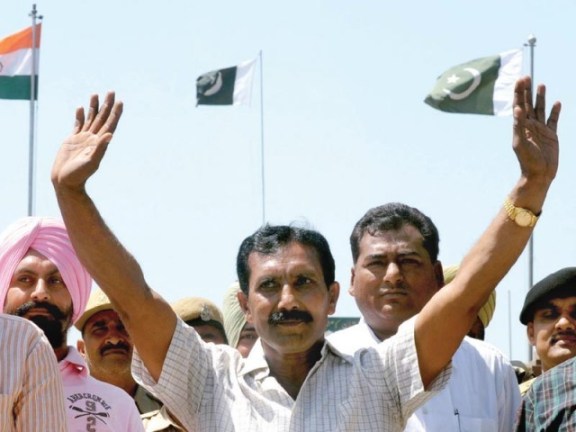
Gopal Das at Wagah border. AFP photo

The central government wants him to do it, the Rajasthan government wants him to do it, but Rajasthan’s acting Governor Shivraj Patil wouldn’t sign on a file for several months now. His obstinacy could become a major hurdle for many Indians and Pakistanis lodged in each others’ prisons.

In an unusual order, the Supreme Court of India quoted William Shakespeare and Faiz Ahmed ‘Faiz’ to directly appeal to the government of Pakistan to pardon and release Indian prisoner Gopal Das. Pakistan President Asif Ali Zardari signed the papers within 16 days, ahead of Prime Minister Yusuf Raza Gilani’s visit to Mohali to witness the cricket world cup semi-final with his Indian counterpart. On 7 April, Gopal Das crossed into India. There were those in Pakistan who had opposed his release, arguing he had a few months left to complete his sentence, and that he should not be shown mercy because he had been found guilty in 1984 by a Pakistani military court on charges of being a an Indian spy. He and his family claimed this was not true, and wanted him pardoned because now 52, he had spent the last 27 years in several Pakistani prisons. Continue reading The inter-connected destinies of strangers across an international border

Human Rights Review – Jammu and Kashmir in 2011: JKCCS

This release comes from the JAMMU AND KASHMIR COALITION OF CIVIL SOCIETY, the Bund, Amira Kadal, Srinagar 190001, (www.jkccs.net)

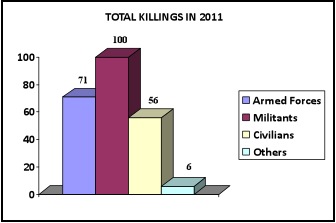
TOTAL KILLINGS

Year 2011 has just passed, and many have declared this year, a peaceful year in Jammu and Kashmir. Of course assertions of peace by various quarters are relative. Enforced silence cannot be construed as peace. Despite the hype of peace, people of Jammu and Kashmir have witnessed unabated violence, human rights abuses, denial of civil and political rights, absence of mechanisms of justice, heightened militarization and surveillance. The figures of violent incidents suggest that 2011 as usual has been the year of loss, victimization, mourning and pain for the people. Continue reading Human Rights Review – Jammu and Kashmir in 2011: JKCCS

A Caste(d) Drive – Paramakudi to Pasumpon: Bobby Kunhu

Guest post by BOBBY KUNHU


Between the occasion of the memorial anniversary of Immanuel Sekharan that falls on 11th September and that of Muthuramalinga Thevar on 30th October are 30 odd road kilometers, 49 days, incalculable castiesm and this year (2011) 7 more Dalit lives. Almost the entire Big Media portrayed the 11th September, 2011 murders at Paramakudi as retaliatory State violence to an unruly and violent mob – to the convenient delight to the defenders of the State administration. Dissenting voices mostly Dalit – located the violence squarely where it belongs – in caste. In his note “Paramakudi Violence: Against Dalits, Against Politics”, inthe November 5th, 2011 issue of the Economic and Political Weekly, Muthukaruppan Parthasarathi clearly outlines the historical and current context in which the this year’s spate of violence that claimed 7 lives happened!

Continue reading A Caste(d) Drive – Paramakudi to Pasumpon: Bobby Kunhu

When the Wandering Falcon came to Delhi: Pragya Tiwari

Guest post by PRAGYA TIWARI

Nilanjana Roy moderating the prize ceremony; Jamil Ahmad in the background via Skype. Photo courtesy: The Shakti Bhatt Foundation

There is this world among the many worlds of Delhi, the world of book events. You show up for a reading followed by a conversation between the author and some other prominent member of the fraternity. Afterwards you drink wine and exchange news with everyone you know there. And you know everyone there. The scale of some of these events would make you think books actually sell. But the greater riddle for those of us who show up is this: Why do we show up? To see friends, to socialise and occasionally to celebrate books, or perhaps the very existence of books irrespective of quality; to register our support for words and stories bound by charming jackets; to toast these objects of desire in a simulated bubble where they shine on undeterred. Debatable as their meaning might be, for most part these events are mere rituals. On the 21st of December, however, for a brief moment I was made to see that they could be more than that. The man who made that apparent was not even physically present in the room. Continue reading When the Wandering Falcon came to Delhi: Pragya Tiwari

J&K government has buried the SHRC report on unmarked graves in Kashmir: APDP

This release comes from the ASSOCIATION OF PARENTS OF DISAPPEARED PERSONS,  the Bund Amira Kadal, Srinagar, Jammu and Kashmir

28 December 2011: Callousness of the government continues vis-à-vis victims of human rights abuses and in particular against the family members of those who have disappeared in the last two decades in Jammu and Kashmir. The relatives of more than 8000 persons continue to wait for the government to probe all the cases of disappearances, deliver justice to the families of the disappeared and punish the perpetrators. Continue reading J&K government has buried the SHRC report on unmarked graves in Kashmir: APDP

Z for Zalim: Semiotics and the Occupation of Kashmir

Ours was the marsh country, down by the river, within, as the river wound, twenty miles of the sea. My first most vivid and broad impression of the identity of things, seems to me to have been gained on a memorable raw afternoon towards evening. At such a time I found out for certain, that this bleak place overgrown with nettles was the churchyard; and that Philip Pirrip, late of this parish, and also Georgiana wife of the above, were dead and buried; and that Alexander, Bartholomew, Abraham, Tobias, and Roger, infant children of the aforesaid, were also dead and buried; and that the dark flat wilderness beyond the churchyard, intersected with dykes and mounds and gates, with scattered cattle feeding on it, was the marshes; and that the low leaden line beyond, was the river; and that the distant savage lair from which the wind was rushing, was the sea; and that the small bundle of shivers growing afraid of it all and beginning to cry, was Pip. – Charles Dickens, Great Expectations

A for Apple and Z for Zebra. Children are taught the alphabet with the help of images. And the association of images with sound. It helps them associate the sound of A with the sound of Apple, and associate that in turn with the image of an apple. The alphabet book depends on images that may be familiar to children. The word Apple is a signifier, and the apple itself is the signified. This is, most simply, what semiotics or the study of signs and sign processes.

In a future world, if there are no zebras, alphabet books may have to replace the last entry with something else. What could it be? Zebra crossing? Zimbabwe?

Last week, the Jammu and Kashmir Police registered a case of sedition, defamation and criminal conspiracy against six officials of BoSE, the government’s very own Board of School Education, for this:
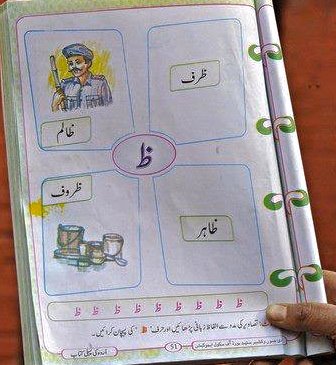
This is a page from a book called Baharistaan-e-Urdu. This attempt to teach Kashmiri children the Urdu alphabet (note to self: this is what I need to learn Nastaliq!) makes them say, “Zoi se Zalim,” Z for Zalim, meaning cruel. That is only one of four examples. The other two are: zaroof (utensils), zahir (visible) and zarf (ornamental cup holder).

Continue reading Z for Zalim: Semiotics and the Occupation of Kashmir

Merry Christmas, Rev. Khanna: Thinking about Freedom and Intolerance in Kashmir

I want to begin writing this by wishing a very happy Christmas to Reverend C.M. Khanna, a Protestant presbyter in the All Saint’s Church, Srinagar, Indian held Jammu & Kashmir, who has been facing a situation that no free man should ever have to countenance. He has had to face an arrest (though, thankfully now he is out on bail) and social ostracism for doing nothing that can be construed as criminal or harmful to any individual or society at large. I write this in solidarity with him and his family, and with all those who have been harassed for their faith, or for their lack of faith, anywhere.

(Please follow this link for a comprehensive report on Rev. Khanna’s situation, in the form of a press note submitted by John Dayal)

I know that many people in Kashmir continue to be in prison for reasons of conscience, because they want to be free of the occupation. And this Christmas, my greetings are to them and to their families too. I know that Reverend Khanna is out on bail now, and that many others are not. And I hope that they too will see freedom soon. I am writing about Reverend Khanna not because I value his freedom more than that of others incarcerated in Kashmir, but because if we value freedom, we should not have to measure its value, or calculate its worth depending on who happens to get bail, and who happens to rot in jail. Continue reading Merry Christmas, Rev. Khanna: Thinking about Freedom and Intolerance in Kashmir

Three Years After 26/11: Raza Rumi

Guest post by RAZA RUMI

As a Pakistani it is difficult for me to talk about the ghastly attacks on Mumbai three years ago and the response of its vibrant citizens. This is not simply due to the nationality of Ajmal Kasab, the lone terrorist captured after the 26/11 Mumbai terror attacks. What happened in Mumbai was a sad reminder of how easy it has become for a handful of militants to wreak havoc, to hold an entire city hostage and undermine humanity. A vast majority of Pakistanis felt the pain and condemned the Mumbai attacks; targeting innocent civilians is heinous and unacceptable.

The Mumbai attacks changed the atmosphere created by President Asif Ali Zardari’s unprecedented offers of peace and cooperation. A few weeks before the carnage in Mumbai, Mr Zardari made historic remarks in a conclave organised by an Indian newspaper, which represented a consensus within Pakistan’s political class: “I do not feel threatened by India and India should not feel threatened from us… today we have a Parliament which is already pre-agreed upon a friendly relationship with India. In spite of our disputes, we have a great future together.” Mr Zardari also declared that Pakistan will not be the first country to use its nuclear weapons, thus altering a carefully constructed Pakistani nuclear doctrine of first-use. Continue reading Three Years After 26/11: Raza Rumi

Shahid in Srinagar: Arif Ayaz Parrey

Guest post by ARIF AYAZ PARREY

Photo by Muhabit-ul-Haq / TheKashmirWalla.com

I must go back briefly to a place I have loved
to tell you those you will efface I have loved [i]

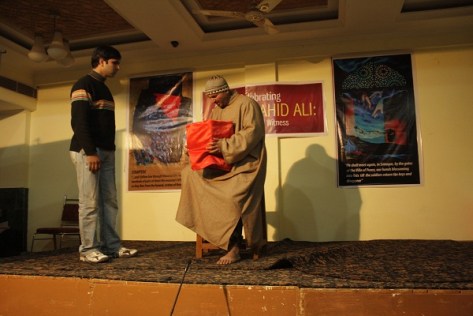
Exactly ten years after he left us, Aga Shahid Ali returned to his Kashmir. A couple of days earlier, many parts of the valley were blessed with the season’s first snowfall, signalling an end to Harud, the autumn season in Kashmir, and ushering in Wande, the winter. The sky over Srinagar was overcast too, as it has been for the past few days, maybe because this year Moharram has been particularly demanding, with mourners not being allowed to mourn because “the processions might be used by separatists to whip up anti-India sentiments”. The reason for the ban is announced from the same bureaucratic offices which, during the summer, employ the entire state machinery to ensure that people from the plains can climb up the mountains into a cave where Amarnath wants to spend some private time with Parvati so that he can explain to her the mysteries of immortality (Which must include, one would like to presume, the secrets of the longevity of a fragile mountain ecology.) Some like to define this variance in state policy and practice as “secularism”. The connection between the tyranny of Karbala and the present-day Kashmir is firmly established, once again. Continue reading Shahid in Srinagar: Arif Ayaz Parrey

Parveena Ahangar rejects CNN-IBN’s nomination for ‘Indian of the Year 2011’

This press release has been issued by the PARVEENA AHANGAR-led ASSOCIATION OF PARENTS FOR DISAPPEARED PERSONS

Srinagar, December 10, 2011:  On this ‘International Human Rights Day’, December 10, 2011, the APDP (Association of Parents of Disappeared Persons), Srinagar, wishes to state that there is something obscene and perverse in the manner the CNN-IBN has nominated our organization for the ‘Indian of the Year 2011’ award. Sometimes, human rights can be violated by merely mocking those who struggle for human rights. Continue reading Parveena Ahangar rejects CNN-IBN’s nomination for ‘Indian of the Year 2011’

Nationwide opposition to the government’s refusal to a peaceful fast in support of Irom Sharmila: NAPM

Press release issued today by the NATIONAL ALLIANCE FOR PEOPLE’S MOVEMENTS

New Delhi, December 10 : For some months now, Save Sharmila Solidarity Campaign (SSSC) has been spreading the word about Irom Sharmila and her struggle across the nation and beyond.

Started only by few organizations, campaign has now received support over more than 80 organizations and movements and thousands of supporters. Campaign has reached in almost every state of India and even outside. Campaign has organized various programs including its famous Nationwide Signature Campaign, Sri Nagar- Imphal Save Sharmila Jan Karwan in October and Ahemdabad- Srinagar Jattha in November this year. Continue reading Nationwide opposition to the government’s refusal to a peaceful fast in support of Irom Sharmila: NAPM

Jagdish Tytler will not attend the Maulana Mohd. Ali Jauhar Award ceremony

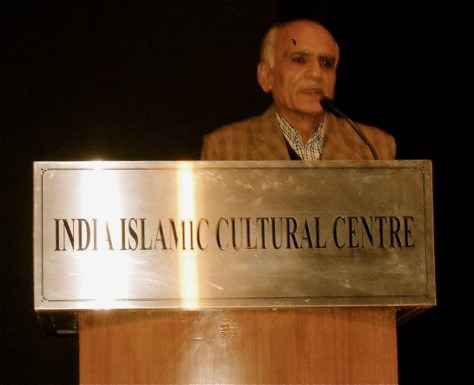
M. Saleem addressing the Maulana Jauhar Award ceremony at IICC in Delhi on 10 December 2011

Update on 11 December:

Twocircles.net reports:

“Zafar Agha was replaced by ex-MP and senior Journalist Santosh Bharatiya. However, M Saleem claimed that Sanjeev Bhatt could not attend the programme due to time constraint and the award may be given to him some other time. While referring to Santosh Bhartiya, being awarded in place of Zafar Agha, M. Saleem said that he has been nominated for the award and nobody has been replaced for the same. The organizer kept totally mum about both Zafar Agha and Jagdish Tytler. ” [Link]

*

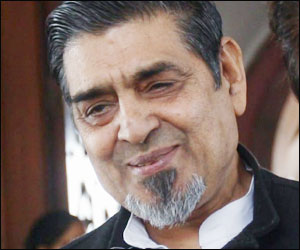
On 3 December, an open letter signed by some of us, and posted here on Kafila, had appealed to seven distinguished individuals to not accept the Maulana Mohd. Ali Johar Award, to be given on 10 December at the India Islamic Cultural Centre. We had reasoned that since the eighth awardee was Jagdish Tytler, they should not share an award and a platform with someone accused of organising mass murder of Sikhs in Delhi in 1984.

Yesterday evening, the general secretary of the Maulana Jauhar Academy, M. Saleem, emailed one of the signatories, Mahtab Alam. The email contained a scanned copy of a letter sent by Jagdish Tytler to M Saleem, which said that Tytler would not attend the award ceremony so as to not embarrass the the other awardees and the organisers, because of this boycott campaign. He, however, stressed on his innocence in the 1984 anti-Sikh pogrom, and, notably, did not say that he would not accept the award. He would only not attend the ceremony. M. Saleem has also not announced whether he is withdrawing his decision to give the award to Mr Tytler. For more details on what has transpired in the last few days, please see Mahtab Alam’s article, Beware of the Sarkari Musalmaan.

Given below is the final list of 150 names who signed the original appeal.  Continue reading Jagdish Tytler will not attend the Maulana Mohd. Ali Jauhar Award ceremony

Harvard does the right thing: drops Subramanian Swamy

The Harvard Crimson reports:

Faculty members chose to remove two summer economics courses at the Summer School taught by Subramanian Swamy, a controversial Indian political figure. Over the summer, Swamy published an op-ed that advocated for the destruction of hundreds of Indian mosques and the disenfranchisement of non-Hindus in India.

Chief Information Officer for the University Anne H. Margulies concluded the meeting by updating faculty on the newly-created Harvard University Information Technology system and its future vision, which included greater collaboration with the library and further digital pedagogy. [Link]

Although DNA never apologised for publishing “How to wipe out Islamic terror,” Swamy’s hate-filled column, (and Kapil Sibal thinks Facebook will cause riots), Harvard University has done the right thing. Continue reading Harvard does the right thing: drops Subramanian Swamy

Transnational Torture by Jinee Lokaneeta reviewed with Prachi Patankar

There are few books as exhilarating as one by a comrade that is intellectually engaging and speaks to the current context. I was invited by 3rd i NY to a Conversation titled ‘Torturing Democracies: Past and Present’, where Jinee and I discussed her new book at Alwan for the Arts. The conversation came to life with the audience which included many of our comrades from the South Asia Solidarity Initiative (SASI) including Prachi. After that wonderful conversation, Prachi and I decided to delve further into the book and write a review. This was an exercise very different from what we normally engage with in SASI around our solidarity campaigns, but it was also a wonderful way to see another side of Jinee. That is the theoretically rich research of someone whom we relied on as a solid activist. I feel we should be doing more of reading, writing about and debating the work of our activist friends. A shorter version of this review has been published by Himal. Perhaps some of the themes in the book can be debated here with this longer review. Continue reading Transnational Torture by Jinee Lokaneeta reviewed with Prachi Patankar

An appeal to seven distinguished individuals to decline the Maulana Mohd Ali Jauhar Award

You can add your name to this appeal in the comments section.

Delhi, 3 December 2011

According to a news report in the Milli Gazette of 1 December 2011, Jagdish Tytler, an accused in the anti-Sikh pogrom of 1984, will be awarded the Maulana Mohd Ali Jauhar Award on 10 December 2011 at the India Islamic Cultural Centre, New Delhi. Seven others will share this award. The undersigned appeal to the other seven awardees to not accept the award as a mark of protest against honouring Mr Tytler, whose contribution in the 1984 anti-Sikh pogrom has been recorded by several fact-finding reports, including those by PUCL and PUDR.

The seven names are:

Continue reading An appeal to seven distinguished individuals to decline the Maulana Mohd Ali Jauhar Award

An open letter from a photojournalist assaulted by Indian security forces in Kashmir: Yawar Kabli

Guest post by YAWAR KABLI

AP photo by Yasin Dar: Local Kashmiri photographers Yawar Nazir, left, and Showket Shafi wait for treatment after they said they were assaulted by police and paramilitary forces during a protest in Srinagar, India, on Nov. 25. At least four journalists said they were assaulted by police and paramilitary forces Friday as they covered a protest in Indian-controlled Kashmir.

All freedoms enshrined in the Constitution of India are being violated or altogether thrown away by the Jammu and Kashmir Police. One could substantiate that with any number of examples. We were not the first pressmen to be thrashed by the police while covering the stone-hurling protests in the Kashmir. On Friday, 25 November 2011, without any rhyme or reason policemen along with the Central Reserve Police Force (CRPF) thrashed four of us, including me, and snatched away our expensive cameras. They did not even hesitate to bundle us into police vehicles while taking us to the Khanyar police station.

Continue reading An open letter from a photojournalist assaulted by Indian security forces in Kashmir: Yawar Kabli

Uthao, uthao video ab, won’t you make the video now?

This photograph shows photojournalist Shahid Tantray being assaulted by the Central Reserve Police Force in Srinagar on 25 November 2011

No tears will be shed for press freedom for attacks on journalists in Srinagar by the Central Reserve Police Force and the Jammu and Kashmir Police. Fahad Shah reports what happened in Srinagar yesterday:

Journalists were beaten up and one of them detained, today, when they were covering the post-Friday prayers protests in the Old City, here at Srinagar. Umar Mehraj, who works as video journalist for Associated Press says he, along with other journalists, was covering protests when Central Reserve Police Force (CRPF) and local policemen start beating. He said while beating, the forces were shouting, “Uthao, uthao video ab (Shoot, shoot the video now.).” Umar says his camera was broken and they were abused too.

Continue reading Uthao, uthao video ab, won’t you make the video now?

Egypt, Revolution 2.0: Alia Allana reports from Tahrir Square

This guest post by ALIA ALLANA is a despatch from Cairo for Kafila, the ninth in a series of ground reports from the Arab Spring. Photographs by Alia Allana

This slideshow requires JavaScript.

The police lobbed another tear gas canister and soon the feeling of suffocation would take over. But he didn’t move, instead he stood in the center; he continued to wave the Egyptian flag. The sound of rubber bullets being fired drowned under the sound of the drum. The drum was the harbinger of doom: when it was sounded by protestors, when the cacophony cut through the air, the message was simple – run, run as fast as you can because the police would begin their attack, again.

Continue reading Egypt, Revolution 2.0: Alia Allana reports from Tahrir Square

JTSA welcomes the SIT report on Ishrat Jahan, demands free and fair probe into Batla House ‘Encounter’

This release comes from the JAMIA TEACHERS’ SOLIDARITY ASSOCIATION

21 November 2011 

JTSA welcomes the SIT report which has concluded that the teenaged college girl Ishrat Jahan and her three companions were killed in cold blood—and were not terrorists on way to kill Narendra Modi. This has reinforced the findings of the Tamang Enquiry Report which had drawn similar conclusions in 2009, and which the Gujarat government had tried to suppress and discredit.  The SIT report has given credence to the allegation of civil rights activists that the officers in Gujarat police had executed several people through the last decade in collusion with the highest political authority in the state. The police officers gained medals and promotions and Modi built his image as the Hindutva hero by highlighting the alleged assassination attempts on him. Continue reading JTSA welcomes the SIT report on Ishrat Jahan, demands free and fair probe into Batla House ‘Encounter’

An account of deadly clashes in Tahrir Square: Alia Allana

This guest post by ALIA ALLANA is a despatch for Kafila from Cairo, the eighth in a series of ground reports from the Arab Spring. Videos and photos by Alia Allana

This slideshow requires JavaScript.

A peaceful protest with men selling candyfloss and making chai turned into an orgy of violence.

Tahrir Square had been quiet for the earlier part of the day today. The Sunday afternoon saw couples strolling, a mother carried her sleeping child, his face was buried in her bosom, scooters with loud speakers blared music.  There was no chanting and very few slogans. Small and sporadic groups of people protested. They called for change.

Continue reading An account of deadly clashes in Tahrir Square: Alia Allana