Appeal to Stay the Execution of Surinder Koli: Concerned Women, Individuals and Groups

Guest Post by Concerned Women, Womens’ Groups and Others against the Death Penalty Awarded to Surinder Koli

To,

The President of India

Rashtrapati Bhavan, New Delhi, India.

2 December 2014

Subject:  Execution of Surinder Koli Would be a Travesty of Justice:
Plea for Mercy from Women’s Groups, Lawyers, Academics, Students and Activists

As women who have been engaged in the struggles for women’s rights and justice, (and their allies) we appeal to you to commute Koli’s death sentence or at least to stay his execution till the completion of the other cases involving other Nithari victims in which he is an accused. 

Continue reading Appeal to Stay the Execution of Surinder Koli: Concerned Women, Individuals and Groups

Days and Nights in Manesar – Reflecting on the ASTI Workers’ Struggle: Anshita & Arya

Guest Post by Anshita & Arya (Krantikari Naujawan Sabha)

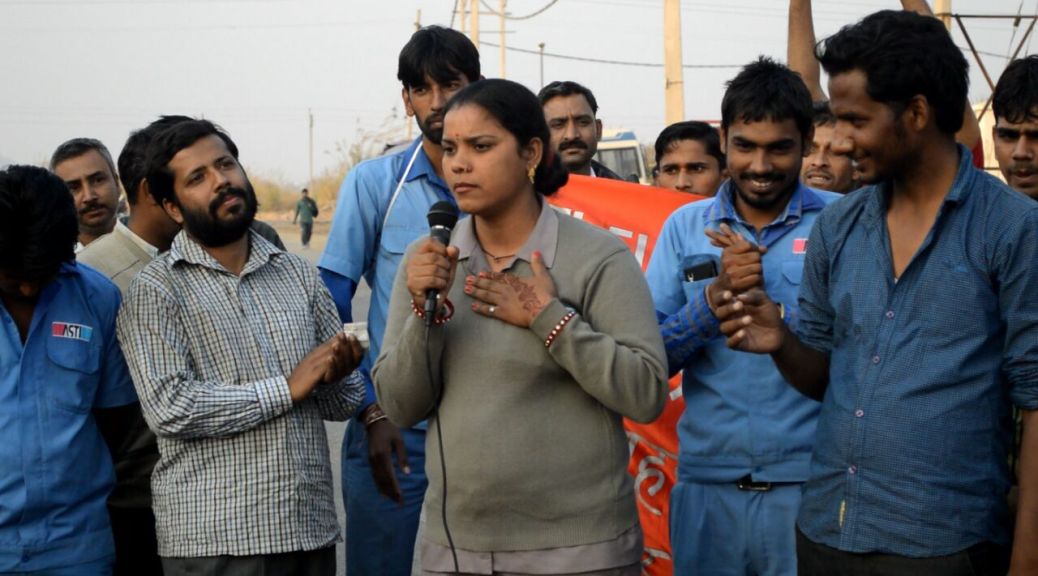
All 310 contract workers in ASTI Electronics factory in IMT Manesar in Gurgaon, Haryana have been on dharna since 3rd November 2014 after they were laid-off on 1st November 2014 citing low work demand. Seven of them are on fast-unto-death from 24th November, while ten workers and pro-worker activists each everyday sit on relay hunger strike.

 In a context where contract workers, increasing exponentially as a demand of the capitalists gleefully forced down by the government through labour law reforms, are finding it ever harder to organize/unite and sustain spontaneous outburts of discontent, due to the precarious nature of their life and work conditions, workers at ASTI Electronics (as a continuation of the 60-70 strikes in various factories in the industrial belt of Gurgaon-Manesar-Dharuhera-Bawal in the last few months) are fighting back and keeping the flame of new emergent struggles alive.

These workers are raising important questions on contractualisation and informalisation within the organized sector which even Central Trade Unions have constantly avoided. Over 250 of these 310 workers are women whose militancy in struggle and leadership is redefining the overall struggle and changing the gender relations within the workers movement.

This struggle for work-livelihood-life is unmasking the heart of the developmental model on DMIC (see current projects in makeinindia.com) which Mr Modi under the supervision of the capitalist class is proposing as the solution to all ills before so-called ‘progress of the country.What follows is a short reflection from the factory gate on the ongoing struggle. Continue reading Days and Nights in Manesar – Reflecting on the ASTI Workers’ Struggle: Anshita & Arya

അഴിക്കാനും ആടാനും തുനിഞ്ഞിറങ്ങിയവർ തന്നെ നാം : തെരുവിൽചുംബനസമരക്കാർക്ക് ഒരു സന്ദേശം

സുഹൃത്തുക്കളെ,


കിസ് ഒഫ് ലൌ സമരങ്ങളുടെ രാഷ്ട്രീയത്തെക്കുറിച്ച് പലതരം ആശങ്കകൾ കേട്ടുതുടങ്ങിയിരിക്കുന്നു.

അത് ആഗോളീകരണ അഴിഞ്ഞാട്ടമാണെന്നും,

അതല്ല, മദ്ധ്യവർഗ്ഗ സന്തതികളുടെ എടുത്തുചാട്ടമാണെന്നും,

അതുമല്ല, അതിനു രാഷ്ട്രീയമേ ഇല്ലെന്നു വരെയും, കേരളത്തിലെ ബദൽരാഷ്ട്രീയങ്ങളിലെ പ്രമുഖവ്യക്തിത്വങ്ങൾ അടക്കമുള്ള പലരും മുറുമുറുക്കുന്നു.

Continue reading അഴിക്കാനും ആടാനും തുനിഞ്ഞിറങ്ങിയവർ തന്നെ നാം : തെരുവിൽചുംബനസമരക്കാർക്ക് ഒരു സന്ദേശം

3 lakh bogus voters found in Modi’s Varanasi seat?

It appears that the Election Commission has so far traced 3,11,057 fake voters who cast their votes in Varanasi in the Lok Sabha election earlier this year. The district administration is expecting the number of fake voters to reach around 6,47,085 by the end of the examination process.

Remember – Narendra Modi ‘won’ this seat by 3 lakh 71 thousand 784 votes.

This news was first reported in Navbharat Times on November 25, 2014:

जिस वाराणासी संसदीय सीट से नरेंद्र मोदी ने 371784 वोटों से जीत हासिल की है, वहां 311057 फर्जी वोटर मिले हैं। अभी गिनती जारी है और जिला प्रशासन का अनुमान है कि फर्जी वोटरों की संख्या 647085 जा सकती है। इतनी बड़ी संख्या में फर्जी वोटर पहली बार वाराणसी में सामने आए हैं। लाखों की तादाद में मिले फर्जी वोटरों का खुलासा तब हुआ जब भारत निर्वाचन आयोग के निर्देश पर जिला प्रशासन ने मतदाता सूची का पुनरीक्षण अभियान शुरू किया। जिले के सभी पोलिंग सेंटर पर तैनात बूथ लेवल ऑफिसर से घर-घर जाकर मतदाताओं का सत्यापन करवाने के बाद इन बोगस वोटरों का खुलासा हुआ है।

Aaj Tak reported it on November 26, 2014:

प्रधानमंत्री नरेंद्र मोदी और उनकी पार्टी बीजेपी के लिए मुश्किलें बढ़ाने वाली खबर है. खबरों के मुताबिक, नरेंद्र मोदी के संसदीय क्षेत्र वाराणसी में 3 लाख 11 हजार 57 फर्जी वोटर मिले हैं. याद रहे कि यहां मोदी ने 3,71,784 वोटों से आम आदमी पार्टी के अरविंद केजरीवाल को हराया था.

बताया जा रहा है कि फर्जी वोटरों की गिनती अभी जारी है और जिला प्रशासन का अनुमान है कि फर्जी वोटरों की संख्या 6 लाख 47 हजार से ज्यादा जा सकती है. इतनी बड़ी संख्या में फर्जी वोटर वाराणसी में पहली बार सामने आए हैं. ये वे लोग हैं जिन्होंने दो या उससे ज्यादा विधानसभा क्षेत्र की मतदाता सूची में अपना नाम लिखवा रखा है. इसी के साथ सोशल मीडिया पर AAP समर्थक नरेंद्र मोदी पर फर्जी मतों से जीत हासिल करने का आरोप लगाने लगे हैं. गौरतलब है कि आम आदमी पार्टी पहले भी बीजेपी पर फर्जी वोट डलवाने का आरोप लगाती रही है.

According to Shubhanshu Sharma:
If we go by district administration’s claims, they are expecting to find around 1,12,160 bogus voters in Pindra, 1,01,456 in Ajgara, 87,140 in Shivpur, 84,757 in Rohania, 65,989 in Cantt, and 90,942 in Sewapuri regions. 
Kohram News had claimed soon after results were declared in May 2014 that the calculation of votes in the Varanasi seat was anomalous:
Kohram News had also publicized the news of the EVM found in the home of Ankit Gaurav Srivastava, an engineer in Varanasi, the night before the elections.  This news had circulated widely, including on Kafila.
If this is true, what next? As I understand it, according to Article 329 of the Constituion of India, for an election to be set aside, an election petition must be presented “to such authority and in such manner as may be provided for by or under any law made by the appropriate Legislature.”

The Election Commission later recommended that trial of election petitions should be entrusted to the High Courts instead of election tribunals. Parliament thus enacted Section 80-A of the Representation of the People Act, 1951 providing that the High Court shall be the authority for presentment of election petitions under Article 329 (b) of the Constitution. This was incorporated by an amendment in the year 1966 (Act 47 of 1966).

The last time the election of a sitting Prime Minister was set aside for corrupt electoral practices, on June 12, 1975, Indira Gandhi (for it was she), declared a state of emergency.

We can expect no less from a Prime Minister who watches benignly over the continuous and growing humiliation of minorities and murderous attacks  on them; and who carefully supervises the wholesale handing over of the country to the biggest and most corrupt corporate bidders.

There is a lot at stake for Modi and his corporate bosses. And now they have the full backing of state power.

Nevertheless, if the news of bogus voters in Varanasi is true, Modi’s election should be set aside through due process.

The deadly land policies planned by Modi’s advisers and the links to Ukraine and Honduras: Aditya Velivelli

This is a guest post by ADITYA VELIVELLI

One year after the Land Acquisition Act was passed in Parliament with bipartisan support, commerce minister Nirmala Sitharaman stated that changes will be made to the Act during the upcoming Winter Session of Parliament.

The earliest indication that this would happen, came from of all people, a first-time MP and microfinance lobbyist Jayant Sinha. Sinha had mentioned in a CNBC interview right after BJP’s win that land acquisition policy was the first priority. For those wondering why CNBC interviewed Sinha and allowed Sinha to lay out the new Government’s priorities, and why Sinha has been appointed junior finance minister, they should refer – Who is guiding Modi’s economic thinking and what is their background? Continue reading The deadly land policies planned by Modi’s advisers and the links to Ukraine and Honduras: Aditya Velivelli

‘Law of the land’ on Kissing in Public: Sanjay Palshikar

SANJAY PALSHIKAR, Professor, Political Science department, University of Hyderabad, clarifies the ‘law of the land’ on kissing in public, to the Committee set up by the Vice-Chancellor to ‘look into the matter of the incident of November 2, 2014.’

Respected Members,

At the centre of the incidents of November 2, 2014, is the alleged act by some students to display demonstratively mutual affection in the form of kissing. Without going into the factual correctness of the charge, let me share with you what I have learnt from legal scholars and activists. I do so in the hope that this will help the Committee “ascertain” “the position of the law of the land” regarding kissing in public.

  1. Indian judiciary at the higher levels has not universally treated kissing in public as illegal. In appropriate context, spelt out variously by the relevant judgments, it has been seen as an expression of love, expression of love and compassion, and its artistic representation as defensible. Absent in all theses cases is the tendency to presume that every kiss is an act of sexual expression and that indulging in this act in public is always obscene. (A & B vs State Thr. N.C.T. of Delhi 2009; Friday vs K.J. Sebastian 2001).
  1. The Supreme Court has observed that the Indian Penal Code “does not define the word obscene and this delicate task has to be performed by courts….” If the Apex Court considers it a delicate task, how much more challenging it would be for university teachers and police officers to say if an act is obscene! (Udeshi vs State of Maharashtra 1965).

Continue reading ‘Law of the land’ on Kissing in Public: Sanjay Palshikar

Statement by Forum for Democratic Rights in EFLU on the present state of affairs

We, concerned citizens and members of women’s organizations, civil rights, students and minority rights forums, have come together to form the “Forum for Democratic Rights in EFL University” to  demand an immediate and thorough enquiry into the incident of gang rape and the suppression of democratic rights in EFL University. We wish to bring the following matter to your notice.

A recent horrific incident of the gang rape of a girl student took place in the EFLU men’s (Basheer) hostel on the night of 31st October 2014. The victim contacted the University authorities and was directed to the police who then arrested two accused on 2nd November 2014.  While this case of sexual assault on the university campus has deeply shocked the campus community, students, faculty and staff, even more shocking and worrying has been the attitude adopted by the university administration in its aftermath. Instead of seeking to undertake measures to make the campus free of violence and assault and promoting gender-sensitivity, the administration has resorted to several measures that are nothing short of severe repression of all democratic rights of the campus community as a whole.

Immediately after the incident, there were some reports with speculations about the victim’s presence in the men’s hostel. Aided by selective leaks by the University and the police, these reports amounted to character assassination and victim blaming, and divulged crucial information regarding the complainant’s identity. This pernicious reasoning amounts to nothing but a justification of the crime. From the well-known case of Rameeza Bee to the recent Nirbhaya Act, it has been repeatedly asserted that the act of sexual assault or gang rape cannot be justified citing the previous history of the victim.  We strongly condemn the propaganda to malign the victim and underplay the gravity of the rape. The complainant must be provided with adequate and competent legal counsel, her psychological and emotional well-being must be taken care of, and her safety must be ensured.   Continue reading Statement by Forum for Democratic Rights in EFLU on the present state of affairs

‘Sant Rampal’ – Farmer’s Son Challenges Hegemony of Arya Samaj, RSS Ally In Haryana : Jaspal Singh Sidhu

Jaspal Singh Sidhu looks at the genesis of Sant Rampal and ‘Satlok Ashram’ the religious centre he established.

The arrest of former public servant -turned-godman 63-year-old Rampal from his Barwala (Hissar) ashram seems to have ended the two-week long much publicized drama enacted by the Haryana police, but it has, rather, widened social and religious gulf among the people of the area . The police operation took life of five women and a child, injuring of many others including two dozen media persons covering the event. Technically, Rampal’s arrest was sought by the Punjab and Haryana high court in a case of ‘criminal contempt of court’ following his persistent in refusal to appear before the court.

The Barwala event signals much more than what one gathers from the media. Rampal’s abortive defiance appears to be (consciously or unconsciously) challenging the hegemony of the Sangh Privar ideology based on Aryans and non- Aryans divide which uses the Vedic literature as manifestation of the Aryan race. The media story, invariably, only covers the present happenings. And, it is meant for the consumption of general public only interested in the day-to-day developments. For obvious reasons, such reporting suits both the government of the day and the media outlets. By and large, the media (newspapers and TV channels) reels out largely that information (official version) which police and official machinery serves them with punctuation of a little-bit material on the root cause of the controversy which has climaxed to the dramatic custody of Rampal by the police.

Read the rest of the article here.

We, or our Nationhood, Redefined.

A couple of weeks ago, filmmaker Anand Patwardhan was invited by the Editors’ Guild to deliver its annual lecture. Patwardhan’s speech, titled We or our Nationhood Redefined, was marked by his characteristically cool tone, systematically reassembling facts that have a tricky habit of leaking from national memory. Facts like the twentieth century’s worst genocidal dictator Adolf Hitler and his programme of racial cleansing has a respectable and massive following in India in the form of the Rashtriya Swayamsewak Sangh. That the RSS has at least 50,000 branches across the country with over 40 million members, and runs a network of 18,000 schools across India. That one such child, recruited from the age of 8 from a relatively poor family, is Prime Minister Modi; and another is Party Chief Amit Shah. That just before the recent reshuffle, 5 Chief Ministers and 17 of the 23 Cabinet-level senior ministers were current or former RSS members. That the assassins of Gandhi are really the RSS, not the lone lunatic Godse who merely carried out what others dreamed about. That RSS’s poisonous communal agenda was roundly condemned by Sardar Patel, of whom PM Modi has promised to build the world’s tallest statue. Or more obscure but equally revealing facts, like the letter written by RSS chief Balasaheb Deoras from jail during Emergency, praising Indira Gandhi and especially her programme of sterilisation of Muslims. And those truly mind-boggling-in-their-irony facts, like the widespread involvement of the RSS in the 1984 anti-Sikh pogrom, when the BJP cynically says “1984” every time somebody says “2002”.

On a day when the Nanavati Commission has termed the 2002 anti-Muslim pogrom in Gujarat as a purely communal reaction to Godhra, and cleared then Chief Minister Modi’s government of any wrongdoing, or even inaction, it is critical we re-read Patwardhan’s speech, to remind ourselves exactly what we are up against if we believe in a non-communal, non-divided, heterogenous India. As Patwardhan put it, given the history of the RSS in this subcontinent, if a Modi didn’t exist, he would have to be invented. Read more.

The end of an era – Mohammedan Sporting, Ambedkar Stadium and Football in Delhi: Jamal Kidwai

Guest Post by JAMAL KIDWAI

Caught up in the launch of the Indian Soccer League (ISL) and its promotion by television and big Bollywood stars, very few noticed that the Kolkata based 123-yr-old Mohameddan Sporting, has effectively decided to close down due to a financial crisis. According to its management, they will stop playing for a year outside Kolkata and have disbanded the senior team.

The historic Mohammedan Sporting won the Calcutta league 11 times, the IFA Shield five times,  the Rovers Cup six times, the DCM tournament four times and the Federation Cup and the Durand Cup twice each.

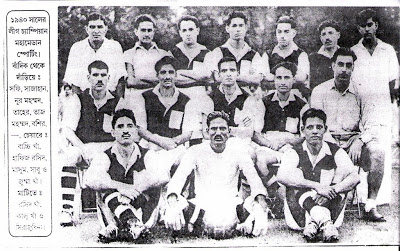
pic 1

Mohammedan Sporting team that won the Calcutta League in 1940

Mohameddan Sporting, along with Mohun Bagan (established 1889) and East Bengal (established 1924) were the most popular clubs of India for over a century. Mohun Bagan drew its fan-following from the elite and the aristocracy of Bengal and its aim was to inspire young people to lead a principled life: for example, those who failed in school and college were not allowed to play and smoking and drinking in the club premises were prohibited. East Bengal, on the other hand, represented the working class and the lower-middle classes who came to stay in Kolkata from east Bengal, which later became Bangladesh.

Given the pan-Indian religious character of Mohd Sporting, it had easily the largest fan following across India. All the big tournaments patronized Mohd Sporting as it drew the largest crowds. The other major clubs like Dempo and Salgaocar came from Goa with a very limited support base outside Goa and Mumbai.  Continue reading The end of an era – Mohammedan Sporting, Ambedkar Stadium and Football in Delhi: Jamal Kidwai

The voices we didn’t hear: K.S. Narendran

Guest Post by K.S. NARENDRAN

As I write this, we are entering the ninth month after the disappearance of Malaysia Airlines flight MH370. I would not want it to be forgotten soon. My wife Chandrika Sharma was on that flight.

Over the past few months, as public attention has shifted to other issues, the long-drawn search for MH370 has seen many developments, ranging from the disturbing to the outrageous. The ineptitude of the Malaysian authorities was on public display, particularly in the early weeks of March 2014, and so merits no further comment. What is intriguing, even worrisome, though is that relevant institutions have been inaccessible or indifferent, be it in terms of pushing for the truth and seeking accountability, or in responding to the affected families’ needs. What follows is my own experience, my take.

The Indian Government: Mute and invisible

In the first week following the disappearance of Malaysia Airlines’ Flight 370, I had asked whether our government had any view on the incident, and any role in responding to it. After all, Indian citizens were involved. This evoked an interesting, if not distressing, set of responses. Indian Minister of State for External Affairs, E Ahmed, deemed the election campaign a higher priority, and opined that the Indian Embassy (at Kuala Lumpur) ought to have stepped in. In informal conversation, many were sympathetic with this view. The Ministry of Civil Aviation and the DGCA seemed similarly indifferent, or saw no role for themselves in responding to the incident or in assisting the affected families. Even the state governments, otherwise quick to take offence at any perceived slight or injury to sons and daughters of their ‘soil’, remained untouched, conspicuous by their silence. The only face of the government that I saw were the CB-CID Special Branch of the Police, the Indian arm of the Interpol and the Intelligence Bureau.  Each asked the same set of questions, suggesting that they work in silos,  that they don’t trust each other. Continue reading The voices we didn’t hear: K.S. Narendran

A kiss for your thoughts, University of Hyderabad: Anu K Antony, Mohan K Pillai, Sinjini Bhattacharya and Vaikhari Aryat

Guest Post by ANU K ANTONY, MOHAN K PILLAI, SINJINI BHATTACHARYA, VAIKHARI ARYAT 

HYD

The protest meeting organised by the students of the University of Hyderabad on the university campus

‘That is knowledge which liberates’, proudly proclaims the crest of University of Hyderabad, a prominent central university in our country. A University space has been traditionally seen as the vanguard of socio-cultural critique and change. Universities pride themselves in upholding the values of freedom of thought, expression and debate. And yet, the reaction of the administration of the University of Hyderabad (UoH) to a recent event, in an otherwise liberal-tolerant and progressive-leaning campus, leaves much space for thought.

On November 2nd, a group of students organised an event on campus in solidarity with the much discussed “Kiss of Love” protest in Kerala. Titled “UoH Against Moral Policing”, the on-campus event, publicised solely on online social media, was supposed to create a space to discuss issues surrounding moral policing and the chain of Kerala incidents, bring out narratives of moral policing, talk about morality and Indian culture, and recite poetry. Also planned was a symbolic act of kissing on a chart paper, with the slogan “Our lips don’t char”. However, some ABVP and BJYM activists, with the aim of saving the students and the Indian culture from Western “immorality”, barged into campus and tried to attack the student protesters. The Telangana Police and campus security, who had failed to stop the intruders, did later succeed in cordoning them off from the protesting crowd, while insisting that the students call off the protest and disperse.

Unaccustomed to Police chauvinism and empowered enough to insist on their rights, the students managed to continue with their planned activities, although once in a while some right-wing activists managed to break ranks and tried to incite violence. The campus community however showed great restraint and continued protesting peacefully.  In response to such moral policing inside campus, the 250-plus students spontaneously started hugging and kissing each other, before dispersing.  Continue reading A kiss for your thoughts, University of Hyderabad: Anu K Antony, Mohan K Pillai, Sinjini Bhattacharya and Vaikhari Aryat

Debating Muslim Law after Shah Bano – the Model Nikahnama Initiative: A Suneetha

Guest Post by A SUNEETHA continuing the discussion on Uniform Civil Code on Kafila.

In popular imagination Muslim women’s unequal position in marriage is symbolized by cases such as Shah Bano or Imrana. It is understood this is the result of the religion-based Muslim personal law and the rigid control of women by the community in general and ulema in particular. Not many are aware that the same religion-based marriage law also offers tools for changing Muslim women’s position in marriage. In the last ten years, an ordinary document that every Muslim couple signs at the time of marriage – nikahnama or marriage contract – has assumed such a role. It has been innovatively used to initiate discussions and push for changes in the community’s thinking about the Muslim women’s position in marriage. In these efforts, a large number of “religious” and “non-religious” Muslim groups got into a conversation and set off a consensus-building process on the issue of a Muslim woman’s “entitlements”.

This discussion assumes importance in the context of the ongoing debate on UCC.  The debate on the UCC entered a new phase when, unhappy with the removal of Muslim women from the ambit of S 125 Crpc that guarantees all divorced women a minimum maintenance and the promulgation of a separate provision for divorced Muslim women called Muslim Women’s Maintenance Act 1986, many women’s groups renewed their demand for a UCC in 1990. Such a Code, it was hoped, would bring marital equality to women of all religions. When the Bharatiya Janata Party hijacked this demand to castigate Muslim men, (as if Hindu men were free of misogynist and patriarchal behaviour), such a hope was irretrievably lost. In the post-Babri Masjid demolition period, when there were pogroms against the Muslim communities, such a law would have found it impossible to garner support from the Muslims, especially if it were made by the BJP dominated Parliament. As anyone familiar with law knows, a consensus is important for law-making so that it is accepted and followed. But the changed situation of unparalleled parliamentary dominance of BJP brings newer challenges to all those working on issues of gender justice in all communities.

Muslim women were caught in this unenviable position since the 1990s – of having to address their own situation – under-age marriages, non-payment of mehr, arbitrary talaq, cruelty in marriage, maintenance after talaq, multiple marriages of men, resistance to women’s employment etc. while taking care that the Muslim men are not vilified further. Continue reading Debating Muslim Law after Shah Bano – the Model Nikahnama Initiative: A Suneetha

Concerns on proposed meetings of Intellectual Property Owners Association with IPAB and the Delhi High Court: Campaign for Affordable Trastuzumab

The Campaign for Affordable Trastuzumab was launched in November 2012 and has been endorsed by over 200 Indian and global patient associations, cancer survivors, health movements, women’s rights activists and eminent jurists.

Kalyani Menon-Sen, Leena Menghaney and KM Gopakumar from this campaign express serious concerns about  the intent and purpose of the “Innovation Dialog” being organised in India from November 16-22, 2014 by the Intellectual Property Owners Association (IPOA).

To: Hon’ble Justice Mr. H.L. Dattu (Hon’ble Chief Justice of India); Hon’ble Justice Smt. G. Rohini, (Chief Justice, Delhi High Court); Hon’ble Justice K.N. Basha (Chair, Intellectual Property Appellate Board)

Dear Hon’ble Justice Dattu, Hon’ble Justice Rohini and Hon’ble Justice K.N. Basha,

We write to you on behalf of the Campaign for Affordable Trastuzumab, a network of treatment activists, patients and public interest lawyers committed to making the breast cancer drug – trastuzumab – affordable in India. We have closely followed the misuse of patent rights and more recently the vexatious litigation of the Swiss pharmaceutical company Hoffmann-La Roche Ltd in India to maintain control over the market for the lifesaving drug (trastuzumab), thus blocking access to treatment for thousands of women with HER2+ breast cancer.

This letter is to express our grave concern about the intent and purpose of the “Innovation Dialog” being organised in India from November 16-22, 2014 by the Intellectual Property Owners Association (IPOA).

The IPOA is a US-based group consisting of large corporations and law firms which has been aggressively lobbying on issues of intellectual property standards and enforcement in India and pushing a pro-corporate agenda. The biased and unbalanced position taken by the IPOA is especially troubling when it concerns medicines, where the use of intellectual property protections have restricted access to affordable treatment and blocked competition.
Continue reading Concerns on proposed meetings of Intellectual Property Owners Association with IPAB and the Delhi High Court: Campaign for Affordable Trastuzumab

The Class Politics of Blasphemy in Pakistan: Fatima Tassadiq

Guest Post by FATIMA TASSADIQ

The brutal murders of Shehzad and Shama, a Christian couple in the village of Kot Radha Kishan in Kasur district on 4th November, spawned predictable outrage in the press and social media. The rush of horror, the diagnoses and prescribed course of action against such violence involved the familiar paternalistic discourse of the ‘illiterate masses’ whose ‘ignorance’ evidently leaves them particularly vulnerable to the manipulation of the much maligned mullahs. Such a narrative serves the dual function of reducing religious violence to the faceless masses while at the same time reaffirming the educated urban upper class as the rightful custodian of Islam and Pakistan. This construction conveniently ignores the role played by the state and the elite in producing religious violence and feeds the class-based blind spots that exist in our understanding of what constitutes religious extremism.

Continue reading The Class Politics of Blasphemy in Pakistan: Fatima Tassadiq

Whatever happened to the great debate? Ankita Anand

Guest Post by ANKITA ANAND

On 6 November 2014 BBC World invited three panellists from different sectors to debate on ‘A New India: Free, Fair and Prosperous’ as part of the World Economic Forum. Issues of content and objectivity apart, one still has high expectations of a group like BBC when it comes to setting high standards of form. But this ‘debate’ fell flat on its face on all counts.

No rules of the game

One would think that in a discussion like this all three panellists would bring in varied viewpoints due to their specialization in their individual sectors. However, if one wants to quote either the minister or the corporate voice in the debate, it would require constant rechecking to distinguish who said what. Of course businnesses and governments need not always be in conflict with each other. But this smooth overlapping can be dangerous if those who are to be at the receiving end of this coalition between corporate bodies and governing bodies get completely left out. So for all practical purposes, instead of having three distinct voices, the format of the session (to keep calling it a debate would be to perpetuate technical erroneousness) was two against one. The yesmanship resulting out of this format naturally dulled the sparkling energy any debate worth its salt should have. Continue reading Whatever happened to the great debate? Ankita Anand

Aligarh Muslim University women should not back down just because BJP has taken up their cause: Asiya Islam

ASIYA ISLAM argues on Scroll.in that AMU’s women students demanding library access have always been warned not to wash the institution’s dirty linen in public, for fear of providing fodder for Hindutva forces.

Things must have changed since I studied at Aligarh Muslim University for three years until 2009. This week, the vice chancellor of the university, Lieutenant General (retd) Zameeruddin Shah, justified the policy of not allowing undergraduate women to use the main Maulana Azad Library. If more women are allowed, the vice chancellor said, the number of men in the library would swell by at least four times. Somehow, I just do not remember hordes of studious men at AMU.

It is worth noting that the vice chancellor has only upheld a ban that has always existed and articulated his reasons for doing so. The issue is not new. It just seems to surface periodically – the media gets interested, makes a bit of noise, after some time it all dies down, and sadly nothing changes…

In this current political climate, we need to realise that inequalities are multifarious. But demands for gender equality do not compete with other social justice issues at hand – rather, they are complementary. We cannot excuse continued discrimination against women while asking for minority rights. Therefore, we should question the government’s and media’s sudden concern with gender equality in AMU (this is after all a deeply conservative government), but let us not discount the gravity of the library issue for women who study and work there.

Read the whole article here.

There is hatred in the air yet again: Preeti Chauhan

Guest Post by PREETI CHAUHAN on the recent communal tension in Noor e Illahi area of Delhi.

It was around 9 pm on Tuesday, November 11th, I was heading to my parents’ home to go with my sister for an interview the next morning, when my cellphone rang, my sister was asking me frantically where I was. I replied a bit anxiously but with irritation, ‘Kya hai? Pahunch jaaungi thodi der mein’. She said don’t come, turn back. I asked why, ‘yahan dange hone waale hain, saari dukaanein band ho rahin hain’, my sister replied. In those two-three seconds my heart skipped many beats, a strange fear about the safety of my family gripped me. I could for the first time feel what it is to live in fear of communal riots. I called up my close relatives who were out of home to ask where they are. There was such an uncertainty as to how will my sister go for the interview tomorrow? Would I be able to reach home tomorrow morning? Would my vehicle be attacked if I decide to go home now?

In those three- four minutes the world seemed to have taken a terrifying turn for me. Mundane, everyday things, everyday routes suddenly turned hostile and suspicious. I could feel the agony and fear so very close. Then there was a sudden burst of anger that I felt against the communal forces that are so hell bent on creating communal trouble everywhere in Delhi. I had not read the newspaper the whole day yesterday and hadn’t watched TV but just before I was leaving home my spouse told me that my native place is in the news and it was then that I had read about the communal tension and curfew in Noore-illahi. It’s the area, the vicinity of my childhood, adolescence and my adulthood too. It’s the area of the weekly bazaar for us, the Eid bazaar as well from which we had returned at 1 am at times. Noor Chicken is where Noor Jahan furniture once stood if I remember correctly; it belonged to the family of one of my classmates in school. I hear today that Noor Chicken’s owner and his son was badly beaten and the son is rumored to have succumbed to injuries. I shudder to think if he is my primary school classmate Shahnawaaz… Continue reading There is hatred in the air yet again: Preeti Chauhan

Crime and Consent: Vrinda Grover

VRINDA GROVER analyses the recent Delhi High Court judgement on the rape and consequent death of a 65 year old woman, acquitting the accused because the woman was ‘menopausal’ and making a curious distinction between ‘forceful’  and ‘forcible’ intercourse.

In a recent judgment in Achey Lal vs State Govt of NCT Delhi, the Delhi High Court on October 30 set aside the conviction of the appellant for rape and murder. What has provoked discussion are the observations, inferences and conclusions of the court. Briefly, the facts as reported in the judgment are: on December 31 2010, a house maid, aged about 65-70 years, was found dead, with her clothes disheveled to expose her body. The accused, Achey Lal, 45 years old, was present in the room in an intoxicated condition. The husband of the deceased deposed that the accused had come at 8 am that day to his house with a quarter bottle of alcohol and when it finished, the husband left, while the accused stayed on with his deceased wife. The cause of death, according to the doctor who conducted the post mortem, “was asphyxia due to aspiration of gastric contents consequent upon forceful sexual intercourse, which was sufficient to cause death in the ordinary course of nature”.

Read the rest of the article in The Indian Express.

Statement On Sterilsation deaths in Chattisgarh by Public Health groups

The Jan Swasthya Abhiyan, Sama Resource Group for Women and Health, Commonhealth and National Alliance for Maternal Health and Human Rights are shocked at the death of 11 women and the critical condition of 50 other women due to the callous negligence of the Health Department, Government of Chhattisgarh. The deaths and morbidities are a result of a botched-up sterilization operation camp organized by a private hospital under the National Family Planning Programme in Takhatpur Block of Bilaspur District on 8 November 2014. Horrifically, during this camp, 83 women were subject to surgeries in a short span of 5 to 6 hours. Amongst those who have died are Dalits, tribals and Other Backward Classes, leaving behind shattered families and young children. This has resulted in gross violation of the reproductive and health rights of the women.

This tragedy raises grave questions about the unsafe, unhygienic conditions and the slipshod attitude under which these operations were conducted. Moreover, the women who are presently critical continue to get treatment in dismal conditions exposing them to further risks and danger.The surgeries were conducted in complete violation of the Supreme Court orders (Ramakant Rai Vs Govt. of India, 2005 and Devika Biswas Vs Govt. of India, 2012). These orders instruct that a maximum of 30 operations can be conducted in a day with 2 separate laparoscopes only in government facilities. Also, one doctor cannot do more than 10 sterilizations in one day.  Despite this, the surgeon in Chhattisgarh performed about three times the permissible number of surgeries (83) in less than 6 hours in a private hospital which has reportedly remained closed for 15 years. This is evidence of how these operations were not done under standard protocols.

Continue reading Statement On Sterilsation deaths in Chattisgarh by Public Health groups

From a Professor to a Showman: Kishen Pattnayak on Prannoy Roy

Translated from the original Hindi by Akhil Katyal

Kishen Pattnayak (1930-2004) was a socialist thinker and writer. He had been a member of the Indian parliament from Orissa. Pattanayak was the founding editor of a Hindi monthly periodical called ‘Samayik Varta’. In this Hindi essay ‘Professor Se Tamashgeer’ published in March, 1994, he understands Prannoy Roy as representative of a new class of intellectuals which came into being precisely with the changing economic policies of the Indian government in the early ’90s.

Those who do not know English in this country might not know Prannoy Roy. But knowing him is important because Prannoy Roy represents a new social phenomenon. Prannoy Roy’s fame has been sealed by the program “The World This Week” running every Friday on Doordarshan. Not unlike a magician putting on a show, it has lately become quite an art for Doordarshan to concentrate the attentions of the TV viewers and keep them spellbound with only select news and statements on the channel. Pritish Nandy’s show and Prannoy Roy’s weekly program etc. are prime examples of this art.

Among the country’s intellectuals, such folks must surely be rare, who apart from being immensely intelligent, can also put on a circus-show in the middle of a street. Television professionals are always on a hunt for such gifted intellectuals. Through them, the TV business gets some intellectual prestige, making it reputable to carry on showing several dreadful and obscene things. Continue reading From a Professor to a Showman: Kishen Pattnayak on Prannoy Roy

DISSENT, DEBATE, CREATE