The end of an era – Mohammedan Sporting, Ambedkar Stadium and Football in Delhi: Jamal Kidwai

Guest Post by JAMAL KIDWAI

Caught up in the launch of the Indian Soccer League (ISL) and its promotion by television and big Bollywood stars, very few noticed that the Kolkata based 123-yr-old Mohameddan Sporting, has effectively decided to close down due to a financial crisis. According to its management, they will stop playing for a year outside Kolkata and have disbanded the senior team.

The historic Mohammedan Sporting won the Calcutta league 11 times, the IFA Shield five times,  the Rovers Cup six times, the DCM tournament four times and the Federation Cup and the Durand Cup twice each.

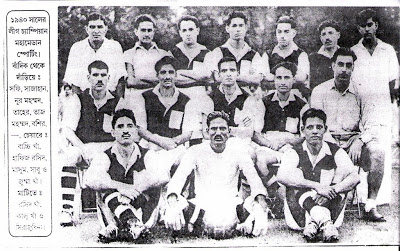
pic 1

Mohammedan Sporting team that won the Calcutta League in 1940

Mohameddan Sporting, along with Mohun Bagan (established 1889) and East Bengal (established 1924) were the most popular clubs of India for over a century. Mohun Bagan drew its fan-following from the elite and the aristocracy of Bengal and its aim was to inspire young people to lead a principled life: for example, those who failed in school and college were not allowed to play and smoking and drinking in the club premises were prohibited. East Bengal, on the other hand, represented the working class and the lower-middle classes who came to stay in Kolkata from east Bengal, which later became Bangladesh.

Given the pan-Indian religious character of Mohd Sporting, it had easily the largest fan following across India. All the big tournaments patronized Mohd Sporting as it drew the largest crowds. The other major clubs like Dempo and Salgaocar came from Goa with a very limited support base outside Goa and Mumbai.  Continue reading The end of an era – Mohammedan Sporting, Ambedkar Stadium and Football in Delhi: Jamal Kidwai

The voices we didn’t hear: K.S. Narendran

Guest Post by K.S. NARENDRAN

As I write this, we are entering the ninth month after the disappearance of Malaysia Airlines flight MH370. I would not want it to be forgotten soon. My wife Chandrika Sharma was on that flight.

Over the past few months, as public attention has shifted to other issues, the long-drawn search for MH370 has seen many developments, ranging from the disturbing to the outrageous. The ineptitude of the Malaysian authorities was on public display, particularly in the early weeks of March 2014, and so merits no further comment. What is intriguing, even worrisome, though is that relevant institutions have been inaccessible or indifferent, be it in terms of pushing for the truth and seeking accountability, or in responding to the affected families’ needs. What follows is my own experience, my take.

The Indian Government: Mute and invisible

In the first week following the disappearance of Malaysia Airlines’ Flight 370, I had asked whether our government had any view on the incident, and any role in responding to it. After all, Indian citizens were involved. This evoked an interesting, if not distressing, set of responses. Indian Minister of State for External Affairs, E Ahmed, deemed the election campaign a higher priority, and opined that the Indian Embassy (at Kuala Lumpur) ought to have stepped in. In informal conversation, many were sympathetic with this view. The Ministry of Civil Aviation and the DGCA seemed similarly indifferent, or saw no role for themselves in responding to the incident or in assisting the affected families. Even the state governments, otherwise quick to take offence at any perceived slight or injury to sons and daughters of their ‘soil’, remained untouched, conspicuous by their silence. The only face of the government that I saw were the CB-CID Special Branch of the Police, the Indian arm of the Interpol and the Intelligence Bureau.  Each asked the same set of questions, suggesting that they work in silos,  that they don’t trust each other. Continue reading The voices we didn’t hear: K.S. Narendran

A kiss for your thoughts, University of Hyderabad: Anu K Antony, Mohan K Pillai, Sinjini Bhattacharya and Vaikhari Aryat

Guest Post by ANU K ANTONY, MOHAN K PILLAI, SINJINI BHATTACHARYA, VAIKHARI ARYAT 

HYD

The protest meeting organised by the students of the University of Hyderabad on the university campus

‘That is knowledge which liberates’, proudly proclaims the crest of University of Hyderabad, a prominent central university in our country. A University space has been traditionally seen as the vanguard of socio-cultural critique and change. Universities pride themselves in upholding the values of freedom of thought, expression and debate. And yet, the reaction of the administration of the University of Hyderabad (UoH) to a recent event, in an otherwise liberal-tolerant and progressive-leaning campus, leaves much space for thought.

On November 2nd, a group of students organised an event on campus in solidarity with the much discussed “Kiss of Love” protest in Kerala. Titled “UoH Against Moral Policing”, the on-campus event, publicised solely on online social media, was supposed to create a space to discuss issues surrounding moral policing and the chain of Kerala incidents, bring out narratives of moral policing, talk about morality and Indian culture, and recite poetry. Also planned was a symbolic act of kissing on a chart paper, with the slogan “Our lips don’t char”. However, some ABVP and BJYM activists, with the aim of saving the students and the Indian culture from Western “immorality”, barged into campus and tried to attack the student protesters. The Telangana Police and campus security, who had failed to stop the intruders, did later succeed in cordoning them off from the protesting crowd, while insisting that the students call off the protest and disperse.

Unaccustomed to Police chauvinism and empowered enough to insist on their rights, the students managed to continue with their planned activities, although once in a while some right-wing activists managed to break ranks and tried to incite violence. The campus community however showed great restraint and continued protesting peacefully.  In response to such moral policing inside campus, the 250-plus students spontaneously started hugging and kissing each other, before dispersing.  Continue reading A kiss for your thoughts, University of Hyderabad: Anu K Antony, Mohan K Pillai, Sinjini Bhattacharya and Vaikhari Aryat

Debating Muslim Law after Shah Bano – the Model Nikahnama Initiative: A Suneetha

Guest Post by A SUNEETHA continuing the discussion on Uniform Civil Code on Kafila.

In popular imagination Muslim women’s unequal position in marriage is symbolized by cases such as Shah Bano or Imrana. It is understood this is the result of the religion-based Muslim personal law and the rigid control of women by the community in general and ulema in particular. Not many are aware that the same religion-based marriage law also offers tools for changing Muslim women’s position in marriage. In the last ten years, an ordinary document that every Muslim couple signs at the time of marriage – nikahnama or marriage contract – has assumed such a role. It has been innovatively used to initiate discussions and push for changes in the community’s thinking about the Muslim women’s position in marriage. In these efforts, a large number of “religious” and “non-religious” Muslim groups got into a conversation and set off a consensus-building process on the issue of a Muslim woman’s “entitlements”.

This discussion assumes importance in the context of the ongoing debate on UCC.  The debate on the UCC entered a new phase when, unhappy with the removal of Muslim women from the ambit of S 125 Crpc that guarantees all divorced women a minimum maintenance and the promulgation of a separate provision for divorced Muslim women called Muslim Women’s Maintenance Act 1986, many women’s groups renewed their demand for a UCC in 1990. Such a Code, it was hoped, would bring marital equality to women of all religions. When the Bharatiya Janata Party hijacked this demand to castigate Muslim men, (as if Hindu men were free of misogynist and patriarchal behaviour), such a hope was irretrievably lost. In the post-Babri Masjid demolition period, when there were pogroms against the Muslim communities, such a law would have found it impossible to garner support from the Muslims, especially if it were made by the BJP dominated Parliament. As anyone familiar with law knows, a consensus is important for law-making so that it is accepted and followed. But the changed situation of unparalleled parliamentary dominance of BJP brings newer challenges to all those working on issues of gender justice in all communities.

Muslim women were caught in this unenviable position since the 1990s – of having to address their own situation – under-age marriages, non-payment of mehr, arbitrary talaq, cruelty in marriage, maintenance after talaq, multiple marriages of men, resistance to women’s employment etc. while taking care that the Muslim men are not vilified further. Continue reading Debating Muslim Law after Shah Bano – the Model Nikahnama Initiative: A Suneetha

Concerns on proposed meetings of Intellectual Property Owners Association with IPAB and the Delhi High Court: Campaign for Affordable Trastuzumab

The Campaign for Affordable Trastuzumab was launched in November 2012 and has been endorsed by over 200 Indian and global patient associations, cancer survivors, health movements, women’s rights activists and eminent jurists.

Kalyani Menon-Sen, Leena Menghaney and KM Gopakumar from this campaign express serious concerns about  the intent and purpose of the “Innovation Dialog” being organised in India from November 16-22, 2014 by the Intellectual Property Owners Association (IPOA).

To: Hon’ble Justice Mr. H.L. Dattu (Hon’ble Chief Justice of India); Hon’ble Justice Smt. G. Rohini, (Chief Justice, Delhi High Court); Hon’ble Justice K.N. Basha (Chair, Intellectual Property Appellate Board)

Dear Hon’ble Justice Dattu, Hon’ble Justice Rohini and Hon’ble Justice K.N. Basha,

We write to you on behalf of the Campaign for Affordable Trastuzumab, a network of treatment activists, patients and public interest lawyers committed to making the breast cancer drug – trastuzumab – affordable in India. We have closely followed the misuse of patent rights and more recently the vexatious litigation of the Swiss pharmaceutical company Hoffmann-La Roche Ltd in India to maintain control over the market for the lifesaving drug (trastuzumab), thus blocking access to treatment for thousands of women with HER2+ breast cancer.

This letter is to express our grave concern about the intent and purpose of the “Innovation Dialog” being organised in India from November 16-22, 2014 by the Intellectual Property Owners Association (IPOA).

The IPOA is a US-based group consisting of large corporations and law firms which has been aggressively lobbying on issues of intellectual property standards and enforcement in India and pushing a pro-corporate agenda. The biased and unbalanced position taken by the IPOA is especially troubling when it concerns medicines, where the use of intellectual property protections have restricted access to affordable treatment and blocked competition.
Continue reading Concerns on proposed meetings of Intellectual Property Owners Association with IPAB and the Delhi High Court: Campaign for Affordable Trastuzumab

The Class Politics of Blasphemy in Pakistan: Fatima Tassadiq

Guest Post by FATIMA TASSADIQ

The brutal murders of Shehzad and Shama, a Christian couple in the village of Kot Radha Kishan in Kasur district on 4th November, spawned predictable outrage in the press and social media. The rush of horror, the diagnoses and prescribed course of action against such violence involved the familiar paternalistic discourse of the ‘illiterate masses’ whose ‘ignorance’ evidently leaves them particularly vulnerable to the manipulation of the much maligned mullahs. Such a narrative serves the dual function of reducing religious violence to the faceless masses while at the same time reaffirming the educated urban upper class as the rightful custodian of Islam and Pakistan. This construction conveniently ignores the role played by the state and the elite in producing religious violence and feeds the class-based blind spots that exist in our understanding of what constitutes religious extremism.

Continue reading The Class Politics of Blasphemy in Pakistan: Fatima Tassadiq

Whatever happened to the great debate? Ankita Anand

Guest Post by ANKITA ANAND

On 6 November 2014 BBC World invited three panellists from different sectors to debate on ‘A New India: Free, Fair and Prosperous’ as part of the World Economic Forum. Issues of content and objectivity apart, one still has high expectations of a group like BBC when it comes to setting high standards of form. But this ‘debate’ fell flat on its face on all counts.

No rules of the game

One would think that in a discussion like this all three panellists would bring in varied viewpoints due to their specialization in their individual sectors. However, if one wants to quote either the minister or the corporate voice in the debate, it would require constant rechecking to distinguish who said what. Of course businnesses and governments need not always be in conflict with each other. But this smooth overlapping can be dangerous if those who are to be at the receiving end of this coalition between corporate bodies and governing bodies get completely left out. So for all practical purposes, instead of having three distinct voices, the format of the session (to keep calling it a debate would be to perpetuate technical erroneousness) was two against one. The yesmanship resulting out of this format naturally dulled the sparkling energy any debate worth its salt should have. Continue reading Whatever happened to the great debate? Ankita Anand

Aligarh Muslim University women should not back down just because BJP has taken up their cause: Asiya Islam

ASIYA ISLAM argues on Scroll.in that AMU’s women students demanding library access have always been warned not to wash the institution’s dirty linen in public, for fear of providing fodder for Hindutva forces.

Things must have changed since I studied at Aligarh Muslim University for three years until 2009. This week, the vice chancellor of the university, Lieutenant General (retd) Zameeruddin Shah, justified the policy of not allowing undergraduate women to use the main Maulana Azad Library. If more women are allowed, the vice chancellor said, the number of men in the library would swell by at least four times. Somehow, I just do not remember hordes of studious men at AMU.

It is worth noting that the vice chancellor has only upheld a ban that has always existed and articulated his reasons for doing so. The issue is not new. It just seems to surface periodically – the media gets interested, makes a bit of noise, after some time it all dies down, and sadly nothing changes…

In this current political climate, we need to realise that inequalities are multifarious. But demands for gender equality do not compete with other social justice issues at hand – rather, they are complementary. We cannot excuse continued discrimination against women while asking for minority rights. Therefore, we should question the government’s and media’s sudden concern with gender equality in AMU (this is after all a deeply conservative government), but let us not discount the gravity of the library issue for women who study and work there.

Read the whole article here.

There is hatred in the air yet again: Preeti Chauhan

Guest Post by PREETI CHAUHAN on the recent communal tension in Noor e Illahi area of Delhi.

It was around 9 pm on Tuesday, November 11th, I was heading to my parents’ home to go with my sister for an interview the next morning, when my cellphone rang, my sister was asking me frantically where I was. I replied a bit anxiously but with irritation, ‘Kya hai? Pahunch jaaungi thodi der mein’. She said don’t come, turn back. I asked why, ‘yahan dange hone waale hain, saari dukaanein band ho rahin hain’, my sister replied. In those two-three seconds my heart skipped many beats, a strange fear about the safety of my family gripped me. I could for the first time feel what it is to live in fear of communal riots. I called up my close relatives who were out of home to ask where they are. There was such an uncertainty as to how will my sister go for the interview tomorrow? Would I be able to reach home tomorrow morning? Would my vehicle be attacked if I decide to go home now?

In those three- four minutes the world seemed to have taken a terrifying turn for me. Mundane, everyday things, everyday routes suddenly turned hostile and suspicious. I could feel the agony and fear so very close. Then there was a sudden burst of anger that I felt against the communal forces that are so hell bent on creating communal trouble everywhere in Delhi. I had not read the newspaper the whole day yesterday and hadn’t watched TV but just before I was leaving home my spouse told me that my native place is in the news and it was then that I had read about the communal tension and curfew in Noore-illahi. It’s the area, the vicinity of my childhood, adolescence and my adulthood too. It’s the area of the weekly bazaar for us, the Eid bazaar as well from which we had returned at 1 am at times. Noor Chicken is where Noor Jahan furniture once stood if I remember correctly; it belonged to the family of one of my classmates in school. I hear today that Noor Chicken’s owner and his son was badly beaten and the son is rumored to have succumbed to injuries. I shudder to think if he is my primary school classmate Shahnawaaz… Continue reading There is hatred in the air yet again: Preeti Chauhan

Crime and Consent: Vrinda Grover

VRINDA GROVER analyses the recent Delhi High Court judgement on the rape and consequent death of a 65 year old woman, acquitting the accused because the woman was ‘menopausal’ and making a curious distinction between ‘forceful’  and ‘forcible’ intercourse.

In a recent judgment in Achey Lal vs State Govt of NCT Delhi, the Delhi High Court on October 30 set aside the conviction of the appellant for rape and murder. What has provoked discussion are the observations, inferences and conclusions of the court. Briefly, the facts as reported in the judgment are: on December 31 2010, a house maid, aged about 65-70 years, was found dead, with her clothes disheveled to expose her body. The accused, Achey Lal, 45 years old, was present in the room in an intoxicated condition. The husband of the deceased deposed that the accused had come at 8 am that day to his house with a quarter bottle of alcohol and when it finished, the husband left, while the accused stayed on with his deceased wife. The cause of death, according to the doctor who conducted the post mortem, “was asphyxia due to aspiration of gastric contents consequent upon forceful sexual intercourse, which was sufficient to cause death in the ordinary course of nature”.

Read the rest of the article in The Indian Express.

Statement On Sterilsation deaths in Chattisgarh by Public Health groups

The Jan Swasthya Abhiyan, Sama Resource Group for Women and Health, Commonhealth and National Alliance for Maternal Health and Human Rights are shocked at the death of 11 women and the critical condition of 50 other women due to the callous negligence of the Health Department, Government of Chhattisgarh. The deaths and morbidities are a result of a botched-up sterilization operation camp organized by a private hospital under the National Family Planning Programme in Takhatpur Block of Bilaspur District on 8 November 2014. Horrifically, during this camp, 83 women were subject to surgeries in a short span of 5 to 6 hours. Amongst those who have died are Dalits, tribals and Other Backward Classes, leaving behind shattered families and young children. This has resulted in gross violation of the reproductive and health rights of the women.

This tragedy raises grave questions about the unsafe, unhygienic conditions and the slipshod attitude under which these operations were conducted. Moreover, the women who are presently critical continue to get treatment in dismal conditions exposing them to further risks and danger.The surgeries were conducted in complete violation of the Supreme Court orders (Ramakant Rai Vs Govt. of India, 2005 and Devika Biswas Vs Govt. of India, 2012). These orders instruct that a maximum of 30 operations can be conducted in a day with 2 separate laparoscopes only in government facilities. Also, one doctor cannot do more than 10 sterilizations in one day.  Despite this, the surgeon in Chhattisgarh performed about three times the permissible number of surgeries (83) in less than 6 hours in a private hospital which has reportedly remained closed for 15 years. This is evidence of how these operations were not done under standard protocols.

Continue reading Statement On Sterilsation deaths in Chattisgarh by Public Health groups

From a Professor to a Showman: Kishen Pattnayak on Prannoy Roy

Translated from the original Hindi by Akhil Katyal

Kishen Pattnayak (1930-2004) was a socialist thinker and writer. He had been a member of the Indian parliament from Orissa. Pattanayak was the founding editor of a Hindi monthly periodical called ‘Samayik Varta’. In this Hindi essay ‘Professor Se Tamashgeer’ published in March, 1994, he understands Prannoy Roy as representative of a new class of intellectuals which came into being precisely with the changing economic policies of the Indian government in the early ’90s.

Those who do not know English in this country might not know Prannoy Roy. But knowing him is important because Prannoy Roy represents a new social phenomenon. Prannoy Roy’s fame has been sealed by the program “The World This Week” running every Friday on Doordarshan. Not unlike a magician putting on a show, it has lately become quite an art for Doordarshan to concentrate the attentions of the TV viewers and keep them spellbound with only select news and statements on the channel. Pritish Nandy’s show and Prannoy Roy’s weekly program etc. are prime examples of this art.

Among the country’s intellectuals, such folks must surely be rare, who apart from being immensely intelligent, can also put on a circus-show in the middle of a street. Television professionals are always on a hunt for such gifted intellectuals. Through them, the TV business gets some intellectual prestige, making it reputable to carry on showing several dreadful and obscene things. Continue reading From a Professor to a Showman: Kishen Pattnayak on Prannoy Roy

Images from Kiss of Love Gathering in Delhi: Ishan Tankha

Guest Post by ISHAN TANKHA

Every time my girlfriend puts her arms around me while we are out  on our terrace i end up first doing a quick scan of the windows that look down at us to see if we are visible to anyone, it’s almost  an instinctive reaction. Mind you, one that doesn’t win me much affection from her ,understandably! It’s not that I care but I do notice them looking, and it’s always disapproving. Unfortunately, It’s not just my neighbours.

After the ‘Kiss of Love ‘ protests in Kochi and Kolkota it was Delhi’s turn and the few hundred who turned up to stand up for their right to not be morally policed did a fantastic job countering the right wing hooligans, for whom showing love or affection to one of our choosing is ‘immoral’.  The police spent it’s time not allowing the peaceful protesters from marching to the RSS headquarters, their intended destination, pushing and shoving them.  While pleading with, instead of arresting those who threatened and abused with impunity.

It’s not over of course, if it’s not a skirt wearing girl being stopped from entering a building or a cafe being trashed, there will be another reason to collect and be heard.
Maybe tomorrow we’ll give my neighbours a matinee to gawk at.Meanwhile, here are some pictures I took at the Kiss of Love gathering in Jhandewalan, Delhi.

Continue reading Images from Kiss of Love Gathering in Delhi: Ishan Tankha

Whither Social Movements? Exploring the Problematic and Action Strategy: Soumitra Ghosh

Guest post by SOUMITRA GHOSH

The context

One of the biggest and most visible problems plaguing the anti-capitalist social movements of today is the statist framework which conditions, shapes and governs their thoughts and actions. Thus the political praxis which should ideally be moored in a post-capitalist (hence post-state) vision of society, is seldom reached, and the movements are stuck in the morass of extremely limited actions informed by their purely normative and emotive thoughts about how the present society should function. The war-cry of justice is aired, millions take to the street demanding it, yet this ‘justice’ is rarely explained in terms of the real and the grounded. It is taken for granted that the state will be transformed from its overtly pro-capital avatar to a more radical one by this means or another because the movements want it to change: what is forgotten is that history has seen hundreds of experiments with such ‘changed’ states—each one of which failed in the long run, and led to a more coercive rule of capital.

Also, today’s social movements are non-violent and democratic, which in reality means that they prefer working within the framework of parliamentary democracy, and where that is absent, fight for it. Once again, the history of the institution of parliamentary democracy is forgotten: willy-nilly, it’s ignored that historically—more so going by today’s neo-liberal situation—such democracy is intrinsically linked with capitalist production systems and the hegemony of capital in both our societies and polities. Continue reading Whither Social Movements? Exploring the Problematic and Action Strategy: Soumitra Ghosh

B Hridayakumari in My Garden: A Loving Memory

I cannot write the standard obituary. The obituary is expected to hold back grief in sedate, decorous ways, remember the departed person’s best qualities with quiet dignity, and forgive her less admirable aspects gracefully. When I try to write an obituary, I usually trip over my own grief and the terrible ache that the memories of the deceased one’s physical presence produce — the turn of the head, the peculiar contortion of lips forming a smile, the wave of a hand.(I cannot write obits for people I don’t feel for). To get away from that, I quickly turn to the personality, and here I find myself mired, completely unable to separate neatly those qualities that drew my admiration and those which I hated and hurt me. Far from sounding dignified, the obituary ends up structured quite like intensely physical mourning, only that it will be composed in words.

Continue reading B Hridayakumari in My Garden: A Loving Memory

Feed The Poor, Go To Jail

image : Courtesy eideard.com

Whether serving food to the homeless is a crime?

Ask Arnold Arbott, known as Chef Arbott, a 90 year old man from Fort Lauderdale, Florida, who along-with two other members of a Church charity faces potential jail term for at least six months for the same ‘offence’. In fact his name finds prominent mention in the police records in the past week for breaking the new city ordinance which has come into effect recently which characterises his act as breach of law, according to reports.

Talking to a newsperson he said:

“These are the poorest of the poor. They have nothing. They don’t have a roof over their head. And who could turn them away?”

Continue reading Feed The Poor, Go To Jail

‘Kiss of Love’ in Delhi, confronting the RSS: Vasundhara Jairath and Bonojit Hussain

Guest Post by Vasundhara Jairath and Bonojit Hussain 

In the first of its kind in India, youth in Kochi launched a campaign called ‘Kiss of Love’ to challenge the moral policing of the Hindu Right. While that protest was attacked by right wing thugs and suppressed by the police, this form of protest has since spread to different parts of the country like Hyderabad, Bombay and Calcutta. Today, the ‘Kiss of Love’ protest was held at nowhere short of the Rashtriya Swayamsevak Sangh (RSS) head office in New Delhi. A few individuals took the initiative and gave a call for this protest on Facebook with the title, ‘Sanghi Gunde Hoshiyar, Tere Samne Karenge Pyaar’ (Sanghi thugs beware, we will love in front you). Continue reading ‘Kiss of Love’ in Delhi, confronting the RSS: Vasundhara Jairath and Bonojit Hussain

This is What Frightens Them….

And the struggle continues, image courtesy Manorama online
And the struggle continues…Kochi, image courtesy Manorama online
“If conservative elements can capture our public spaces and impose their diktat on us, we will do the same in retaliation. Our university spaces, parks and roads are not free any more. We are reclaiming them now. We live in an age where a Dalit man is hacked to 40 pieces because he fell in love with a woman from a higher caste. This Kiss of Love campaign is a defiance of moral policing and a struggle to uphold the spirit of love in all its forms and for everyone,” said Zareen, a campaigner.
Kiss of love Delhi, image courtesy, DNA

नौ नवंबर:एक और वर्षगाँठ

नौ नवंबर एक और वर्षगाँठ है.इस साल नौ नवंबर को अयोध्या में रामजन्मभूमि मंदिर के शिलान्यास के पचीस साल हो जाएँगे.यह मात्र एक मंदिर का नहीं,हिंदू राष्ट्र का शिलान्यास है,अशोक सिंघल ने शिलान्यास के बाद कहा था.1989 कई दृष्टियों से घटनापूर्ण वर्ष था.यूरोप में बर्लिन की दीवार का दरवाज़ा नौ नवंबर को ही खोल दिया गया जिससे पूर्वी और पश्चिमी जर्मनी के लोग आसानी से आ-जा सकें.यह बर्लिन की दीवार के ढहने की शुरुआत थी.राष्ट्रीय स्वयंसेवक संघ के समर्थक जय दुबांशी ने लिखा,“इधर एक मंदिर खड़ा हो रहा था और उधर एक मंदिर ढह रहा था.” सिंघल और दुबांशी के वक्तव्यों में रामजन्म भूमि मंदिर अभियान के राजनीतिक प्रोजेक्ट को लेकर कोई दुविधा नहीं.यह एक दक्षिणपंथी,राष्ट्रवादी राजनीतिक परियोजना थी जो भारत में बहुसंख्यक हिन्दूवाद को संगठित किए बिना  फल-फूल नहीं सकती थी.

1989 के अक्टूबर के अंत में ही भागलपुर में भारत की एक और  भयानक साम्प्रदायिक हिंसा हुई.यह भी याद रखने की ज़रूरत है कि प्रधान मंत्री राजीव गाँधी ने भागलपुर पहुँचकर जब लापरवाही और हिंसा को जारी रखने के आरोप के कारण वहाँ के पुलिस उपाधीक्षक को निलंबित किया तो स्वयं पुलिस ने विद्रोह कर दिया और उनका घेराव कर लिया.यह घटना तत्कालीन भारत में सांप्रदायिक मानस के आक्रामक होने की सूचना देती है और प्रशासन की हर स्तर पर उसमें भागीदारी का एक प्रमाण भी है.भागलपुर की सांप्रदायिक हिंसा में राष्ट्रीय स्वयंसेवक संघ की भागीदारी के साफ प्रमाण हैं.याद रखने की ज़रूरत है कि यह रामशिला पूजन के समय ही भड़की हिंसा थी.न भूलें कि संघ ने दो  सौ हिंदू छात्रों के मारे जाने और छात्राओं के बलात्कार की अफवाह फैलाई थी जिससे उनके गाँव में हिंसा भड़काने में आसानी हुई.भागलपुर में अफवाहों के जरिए लोगों को भड़काकर मुस्लिम-विरोधी हिंसा भड़काने के संघ के तरीके को याद इसलिए रखना ज़रूरी है कि मुज़फ्फ़रनगर के गाँवों में फैली मुस्लिम विरोधी हिंसा को समझने में वह मददगार है.इसलिए भी कि कई विद्वानों ने मुज़फ्फ़रनगर को इस वजह से विलक्षण माना था कि यहाँ ग्रामीण क्षेत्र हिंसा में शामिल हुए. ऐसा करते वक्त वे भागलपुर को भूल ही गए थे. Continue reading नौ नवंबर:एक और वर्षगाँठ

‘Downtown’ – Where the Kiss of Love Began: Sudha K. F.

Guest post by SUDHA K. F.

[This article was written in response to the recent incident of vandalism and violence meted out by BJP- affiliated Yuvamorcha activists against a restaurant called Downtown in Kozhikode, Kerala. This was the incident that led to the protest – the Kiss of Love at Kochi, Kiss of Love in Kolkata, and now, most audaciously outside the RSS Office in Jhandewalan. Wherever it goes, it acquires a flavour of its own. Thus in Kolkata, hokkolorob (let there be turmoil) mutated into another set of slogans – hokchumban (let there be kiss – or, let us kiss) and now, Sanghi gunde hoshiyar, tere saamne karenge pyar (beware Sangh goons, we will (make) love right before you. Sudha K. F. gives a sense of what it felt like after the goons attacked, the sense of indignation that subsequently burst forth.]

Kiss of love, Delhi
Kiss of love, Delhi, from the official facebook page

The now “notorious” Downtown restaurant is 5 minutes away by foot, from my home in my hometown Kozhikode. During my schooldays, that place was an old workshop. The restaurant came up after I had been away from my hometown for quite a while for my higher education. I remember being thrilled at the sight of this fine looking restaurant/coffee shop with glass windows, near my home during one of my visits. Earlier a few establishments had replaced the old workshop but didn’t do well commercially and closed down hastily. As I passed Downtown one evening, its busiest hour, my father remarked that this might have a longer life because it is so crowded with so many people frequenting the place for dinner. Still I remained a stranger to that place. Continue reading ‘Downtown’ – Where the Kiss of Love Began: Sudha K. F.

Resist the Sangh Parivar’s Hatred of Love: Nayanjyoti and Subhashini

Guest Post by Nayanjyoti and Subhashini

In late October, the youth wing of the Sangh Pariwar among others vandalised a café in Calicut on the pretext that lovers ‘date’ each another sitting in this café. When many young men and women in Kochi gathered together to protest by expressing their love in public, they got beaten up by various right wing groups and the police in response. The students and youths in different regions of the country gathered in solidarity of this protest going by the name of ‘Kiss of Love’. At the same time, as the news spread rapidly through the media and social networking site, a polarization continues to develop in the society, even among the individual activists and similar organizations, for and against the form of this movement.

Continue reading Resist the Sangh Parivar’s Hatred of Love: Nayanjyoti and Subhashini

DISSENT, DEBATE, CREATE