#Hokkolorob – Images from a Jadavpur Solidarity Meeting in Jantar Mantar, Delhi

Here are some images from a  meeting held in solidarity with Jadavpur University Students at Jantar Mantar, New Delhi, on Thursday, September 2014. Students from Delhi University, Jawaharlal Nehru University, Jamia Millia Islamia, Indian Institute of Mass Communications, teachers and professors from different universities in Delhi, Jadavpur University Ex-Students, Workers and Professionals from the Delhi NCR Region spoke at the meeting. A signature campaign was undertaken, and the assembled people wrote their statements on to a scroll in support of their friends at Jadavpur.

All Photographs are by Akhil Kumar, Youth Ki Awaaz. 

This slideshow requires JavaScript.

Khushi Ram, a terminated worker from the Maruti Suzuki Factory at Manesar had come from Haryana to express the solidarity that the workers of the Delhi-NCR region have for the students of Jadavpur University. He read a poem at the gathering. Kafila caught up with him as the meeting was about to end. Here is a video of him reading his poem for the readers of Kafila, and a brief record of a conversation with him about solidarity between workers and students.

Indian tea is laden with pesticides: Greenpeace India

downloadTrouble Brewing – Pesticide Residues in Tea Samples is the result of an investigation carried out by Greenpeace India to understand the situation concerning the use of pesticide usage in tea, which is a quintessential part of Indian culture and critical to the economy. The study has found residues of hazardous chemical pesticides in a majority of samples of the main brands of packaged tea produced and consumed in India. Over half of the samples contained pesticides that are ‘unapproved’ for use in tea cultivation or which were present in excess of recommended limits. The report underscores possible implications for health and the environment, which is both unnecessary and avoidable. While it highlights the fact that the tea industry is stuck on a pesticides treadmill, it suggests that tea companies, which are critical stakeholders in the tea industry, take the necessary steps in moving away from pesticides while adopting a holistic approach is best way forward. Continue reading Indian tea is laden with pesticides: Greenpeace India

Missing Person Notice: Ben Zachariah

Guest Post by Benjamin Zachariah

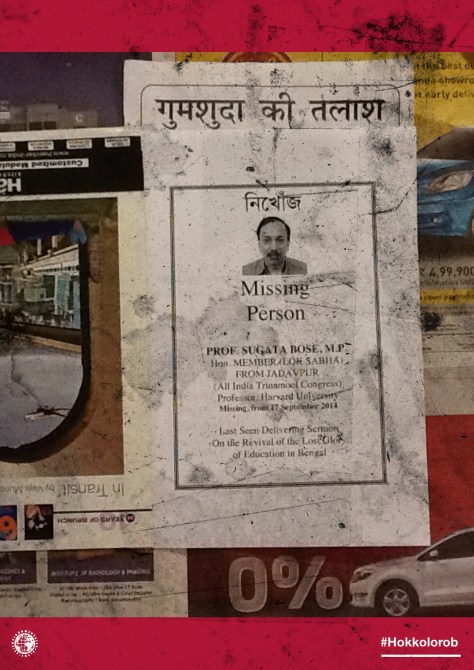
Looking for Prof. Bose

It was not so long ago that Sugata Bose, now Lok Sabha Member for Jadavpur, made his way back from Harvard to serve his people. West Bengal had voted for ‘poriborton’, ‘change’, and as everybody assumed that Bengalis loved their fellow-men who had been anointed abroad, Sugata Bose returned to conquer the heights of Bengali higher education. The plan was to use a brand name within a brand name to shore up another brand name : Harvard, Netaji, Presidency. The Trinamul Congress, Bose was confident, would not interfere with his plans. Or so he said in public; his mother, Krishna Bose, had been the Trinamul Congress’s Presidential candidate, and long regarded as the force behind the attempted bhadramahilafication of Didi, apparently a prerequisite for political acceptability in West Bengal (otherwise known as Waste Bengal or Poschimbongobongo). It was therefore no surprise that his plans did not diverge from the plans of the TMC, although ‘internal differences’ were often heard of. It was also no surprise that, as the attempts to turn Presidency ‘University’ into the font of moral and intellectual legitimation for the TMC faltered, Bose took the mantle of his great-uncle upon himself and stood as a candidate for the TMC in the Lok Sabha elections, from the Jadavpur constituency. There was not even the pretence that Sugata Bose stood on his own credentials: his campaign marches were led by a child in Netaji uniform and Netaji glasses, prompting a complaint to the National Commission for Protection of Child Rights.

Now, in the Jadavpur constituency, duly won by Netaji’s heir, and not by a hair’s breadth, developments at Jadavpur University are cause for concern.

Continue reading Missing Person Notice: Ben Zachariah

Note of Solidarity with the Students of Jadavpur University: Jagriti

Guest Post from Jagriti, Women’s Development Cell, Bharati College, Delhi University

(The authors of this post sent it to us at Kafila saying –  “…since we don’t have any direct mean of contacting them (Students of Jadavpur University), we wish to do so through, if possible, your website”. Accordingly, we are uploading this post to honour their wishes and their sense of solidarity)

Dear students of Jadavpur University (JU),

We, members of Jagriti, the Women’s Development Cell of Bharati College, University of Delhi, pledge our support to your struggle for gender justice and administrative and pedagogical accountability. We are deeply disturbed to receive news of administrative indifference to sexual harassment and of the consequent police brutality in JU campus. We unanimously and unequivocally condemn JU administration and the West Bengal police for ignoring students’ valid demands and for orchestrating violence onto students.

In iterating our support to you, we iterate also the belief that the entire administrative mechanism of JU failed to protect its own students. We hold the Vice-Chancellor (VC) and the Dean of Students responsible for not ensuring that the students’ demands were satisfactorily addressed; we also hold the Internal Complaints Committee responsible for letting what could have been only a campus-specific issue escalate into a major humanitarian and academic crisis. This incident is a lesson not just for JU but for educational institutions and workplaces globally to comprehensively commit themselves to gender justice and to accountability. University administrations are in anyway obliged to engage with their students in healthy and open dialogues on each and every issue that the students, persons whom the university is supposed to service, feel pertinent, and to do the complete opposite, to break down all communication and instead call armed police personnel to violently disperse students is totally unacceptable. JU has been known nationally as well as internationally as a hub of free and liberal thinking, and this shocking attempt to choke dissent out of it attracts our unstinting condemnation.

We support your demand for the non-extension of the tenure of Mr. Chakrabarti, the current interim VC. This issue is political, but it does not belong to any political party, and we commend your transcending political barriers in pursuance of your struggle against the JU administration. We commend your courage, strength and commitment to gender justice and to human rights, and offer our condolences for the losses which you have suffered these past few days. Through this note, we also appeal to the Governor of West Bengal to initiate a magisterial enquiry into the police brutality on JU campus, and have all officials, JU as well as police, who ordered this dismissed from service and tried in a court of law for gross dereliction of duty and for grievous injury to innocent lives.

Jagriti unanimously stands in solidarity with the complainant and the students of Jadavpur University.

This post was sent to us by Pallavi Rohatgi on behalf of Jagriti at Bharati College, Delhi University.

Jadavpur’s Infectious Autumn Thunder Goes Viral: Kasturi

Guest post by Kasturi

One of the slogans churned out of the womb of turbulent Paris in the Maydays of 1968 was ‘Don’t trust anyone over 30’. The student uprising of May ‘68 with its audacity and exaggeration might have failed. Yet the mahamichhil (grand rally) called by students which took command over the heart and pulse of Kolkata on 20th September was a literal, vivid, living embodiment of this slogan. As I stood with a video camera on a spot on the Jawaharlal Nehru Road, with hope to capture the moments and 50,000 faces that made history with each footstep, all I could see was an ocean of people most of who had perhaps not even reached their twenty fifth year, and many of who were walking their very first rally. Those slightly older, those weathered yet young at heart paced alongside them in solidarity. ‘Such a student gathering – so huge, determined and disciplined – I have not seen in my life’, wrote poet Sankha Ghosh, ‘This really moved me. It’s very early to say if this will mark the beginning of a new era but I will reiterate this is one of the biggest student rallies I have seen in my life’.

The rally was replete with slogans reflecting basic demands of the movement, but there was a unifying chant, rather a call to action, that instantly bonded with and caught the fancy of the first timers that hit the street – Hok, Hok, Hok Kolorob (‘let there be clamour’). A call, ripped off from a popular song by Bangladeshi singer Ornob and used as hashtag on social media to mobilize – was surreal, refreshing, imaginative enough to break the deafening silence, stupor and suffocation strangling students’ aspirations for democracy, freedom of expression and association across education campuses of Bengal. The other interesting aspect of this call was that unlike regular slogans where someone leads and the rest follow, here there was no single lead but many voices all chanting the four words in unison, accompanied by clapping of hands. As a comrade observed, ‘the zeitgeist and slogan of the contemporary present is #hokkolorob’!’ (‘Kolorob’/ ‘kalrav’, roughly translated here as ‘clamour’, conveys the sense of a symphony of birdsong in many Indian languages.) Continue reading Jadavpur’s Infectious Autumn Thunder Goes Viral: Kasturi

Fast Track to Troubling Times: The Ghadar Alliance

1400132554-1045_1

A promise fulfilled? File photo from scroll.in of what was left in the wake of Modi’s helicopter on the election campaign trail (Image by Ravi Mishra)

The first 100 days of the Modi government points to emergent disaster, says this report by The Ghadar Alliance, a US-based educational/watchdog coalition created by concerned citizens in the wake of the BJP victory. The report points to the Economy, Religious Extremism and Human Rights as areas of biggest concern, and is released on the eve of Modi’s visit to the USA as Prime Minister of India.

The entire report can be downloaded at Fast Track to Troubling Times.

In a press release, The Ghadar Alliance said:

The report is the first independent ‘people’s’ report to be published since Modi came into office, and identifies the economy, religious extremism and human rights as grave areas of concern. Continue reading Fast Track to Troubling Times: The Ghadar Alliance

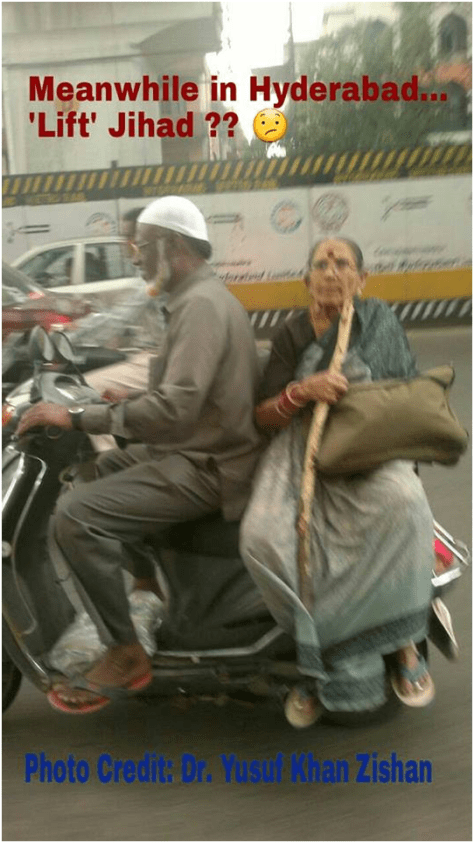
Lift Jihad: Yusuf Khan Zishan

This picture by YUSUF KHAN ZISHAN is circulating widely on Facebook. Received @ Kafila from Janaki Rajan who writes:

I was in Hyderabad on that day – August 19th, the day of the Telengana Intensive Household Survey, when people with two wheelers volunteered to help those arriving by trains to reach their homes as autos and taxis were not permitted to to ply that day… a spontaneous idea..

securedownload


A Letter to the Vice Chancellor of Jadavpur University, Kolkata: Ahona Panda

Guest Post by AHONA PANDA

[Ek Je Cchilo VC / Once There Was a VC – Thanks to Utsavdan, and to Manik-da of Bishop Lefroy Road]

To

The Vice Chancellor,
Jadavpur University,

and the Education System of West Bengal.

Respected Sir,

I would like to return to this university a gold medal that it awarded me, then a girl of 21, in the year 2009. I’ve never worn that medal since my convocation, and it lies in the box it was awarded in. I was a student of the English department in this university, and went on to study at Oxford and University of Chicago. Continue reading A Letter to the Vice Chancellor of Jadavpur University, Kolkata: Ahona Panda

Partha Chatterjee on Partha Chatterjee – An Interview with an Impostor: Partha Chatterjee

Guest Post by PARTHA CHATTERJEE

Continue reading Partha Chatterjee on Partha Chatterjee – An Interview with an Impostor: Partha Chatterjee

Lessons from Scotland for South Asia: Satya Sagar

Guest Post by Satya Sagar

Though ‘No’ finally trumped ‘Yes’ and the United Kingdom stayed ‘united’ the recent referendum for Scottish independence holds several important lessons for both votaries of separatism as well as national unity everywhere.

It also raises many questions, chief among them being, on a planet run by corporations and shaped by tsunami-like capital flows, do terms like national ‘independence’, ‘unity’ or ‘sovereignty’ have real meaning anymore? An even more fundamental question would be whether the nation-state, in its current form, has any future at all or not?

Coming to the lessons first, among the most obvious is the fact that it is possible to hold a referendum on independence peacefully, without a single shot being fired or spilling a single drop of blood.This has been hailed as a triumph of democracy and rightly so too.  How many countries around the world, which call themselves democracies, can muster the guts to allow a section of their citizens to exercise their right to self-determination through a simple vote? Continue reading Lessons from Scotland for South Asia: Satya Sagar

Media Landscape and the Making of an Unconventional Journalist: Monobina Gupta

Guest post by MONOBINA GUPTA

A profile of Ravish Kumar, this post tells the story of the media from a uniquely interesting vantage point – even as it presents before us a slice of contemporary social conflicts. 

I

Five days a week at 9 PM, Ravish Kumar begins his news programme, Prime Time, on NDTV India with “namashkaar, main Ravish Kumar…” At the same time when English news channel anchors scramble over each other for ratings, putting on display wild (often unsubstantial) discussions on the day’s events, Prime Time – in style and news content – strikes a very different note.

A journalist on the move
Journalist on the move

Ravish starts his programme with a 5-minute introduction, which is its unique selling point and also one of the highlights of the show. Packaging the topic of debate with a well-researched perspective, Ravish speaks in lucid, eloquent Hindi, interspersed with subtle and witty asides. Meticulously, he references the news reports, analyses, blog posts and opinion pieces he has swotted over during the day. In his mindful reference to every author whose work he has accessed through both mainstream and social media, Ravish has created a new media morality. The cutthroat universe of corporate media is more dedicated to grabbing information first rather than acknowledging sources or granting space to insights generated by others.

“Firstpost.com is our rival but whenever I take any news or analysis from the website, I acknowledge it. You could say this is NDTV India’s inherent culture. English channels don’t have that system. But they can have it if they want to. I do that consciously. I want viewers (a lot of them are students) to follow up these references,” Ravish told me. Continue reading Media Landscape and the Making of an Unconventional Journalist: Monobina Gupta

From Jadavpur to Everywhere #Hokkolorob – Let There be Clamour

#HOKKOLOROB
#HOKKOLOROB

More then one hundred thousand students and their friends (according to Kolkata Police estimates) defied the rain to walk in protest yesterday against the assault on Jadavpur University by Kolkata Police, backed by an insensitive University Vice Chancellor and a cynical State Government. There were students, ex students, professors, students from Presidency University, and many other colleges in Kolkata and the neighborhood, there were many ordinary citizens, some who had never been university students, and many who had stopped being university students a long time ago.

Continue reading From Jadavpur to Everywhere #Hokkolorob – Let There be Clamour

Syrian Jihad spawned the Islamic State: Nauman Sadiq

Guest Post by NAUMAN SADIQ

Let me admit at the outset that Assad is an illegitimate tyrant who must abdicate his hereditary throne to the will of the people when the opportune moment arrives. But at the moment our primary concern shouldn’t be bringing democracy to Syria; at the moment our first and foremost priority should be reducing the level of violence in Syria. There are two parties to this conflict: the regime and the rebels (the majority of whom are takfiri jihadis). It is not possible for the regime to deescalate the conflict because it is holding a tiger by the tail. The regime is fighting a war of defense; and what is at stake in this war is its survival; not only its survival but the survival of its clan: the Alawite minority of 2.6 million people who comprise 12% population of Syria’s 22 million people.

The second party to the conflict is the rebels who are generously supported by the Gulf monarchies, Turkey (Sunni Muslims), Western powers and Israel. Don’t get alarmed and be dismissive of the possibility of an alliance [1] between the Sunni Muslims of Saudi Arabia, Qatar, Jordan, Turkey and the Zionists of Israel. It is realpolitik: the enemy of my enemy is my friend. In fact the Western interest in this war is partly about Israel’s regional security[2] because the Shia axis comprising Iran-Syria-Hezbollah is an existential threat to Israel; and with each passing year the nature of this threat will enhance proportionally with the increased sophistication of Iranian missile program. During the 2006 Israel-Hezbollah conflict in Lebanon, most of the rockets fired by Hezbollah into the Israeli territory missed their target; but according to some reports Iran and Hezbollah have already developed smarter missiles and with every passing year the threat of Hezbollah’s guided missiles so close to Israeli borders will keep on haunting the Israeli strategists’ dreams.  Continue reading Syrian Jihad spawned the Islamic State: Nauman Sadiq

Some Feminist Blogs from India

Please feel free to add to the list!

1. Ultra Violet. Indian Feminists Unplugged

Peacocks-300x132

Image – Sheba Chhachhi 

From

Ultra Violet. Indian Feminists Unplugged

2. The Ladies Finger

A post from The Ladies Finger: The Varied Social Life Of Hindustani Classical Music Before Respectability Took Over

Raja_Ravi_Varma_Lady_in_the_Moon_Light_1889-310x375


3. Savari – adivasi bahujan and dalit women conversing

savari_banner_1

A post from Savari: Sanskritization or Appropriation : Caste and Gender in “Indian” Music and Dance


4. Feminists India

A post from Feminists India: Bhagana rape in the context of Dalit rights to common land

Dalit-rights-India-400x300

The Islam we do not like: Nandagopal R Menon

Guest post by NANDAGOPAL R MENON

Some recent posts on Kafila have identified a “movement of sorts” in South Asian Islam – A Short Memoir On the Arabisation of Islam in India and The Sheepification of Bakistan

Named ‘Arabisation’, this is a “remarkably dispersed” and “subtle” movement most readily evident in certain changes in quotidian linguistic choices, for example, Khuda Hafiz and Ramazan has or is being replaced by Allah Hafiz and Ramadan. This linguistic shift from Farsi/Urdu to Arabic is taken to index a “great cultural battle” under way in South Asian Islam – one that attempts “to ‘correct’ Islam as Muslims in the subcontinent have understood, practiced and lived it, and instead replace it with an Islam which is uniform, seemingly universal and which need not have any affiliation with our cultural and local identities and beliefs”. That ‘Arabisation’ is not something innocuous or laudable is clear, for it “conveniently ignores” – or undermines? – Islam’s “age-old assimilation in the Indian sub-continent”. The following are some thoughts provoked on reading these posts. This is not meant as a coherent response to any of the posts, but just an unsystematic attempt to think through some of the assumptions that condition the creation of concepts like ‘Arabisation’ in public discourse.  Continue reading The Islam we do not like: Nandagopal R Menon

Notes from Jadavpur: Ahona Panda

Guest Post by Ahona Panda

About eight years ago, while lounging about doing nothing much in the campus of Jadavpur University where I was a student of the English department, I came across some callously etched graffiti:

Jodi prem na dile praane
Tobe Jadavpure pathanor ki mane?
(If you haven’t given this life some love–
What is the point of sending one to Jadavpur?)

Eight years on I cannot imagine the luxury of lounging about doing nothing much. One moves on in life after graduating from Jadavpur University. Meanwhile, in home and the world, the complete freedom (some will persist in calling this anarchy) of the JU campus has made it a legend somewhat like Dirty Harry: either worship and put it in on a pedestal, or condemn it thoroughly. The reputation of JU since the infamous 1970s has been as a hub of constantly bubbling anarchism, where Naxalites are hatching their next program of action, where ignorant armies like SFI and other anti-SFI groups clash by night.

Continue reading Notes from Jadavpur: Ahona Panda

Happy to Disturb – RJ Sayan and The Jadavpur Police Station, Kolkata

The disgusting police violence and simple thuggery unleashed by the Vice Chancellor of Jadavpur University at the behest of his masters in the Trinamool Congress Party and the West Bengal Government has resulted in a counter-offensive that features rage mixed with humour, mirth, music and creativity. Nothing can be more lethal for the zombies in power than the laughter and music of the young.

Here is a brilliant radio clip – produced by RJ Sayan (Meter Down, 104 FM, Kolkata).

Thanks to Debjani Dutta for the translations and the English subtitles in the video.

Long Years Ago We Made a Tryst, with…Mathematics

I thought it wasn’t that complicated. When you make a new nation, make sure everybody gets a place. A roughly equal place. When you undertake any development in that new nation, make sure the benefits equal the costs. These are easy equations, easy maths. Maa-tha-maa-tics, my school maths teacher would say portentously, full of meaning and threatening.

This summer, quietly, safe from the media’s attention, 17 more metres were added to the biggest dam of the Sardar Sarovar Project, a dam that was already 400-plus metres high. Being ‘weak at maths’, I hesitate to calculate the catchment area of this big big dam, only one of many big dams in the web of waterworks created by the Sardar Sarovar project. I am getting goosebumps writing these words – the Sardar Sarovar project. As I did way back in school, as a fifteen-year old with a mind like an occupation zone for textbooks. Nehru’s photo radiates in waves out from that mind, that iconic Bhakra Nangal photo with him pointing to something in the far distance. The blazing sun, the deep shadows, the monumental respectability of it all…now the photo is fused with a different, equally iconic image – that of Sunil Dutt’s youthful strides across a dam site in Hum Hindustani. Continue reading Long Years Ago We Made a Tryst, with…Mathematics

From Jadavpur University, Kolkata – ‘I am, one of those survivors, who has experienced a nightmare last night’: Tanumay Naskar 


Guest Post by TANUMAY NASKAR

[ This is an account of the events of last night in Jadavpur University, Kolkata, were students sitting in on a peaceful protest against university authorities inaction on a recent complaint of sexual harrassment. What followed (an attack from two fronts, by police and goons affiliated to the Trinamool Congress) brought back memories of the many times that students have been attacked mercilessly in JU. Currently, around 40 students have had to receive medical attention, and 38 are in police detention. Protests against this event are being organized today in Kolkata (at 4:00 in the afternoon, at Jadavpur University, and at 6:00 PM at JNU in Delhi, by the JNU Students Union]

Follow this link to read a detailed time-line of the events as they unfolded.

Follow this hashtag – ‪#‎hokkolorob‬ for details of how people are responding to the situation.


I am one of those survivors who has experienced a nightmare last night.
We were singing. We were dancing. We were peacefully protesting. 
When someone yelled, “Let’s make the barricades, the police is coming”. 
After that, we saw police (READ GOONS) of grade A, barred all the entrances and charged us with Lathis.

Continue reading From Jadavpur University, Kolkata – ‘I am, one of those survivors, who has experienced a nightmare last night’: Tanumay Naskar 


Muslims should Counter the Divisive ‘Love Jihad’ Campaign with Friendship Towards Secular Hindus: Kaleem Kawaja

This is a guest post by KALEEM KAWAJA

Abhee sub kuch nahin mita shaayad
Hindu-Muslim main pyaar baaqi hai
Ek Bhaayee kaa ek Bhaayee pur
Pyar ka kuch udhaar baaqi hai … 

Jawaid Badauni.

unnamed

Since the past one year, especially after the parliamentary elections were looming close, extremist RSS elements have become all the more aggressive all over the country, especially in the north, east and west. They have taken pains to circulate false news stories about Muslims in general, and Muslim youth in particular, as somehow prone to violence ,and conniving to entrap Hindu girls in romantic relationships with the sole object of securing their conversion to Islam. Regional vernacular newspapers have carried fabricated stories about Muslim youth turning to terrorism and planning bomb blasts in many Indian cities.

Since the past one year, especially after the parliamentary elections were looming close, extremist RSS elements have become all the more aggressive all over the country, especially in the north, east and west. They have taken pains to circulate false news stories about Muslims in general, and Muslim youth in particular, as somehow prone to violence ,and conniving to entrap Hindu girls in romantic relationships with the sole object of securing their conversion to Islam. Regional vernacular newspapers have carried fabricated stories about Muslim youth turning to terrorism and planning bomb blasts in many Indian cities. Continue reading Muslims should Counter the Divisive ‘Love Jihad’ Campaign with Friendship Towards Secular Hindus: Kaleem Kawaja

A Short Memoir On the Arabisation of Islam in India: Shireen Azam

This is a guest post by SHIREEN AZAM

A Pakistani writer Mina Malik Hasan recently wrote about the Arabisation of Islam in Pakistan, (The Sheepification of Bakistan), a movement of sorts which is transforming Islam in the Indian subcontinent by the day, even though it is remarkably dispersed and often subtle. The Arabisation of Islam seeks to “correct” Islam as Muslims in the subcontinent have understood, practiced and lived it, and instead replace it with an Islam which is uniform, seemingly universal and which need not have any affiliation with our cultural and local identities and beliefs. Having been a participant observer of this change in India, I wish to supplement Mallik’s experience in Pakistan with my own, in the form of a short memoir of the nearing extinction of the urdu phrase “Khuda Hafiz”, a customary way to bid goodbye, with the phrase “Allah Hafiz”. While both the phrases literally mean ‘May god keep you safe’, the reason for the shift was likely because of a lack of clarity in the particular god being invoked term by the term ‘Khuda’, since Khuda has Persian roots. If anything, “Khuda” speaks of Muslims’ age-old assimilation in the Indian subcontinent, something that ‘Arabisation’ of Islam would conveniently want to ignore, and is sadly becoming successful in. Continue reading A Short Memoir On the Arabisation of Islam in India: Shireen Azam

DISSENT, DEBATE, CREATE