
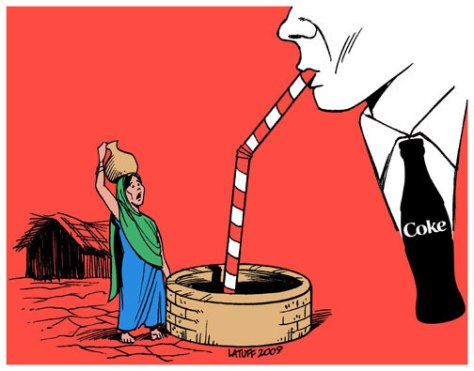
 Farmers who have for three decades non-violently protested the brutal ousting from their lands for the dam project on the Narmada river have been castigated for being anti-development. The dam would bring water to the thirsty, to the parched agricultural lands around it, we were told. Continue reading Narmada waters for Coca Cola – really, how much more development can we take?
Look who’s leading the campaign against ‘Love Jihad’!

Hindu Mahasabha members protest against ‘love jihad’ in Lucknow (File photo by Vishal Srivastav in The Indian Express)
Right up in front, a police bike. Imagine the level of intimidation. And the brazen implication of state agencies in what Paul Brass described as “institutionalized riot systems.“
The Indian Illusion: Shashank Kela
Guest post by SHASHANK KELA
Some time ago, I wrote an article seeking to dissect certain myths about Indian politics – and the class that dominates it, despite protestations to the contrary, the middle-class.[1] It is one of the habits of this class to see, and self-pityingly portray itself as victim – of mass politics, reservation policies, the great unwashed, of politicos bent upon appeasing the poor at the cost of sound principles and policies. Its conviction, of course, is that India was great, and on the cusp of becoming so again. This unfading glory is no more to be disputed than the existence of the sun, although opinions differ upon the precise placement of our golden age.
To the rabid fanatics of Hindutva, it resides in an unspecified Vedic time, when Hindus (not Indians) mysteriously succeeded in inventing aeroplanes, dynamite, nuclear weapons, the wheel, zero, and what have you (and mysteriously losing most of these wonderful things). To the Nehruvians, it is the age of Akbar, Ashoka, Harsha, periods of syncreticism and unique tolerance, where people of different faiths lived together peacefully and a composite culture flowered. To them, and to Gandhians, it also resides in the figure of Gandhi and the tradition of practical spirituality. To the fanatics of Islam, it is probably the age of Alauddin Khilji, the reign of Aurangzeb, and so on.
The never-ending debate about India’s pasts contains a diversity of opinions; however, on its future destiny, these begin to converge. The RSS and BJP believe, for example, that India is destined to become a great industrial power. So did Nehru, and assorted Indian Marxists. Indeed, it is an article of faith for the burgeoning middle-class (mostly, but not entirely Hindu) that India can, should and will equal China to become a great power, economic and military (thus leaving Japan and South Korea in the dust). Continue reading The Indian Illusion: Shashank Kela
Demolitions in Aya Nagar, Delhi: Thomas Crowley
Guest Post (and photographs) by THOMAS CROWLEY
The media is all praise for the central government’s rescue efforts in Kashmir, despite the evident hollowness of the government’s claims to heroism. But the press has little to say about the brutal destruction authored by the government in its capital city. Thursday, September 11, saw another demolition drive in a city that has seen far too many of them, from the Emergency to the Commonwealth Games. The demolition took place in the South Delhi neighborhood of Aya Nagar, where residents say about 250 houses were destroyed.
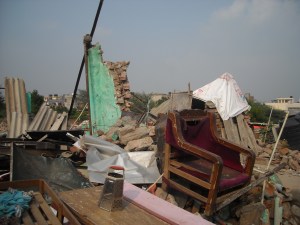
Continue reading Demolitions in Aya Nagar, Delhi: Thomas Crowley
Of Money-in-the-Blood and Blood-Money: Ravi Sinha
Guest Post by Ravi Sinha
Recently, the Indian Prime Minister had occasion to report to the Japanese on his genealogy and haematic chemistry. Addressing a house-full of corporate honchos in Tokyo he declared, “I am a Gujarati, money is in my blood”. One does not know what percentage of Gujaratis would feel insulted by such a description. It can be asked, perhaps more meaningfully, if great civilizations are created by money-in-the-blood types and one may wonder if Gujarati greats such as Narsi Mehta, Narmad, Govardhan Ram or Gandhi, too, had money flowing in their blood.
There is also some irony in the situation – prime minister of a country with the largest number of world’s poor boasting about ‘money in the blood’ to the richest men of a country that has, in the post-war decades, made more money per capita than any other on the planet. This prime minister can be accused of many things but not of lacking in hubris unencumbered by learning and cultivation.
One may wonder about something else too. The Indians may deserve their new prime minister and all his speeches – on the Independence Day, the Teacher’s Day and on all the other days. After all, they have elected him. But what have the Japanese done to deserve this? What forces them, despite the depth and dignity of their civilization, to lap up such crassness and banality?
The answer can be given in one word – money. Continue reading Of Money-in-the-Blood and Blood-Money: Ravi Sinha
Sailaab Nama – An Insider’s View of the Flood in Kashmir from the Outside: Gowhar Fazili
Guest Post by Gowhar Fazili
The floods in Kashmir can provide an outsider a momentary glimpse into the reality of Kashmir behind the corporate media propaganda smokescreen that is fumbling at the moment and like Truman Show (1998) exposing bits of the backstage. At the moment there are three key actors in Kashmir. There are the floods, the state and the people. Each one is on its own. One limb of the state—the state government was the first to crumble before the approaching waters. The other limb—the mammoth military apparatus that has already inundated Kashmir since several decades, took two days to wake up to the crisis and when it finally did, its priority was to fish out the rich Indian tourists and the people close to the establishment out of the state. In the initial days, local people had to risk their own lives to get their marooned relatives to safety. Some hired local boats, some swam or waded through water, some made makeshift rafts out of anything that floats, including water tanks, car tubes, foam sheets, inflated baby bathtubs, so on and so forth to save their dear ones. The rest either drowned or kept moving up the floors of their houses as the waters kept rising until they reached their attics.
Jadavpur University students struggle against gender violence
In Jadavpur University (a State aided university of West Bengal), the Arts Students Faculty Union organizes a students’ cultural festival, Sanskriti. On the second night of the festival, an incident of violence occurred in the campus that resulted in a chain of events.
On the night of 28th August, during the ongoing festival, a second year student from the Department of History, Jadavpur University, was allegedly molested inside campus premises by a group of people from the hostel, and her male friend (not a JU student), was beaten up. According to the victim, she had gone near the hostel to relieve herself given the unavailability of bathrooms at the time, accompanied by her friend. On their way back, a group of hostel boys allegedly passed snide remarks which led to a scuffle, and then escalated to something bigger. While her friend was allegedly pulled away and beaten up, she was dragged into the hostel, where she claims she was molested. Continue reading Jadavpur University students struggle against gender violence
Thinking through the application for “clarifications” of transgender rights
Newspapers have been reporting about an application for clarification filed, it appears, by the Ministry of Social Justice and Empowerment with the Supreme Court about the NALSA judgment on transgender rights. Here is the full text of that application, and here is a very useful and short summary of its content. The reflections below follow from that summary.
Any move that makes the inclusion of trans-men, non-hijra trans-women, and genderqueer/trans folks in the SC judgment explicit is welcome. Many had written to the Ministry of Social Justice and Empowerment seeking this, following the MSJE report and the judgment. The principle of self-determination of gender identity without psychological and medical examination or surgery is upheld and that remains critical.
Continue reading Thinking through the application for “clarifications” of transgender rights
Gajanan Madhav Muktibodh: Put fire back into firewood
“ Why did Muktibodh became uniquely significant in the summer of 1964? Why did …almost all the weeklies, monthlies and dailies started introducing him to their readers?” Fifty years ago, Shamsher Bahadur Singh, asked this question in the preface to Chand Ka Munh Tedha hai, the first anthology of poems of Muktibodh being compiled.
Muktibodh then, was in a state of coma , being brought to Delhi from Rajnadgaon,a small town in Chhattisgarh, by his young writer comrades – like Harishankar Parsai, Srikant Verma and Ashok Vajpeyi, in a desperate, last ditch attempt to save their beloved elder poet. It was not be . He breathed his last on 11 September, 1964 at the AIIMS , before completing his 47th year. And in the words of Shamsher, the story of heroic struggle of his brief life and tragic, untimely death turned him into an event for the world of Hindi literature.
Gajanan Madhav Muktibodh continues to be an event of Hindi literature, the full meaning of which is still being discussed. And yet, he as a poet was not interested in portraying events . He was more interested in the drama of the human soul, rather soul of a human being, ravaged, wrecked and fatally wounded by industrial modernity. Living the life of a lower middle class family man, constantly changing jobs and places in search of a modestly secure life which would allow him to write the kind of poetry he wanted, he witnessed the humanness and individuality of the people being crushed under the ruthless wheels of capitalist modernity. Continue reading Gajanan Madhav Muktibodh: Put fire back into firewood
मीडिया और मज़दूर: फ़ैज़ुल्लाह
Guest Post by Faiz Ullah
The following text is a version of a text originally written for Faridabad Majdoor Samachar, a workers’ paper distributed in Faridabad, Gurgaon and Delhi. It is an attempt to speak to the concerns often expressed by workers’ about what they consider to be inadequate and unfair representation of their issues in the mainstream media
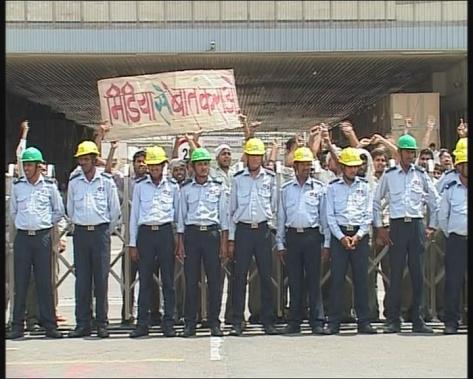
मीडिया और मज़दूर
समाज जैसे-जैसे बड़ा और जटिल होता जाता है वैसे-वैसे हमारे एक दूसरे से सम्बन्ध कमज़ोर होने लगते हैं। ऐसे में हम एक दुसरे को कैसे जानें, कैसे समझें? मीडिया के ज़रिये हम अपनी बात आगे रख सकते हैं, दूसरों की सुन सकते हैं और अपने तजुर्बों को साझा कर सकते हैं। चर्चा-बहस भी कर सकते हैं और किस तरह का समाज बनाना है उसकी एक साथ कल्पना कर सकते हैं। समाज में मीडिया की एक बड़ी भूमिका बनती है। वैसे तो मीडिया को आपकी और हमारी बातों को जगह देनी चाहिए पर आमतौर पर ऐसा होता नहीं है। हमारी बातों, हमारे मुद्दों को बड़े टीवी चैनल और अखबार हमेशा ही नज़रअंदाज़ करते रहे हैं।
Striving for plurality in Media – The promises and shortcomings of TRAI’s recommendations on media ownership: Smarika Kumar
Guest post by SMARIKA KUMAR
TRAI published a set of recommendations on issues relating to media ownership on 12 August 2014. A summary of the key points of these recommendations may be found here. But what do these recommendations imply for the freedom of speech and expression in India? This post is an attempt to contextualise TRAI’s recommendations against this question.
From No Regulation on the Business of Speech to Some Regulation on the Business of Speech
In its introductory chapter, TRAI says that the objective of its recommendations is to achieve plurality of views and opinions in media. It states:
“The objective of these recommendations is not, in any sense whatsoever, to curb the media or deprive it of its rights – that, in fact, would be a disservice to the Indian citizen – but to put in place suitable safeguards that would ensure citizens the right to obtain objective, unbiased and diverse views and opinions.” (para 1.5)
This is a remarkable move because the idea of media plurality has remained contested in the understanding of Article 19(1)(a) of our Constitution, which guarantees the right to freedom of speech and expression to Indian citizens. The whole dance began in 1961 with the judgment of Sakal Newspapers v. Union of India, where the government sought to regulate the number of pages a newspaper could carry. Since such regulation would make newspaper prices of smaller newspapers comparable to big newspapers, the government argued that it would enable the smaller newspapers to secure larger circulation. One can clearly see how this was an attempt at enabling plurality in the newspaper business, so that the smaller voices are not stifled by the big voices.
‘My Heart says Yes, but the Head says No’: Economizing Politics in the Scottish Referendum: Akshaya Kumar
Guest post by AKSHAYA KUMAR
I
About two months ago, while walking by the roadside in Glasgow, a middle-aged man handed me out a pamphlet. In an endorsement of UKIP, the pamphlet declared ‘Our government pays GBP 55 million a day in fees to the EU’ (emphasis added). It went on to inform that in return, the EU gives ‘us’ accounts riddled with fraud, no control over ‘our’ own borders – putting pressure on our health, education and welfare services – and a super-government that makes more than 70% of ‘our’ laws. The pamphlet intrigued me a fair bit, not in the least because as an international student in the UK, I wondered if my case was a bigger or smaller burden on the UK defined thus – their UK. But who are they? One might rubbish them as a deviant community, or one might consider them a threat to yet another definition of us – the liberals or suchlike. But what intrigued me was not the neatness of these boundaries, or the speculations about how many of ‘us’ and ‘them’ there are. I was intrigued by the language of the starkly political proposition. Let us tentatively assume that in the pamphlet, ‘us’ meant the citizens of UK and it constructs an antagonistic position vis-à-vis other national citizens who are entitled to living and working within the UK. Surely the two are politically distinguishable? Or are there too many of them living next to us, so they cannot exactly be identified as such? Continue reading ‘My Heart says Yes, but the Head says No’: Economizing Politics in the Scottish Referendum: Akshaya Kumar
Temperance in the time of Rahu
So Onam is here again — despite the fact that several contradictory stars above now form a malefic conjunction in the fate of poor Malayalis in Kerala. Indeed, rarely has a stranger gang dominated the starry heavens of our destiny: V M Sudheeran’s targeted gullet moralism that promises to close down a very large number of bars in Kerala and pave the way for total prohibition in the future, gangs of Hindu right wing youth and women forcing the government’s liquor outlets to close, policemen puffed up with jingoistic nationalism who hallucinate about Maoists in wake and sleep and declare social activists like Ajitha “dead”, CPM offspring who think that making foul, putrid public statements justifying murder is politics. All these are, well, rather drunk on self-righteousness and to be true, present a slightly ridiculous sight. Even the weather looks ridiculously inebriated – the sky alternates between bright sunny spells and horrid, harsh showers, crazily swinging between sunny smiles and bursts of tears. Continue reading Temperance in the time of Rahu
Statement of concern regarding PM’s takeover of the Teacher’s Day
We are disturbed by the circulars issued by the CBSE and other authorities dealing with different systems like the Central Board of Secondary Education (CBSE), Directorate of Education, Delhi, Kendriya Vidyalaya Sangathan, etc. asking schools to make arrangements to ensure that all the school children across the country listen to the Prime Minister’s address to the children in their school premises on the occasion of Teacher’s Day on September 5.
It is an extraordinary and unprecedented step in the history of school education in independent India. Not only does this order treat children as passive and captive elements who do not have a view of their own, it also violates the international convention of Child Rights which says that children have a right to form opinion and therefore they need to be asked whether they would like to be part of such an extra-school activity beyond their usual school hours.
Although the MHRD has clarified verbally that this is a voluntary activity and not binding on the schools and children, yet the written orders by the authorities are still in effect asking the schools to furnish the status report by 2nd September and remain prepared for surprise inspections in this regard. Continue reading Statement of concern regarding PM’s takeover of the Teacher’s Day
‘Son, you outgrew my lap but never my heart’ – Fauzia Ansari in search of her son: Debangana Chatterjee
On August 14, 2013, Shivam Vij wrote in Kafila about Hamid Ansari, a young Management Studies graduate from Mumbai who crossed the border illegally to Pakistan in November 2012, to meet a young woman, and has been missing since. At the time Shivam wrote the post, there were indications that Hamid had been picked up by Pakistani security agencies.
Beena Sarwar, Pakistani human rights activist, wrote in July this year about the possibility of ‘cautious optimism’, following the directive of Peshawar High Court to Pakistan’s defence and interior ministries to provide full information about the forced disappearance of Hamid Ansari and of 25 others, who are Pakistani nationals. Her account is worth reading in full, outlining as it does, the ways in which cross border solidarities of democratic forces consistently work to soar above and also to undermine the barbed wire fences of nation-states.
DEBANGANA CHATTERJEE, a Delhi-based MA student, met Hamid’s mother a few days ago, and wrote this piece after talking to her, outlining some new developments in the case. We have retained Fauzia Ansari’s voice as far as possible in this narrative.
The story of Hamid Ansari, a 28 year old IT engineer and management studies graduate, started unfolding when I came across his mother, Fauzia Ansari at a conference on ‘Challenges to Indian Democracy’ organized in Delhi by the Coalition for Nuclear Disarmament and Peace a few days ago, on August 30-31. Fauzia Ansari is a lecturer of Hindi at a college in Mumbai. Like other mothers, Fauzia says she too had vibrant dreams of her son’s bright future. But a nightmare has unfolded instead. Continue reading ‘Son, you outgrew my lap but never my heart’ – Fauzia Ansari in search of her son: Debangana Chatterjee
‘लव जेहाद’ की असलियत – इतिहास के आईने में: चारू गुप्ता
Guest post by CHARU GUPTA
लव जेहाद आंदोलन स्त्रियों के नाम पर सांप्रदायिक लामबंदी की एक समकालीन कोशिश है. बतौर एक इतिहासकार मैं इसकी जड़ें औपनिवेशिक अतीत में भी देखती हूँ. जब भी सांप्रदायिक तनाव और दंगों का माहौल मज़बूत हुआ है, तब-तब इस तरह के मिथक गढ़े गए हैं और उनके इर्द गिर्द प्रचार हमारे सामने आये हैं. इन प्रचारों में मुस्लिम पुरुष को विशेष रूप से एक अपहरणकर्ता के रूप में पेश किया गया है और एक ‘कामुक’ मुस्लिम की तस्वीर गढ़ी गयी है.
मैंने 1920-30 के दशकों में उत्तर प्रदेश में साम्प्रदायिकता और यौनिकता के बीच उभर रहे रिश्ते पर काम किया है. उस दौर में लव जेहाद शब्द का इस्तेमाल नहीं हुआ था लेकिन उस समय में भी कई हिंदू संगठनों — आर्य समाज, हिंदू महासभा आदि –- के एक बड़े हिस्से ने ‘मुस्लिम गुंडों’ द्वारा हिंदू महिलाओं के अपहरण और धर्म परिवर्तन की अनेकोँ कहानियां प्रचारित कीं. उन्होंने कई प्रकार के भड़काऊ और लफ्फाज़ी भरे वक्तव्य दिए जिनमें मुसलमानों द्वारा हिंदू महिलाओं पर अत्याचार और व्यभिचार की अनगिनत कहानियां गढ़ी गईं. इन वक्तव्यों का ऐसा सैलाब आया कि मुसलमानों द्वारा हिंदू महिलाओं के साथ बलात्कार, आक्रामक व्यवहार, अपहरण, बहलाना-फुसलाना, धर्मान्तरण और जबरन मुसलमान पुरुषों से हिंदू महिलाओं की शादियों की कहानियों की एक लंबी सूची बनती गई. अंतरधार्मिक विवाह, प्रेम, एक स्त्री का अपनी मर्जी से सहवास और धर्मान्तरण को भी सामूहिक रूप से अपहरण और जबरन धर्मान्तरण की श्रेणी में डाल दिया गया. Continue reading ‘लव जेहाद’ की असलियत – इतिहास के आईने में: चारू गुप्ता
A civil-war is on the doorstep of India: Interview with Kancha Ilaiah by Mahmood Kooria
This is a guest post by Mahmood Kooria
We are publishing an English translation of an important interview of the intellectual and academic Kancha Ilaiah, conducted by Mahmood Kooria for the Malayalam weekly Mathrubhumi. While what I see as Professor Ilaiah’s underestimation and perhaps misreading of the historic role of the Communists in Indian politics leaves me severely uncomfortable, especially when he exonerates the right from commensurate charges of elitism, his framing of Hindustva and Modi’s appeal within the great stream of caste in the subcontinent is brilliant and thought-provoking, as always.
Kooria conducted the interview as well as translated it in to English. His introduction is as follows, “At a time when there was no any such discussion, in 2002 Professor Kancha Ilaiah predicted that Narendra Modi will be the prime-ministerial candidate of Baratiya Janata Party. It has come true and now Modi is in the office. At this point, I talked with him at Moulana Azad Urdu University Hyderabad where he chairs the Centre for the Study of Social Exclusion and Inclusive Policy. In the conversation, he talked about the future of Modi government and he predicted that a civil war is going to break out in India if Modi does not cater the needs of backward classes. A Malayalam-version of this interview was published in the Mathrubhumi Illustrated Weekly (August 24, 2014).”
Mahmood Kooria: Ten years ago you wrote that Modi will be the prime ministerial candidate of BJP. What would be your response as your prediction has come true?
Kancha Ilaiah: Well, at that time I was predicting that based on the Left parties’ indifference to understand the caste question. The caste question is not been seriously taken by the Left parties. And, after Mandal, the BJP and the RSS wings started looking at caste-question seriously because when Babari Masjid was demolished they mobilized a lot of backward classes. Though they oppose Mandal reservation, they wanted the backward classes to be part of the Hindu religion. Around 1994, a non-Brahmin called Rajju Bhaiya became the Sarsanghchalak of the RSS. Then he recruited a large number of backward classes, large number of youth, and he promoted the people like Narendra Modi, Uma Bharati at that time. Earlier, the first backward-class chief minister of Uttar Pradesh was a BJP man: Kalyan Sing. He was the chief minister in 1992 when the Babri Masjid was demolished.
The Sangh Pariwar was responding to the backward class demands more. But the Left or the Congress was not responding to the OBCs. The Congress was responding to the Dalits and Muslims. There was upper caste all the time on the top. So, when Narendra Modi became the chief minister and this whole atmosphere was created, I was writing a column in The Hindu. I thought that this seems to be cause/course of India, since the Hindu religion is surviving because of the backward classes. It is inevitable for the Hindutva organizations that they will have to project an OBC for the prime-ministership. But there was resistance from within itself. It is not that the Brahmins have given up the principle of varna-dharma. After that article came and of course after my writing Why I am not a Hindu itself, the backward classes even within RSS seemed to use that material for their advantage. The communists did not use or recognize it. The question of labour and caste which I have been consistently raising, which was also part of their theory, they did not care about. So the Communist Party remained tightly under the control of upper castes.
The European Union And The Twin Civil Wars In Syria/Iraq: Peter Custers
Is this one of those rare occasions where policymakers self-critically correct a gigantic blunder? Or is it a cold turn-about guided by pure self-interest? On August the 15th, the Foreign Ministers of EU-countries gathered in Brussels and decided that each would henceforth be free to supply arms to Kurdish rebels fighting Sunni extremists of ISIS in the North of Iraq. Even Germany which in the past had been unwilling to furnish military supplies to warring parties in ‘conflict zones’, is now ready to provide armoured vehicles and other hardware to the Kurds opposing ISIS’ advance. The decision of Europe’s Foreign Ministers may surprise some, for barely a year and four months ago, in April of 2013, the European Union had lifted a previously instituted ban on all imports of Syrian oil (1). Moreover, the lifting of this boycott was quite explicitly intended to facilitate the flow of oil from areas in the North-East of Syria, where Sunni extremist rebel organisations had established a strong foothold, if not overall predominance over the region’s oil fields (2). ISIS was not the only Sunni extremist organisation disputing control over Syrian oil fields. Yet there is little doubt but that the fateful decision the EU took last year has helped ISIS consolidate its hold over Syrian oil resources and prepare for a sweeping advance into areas with oil wells in the North of Iraq (3). Continue reading The European Union And The Twin Civil Wars In Syria/Iraq: Peter Custers
The Wrongs In The Right To Education: Noyonika Bose
Guest Post by NOYONIKA BOSE
In the winter of 2013 I had carried out a survey as part of an NGO CRY, Child Rights and You in 10 schools in the heavily populated slums of Rajabazar, an area in north Kolkata. The objective of the survey was to see whether the Right To Education (RTE) Act was being properly implemented in these schools. The findings of the survey though not absolutely abysmal, were not positive either. However what I learnt is that it is not entirely the fault of these government and government aided schools that they were unable to provide their students with quality education. It has also to do with the basic structure of the RTE act which is peppered with several flaws. This article is a critique of the RTE and some possible solutions. Continue reading The Wrongs In The Right To Education: Noyonika Bose
Strange yet familiar – race politics in the USA
Here is a link to Jon Stewart on race politics in the USA, in the context of the recent shooting by a white cop of a black unarmed teenager in Ferguson.
See any resemblances to our own fair country and the politics of caste, class, gender and community here? So familiar are the doubts expressed, questions raised, biases proudly stated, you could be pardoned for thinking it’s not the US of A, but Mera Bharat Mahan. Continue reading Strange yet familiar – race politics in the USA
Reading the Debate on the Planning Commission
I find it hard to think through the current debate on the Planning Commission (PC) outside a few things. The first is a clear centralisation of power at and within the PMO which I cannot help but be alarmed by. It’s all well and good when the decisions are those you agree with and all to easy to forget what centralisation does in the hands of, let’s please not forget so easily, a man whose IMHO has no H.
Its faults are easy to list but the PC (when it worked) did remain a space for thinking through a centre-state relationship and a development vision outside the government. It was a moment of articulation of intent with an (albeit diminishing) ability to put some weight behind it. I can’t quite bring myself to defend it because of what it refused to become in the more recent years, and the fights it refused to fight, but the need for such an autonomous voice remains. I don’t believe this new body will be anything other than a rubber stamp for a deeply authoritative PMO. In that, I am cautious of what will come. And by cautious, I mostly mean afraid.
Continue reading Reading the Debate on the Planning Commission
 KAFILA - COLLECTIVE EXPLORATIONS SINCE 2006